
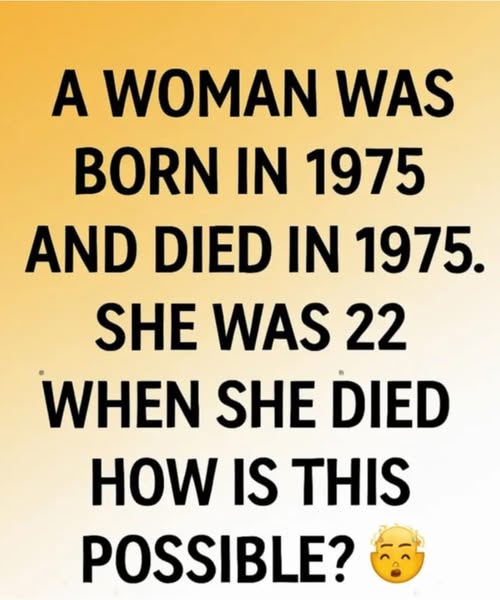
In the fast-moving world of the internet, lateral-thinking riddles have become viral favorites, and one deceptively simple puzzle recently took over social media: “A woman was born in 1975 and died in 1975, yet she was 22 years old. How is this possible?” At first glance, the logic feels impossible, which is exactly why it works.
The riddle exploits a mental habit known as assumption bias. Most people instantly read “1975” as a year, forcing the brain into a timeline that can’t make sense. As the puzzle spread across platforms, users proposed increasingly complex explanations, from time anomalies to supernatural theories.
The solution is simple once perspective shifts: 1975 isn’t a year at all—it’s a room number. The woman was born in hospital room 1975 and died in the same room 22 years later. By reframing the number from time to place, the contradiction disappears instantly.
Beyond entertainment, the riddle highlights how context shapes perception. It serves as a reminder to question assumptions, consider alternative meanings, and slow down before jumping to conclusions—skills that matter far beyond puzzles in an era driven by fast information and viral content.