I had been looking forward to coming home all week.
After days of airports, meetings, and hotel rooms that all felt the same, I wanted the simple comfort of my own hallway and my daughter’s familiar laughter.
My name is Aaron, and every time I returned from a work trip, my eight-year-old, Sophie, usually met me at the door like I’d been gone for a year instead of a few days. She would run so fast her socks would slide across the floor.
She’d wrap her arms around me, talk a mile a minute, and ask what I brought back for her, even if it was just a silly keychain.
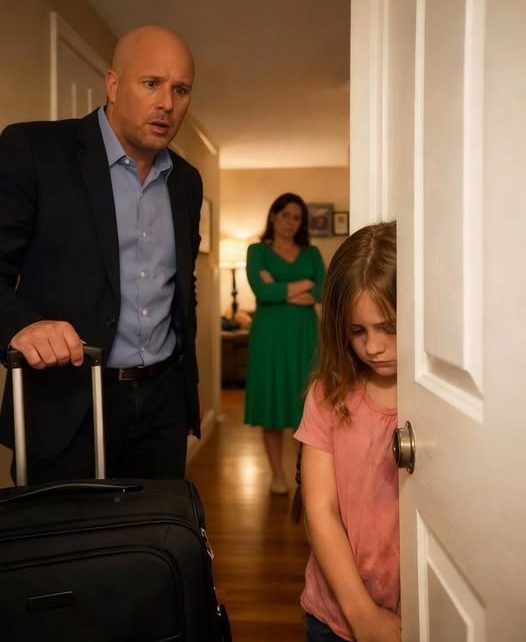
That’s the picture I carried in my mind as I pulled into the driveway outside Chicago and rolled my suitcase across the entryway.
But the house was quiet.
Not peaceful quiet.
The kind of quiet that feels wrong.
I set my bag down and called out, expecting to hear a small voice answer from the living room or the kitchen.
Nothing.
I was still holding the handle of my suitcase when I heard it.
Soft, shaky, almost like a breath getting stuck between words.
“Papa… my back hurts so much I can’t sleep. Mommy told me I’m not allowed to tell you.”
I turned toward Sophie’s bedroom so quickly my heart started pounding in my ears.
She stood just inside the doorway, half-hidden like she wasn’t sure she was allowed to be seen. Her shoulders were tight. Her gaze was lowered. She looked like a child trying to take up as little space as possible.
That sight alone was enough to make me feel cold all over.
“Sophie,” I said gently, forcing my voice to stay calm even as my mind raced. “Hey. I’m home. Come here, sweetheart.”
She didn’t move.
Instead, she swallowed, and her eyes flicked toward the hallway as if she expected someone to appear behind me.
That small motion told me everything I needed to know about how she’d been feeling while I was away.
I lowered my suitcase slowly, like the sound might startle her.
Then I walked toward her, careful with every step.
When I knelt down so we were eye level, she flinched.
It was slight, but it hit me hard.
I held my hands where she could see them, palms open.
“It’s okay,” I said. “You’re safe. Tell me what’s going on.”
Her fingers twisted the hem of her pajama top until the fabric stretched tight.
“My back,” she whispered again. “It hurts all the time. Mommy said it was an accident. She told me not to tell you. She said you’d be mad and things would get worse.”
My stomach dropped.
I didn’t want to frighten her. I didn’t want to ask questions in a way that sounded like an interrogation. But I also couldn’t ignore the fear in her voice or the careful way she stood, as if moving might hurt.
“Sweetheart,” I said quietly, “I’m not mad at you. Not ever. I just need to understand so I can help.”
Sophie hesitated, then spoke in fragments, like she was choosing each word carefully.
“I spilled juice,” she said. “Mom got really angry. She said I did it on purpose. She pushed me into the closet and my back hit something hard.”
Her voice broke, and she pressed her lips together like she was trying not to cry.
“I couldn’t breathe for a minute,” she whispered. “I was scared.”
I felt my chest tighten so sharply I had to take a slow breath.
“Did she take you to a doctor?” I asked, already fearing the answer.
Sophie shook her head.
“She put something on it,” she said. “She said doctors ask too many questions.”
I stared at her, trying to keep my face steady.
“Can I see your back?” I asked gently. “Only if you’re comfortable. I’ll be very careful.”
Sophie nodded, barely.
She turned around slowly and lifted the back of her pajama top.
I saw a bandage that looked old and uneven, the kind of thing placed quickly and left too long. The skin around it was swollen and deeply discolored.
Even before my mind caught up, my body reacted.
My hands trembled.
My throat went tight.
I reached for the edge of the bed to steady myself.
“Oh, sweetheart,” I whispered. “This isn’t something we ignore. We’re going to get help right now.”
“Am I in trouble?”
That question nearly broke me.
I leaned forward and kissed the top of her head, careful not to touch her back.
“No,” I said. “You did the right thing. You were brave. I’m proud of you for telling me.”
Within minutes, I had Sophie in the car, a blanket tucked around her.
Every bump in the road made her wince.
I kept my eyes on the road, but my mind was somewhere else entirely. I kept replaying her whisper, her flinch, her fear of “things getting worse.”
At the children’s hospital, the staff moved quickly. They saw her discomfort and took it seriously. They brought her back right away, spoke to her in calm voices, and helped her settle into a bed.
A pediatric doctor introduced himself and explained what would happen next.
He examined the injury carefully, then spoke to me in a steady tone.
“This needs treatment and close monitoring,” he said. “We’re going to start care tonight.”
I tried to breathe.
“Is she going to be okay?” I asked.
“She has a very good chance of recovering well,” he said. “And you did the most important thing by bringing her in promptly.”
As they continued the exam, they noticed other bruises along her arms.
The doctor asked Sophie gentle questions, and she answered in the same careful voice.
“Mom grabbed me when she was yelling,” she said, eyes lowered.
I felt a wave of anger so strong I had to clench my jaw to keep it from turning into something Sophie could feel.
The doctor stepped into the hallway with me.
“I’m required to file a report when we see injuries like this,” he said calmly. “It’s part of making sure children are safe.”
I didn’t hesitate.
“Do what you need to do,” I said. “My first priority is my daughter.”
Later that evening, hospital staff connected me with the right people to document what had happened and to make sure Sophie had protection and support.
I want to be careful with how I describe that part, because the focus of this story isn’t about punishment or drama.
It’s about a parent finally seeing what a child was too afraid to say out loud.
It’s about choosing action over denial.
While Sophie rested, I called her mother, Lauren.
I put the call on speaker so everyone involved could hear.
Lauren answered with an irritated tone, like I was interrupting her day.
“What is it?” she snapped. “I’m busy.”
“I’m at the hospital with Sophie,” I said, keeping my voice controlled. “Her back injury is serious. Why wasn’t she seen earlier?”
“It was minor,” Lauren said quickly. “Kids get bumps. You’re making a big deal out of nothing.”
“It isn’t nothing,” I replied. “She’s been in pain and scared to talk to me.”
There was a pause.
Then Lauren said something that made the room feel colder.
“She exaggerates,” she said. “She wants attention.”
I looked at my sleeping daughter through the hospital room window and felt a clarity settle in.
This wasn’t a misunderstanding.
This wasn’t a one-time oversight.
This was a pattern that could not continue.
That night, I went home briefly to gather clothes and a few comfort items Sophie loved.
While I was packing, I found something that made my heart drop again: a small bag tucked away, filled with important documents and travel items that suggested someone might be preparing to leave in a hurry.
Alongside it was a note with a message that didn’t belong anywhere near a child’s life.
It was the kind of message that makes you realize how heavy secrets can become inside a home.
I brought everything back and handed it over to the people responsible for Sophie’s safety.
When Lauren arrived later, she tried to appear calm and composed, speaking as if she could talk her way out of concerns with confidence alone.
But the facts were already documented.
In the days that followed, temporary arrangements were made so Sophie could recover in peace.
She stayed with me.
She received follow-up care.
And, just as importantly, she began talking to a counselor who helped her put words to feelings she had been taught to hide.
Healing wasn’t immediate.
Some days she was cheerful and light, like she always had been.
Other days she startled at small sounds, or asked questions that no child should have to ask.
“Did I do something wrong?”
“Will you leave again?”
Each time, I answered the same way.
Over the next weeks, professionals reviewed medical notes, timelines, and the information Sophie shared in a safe setting.
The outcome was clear: Sophie needed stability, boundaries, and protection.
Arrangements were put in place to ensure that.
Months later, I watched Sophie on a playground, running freely again, her laughter returning in a way that made my throat tighten.
She climbed, slid, and ran with the confidence of a child who finally believed she wasn’t in trouble for being honest.
She turned to me and smiled.
“Dad,” she said, “you believed me.”
I walked over and brushed hair from her forehead.
“Always,” I told her. “Every time.”
And this time, I could see in her eyes that she believed it, too.