
Some moments arrive quietly, without warning, and yet they change everything that follows. They do not come with dramatic music or flashing signs. They come disguised as ordinary days. Mine arrived on a cold winter morning, in the narrow hallway of my apartment building in Vallecas, when I was thirty years old and living a life that felt small but honest.
At the time, I worked as a nursing assistant. My days were long, my pay modest, and my evenings usually quiet. I lived alone and had learned to be content with routines. That morning, I stepped outside my door to take out the trash before heading to work. That is when I heard it. A faint sound, barely more than a whisper, but unmistakably the cry of a child.
At the end of the hallway, near the stairwell, I saw a bundle on the floor.
A Choice Made in Silence
Inside a thin, worn blanket lay a newborn baby. His skin was cold to the touch, his tiny fists clenched as if holding on to the world by instinct alone. Tucked into the blanket was a folded piece of paper. It held only two words: “Forgive me.”
There was no one else around. No footsteps, no voices. Just that sound, fragile and urgent.
I did what anyone would do, or at least what I thought was right. I called the authorities and social services. The baby was taken for medical care, and an investigation followed. Days turned into weeks. No one came forward. No relatives. No explanation beyond that note.
Eventually, I was asked if I would be willing to foster the child temporarily. I said yes without fully understanding what that yes would mean. I named him Daniel, because it felt strong and kind, and because saying his name out loud made him feel real.
The temporary arrangement quietly became permanent.
Daniel grew up alongside my exhaustion and determination. He learned to do homework at the kitchen table while I reheated soup after late shifts. Sundays were for the park, worn soccer balls, and laughter that did not cost anything. Our life was not easy, but it was steady.
From the beginning, I promised myself one thing. I would never lie to him about where he came from. He knew he was not born to me. He also knew that he was chosen.
When he was twelve, after a school project about family trees, he came home thoughtful and quiet. That night, he told me something I will never forget. He said that being a mother was not about giving birth. It was about staying. That was enough for me.
We lived carefully. I saved what I could for his education. He studied hard, not because he was pressured, but because he understood effort. We were not rich, but we lived with dignity. We were a family in every way that mattered.
When the Past Knocked on the Door
Everything changed shortly after Daniel turned seventeen.
I received a formal notice requesting my presence in court. A woman had come forward claiming to be Daniel’s biological mother and was seeking custody. Her name was Isabella Cruz, a highly successful businesswoman with significant financial resources. Through her lawyer, she presented genetic proof and a story shaped by fear, youth, and pressure from her own family many years earlier.
She spoke politely about gratitude. She acknowledged the role I had played. Then she said it was time for her son to return to the life he was meant to have.
The courtroom felt enormous on the day of the hearing. Cameras, whispers, polished shoes on marble floors. I felt painfully aware of my simple clothes and tired hands. Still, I stood firm. I brought school records, medical histories, letters from neighbors and teachers. Evidence of a life built carefully, patiently, over seventeen years.
Isabella spoke of opportunity. Of education abroad. Of comfort and security. Her words were measured and emotional in a way that felt rehearsed.
The Words That Changed Everything
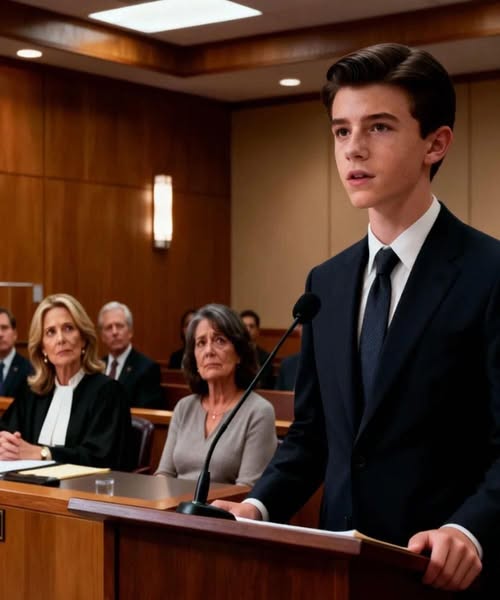
Daniel stood up slowly. He took a breath, looked at the judge, then at the room filled with strangers who believed they knew his future.
He spoke clearly and without anger. He said he understood the truth of his origins and that he did not carry resentment. He thanked Isabella for giving him life. But then he said something that seemed to stop the air itself.
He explained that life needs more than a beginning. It needs care.
He talked about watching me come home exhausted and still help him study. About nights spent sitting by his bed when he was sick. About birthdays celebrated with homemade cakes and laughter instead of extravagance. He did not speak of money. He spoke of presence.
Then he shared something else. He said that in the months leading up to the trial, Isabella had tried to connect with him through expensive gifts and promises. Not cruelly, but insistently. He said it made him uncomfortable. Not because he felt tempted, but because he felt pressured.
The judge listened closely. Objections were raised and dismissed.
Daniel ended with words no one in the room forgot. He said that motherhood is not something that can be postponed and then reclaimed. It is something practiced daily.
I cried quietly, my head lowered, my heart full.
The ruling did not come immediately. When it did, it was thoughtful and measured. Custody remained with me until Daniel reached adulthood. A gradual and respectful visitation plan was established, always centered on his well-being.
Isabella accepted the decision publicly. Later, she asked to speak with me privately. Without lawyers or formalities, she admitted that leaving him had been the greatest regret of her life. We did not become friends, but we reached an understanding. Daniel came first.
In the months that followed, life settled into a new rhythm. Isabella followed the guidelines carefully. She showed up without excess and listened more than she spoke. Daniel finished high school with distinction. I continued my work, now with the quiet assurance that I had done what I could.
What Remains After the Storm
Today, Daniel is an adult, preparing to study law. He says he wants to help those who feel unheard, because he once stood in a room where his voice mattered.
Isabella contributes to his education without conditions. I remain what I have always been. The person who reminds him to eat, who worries when he is late, who makes soup when the weather turns cold.
Sometimes I think back to that morning in the hallway. How close I came to closing my door and continuing on with my life. I did not. That quiet choice changed everything.
This is not a story about heroes or villains. It is about responsibility, second chances, and boundaries. It is about understanding that a child’s well-being outweighs pride, even biological pride.
Love is not proven in grand gestures. It is proven in showing up, again and again, when no one is watching. And sometimes, that is enough to stand up to anything, even a courtroom full of doubt.