I was 11 years old when a new boy joined our private school, and I remember that day like it was yesterday.
It was a Monday morning in September, and our teacher introduced him to the class with a tight smile.
His name was Evan, and everyone noticed him immediately.
Not because he was loud, confident, or charming. No, we noticed him because he clearly didn’t belong in a place like Westbrook Academy.
His clothes were old and faded, the kind that had been washed so many times the colors had dulled to almost nothing. His shoes were worn down at the heels, and you could see where the soles had started to separate from the leather. His backpack looked like it had been used for years, maybe even handed down from someone else.
Everything about him screamed different.
Word spread through the hallways faster than wildfire. He was there on a scholarship. A poor kid in a school full of wealthy families, where kids showed up in designer clothes and got dropped off in luxury cars. At Westbrook, your last name mattered. Your family’s money mattered.
And Evan had neither.
No one wanted to sit with him during class. When the teacher asked for a volunteer to be his partner for a science project, the room went silent. Kids looked down at their desks or suddenly found something fascinating to stare at out the window.
I remember feeling embarrassed for him, watching his face turn red as he stood there waiting for someone, anyone, to raise their hand.
At recess, while the rest of us played soccer or hung out in groups near the playground equipment, Evan stood alone by the fence at the far edge of the yard. His hands were shoved deep in his pockets, and he kept his eyes down.
It felt like he was trying to make himself invisible.
That first day at lunch, I was sitting with my usual group of friends when I noticed something that made my stomach twist. Evan was sitting by himself at a table in the corner, and he didn’t have any food in front of him.
I looked down at my own lunch. My mom had packed me a turkey sandwich, an apple, a bag of chips, a chocolate chip cookie, and a juice box. More than enough for one person. Way more than I usually finished anyway.
Without really thinking about it, I stood up.
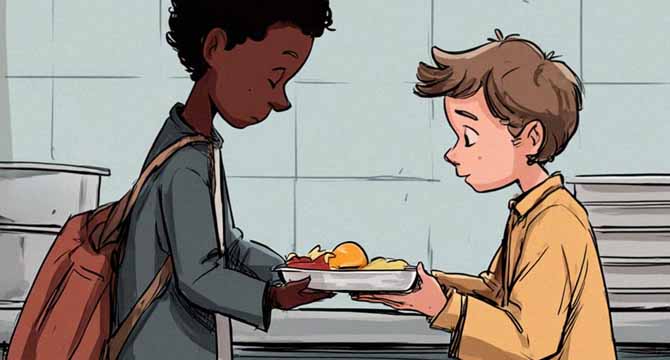
My friends looked at me like I was crazy when I grabbed my lunchbox and walked across the cafeteria toward Evan’s table. I could feel eyes on me from every direction, could hear the whispers starting up behind me, but I didn’t stop.
When I reached his table, I put my lunchbox down in front of him.
“Take it,” I said simply.
Evan looked up at me with wide eyes, confusion, and surprise written all across his face. He didn’t move. Didn’t reach for the food.
He just stared at me as if I’d spoken in a foreign language.
“I’m not that hungry today,” I added, even though it wasn’t true. “Seriously, take it.”
He hesitated for a long moment, then quietly asked, “Are you sure?”
His voice was so soft I barely heard him, and there was something in his eyes that made my chest hurt. It wasn’t just hunger. It was loneliness. It was the look of someone who’d been invisible for so long that kindness felt like a trick.
“Yeah, I’m sure,” I said, and I meant it.
He reached for the sandwich slowly, like he expected me to snatch it back at the last second. When I didn’t, when I just nodded at him and walked back to my table, I saw the smallest hint of a smile cross his face.
That was the beginning of everything.
After that day, things changed between us.
Slowly at first, but then completely.
The next morning, Evan showed up to school and actually looked at me when he walked past my desk. I nodded at him, and he nodded back.
At lunch, I brought extra food again and sat with him. My friends thought I was being weird, but I didn’t care. There was something about Evan that I liked. He was quiet, but when he did talk, he was smart. Really smart. Way smarter than most of the kids in our class, who thought they were better than everyone else.
Within a few weeks, we were inseparable.
We shared lunches every single day. I’d bring extra sandwiches, and he’d help me with my math homework, which I was terrible at. We’d spend recess talking about everything from comic books to what we wanted to be when we grew up. He wanted to be a doctor. I wanted to run my parents’ business someday and make them proud.
We became best friends in the way that only kids can.
We had each other’s backs against the world, against the bullies who made fun of Evan’s clothes, against the teachers who treated him differently because of where he came from. We were both 11 years old, and it felt like nothing could ever break us apart.
Before the school year ended, we made promises to each other. We’d stay in touch no matter what. We’d be friends forever. We even exchanged phone numbers written on scraps of notebook paper.
But life doesn’t care about the promises kids make.
Evan’s family moved that summer. I never found out where they went. The phone number he’d given me didn’t work anymore. I tried calling a few times, but it just rang and rang with no answer.
Eventually, I stopped trying. I told myself we’d find each other again someday, that our friendship had meant too much to just disappear.
But 32 years passed, and we never did.
Life happened. I grew up. I went to college. I came back home and started working for my parents’ company, just like I’d always planned.
For a while, things were good. The business was successful, my parents were proud, and I felt like I was building toward something real.
Then everything fell apart.
My parents’ business collapsed. Bad investments, an economic downturn, partners who disappeared when things got tough. It all came crashing down faster than any of us could have imagined.
My father had a stroke from the stress. My mother withdrew into herself, barely speaking. And my older brother, Michael, swooped in like a vulture.
He convinced me to sign papers. Trust documents. Agreements that I didn’t fully understand because I was too devastated and too worried about our parents to read the fine print. He told me it was to protect the family, to make sure we didn’t lose everything.
He lied.
Michael walked away with almost the entire inheritance. The house, the remaining assets, and the life insurance policies.
Everything that should have been split between us somehow ended up in his name. By the time I realized what he’d done, it was too late. The lawyers said I didn’t have a case. I’d signed everything away.
So, at 43 years old, I found myself broke and alone.
I ended up working at a paint manufacturing plant on the outskirts of town. Long shifts, heavy chemicals, and no protective equipment beyond a flimsy mask that did almost nothing. The air in that factory was thick and toxic, and I could feel it settling into my lungs with every breath. But I needed the money. I needed to survive.
I worked there for years, watching my body slowly break down. The cough started first. Then the fatigue. Then the weight loss I couldn’t explain.
Then came the diagnosis that changed everything. Cancer.
The doctor sat across from me in a sterile white office and spoke calmly about treatment options, surgery possibilities, and survival chances. But I barely heard any of it.
All I could focus on was the cost. The numbers he kept mentioning were impossible. Tens of thousands of dollars. Maybe more. I didn’t have insurance that would cover it. I didn’t have savings. I had nothing.
So, I made a decision that felt like the only option I had left.
I stopped fighting.
I kept working at the factory. I kept going through the motions of living, even though I knew I was dying. What else could I do? I couldn’t afford to save myself, so I just existed, day after day, waiting for my body to finally give up.
Then one day at work, everything went black.
I don’t remember falling. I don’t remember my coworkers shouting or someone calling an ambulance. One moment I was standing at my station, and the next moment there was nothing but darkness.
When I opened my eyes again, everything was blurry and too bright.
I heard machines beeping steadily beside me. Voices speaking in low, urgent tones. The sharp, clean smell of disinfectant filled my nose, so different from the chemical stench of the factory.
A hospital.
I tried to move, but my body wouldn’t cooperate. My arms felt like lead. My chest hurt with every shallow breath. Panic started to rise in my throat because I knew what this meant. I was dying, and I couldn’t even afford to be here.
Then I heard someone speak softly, gently, close to my bed.
“Theo?”
I blinked hard, trying to clear my vision.
A man in a white coat was standing over me, his face partially covered by a surgical mask. He looked about my age, with calm, intelligent eyes that seemed familiar somehow.
He reached up and lowered his mask slowly, and when he did, he whispered, “Theo, is that really you?”
My heart stopped.
I knew that face. Older now, lined with age and experience, but unmistakable. Those same eyes that had looked at me with gratitude across a cafeteria table 32 years ago.
It was Evan.
The poor kid from my school. The boy I’d given my lunch to. The friend I’d lost.
“Evan?” My voice came out as barely a whisper, rough and broken.
His eyes filled with tears, and he nodded. “It’s me. I can’t believe it’s you.”
For a moment, neither of us could speak. We just stared at each other, two middle-aged men connected by a kindness that happened when we were children.
Then he pulled up a chair and sat down beside my bed, and he started explaining everything. He’d seen my name on the patient chart when I was brought into the emergency room. He’d recognized it immediately and asked to be assigned to my case. He’d reviewed my medical history, my diagnosis, and the surgery I desperately needed but couldn’t afford.
And he’d made a decision.
“I’m paying for everything,” he said firmly, leaving no room for argument. “Your surgery, your treatment, all of it. It’s already taken care of.”
I tried to protest, tried to tell him it was too much, but he stopped me with a gentle hand on my shoulder.
“You saved me when I was a kid, Theo,” he said, his voice thick with emotion. “I was alone, scared, and hungry, and you were the only person who saw me as human. You shared your lunch with me every single day. You became my friend when no one else would. That kindness kept me going through the hardest years of my life.”
Tears were streaming down my face now, and I couldn’t stop them.
“I became a doctor because of you,” Evan continued. “Because I wanted to help people the way you helped me. And now I get to repay you. Now it’s my turn to save you.”
The surgery happened two days later. It was successful. The cancer was removed, and the prognosis was good. Better than good. I had a real chance at life again.
We’re friends again now, Evan and I. We meet for coffee every week and talk about everything we missed in those 32 years. He tells me about medical school, about his wife and kids, about the patients he’s saved. I tell him about the hard years, about my family, about learning to rebuild.
And for the first time in years, I’m not just alive. I’m grateful.
Sometimes I think about that 11-year-old boy standing alone by the fence, and I wonder what would have happened if I’d just walked past him that day in the cafeteria.