
 79 views
My husband left me and our children for another woman. His mother had no idea until she came to visit her grandchildren and noticed something missing from our home…
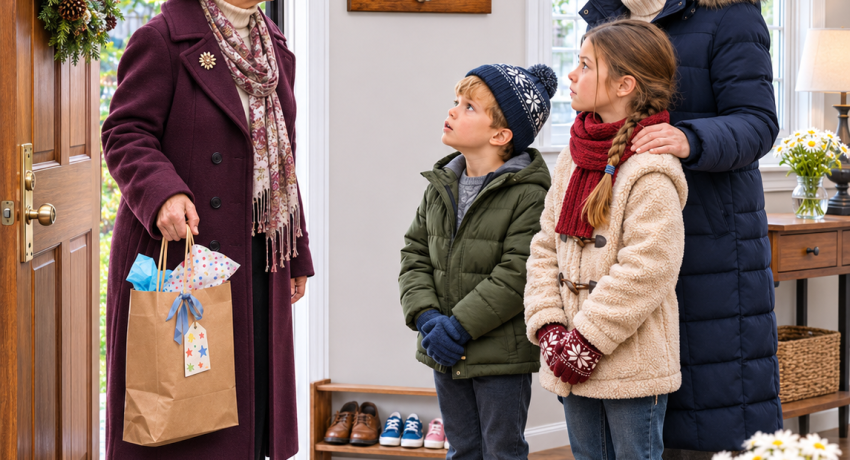
My mother-in-law showed up with presents for the children, but the first thing she noticed was the empty space where her son used to hang his coat.
“On a Saturday?”
I could have reached over and taken the bag from her, just to give my hands something to do. Instead, I let her hold it while I explained how busy he had been recently. I had been repeating some version of that explanation for six months. Until that morning, most of those conversations had happened over the phone, where Dorothy couldn’t look around and notice that only three pairs of shoes stood beside the door.
She called while I was making breakfast, asking about the children before even saying hello to me. I pointed her toward the living room, expecting her to hand them their gifts and come straight inside. Instead, she stopped beside the shoe rack, the colorful tissue paper brushing against her sleeve.
Piper recognized her grandmother’s voice right away. “Grandma!” she shouted, racing down the hallway with Gavin close behind. Piper was eight, already tall enough to wrap her arms around Dorothy’s waist without having to stretch. Gavin was five. He rushed toward her knees and clung to them even as she tried to put the bag down.
“Let me have a proper look at you two,” Dorothy said, pulling both children close. She brushed a crumb from Gavin’s cheek, and he leaned back, expecting the kiss she immediately gave him.
While they talked, I slipped into the kitchen with the presents, grateful for an excuse to finish preparing breakfast. Avoiding uncomfortable conversations had become a habit. I added a little milk to Dorothy’s coffee before moving the cup away from Trevor’s empty chair.
Dorothy came over to the table. Piper had carried her plate in from the living room, while Gavin was trying to work out where he could sit so he would be close to both his sister and grandmother. Dorothy listened to his explanation long enough to understand the dilemma. She shifted her chair slightly, making room for Gavin to squeeze in beside her.
When he returned his attention to breakfast, I noticed Dorothy glancing at Trevor’s chair. Then her eyes moved to the calendar hanging on the refrigerator. It held school reminders and payment deadlines, all written in my narrow handwriting. The family photographs displayed between the kitchen and hallway were the same ones she had seen for years. In one picture, Trevor held Gavin when he was still small enough to fit across his father’s forearms. I had walked past that photograph countless times carrying laundry baskets. It had been quite a while since I had stopped to look at it properly.
“Would you like another cup of coffee?” I asked Dorothy.
She pushed her cup toward me. My hand trembled, spilling some coffee, and I hurried to grab a napkin before it reached Gavin’s plate. Piper raised her fork, while Dorothy held her cup as I wiped up the spill.
“Joanna,” she said, “how long has it been since Trevor came home?”
I flattened the damp napkin beneath my fingers. “I told you he’s working away from home.”
“I asked how long.”
I had prepared an answer for every question I thought she might ask. I could explain how busy he was, why his trip had lasted longer than planned, and why calling him at certain times was pointless. But I had never before needed to explain the empty chair beside me. Piper placed her fork back on her plate.
“Grandma, Daddy doesn’t live here anymore.”
Dorothy turned toward her. “What do you mean, sweetheart?”
Piper lowered her eyes. “Mommy says he’s busy. I think he doesn’t want to live with us anymore.”
My daughter had finally said aloud what she believed. For six months, she had noticed everything I had noticed, even while I kept making excuses and telling everyone to be patient.
Gavin looked from one of us to the other before sliding his plate toward Dorothy. I held the wet napkin tightly, wishing I could ask Piper to give me a moment, the way I sometimes did when sorting through bills. My eyes filled with tears, and she noticed.
“It’s okay, honey,” I told her. “You can finish your breakfast.”
Dorothy studied me briefly. Then she set down her cup and asked Gavin whether he thought he could eat another piece of toast. He held up the piece already in his hand to show her that he was still working on it. She allowed the subject of Trevor to remain untouched while the children finished eating.
Six months earlier, Trevor had placed his keys on that same table without even taking off his coat. I was gathering some clutter in my arms, waiting for him to explain why he looked so troubled.
“Did something happen at work?” I asked.
He pushed his keys closer to the middle of the table. “I’m tired of living this way, Joanna.”
I waited for him to mention something specific that I might be able to help him with. After eleven years of marriage, I thought I understood the kinds of pressures that made him come home looking like that. If money was the problem, we could sit down and review the bills. If work was bothering him, I could give him time to take off his coat and talk when he felt ready. I asked whether he wanted to discuss it after the children went to bed. Even when I went to sleep that night, I still believed we would have that conversation once he found the words.
The following morning, while both children were at school, I heard a suitcase being zipped upstairs. Trevor was closing it on our bed. He finished packing before he looked at me.
“Where are you going?” I asked.
“There’s someone else,” he replied.
He seemed to expect me to ask who it was. At first, I couldn’t think beyond the suitcase. He had already decided what clothes he needed and packed them. I stood on the opposite side of the bed, trying to come up with one question that might help me understand what I was supposed to do when the children returned home.
Her name was Tiffany. She worked alongside him. He said they had been in love for months, speaking as though he had rehearsed those words until he could deliver them without hesitation. During most of those same months, I had been going to work, returning home in time to feed our children, and hoping he might eventually share something about his day if we could get through dinner without someone needing attention.
“What are we supposed to tell Piper and Gavin?” I asked.
He placed his hand on the suitcase handle. “I’ll still see them.”
“They’ll want to know when.”
“I’ll figure something out.”
He lifted the suitcase slightly and set it down again, apparently expecting me to ask more questions about Tiffany. I had plenty. I wanted to know how she had learned so much about his life when he had stopped sharing it with me. But my thoughts kept returning to Gavin asking about his father at bedtime and Piper wondering where he was after school.
“I’ll talk to them,” he said.
“When? Today?”
He stared at his hand resting on the handle. “I’ll see what I can arrange.”
He waited for me to move out of his way. I remembered how we had once laughed while squeezing through that same doorway together, exchanging playful apologies. This time, I stepped aside without saying anything, and he carried his suitcase past me.
I remained in the bedroom for some time after hearing the front door shut. A crease remained in the bedspread where his suitcase had rested. I smoothed it with the side of my hand, then stood with my palm against the mattress, wondering how soon I needed to leave to pick up the children.
For the first few weeks, he responded to some of my messages. I kept them brief. When I asked whether he would be there on Saturday, I thought that would be easier for him to answer than a question about how he intended to remain involved as their father. A few of his promises included specific dates, giving the children something to anticipate. I eventually stopped sharing those plans after having to explain too many cancellations.
Gavin frequently asked about his father’s bedtime calls just as I reached for the light switch. All I could tell him was that I didn’t know. He would then ask me to leave his bedroom door open a little wider. Piper started noticing that other busy adults still managed to find time to call their children.
I continued going to work. After the children fell asleep, I sat at the kitchen table paying bills and arranged everything they needed for school where I could easily find it the next morning. Some days, I had enough time to think about everything that had happened. On other days, I was doing well just to remember whose shoes were getting too tight and which afternoon I needed to get two children and a pair of soccer cleats out the door. As Trevor’s replies became less frequent, I discovered that I could get through countless ordinary days without finding answers to a single question about what he had done.
Dorothy was the last person I could imagine having this conversation with. Frank had passed away, leaving Trevor as her only son. She was proud of him in that special way mothers can be proud of their grown children, still remembering how hard he had worked at things he probably no longer recalled. She believed he would always be there when she needed him. After he walked away, telling her he had failed to be there for us felt almost like asking her to lose another person she loved.
At first, I made up a work trip to get through one difficult week. After that, I blamed meetings and another assignment out of town. Every explanation led to more questions, until I eventually started telling people we weren’t sure whether he would be home that weekend. At least that much was true.
In the meantime, the children continued getting older. Gavin’s shoes beside the door kept changing sizes, while Piper started checking the family calendar whenever she wanted to find out what was happening over the weekend. I had assumed Dorothy would grow tired of my explanations sooner than the children did. But at breakfast that Saturday, Piper was the one who finally stopped pretending.
After I finished clearing the table, Dorothy brought the gift bag inside. She allowed the children to share their news in whatever order they remembered it. Gavin wanted to repeat his first story because he had rushed through an important part the first time. She patiently let him begin again. Piper remained quieter. More than once, I noticed her glancing toward me, making sure the morning was still okay. I hoped it was. I gathered the dishes and stayed close enough to hear their conversation, even after they started talking about school.
Piper came into the kitchen behind me, twisting her napkin as I washed the dishes. In a quiet voice, she asked whether I wished she hadn’t said anything about Dad.
“I wish I’d made you feel more comfortable telling me what was on your mind,” I replied. “You can always talk to me about things like that. You can tell Grandma, too.”
“She got quiet.”
“She has a lot to think about. I’ll talk with her later.”
Piper looked at the napkin she had twisted and slowly smoothed it against the counter. “Can I go back in there now?”
“Of course.”
She quickly returned to Dorothy, eager to show her something from school. I heard Grandma ask her to bring it over so she could have a look.
After lunch, when the children had gone upstairs, Dorothy asked me to sit with her in the kitchen. She slowly turned her nearly empty cup until her fingers settled around its handle.
“I want you to explain what happened,” she said.
I sat down, making myself say the words I had been holding back all morning.
“Trevor left.”
“When did this happen?”
“Six months ago.”
Her grip tightened around the cup handle. “And the children have been living here with you?”
“Yes.”
“Does he ever visit them?”
I shook my head. She looked toward the quiet staircase before asking whether there was another woman.
“Her name is Tiffany,” I answered. “They work at the same place.”
Dorothy got up and carried her cup to the kitchen counter. A little later, I heard her footsteps going upstairs. She returned with our wedding photograph from the bedroom. Holding it in both hands, she kept it low enough that I noticed the light reflecting off the glass before I could see the picture itself. She had been present when it was taken. She probably remembered what had made us look so happy that day.
“I can’t believe he would do something like this,” she said.
She showed me the photograph before placing it on the table. I assumed she would leave or tell me she planned to call Trevor. Instead, she reached into her purse and pulled out her phone.
“He’s been contacting me,” she said. “For all these months.”
Her words caught me off guard. “What has he been saying?”
“He told me you made him leave. He claims you’re preventing him from seeing the children and encouraging them to turn against him.”
I put my hand over my mouth. From that very chair, I had asked Trevor again and again to arrange visits with the children. I wanted to compare my messages with the ones he had sent her, but I couldn’t decide whose phone to look at first.
Dorothy moved her chair closer to mine. “He sent me a message three days ago. Have a look yourself.”
She located Trevor’s message and handed me her phone. I shifted our wedding photograph aside to make room for my elbow.
“Mom, I need you to testify on my behalf. If you tell them Joanna is an unstable mother, I can get custody of the children. Please don’t let me down.”
I read it again, struggling to understand how he could demand custody after all those nights when his children had waited for him without receiving a call.
“Has he actually started doing anything about this?” I asked.
Dorothy rested one hand on the table. “I’ve already spoken with his lawyer.”
At 4:20, I could hear a neighbor’s lawn mower running outside. Until then, I had thought telling Dorothy that Trevor had left would be the most difficult thing I would have to do that day.
“What did you say to him?” I asked.
“I spoke to him on Thursday.” Dorothy looked at her hand, then slowly brought it back into her lap. “I told him I wanted to help Trevor. I said I would tell them whatever they needed me to say.”
I lowered her phone, accidentally bumping the wedding photograph. The glass rattled, making me pull my hand away.
“You told him you would do that?”
“I wanted to find out what he thought he could ask me to do.” She raised her hand again, and this time I noticed it trembling. “Joanna, I recorded the conversation.”
My eyes moved toward the staircase. The mower could be heard turning at the far end of the neighbor’s yard, followed by the same silence upstairs. As far as I knew, both children were asleep. Dorothy picked up her phone and located the recording. Before playing it, she slid the photograph farther down the table so she could lay the phone flat between us.
A man’s voice came through the speaker. He addressed her as Mrs. Hale. His manner was pleasant, almost as though he were explaining which section of a form she needed to complete. He said they needed to establish a pattern. Trevor would claim I had emotional outbursts and that I drank alcohol. If Dorothy could say she had personally witnessed me behaving that way, even on one occasion, it would strengthen their case.
Then Dorothy’s voice came through.
“Are you asking me to say I personally saw her doing these things?”
She spoke with the careful courtesy she used when she wanted someone to finish explaining themselves before she gave her opinion. The lawyer continued speaking. Listening to her leave space for him to respond helped me imagine how patiently she must have sat through that call. Sitting beside her now, I could barely tolerate hearing him finish a sentence.
I reached toward the phone, and Dorothy stopped the recording.
“He knows I don’t drink like that,” I said. “I’ve had a glass of wine at Christmas. That’s all I can remember in the past two years.”
“I know.” Dorothy waited until I looked directly at her. “I’ve known you for fourteen years, Joanna.”
Before she started the recording again, I tried to remember whether Trevor had even poured the wine that Christmas. I hated that I suddenly felt the need to justify an ordinary evening from years earlier.
The lawyer went on to explain Trevor’s financial reason for pursuing primary custody: he wanted to avoid paying child support. Tiffany was pregnant, and his financial situation was already under pressure.
For a moment, I thought I had misunderstood what he meant.
“She’s expecting a baby?”
“Tiffany is pregnant,” Dorothy said. “She’s nearly five months along.”
She allowed the recording to finish before tapping the screen and switching it off. I had heard the lawyer discuss his client’s finances and my children in that same calm, measured tone. I had watched Trevor look directly at our daughter and promise he would call while he was away. I could still see her waiting, hoping he would remember. I tried to imagine the two children living somewhere else simply because he had calculated what it would cost him to leave them with me.
“Why does he want custody if he doesn’t even bother visiting them?” I asked.
Dorothy glanced down at her phone. “He believes it would be cheaper than paying child support. That’s what he told the lawyer.”
I picked up our wedding photograph, remembering the smiles we had shared for someone standing beyond the frame. That moment had meant so much to me. I had believed we would always care about our children’s well-being together.
Dorothy placed her hand over mine as I put the photograph down. Then she told me about something she had seen the previous spring.
She had been in Columbus for a medical appointment. Afterward, she stopped at a small Italian restaurant near the courthouse to have something to eat. Trevor was sitting at a corner table, holding a woman’s hand. He noticed Dorothy almost immediately. By the time he approached her, he had already let go of the woman’s hand. He explained that they were coworkers celebrating a business deal.
“I knew exactly what I had walked in on,” she said. “But when I got home, I tried to convince myself I’d misunderstood what I saw.”
Dorothy was usually willing to admit when she was wrong, even about something as ordinary as taking the wrong turn while driving. It hurt to imagine her persuading herself that she hadn’t witnessed an affair, although I understood that kind of denial better than I wanted to.
“Did you ever consider telling me?”
“Whenever you picked up the phone.” A tear slipped down her nose, but she made no effort to wipe it away. “Then you’d say he was away on another trip, and I’d allow myself to feel relieved because you believed that was true.”
“He also told you I had kicked him out.”
“Yes.” She looked down at my hand beneath hers. “I listened to his version of things, and I listened to yours. I should have asked you directly what was happening a long time ago.”
“What did you expect to discover by coming here?”
She took a moment before answering. “I thought you might tell me where he was, and I would ask whether he’d come home. I could have asked you all of that on the phone. I knew what it felt like to accept your answer over the phone and then simply carry on with my day.”
I remembered her examining the shoe rack. I had assumed she was suspicious of me, but she had also been comparing Trevor’s story with the evidence in front of her.
I pulled my hand back to my side of the table. I thought about what I might have done if I’d had a few more weeks to adjust to everything. Perhaps I would have questioned him myself. Maybe I would have found a way to explain things to the children and reassure them that, whatever happened, we would be honest about what we knew. More than anything, I wondered whether I would have believed her.
“I would have been angry with you,” I said.
“I understand.”
“I might have asked him about it and believed whatever he told me.”
“That’s exactly what I did.” Dorothy stopped speaking for a moment. She pressed the heel of her hand against one eye. “He’s my son. I wanted to continue believing I knew the kind of man he was. You were the one who had to go home and deal with the reality of what I already knew. I’m truly sorry, Joanna.”
She reached across the table to hold my hand once more. This time, I let her. Her fingers felt cold, and she held mine so firmly that eventually I found myself squeezing back. I told her I had kept the truth from her because I feared what learning about Trevor would do to her after losing Frank. That much I could finally admit. I had also been afraid of the moment when she might ask me something about my marriage that I couldn’t answer without openly acknowledging what had happened.
“You were trying to protect me,” she said. “I wish I’d used some of that time to ask whether you were all right.”
A little after five, the sound of the lawn mower stopped. Upstairs, a faint noise suggested that one of the children was beginning to wake. We let go of each other’s hands at the same time. Dorothy dried her cheeks and straightened in her chair.
“What happens if he submits the paperwork on Monday?” I asked.
“Gerald Whitcomb wants to meet you Monday morning. I’ve already spoken to him. He was Frank’s lawyer.”
I knew the name. Frank had relied on Gerald whenever complicated matters needed to be handled properly. Dorothy said that at eighty-one, the attorney could become as unpleasant as a snapping turtle whenever someone tried to manipulate him.
“I can’t afford to hire him,” I said.
“I can.” She lightly tapped the tabletop with one finger. “I have my pension and Frank’s life insurance money. I’ve often wondered how I would use it if something happened to one of you. Well, now it has.”
I let out a small laugh, but then I had to steady my breathing after the sound that followed. I had been handling the bills as they came, one after another. The thought of paying someone who understood what Trevor was planning seemed so far beyond my immediate worries that I hadn’t even considered where the money might come from.
“I’ll come with you,” she said.
I looked carefully at her. “Can you tell him what you heard?”
“I’ll explain the phone call. And if he needs to know about the restaurant, I’ll tell him that too.”
I imagined Dorothy giving testimony while her son sat nearby. Her steady voice made it clear that she had already decided what she was willing to do.
I pushed my chair away from the table. “All right,” I replied. “I’ll come.”
On Monday morning, Dorothy and I sat in a wood-paneled office in downtown Cleveland while Gerald Whitcomb listened to the recording. One hand rested on his legal pad. He made very few notes while the lawyer spoke. When the recording ended, he asked Dorothy whether he could listen to it a second time.
As it played again, I noticed Dorothy clutching the straps of her upright purse between her feet, like someone nervously waiting for a bus. I already knew most of the conversation by heart, but I allowed the recording to play without interruption.
When it ended, Gerald removed his glasses. “Mrs. Hale, if you decide to testify, you’ll be giving evidence against your own son. Have you considered what it will be like to do that while he’s sitting in the room?”
Dorothy met his eyes. “I’ve considered what it would feel like to sit there while someone claims I witnessed things that I know never happened.”
“He may have something to say to you afterward.”
“Then he’ll have to decide whether he can forgive me or not,” she replied. “Either way, I’m going to tell the truth.”
Gerald placed his glasses on the legal pad. He then turned toward me and asked me to describe everything that had happened from the day Trevor left. I began with the evening he placed his keys down, speaking too quickly. I had reached the part about his suitcase before I had even mentioned that the children were at school. Gerald interrupted to ask how old they were. I realized that if I slowed down and explained everything in the proper sequence, I could answer many of his questions. I could tell him where the children were, who collected them from school, and how I responded when Trevor said he wanted to come over. I could explain what I had heard that Saturday and everything I had personally witnessed.
Dorothy remained silent as I spoke. At one point, I stopped because I couldn’t remember the date of a particular phone call. She quietly moved the glass of water Gerald had placed on the table closer to me. I took a sip and continued from the last detail I could remember with certainty.
Just as he had promised, Trevor’s lawyer filed the custody petition. The documents accused me of being unstable, neglectful, and abusing alcohol. I read through them at home. I managed to get through the names printed at the top more easily than the statements that followed. For some reason, I kept trying to identify a specific day when I might have done something differently, as though changing one moment in the past could somehow have prevented my name from appearing in those accusations.
I brought the petition to Gerald and he asked me to review the allegations and explain which ones I could respond to. I wanted to answer every accusation in one go. If those documents had been about someone I knew, I would have wanted to ask where her children went after school, whether she had ever forgotten an appointment, and how she handled things when they were ill. They were simple, everyday questions. But when Gerald asked them about me, I realized how desperately I wanted every answer to prove that I still deserved to be their mother.
Gerald issued subpoenas for Piper’s teachers. They described how regularly I attended parent-teacher meetings and helped with school bake sales. He also spoke with the pediatrician and neighbors who often saw me carrying groceries or bringing the children’s soccer equipment home. Their ordinary observations helped establish Trevor’s absence, even though none of them had realized they might one day serve as witnesses.
There were phone records as well. Since March, Trevor had called his children only four times. Gerald gave me that figure while we were reviewing the petition. I thought I could recall every call, but the first thing that came to mind was all the occasions when I had checked my phone because Gavin wanted to know whether his father had contacted us. Four was the answer to a question I had been asking myself nearly every day.
The legal battle continued for four months. Meanwhile, ordinary life carried on, filled with soccer shoes and Piper’s school preparations. One day, she came into the kitchen while I was reading the petition again, so I quickly folded the familiar pages.
“Is that about Dad?” she asked.
“Yes. The adults are trying to decide when you and Gavin will get to spend time with him.”
She came and stood next to my elbow. “Am I supposed to read it?”
I placed the folded papers on the chair beside me. “You can ask me anything you want to know. Those papers are something I need to read.”
She wanted to know who would collect them the following day. She also had a picture from school that she wanted to bring home and worried it might get damaged if she left it inside her bag. I assured her I would pick her up and could carry the picture for her. Once she had the answers she needed, she returned to whatever she had been doing.
Some evenings, I accidentally skipped a few lines while reading to Gavin, and he always insisted that I go back and read them properly. He never questioned whether I would be there the following day. While we waited for the court proceedings to finish, I kept up the familiar little routines that gave both children a sense of security.
It happened on a gloomy Tuesday in February. Before reaching the courtroom, I had checked twice to make sure I knew where each child would be after school. I put my phone away, then pulled it out again just to look at the time. Dorothy sat beside me. She noticed me doing both things and told me I could keep the phone in my hand for a while if that made me feel more comfortable.
Trevor sat on the opposite side of the room wearing a navy suit I had never seen before. His eyes were fixed on the table. Whenever he used to forget an anniversary, I would catch him staring at a tabletop in much the same way, as if the answer might be hidden somewhere along its edge. Back then, I always knew how to bring his attention back. I would remind him of the date or give him another minute to remember it on his own.
Tiffany was seated in the gallery behind him. Her pregnancy had progressed far enough that I noticed her condition before I realized who she was. I had spent so much time imagining how I might react when I finally saw her that I was surprised by how quickly I turned my eyes away. My concern was what the court would decide for Piper and Gavin. Whatever Trevor had told her about me, she was now present to hear at least some of the truth herself.
Dorothy placed her purse between her feet, just as she had in Gerald’s office. Trevor glanced toward her, but she offered him no comforting gesture. She continued holding the straps until the court called her to testify.
On the witness stand, Trevor’s lawyer spoke with the same confidence I remembered from the recording. He confirmed that Dorothy had seen how I cared for the children, then asked whether she considered me a stable person.
Dorothy brought her hands together. “I would call her the strongest woman I know,” she replied. She paused until the lawyer looked at her again. “I watched her raise two children after my son walked away and gave them very little of his attention. He told me she was preventing him from seeing them. Then he asked me to make a statement about her that I knew was false.”
Trevor suddenly lifted his head and stared at his mother. Dorothy turned toward the judge.
“I have a recording of the conversation with his lawyer,” she said. “I’m willing to have the court listen to it.”
I had heard that voice in my kitchen and again in Gerald’s office. In both places, I could reach for someone’s hand or stand up if I needed to. I knew exactly how many people were listening to what he said. Now the recording was playing across the courtroom, and all I could do was sit still and let it continue. The man discussed the things my husband was prepared to claim about me. He explained what he wanted Dorothy to add to the story. He talked about the money Trevor expected to save and the baby he was having with Tiffany.
I watched Dorothy closely during the section about my supposed drinking. She could have answered a few questions and then left the courtroom. I remembered her sitting at breakfast that Saturday, lifting her coffee cup while I cleaned up a spill. She already knew what Trevor had asked her to say. Yet she had stayed there, listening patiently while Piper spoke. Now, in the courtroom, her son was watching her from the other side of the room. Dorothy kept her attention on the judge until the recording finished.
The judge took off her glasses. In the quiet that followed, I heard a page rustle somewhere behind me before she turned to Trevor.
“In my twenty-two years on this bench,” she said, “I have seldom heard anything that has disappointed me more.”
His shoulders moved as though he wanted to respond, but he simply lowered his gaze.
The court awarded me primary custody and required Trevor to have supervised visits every other weekend for six months. He was also ordered to pay the full guideline amount of child support. His lawyer tried to object, but the judge cut him off.
I looked toward Gerald. What overwhelmed me wasn’t so much the legal ruling as the knowledge that the children would continue sleeping in their own bedrooms. He nodded at me. I held my phone for a moment before putting it away. The children were still at school, and I would be there to collect them.
Dorothy joined us in the hallway. She walked slowly in the direction of the elevators, but stopped when she heard Trevor calling after her. I had heard him use her name countless times when he wanted something. This time, he said “Mom” in a tone that suggested he wanted her to step away from us before he continued.
She stopped and turned to face him.
“How could you do that?” he asked.
For a moment, Dorothy, now seventy-three, looked at Trevor the way she used to when he came home late. She would first study his face to make sure he was all right before demanding an explanation. She held his gaze.
“I did it because I love you,” she said. “Someone needed to tell you no a long time ago. Go and see your children. Be there for them. When you finally do, I’ll be the first person to hug you.” She paused briefly. “But I will never lie for you again.”
He appeared to be expecting an argument. Instead, Dorothy took my arm and stepped into the elevator. When the doors began closing, he was still standing exactly where she had left him.
She kept her hand resting on my arm as the elevator descended. Then she withdrew it and carefully smoothed the edge of her sleeve. I suspected she was replaying everything she had just said to him in her mind. I knew that feeling, so I gave her the time she needed. When we reached the ground floor, she stepped out ahead of me and held the door open with her palm.
I can still remember what it was like coming home that day and seeing the shoes exactly where I had left them. I had passed them on my way out that morning, wondering anxiously what I would find when I returned. Now, there was a loose shoelace beneath one of Gavin’s shoes and a small patch of dried mud under Piper’s. I moved both pairs a little farther from the doorway so I could open it completely. They could stay there until the children needed them again.
Piper came home, put her backpack away, and started telling me about everything that had happened at school. Halfway through her story, she noticed that my attention seemed elsewhere and asked if there was any news.
“You and Gavin will continue living here with me,” I explained. “You’ll have days when you can visit Dad.”
“Do we need to pack our things today?”
“Not today.”
She thought about that briefly before continuing her school story. Partway through, she rested her hand on my arm to check that I was paying attention. I was listening. Just a few months earlier, I had believed I would need to explain everything that had happened to both children before I could honestly tell them what the following day would bring. But at that moment, Piper simply wanted to know what she needed to prepare for.
That spring, Dorothy sold her home in Cleveland and purchased a little yellow bungalow just six blocks away from ours. She had her own kitchen, but she spent most afternoons in mine after school. Piper would take out her fraction homework and sit beside her. Dorothy always wanted her to show her work on paper so they could identify exactly where she was getting confused. Sometimes they spent so much time working through a single problem that Gavin grew tired of waiting for Grandma and began gathering everything he needed to make cookies.
The first time Dorothy taught him to bake her butterscotch cookies, he asked which part of the process he was supposed to keep an eye on. She told him to watch the bowl. He interpreted that instruction so seriously that when she went to fetch a spoon, he kept staring at the bowl on her behalf. Later, he counted the cookies on the cooling rack while she held it steady. They both lost track when I took one. Gavin wanted me to put it back so they could count correctly, and after I took a bite, he asked whether he could have the first cookie the next time they baked.
Ever since Trevor had left, I had taken responsibility for everything without thinking twice. One afternoon, I arrived home prepared to help Piper with her homework, only to find her explaining a fraction to Dorothy while Gavin was busy fetching the baking tray. I put my keys down, slipped off my shoes, and sat with them at the table.
Trevor continued visiting the children during the first few months. Initially, each visit seemed to take a little while to settle into. He would ask Piper something, and she would give him only the answer he had requested. Gavin, meanwhile, wanted to show him every new thing he had gotten since their previous visit, even something so minor that he might have forgotten about it if he hadn’t had someone to share it with. One time, he returned with the item still tucked inside his coat pocket. He seemed satisfied simply knowing that his father had seen it.
As time passed, the visits became less regular. Whenever one was scheduled, Piper wanted to know the details as soon as I had them. Gavin usually waited until the time was closer before searching for something he could take along. I tried to give them information they could depend on. It became easier than before to admit when I didn’t have an answer. They could tell me whether they were excited about a visit or whether anything about it made them uncomfortable.
Every so often, I found myself wondering whether I had forgiven Trevor, as though I was supposed to reach a final decision by some particular evening. I thought about all the nights I had spent waiting for him to respond when there were things I could have gone ahead and done for the children instead. I had become better at recognizing those moments and making the necessary choices. The children would have whatever relationship with their father he was willing to make possible. When they returned home, I could be there to listen to whatever they wanted to tell me. That already occupied more than enough of the space I was willing to give him.
One year after Dorothy’s unexpected visit on that Saturday, she arrived carrying another gift bag. Gavin rushed out of the living room so quickly that Piper had to catch the bag to keep it steady. Inside were two matching baseball gloves.
Gavin slipped his glove on before he had even taken it completely out of the bag. Piper sat on the bottom step and carefully worked her fingers into hers. Then she lifted it so Dorothy could have a look. I noticed Dorothy checking where Piper’s fingertips reached, trying to judge how much room she had left to grow into it. Gavin was already busy opening and closing his glove.
“Grandma, are you staying for dinner?” he asked.
“There’s no way I’d miss it,” she replied.
Dorothy walked over to the coat rack, where my jacket, the children’s backpacks, and her own bright yellow raincoat were hanging. She touched the sleeve of her coat and glanced toward me while the children continued getting used to their new gloves.
“It feels like a home again,” she said.
“It never stopped being one.” I slipped my arm around her shoulders. She leaned against me and stayed to watch the children trying out their gloves.