
 146 views
The Signature
I arrived at the bank at ten o’clock. Sarah Jenkins welcomed me at the reception desk and escorted me straight to a small office with glass doors. She looked to be around forty, spoke in a composed manner, and held a folder beneath one arm.
“Thank you for coming in, Mrs. Beckett. Please have a seat.”
I lowered myself into the chair and placed my cold hands in my lap.
“I’m going to show you what we received,” she explained. “After that, I’d like you to tell me what you notice.”
She slid a document across the desk toward me.
My name is Evelyn Beckett, and I’m sixty-eight. I spent thirty-five years working at a bank in Dayton, Ohio. I began as a teller at twenty-three and eventually retired as a branch operations manager. After reviewing thousands of signatures over the years, I know what a genuine one looks like.
I looked closely at the paper. Its heading read Limited Power of Attorney. Just above my typed name at the bottom was a handwritten signature.
It was a fairly convincing forgery. The large E and the loop of the B had been reproduced with impressive accuracy. But the slant gave it away. My handwriting leans slightly to the left, whereas this signature tilted to the right.
“That isn’t my signature,” I said.
“I suspected as much,” Sarah replied. “One of our tellers noticed something unusual. The finishing stroke on the final letter doesn’t match the signature we have on your account.”
“Who submitted it?”
She turned the page over. Attached to the back was a visitor registration sheet. One name had been written in blue ink.
It belonged to my own son.
I stared at his familiar, carefully formed handwriting. Years ago, he had written my name just as neatly on Mother’s Day cards.
You need to understand Logan. Despite everything, I still loved him.
He is thirty-nine years old. He was nine when his father, Tom, died. Tom was killed in a car accident on Route 4 while driving home from work. I was thirty-eight then, with a mortgage to pay, a nine-year-old child to raise, and a job at the bank. I never remarried.
I raised Logan entirely on my own salary. I never missed one of his games. Even when I came straight from work, still wearing my office clothes, I made sure I was there in the stands. At his Ohio State graduation, I cried so much that a stranger actually offered me a tissue.
Logan inherited his father’s height. He built a career in software sales. He was charming, outgoing, and naturally gifted at winning people over. Unfortunately, learning to live within his means had never been one of his strengths.
Ten years ago, he married Chloe. She was thirty-six, attractive, and sharp-tongued, with a habit of laughing before anyone else reached the punchline. She worked in property sales. She had never called me Mom. She always used Evelyn, as if we were simply colleagues at the same workplace.
My duplex was on Linden Street. I had bought it in 1998 for $94,000. By 2019, I had paid off the mortgage completely. It was a two-story brick building with separate entrances. I lived on the ground floor, while the upstairs apartment had remained empty for years.
Four years ago, Logan and Chloe found themselves unable to afford their apartment anymore. They had fallen behind on rent. Logan came into my kitchen and pleaded, “Mom, just let us stay for a few months.”
Of course, I said yes.
They moved into the upstairs unit. I charged them $900 in monthly rent. They paid for the first two months and nothing after that. Chloe later explained that they were “putting money aside for a house.” Eventually, Logan blamed a slowdown in his industry. After that, neither of them brought up the rent again.
I continued paying for the water, electricity, insurance, and yard maintenance. When the roof began leaking, replacing it cost me $11,400. Later, the heat pump broke down, leaving me with another bill of $8,900. When Chloe decided she needed a newer SUV, she insisted her old vehicle was unsafe. I gave her $14,000 toward the down payment.
I never asked them to return the money. To me, that was simply part of being a mother.
Even so, I maintained careful financial records. I kept a gray binder in the bottom drawer of my office desk.
Their tenth wedding anniversary was on a Friday. Chloe called me on Thursday afternoon.
“We’re celebrating at Black Angus. Six-thirty. I’d really like you to come, Evelyn.”
“I’ll be there.”
“Make sure you arrive at six-thirty sharp.”
About an hour later, I called her again to double-check. She repeated, “Six-thirty. I promise.”
I put on my blue dress and the pearl earrings Tom had given me for our twentieth wedding anniversary. I reached the restaurant at 6:28.
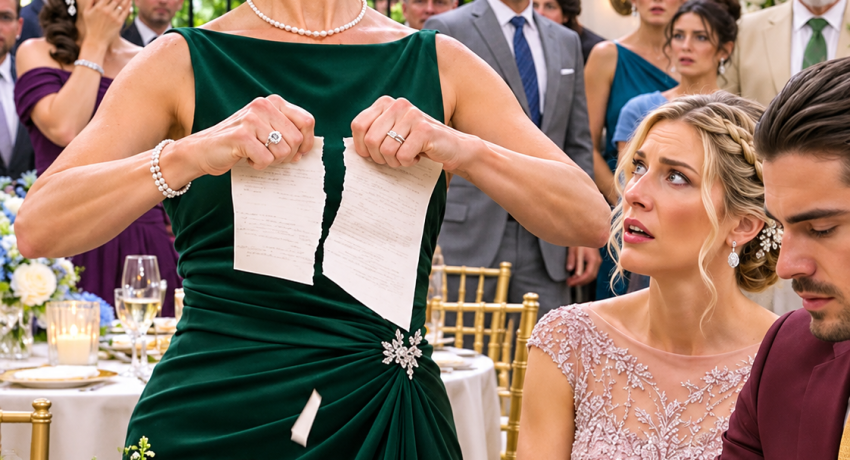
What happened next has never left my mind. Fourteen plates had already been cleared. Chloe’s sister was just finishing her cake. They had changed the reservation to five o’clock. The bill came to $2,243.50. You’re our ATM.
I tore it into pieces.
That moment is important. I didn’t rip up the bill because I was angry. For the first time, my hands acted before my mind had time to intervene.
When I returned home, I began adding up the expenses.
I spent roughly an hour going through everything. I reviewed three years of records and wrote each expense down on a yellow sheet of paper.
The final amount was $58,412.30.
I sat staring at that figure for several minutes. Then I thought about how no one had bothered to save me a place at the table.
I logged into my bank account and cancelled the automatic monthly transfer. It had been $600 a month. I also contacted the credit card company and removed Chloe’s authorized-user access. Then I checked every bill to make sure my name alone appeared as the responsible account holder.
After that, I went to bed. To my surprise, I slept peacefully.
Three uneventful days went by before a neighbor stopped me in the driveway.
Dolores Pruitt was seventy-four, a retired nurse with a short gray bob. She leaned toward me as though she had something important to share.
“Evelyn, sweetheart, are you doing okay?”
“I’m fine. What makes you ask?”
“Chloe has been telling people you had a, well, some kind of episode at the restaurant.”
“An episode?”
“She says you became confused, tore up a bill, and stormed out. Apparently, Logan is worried about you.” Dolores lowered her voice. “She also mentioned that perhaps you shouldn’t be living by yourself anymore.”
I stood perfectly still in the driveway, my grocery bags in my hands.
Working in banking had taught me to recognize certain things. I knew what it looked like when someone was trying to establish a story. First, they told the neighbors. Then they spread it among relatives. Eventually, they brought in paperwork.
“Thank you for letting me know, Dolores.”
“You aren’t confused, are you?”
“I don’t think I’ve ever been clearer in my life.”
She gently patted my arm. “I didn’t believe her.”
The next visitor was Chloe’s mother, Barbara. She arrived wearing a pink cardigan and carrying a box of chocolates. I watched her from the window as she stood on my porch and rang the bell three separate times.
I chose not to open the door.
That evening, Logan pounded on it four times.
“Mom! Open the door!”
“What is it, Logan?”
“This has gone too far!”
“What are you talking about?”
“The money!” His voice broke. “Chloe couldn’t pay the deposit for the couch. They’re holding it for us until tomorrow. It’s all because you stopped the transfers!”
I leaned my forehead against the door.
Apparently, their biggest emergency was a couch.
“I’m not covering your expenses anymore,” I told him.
“You can’t just stop doing that. We rely on you!”
“Then it’s time you learned to rely on yourselves.”
I heard Chloe’s quick, sharp heels clicking as she came down the stairs.
“Evelyn! Open this door!”
“No.”
“What makes you think you can treat us this way? We’re family!”
“Yes,” I replied. “We are family. But I am not your bank.”
She went quiet for a moment. Then, in a chilly voice I had never heard her use before, she said:
“You’re going to regret this.”
I stayed behind the locked door without saying another word until I heard them walk back upstairs.
I should have understood that she was warning me, but I didn’t.
I assumed she was simply furious, so I made myself a cup of tea and watched the evening news.
I had completely forgotten about what had happened with my printer.
The incident had taken place two Saturdays earlier. Logan came downstairs and told me his printer had run out of ink. He asked whether he could use mine, and I agreed without giving it a second thought. He spent nearly an hour in my office.
At one point, I brought him a glass of water. He quickly closed a folder, almost as though he didn’t want me to see what was inside. “Just some work stuff, Mom,” he said.
I put the glass down and left the room.
That Tuesday, while listening to Sarah Jenkins speaking on the telephone, the memory suddenly came back to me.
“Mrs. Beckett?” Sarah asked from the glass-walled office. “Are you okay?”
“I’m just thinking.”
“There’s no need to rush.”
“Where did he get my signature?”
She gave a slight shrug. “It could have come from anywhere. A check, a birthday card, or anything else with your name on it.”
“My son has had access to my signature on cards for thirty years.”
“I understand.”
I examined the form again, focusing on the E that leaned to the right. People who copy signatures often fail to notice the direction of the writing.
“Sarah, you mentioned there was another document included with the paperwork.”
“Yes, there was.”
She took out another page. It was a typed cover letter printed on plain white paper and addressed to the branch manager.
Re: Evelyn Beckett — Request for Account Access
My mother, Evelyn Beckett, is sixty-eight years old and has recently begun displaying symptoms of cognitive decline. She has become forgetful, made unreasonable financial choices, and can no longer safely handle her personal affairs. I am her only child, and she has given me complete permission to act for her. Enclosed is a limited power of attorney. I would appreciate it if you could grant me access to her accounts as soon as possible so I can protect her from financial losses.
— Logan Beckett
I read the letter once more.
Cognitive decline. Unreasonable financial choices.
Yet my hands did not shake. Instead, I felt an unusual sense of calm and clarity.
“There’s one more document attached,” Sarah explained. “I wanted you to look at it before contacting anyone.”
She passed me a third page. It appeared to be a letter from a doctor, complete with medical office letterhead. The heading read Mercy Family Medicine. It was dated two weeks earlier.
To whom it may concern: I have examined Evelyn Beckett and have concerns about her short-term memory and decision-making abilities. I recommend that a family member be assigned supervision over her financial matters.
The letter carried the signature of a Dr. Gregory Pruitt.
I had never heard of him.
For twenty-two years, I had received my medical care from the same practice in Oakwood. My doctor was Dr. Okafor, a woman. The last time I had seen her was in September for my flu shot. I had never once been to Mercy Family Medicine.
“That document is fake as well,” I said.
“That was my suspicion.”
“I’ve never even met this doctor.”
“We contacted the clinic this morning,” Sarah said, bringing her hands together. “The medical practice is real, but there is no Dr. Pruitt there. They have no record of anyone by that name.”
I settled back in my chair. Someone passing through the corridor caused the glass door to tremble slightly.
“So he invented a doctor.”
“Or someone was paid to produce the letter,” Sarah replied. “There are services that do that.”
I thought about Chloe jokingly calling me her cash cow and the story she had spread about my supposed episode. Their goal had never been limited to making me pay for their anniversary dinner. They had been putting together evidence against me.
First, they had spread doubts among the neighbors. Then they obtained a supposed medical assessment. Finally, they took their documents to the bank. If they had succeeded, my son could have gained control over my savings and possibly my property.
“Sarah,” I asked, “what should I do now?”
She paused before answering. Then she said, “Can I speak openly, not as a bank employee, but as a person?”
“Of course.”
“I would contact a lawyer today. I would also report this to the police. This is financial exploitation of an older person. In Ohio, it’s a felony.”
“But he’s my son.”
“I understand.”
“I brought him up by myself.”
“I know.” Her tone softened. “Mrs. Beckett, I’ve worked here for nineteen years. In most cases like this, it’s a son or daughter. They’re not usually monsters. They’re people who have become accustomed to taking advantage.”
I looked down at my hands.
“I would still get a lawyer involved,” she repeated.
From the bank parking lot, I called an attorney I had known for years. Marguerite Okafor was sixty, wore her silver hair in a braid, and had an office above a flower shop in Kettering. She had written my will in 2015. A sign on her desk read SAY IT PLAINLY. She answered after the second ring.
“Evelyn. What’s happened?”
“Marguerite, my son has forged my signature.”
There was a brief silence. Then she replied, “Come to my office. Bring your binder.”
I reached her office at one o’clock. For the next twenty minutes, she quietly reviewed my gray binder, holding a yellow pencil while her glasses rested on a chain around her neck.
“This is excellent,” she said. “You’ve documented everything.”
“I’ve always kept records.”
“That’s a valuable habit.” She tapped the binder. “All right. Let me explain what I’m seeing.”
I waited without speaking.
“First, the power of attorney has been forged. That’s a felony. Second, the doctor’s letter is likely fraudulent as well, which could mean another offense. Third, the bank refused to accept the documents, so no money was taken. That’s in your favor.”
“What happens to my house?”
“Whose name appears on the deed?”
“Mine. No one else’s.”
“Good. Have you made a will?”
“Yes. You prepared it. Logan is supposed to inherit everything.”
Marguerite removed her glasses.
“Evelyn, I think we should change that.”
I had already considered the possibility, although I hadn’t shared the thought with anyone. Contemplating it privately outside the bank was one thing. Hearing my lawyer suggest it directly was quite another.
“What would you recommend?” I asked.
She spent the next two hours explaining the options, while I carefully wrote down each point.
We would start by preparing a new will. Logan would not be completely excluded from the inheritance, but his ability to access it would be limited. A bank-supervised trust would safeguard the property against fraudulent authorizations. I would then appoint my seventy-year-old sister Naomi, a strong-willed retired librarian from Springfield, as my attorney-in-fact through a valid power of attorney. Finally, we would give the bank formal written instructions regarding my accounts: No changes would be permitted unless I appeared in person and presented photo identification.
“What about the duplex?” I asked.
“What would you like to do with it?”
It was the first time anyone had asked me what I wanted.
“I don’t want him to end up on the street,” I replied. “I want him to learn a lesson, but I don’t want my own son to become homeless.”
“That’s a reasonable position.”
“It’s the only answer I can give you.”
She nodded. “In that case, here’s my suggestion. Put a proper written lease in place. Charge them actual rent. If they fail to pay, they’ll have to move out. Give them thirty days’ notice.”
“Rent.”
“Nine hundred dollars, just as you originally requested.”
I thought about her proposal. It was perfectly fair, and, if anything, quite generous. It was exactly the arrangement I had suggested four years earlier.
“Prepare the lease,” I said.
She then discussed what she thought we should do about the forged documents.
“I’d like to give him an opportunity,” she explained. “But not a free pass. Give him a chance to admit what he did.”
“Admit it?”
“Before the bank sends the matter to the authorities. Before a detective gets involved. If he comes forward in writing and formally withdraws the documents, I can request that the prosecutor consider handling it as a family matter. I can’t guarantee anything, but that does happen.”
“And what if he refuses?”
“Then we’ll let the process take its course.”
I glanced at the binder filled with three years of receipts.
“How should I approach him?”
“Ask him to come to a meeting,” Marguerite advised. “Have him meet with both of us. Then give him the opportunity to speak for himself.”
My thoughts drifted back to Logan at nine years old, standing beside his father’s grave in an oversized black suit. He had held my hand so tightly that the bruise remained for an entire week.
“I’d like to do that,” I said.
We scheduled the meeting for Saturday morning at ten in my kitchen.
As I always did, I made a pot of coffee and baked a coffee cake. I placed four cups on the kitchen table. I wore my navy cardigan and Tom’s old wristwatch, which had always given me a little extra courage.
At 9:55, I heard footsteps coming down the stairs. Two people were approaching at an unhurried pace.
I went to answer the door.
Logan was wearing a gray sweatshirt. His unshaven face made him look exhausted. Chloe stood behind him in white jeans and sunglasses, her arms folded across her chest.
“Mom,” Logan said. “You wanted to talk?”
“Come inside.”
They walked in and stopped when they noticed Marguerite sitting at the table in a gray suit, a folder placed in front of her.
Chloe took off her sunglasses.
“Who’s she?”
“My lawyer,” I answered.
For the first time in ten years, I saw every trace of expression disappear from Chloe’s face.
“Your lawyer?”
“Please, have a seat.”
“Evelyn, this is ridiculous.”
“Sit down.”
Logan pulled out a chair before Chloe could respond. He sat on its edge, placing his hands between his knees. Chloe stayed standing for a moment longer. Eventually, she lowered herself into the chair beside him, sitting stiffly like someone waiting for a bus.
I offered each of them a slice of coffee cake. Neither touched theirs.
Marguerite opened her folder and took out the documents.
“Mr. Beckett,” she began, “I’m representing your mother. There’s something I’d like you to look at.”
She placed the three documents in front of them, one at a time: the forged power of attorney, the accompanying letter, and the fraudulent medical statement.
I watched Logan closely as he looked through the papers. At first, his expression remained blank. Then, little by little, the color drained from his face.
“Where did you get these?” he asked.
“The bank provided them,” Marguerite replied. “They contacted your mother on Tuesday.”
“I didn’t—I was only trying to help.”
“By forging her signature?”
“I didn’t forge it. She gave me permission.”
“I never did,” I said.
“Mom.” His voice began to crack. “You’ve been confused. You tore up a bill in front of fourteen people.”
“I did.”
“You’ve been… you’ve said some strange things.”
“What strange things?”
He fell silent.
“Name one,” I said. “Tell me one thing I’ve said that shows I’m confused.”
“You said you were going to stop giving us money.”
“I did stop giving you money.”
“That’s not a sensible decision, Mom. We depend on it.”
“It makes perfect sense. It’s called managing a budget.”
Chloe let out a quiet sound. “Evelyn. Please don’t.”
“Chloe, there’s something I’d like to ask you,” I said. “Did you prepare the doctor’s letter?”
Her expression became completely blank.
“What doctor’s letter?”
“The one supposedly written by Dr. Gregory Pruitt from Mercy Family Medicine.”
“I have no idea what you’re talking about.”
“There is no such doctor.”
“I’ve never heard of him.”
“It was quite a convincing letter,” I said. “It claimed I was confused and needed someone to take control of my finances. It was dated two weeks before the anniversary dinner.”
Chloe kept her eyes fixed on the table.
“Two weeks beforehand,” I repeated. “Before the bill. Before I tore it up. Before any of that happened.”
I paused to let my words sink in.
“Do you understand what that tells us?” I asked. “You had prepared it before I had done anything. You were already making plans.”
Logan was the first to admit what he had done.
He had been staring at the forged signature. He picked up the page with both hands, placing his thumb over the letter E.
“I didn’t write the doctor’s letter,” he said.
“Logan,” Chloe warned.
“I didn’t. I swear. She gave it to me.”
“Logan, stop talking.”
“She told me it came from a friend.”
“Shut up.”
“She said it was just a favor.” He raised his head, his eyes filling with tears. “Mom, I signed the power of attorney. I did it. I’m sorry. I spent three days practicing your signature. Chloe told me it was the only way.”
The kitchen fell silent. The only sound was the ticking of the wall clock.
“Why?” I asked.
“We’re in trouble.”
“How much trouble?”
He lowered the paper and buried his face in both hands.
“One hundred and twelve thousand,” he said. “Credit cards and a loan. I borrowed it in April. Chloe didn’t know.” He looked toward her. “She found out in June.”
“Who did you borrow from?”
“A man. A private lender. The interest is twenty-four percent.”
I closed my eyes.
The complete explanation took an hour. I’ll summarize the important details.
This was what had happened. Logan had been out of work since January, something he had deliberately kept from me. He had continued telling Chloe that he was working remotely. For six months, he spent his mornings at the library instead. He took out loans, supposedly to cover rent, even though he hadn’t paid anything for living upstairs. He borrowed money to clear his credit card balances, then took out more loans to repay the earlier ones.
Chloe learned the truth in June but said nothing. Her property sales had almost dried up. Her real estate license was due for renewal, and she hadn’t paid the renewal fee.
“We were terrified,” Logan said in a lifeless voice. “We thought, Mom has all that money. She wouldn’t even notice if some of it was gone. And eventually, when she got older, it would belong to us anyway.”
“When I got older?”
“I mean…” He grimaced. “I mean, it’s going to be ours.”
“I understand.”
“I’m not explaining it properly.”
“No,” I replied. “You’re explaining it perfectly.”
Chloe sat without speaking, her back stiff and her hands clasped together. A tear slowly rolled down her cheek.
“I’m sorry, Evelyn,” she said.
I looked directly at her.
“I called you a cash cow.”
“I remember.”
“It was a terrible thing to say. I’d had two glasses of wine.” Her voice trembled. “That’s no excuse. I thought it was funny. I saw you coming in wearing that blue dress, carrying your little purse, and thought you had no idea what was going on. I was so angry.”
“What were you angry about?”
“You.” She wiped her cheek. “Because you were always so good to us. You never complained. You paid for everything and kept smiling. And every time you did, I felt like a thief.”
“You were stealing.”
“I know.”
“Not just money. You were taking my dignity.”
She began to cry openly, covering her mouth with one hand to muffle the sound. When Logan reached toward her, she pulled away.
“I changed the dinner time,” she admitted. “I deliberately told you six-thirty.”
“I know.”
“I wanted to find out whether you’d still pay.”
“Why would you do that?”
“Because I wanted to prove something.” She gave a strained, tearful laugh. “I wanted to know that you’d never refuse us. Then I wouldn’t have to feel guilty.”
I placed my palm flat on the table.
“That’s the most truthful thing you’ve ever said to me,” I told her.
I had rehearsed what I was about to say many times, both in the shower and while driving.
“I’m going to explain what happens next,” I said. “I want both of you to listen carefully.”
They turned to face me.
“First, I’m not going to the police. Not today. Marguerite has explained the options available to me, and I’ve decided to give you a choice.”
I noticed Logan visibly relax.
“You will both write a letter to the bank. Use clear, straightforward language. State that the signature wasn’t mine and that the doctor’s letter was fraudulent. You’ll sign the letters and have them notarized. Marguerite will deliver them.”
“Mom.” Logan’s voice was barely audible. “That’s a confession.”
“It’s a correction.”
“It’s a criminal offense.”
“It was a crime when you committed it. Now you’re being asked to acknowledge what you did.” I looked straight into his eyes. “If you refuse, the bank will report the matter. They’ve already flagged the documents.”
After a long silence, he finally nodded.
“Second, you’ll pay rent. Nine hundred dollars every month, starting on the first. Everything will be in writing. If you miss two payments, you’ll have to move out.”
Chloe murmured, “We can’t afford that.”
“You can’t manage nine hundred dollars?”
“We’re unemployed.”
“Then you’ll need to find jobs.”
“Third,” I continued, “you’ll meet with a woman named Rosalind Park.”
They both looked at me in surprise.
“She’s a debt counselor in Kettering. There’s a laminated sign on her desk that reads DEBT IS A SHAPE, NOT A SENTENCE. You’ll attend her sessions every Tuesday for three months. I’ll cover the cost of the first six appointments.”
“We don’t need a counselor,” Chloe said.
“You have a debt of $112,000 carrying twenty-four percent interest.”
“We’ll figure something out.”
“You’ll lose the SUV within a month.”
She looked as though she wanted to argue, but no words came out.
“I’m not giving you any money,” I said. “I want that understood. What I’m giving you is a person who can help.”
Logan covered his face with both hands.
“Fourth,” I continued, “I’m going to revise my will.”
He slowly lifted his eyes toward me.
“I’m not disinheriting you. I could never do that. But I’m placing the house in a trust managed by a bank. If you want to inherit it one day, you’ll have to prove yourself worthy of owning a home.”
“That’s cruel.”
“It’s the same decision I would make for any child,” I replied, “who had forged my signature.”
Our coffee sat untouched, growing cold in the silence, while a mockingbird called from the fence outside.
After a while, Logan finally spoke, his voice subdued.
“Mom, I’m sorry.”
“I know.”
“I’m truly sorry.”
“I know, sweetheart.”
“I don’t understand how things got this bad.”
“It happened one signature at a time,” I replied.
He started crying. He was thirty-nine years old and stood six-foot-one, yet he folded forward over my kitchen table and sobbed with the same unrestrained sorrow he had shown beside his father’s grave when he was nine.
I stood up and walked around the table. As soon as I placed a hand on his shoulder, he leaned forward and buried his face against my cardigan.
“I’m sorry,” he whispered into the wool. “I’m so sorry, Mom. I really am.”
I put my arms around my son.
Across the table, Chloe remained still while Marguerite quietly busied herself with the papers in her folder.
Looking over Logan’s shoulder, I caught Chloe’s gaze.
“You too,” I told her.
She looked at me without speaking.
“Come here.”
After a brief hesitation, Chloe got to her feet. She slowly walked around the table in her white jeans, and I opened my free arm toward her. She stepped into the embrace. Her body felt thin and stiff, and she smelled of jasmine and cigarettes.
“I’m sorry,” she whispered. “Evelyn, I’m truly sorry.”
“I know,” I answered. “It’s a beginning.”
It took an entire year for us to put our lives back together.
On Monday, the bank received their written admission. Sarah Jenkins confirmed it over the phone. “Mrs. Beckett, I’ve never seen a family do something like this.” I told her that I hadn’t either.
The bank marked the matter as settled and added a notation to my file. No official report was filed. Marguerite later described the outcome as the finest result of her twenty-year career.
Logan secured a job in February. A small insurance company in Beavercreek hired him for $46,000 a year, which was only half of what he had earned previously. He started commuting by bus, saying the journey gave him time to think.
In March, Chloe renewed her real estate license and took a part-time position with a title company. She told me that, for the first time, she could honestly explain where her income came from.
They started paying rent. April was the only month when things became difficult. Chloe came downstairs in tears, holding an envelope in her hand. “We’re two hundred dollars short,” she told me. I replied, “Bring the rest on Friday.” She did exactly that.
They continued attending their Tuesday appointments with Rosalind Park. In July, Rosalind called me. “Mrs. Beckett, I’m not permitted to share the details of their sessions. But your son asked to review the loan agreement himself. He read all eleven pages.” She paused before adding, “Out loud, to his wife.”
In May, they sold the SUV. By the following summer, their outstanding debt to the private lender had dropped to $38,000.
There was one last incident that meant more to me than the rest.
It took place the following October, exactly one year after the disastrous dinner. I invited them to celebrate their anniversary, this time marking eleven years together. A week beforehand, I had told Chloe, “I’d like to take you both out. Dinner is on me.”
She replied, “Evelyn, you really don’t need to.”
“I want to.”
“Are you certain?”
“I’ll pay,” I told her. “But you must arrive on time.”
She laughed. It was a genuine laugh, brief and unexpected.
We returned to Black Angus. It was a Friday evening at six. I wore the same blue dress. When I arrived at 5:50, I found them already seated at the table, with a candle glowing and bread waiting. Logan stood as I approached and pulled out a chair for me.
“Hello, Mom.”
“Hello.”
“We kept a place for you,” Chloe said.
I looked over the table. There were three settings. A plate and napkin were waiting at mine, along with a small card written in Chloe’s unmistakable, flowing handwriting.
Evelyn.
I sat down.
I would like to say that tears filled my eyes, but they didn’t. Instead, I felt a quiet warmth, a sense of peace, and just a little weariness.
We placed our orders and enjoyed dinner together. Logan told us about a customer who had asked whether insurance covered “acts of God.” He said he had replied that it depended on which one was responsible. Chloe laughed so hard she nearly choked, and I laughed along with her.
When the check came, I reached for it.
Chloe got there first.
“No,” she said.
“Chloe.”
“Please.” She took out a simple debit card with a chip. “Let me pay this time.”
“It’s two hundred dollars.”
“I know.” Her tone remained calm. “I worked it out. I’ve been putting money aside.”
I looked at her. She was thirty-seven, wearing a gray sweater, with no makeup on. She looked completely like herself.
“Okay,” I replied.
She paid the bill, signed the receipt, and passed it across the table to me.
$187.40. Tip: $40.
It was unmistakably her handwriting, with its oversized loops and slight slant to the right.
I stared at it for quite a while.
I drove home alone, with the radio playing quietly. The night was crisp and clear, and a thin crescent moon hung over the fields.
The porch light at the duplex was on. Both entrances were illuminated. Their own ten-year-old Corolla was parked in the driveway. Upstairs, the light in their window was shining.
I went inside and hung my coat up. Then I walked into my office and pulled open the bottom drawer.
I took out the gray binder and sat at my desk, opening it to the last page.
A year earlier, I had written a number there in my own handwriting: $58,412.30. Below it were monthly records written in a different pen.
Rent: $900. Paid. Rent: $900. Paid.
There were twelve payments altogether. April had been short by two hundred dollars. $700. Paid Friday.
I turned to a fresh page and wrote down the date. Then, in the careful handwriting I had developed through thirty-five years in banking, I added:
Dinner. $187.40. Paid by C.
I looked at the entry for a moment. Then I made a note I had never made before, adding one final line beneath it.
Saved my seat.
I closed the binder, placed it back in the drawer, and locked it.
A floorboard creaked above me. Logan’s easy laughter drifted down through the ceiling, followed by Chloe’s voice. They were talking the way people do when they are enjoying the last moments of a pleasant dinner together.
I turned off the light. Sitting in the darkness with my hands resting in my lap, I listened to the sounds of family life coming from upstairs.
For once, I was glad to hear them.









