
 46 views
Sam’s Table
Part One: The Quiet One
My daughter, Lily, has always been a reserved child. Even when she was a baby, she rarely cried. She would lie in her crib, quietly watching the ceiling fan spin with an intensely focused expression, almost as if she were trying to solve a complicated math problem. Whenever I came to pick her up, she would simply stretch both arms toward me without saying a word.
Her father always believed she had an old soul. “She’s lived a life before this one,” Sam would joke, lifting her above his head in the kitchen while she carefully studied his face. “She’s just making sure we get things right this time.”
Sam passed away four years ago, when Lily was eleven. After losing him, my already quiet little girl became even more withdrawn.
My name is Megan Porter. I’m forty-one, and I live in a modest white house with green shutters along a gravel road just outside Mountain Grove, Missouri, in the Ozark hills. Every morning and afternoon, I drive a school bus for the Mountain Grove school district. During the hours between those shifts, I clean guest rooms at the Super 8 near the highway. It’s not an exciting life, but it provides enough to keep our household running. At least most of the time.
Sam worked as a lineman for the local electric cooperative. He climbed utility poles during freezing storms, tornadoes, and scorching hundred-degree afternoons to restore electricity for strangers he would probably never meet. His hands were large and covered in scars, his laughter could be heard all the way from the barn, and he always sang Merle Haggard songs terribly out of tune while doing the dishes.
There was something he repeatedly told Lily whenever she wondered why he went out in dangerous weather to restore electricity for other people.
“Being a decent human being means helping others when nobody is there to see it, Lil,” he would tell her. “Anyone can act good when there’s a medal waiting for them.”
Part Two: The Flood
It happened in April, four years earlier, during the most devastating flooding the Ozarks had experienced in an entire generation.
Rain fell continuously for six days. Small creeks overflowed the low-water crossings, rivers spilled across the roads, and the entire county became a muddy, rushing landscape. Sam had been working almost nonstop, bringing power back to substations and getting barely three hours of sleep each night in his truck.
On the sixth evening, while driving home along Highway 95 near the Gasconade River bridge, he noticed headlights shining through the floodwater.
A vehicle had entered a flooded section of road where the pavement dipped near Beaver Creek. The water was rushing rapidly, already four feet deep and continuing to rise. The car had begun sliding sideways off the road toward the creek channel. A man was trapped inside. Sam spotted him through the windshield, illuminated by his truck’s headlights, desperately striking the glass with his fists.
Sam immediately contacted 911 from his truck. The dispatcher informed him that a swift-water rescue crew would arrive in twenty-five minutes. But the trapped driver couldn’t possibly survive that long.
So Sam climbed out of his truck. He secured one end of a tow rope around his waist and attached the other end to the front bumper of his cooperative truck before stepping into the water.
I learned everything from the sheriff’s report and from two individuals traveling in a pickup truck who had stopped on the opposite side of the flooded road and witnessed the entire incident. According to them, Sam reached the vehicle in approximately one minute, battling the powerful current along the way. They said he smashed the driver’s window with his elbow, pulled the trapped man out through the opening, and turned around to bring him back while holding on to the rope.
They also reported that the rope broke when they were halfway back.
The swift-water rescue crew discovered the vehicle the following morning, nearly a mile downstream, tangled around a sycamore tree. Sam’s body was recovered three days later, another two miles farther along the creek, trapped in a pile of logs near a bend in Beaver Creek.
At six o’clock on a Tuesday morning, the sheriff arrived at my front door. His name was Dale Huff, and he and Sam had known each other since their high school days. He stood on my porch, holding his hat in both hands as rainwater dripped from his raincoat.
“Megan,” he said quietly. “I’m terribly sorry. Sam didn’t make it.”
I remember gripping the doorframe to keep myself standing. I also remember Lily coming down the stairs behind me, still dressed in her pajamas.
“What happened to the man in the car?” I asked. Even now, I don’t know why those were the first words out of my mouth. Perhaps some part of me knew that was what Sam would have wanted to know.
Dale slowly shook his head. “We couldn’t save him either,” he replied. “Both of them are gone.”
Part Three: Four Years
The local weekly newspaper published the story that Thursday. Local Lineman and Motorist Die in Beaver Creek Flood. Two photographs appeared beside each other on the front page: one showed Sam smiling in his cooperative hard hat, while the other featured a man from another state whose identity had been established through his driver’s license. His name was Elliot Graves, a fifty-four-year-old man from Memphis, Tennessee. I’ve never forgotten it.
I read the newspaper article a single time. Then I carefully folded it, tucked it into the back of my Bible, and made a decision never to read another report about the flood. I avoided the follow-up articles, the corrections, and even the letters sent to the editor. I simply couldn’t face any more of it. I had an eleven-year-old daughter to care for, a funeral to arrange, and a mortgage that was becoming impossible to manage on a single income.
That first year was the most difficult of all. The life insurance Sam received through the cooperative covered the remaining balance on our truck, funeral expenses, and approximately four months of mortgage payments. Once that money was gone, I had nothing except my school bus job and the cleaning work at the Super 8.
I figured out how to make one pound of ground beef last for three separate meals. I discovered which supermarket reduced the price of its bread every Tuesday. I learned to calculate every item in my head while standing in the checkout line, quietly returning things whenever the total became too expensive: the expensive cereal, fresh strawberries, and Lily’s favorite ice cream. I would simply tell the cashier that I’d decided against buying them.
I also became accustomed to missing dinner. Not every evening, but whenever our money started running low toward the end of the month. I’d prepare a meal for Lily and tell her I’d already eaten at work. Sometimes I’d claim I wasn’t hungry or that I’d enjoyed a large lunch. Then I’d sit opposite her at the table, drinking coffee and watching her finish her food.
I genuinely believed she hadn’t noticed. I was completely convinced I had kept it hidden from her.
There was another painful loss after Sam’s death, something I rarely discuss.
Sam’s mother, Rose Porter, lived by herself in a small yellow house on the opposite side of Mountain Grove. She had been widowed for twenty years, and Sam was her only son. During his funeral at the Methodist church, she stood beside his casket and said something that has remained with me ever since.
“He went into that water because he never knew how to refuse anyone,” she told me. “You should have kept him at home, Megan. You should have made him take a break.”
I didn’t respond. I was incapable of saying anything. We haven’t spoken since that day. We didn’t see each other at Christmas or even on Lily’s birthdays. For the first two years, I mailed her cards containing Lily’s school photographs, but she never responded. Eventually, I gave up sending them.
Part Four: The Job
Last spring, Lily celebrated her fifteenth birthday. That autumn, she came to me and announced that she had found a weekend job.
We were at the kitchen table on a Sunday evening in September. I was working through our bills with a calculator and a pile of envelopes spread out in front of me. Lily sat opposite me, busy with her geometry homework. Suddenly, she put her pencil down.
“Mom,” she said. “I found a job.”
I raised my head. “A job? Where?”
“At the Junction,” she replied. “The restaurant on Highway 60, near the truck stop. I’ll be clearing tables on Saturdays and Sundays.”
I knew the Junction. Everyone in Wright County knew that place. It was an old roadside diner with a red metal roof and an arrow-shaped sign, serving chicken-fried steak and homemade pie to truck drivers and farmers since 1962. Sam used to eat breakfast there after working night shifts. He always ordered two eggs over easy with biscuits and gravy.
“Sweetheart, you’re only fifteen,” I said. “Why are you already thinking about getting a job?”
Lily shrugged and picked up her pencil again. “I just want to have a little money of my own to buy things, Mom,” she answered.
For several months, she’d been asking about getting a new phone. Her current one was an old hand-me-down from Sam’s cousin. It was four years old, with a cracked screen that had developed a spiderweb of lines from one corner and a battery that barely lasted until lunchtime. All her friends had newer phones. I’d watched her standing at the bus stop, struggling to read messages through the damaged screen and constantly adjusting its angle to see better.
I’d been putting money aside to buy her a replacement for her birthday. Unfortunately, I’d managed to save only sixty-two dollars before the truck needed new brakes.
So I assumed she’d finally decided to earn the money for the phone herself. I felt proud of her, although I also felt a little guilty about our situation. Still, I agreed.
Part Five: Saturdays
Every Saturday morning, Lily headed out of the house at eight. Her manager, Patricia, didn’t allow employees younger than sixteen to work the early morning hours, so Lily’s shift began at eight-thirty and continued until four. I’d drive her the fifteen minutes to Highway 60 in an extra pickup from the bus barn, which my supervisor permitted me to use on weekends.
She always wore her worn-out sneakers, whose soles were beginning to separate, along with black jeans and a simple T-shirt. Her hair was tied back in a ponytail, and she carried a small blue backpack she’d owned since sixth grade.
Every Saturday afternoon, I’d return to collect her at four-fifteen. She would emerge through the diner’s side entrance looking completely worn out, smelling of coffee, fried food, and dishwashing soap. Her hands were usually red and rough from working with hot water. Occasionally, she’d have a small burn on her forearm from the coffee machine.
By Sunday afternoon, she looked even more exhausted when she returned home. She’d head straight for the couch, and sometimes she’d fall asleep before dinner, still wearing her work clothes, with her backpack lying beside her.
“Lily,” I said one Sunday in October. “You’re pushing yourself much too hard. Let me help you find an easier job. The library needs people to organize books. Or you could try the pharmacy in town.”
Without even opening her eyes, she shook her head. “I enjoy working there, Mom,” she replied. “I really do.”
“But you’re completely worn out.”
“It’s the good kind of tired,” she answered. Then, with her eyes still closed, she gave me a little smile. “That’s what Dad used to say after working through storms.”
She never discussed the amount of money she was putting away. She didn’t show me her paychecks either. Whenever I asked how much she’d saved, she’d simply reply, “I’m getting there,” before steering the conversation somewhere else.
I didn’t insist. I assumed she was secretly saving enough to surprise me with a new phone. I imagined her walking through the door one day in December, holding a shiny new box and wearing a huge smile while I pretended to be surprised.
But that wasn’t what happened.
Part Six: The Call
One Thursday afternoon in November, my phone started ringing while I was sitting inside the bus barn between my driving shifts.
The number wasn’t familiar. I nearly ignored the call. Then I noticed the area code was local and thought it might be someone from the school.
“Hello?”
“Am I speaking with Megan Porter?” a woman asked. Her voice sounded rough and gravelly, as though she’d spent her entire life speaking over the noise of a busy restaurant kitchen. “Are you Lily’s mother?”
“Yes,” I answered. “Is something wrong?”
The woman remained silent for several seconds. The pause lasted long enough for my heart to start racing.
“My name is Patricia Dunn,” she finally said. “I’m the manager at the Junction. Your daughter works here.”
“Has something happened to her? Is she alright?”
“She’s perfectly fine,” Patricia quickly assured me. “I’m assuming she’s at school right now. Mrs. Porter, your daughter hasn’t done anything wrong.”
Then she stopped speaking again.
“But I really think you need to come down here,” she added. “There’s something I’d like you to see.”
My stomach immediately tightened.
“What happened?” I asked.
“I’d prefer to explain when you get here,” Patricia replied. “Would you be able to come now? It shouldn’t take very long.”
I glanced at the clock hanging on the bus barn wall. My afternoon bus route was scheduled to begin in forty-five minutes.
“I’ll be there shortly,” I told her.
Part Seven: The Junction
During the fifteen-minute drive to the restaurant, I kept imagining every terrible possibility.
I wondered whether Lily had been caught stealing something. Maybe someone had hurt her and she’d been hiding it from me. Perhaps she’d become involved with an older boy, a truck driver, or someone dangerous. I even imagined things I didn’t want to think about. By the time I reached the gravel parking lot beneath the arrow-shaped sign, my hands were trembling against the steering wheel.
Patricia was waiting for me near the entrance. She stood outside the restaurant’s front door wearing her apron and smoking a cigarette. As soon as she noticed my truck, she put it out against the side of the building.
She looked around sixty, perhaps a little older. She was short and solidly built, with gray hair gathered into a tight bun and reading glasses dangling from a beaded chain. Her eyes appeared tired, but her voice was kind. When she shook my hand, I could feel how rough her palm was from four decades of handling hot dishes and washing plates.
“Mrs. Porter,” she greeted me. “I appreciate you coming.”
“Please tell me what’s going on,” I said.
Patricia studied my face for a few moments.
“Your daughter,” she began, “is among the hardest-working young people I’ve ever employed. And I’ve been managing this restaurant for twenty-six years.”
“Then why did you call me?” I asked again.
Patricia offered no explanation. Instead, she opened the door, motioned for me to follow her, and pointed toward the back of the restaurant.
Part Eight: The Locker
She guided me across the dining area. It was a weekday afternoon, that quiet period between the lunch and dinner rushes, and only a handful of customers were sitting inside. Two truck drivers occupied seats at the counter. In a corner booth, an elderly couple were sharing a slice of pie.
As we walked past, the older woman looked up and smiled at me. She held my gaze for slightly longer than usual, almost as though she recognized me.
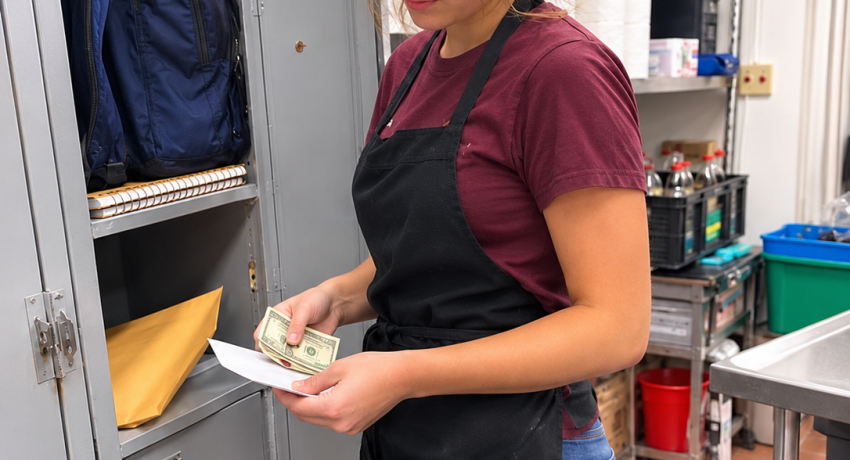
Patricia continued through the swinging doors into the kitchen, passing the grill, the deep fryers, and the dishwashing station before leading me into a little storage area at the back. The shelves were packed with canned tomatoes, bags of flour, and rolls of paper towels. A mop bucket stood in one corner. Along the opposite wall was a line of metal lockers, similar to those found in high school gymnasiums. They were beige, with dents scattered across their surfaces.
One locker had a strip of masking tape attached near the top. Written across it in purple permanent marker, using my daughter’s familiar, carefully slanted handwriting, was a single word: LILY.
“She doesn’t use a padlock,” Patricia explained. “Nobody who works here does. I noticed it was open this morning when I went looking for an extra apron.” She hesitated before continuing. “I wasn’t trying to look through her things, Mrs. Porter. I promise you that. But when I noticed what was inside, I sat down on that milk crate and cried for twenty minutes.”
Then she opened the locker.
Inside, I could see Lily’s little blue backpack. There was also an extra T-shirt folded neatly, a hairbrush, and a collection of grocery receipts fastened together with a binder clip. They came from Walmart in Mountain Grove, the IGA in Cabool, and the Dollar General on Main Street.
Several white envelopes were stacked neatly inside, each one carefully folded and labeled.
There was also a small spiral notebook with a purple cover, the inexpensive kind sold at the drugstore for a dollar.
Patricia reached inside the locker, picked up the notebook, and placed it in my hands.
Part Nine: The Notebook
I recognized the handwriting immediately. Lily’s letters were small, neat, and slightly tilted toward the right, exactly like Sam’s handwriting.
On the opening page, she’d written a title and drawn two lines beneath it.
Money for Mom’s groceries.
Below the heading were several dates and amounts covering September and October.
Sept 14 — $35
Sept 21 — $48
Sept 28 — $62
Oct 5 — $41
Oct 12 — $55
I couldn’t take my eyes off the page.
“Money for Mom’s groceries,” I read aloud. “What exactly does this mean?”
Patricia didn’t say anything. She simply motioned for me to keep reading.
I turned to the following page.
A different heading appeared at the top. Sundays.
Below it were more dates, amounts, and several names written beside them.
Oct 6 — Mrs. Bennett — milk, bread, eggs, soup — $22
Oct 13 — Mrs. Bennett — groceries + Mr. Bennett’s Ensure — $38
Oct 13 — Mr. Wilson — prescription pickup (copay) — $15
Oct 20 — Mrs. Bennett — groceries — $31
Oct 20 — Grandma Rose — groceries — $27
Oct 27 — Grandma Rose — groceries + furnace filter — $34
I suddenly stopped reading and lifted my eyes toward Patricia.
“Grandma Rose,” I whispered.
Patricia slowly nodded. “Rose Porter,” she explained. “She lives over on Elm Street. She comes here every Tuesday to enjoy our senior special.”
“That’s Sam’s mother,” I said, my voice breaking. “She’s Lily’s grandmother. We haven’t had any contact for four years.”
“I know,” Patricia replied softly. “Lily told me about it.”
I dropped heavily onto the milk crate, unable to remain standing. The notebook shook in my hands.
“What am I looking at?” I asked. “Patricia, what has my daughter been doing?”
Patricia brought a folding chair over from the corner and sat down opposite me.
Part Ten: The Soup
“Something happened about two months ago,” Patricia began. “Lily noticed a particular customer.”
She placed her hands together in her lap.
“We have a regular customer here. Her name is Dorothy Bennett, and she’s eighty-one years old. Every Saturday at noon, she comes through that door, takes her usual seat in the corner booth, and orders a cup of soup. Nothing else. Just the small cup, which costs a dollar ninety-five. She takes almost an hour to finish it, eating very slowly and making the most of all the free crackers she can get.”
Patricia slowly shook her head.
“I’d noticed her situation as well,” Patricia explained. “I’ve been working here for twenty-six years, and I’d seen what was happening. Occasionally, I’d send her a complimentary piece of cornbread. But I never actually asked her about it.”
“Lily was the one who approached her,” Patricia continued.
She glanced at the notebook I was holding.
“During her second Saturday working here, she walked over to Dorothy’s booth to collect the empty cracker packets and pulled up a chair across from her. She simply sat down in her apron as though it were the most ordinary thing in the world and asked how she was doing.” Patricia’s eyes began filling with tears. “Dorothy opened up and told her everything. Her husband, Harold, has Parkinson’s disease, and she looks after him all by herself. Their Social Security payments barely cover the cost of his medication. She comes here every Saturday for that little cup of soup because it’s her only opportunity to leave the house, and she simply can’t afford anything more.”
“Lily paid for her entire meal,” Patricia said. “That very afternoon, using the money from her first paycheck. She ordered chicken-fried steak, mashed potatoes, green beans, and a piece of coconut cream pie. She also purchased another complete meal to take home for Harold.”
I pressed my hand against my mouth.
“After that, she found out where the Bennetts lived,” Patricia continued. “Their home is on County Road AA, roughly two miles from the restaurant. Since then, your daughter has been delivering groceries to them every Sunday after finishing her shift. She asks Joe, our cook, to give her a lift. He takes her there, helps her unload the bags, and waits inside the truck until she’s finished.”
I glanced down at the notebook again. Mrs. Bennett — groceries + Mr. Bennett’s Ensure — $38.
“What about these other names?” I asked. “Mr. Wilson? And Rose?”
Patricia’s eyes became watery.
“She started talking to some of our regular customers,” she explained. “Very discreetly, one person at a time. She’d ask whether they knew anyone going through financial difficulties. Someone who needed assistance but would never have the courage to ask for it.” She shook her head in amazement. “Every week, she takes part of her paycheck and puts it toward helping someone. She does it without fail.”
Part Eleven: Rose
“How did she end up finding Rose?” I asked, barely able to get the words out.
“Rose was the one who came across her,” Patricia answered.
“It happened during the third week of October,” Patricia explained. “Rose came in for her usual Tuesday senior special, just as she always does, but that particular day she couldn’t afford to order it. All she asked for was a cup of coffee. Nothing else. She sat alone in the booth beside the window, staring out toward the highway.”
Patricia paused to catch her breath.
“The following Saturday, I mentioned it to Lily. It wasn’t anything important, just a passing comment. I told her about an elderly woman named Rose Porter who used to visit every week but was now having financial problems.” She looked directly at me. “I had absolutely no idea she was Lily’s grandmother. I promise you. When Lily heard the name, all the color drained from her face.”
“That Sunday, Lily walked all the way to Rose’s house,” Patricia continued. “She covered the three miles between this restaurant and Elm Street on foot. When she arrived, she was carrying two bags filled with groceries. She knocked on the door.”
I covered my mouth with my hand.
“At first, Rose didn’t recognize her,” Patricia said. “The last time she’d seen Lily, your daughter was only eleven. Then Lily introduced herself, saying, Hello, Grandma. It’s me, Lily. Sam’s daughter.” Patricia’s voice broke. “Rose sat down on her front porch and cried for an entire hour. Lily stayed right there beside her the whole time.”
“She hasn’t missed a Sunday visit since then,” Patricia said. “She brings Rose groceries and helps her with little household repairs. Just last week, she replaced the furnace filter. Joe even had to take her to the hardware store so she could purchase the correct size.”
I looked down at the notebook once more. Grandma Rose — groceries + furnace filter — $34.
“She never mentioned any of this to me,” I whispered.
“She was afraid it would make you feel uncomfortable,” Patricia replied softly. “Lily told me that Rose had said some very hurtful things about you at Sam’s funeral. Your daughter didn’t want you to believe she was choosing her grandmother’s side over yours.”
Part Twelve: The Last Envelope
Patricia then reached into the locker and pulled out one final envelope.
It looked like the others, made of white paper, but it was noticeably thicker. On the front, my daughter’s familiar, carefully written letters appeared in purple marker. There was just one word.
Mom.
My hands were trembling as I accepted it.
Inside was a bundle of cash. Several ten-dollar and twenty-dollar bills, along with a few five-dollar notes, all folded neatly in half. Without even thinking, I began counting the money, just as I had learned to do over the past four years while carefully managing every dollar.
There were four hundred and thirty dollars.
A folded message rested on top of the money. It was a piece of notebook paper, folded into four sections.
I slowly opened it.
Mom,
I know you sometimes tell me you’re not hungry when you skip dinner. But I notice. I see you returning things at the grocery store so I can have everything I need. I’ve watched you do it. You always put the strawberries back first, even though I know you love them more than I do.
I also know that sometimes you cry at night when you believe I’m asleep. I can hear you through the wall.
Dad always taught me that being a good person means helping others when nobody is watching.
I know I can’t bring him back. But I can help take some of the weight off your shoulders until things become easier.
I saved this money for groceries. For strawberries. And so you can have dinner, too.
Please don’t be upset with me for keeping it from you.
I love you, Mom.
— Lily
I lowered myself onto the floor of the storage room.
I hadn’t planned to sit down. My legs simply gave way beneath me. I slipped from the milk crate onto the cold concrete between the shelves of canned tomatoes and the mop bucket, clutching the letter in one hand and the four hundred and thirty dollars in the other.
And I began sobbing.
Part Thirteen: What I Missed
For the past four years, I’d been doing everything I could to make my daughter believe she didn’t need to grow up before her time.
I’d constantly reassured her that money wasn’t something she needed to worry about. I’d told her we were managing just fine. Whenever our finances became tight, I’d sit across from her at the dinner table with my coffee and say, I’ve already eaten at work, sweetheart. I’d return the strawberries at the checkout counter, telling the cashier I no longer wanted them. Every single time, I convinced myself that Lily hadn’t noticed.
But she had been paying attention all along.
For four entire years, she’d noticed everything. She’d seen me miss meals and watched me put those cartons of strawberries back. She’d heard me crying through the bedroom wall night after night. Yet rather than confronting me or asking me for anything, my quiet little girl, with her old soul, had found a job clearing tables at a roadside truck stop restaurant. She was using her earnings to make sure the people around her never had to feel abandoned or forgotten.
Not her own mother. Not the elderly woman sitting alone in the corner booth, eating nothing but crackers. Not even the grandmother who had once held me responsible for her son’s death.
Patricia lowered herself onto the storage room floor beside me. She gently placed her calloused hand on my shoulder.
“Mrs. Porter,” she said softly. “I honestly believe your daughter is the kindest person I’ve ever known.”
I couldn’t manage a response. I simply pressed Lily’s letter against my chest.
“She hasn’t spent a penny of her earnings on herself,” Patricia added. “Not a single time. I once asked her about getting that new phone. She told me, My old one still makes calls.”
Then Patricia said something that made me raise my head.
“There’s another thing you need to hear about Lily,” she told me.
I brushed the tears from my face with the back of my hand. “What is it?”
Patricia paused for a moment, glancing toward the storage room entrance before looking back at me.
“Yesterday,” she began, “a man came into the restaurant looking for your daughter.”
Part Fourteen: The Photograph
I felt as though my heart had stopped beating.
“A man?” I repeated. “Who was he? Patricia, my daughter is only fifteen.”
“I understand,” Patricia replied immediately. “Please don’t misunderstand. It’s nothing like that. I promise.” She raised both hands reassuringly. “He’s an older gentleman, probably in his late fifties or around sixty. He had gray hair and seemed extremely polite. He took a seat in the corner booth and asked whether a girl named Lily Porter worked here.”
“What did you tell him?”
“I explained that she only comes in on weekends,” Patricia answered. “Then I asked him why he was looking for a fifteen-year-old girl.” Her eyes became moist again. “When he explained why he’d traveled almost three hundred miles to meet her, I could hardly believe what I was hearing.”
She got up and walked over to a small desk in the corner of the storage room, where she usually handled the restaurant’s paperwork. Opening the top drawer, she pulled out a photograph.
It was a cheaply printed picture, apparently copied from someone’s phone. In the background, I could recognize the interior of the Junction, including the red booths and the old Coca-Cola sign hanging on the wall.
“He returned this morning,” Patricia explained. “He came before you arrived. Lily had already gone to school, so he asked me to pass along a message to her. He also showed me a photograph he’d taken of your daughter. He said he’d come across her on Facebook.”
“Facebook?”
Patricia nodded. “I shared something about Lily,” she admitted. “I posted it on the restaurant’s page about three weeks ago. It was just a short message. Our fifteen-year-old Lily spends every Sunday delivering groceries to people who need a helping hand. Her father was Sam Porter, the lineman who lost his life in the Beaver Creek flood. She’s keeping his spirit alive through her kindness.” Patricia shook her head in disbelief. “The post was shared nearly four thousand times. I never imagined it would reach so many people.”
She passed the photograph to me.
It showed my daughter. Lily was wearing her apron and standing beside the corner booth. A gentle, slightly shy smile spread across her face—the kind she only wore when she was genuinely happy. Beside her stood a man, one hand resting on her shoulder.
The instant I saw his face, my heart almost stopped.
I knew who he was.
Four years earlier, I had seen that same face on the front page of the Mountain Grove Journal, next to a photograph of my husband wearing his co-op hard hat. I had folded the newspaper, tucked it into the back of my Bible, and never opened it again.
But that face had stayed with me.
Elliot Graves. Fifty-four years old, from Memphis, Tennessee.
The man inside the car.
The man Sam had died trying to rescue.
And there was no possible way he was supposed to be alive.
Part Fifteen: Elliot
He returned to the Junction that Saturday.
Patricia had called him. He had left his phone number, and she told him Lily would be on duty and that her mother wanted to speak with him.
I nearly turned around and went home. For twenty minutes, I remained inside the pickup in the bus barn’s gravel parking lot, gripping the steering wheel and staring at the arrow-shaped sign. Then Lily emerged from the side entrance, still wearing her apron. She had spotted me through the window. She came over, opened the passenger door, and settled into the seat beside me.
“Patricia told me,” she said softly. “She said you found the locker.”
I turned toward my daughter. My quiet, thoughtful girl, fifteen years old, with dish soap still on her hands and a coffee-machine burn on her forearm.
“I’m not angry,” I told her.
She immediately began to cry. I reached across the seat, drew her into my arms, and held her there in the parking lot of the Junction until her tears finally stopped.
After that, we walked inside together.
He was seated in the corner booth, the same one Dorothy Bennett occupied every Saturday when she came in for her bowl of soup. As soon as he noticed us approaching, he rose to his feet.
He was tall and slender, with silver hair and a gray mustache. His posture was cautious, like someone who had suffered a serious injury and never quite recovered. He had a slight limp. He wore a corduroy jacket over a plaid shirt, buttoned all the way to the top, the way older men sometimes dress when they’re anxious.
He looked directly at me, and tears began gathering in his eyes.
“Mrs. Porter,” he said. “I’m Elliot Graves. Your husband saved my life.”
Part Sixteen: What the Paper Didn’t Say
The three of us settled into the corner booth. Patricia brought us coffee without needing to be asked. She also placed a slice of coconut cream pie in front of Lily. Then she quietly walked away, giving us some privacy.
Elliot wrapped both hands around his coffee cup. They trembled slightly.
“The newspaper reported that I had died,” he said. “I know. My sister showed me the article afterward. She had saved a copy.”
He slowly shook his head.
“I survived,” he said. “Although I came very close to dying.”
He began explaining what had happened that night.
He had been driving back to Memphis after visiting his daughter in Springfield. The rain was so heavy that seeing the road ahead was almost impossible. As he rounded the curve on Highway 95, he noticed the water covering the road too late to avoid it. He slammed on the brakes, but the car hydroplaned into the low-lying area. The rushing water seized it and began dragging it toward the creek.
“The doors wouldn’t open,” he explained. “The water was pushing against them. The windows wouldn’t come down either. The electrical system had shorted out. I kept pounding on the glass.” He paused and swallowed. “I honestly thought I was going to drown inside that car.”
“Then I saw headlights,” Elliot continued. “Coming along the road. A truck pulled up, and a man stepped out and walked straight into the floodwater.”
He turned his eyes toward me.
“He had a rope secured around his waist,” he said. “He made it all the way to the car. The water reached his chest. He smashed the window with his elbow, reached inside, and dragged me out by my jacket.”
He brushed the tears from his eyes.
“He told me, I’ve got you, buddy. Hold on to me. We’re going home.”
“About halfway back,” Elliot continued, “the rope snapped.”
He fell silent for quite some time.
“We were both swept beneath the water,” he said. “The current carried us away. I can’t remember much of what happened afterward. Just being tossed around, striking things, and feeling the cold.” He slowly shook his head. “But I remember his hand. He kept hold of my jacket the entire time. He never released it.”
“The rescue crew discovered me the following morning,” Elliot said. “I was caught in a fallen tree near the riverbank, roughly half a mile downstream. I was unconscious and suffering from hypothermia. My pelvis and arm were broken, and I had a head injury. They rushed me to the hospital in Springfield.”
He lowered his gaze toward his coffee.
“The deputies first found my car. It was empty, and my wallet was still in the console. Then they discovered your husband’s truck, with the rope still attached. In the middle of all that confusion, during the worst flood in fifty years, someone reported to the newspaper that both men had died.” He shook his head. “The paper published a correction the following week, after the hospital confirmed my identity. It was a small notice on page six.”
I shut my eyes. I had never read page six. I hadn’t read any of it.
“I remained in a coma for nineteen days,” Elliot continued. “When I finally woke up, I couldn’t remember anything about the flood. I had no memory of the car, the water, or your husband. My family transferred me to a rehabilitation hospital in Memphis. It took me two years to learn how to walk again.”
He raised his eyes to meet mine.
“The memories returned gradually,” he said. “A little at a time. A rope. A shattered window. A man’s voice saying, I’ve got you, buddy.” His voice broke. “And the feeling of a hand gripping my jacket, refusing to let go.”
Part Seventeen: The Watch
“I started looking for you once I remembered enough,” Elliot said. “That was two years ago. I contacted the sheriff’s office here. They gave me Sam’s name and told me his widow had moved away. That turned out to be another mistake. I learned later they had confused you with someone else.” He shook his head. “I had no idea where to search after that.”
He turned toward Lily.
“Then, three weeks ago, my granddaughter showed me something on Facebook,” he said. “It was a post about a restaurant in Mountain Grove and a girl named Lily Porter. It said, Her daddy was Sam Porter, the lineman who died in the Beaver Creek flood.”
He looked at Lily and smiled through his tears.
“The very next morning, I got into my car and drove here,” he said.
Then he reached inside his corduroy jacket.
He pulled out an object wrapped in a white handkerchief. Placing it on the table between us, he carefully unfolded the cloth, opening one corner after another.
Inside was a watch. An old, oversized steel Timex with an expandable metal band. Its surface was covered in scratches and dents, the glass face cracked near one corner. One side of the band had snapped completely apart.
I recognized it immediately.
“I was clutching it in my fist when they found me,” Elliot said. “The rescue workers actually had to force my fingers open. The nurses told me about it afterward. I had been gripping it so tightly that the band cut into my palm.”
He slowly slid the watch across the table toward Lily.
“It belonged to him,” he said. “When we went under, I grabbed his wrist. That’s when the band broke. I’ve kept it with me for four years.” He swallowed with difficulty. “I never knew who I was supposed to return it to.”
Lily carefully lifted the watch with both hands and turned it over.
Six words had been engraved in tiny letters on the back of the steel case. For our tenth anniversary, I had paid a jeweler in Springfield fifteen dollars to have them inscribed.
Come home safe. Love, M & L.
Lily pressed her father’s watch against her chest and began to sob.
Part Eighteen: His Last Words
“Mr. Graves,” I asked when I finally found my voice. “Did he say anything else while you were in the water?”
Elliot held my gaze for a long moment before giving a nod.
“Just before the rope snapped,” he said, “when we were halfway back and the water had reached our necks, he said something. I didn’t understand what he meant then. I’ve carried those words with me every single day for four years.”
He paused to take a breath.
“He said, Tell my girls I’m sorry I’ll be late for dinner.”
I felt as though I couldn’t draw another breath.
Sam had always said those words. Whenever he was called out during a storm, he’d stand by the back door wearing his rain gear and hard hat, his keys in his hand, and say it. Sorry I’ll be late for dinner, girls. Save me a plate.
We always kept a plate for him. Even that night, I had set one aside. Meatloaf and mashed potatoes. It remained in the oven until morning, when the sheriff arrived.
“I’m sorry it took me four years to pass his message along,” Elliot said softly.
Lily reached over the table and held his hand. It was the hand with the scar left by the watchband.
“You came,” she told him. “That’s what counts.”
Part Nineteen: What Elliot Did With His Life
We remained there talking for three hours. Patricia continually refilled our coffee cups. The lunchtime crowd arrived and eventually left, but no one disturbed us in the corner booth.
Elliot shared what his life had been like since the flood. Before the accident, he’d worked as a pharmaceutical sales representative, traveling throughout the South, earning a good living, and spending most of his time on the road. Afterward, driving long distances was no longer possible because of his injured pelvis. Eventually, he retired.
“For the first year, I was angry,” he said. “I was angry at the flood, at my own body, and at God. Then one day, my daughter asked me something. She said, Dad, what do you think that man would want you to do with the life he gave you?”
He began by volunteering at his church’s food pantry in Memphis. Later, he started taking groceries to elderly people in his neighborhood who couldn’t leave their homes. The trips were short, and he never traveled far. Before long, he had persuaded a few friends from church to join him. Then more people came forward to help.
“We have forty-one volunteers now,” he said. “Every week, we bring groceries to two hundred families across South Memphis. We named the program Sam’s Route.”
He turned toward Lily.
“When I first began, I didn’t even know your father’s name was Sam,” he explained. “All I knew was that he had been a lineman. My daughter researched it for me. When I finally learned his name, I cried for an entire week.”
“So when I came across that post,” Elliot continued, “about a fifteen-year-old girl delivering groceries to people every Sunday, I understood. I knew exactly who her father must have been.”
He gave Lily a warm smile.
“Your father told me, I’ve got you, buddy, while we were in that water,” he said. “Then he held on to me until the very last moment. And you’ve been doing something just like that, haven’t you? Every Sunday, you keep holding on and helping people.”
Lily remained silent. She simply kept her father’s watch clasped between both hands.
Part Twenty: Rose
The following morning was Sunday, and I drove Lily to Elm Street.
She had asked me to come along. As we drove home from the Junction the previous evening, she had spoken very softly.
“Mom, would you come with me tomorrow? To Grandma’s?”
I remained quiet for a long time. My thoughts went back to the funeral, the casket, the Methodist church, and the expression on Rose’s face. You should have made him stay home, Megan.
“Yes,” I finally answered.
Rose lived in a little yellow house with peeling paint and a porch swing that hung crookedly. I pulled over and parked along the curb. Lily climbed out carrying two grocery bags from the IGA. I got out behind her and followed her along the cracked walkway.
Lily raised her hand and knocked.
Rose came to the door.
She was seventy-eight years old and looked thinner than I remembered. Her white hair was pinned up, and she wore a blue house dress with a cardigan missing one button. When she saw Lily, a smile appeared on her face. But then she noticed me standing behind her granddaughter on the porch, and her expression shifted.
For several seconds, neither of us spoke.
Then Rose’s eyes fell on Lily’s wrist.
Lily was wearing her father’s watch. It was much too large for her, and the broken band had been fastened with a safety pin. It hung loosely around her slender wrist.
Rose couldn’t take her eyes off it.
“Where did you get that?” she whispered.
We explained everything to her right there on the front porch, on that chilly November morning, with the two grocery bags resting at our feet. We told her about Elliot Graves, the corner booth at the Junction, the car trapped in the flood, the broken rope, and the hand that had refused to let go.
Tell my girls I’m sorry I’ll be late for dinner.
By the time we finished, Rose was gripping the doorframe with both hands, just as I had clung to mine on the morning the sheriff came.
Part Twenty-One: What Rose Said
“I said some awful things to you,” Rose told me. “At the funeral.”
I stayed silent.
“I told you that you should have made him stay home,” she continued. Her voice trembled. “I blamed you. I said it was your fault.”
Her gaze dropped to the watch on Lily’s wrist.
“It wasn’t your fault,” she said. “It was never your fault. I was the one who was wrong.”
I looked at her in confusion. “Rose, what are you saying?”
Rose lowered herself onto the porch swing, moving slowly as though her knees were aching. Her eyes turned toward the street.
“When Sam was nine years old,” she began, “a little girl fell through the ice on Miller’s Pond, just behind our house. He spotted her from his bedroom window. He rushed outside wearing only his socks. Then he stretched out on his stomach across the ice and pulled her to safety by the collar of her coat.”
She shook her head.
“I was incredibly proud of him,” she said. “I told him, Sammy, that’s what good people do. They go in when everybody else stands on the bank.”
She gazed at me, tears streaming down her cheeks.
“I brought him up to run toward danger, Megan,” she said. “I taught him that lesson every single day. And when he finally did exactly that, I blamed you because I couldn’t bear to accept that I was partly responsible.”
I lowered myself onto the porch swing beside her.
For a long while, I couldn’t find anything to say. Lily stood in front of us, holding the grocery bags while her father’s watch slipped loosely around her wrist.
Finally, I reached over and put my arm around my mother-in-law.
“Rose,” I said, “he went into that water because of both of us, and because that’s the kind of man he was.” I glanced at Lily. “Just look at what he left behind.”
Rose studied her granddaughter for several moments.
“She’s so much like him,” she whispered.
“I know,” I replied.
“Every Sunday,” Rose continued. “She comes by without expecting anything in return. She brings groceries and takes care of whatever needs fixing.” She gave a little laugh through her tears. “She even replaced my furnace filter. Sam always used to do that for me.”
Part Twenty-Two: Sam’s Table
Elliot didn’t return to Memphis immediately. He stayed another week at the Super 8 near the highway. I made certain he had the nicest room, the one at the end with a view of the hills, and I personally cleaned it every morning.
On Wednesday, he joined Patricia, Lily, and me at the Junction’s corner booth. He had brought a yellow legal pad and a pen.
“I’d like to start something,” he said. “Right here, in Sam’s hometown.”
That’s how Sam’s Table came into existence.
It’s a bulletin board hanging beside the register at the Junction, beneath the old Coca-Cola sign. Customers can purchase a meal ahead of time, whatever meal they choose and for whatever amount they wish. Patricia writes each purchase on a small paper ticket and pins it to the board. Anyone who doesn’t have enough money to pay for food can come inside, pick a ticket, and order whatever they like. Nobody asks questions. There are no forms to complete or explanations to give.
Elliot personally bought the first hundred tickets. He said it was the smallest way he could repay what he owed.
The truck drivers were the first to get involved. A man called Big Earl, who transports chickens for Tyson, heard about the idea over his CB radio. The following morning, he stopped by and paid for twenty meals. After that came the farmers, followed by the high school teachers. Then a bus full of Baptists traveling to Branson noticed the sign in the window and joined in.
By Christmas, the board held four hundred and twelve meal tickets.
Dorothy Bennett no longer asks for a simple cup of soup. These days, she orders chicken-fried steak, a slice of coconut cream pie, and another dinner packed to take home to Harold. Every Saturday, she takes a ticket from the board and leaves $1.95 in the tip jar. “That’s for the next person,” she always says.
Part Twenty-Three: The Money
I never used the four hundred and thirty dollars.
I made an effort, though. Lily insisted that I should. The week after I discovered the locker, she took me to the IGA and stood beside me with a shopping cart. She made me buy two pints of strawberries, half a gallon of the expensive ice cream, and some steaks. Real steaks. At the checkout, she folded her arms and watched carefully to make sure I didn’t return anything to the shelves.
Still, I paid for every item with my own money. Once we got home, I placed her envelope in my dresser drawer and didn’t touch it.
On New Year’s Day, I drove to the Junction. I went into the storage room at the back and opened Lily’s locker.
I returned the envelope to its place, leaving all four hundred and thirty dollars inside. Then I added a note that I had written myself.
Lily,
I’m not angry with you. I’ve never been prouder of anything in my entire life.
Something became clear to me this year. I’ve spent so much time trying to keep you from growing up too quickly that I failed to see you’d already become the finest person I know.
Your dad always said that being a good person means doing the right thing when nobody is looking. There’s something I want you to understand. I was looking. Your grandmother was looking. Patricia was looking. Elliot Graves drove three hundred miles because he was looking.
This money isn’t meant for groceries anymore. It’s meant for the next person who needs help. You’ll recognize who that is. You always seem to know.
I love you.
— Mom
P.S. I had dinner. Steak, with strawberries afterward.
Part Twenty-Four: The Phone
Lily never purchased the phone she had wanted.
In February, when she turned sixteen, Elliot sent her a package from Memphis. Inside was a brand-new phone accompanied by a note. For calling your grandma. — E.G.
She thanked him by calling from her old phone, the one with the cracked screen. They spoke for an hour about Sam’s Route, the Junction, and her chemistry class. Afterward, she drove to Rose’s house on Elm Street, using her new learner’s permit with me sitting in the passenger seat. When she arrived, she handed the new phone to her grandmother.
“Now you can call me whenever you want, Grandma,” she said. “It doesn’t have to be Sunday.”
Rose’s previous phone was a flip model from 2009. She held the new one carefully in both hands, as though it might shatter. Then she started crying, something Rose does quite often these days. She says she’s making up for all the tears she held back over the previous four years.
Lily still uses her old cracked phone. The screen remains shattered in a spiderweb pattern from one corner, and the battery still runs out before noon.
“It can still make calls,” she says.
Part Twenty-Five: Sunday
Spring has returned. It’s April now. The creeks are swollen from the rain, pink redbud blossoms cover the ridges, and the Gasconade flows swiftly and brown beneath the Highway 95 bridge.
Every Sunday, once her shift at the Junction ends, Lily visits the people on her route. I drive her these days. I took over the job from Joe, the cook. He said he was happy to have his Sundays free again, although he still sneaks extra biscuits into her grocery bags.
Our first stop is the Bennetts’ home on County Road AA. Dorothy makes coffee for us, while Harold, who can barely speak anymore, holds Lily’s hand as she tells him about everything that happened during her week. After that, we visit Mr. Wilson’s trailer near the lake to collect his prescription. Then we stop at two more homes belonging to families Big Earl, the truck driver, told her about.
And our final stop, always the last one, is Elm Street.
Rose now waits for us on her porch swing every Sunday. She keeps the new phone in her cardigan pocket and enjoys showing Lily the pictures she’s taken. Most are photographs of her own thumb. A few show her rosebushes. There’s also one extremely blurry picture of a cardinal.
Last Sunday, after Lily had put away the groceries and inspected the furnace filter, the three of us settled onto Rose’s porch swing. Rose sat at one end, I sat at the other, and Lily sat between us, wearing her father’s watch.
She had finally gotten the band repaired. A jeweler in Springfield replaced the broken link without charging her after she explained the story behind it. The watch still hangs loosely around her wrist because it’s too large. She refuses to let me have it adjusted.
“It’s meant to be big,” she tells me. “It belonged to Dad.”
We remained together on the porch swing, enjoying the warmth of the April evening as the sun slowly disappeared behind the hills.
“Mom,” Lily said. “Can I ask you something?”
“Of course.”
“Do you think Dad knows?” she asked. “About the Junction, Sam’s Table, Elliot, Grandma, and everything else?”
I considered her question for a long time.
I pictured Sam standing by the back door in his rain gear, holding his keys. Sorry I’ll be late for dinner, girls. I remembered him stepping into that flood with a rope secured around his waist. I remembered his hand gripping a stranger’s jacket and refusing to release it.
Then I thought about our daughter, just fifteen years old, wearing worn-out sneakers with their soles beginning to separate, sitting across from an elderly woman in a corner booth and asking how she was doing.
“I believe he knows,” I said. “I think he’s been watching all of it.”
Lily rested her head against my shoulder.
“Good,” she said. “But I’d still keep doing it even if nobody could see.”
“I know you would, sweetheart,” I replied. “That’s exactly what matters.”
Rose gave a quiet laugh from the other side of Lily.
“That’s precisely what Sammy used to say,” she said. “Those were his exact words.”
She reached across and gently placed her hand over Lily’s, resting it on top of the large steel watch.
The three of us stayed together on that porch swing until nightfall. None of us felt any need to rush home. For the first time in four years, nobody was going to be late for dinner.









