
 131 views
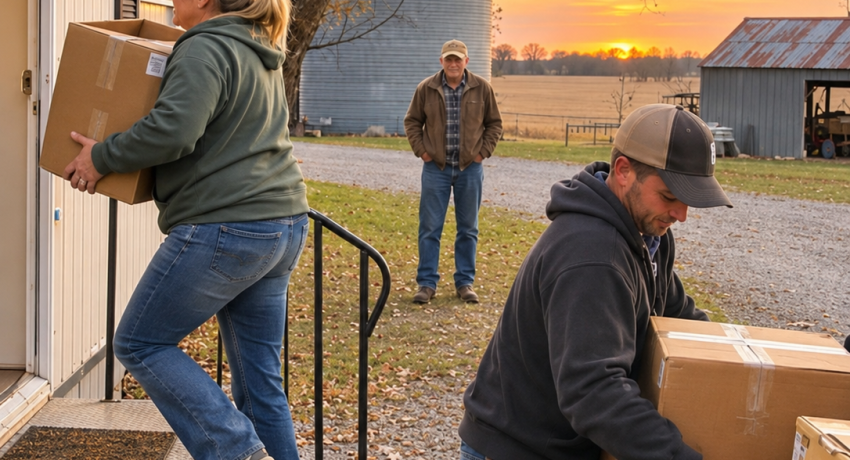
Vern remained beside the grain bin, silently watching us pack the pickup.
He made no effort to approach us.
He didn’t utter a single word.
It was Thursday evening in the final days of October. The sky above the harvested fields looked like a fading bruise, with purple slowly blending into gray. The yard light mounted on the pole beside the machine shed had just come on. It made the same humming noise it had made every evening for the past ten years.
My father-in-law stood at the foot of the large grain bin, both hands tucked inside his chore coat pockets. He was sixty-seven, a big man whose shoulders had begun to bend with age. His feed cap was pulled down over his forehead.
He watched everything we did.
Nate placed another carton in the pickup bed, deliberately keeping his back turned toward his father.
That one contained kitchen supplies. Pots and pans, including the cast-iron skillet my grandmother had given me as a wedding present. Nate carefully lowered it beside the box of towels, then pushed everything closer to the cab to keep it from shifting.
He never glanced toward the grain bin. Not even once. But I noticed his jaw tightening.
I stepped down from the trailer with another box in my arms.
We had spent ten years living in that same single-wide trailer.
A 1994 Fleetwood, measuring fourteen by seventy feet, painted beige with brown trim. Vern had arranged to have it delivered on a semi the spring we married, placing it on cinder blocks forty feet away from the machine shed. He called it temporary accommodation. Just until we got established.
The furnace was older than our marriage. During winter, condensation covered the windows before they eventually froze shut. The bathroom floor had become spongy beside the toilet, so we learned to avoid stepping on that particular spot. Whenever January winds blew from the northwest, our breath was visible in the back bedroom.
Still, we made it feel like home. I put up curtains. Nate built a small porch using leftover lumber. Every July, we set up a children’s pool outside for the dog.
But the place never truly belonged to us. It remained Vern’s trailer, sitting on Vern’s property, forty feet from Vern’s machine shed.
Our combined monthly pay was fifteen hundred dollars.
That was what the two of us received for managing twelve hundred acres of corn and soybeans in Lyon County, Minnesota. We planted, sprayed, harvested, transported crops, and repaired practically everything that broke on the farm. We checked grain bins at two in the morning during blizzards. We also looked after the forty cattle Vern kept simply because he enjoyed having them around.
Eighteen thousand dollars annually. For both of us.
We never received an increase. Not even once.
I remember the exact amount because I handle the farm’s bookkeeping.
I’ve been doing it for ten years. During the winter following our wedding, I completed a bookkeeping course at the community college in Marshall because Judy’s eyesight was deteriorating, making it difficult for her to read the figures. I assumed responsibility for the farm accounts that March and have maintained them every month since.
Every payment, every bill, every grain receipt, and every transaction with the bank in Marshall, the co-op, and the seed supplier. I’ve recorded all of it and checked every balance.
That means I know precisely how much revenue twelve hundred acres can produce during a successful season. I also know exactly how much the operation spends.
And I know exactly what Nate and I received from it. Fifteen hundred dollars each month.
Nothing was ever written into a formal agreement. We operated entirely on an informal family arrangement.
The week before our wedding, Vern and Nate shook hands in the workshop. Fifteen hundred dollars monthly, along with the trailer and electricity. Vern also promised that eventually the land would belong to Nate. According to him, everything would balance out in the end.
Eventually. Nobody ever specified a date.
Besides, taking Nate’s parents to court was never something we intended to do. We discussed it once while lying in our freezing back bedroom. Nate rejected the idea before I could finish explaining it.
“I’m never taking my dad to court, Holly,” he told me. “Not under any circumstances.”
Our only option was to stop giving away our labor for nothing.
Chapter Two: Five Hundred Dollars
In March, I approached Vern and requested an additional five hundred dollars per month.
I didn’t ask Nate to speak to him. He would have agreed, but I already knew how that conversation would end. Nate and his father avoided discussing finances. They could spend hours talking about the weather, seed varieties, diesel prices, or whether the Vikings would ever manage to win a Super Bowl. But whenever money came up, both men became silent.
So I decided to handle it myself. I managed the books. Financial matters were my responsibility.
I chose a Tuesday afternoon. Vern was inside the workshop, repairing the planter. Outside, the temperature was twelve degrees, while the woodstove in the corner kept the shop warm.
I carried him a cup of coffee and stopped beside his workbench.
“Vern,” I said. “Could I talk to you about something?”
He raised his head from the planter. “Sure.”
“Nate and I could really use some additional money,” I explained. “We need another five hundred each month. Two thousand instead of fifteen hundred.”
He placed his wrench on the bench.
“The furnace in the trailer broke down twice this winter,” I continued. “The first time was in January, and it stayed broken for three days. We had to sleep wearing our coats. Then it happened again in February. The repairman says there’s nothing more he can do. We need a completely new furnace. It’ll cost thirty-two hundred dollars.”
Vern remained silent.
“We’ve also gone ten years without a single pay increase,” I added. “Not once. Almost everything costs more now than it did back then. Food, fuel, insurance. We’re buying our own health coverage through the MNsure exchange, and that alone costs us six hundred and forty dollars every month.”
I paused to collect my thoughts.
“Five hundred more, Vern. That’s all I’m asking for.”
He stared at me for several seconds before reaching for his wrench again.
“We don’t have any money available this year, Holly,” he replied.
Then he returned to working on the planter. The conversation was over.
I remained beside the workbench for another minute. The woodstove made occasional ticking sounds, and the coffee I’d brought him continued steaming on the bench.
I knew his answer wasn’t honest.
I maintained the farm accounts. I knew exactly what the finances looked like. The previous autumn had produced our strongest harvest in five years. The corn averaged 208 bushels per acre, while the soybeans yielded fifty-eight. We’d sold a portion during harvest and stored the remaining crop. Fourteen thousand bushels of corn were sitting inside the large grain bin, waiting for prices to improve.
At $4.60 per bushel, that represented more than sixty thousand dollars.
The money was there. It simply wasn’t available for us.
I walked through the snow toward the trailer. Nate was sitting at our small kitchen table, still wearing his coveralls and eating a sandwich. He glanced up when I entered.
“Well?” he asked.
“He says there’s no money this year.”
Nate lowered his sandwich onto the table. For quite a while, he didn’t respond.
“There’s fourteen thousand bushels sitting in the big bin,” he eventually said.
“I know.”
He turned toward the window, looking at the workshop and the smoke rising from its stovepipe.
“Okay,” he said. Nothing more. Just okay.
That same night, the furnace stopped working again.
It happened at two in the morning. I woke up freezing, while Nate was already out of bed wearing his long underwear. He stood beside the furnace closet, hitting it with a flashlight in his hand. I could hear him muttering curses under his breath.
He managed to get it running again around three-thirty. When he returned to bed, he lay down with one arm covering his eyes.
“I’m going to find a way to fix this, Holly,” he whispered into the darkness. “I haven’t figured out how yet, but I will.”
Chapter Three: The Corn
In June, the fourteen thousand bushels of corn were finally removed from the grain bin.
I watched the trucks arrive. Three semis came from the elevator in Marshall. One after another, they backed up beside the large bin, and the auger continued running for two straight days. I stood at the trailer window, holding my coffee, watching the golden corn flow into the trucks in a steady stream.
That evening, I entered the grain receipts into the farm books. Fourteen thousand, two hundred bushels. Sold at $4.41 each. The total came to $62,622.
Vern had waited until the June price increase before selling. The market finally moved in his favor, and he took advantage of it.
The money went toward Tiffany’s barn wedding.
Tiffany was Nate’s younger sister. She turned twenty-eight that summer and now lived in Minneapolis. She worked as a marketing director for a business that manufactured yoga clothing. She had met her fiancé, Brandon, through a dating application. He worked in finance, doing something involving spreadsheets. He was the kind of man who wore loafers without socks.
They had decided they wanted a barn wedding on the farm. The ceremony and reception would take place inside Vern’s old red hay barn, originally constructed in 1912 by Nate’s great-grandfather.
Sixty thousand dollars.
That was the final expense. I knew the amount because I personally prepared and wrote every check.
The tent was a massive white sailcloth structure rented from a company in Sioux Falls. It had sides that could roll upward and was installed on the lawn between the farmhouse and the barn. The rental alone cost twelve thousand, four hundred dollars.
The music came from a six-member band based in Minneapolis. They performed covers of popular songs from the eighties. Their fee was eight thousand dollars, not including the hotel accommodations booked for them at the AmericInn in Marshall.
The decorative lights were another major expense. Hundreds of feet of string lights hung across the rafters. A company from Mankato brought in a lift and spent two full days installing them in the hayloft. The bill came to forty-six hundred dollars.
Then there was the catering, flowers, photography, and all the rented tables, chairs, and tablecloths. We also hired portable restroom facilities, the upgraded kind equipped with sinks and mirrors.
The barn itself required repairs before it was safe to accommodate guests. New flooring boards had to be installed in the hayloft, along with a railing on the staircase. The county building inspector visited three separate times. The total expense was nine thousand dollars.
Vern signed every check without bothering to examine it.
Every last one. In the evenings, I’d bring a manila folder into the house containing the completed checks and place it on the kitchen table in front of him. He would take his pen and sign each one. Vernon A. Haugland. Again and again.
He never bothered checking the figures. Not once. He didn’t even ask what the payments were for.
He trusted me.
And somehow, that made the whole thing hurt even more.
I’d sit opposite him at the kitchen table, watching his pen move across the checks. Twelve thousand four hundred. Eight thousand. Forty-six hundred. Nine thousand.
All the while, I’d remember the broken furnace in our trailer. The thirty-two-hundred-dollar replacement. The additional five hundred dollars we’d asked for every month.
There’s no money this year, Holly.
After signing everything, he’d slide the folder back across the table and say, “Thanks, Holly. I honestly don’t know how we’d manage without you.”
I’d respond, “You’re welcome, Vern.”
Then I’d return to the trailer through the darkness.
At the wedding, I ran into Judy near the dessert table.
It was the second Saturday of August. The weather was hot, and the air was still. The barn looked absolutely stunning. I won’t deny that. Golden lights illuminated the rafters, while round tables covered in white linens and mason jars filled with sunflowers occupied the tent. The band was performing “Don’t Stop Believin’,” and two hundred guests were dancing in the hayloft.
I was standing beside the dessert table, an antique buffet we’d rented and decorated with miniature pies and cupcakes. Tiffany hadn’t wanted a traditional wedding cake. I held a lemon bar on a napkin, although I hadn’t taken a bite.
My mother-in-law approached with a glass of white wine. Her cheeks were flushed.
“Doesn’t it look wonderful?” she asked.
“It really does, Judy.”
She turned toward the dance floor, watching Tiffany dance with Brandon. Tiffany was wearing her four-thousand-dollar wedding dress, while Brandon had his usual loafers on.
“She’ll only have one wedding,” Judy remarked.
I remained silent.
Judy turned toward me, and for a brief moment, I noticed something change in her expression.
“I heard about the furnace, Holly,” she said softly. “Vern mentioned that you’d asked him for help.”
I placed the lemon bar on the dessert table.
“And what happened?” I asked.
Judy lowered her eyes toward the wine in her glass.
“Well, it’s an awful lot of money,” she replied. “Especially this year, with everything we’ve spent on the wedding.”
She gently patted my arm before returning to the dance floor.
Later, I found Nate standing behind the barn near the old silo. It was dark, and he was alone, holding a can of beer while staring toward the cornfield.
He’d spoken to his father earlier, during the cocktail hour. They’d discussed the money and the corn.
“What did he tell you?” I asked.
Nate took a slow drink from his can.
“He said, ‘That was your mother’s money to spend,’” Nate replied.
I understood exactly what he meant.
Judy had also grown up on a farm. Her family owned a hundred and sixty acres three miles to the east. When her parents passed away, they left the property to her. It belonged to her personally, not Vern and not the farming business.
Vern and Nate worked those acres alongside the rest of the operation. However, the harvest from Judy’s quarter technically belonged to Judy. Her father had arranged things that way, and that was how they’d always been handled.
That autumn, I’d recorded the corn harvested from Judy’s property in the same large grain bin as everything else. Fourteen thousand bushels. Once it was stored, there was no visible difference between the crops.
“So the corn belonged to Judy?” I asked.
“Part of it,” Nate explained. “Not all of it. Definitely not fourteen thousand bushels. Her quarter only produced around six thousand.” He looked at me in the darkness. “But he’s right, Hol. Legally speaking, Mom’s land means Mom’s money. The remaining crop belonged to him.”
Nate didn’t challenge his father that evening.
He didn’t return to the barn to start an argument or make a scene. He said nothing to Tiffany, Brandon, or his mother. Instead, he finished his beer and tossed the empty can into a trash barrel beside the silo.
Then he reached for my hand, and together we walked back toward the trailer. We passed the barn glowing with golden lights, where the eighties music continued playing, and eventually went to bed.
He decided to wait.
Chapter Four: Harvest
Nate wasn’t going to abandon his father halfway through harvest.
That’s simply the kind of man he is. It’s how his father brought him up. You don’t abandon a responsibility before finishing it. You don’t walk away while twelve hundred acres of crops are still standing and leave someone without an operator for the combine.
So when September arrived, we began harvesting.
We worked our way through every acre.
Soybeans came first in late September. Nate operated the combine, a John Deere S670 he’d been driving for six years. Vern hauled the grain to the elevator in Marshall using the semi. I handled the grain cart.
Then came the corn in October. We kept the same assignments and followed the same exhausting routine. Our mornings began at five-thirty. By ten, once the morning dew had dried, we were combining. We continued working until midnight, sometimes one or even two in the morning, with the equipment lights illuminating the fields until the moisture levels became too high.
Judy brought meals to the fields twice daily, at noon and six. She packed sandwiches, dessert bars, and coffee inside a cooler.
I operated the grain cart alongside Nate until we finished the final eighty acres.
You need to understand exactly what that job involves. Driving a grain cart means operating a tractor with an enormous hopper attached, keeping pace with a moving combine so the harvested grain can be transferred without stopping the machine. You have to monitor the auger, the combine, the ground conditions, and your speed simultaneously. Get too close, and you risk striking the combine’s header. Fall too far behind, and grain ends up scattered across the field.
I’d been doing that work for nine harvest seasons. I knew what I was doing. Nate always told me I was the finest grain-cart operator in Lyon County.
For six weeks, I drove beside my husband every day. Load after load, I watched him through the side window of my tractor cab as he sat inside the combine, his cap turned backward and his attention fixed on the header.
We never discussed our situation. Not even once throughout the entire harvest.
Our conversations were about grain moisture, yield readings, corn prices, and whether the weather system moving in from South Dakota would bring rain. We discussed which field to harvest the following day and the bearing in the grain cart that had begun making a squealing noise.
But we avoided talking about what would happen once the season ended.
Still, I knew what was coming. Nate knew it too. I could see it in his expression each night when he returned from the fields around one in the morning and stood in our trailer kitchen, eating a cold sandwich over the sink.
Paul Engstrom stopped by the field in early October.
He owned the farm across the road, with two thousand acres under cultivation. He was sixty, a widower without children. His wife, Lynn, had died from cancer four years earlier. His hired worker had retired in August, leaving Paul to handle the entire operation himself throughout the autumn.
He drove his pickup to the edge of the field where I’d parked the grain cart, waiting for Nate to fill it. Then he lowered his window.
“Holly,” he called.
“Hello, Paul.”
“Has Nate told you what I asked him?”
I nodded.
Paul had visited us in August, shortly after the wedding. He’d found Nate alone in the workshop, pulled up an overturned bucket, and spent an hour talking with him.
He was looking for someone to hire permanently. A full-time worker who could manage the entire farm throughout the year. His back was giving him trouble, and he could no longer handle the operation by himself.
The salary was fifty-eight thousand dollars annually. He was also offering health insurance for both Nate and me, along with a house. It was Lynn’s mother’s former home, situated on Paul’s property across the road. A two-story farmhouse with four bedrooms and a newly installed furnace that Paul had replaced after Lynn died. We wouldn’t have to pay rent.
There was another opportunity as well. After five years, Nate could potentially purchase a share of the farming operation. Paul had no heirs and wanted someone reliable to eventually take over.
“He turned me down,” Paul explained. “Back in August. Said he couldn’t leave his father without help during harvest.”
“I know,” I replied.
“That’s precisely why I want him working for me,” Paul said. “That’s the kind of person I’m looking for.” He glanced toward the combine approaching us down the row. “The offer is still open, Holly. After harvest, whenever he’s prepared to make the move.”
He raised his window and drove away.
Chapter Five: The Notice
It happened on a Thursday in October.
We were harvesting the final field, the eighty acres at the northern end beside the county road. Nate completed the work at four that afternoon. The final row of corn entered the header, passed through the combine, and traveled up the auger into my grain cart in a steady stream of gold.
I drove the load over to the semi. Vern was standing there waiting with the truck. He watched as the corn emptied into it. When the cart was unloaded, he climbed into the cab and drove toward Marshall.
Nate returned the combine to the yard and parked it inside the machine shed. Then he switched off the engine.
As the machinery cooled, the engine made occasional ticking sounds. Nate remained seated inside the cab for a long time, completely motionless.
After dinner, Nate placed a piece of paper on his parents’ table and pushed it toward his father.
During harvest, we always had supper with his parents. Judy prepared meals for everyone. That evening, she’d made pot roast, just as she traditionally did on the final day of harvest. It was something we’d always done. There were mashed potatoes, green beans, and apple pie.
Once everyone had finished dessert, Nate reached into his flannel shirt pocket and pulled out a folded sheet of paper. He opened it on the table and carefully flattened it with his palm.
Then he pushed it toward Vern.
It was our written notice, prepared in my handwriting and bearing both our signatures.
I’d put it together the previous evening at the trailer’s kitchen table while the furnace made its usual ticking noises. Nate had sat beside me, helping me decide what to write.
Dad and Mom,
After ten years, we’ve decided to give our notice. We’ll finish all the remaining cleanup after harvest, and our last working day on the farm will be November 1.
We love you both. This decision isn’t about our feelings for you. It’s about being treated fairly.
Nate and Holly
“Paul Engstrom has offered us jobs,” Nate explained. “We’ve decided to accept.”
Judy immediately covered her mouth with one hand.
Vern remained perfectly still. His attention was fixed on the paper lying in front of him. He picked it up and held it farther away to read because his glasses were tucked inside his shirt pocket. He didn’t bother taking them out.
He read the notice two times.
Nobody spoke in the kitchen. The clock above the stove continued ticking, while the yard light outside produced its familiar hum.
Judy had begun crying quietly, keeping her hand pressed against her mouth.
Vern placed the paper back on the table and looked across at his son.
“My father didn’t pay me a single cent until I turned forty,” he said.
His tone was low and emotionless. There was no anger in it. He sounded as though he were simply describing the weather.
I knew the history. Everyone in the family had heard that story.
Vern’s father, Arvid Haugland, had worked the very same farmland. Vern started helping him when he was twelve years old. He received no wages, only a place to live, meals, and a little pocket money. Arvid always promised that the property would eventually belong to Vern, so everything would balance out in the end.
Vern married at twenty-four and brought Judy to a small house on the edge of the farm. His father still didn’t pay him. For sixteen years, they survived on Judy’s earnings from her job at the bank in Marshall.
Arvid finally began giving Vern a proper salary when he reached forty. That happened in the same year Arvid started experiencing heart problems.
“I understand, Dad,” Nate replied. “I know Grandpa never paid you.”
He leaned toward the table, resting both forearms on its surface.
“But I also saw what that did to you,” he continued. “I was young, but I remember you coming inside at night, sitting at this very table, and staring blankly at the wall. I watched Mom use her paycheck to cover every household bill. I watched Grandpa spend sixteen years telling you what crops to plant, when to plant them, and exactly how to do it, even after you knew more than he did.”
Vern remained silent.
“I’m not going to wait until I’m forty,” Nate said softly. “I’m already thirty-six. I have a wife who has to sleep wearing her coat when January comes. I’m not going to live that way anymore.”
Vern kept looking at his son for a long moment.
Eventually, he picked up the notice and carefully folded it down the middle. Then he folded it in half once more.
He slipped the folded paper into his shirt pocket, beside his reading glasses.
After that, he moved his chair backward and stood up. He removed his chore coat from the hook near the doorway.
Then he walked out to the workshop.
Judy and we remained seated around the kitchen table. Nobody knew what to say.
After some time, Judy used her napkin to dry her eyes. She turned toward me.
“Holly,” she began. “About the wedding. Did you…” She paused before continuing. “What was the final cost of everything?”
I wasn’t comfortable giving her the figure, but she’d asked directly.
“Sixty thousand, two hundred and forty dollars,” I answered.
Judy shut her eyes.
“I had no idea,” she whispered. “I knew it was expensive, but I never imagined it cost that much. I didn’t examine the checks.” She slowly shook her head. “Vern didn’t either.”
“I know,” I replied. “I was the one who wrote every check.”
Chapter Six: Balanced to the Penny
We took the following week to complete everything that remained.
That’s how you handle responsibilities. You don’t simply abandon a job and disappear. You leave everything in proper condition, the same way you’d hope to find it.
The combine was cleaned thoroughly, blown out, and greased.
Nate devoted two entire days to servicing the S670. Using the air compressor, he cleared every section of the machine, including all the corners filled with chaff, along with the screens and sieves. He lubricated every grease fitting, replaced the oil, and installed new belts wherever the old ones showed signs of wear. Every part he used was recorded on a notepad, which he left on the driver’s seat.
He repeated the entire process with the grain cart, planter, sprayer, and semi.
Every grain bin was leveled.
Nate climbed into each bin on the property and used a shovel to distribute the corn evenly so it could dry properly. He inspected the ventilation fans, aeration equipment, and temperature cables. He recorded every reading.
A decade of financial records was balanced down to the last penny and prepared for Vern.
That responsibility belonged to me. For four days, I sat at the kitchen table in our trailer surrounded by every ledger, bank statement, and grain receipt from the previous ten years. I reviewed each month and reconciled every account. I prepared a detailed inventory of all suppliers, invoices, account numbers, and payment deadlines. I also documented instructions explaining every task I’d handled.
How to pay the property taxes. How to manage the crop insurance. Which seed supplier offered an early-payment discount. How to understand the grain contracts. Where to locate the online banking passwords. Even the phone number of the co-op employee who could usually arrange a better fuel price if you specifically asked for him.
I organized everything inside a three-ring binder, two inches thick, with clearly marked dividers.
Across the front cover, I wrote:
FARM BOOKS. FOR VERN.
Paul decided to speak with Vern directly, face-to-face, man to man.
It was his suggestion, not ours. He didn’t want Vern finding out through someone else, and he certainly didn’t want him thinking he’d secretly gone behind his back.
Paul arrived one Saturday morning and found Vern working in the shop. The two men stood beside the woodstove for about twenty minutes. I watched them from the trailer window, but I couldn’t hear their conversation.
When they finished, Vern extended his hand.
Paul shook it.
Then he crossed the road and returned to his own property.
After that came the final pickup load at dusk.
It was the last Thursday of October, exactly one week after we’d submitted our notice. Everything had been taken care of. The combine was cleaned, the grain bins were leveled, and the binder was sitting on Vern’s kitchen table.
We’d started loading the pickup around three o’clock. Three previous trips had already taken most of our belongings across the road. Paul’s house was spacious, with four bedrooms. We didn’t own enough furniture to properly fill even one of them.
Only a few things remained. Boxes from the kitchen, our towels, Nate’s toolbox, and the cast-iron skillet my grandmother had given me.
That’s when Vern appeared outside and stopped beside the grain bin.
Just as I described earlier. His hands were buried in the pockets of his chore coat, his feed cap pulled down over his forehead. He stood there watching.
He made no effort to approach us. He said nothing.
Nate placed the final box in the pickup bed and lowered the tailgate halfway. He paused, resting one hand against it.
“Would you like to go over and talk to him?” I asked.
He didn’t turn toward the grain bin. His eyes remained on the tailgate.
“Not tonight,” Nate replied. “I’d rather get the truck unloaded.”
I understood what he was saying. If he walked over to his father and looked him in the face, there was a good chance he’d change his mind. He’d start taking every box out of the pickup and carrying it back into the trailer. We’d end up sleeping in our coats again when January arrived, and the whole situation would repeat itself.
He pulled the tailgate shut.
We climbed into the pickup. Nate started the engine, backed away from the trailer, and drove out of the yard. We passed the machine shed and then the barn, where the wedding lights still hung from the rafters, although they were dark now.
We drove past the grain bin where Vern remained standing.
Nate kept his eyes ahead. I turned around and looked.
Under the yard light, Vern’s face appeared pale and gray. He watched us drive away without moving or raising a hand.
That first night, we slept across the road.
Paul had already switched on the furnace.
It was the first thing I noticed when we entered the farmhouse through the back door. The place felt warm. Not merely comfortable, but heated throughout. Every room was cozy. Even the floors felt warm, and the windows were completely clear.
A handwritten message from Paul was waiting on the kitchen table, written on the back of an envelope.
Furnace is set at 70. Turn it higher if you need to. There’s milk and eggs in the refrigerator. Welcome home. Paul.
I remained standing in the kitchen for quite some time.
Eventually, I went upstairs to the bedroom Paul had told us would be ours. It was a spacious room at the front of the farmhouse, with two windows overlooking the road. Through them, I could see Vern and Judy’s property across the road. The yard light, the grain bins, and the dark outline of the trailer sitting forty feet from the machine shed.
The kitchen light was still glowing inside Vern and Judy’s house.
Nate came up behind me and wrapped his arms around my waist.
“Are you all right?” he asked.
“I’m warm,” I answered.
That was all I could manage. For the first time in ten years, I was going to bed in October without feeling cold.
Chapter Seven: Across the Road
By six the following morning, Nate’s pickup was already sitting in Paul’s yard.
He’d gotten up at five, just as he always did. Old habits were difficult to break. He prepared coffee in Paul’s kitchen using Lynn’s old percolator. Then he stood beside the window, drinking it while looking across the road.
At five-forty-five, he headed outside toward Paul’s workshop. Paul was already there. They stood near the woodstove discussing the day’s responsibilities. Fall tillage, transporting a load of corn to Marshall, and a damaged hydraulic hose on Paul’s chisel plow.
I stayed inside the kitchen, opening boxes and putting things away.
At fifteen minutes before seven, I noticed Vern walking across the road.
I was standing at the kitchen window, placing my cast-iron skillet on the stove when I glanced outside and spotted him. He was coming down his own driveway, dressed in his chore coat and feed cap. He crossed the gravel county road and continued up Paul’s driveway.
He was walking. He hadn’t driven his pickup.
I put the skillet down. My heart began beating faster.
Nate stepped out of the workshop and straightened his posture.
He had noticed his father approaching too. He stood in the open doorway of Paul’s shop, holding a cup of coffee. He placed it on a fence post, then let his arms fall naturally beside him.
He waited.
I walked out onto the back porch but didn’t go any farther.
Vern slowly made his way up the driveway. His knees had been troubling him for years. He passed the corncrib and the old chicken coop before crossing the yard toward the workshop.
Straight toward Nate.
But Vern walked directly past his son.
He didn’t pause. He didn’t even glance in Nate’s direction. He continued past him, as though Nate wasn’t standing in the workshop doorway at all.
The color drained from Nate’s face.
Vern stopped in front of Paul.
Paul had followed Nate outside and was standing beside the tailgate of his pickup, which was parked next to the workshop. He held his coffee in one hand.
Vern stopped approximately four feet away from him.
Paul placed his cup on the tailgate.
Vern removed his feed cap and held it with both hands.
He positioned it in front of his waist, just above his belt buckle. It was the same way men around here held their caps during funerals or while attending church.
“Paul,” he began. “How much are you paying my son?”
Nobody moved.
Paul studied Vern for several seconds. Then he glanced toward Nate, who remained standing in the workshop doorway, before looking back at Vern.
He didn’t hesitate or try to make the offer sound less generous.
“Fifty-eight thousand dollars a year,” Paul answered. “Health insurance for both of them, too. And the house, without any rent. I’ll cover the heating and electricity as well.”
Vern remained silent.
“And after five years,” Paul continued, “assuming everything works out, I’ll sell him half the operation under a contract at a reasonable price. I don’t have any children, Vern. I’ve watched that young man work the fields across the road for ten years. He’s the finest young farmer in this county.”
Vern stood in the middle of Paul’s yard, still holding his cap.
For a considerable time, he said nothing.
Fifty-eight thousand dollars. Health coverage. A house. I watched him compare those figures with the eighteen thousand dollars he paid us annually and the aging single-wide trailer with its broken furnace.
“Fifty-eight,” Vern finally repeated.
“That’s right,” Paul answered. “Fifty-eight to begin with.”
Chapter Eight: Pay Him More
I expected Vern to start arguing.
I thought he’d bring up family obligations. He might mention that the farmland would eventually belong to Nate or accuse Paul of trying to take his son away. Perhaps he’d repeat that everything would balance out in the end.
I was prepared for that kind of response. I stood on the back porch, gripping the railing tightly with both hands.
Vern lowered his eyes toward the cap he was holding.
Then he raised his head and looked directly at Paul.
“That’s not enough,” he said.
Paul looked surprised.
“You should offer him more than that,” Vern continued. “He’s worth more.”
Nobody responded.
Nate was still standing in the workshop doorway, staring at his father with his mouth slightly open.
“He deserves more than that,” Vern repeated, his voice low. He was speaking directly to Paul. “He knows every field on my farm just by looking at it. He can operate a combine in complete darkness. There’s hardly anything with an engine he can’t repair. In ten years, he’s never missed a morning.” His voice began to break. “Pay him more, Paul. Because I never did.”
Vern placed his feed cap back on his head.
Then he turned around and looked at his son for the first time.
Nate stood only four feet away, directly inside the doorway of Paul’s workshop, his arms hanging at his sides.
The two men stared at each other for several moments.
“I’m sorry, Nate,” Vern said.
Nothing else. Just three simple words. I’d never heard him say those words before, not to anyone.
Afterward, Vern turned away and began walking back across the road. He moved slowly, on foot, struggling with his bad knees.
He never turned around.
Nate remained in the workshop doorway, watching until his father disappeared down Paul’s driveway, crossed the gravel county road, and climbed his own driveway. He continued watching as Vern passed the grain bins and entered his workshop.
Only then did Nate turn around. He walked back inside Paul’s shop and stopped beside the woodstove, standing with his back toward the doorway.
Paul walked over to the back porch.
He stopped at the foot of the steps and looked up at me.
“Holly,” he said, “do you understand what it cost him to come over here? On foot?”
“I do,” I replied.
“That man is proud,” Paul said. “The proudest man I’ve ever known. Only Arvid Haugland was prouder.” He shook his head. “I’ve known Vern for sixty years, and I’ve never heard him apologize. Not once.”
“Neither have I,” I said.
Paul glanced across the road toward Vern’s shop, where smoke was rising from the stovepipe.
“I’m going to pay Nate sixty-two,” he said. “Starting today. Don’t tell him I told you.”
Nate came in for lunch at noon. He took a seat at Paul’s kitchen table but didn’t touch his food. He simply sat with both hands wrapped around a cup of coffee.
“He’s never said anything like that,” he finally said. “Not in thirty-six years. Not once.”
“I know,” I said.
“He told him to pay me more.” Nate’s voice cracked. “He said it was because he never had.”
He lowered his head into his hands.
I walked around the table, stood behind him, and wrapped my arms around his shoulders. I held him close.
Chapter Nine: Judy
Judy came to visit me in December.
She drove her Buick across the road and knocked on Paul’s back door as though she were a stranger. Standing on the porch in her winter coat, she held a pan of bars covered with aluminum foil.
“May I come in?” she asked.
I opened the door and let her inside. She took a seat at the kitchen table while I made coffee.
“Vern isn’t doing very well,” she said.
“Is something wrong with him?”
“Not physically.” She looked down into her coffee. “He’s just lost. He spends the entire day in the shop without doing anything. He sits beside the woodstove. He has twelve hundred acres that need planting in four months, no one to help him, and his back won’t let him operate a combine by himself.”
She raised her eyes to me.
“He reads your binder,” she said. “Every evening at the kitchen table, wearing his reading glasses. He goes through it page by page. In forty-four years of marriage, I’ve never seen him read anything that long.”
“Judy,” I asked, “why did he tell me there was no money in March, when I asked for five hundred dollars?”
She remained silent for quite a while.
“Because he was afraid,” she finally answered. “He’s always been frightened about money. It goes back to his father. Arvid never gave him a penny, and when he died, he left no will. Vern had to buy out his three sisters. It cost him two hundred and forty thousand dollars. He spent twenty years paying that debt off.” She shook her head. “He finally made the last payment in February. Just one month before you asked him.”
I stared at her.
“So he did have money,” I said.
“For the first time in twenty years,” Judy replied. “But he didn’t know how to handle it. He was still afraid. Saying no to you had become a habit. Then Tiffany called about the wedding.”
She covered her mouth with one hand.
“Holly, that was my fault,” she said. “Not Vern’s. Mine. Tiffany called and said she wanted a barn wedding, and I agreed before she had even finished asking. I told Vern my quarter would cover the cost, and he said all right.” She shook her head. “Neither of us ever checked the numbers on the checks. I had no idea it came to sixty thousand dollars. I swear. I thought it would be around twenty thousand.”
“Your quarter produced only about six thousand bushels,” I said. “That comes to twenty-six thousand dollars. The rest was paid from the operation.”
“I know. I saw it in your binder.” Judy’s eyes began to fill with tears. “Page forty-one. You listed everything. Every check, along with its date and amount. Beside the furnace repair in January, you wrote, ‘Requested raise denied. March fourteenth.’”
She reached inside her coat pocket, pulled out an envelope, and placed it on the table.
“Tiffany sent this,” she said. “Last week. She sent it to Vern and me.”
I opened the envelope.
Inside was a check from Tiffany and Brandon Kessler, made payable to Nate and Holly Haugland.
Twenty thousand dollars.
A note was folded alongside it. The handwriting was Tiffany’s.
Holly and Nate. Mom told me about the furnace, the trailer, and the raise. I had no idea. I swear I didn’t know. I’m so sorry. This money is from our wedding gifts. I know it isn’t enough, but please accept it. I want my brother to have a warm home. Tiff.
I sat there holding the check, unable to say a word.
“She spent an hour crying on the phone,” Judy said. “She told me she would never have had the wedding if she’d known what was happening. She said she would have gotten married at the courthouse instead.”
I placed the check on the table.
“Judy,” I said, “I can’t accept this.”
“You can, Holly,” Judy replied. “And you will. That’s my daughter trying to make things right, and I won’t let you refuse her.”
Chapter Ten: The Lawyer in Marshall
In January, Vern phoned Nate.
He hated using the phone. He always held it about two inches from his ear and shouted into it.
“I want you and Holly to come to Marshall,” he said. “Tuesday. Ten in the morning. Megan Kittelson’s office, beside the Hy-Vee.”
“Dad, what is this about?”
“Just get here,” Vern replied before hanging up.
Megan Kittelson was an attorney who handled farm estates, land contracts, and succession planning. She was around forty, with dark hair tied back in a ponytail and glasses. She had grown up on a farm outside Tracy.
Vern and Judy were already waiting when we arrived. They sat in two chairs beside her desk. Vern held his feed cap on his knee.
Megan brought out two additional chairs for us.
“Thank you for coming,” she said. “Your father asked me to explain a few documents to you.”
The first document was a lease.
A proper written agreement, seven pages long. It was a crop-share lease covering the twelve hundred acres. Beginning the following year, Nate would lease the land from Vern and Judy. He would no longer be working for them. Instead, he would rent the property and operate the farm independently. The crop would be divided equally between them.
“This is based on the standard lease provided by the University of Minnesota Extension,” Megan explained. “I’ve made a few changes to suit your situation. Your father will cover half the cost of the seed, fertilizer, and chemicals. Nate will pay the other half and provide all the labor and machinery.” She turned toward Nate. “For a twelve-hundred-acre operation in this county, assuming average yields, your share should bring in somewhere between one hundred and forty thousand and one hundred and eighty thousand dollars in gross income, before expenses.”
Nate was too stunned to speak.
The second document was a machinery purchase agreement.
It covered all the equipment: the combine, planter, sprayer, grain cart, tractors, and everything else.
“Your father is selling you the entire equipment line,” Megan explained. “The price is based on its appraised value. You’ll have seven years to pay it off, with four percent interest. Your payments won’t begin until after the next harvest.”
“Dad,” Nate said, “there’s no way I can afford…”
“You can,” Vern interrupted. “I’ve worked out the figures. I used Holly’s binder. Page sixty-two.” A faint smile crossed his face. “She’s got it all written down.”
The third document was a deed.
It covered the home place: the house, the yard, the barn, the machine shed, the grain bins, and the forty acres surrounding them.
It was being transferred to Nate and Holly Haugland.
“This is a gift,” Megan explained. “Your parents are transferring the entire farmstead to you. They’ll submit a gift tax return, but nothing will be owed because the value falls within their lifetime exemption.”
“Where are you two going to live?” I asked Judy.
“In town,” Judy replied. “There’s a two-bedroom house on Lyon Street in Marshall, near the hospital. It’s all on one level, without any stairs.” She smiled, tears in her eyes. “Vern’s knees can’t handle stairs anymore, and I’m ready to stop driving twenty minutes just to get to church.”
Nate sat looking at the three papers spread out before him: a lease, a contract, and a deed.
He didn’t reach for any of them.
“Dad,” he said, “I promised Paul I’d work for him for a year. I can’t leave him halfway through.”
Vern gave a slow nod.
“I understand. I wouldn’t expect you to.” He turned toward Megan. “That’s why the lease doesn’t begin until next November, after Paul finishes harvesting.”
“But who’s going to plant your fields this spring?” Nate asked. “Who’ll take care of the operation?”
Vern lowered his eyes to his hands.
“Paul called me last week,” he said. “He told me he has two thousand acres and could use some help. He offered to handle my twelve hundred alongside his own for this one year. You’d work for him as his hired man, and I’d pay him the going custom rates.”
He shook his head.
“For sixty years, we’ve farmed on opposite sides of the road,” he said. “And in all that time, I never once asked that man to help me.”
Nate sat silently for several minutes.
Then he reached for the pen on Megan’s desk and signed the lease. Next, he signed the contract. After that, he passed the pen to me.
I signed the deed.
Holly Haugland. My name, written on my own property deed. It was the first time in my life I had ever done that.
Outside, in the snowy parking lot, Vern paused beside his pickup.
He reached into his shirt pocket and pulled out a piece of paper folded several times.
It was our notice from October, written in my handwriting.
He held it out toward Nate.
“I’ve carried this in my pocket every single day,” he said. “Right here in my shirt, ever since October.”
“Dad…”
“I read it every morning,” Vern continued. “This isn’t about love. It’s about fairness.” He shook his head. “I’d never looked at things that way before. Not once in my entire life. My father never saw it that way, either.” He swallowed hard. “You were right, son. Both you and Holly were right.”
He placed the notice in Nate’s hand.
“Hold on to it,” he said. “Maybe someday you can show it to your children, if you have any.”
Chapter Eleven: The Trailer
In April, the single-wide trailer was finally taken away.
A semi-truck from a mobile home company in Worthington arrived. The crew lifted it off its cinder blocks and secured it onto a flatbed trailer. The driver told us it was headed to a hunting camp near Bemidji. Someone there would probably take it apart and salvage the pieces.
Nate and I stood in the yard, watching as it disappeared. It traveled down the driveway, turned onto the county road, and headed north toward Marshall.
Ten years.
Just forty feet from the shed.
Where it had stood, there was now a rectangular patch of dead grass, the old cinder blocks, and the small deck Nate had built for me from leftover lumber.
“Do you want me to pull the deck out, too?” Nate asked.
I studied it. The boards were gray and worn, and the whole thing leaned a little to one side.
“No,” I told him. “Let it stay.”
“What for?”
“I haven’t decided yet,” I said. “Maybe something.”
That spring, we planted both farms for Paul. A total of thirty-two hundred acres. Nate operated Paul’s large sixteen-row planter, while Paul used Vern’s twelve-row machine. I drove the tractor pulling the tender truck, making sure both planters stayed supplied with seed and fuel.
Vern showed up at the fields every day in his pickup. He would park at the end of a row, roll down his window, and watch them work. Sometimes he brought sandwiches. Other times, he simply sat there.
One day in May, Nate drove the planter to the end of the field where Vern was parked. He brought it to a stop and opened the cab door.
“Dad,” he called. “Would you like to do a round?”
Vern looked up at him. “My back won’t let me.”
“It has an air-ride seat,” Nate said. “It’s the smoothest ride in the whole county. Come on.”
Vern climbed out of his pickup and walked over to the planter. Nate got down from the cab and helped his father climb the steps.
Vern settled into the seat and placed his hands on the steering wheel.
He drove one round, going all the way to the far end of the field and then returning. Half a mile in each direction. His rows were perfectly straight.
When he reached the end, he shut off the machine and remained seated for a long while, his hands still resting on the wheel.
“That’s the first time,” he said, “anyone has ever asked me if I wanted to do that.”
Paul paid Nate the promised sixty-two thousand dollars that year.
When November came and the year was over, Nate tried to return part of the money. Paul refused to accept it.
“You worked for every penny of that,” Paul said. “Besides, I’ll need you again next year. You can help with my two thousand acres on a custom basis while you take care of your dad’s twelve hundred.”
“I can’t manage both operations, Paul.”
“Of course you can,” Paul replied. “You’ll hire someone. Just make sure you pay him fairly.” He grinned. “I happen to know a fellow who’s pretty good at explaining what fair means.”
Chapter Twelve: The First Check
It’s November again, two years after that last load.
The corn is harvested. The beans are harvested, too. The Haugland operation has finished harvesting twelve hundred acres of our own land and two thousand acres belonging to Engstrom.
Our operation. Nate’s and mine.
We have a hired hand now. His name is Tyler, a twenty-four-year-old from Tracy who recently got married. We pay him forty-six thousand dollars a year, along with insurance. We also installed a new furnace in the old foreman’s house on Paul’s property, where Tyler and his wife now live.
He’s never had to sleep wearing his coat.
I still handle the books. I do it in the old house now, sitting at the big oak table in what used to be Judy’s kitchen and is now mine. Judy left the table behind because she said it was too large for her two-bedroom house on Lyon Street.
The binder still sits on the shelf. FARM BOOKS. FOR VERN. When Vern and Judy moved into town, he brought it back and told me I would have more use for it than he would.
Last week, I prepared the first lease payment for Vern and Judy.
It was their share of the crop, sold at the elevator in Marshall. The total came to fifty-two thousand, three hundred and eighteen dollars.
I wrote the check at the oak table and slipped it into a manila folder. Then I drove into town and headed up Lyon Street to their little house near the hospital.
Vern was sitting in his recliner. Judy was in the kitchen, preparing coffee.
I placed the folder on the coffee table in front of Vern.
“Here’s your lease payment,” I said. “For this year.”
He opened the folder and pulled out the check.
Then he reached into his shirt pocket, took out his reading glasses, and put them on.
He studied the check.
He read every detail: the date, the amount, the amount written in words, the memo, and the signature. He went through it twice. Then he held it up toward the lamp to get a better look.
Nearly a full minute passed before he finished.
Once he was done, he removed his glasses, folded them, and slipped them back into his shirt pocket.
Then he looked at me.
“Ten years,” he said. “I signed every check you ever handed me, and never once bothered to read one.”
“I know, Vern.”
“I told myself I trusted you,” he said. “I trusted Holly.”
His eyes dropped to the check he was holding.
“But that wasn’t trust,” he said. “I just didn’t want to know what was going on.”
He placed the check on the coffee table with great care.
Then he opened the drawer of the small table beside his recliner. Inside, he found a checkbook. It was the old farm checkbook, the one I had once kept.
He opened it and picked up a pen.
Taking his time, he wrote out a check in his large, uneven farmer’s handwriting, carefully reading each line as he filled it in.
When he finished, he tore it from the book and held it out to me.
I accepted it.
Pay to the order of: Holly Haugland.
Amount: Five thousand, five hundred dollars.
Memo: Furnace. Plus five hundred monthly. March through October. Including interest.
“Vern,” I began, “you really don’t have to…”
“I do,” he interrupted. “On March fourteenth, you came into my shop and asked me for five hundred dollars. You even brought me coffee.” He looked straight at me. “And I told you there wasn’t any money that year.”
“That happened a long time ago.”
“Page forty-one,” Vern replied. “Your binder says it all. Requested raise denied. March fourteenth.” He shook his head. “For an entire year, Holly, I read that page every night. Every single night.”
Judy came out of the kitchen carrying three cups of coffee. She placed them on the coffee table, then noticed the check in my hand.
She said nothing. Instead, she sat on the arm of Vern’s recliner and rested her hand on his shoulder.
I remained on their couch, holding the check.
After a moment, I folded it in half and slipped it into my coat pocket.
“Thank you, Vern,” I said.
“You don’t need to thank me,” he replied. “It’s only fair.”
When I arrived home that evening, Nate was standing outside beside the grain bin. The big one. The same spot where his father had stood two years earlier, watching us load the pickup.
The yard light was switched on, making its familiar humming sound.
I parked the pickup and walked over to Nate. I stood beside him, and together we gazed across the yard.
We looked toward the barn, where the lights from the wedding were still hanging in the rafters. No one had ever taken them down. Some evenings, we switched them on just to watch them shine.
Then there was the machine shed, where the S670 stood clean and freshly greased.
And finally, the small, crooked deck, forty feet from the shed. It stood alone on the patch of new grass where the single-wide trailer had once been.
I had decided what to do with that little deck the previous spring. I added a bench and two flower boxes. Nate also made a sign in the shop, using a wood-burning tool to carve the words into a board.
It read:
HIRED MAN’S PORCH. EVERYBODY GETS PAID.
“Dad stopped by today,” Nate said. “While you were in town.”
“He did?”
“He sat out on the deck,” Nate said. “On your bench. He stayed there for about an hour, just watching the grain bin.”
I remained silent and reached for his hand.
“He said something before he went home,” Nate continued.
“What did he say?”
Nate gazed toward the grain bin and the yard light buzzing above it.
“He said his father would never have sat on that porch. And ten years ago, he wouldn’t have sat there either.” He swallowed. “Then he said, ‘I’m glad someone built it.’”
We stayed outside together for a long while, standing in the cold as the yard light hummed and the stars slowly appeared above the harvested fields.
Eventually, we went inside.
The furnace was running, and the warmth had reached every corner of the house. Every room was comfortable. Every floor was warm.
I took off my coat and hung it on the hook beside the door. The check was still tucked inside its pocket.
I left it there. There was no need to cash it just yet.
For now, it was enough simply knowing it was there.









