
 143 views
My parents cut me out of their lives because I married a man they believed wasn’t good enough for our family.
But on our wedding night, in a rundown roadside motel, my husband sat beside me and quietly revealed something that turned my world upside down.
“Genevieve, there’s something I should have told you before we got married.”
My husband, Owen Hale, and I had been a couple since our high school days.
We first met in chemistry class when we were both seventeen.
I was born into the wealthy Beaumont family of Ridgefield, Connecticut.
Owen, on the other hand, was raised in a humble neighborhood called Pine Creek by his single mother, who held down two jobs just to make sure they had enough to eat.
He didn’t have the money for fancy dinners or extravagant presents.
Instead, he would bring me wildflowers he’d gathered on his way to school.
Each morning, he’d wait near my locker with a little bunch of flowers and that unmistakable crooked grin.
I fell for him because my family’s wealth meant nothing to him.
The other boys either felt intimidated by my father’s power or hoped to benefit from his money.
Owen only wanted to be with me.
When he started working as a mechanic, my parents made no effort to hide their disapproval.
My father, Richard Beaumont, was convinced his daughter should marry someone with money, prestige, and influential connections.
When Owen asked me to marry him, my father presented me with an ultimatum.
“If you marry him, you’ll lose everything. Your inheritance, your trust fund, and your place in this family.”
I chose Owen.
My parents wasted no time cutting me out of their lives.
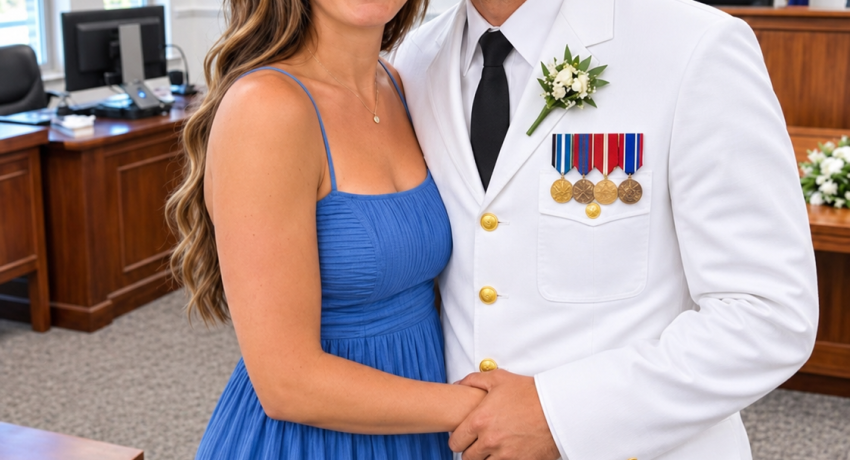
We got married at the courthouse, with our two friends, Clara and Jasper, serving as witnesses.
There was no lavish wedding reception.
No expensive designer gown.
No family gathering to celebrate.
Afterward, we picked up some takeout and checked into a modest motel near the interstate.
The peeling wallpaper and loud air conditioner didn’t bother me.
I had married the man I loved.
But as the evening went on, Owen grew strangely silent.
He sat on the bed with a leather folder in his hands.
“Genevieve,” he began, “I’ve inherited a considerable amount of money.”
I gave a nervous laugh.
He opened the folder and showed me the paperwork.
The figure was almost too enormous to believe.
Hundreds of millions of dollars.
Owen told me that his grandfather was Arthur Blackwood, a billionaire businessman.
Arthur had recently passed away and had named Owen as his primary heir.
I looked at my husband in disbelief.
The mechanic who drove an old pickup truck.
The man who had carefully put money aside for our apartment.
The boy who couldn’t afford to buy roses.
He had suddenly become wealthier than my entire family.
Before I could ask him anything else, someone rapped on the motel door.
Then I heard a voice I never expected to hear again.
“Genevieve. Open the door.”
It was my father.
When I opened it, Richard Beaumont was standing outside in an expensive charcoal-gray suit.
My mother, Evelyn, stood next to him, wearing diamonds and a cream-colored coat.
Neither of them looked at me.
Their eyes went straight to Owen.
Then they noticed the inheritance papers lying on the bed.
“So it’s true,” my father remarked.
I crossed my arms.
“What are you doing here?”
“We have something important to discuss.”
“You couldn’t even be bothered to attend my wedding.”
My father acted as though he hadn’t heard me.
He placed a financial proposal on the table.
“Our company is in trouble.”
I stared at him.
Beaumont Holdings was among the most respected business empires in the region.
Our family had interests in hotels, commercial real estate, investment funds, and development firms.
Growing up, I had always believed our fortune was untouchable.
But now my father confessed that several investments had gone badly.
The company had taken out enormous loans secured against its assets.
Its total liabilities had climbed beyond $300 million.
And one of its major lenders could activate default clauses in just twelve days.
Owen studied the paperwork.
“You’re looking for an emergency loan of $80 million,” he said.
My father paused.
“There’s a chance we’d need another forty million after that.”
I was stunned.
Only the day before, my parents had rejected Owen as a suitable husband because he had no money.
Now they expected him to save their business.
I turned to my father.
“So now that he’s rich, he’s suddenly good enough for us?”
“This is a business matter, Genevieve.”
“To you, everything is about business.”
My father pointed out that thousands of employees might lose their livelihoods if the company went under.
That made things less straightforward.
Owen didn’t want innocent workers to pay the price for my father’s arrogance.
However, he wasn’t willing to sign anything without careful consideration.
“I’ll need some time to review the financial records.”
My father objected.
Owen simply opened the motel door and made it clear the discussion was finished.
Just before leaving, my father looked back at him.
“Arthur Blackwood was a complicated man,” he said.
Then he added:
“You should ask yourself why he chose to wait until now.”
After the door shut, I turned to my husband.
“What was he talking about?”
Owen dropped his gaze.
And I understood that his secret went much deeper than I had imagined.
Owen eventually explained the whole story.
His mother, Margaret Hale, had once been part of the wealthy Blackwood family.
But when she fell in love with a construction worker, Arthur Blackwood demanded that she end the relationship.
She refused to obey him.
In response, Arthur disowned her.
It was almost the same thing my father had done to me.
Margaret brought up Owen without relying on her family’s wealth.
For years, Arthur made attempts to rebuild his relationship with his grandson.
Owen ignored his letters and refused his phone calls.
Then, one afternoon, Arthur showed up at Owen’s garage driving a 1967 Mustang that was barely running.
He didn’t tell Owen who he was.
Instead, he simply asked him to fix the car.
Owen and Arthur spent two hours talking while Owen changed a defective fuel pump.
Once the repair was complete, Arthur finally disclosed who he really was.
Owen attempted to give the payment back.
Arthur chuckled.
“Good. At least there’s someone in this family who can’t be purchased.”
He then confessed that he was seriously ill.
All he wanted was to share a single dinner with his grandson.
Owen eventually accepted his invitation.
That one dinner turned into several more.
Little by little, the two of them built a relationship.
However, Margaret never made peace with her father.
Three months before he passed away, Arthur told Owen that he planned to leave him his entire fortune.
Owen declined.
“He told me that my refusal to accept the money was exactly why he trusted me to inherit it,” Owen explained.
I could understand his reasoning.
Still, I felt hurt.
“You should have been honest with me.”
“I was scared that money would come between us and change everything.”
“You allowed me to think we couldn’t even pay for a decent wedding.”
“I know. I shouldn’t have done that.”
Owen then showed me a sealed envelope Arthur had left for us.
Five words were written across its front:
FOR OWEN AND GENEVIEVE TOGETHER.
Arthur had given him specific instructions not to break the seal unless I married Owen even after losing my family’s financial support.
Together, we opened it.
Inside, the letter explained that Arthur and my grandfather, Charles Beaumont, had once been business associates.
Arthur claimed that Charles had secretly seized assets that belonged to the Blackwood family.
Then we came across an unusual instruction.
If Richard Beaumont ever came asking for financial help, we were supposed to examine what was hidden beneath the eastern greenhouse at Blackwood Manor.
I turned to Owen.
Our honeymoon was suddenly taking a direction neither of us could have predicted.
At two in the morning, we checked out of the motel and headed for Blackwood Manor.
The sprawling estate was surrounded by dense woodland and tall iron fences.
Three greenhouses stood behind the mansion.
The one on the eastern side had been deserted for years.
Its glass was broken, the metal framework was covered in rust, and dead vines had spread across its walls.
We searched the area using flashlights.
Eventually, I spotted a section of stone flooring that looked unusually clean.
An iron ring was hidden beneath an old potting table.
Owen grabbed it and pulled.
A concealed trapdoor swung open.
A flight of stone steps led down into the darkness.
At the bottom, we found a storage room packed with boxes.
Inside were agreements, financial records, letters, and photographs.
One particular document immediately caught my eye.
It was an original business partnership agreement.
The contract stated that Arthur Blackwood had owned sixty percent of the company that later became Beaumont Holdings.
Yet our family’s official account claimed that Charles Beaumont had established the business entirely on his own.
Then I came across a letter written by my grandfather.
In it, he admitted that he had betrayed his friend’s trust and taken control of property and assets that were never his to claim.
I lowered myself onto a wooden crate.
The fortune my father had always used to measure Owen’s worth might have been built, at least in part, on deception.
Before we could investigate further, my mother called.
She knew our location.
She also knew about Arthur’s letter.
“Your grandfather made a recording before he died,” she whispered. “Richard hid it.”
“What does the recording contain?”
She began to cry.
“Arthur wasn’t trying to ruin our family. He wanted to give back what rightfully belonged to someone else.”
Then the call suddenly ended.
A few minutes later, a black SUV pulled up beside the greenhouse.
Daniel Cross, the chief financial officer of Beaumont Holdings, climbed out with two other men.
“Hand over Arthur’s files,” he demanded.
Owen stepped in front of me.
But Daniel quickly clarified that the men with him were forensic accountants.
He hadn’t come to destroy the evidence.
He wanted to protect it.
And the truth behind his visit was even more alarming than we had expected.
Daniel explained that the financial troubles at Beaumont Holdings weren’t simply the result of failed investments.
For years, millions of dollars had been transferred through questionable consulting deals and shell companies.
The individual behind the scheme appeared to be my uncle, Stephen Beaumont.
My father’s younger brother.
Stephen had learned about the original Blackwood fraud when he was still young.
For years, he had used that information to intimidate Richard and force him to cover up suspicious financial dealings.
Daniel had secretly reached out to Arthur because he was afraid the company was being deliberately brought down.
Before he could tell us anything more, a message appeared on my phone.
COME ALONE.
It seemed to have come from my mother.
Daniel examined the message and warned me that her account appeared to have been hacked.
Another message arrived moments later.
BRING THE BLACKWOOD RECORDS IF YOU WANT YOUR MOTHER SAFE.
Then Stephen phoned me.
He insisted that my mother was safe, but threatened to expose the company’s financial secrets unless I handed over the documents.
He also reminded me that thousands of employees might lose their jobs.
I agreed to meet him.
But Owen and Daniel wouldn’t allow me to go by myself.
At the same time, the forensic accountants started making secure digital copies of all the records.
An hour later, we arrived at my parents’ estate.
Stephen was waiting in the library.
My father stood near the fireplace.
My mother was sitting on the sofa, looking visibly shaken but unharmed.
I rushed over to her.
Then I faced my father.
“Where is Grandfather’s recording?”
For the first time I could remember, Richard Beaumont appeared completely broken.
He took a small drive from his desk drawer.
We plugged it into the television.
My grandfather’s face appeared on the screen.
He looked old and frail, clearly nearing the end of his life.
He began by admitting that Arthur Blackwood had once been his closest friend.
Together, they had established the original company.
But Charles had eventually allowed greed to take control of him.
He had altered ownership papers and moved assets around until Arthur’s share of the business had almost vanished.
Arthur had every opportunity to challenge him.
Instead, he chose to walk away because he didn’t want to destroy the company or threaten the livelihoods of the people who depended on it.
Charles confessed that he had lived the rest of his life carrying the shame of what he’d done.
Then he revealed something that left everyone speechless.
He had placed a protected 31.4 percent ownership stake in Beaumont Holdings into a special trust.
The trust would become active if descendants of the Blackwood and Beaumont families married each other for love without knowing the trust existed.
If that condition was never fulfilled, the ownership interest would eventually pass to the employees.
My courthouse marriage had satisfied the requirement.
Owen and I now shared the beneficial interest.
Stephen stared at us in disbelief.
Along with Owen’s inheritance, our newly acquired voting rights had the power to transform the company’s future completely.
But Owen shook his head.
“I didn’t marry Genevieve because I wanted control of a corporation.”
He reached over and held my hand.
“I married her because I love her.”
Before anyone could say a word, Daniel’s phone rang again.
The lenders had moved to accelerate Beaumont Holdings’ outstanding debt.
Someone had exposed the company’s internal financial investigation.
Stephen smiled.
He confessed that he had organized an investment group that was ready to buy valuable company assets if Beaumont Holdings went bankrupt.
He had spent eleven years getting everything in place for this moment.
Owen looked directly at him.
“I have the money to pay off the debt.”
Stephen’s expression shifted.
“Then pay it.”
“But I won’t put money into a system that’s already broken.”
Instead, Owen proposed another approach.
We would reorganize the company.
Emergency funding from the Blackwood estate could be converted into an ownership stake.
Our trust’s interest could be used to create an employee ownership structure.
Executive bonuses would be put on hold.
Luxury properties and possessions would be sold.
All questionable transactions would undergo investigation.
And my father would step down from his position as chief executive.
Richard looked utterly crushed.
“Are you taking my company away from me?”
I shook my head.
“We’re doing this to safeguard the people who work for it.”
He remained silent for a long while.
Eventually, he nodded.
He confessed that he had known about his father’s betrayal for many years.
He had kept the truth buried because power and reputation mattered more to him than honesty.
When I asked why he had cut me out of his life for marrying Owen, his response caught me off guard.
“Because you had the courage to turn down a life I was too afraid to question.”
It wasn’t a full apology.
But it was a first step toward one.
Lawyers and accountants assembled.
A restructuring strategy began to come together.
Then Daniel uncovered another emergency.
Forty-six million dollars had disappeared from the company’s accounts.
Without that money, the following day’s payroll might not go through.
Thousands of families were counting on those wages.
Just when we thought matters couldn’t get any more complicated, Owen’s mother got in touch with us.
Arthur had entrusted her with an old brass key.
It unlocked a bank vault held in Charles Beaumont’s name.
And according to Arthur, what was inside was worth more than either family could have imagined.
A little after midnight, we arrived at a private bank vault in downtown Ridgefield.
Margaret held the key.
My parents and Daniel came along with us.
Inside, we discovered a small metal case.
There were no piles of money.
No diamonds.
Just photographs, letters, and an old notebook.
One picture showed Arthur and Charles when they were young, standing alongside two women.
Their wives.
Rose Blackwood and Eleanor Beaumont.
Margaret told us that before wealth and betrayal came between them, the two couples had been close friends.
We opened the notebook.
Its contents showed that the original business hadn’t started with Arthur’s wealth.
It had begun with $400 that Rose and Eleanor had saved.
The founding agreement listed four partners with equal shares.
Arthur.
Charles.
Rose.
Eleanor.
Each held a twenty-five percent stake.
But the biggest revelation was hidden beneath the papers.
After their relationship fell apart, Arthur and Charles had secretly created a separate investment portfolio.
They had both put in their own money.
Over the next four decades, those investments had grown to an extraordinary value.
Daniel checked the valuation.
Then looked at it once more.
$1,084,000,000.
Over a billion dollars.
But the money wasn’t meant to fund anyone’s extravagant lifestyle.
It belonged to a charitable trust and an employee trust.
Owen and I had been appointed to supervise it because our marriage had brought the two families together without either of us knowing about the money.
The fund could rescue Beaumont Holdings financially, safeguard employee pensions, help struggling manufacturing communities, and provide scholarships and vocational training opportunities.
Owen studied the documents.
“Looks like Grandfather made sure I couldn’t blow the entire fortune on sports cars.”
Margaret smiled.
“You’d probably just want to fix them.”
Then Daniel received another update.
Investigators had tracked down Stephen’s missing forty-six million dollars.
It hadn’t been deposited into a private account.
Instead, it had been moved into an employee protection trust.
We took a closer look at the financial records.
The suspicious shell companies had eventually routed the money into pension accounts, protected trusts, and debt purchases.
Stephen hadn’t simply been taking money for himself.
He had been shifting assets somewhere Richard couldn’t control them.
When I called him and confronted him, he admitted that he had intentionally created the financial pressure to force his brother out.
He believed Richard would never willingly admit what the family had done wrong.
“Why didn’t you tell us?” I asked.
“Would you have believed me?”
I had no answer.
Stephen apologized for putting my mother through such fear.
Then he told me there was only one thing he wanted.
“To finally escape the Beaumont name.”
Not long afterward, he vanished.
But the forty-six million dollars remained secure.
Every employee received their paycheck.
Once the company’s immediate financial troubles had been dealt with, the restructuring continued.
Richard stepped down.
The employee trust became the company’s largest voting shareholder.
Executive pay was overhauled, unnecessary luxury properties and assets were sold, and the new foundation began funding education and local businesses.
Owen and I were offered executive roles.
Neither of us was interested.
Owen had another ambition.
“A really good garage,” he told me.
I knew exactly what he meant.
A few days after our wedding, we finally made our way back to our little apartment.
It had a single bedroom, a used sofa, and a kitchen table that never quite stood straight.
Yet standing there beside Owen, I felt happier than I had ever been in my parents’ mansion.
That night, he placed a small key in my hand.
I eyed it with suspicion.
“If this unlocks another billion-dollar vault, I’m leaving you.”
Owen burst out laughing.
“It’s the garage.”
He told me that the owner of the repair shop where he’d been working had decided to retire.
With his own savings—not a penny from Arthur’s inheritance—Owen had made arrangements to buy the business.
The key had an engraving:
HALE MOTORS.
On the reverse side, he’d added:
AND GENEVIEVE, OBVIOUSLY.
I laughed so hard that tears came to my eyes.
That little key meant more to me than every mansion we’d inherited.
It stood for the future we’d chosen together before we knew a fortune was waiting for us.
But our family had one last surprise in store.
The following morning, Margaret showed up carrying a box filled with Arthur’s personal letters.
One of the letters revealed that Owen wasn’t his grandfather’s only descendant.
Arthur had another child.
A daughter he’d never acknowledged publicly.
And, unbelievably, she was someone we already knew.
Clara Lawson.
My closest friend.
One of the two people who had witnessed our courthouse wedding.
When we shared the news with Clara, she laughed, thinking it was yet another absurd family prank.
Then she looked at the documents.
The color drained from her face.
Clara had always believed that Peter Lawson was her father.
He had lovingly raised her until he passed away when she was thirteen.
Learning that Arthur Blackwood might be her biological father left her completely shaken.
Arthur’s letter explained that he had discovered Clara’s existence years after she was born.
Her mother had never wanted money or public attention.
Arthur had honored her wishes and avoided interfering with Clara’s childhood, though he had quietly kept track of her accomplishments.
He had left Clara five million dollars and a cottage beside Blackwood Lake.
She was overwhelmed by the revelation.
“I don’t want to be rich.”
“Apparently, that’s the reason our family keeps ending up with fortunes.”
Clara eventually went to visit the cottage.
Inside, she discovered a letter from her mother that revealed the truth.
After reading it, she came to terms with her newly discovered family connection.
However, she made it clear that Peter Lawson would always be her father.
Being biologically related to someone couldn’t change the fact that he was the man who had raised her.
Everyone understood.
Some time later, Clara created an arts scholarship in Peter’s honor.
Meanwhile, Owen grew Hale Motors and introduced paid apprenticeship opportunities for teenagers.
The initiative started with twelve students.
Within twelve months, that number had increased to forty.
My father went through an unexpected change as well.
After stepping down, he found it difficult to adjust to life without an executive title.
Eventually, Owen offered him a position handling supplier negotiations for the garage.
Richard Beaumont, who had once been a powerful corporate chairman, now worked three days each week in a modest office surrounded by mechanics.
Initially, he continued wearing costly suits.
Before long, he gave up wearing ties.
One afternoon, I came across him sharing sandwiches with the staff and debating baseball.
For the first time, he seemed like a genuinely happy, ordinary man.
Our relationship didn’t mend all at once.
But he continued making an effort.
And little by little, I learned to accept it.
On our first anniversary, Owen asked me to meet him outside our old high school.
He was waiting beside the locker I used to have.
He was holding a modest bunch of wildflowers.
Just as he had when we were seventeen.
“Happy anniversary,” he murmured.
Then he told me he’d arranged something special.
A wedding.
A proper celebration surrounded by the people who cared about us.
We drove to Blackwood Manor.
Behind the eastern greenhouse, where we’d uncovered Arthur’s hidden records, a beautiful garden was now filled with hundreds of wildflowers.
Our relatives, friends, mechanics, teachers, and foundation staff were all there.
The decorations were simple, with music and plenty of food.
Nothing over the top.
My father came toward me and offered his arm.
“You don’t have to let me walk you down the aisle,” he said.
“I know.”
But because the choice was finally mine, I took his arm.
Partway down the aisle, Dad paused.
He turned to face everyone.
He confessed that a year earlier, he had refused to attend his daughter’s wedding because he believed a person’s value was determined by money.
He had been mistaken.
Owen hadn’t shown him how wrong he was by inheriting a fortune.
He had shown him through his decision to use that wealth to protect employees instead of getting even with the family that had turned him away.
Then Dad turned to me.
“And you showed me how wrong I was when you chose love over everything I could offer you.”
His voice began to crack.
“I should have been there at your first wedding.”
I gently squeezed his arm.
“Yes, Dad. You should have.”
Then we walked on.
Owen and I exchanged the same promises we’d made at the courthouse.
The words for richer or poorer seemed much more amusing this time.
Later, as the sun started to disappear below the horizon, I spotted Owen standing among the wildflowers.
I walked over with a little envelope in my hand.
“There’s something I have to tell you.”
He looked worried.
“Please don’t tell me you’ve inherited another corporation.”
I burst out laughing.
Then I placed the envelope in his hands.
Inside was an ultrasound picture.
He gazed at it.
Then lifted his eyes to me.
“Genevieve…”
I nodded.
“We’re going to have a baby.”
His eyes welled up.
He laughed, began to cry, and pulled me into his arms.
“I’m going to be someone’s father.”
The amazement in his voice brought tears to my eyes as well.
Our little girl arrived the following spring.
We called her Rose Eleanor Hale, in honor of the two women whose $400 had helped establish the fortunes that eventually drove our families apart.
When Rose was six weeks old, we brought her to the wildflower garden.
Beside the greenhouse stood a small stone memorial dedicated to our grandparents.
It said nothing about their wealth.
Instead, it remembered the families they had created, the errors they had made, and the generations that followed who had chosen a better way.
Years afterward, people would tell our story as one about a wealthy young woman who abandoned everything to marry a poor mechanic, only to discover that her husband was actually even wealthier than she was.
But that wasn’t the truth.
I hadn’t given up a fortune for love.
I had walked away from a world where my value was measured by money.
Owen hadn’t turned into a good man because millions had come into his possession.
He had always been the young man who gathered wildflowers because he couldn’t afford to buy roses.
His inheritance merely gave him greater chances to share the generosity that had always been part of him.
And what about our grandfathers?
They had devoted decades to battling over an empire.
Ultimately, their grandchildren turned it into something meaningful.
One evening, Owen and I drove by the motel where we’d spent the night after our first wedding.
We pulled over at the small restaurant where we’d once eaten inexpensive burgers together as teenagers.
He reached across the table and held my hand.
“Owen,” I said, “even if you’d told me about the inheritance before we got married, I would still have chosen you.”
He smiled.
“I understand that now.”
“And what if all that money vanished tomorrow?”
He paused to consider it.
Then gave my hand a gentle squeeze.
“We’d still have one another.”
I laughed.
“And we’d probably still be able to afford burgers.”
“That’s right.”
Outside, wildflowers moved gently in the roadside breeze.
No one had planted them.
No one had decided where they belonged.
They had simply discovered a place where they could take root and flourish.
And despite two influential families, secret fortunes, betrayals from the past, and generations of pride, somehow, we had managed to do the same.
Because the most valuable thing we inherited wasn’t wealth.
It was the freedom to build our lives around love.









