
 119 views
Randy pushed the envelope across the table toward me, sliding it past the salt and pepper shakers.
“This is the buyout,” he said quietly, keeping his voice down so the people at the next table wouldn’t hear. “It’s what the agreement calls for. We worked everything out with the bank this week. We didn’t want you to have to deal with any worries.”
We were in the basement of St. Paul’s Lutheran Church in Blue Hill, Nebraska. Long folding tables stretched across the room, covered with white paper tablecloths. There were ham buns, scalloped potatoes, and three different kinds of dessert bars. It was the same funeral luncheon the women of St. Paul’s had prepared for every funeral I could remember.
Someone had filled a plate for me and set it in front of me. I hadn’t touched a single bite.
My husband had been gone for six days.
I slipped my fingers under the envelope flap and opened it, though my hands hardly felt like my own.
Inside was a cashier’s check from the bank in Hastings. It was made payable to Melissa Engel.
Five hundred thousand dollars.
Scott, my other brother-in-law, cleared his throat. He sat beside Randy, staring down at the paper tablecloth instead of meeting my eyes.
“The house is part of the partnership, Melissa,” he said. “You know how that works. We’d need you to be out before planting season. We figured that should give you enough time to find a place in town.”
Enough time.
It was the middle of March. Planting season would begin at the end of April, or in the first week of May if the weather remained cold. That gave me roughly seven weeks to pack up and leave behind twenty years of my life.
I glanced at the table nearby. My twelve-year-old daughter, Abby, was sitting with my sister, Pam. She was using a plastic fork to push a lemon bar around her paper plate.
She hadn’t shed a tear during the service. Not a single one. During the final hymn, she had gripped my hand so tightly that faint red marks were still visible on my fingers.
I want to be truthful about what I felt at that moment. I’ve told this story several times since then, and people always expect me to say that I was furious.
But I wasn’t angry.
I was far too exhausted to feel anger. More than anything, it felt as though someone had opened a door in the middle of winter and allowed every bit of warmth to escape the room.
I folded the envelope flap closed again, slipped it into my purse, and fastened the clasp.
“Okay,” I said.
Randy breathed out slowly, a long sigh of relief.
He looked relieved. That was what stayed in my mind later as I lay awake at night. It wasn’t the check itself. It was the look on his face, as though he’d been expecting an argument and was thankful I hadn’t caused a scene.
“We just figured a clean break would make things easier for you,” he said. “No reason to hold on. No need to worry about the bank or the markets.”
“I understand,” I replied.
And I truly did. I understood perfectly.
I stood up and walked over to sit beside my daughter.
My husband was Jeff Engel. He was 47 years old.
After supper on a chilly Tuesday evening in March, he headed out to the machine shed to check a hydraulic leak on the planter. As he passed through the back door, he leaned over and kissed the top of my head. Then he took his green seed cap from the hook.
“Give me twenty minutes,” he said.
When he still hadn’t come inside by nine, I pulled on my boots, grabbed a flashlight, and went out to look for him.
I found him lying on the concrete floor beside the planter, a wrench still clutched in his hand. The doctor in Hastings told me it had been his heart. A blockage no one had known was there. He said Jeff had died before he even struck the floor.
Even then, it didn’t feel real. Six days later, sitting in the basement of that church, it still felt impossible to believe.
Randy was 52, the oldest of the three Engel brothers. Scott was 49. Jeff had been the youngest.
The brothers had worked the farm together ever since their father, Walter, retired. Before handing the operation over to them, Walter had established a partnership called Engel Brothers to ensure the land would never be divided into parcels too small to farm. They operated eleven hundred acres of corn and soybeans in Webster County, Nebraska. Half the acreage was irrigated, while the other half was dryland.
Here’s the truth. This is why I chose not to argue with them.
For twenty years, I had managed the books for Engel Brothers.
Every check, every seed bill, every operating loan, and every land payment passed across my kitchen table. I handled the quarterly taxes and reconciled the accounts at the end of each month, armed with a calculator and a pot of coffee.
I understood that partnership agreement better than Randy ever had. I knew its terms far better than Scott did, too. He hadn’t looked at it since the day he put his signature on it.
According to the agreement, if one partner died, the remaining partners had the right to purchase his share from his spouse. The amount would be determined by a formula using appraisals of the land and farm equipment.
The agreement also specified that the house on the home place belonged to the partnership. Walter had paid for its construction with partnership funds back in 1979.
Jeff had signed that agreement. I was right beside him in the lawyer’s office in Red Cloud when he put his name on it. Our daughter, Abby, was a baby then, and I was holding her on my lap.
The night after the funeral, I sat at my kitchen table at two in the morning, unable to sleep, and calculated the formula myself. I added up the land value and equipment, subtracted the partnership’s debts, and worked out Jeff’s one-third share.
The total came to just under five hundred thousand dollars.
They had rounded the amount up.
That meant the price was fair. The paperwork was legally valid. Jeff had agreed to every single term and signed it with his own hand. There was no reason to consult a lawyer or anyone else.
The only thing that felt wrong was when they had chosen to do it. But you can’t take legal action against a man simply because he gives you a check at a funeral.
There was one other detail, something I knew that they had no idea I was aware of.
Back in January, I had seen the letters from the bank.
Two consecutive years of dry summers had left the partnership’s operating credit line dangerously stretched. The bank in Hastings had brought in a new loan officer, a young man named Kyle Hoffman. Before agreeing to renew the credit line for another year, he wanted the balance sheet brought into order.
And a widow who owned a third of a farm partnership was an unresolved issue on that balance sheet.
That evening, after we returned home, Abby sat at the kitchen table wearing her navy funeral dress, her shoes tossed off to the side.
“Mom,” she asked, “are we going to live with Aunt Pam in Hastings now?”
Someone at the funeral luncheon had already said something about it within her hearing. That’s how people are.
“I’m not sure yet, sweetheart,” I told her. “I haven’t made any decisions.”
“Do we have to move out of our house?”
I considered lying to her. For a moment, I thought about it.
But she was twelve years old, and she had grown up on a farm. Farm kids can sense a lie just as easily as they can tell when rain is on its way.
“Yes,” I answered. “The house is owned by the farm. And now the farm belongs to Uncle Randy and Uncle Scott. They paid us for Dad’s share.”
She sat quietly, thinking it over for quite some time.
“But Dad’s fields are still here,” she said at last.
“Yes, they are.”
“I can see them through my bedroom window,” she continued. “When he went out planting, I could watch the lights moving back and forth at night, even when I was supposed to be asleep. I used to count each pass.”
Then she stood up and went upstairs. A moment later, I heard her bedroom door shut.
I remained at the kitchen table until well past midnight. The yard light shone through the window as I stared across the gravel road at the old Wiebe property.
The Wiebe place consisted of eighty acres of dryland farmland, a little white farmhouse, and a red barn that leaned to one side.
Mrs. Wiebe had lived there by herself until she moved into the care center in Red Cloud three years earlier. She died the following August. Harold Fischer had rented the land for years, but at 78, he retired after the last harvest. The Wiebe grandchildren, who lived in Lincoln, had put the entire property up for sale that fall.
It was still on the market.
Nobody wanted an aging farmhouse, and the neighboring farmers interested in the acreage were holding off, hoping the asking price would drop.
Jeff and I had occasionally talked about buying it late at night, the way people discuss dreams they know they’ll probably never pursue.
“If I ever win the lottery,” he would say, “I’m buying those eighty Wiebe acres. Then I’ll give them to Abby for her eighteenth birthday.”
I stood up, found a pencil and an old seed company calendar, and flipped it over to the blank side.
Then I started working through the numbers.
In our part of Webster County, dryland farmland was selling for around five thousand dollars per acre. For eighty acres, that came to four hundred thousand dollars.
The farmhouse was old, but structurally sound. I knew that because Jeff had helped Mrs. Wiebe install a new roof back in 2018.
The asking price had dropped to four hundred and thirty thousand dollars for the entire property, including the house, barn, and all eighty acres.
That would leave me with roughly seventy thousand dollars, give or take, to cover everything else.
A tractor. A planter. Seed. Fertilizer. And enough money to get by until fall.
I didn’t get any sleep that night.
But by the time the sun rose above Randy’s grain bins, I had made up my mind about exactly what I would do.
The following Monday, I drove to the bank in Hastings.
Kyle Hoffman, the loan officer, stepped out of his office to greet me. He looked to be around thirty, dressed in a blue shirt and a tie patterned with little tractors. He was carrying the partnership’s file under his arm.
His eyes moved from the check to my face.
“Mrs. Engel,” he said softly, “I’m really sorry about Jeff. He was always kind to me when I was just starting out.”
“Thank you, Kyle.”
“Would you like me to deposit this into your savings account?”
“For the time being,” I replied. “After that, I’d like to put in an offer on a farm.”
He stared at me for a moment, blinking in surprise.
That very afternoon, I called the realtor, a woman named Connie Brandt who worked out of Red Cloud.
“I want to put an offer on the Wiebe property,” I told her. “The full asking price. Four hundred and thirty thousand dollars. Cash, with no contingencies. I need to have the deal closed before the end of April.”
The line went silent for a long moment.
“Melissa?” Connie finally asked. “Melissa Engel? Oh, honey, I’m so sorry about Jeff.”
“Thank you, Connie. Can you send them the offer?”
“I’ll give them a call tonight,” she replied.
I didn’t try to negotiate a lower price. There simply wasn’t time for that.
The Wiebe grandchildren accepted the offer the very next morning. I suspect they were tired of paying property taxes on an empty house.
Before the closing, I made one additional phone call. I contacted Gary Lindholm, the lawyer in Red Cloud who had drafted the partnership agreement all those years ago.
“Gary,” I said, “I just want to confirm that I’ve understood this correctly. Once I sign the buyout documents, I won’t owe the partnership anything, and I won’t be responsible for any of its loans?”
“You’re completely clear, Melissa,” he assured me. “Jeff’s share is being bought out. You’re no longer part of the operating credit line or the land contracts. Whatever happens to Engel Brothers from this point forward, you won’t be financially liable for it.”
“What about the house?”
He paused briefly before answering. “The house belongs to them. I’m sorry.”
“I understand that,” I told him. “I just want to be certain the new place will belong entirely to me.”
We finalized the purchase on April 22 at the title company in Red Cloud. I signed my name nineteen separate times. Then Ruth, the title officer, an older woman, placed two keys in my hand on a ring with a small plastic tag. One opened the front door, and the other unlocked the barn.
I drove home with the keys tucked into my coat pocket, keeping one hand over them for the entire journey.
No one in the family knew what I had done yet. I wasn’t trying to deceive anyone. I simply didn’t want to listen to anyone attempting to change my mind.
The money I had left would have to go further than anything I’d ever had to make it cover before.
On a cold, overcast Saturday in April, I drove out to a farm auction near Red Cloud. An elderly couple was retiring and selling off everything they owned. I stood in the mud wearing my barn boots, surrounded by fifty men in seed caps, with a cup of church-basement coffee growing cold in my hand.
I could sense people watching me. I recognized most of them. Some had been at Jeff’s funeral just eleven days before.
When the John Deere 6420 came up for auction, I moved closer. It was a cab tractor, slightly faded, with nine thousand hours showing on the meter. Jeff had always said the 6420 was the most dependable tractor John Deere had ever made.
The bids climbed quickly. Twenty-five thousand. Twenty-eight thousand. Thirty thousand.
“Can I get thirty-two?” the auctioneer shouted.
I lifted my bidding card.
The man bidding against me was Dale Kroeker, a farmer I’d known since high school. He turned to see who was competing with him and realized it was me.
He slipped his hands into his pockets and lowered his gaze to the ground.
“Thirty-two thousand five hundred,” the auctioneer announced. “Sold to the lady!”
I bought the tractor for thirty-two thousand five hundred dollars.
About an hour later, I purchased an eight-row John Deere 7000 planter for nine thousand dollars. Afterward, the farmer holding the sale, the older man who owned the equipment, came over and gave me a cardboard box packed with spare seed plates.
“Take these with you,” he said. “My wife would never forgive me if I let you leave without them.”
I was left with around twenty-five thousand dollars.
I drove to the co-op in Blue Hill and purchased my seed corn. Twenty-five bags. I planned to plant the dryland acreage at a lower rate of about twenty-four thousand seeds per acre, just as Jeff had always done on lighter soil.
I paid the entire amount at the counter. Ron, the man working there, rang up the purchase without making a single comment. In our town, that kind of silence says a lot.
There was one thing I couldn’t purchase.
In Nebraska, the deadline to sign up for corn crop insurance is March 15. On that very date, I had been sitting in a church basement with a cashier’s check in my hands.
That meant the eighty acres would have no crop insurance protection. If hail struck, or if July turned dry as it had during the previous two years, I could lose the entire crop and nearly everything I had left.
I understood the risk.
I went ahead anyway.
It was while I stood at the co-op counter holding my seed receipt that I heard the news about the house.
A man I hardly knew was standing beside me, buying mineral supplements. He mentioned it to Ron as though everyone already knew.
“I hear Randy’s son Luke is coming back from Lincoln to farm with them. He’ll move into the home place once Jeff’s widow gets out.”
Ron glanced in my direction, then quickly turned his attention back to the register.
I picked up my seed receipt, thanked him, and walked outside to my car. I sat behind the steering wheel for a long time.
Luke was 24. He had recently graduated with an agronomy degree from the University of Nebraska in Lincoln. I had always been so proud of him.
He had served as one of the pallbearers at Jeff’s funeral, standing at the front left corner of the casket. As he walked down the aisle, he cried so uncontrollably that the man behind him reached forward and placed a hand on his shoulder.
Now I understood the reason behind their desire for a clean break.
The bank wanted the partnership’s balance sheet put in order, and Randy wanted his son to have a home waiting for him when he returned.
Somewhere along the way, the two of them had convinced themselves that giving a widow a substantial check at her husband’s funeral was an act of kindness. In their minds, it meant I wouldn’t have to worry about anything.
I didn’t hate Randy for what he had done. I want to make that perfectly clear.
He was a man who wanted to provide something good for his son. He had found a way to make it happen while still feeling generous about the whole thing. Most of us have done something similar on a much smaller scale.
But I had no intention of moving into town.
On the night we finalized the purchase, I went to Abby’s bedroom. I sat down on the edge of her bed and placed the key ring in her hand.
“We bought the Wiebe place,” I told her. “The house across the road, along with the eighty acres that come with it.”
She immediately sat upright in bed. “We actually bought it?”
“Yes, we did. You and I are going to farm it together.”
“But do you know how to farm?”
I laughed. It was the first time I had laughed in five weeks.
“I spent nineteen harvest seasons driving the grain cart for your dad,” I said. “I grew up on a farm outside Blue Hill. Your grandpa had me driving a tractor when I was younger than you are now. I know what I’m doing.”
“But why that place?” she asked. “Why not move into town like everyone expects us to?”
“Because your dad’s fields are just across the road,” I explained. “I want you to wake up every morning and see them. I want you to keep counting the passes.”
She didn’t respond.
Instead, she leaned forward and rested her forehead against my shoulder. She stayed there for a very long time.
We moved into the Wiebe place during the final week of April.
My sister, Pam, arrived with her husband and their stock trailer. Two men from our church showed up with a flatbed truck. In a single afternoon, we carried twenty years of married life across a gravel road.
Randy’s wife, Lori, came by while we were taking the final boxes out of the kitchen.
She stood on the back step wearing her barn coat but never came inside.
Lori and I had been sisters-in-law for twenty-one years. Every August, we canned tomatoes together without fail. We had worked side by side at that kitchen counter more times than I could ever count.
“Randy told me you bought the Wiebe place,” she said.
“I did.”
“He had no idea,” Lori replied. “He heard about it from Dale Kroeker at the elevator.”
Her gaze moved past me into the empty kitchen, settling on the bare nail where my calendar had once hung.
“Melissa, I told him the funeral was the wrong time to do it,” she said. “I want you to know I said that to him. I told him.”
“I know you did,” I replied.
The truth was, I hadn’t known. But I believed her.
Later that afternoon, I pulled up at the field’s edge to refill the boxes.
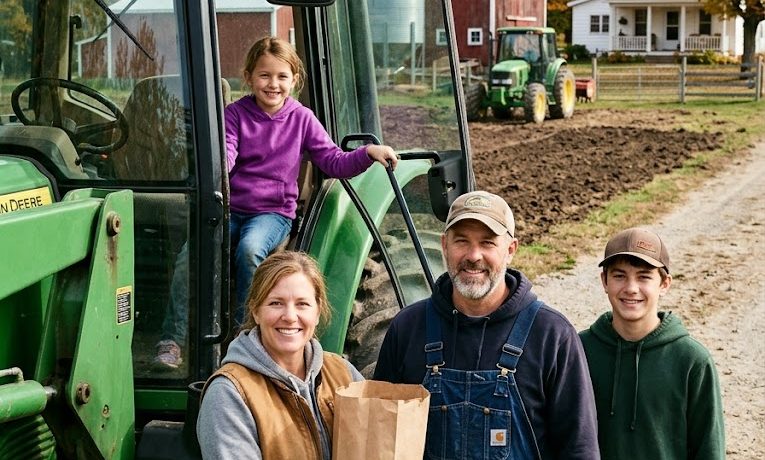
I stood beside the green tractor, wearing my ball cap and canvas chore coat, with a paper sack of seed cradled in my arms. The small white farmhouse stood behind me. Abby was sitting up in the cab, while across the road, their large tractor continued making passes through the field, trailing dust in the fading sunlight.
Scott was at the wheel.
Randy and Luke had come out to the edge of their field. They stood next to each other without saying a word, watching as I hoisted the sack.
I didn’t spend much time looking their way.
I raised the bag and emptied it into the box. Then I picked up another one and did the same. After that, I climbed back into the cab.
I managed to plant around twenty acres that first day. Jeff could easily have covered sixty.
By the time I finally switched off the tractor after nightfall, my hands were trembling. My shoulders hurt so badly that I could barely lift a gallon of milk from the refrigerator.
Abby cooked scrambled eggs for us. She burned one side of them.
Then she went to the bathroom cabinet and returned with a small glass jar. It was the liniment her dad had always kept around for his troublesome knee.
She stood behind my kitchen chair and began massaging it into my shoulders with her little hands. Before long, the entire kitchen smelled of wintergreen.
“Is this how Dad used to do it?” she asked.
“Exactly like that,” I answered.
Then I lowered my face onto the kitchen table so she wouldn’t see my tears.
That night, I went back outside and refilled the planter boxes beneath the yard light, making sure everything was ready for the morning.
I was so exhausted that, once I finished, I sat on the planter hitch to rest for a moment. Before I knew it, I had fallen asleep sitting upright, my back resting against the large tractor tire.
When I woke, I glanced across the road.
The kitchen light was glowing inside the home place. My old kitchen. Through the window, I could make out a figure standing there, staring toward the yard light on my property.
I couldn’t make out who it was.
A moment later, the light went dark.
was still just getting light when I began carrying seed bags from the trailer over to the planter. That was when I heard footsteps crunching along the gravel.
I turned to see who it was.
Luke was walking across the road toward me. He wasn’t driving a vehicle; he was on foot, with both hands buried in his jacket pockets.
Farther behind him, his father stood beside the pickup at the edge of their field, watching him make his way over.
Randy didn’t call out to stop him.
I’ve never forgotten that. He could have called him back, but he chose not to.
Luke halted at the end of my rows. His eyes moved over the planter, the tractor, and the pile of seed bags stacked on the trailer.
Then he turned his attention to me.
He had inherited his father’s face, but the way he stood reminded me of his Uncle Jeff. He rested most of his weight on one leg, just as Jeff used to do.
“Morning, Aunt Melissa,” he said.
“Good morning, Luke.”
“Row number six is skipping,” he told me. “I noticed it from across the road yesterday. There’s a gap every few feet along that row.”
“I took care of it,” I replied. “One of the fingers was bent.”
“All right.” He glanced back at the seed bags before speaking again. “Let me drive the tractor while you bring the seed over. We’ll cover twice as much ground that way.”
“Your dad needs you over there.”
“Uncle Scott is running our tractor this morning,” he explained. “Dad can take over after lunch. They’ll manage.”
He swallowed, struggling to get the next words out.
“I didn’t know they were going to do that at the funeral,” he said. “The check and everything. I had no idea they planned to hand it to you that day. If I’d known, I would have said something. I only found out afterward.”
“I believe you,” I told him.
“And I never asked for the house,” he continued. “I need you to understand that. Dad offered it to me, and I accepted. I just didn’t stop to think about where you would go. I wasn’t thinking at all.”
He lowered his eyes toward his boots.
“Uncle Jeff taught me how to operate a planter,” he said. “This exact model. I was eleven years old.”
“I remember,” I said. “I used to pack your lunch.”
He gave a small laugh, though it wasn’t quite a real one.
Then he climbed into the tractor cab. Abby was already waiting in the buddy seat. She looked up at him from beneath the brim of that green cap, and he looked back at her.
“That’s his cap,” Luke said softly.
“I know,” Abby replied.
“It suits you,” he told her.
Then he started the tractor.
Luke operated my planter throughout the morning while I handled the seed.
Whenever he signaled, I drove the pickup and trailer down to the far end of the field. He would climb down, and the two of us would lift the bags together. We refilled those planter boxes much faster than I ever would have expected.
He planted more evenly than I did. To tell the truth, he even planted straighter than Jeff had. And Jeff would have been the first person to admit it.
Around noon, I heard the sound of a diesel engine approaching along the gravel road from the east.
I raised my head.
It was Scott, driving his pickup with the partnership’s seed tender in tow.
It was the big gray model with the conveyor arm, the one Jeff had purchased at a dealer auction four years earlier. I remembered writing the check for it at my kitchen table. Fourteen thousand five hundred dollars.
Scott turned into my field without stopping at the house. He pulled up beside my planter and climbed out of his pickup. Then he swung the conveyor arm over the first planter box and began filling it.
He said nothing to me.
He didn’t even glance in my direction.
He filled every box on the planter. When he finished, he climbed back into his pickup, drove the seed tender to the end of my field, unhitched it there, and left it behind.
He was heading back toward his truck when I caught up with him.
“Scott.”
He stopped walking, but he didn’t turn around immediately.
Of the three brothers, Scott had always been the quiet one. He was the man who stayed toward the back of the room and allowed Randy to do all the talking.
“You’re going to need that for the rest of the week,” he finally said, still facing his pickup. “Return it when you’re finished. Carrying bags will wear you out.”
“Thank you, Scott.”
That was when he turned to face me.
His eyes were red.
“I should have spoken up in that basement,” he said. “Randy had everything planned, and I let him handle the conversation. I always let Randy do the talking. So I just sat there. Jeff isn’t even cold yet, and I’m telling his wife she has to leave her own home.”
He slowly shook his head.
“I’ve felt sick about it ever since March,” he continued. “I’m sorry, Melissa.”
“I know you are,” I replied.
“That’s all I wanted to say,” he said.
Then he climbed into his pickup and drove back across the road.
With the seed tender available, Luke and I managed to plant nearly forty acres that day.
Abby spent the entire afternoon riding along with him. When I brought them ham sandwiches at four o’clock, she was telling him how her dad always preferred to plant the end rows first. Luke listened and nodded with great seriousness, as though she were sharing something he had never heard before.
Rain arrived on Friday.
It was a gentle, steady rain that lasted all day, exactly the kind you hope for after planting fresh seed. I stood at the kitchen window of the little white farmhouse, watching the rain fall across my forty acres. I prayed for every single seed in the ground.
Saturday was far too wet for fieldwork.
I still had about twenty acres left to plant. Across the road, the brothers were working on their final field at the northern end of their land.
On Saturday evening, the telephone rang.
It was Lori.
“Sunday dinner is at twelve-thirty,” she said. “Just like it always is. I expect you and Abby to be here.”
I didn’t respond immediately.
“I’m putting your places at the table, Melissa,” she continued. “Whether you decide to come or not, your places will be set. You might as well come over and have dinner.”
We attended church the next morning. Pastor Lindgren shook my hand at the door and held it a little longer than he usually did.
After the service, we drove across the road to the house where I had lived for twenty years. I parked in the yard, in the very same spot where I had parked a thousand times before.
Walking through the back door as a guest felt strange.
Lori had spread a clean tablecloth across the table, the white one with blue stitching along its edges. The roast was resting on the stove, and the entire house was filled with the smell of gravy and freshly baked rolls.
Scott was there with his wife, Deb. Luke was there, too. Randy sat at the head of the table, just as he had at family dinners ever since their father died.
Two places had been arranged along the left side of the table.
At one of them was my old coffee mug.
It was white, with a chip in the handle. I had left it behind in the cupboard when we moved because there hadn’t been enough room for it in the box.
When Randy saw us enter, he rose from his chair. That was unusual for him. He remained standing until I had taken my seat, then sat down himself.
We lowered our heads, and Scott said the blessing.
Afterward, Randy left his fork untouched.
“Melissa,” he began, “there’s something I need to say before we start eating. Otherwise, I won’t be able to eat at all.”
The entire table fell silent.
That was when Abby, who had been completely silent, reached up and removed her dad’s green seed cap.
She placed it on the tablecloth beside her plate.
Randy stared at the cap.
He became completely motionless.
Then he reached across the table and touched the brim with a single finger, as gently as someone handling an artifact in a museum.
“I gave him that,” he said, his voice breaking halfway through the sentence. “The year he began planting by himself. I bought it at the seed meeting in Hastings. He was sixteen. He wore it every spring for thirty years.”
“He still had it hanging on the hook,” Abby said. “Mom almost left it behind, but Aunt Lori remembered it.”
Randy grabbed his napkin and pressed it against his face.
For a long while, nobody spoke.
Lori rose from her chair, walked over to the stove, and stood there with her back turned to everyone.
Luke reached across and rested his hand on his father’s shoulder, just as the man behind him had done at the funeral.
After a while, Randy lowered the napkin and cleared his throat.
“Well,” he said, “the roast is getting cold.”
And we began eating.
After dinner, Luke told Abby he had something he wanted to give her. He led her down the hallway toward the pantry.
When they returned, he was carrying a long, narrow strip of painted wood, about six feet long. It was white door trim, with the old nail holes still visible at both ends.
It was the inside frame from the pantry doorway.
Every year since Abby had been able to stand on her own, Jeff had placed her against that door frame on her birthday. He would lay a book flat across the top of her head, then mark her height with a carpenter’s pencil and write down the date.
There were twelve marks on that piece of wood.
The final mark, written in Jeff’s blocky handwriting, read: “Abby, 12, last Nov.”
“I carefully pried it off this morning,” Luke explained. “I took my time so I wouldn’t damage it. I’ll install a new piece for myself. You ought to have this one.”
Abby wrapped both arms around the wooden strip.
She slowly traced each mark with her finger, starting at the bottom and moving all the way to the top. One year old. Two years old. Five years old, with a little star drawn beside the mark. Twelve years old.
Then she carefully leaned the piece of wood against the wall.
She walked over to Luke and wrapped her arms tightly around his waist.
For a moment, he stood there with his arms held out awkwardly, as if he had no idea what to do with them. Then he finally embraced her.
I glanced toward Randy. He was watching his son with an expression I had never seen on his face before. I think he felt proud, ashamed, and grateful all at once, without knowing which feeling he should allow himself to feel first.
We finished planting all eighty acres on Monday.
At first light, Luke came over the road without anyone having to ask him. He drove the tractor while I operated the seed tender. Abby sat in the buddy seat wearing her father’s green cap.
Around four in the afternoon, Scott crossed the road carrying a box of donuts from the gas station in Blue Hill. He stood at the edge of my field, eating a long john and watching the final passes, much like someone watching a ball game.
Across the road, Randy was working on their last field at the northern end, planting it himself.
Both of us worked until late. Daylight was fading. The sky above the Wiebe barn turned orange, then pink, and finally purple. The meadowlarks had stopped singing for the evening.
Luke switched on the tractor’s lights.
Across the road, I watched Randy’s lights come on as well.
I stood at the edge of my field, holding the last empty seed bag, folded beneath my arm.
Abby climbed down from the cab and walked over to stand beside me. She leaned her head against my side.
Together, we watched.
On our side of the road, Luke guided the tractor through the final rows, the planter lights slowly swinging around at the end of every pass. Across the road, Randy’s lights moved in the same pattern. Back and forth. Back and forth. Across the ground Jeff had once farmed.
“Count the passes,” I told her.
Abby lifted one hand to hold her father’s green cap in place, even though there wasn’t a breath of wind.
And there we stood together in the fading light, watching two sets of planter lights travel back and forth on opposite sides of the gravel road.
Rain came in July.
It wasn’t much, but it was enough. We got two good, soaking rains, one on the Fourth of July and another the following week. Everyone at church said it was the finest July we’d had in three years. I kept quiet about how I’d spent every night in June lying awake, listening for thunder and knowing I didn’t have a single dollar of crop insurance covering those eighty acres.
The corn emerged evenly across the field, including row number six.
That October, on a Tuesday morning, Luke brought the partnership’s combine across the road. Randy followed him in the pickup.
I had already written a check for the custom harvesting fee. Forty-two dollars per acre, the same rate charged by the custom harvesters from Superior. The total was $3,360.
I held the check out to Randy.
He stared at it for quite a while.
Finally, he accepted it, folded it in half, and slipped it into the front pocket of his chore coat.
“Jeff would’ve argued about that for an hour,” he said.
“I know,” I replied. “But you would’ve bought him supper afterward.”
That evening, Randy and Lori invited Abby and me to the steakhouse in Hastings. Randy picked up the bill and wouldn’t even let me look at it.
The eighty acres at the Wiebe place yielded 141 bushels per acre. Dryland corn, planted late and at a low rate, by a widow, a twelve-year-old girl, and a young man fresh out of college.
When I took the grain check to the bank, Kyle Hoffman came over and shook my hand.
“Mrs. Engel,” he said, “I’ll be honest with you. I didn’t believe you’d pull it off.”
“Neither did anyone else, Kyle,” I told him.
I paid off the tractor loan I’d taken out in June to cover the fertilizer costs. I purchased crop insurance for the following year on the very first day enrollment opened. Then I deposited $5,000 into a savings account at the credit union under Abby’s name.
On the deposit slip, I wrote, “For the Wiebe eighty.”
When Abby turns eighteen, I intend to hand her the deed, just as her father always promised he would if he ever won the lottery.
The pantry door trim now hangs in the hallway of our little white farmhouse, just inside the front entrance. One Saturday, Luke came over and helped me put it back up, using new nails and making sure it was perfectly level and straight.
Last November, on her thirteenth birthday, Abby stood against it wearing her socks.
I placed a book flat on her head, took Jeff’s carpenter’s pencil from the shop apron where I’d found it, the flat orange one, and marked her height.
Then I added the thirteenth line.
“Abby, 13,” I wrote. “Wiebe place.”
She stepped back from the wall to examine the mark. Then she gazed through the front window, across the gravel road toward her father’s fields. They were bare and brown now, waiting for spring.
“Next year,” she said, “I want to drive the end rows.”
“You’ll have to be able to reach the pedals first,” I told her.
She straightened herself as tall as she could. Then she reached for the green cap hanging on the hook beside our back door. Our hook now. Our door.
She put it on. It still slipped down over her ears.
Just not quite as much as it used to.









