
 381 views
My son-in-law pushed a piece of notebook paper across the kitchen table. A single figure was written on it, circled twice.
$800.
“That covers rent, utilities, and your portion of the groceries,” my daughter explained. She held a coffee mug in both hands, though its contents had gone cold quite some time ago. “And then you’d watch the kids four days a week. That way, you’d be contributing toward your living expenses, Mom. It wouldn’t be charity.”
Contributing toward my living expenses.
It was Saturday, shortly after lunchtime, during the first week of October. The kitchen window stood slightly open, and I could hear the dryer fans humming down by the elevator, just as you could hear them throughout Holdrege during harvest season. A deep, continuous rumble, like a river flowing without ever reaching its destination.
I stared at the paper. It had been pulled from a spiral notebook, leaving behind the tiny, uneven edge of torn paper. The handwriting belonged to Todd. He formed his eights like two circles placed one above the other, just as children are taught in second grade.
“Eight hundred dollars,” I repeated.
“A one-bedroom apartment near the highway goes for seven hundred seventy-five,” Todd replied. He directed his words toward the salt shaker rather than looking at me. “We checked the prices. So it’s reasonable. Pretty much the going rate.”
“And you’d have family around,” Michelle added. “You wouldn’t have to live out there all alone anymore.”
I am sixty-seven years old. The Social Security payment I receive as Dale’s widow amounts to $1,640 each month. I spent twenty-two years keeping the books at the lumber yard, so I didn’t need a calculator to work this out. Taking eight hundred dollars from sixteen hundred and forty would leave me with eight hundred and forty. That money had to cover my car insurance, my Medicare supplement, gasoline, prescriptions, church tithe, and Christmas gifts for my two grandchildren.
And in return, I would become the hired help in my own daughter’s home, working four days out of every seven.
I want to give her a fair assessment, because I’ve had time to look at things more fairly now. She wasn’t cruel when she said it. In some ways, that made it even worse. She delivered the words as though she were explaining the conditions of buying a used car. Her tone was polite but hurried, as if she had rehearsed the conversation in front of the bathroom mirror and wanted to finish before she lost her courage.
“Could I take another look at it?” I asked. “The basement.”
“Of course, Mom. Absolutely.”
We headed downstairs. Todd remained seated at the kitchen table.
They had done their best to fix the place up. I’ll give them credit for that. A leftover piece of beige carpet covered part of the concrete floor. There was a double bed with a frame beneath it and a lamp taken from Michelle’s old bedroom back home. In one corner, a dehumidifier hummed away, with a hose draining into the floor drain.
The only window sat high near the ceiling, roughly the size of a cake pan. Through it, the only thing visible was the bottom portion of the neighbor’s fence.
The air carried the smell of damp cardboard mixed with laundry detergent.
“Todd plans to build a wall right here,” Michelle explained, gesturing toward one area. “That way, you’d have a room of your own. Your own little space. And the bathroom is just upstairs.”
“Upstairs,” I repeated.
“It’s just thirteen steps.”
I counted each one myself as we climbed back up. She hadn’t been wrong. Thirteen steps.
Sadie had come downstairs behind us. She was four years old, wearing one sock and a princess nightgown at one in the afternoon. She stood on the lowest step, her thumb hovering near her mouth. Not inside it. Just close. She was trying to break the habit.
“Grandma,” she asked, “are you going to live in the under?”
“We’ll see, sweet pea.”
“There’s a spider in the under. Eli named him Kevin.”
“Well,” I replied, “at least I’d have some company.”
Now, I know what some of you might be thinking. My friend Brenda from church said exactly what was on her mind when we talked about it later.
Why didn’t you simply say no? Why didn’t you tell Michelle, I’m your mother, and I refuse to pay for the privilege of living with you?
I could have said those words. They were sitting right there behind my teeth.
But saying no at your daughter’s kitchen table can lead to an argument. And an argument can lead to words that you can never gather back up once they’ve fallen to the floor. I have only one child. I had already buried my husband. I wasn’t about to jeopardize the only other person alive who still remembers the sound of Dale’s voice over a sheet of notebook paper.
So I said, “Thank you, honey. That’s a thoughtful offer, and I can tell you both put some effort into it. Let me give it some thought.”
Michelle exhaled. “All right. But, Mom, you have to be out of the farmhouse by the first. So…”
“I’m well aware of when I need to leave.”
I folded Todd’s paper once, then folded it again, and slipped it into my purse. Into the pocket where I kept my checkbook.
Todd watched me put it away. He remained silent. A look crossed his face that I couldn’t understand at the time. I’ll explain later what I think it meant.
Then I walked out to my Buick and sat behind the wheel for a moment, gripping it with both hands.
I should tell you about the farmhouse so you can understand why staying where I was wasn’t an option.
Dale worked as a hired hand. I say that proudly. He spent thirty-one years working for Jim Olson, south of town. And throughout those thirty-one years, we lived in the hired man’s house on the Olson property. It was a square, white, two-story house that took the full force of the north wind and had the finest garden soil I had ever dug into.
The house came with the job. We never paid rent, but we never owned even one board of the place, either. That was the agreement. It was a fair arrangement. Plenty of families around here have raised their children that way.
Dale passed away two years ago, in March. He had been greasing the planter in the machine shed when he sat down on an overturned bucket to catch his breath. And that was it.
Jim was the one who found him.
Jim Olson cried harder at the funeral than I did. That was because I hadn’t begun crying yet.
The house belonged with Dale’s job. Technically, that meant I should have moved out in the spring he died. But the Olsons allowed me to remain there. Two years and seven months went by, and they never once mentioned it. Every August, Jim’s wife brought me fresh sweet corn. Each winter, Jim cleared my driveway without my ever having to ask.
But their son was returning home to take over the farm. He and his wife had a baby, with another one on the way. They had been renting a place in Kearney. And the hired man’s house was the only home on the property available for them to move into.
Jim showed up at my door in August, holding his cap in both hands. It took him ten minutes to find the words he wanted to say.
“You can stay until November, Judy. Take more time if you need it.”
“I won’t need any extra time,” I assured him. “That house has always belonged to you, Jim. You’ve treated me better than anyone could ever expect.”
And that settled it. There was no bad guy in the situation. A young family needed a place to live, and I was a widow living alone in five rooms that belonged to someone else.
That was how I ended up sitting in my car outside my daughter’s split-level home, with a piece of notebook paper tucked inside my purse, telling me that my keep would cost eight hundred dollars a month.
I turned the key and started the engine. My plan was to drive straight home. That was what I fully intended to do.
Instead, I drove four blocks down the road and pulled into a parking spot outside the feed store.
Brandt’s had occupied that corner since before I was old enough to drive. The old wooden floor was still there, worn down into a shallow groove stretching from the front entrance to the counter. The place smelled of molasses, leather, and the sweet, dusty scent of calf starter. For thirty years, Dale had purchased mineral blocks and fence staples there.
Mr. Brandt was seventy-four. He still hauled fifty-pound bags out to customers’ pickups, although these days he lowered them to the ground a little more carefully than he once had.
For three weeks, an index card had been taped to the side of his cash register. I had noticed it every time I stopped in to buy birdseed. And each time, I told myself it wasn’t any of my concern.
House available for rent. Two rooms and a bathroom. Ask Brandt.
During harvest season, he stayed open until four on Saturdays. It was twenty minutes past two.
“Judy,” he greeted me as I walked inside. “Need some black oil sunflower seeds?”
“Not today.”
I pointed at the card with my finger.
“Is this place still available?”
He glanced at the card, then turned his eyes toward me. I could see him putting the pieces together without needing me to explain a thing. Everyone in Phelps County knew the Olson boy was returning home.
“It’s a small place,” he said.
“Where can I find it?”
“Just behind the elevator, along the side street. My mother lived there for the last eleven years of her life. After she passed, I rented it to a young fellow from the co-op until he got married in June.”
He was already reaching for a set of keys hanging from a nail.
“Come along. I’ll take you over. Roy, keep an eye on the counter.”
We set off on foot. It was barely a block and a half away.
Trucks stretched in a long line at the scales, all the way back to the railroad tracks. Golden corn piled high above the sides of their beds. Drivers had their windows rolled down, arms dangling outside, chatting with one another from cab to cab. The air was filled with the fine, reddish chaff that clings to your hair and gets between your teeth at this time of year.
The elevator towered above everything, tall and white, like a church without a steeple.
And tucked beneath its shadow, like a little chick sheltering under a mother hen, stood the smallest house I had ever seriously considered renting.
The house had white siding and a green shingle roof, with a front porch just wide enough to hold a swing. And there it was, hanging from chains, its seat looking as though someone had given it a fresh coat of paint not long ago.
There was just one step from the walkway to the porch.
One.
“Mother couldn’t manage stairs,” Mr. Brandt explained when he noticed me looking.
He unlocked the door and let me inside.
The kitchen and living room shared one space. There was a sink beneath a nice, wide window, a four-burner gas stove, and a refrigerator that hummed steadily. There was room for a table against the wall, space for a couch, and a heating stove tucked into the corner.
A doorway led to the bedroom, which had a closet. Beyond that was the bathroom, where a grab bar had been securely fastened to the wall studs beside the bathtub.
That was the entire house. Nothing more. You could stand in the center of the living room and see every corner of the place that would belong to you.
The window above the sink faced directly toward the grain elevator, the scales, and the trucks.
“It gets noisy during harvest,” he told me. “The fans run all night long. The train passes through around two in the morning, then again about five. Mother always said she stopped noticing it after a month.”
“I’ve spent two years listening to nothing but a quiet house, Mr. Brandt. I think I can handle a little noise.”
He scratched the back of his neck. “Corn dust gets everywhere from now until Thanksgiving. I don’t want to pretend otherwise.”
“How much rent do you want?”
“Five hundred and fifty. You cover your own electricity and gas. I’ll handle the roof and furnace repairs, and I’ll mow the lawn whenever I cut the grass around the store.”
Five hundred and fifty dollars out of my sixteen hundred and forty would leave me with $1,090. I worked that out in my head without needing a pencil, too.
“It’s a small place,” he repeated.
“But it has a door of its own,” I replied. “I’ll take it.”
He stared at me, blinking in surprise.
“Wouldn’t you like to give it some thought? Maybe discuss it with Michelle?”
“I’ve been considering it for three weeks. Every time I came in to buy birdseed.”
I filled out the check right there on the hood of my Buick. I didn’t want to return to the store and give myself enough time to talk myself out of it.
He tried to refuse a deposit, insisting he didn’t need one from Dale’s wife. Still, I wrote the check for the first month’s rent and told him he could hold the deposit in trust.
He removed two keys from his large key ring and slipped them onto a smaller ring.
“One for the front door, one for the back,” he explained.
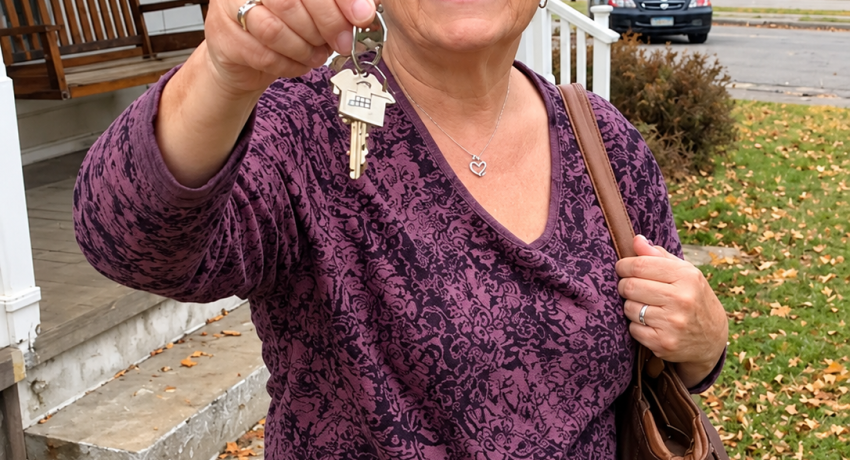
I closed my fingers around them. Two brass keys, still warm from his pocket.
At nineteen, I had moved from my father’s house into the home provided for a hired farmhand. I had spent my life as someone’s daughter beneath her father’s roof, then as someone’s wife beneath the roof supplied by her husband’s employer. I was thankful for both arrangements. I genuinely was.
But I had reached the age of sixty-seven before anyone had ever placed the keys to a home I had chosen for myself into my hands.
I’m not embarrassed to admit that I had to turn toward the grain elevator and look away for a moment, so Mr. Brandt wouldn’t notice my expression.
There’s one part of this story I’m not particularly proud of.
I didn’t tell Michelle.
Not that afternoon, and not during the following week. She called on Monday to ask whether I had made up my mind, and I told her I was still considering it. That wasn’t exactly a lie, though it wasn’t the whole truth either. I was still thinking. I was thinking about where I wanted to put the couch.
Jim Olson and his son helped me move on a Wednesday. They backed a flatbed truck up to the farmhouse porch and refused to let me lift anything heavier than a lamp.
I brought my bed, the couch, the kitchen table Dale and I had purchased at a farm sale in 1981, along with four chairs. I took my sewing machine, Dale’s recliner, and nine boxes.
After thirty-one years in one house, everything I owned amounted to a single flatbed load and whatever I could squeeze into the trunk of my Buick.
I gave the things I couldn’t take to the Olson boy’s wife. She became tearful over the canning jars.
Jim stood in the middle of my new living room without his cap, slowly turning around to look at everything.
“Well, Judy. It’s cozy.”
“It sure is.”
“Dale would’ve made sure that porch step was level with a shim before I’d even finished unloading the truck.”
“He certainly would have,” I replied.
We both laughed. Then the laughter faded for both of us.
I put up my curtains. I placed Dale’s recliner beside the heating stove, facing the window. I arranged my African violets along the windowsill above the sink, where they could look out at the trucks.
That first night, the fans rumbled loudly, and the two o’clock train rolled past, rattling the water in the glass beside my bed. I lay there awake, wondering, Judith, what on earth have you done?
On the second night, I slept straight through until five in the morning.
Todd was the one who discovered where I had gone.
He drove past the elevator every morning on his way to the plant for the first shift. On the ninth morning, a Monday, he noticed my Buick parked outside the Brandt house at fifteen minutes before six. A light was glowing in the window, and a woman in a housecoat was standing there watering her violets.
Michelle called me that evening at seven.
I could tell from the way she said “Mom” that she already knew the truth.
“You rented a house.”
“I did.”
“From Mr. Brandt. The one by the elevator. Todd spotted your car.”
“That’s correct.”
“You’ve been living just four blocks away from me for more than a week, and you kept letting me ask whether you’d made a decision.”
“I was wrong to do that,” I admitted. “I should have told you the same day I rented it. I was scared of having this conversation, so I kept putting it off. That was cowardly of me. I’m sorry for that.”
A long silence followed. I could hear cartoons playing somewhere in the background.
“How much are you paying?”
“Five hundred and fifty dollars.”
“So money wasn’t even the issue.” Her voice rose, becoming thin and sharp. “It’s only a difference of two hundred and fifty dollars. You’d rather give your money to a stranger than to your own family?”
“Mr. Brandt isn’t a stranger. And no, Michelle. I’d rather remain your mother than become your tenant. That’s all there is to it.”
“We prepared a place for you!”
“You did. I saw how much work you put into it.”
“I told the daycare we might take Sadie out. I told my boss I might be able to start picking up Fridays.”
“I didn’t know any of that.”
“Because you never asked! You smiled, thanked us, and then went off and did whatever you wanted!”
I didn’t shout back. I had never managed to get anywhere with that girl by raising my voice, not when she was fifteen and certainly not now.
“Sweetheart,” I said, “I’m going to tell you one thing, and then I’ll let you go. You’re upset, and it’s time to get the children to bed. I would have watched those babies without charging you a penny. I would have been happy to do it. But you said I’d be earning my keep. I earned my keep with you a long time ago. I don’t think I owe you anything more for it.”
She hung up.
I placed the phone on the table Dale and I had bought back in 1981. Then I sat there until the daylight disappeared from the window and the lights on the elevator came on.
Ten days passed.
Not a single phone call. No pictures sent to my phone, either, even though she used to send me something almost every evening. Sadie with spaghetti smeared across her forehead. Eli showing off a missing tooth. Nothing at all.
Let me tell you honestly what those ten days were like.
I had my own door. I had my two brass keys, my porch swing, and my violets. Every evening, I sat on that swing wearing my denim jacket, watching the trucks roll onto the scales. And I kept wondering whether the price I had paid for my independence was too high.
Because it was never the basement itself that bothered me. I had lived in much humbler places. It wasn’t even the eight hundred dollars, although the numbers certainly hurt when I added them up.
What troubled me was the fact that I would have been living there under an agreement with conditions attached.
Whenever groceries came into the house, I would have been calculating my share. Every Thursday when I felt worn out and wanted to rest, I would have heard those words echoing inside my head. Earning your keep.
A grandmother living in someone’s home as a paid worker stops being just a grandmother. She becomes the help who happens to love the children.
And what would my keep be worth once the children were older and the daycare expenses disappeared?
I wanted to be close to those children. I truly did. But I didn’t want to become bound to them by an arrangement that made me feel indebted.
Still, I would have gladly given up my swing, my violets, and both keys for just five minutes with Sadie sitting on my lap. I knew that was true. And knowing it made those ten days feel terribly long.
What helped me get through them was a shoebox.
On the second day, I went into Brandt’s to buy sunflower seeds. Mr. Brandt stood behind the counter, his glasses pushed up onto his forehead, with roughly two hundred pieces of paper scattered in front of him. There were invoices, charge slips, and a bank statement marked by a coffee ring.
“Lois used to take care of all this,” he said. He wasn’t really speaking directly to me. Lois was his wife, who had died four years earlier. “She handled it for forty-three years, and I never once asked her how she managed. Now the accountant over in Kearney needs the third-quarter figures by the fifteenth, and I can’t even tell you whether Don Swanson has paid for his creep feed since May.”
I put my purse down on the counter.
“Do you keep a ledger, or is everything just piled into that box?”
“There’s a ledger. I just haven’t been able to make the numbers balance for about a year now.”
“Mr. Brandt, I kept the books at the lumber yard for twenty-two years. Double-entry bookkeeping. Hand me that ledger, the shoebox, and a pot of coffee.”
He looked at me as though I had just volunteered to haul those fifty-pound sacks out to the customers’ trucks.
It took me three afternoons working at the small desk in the back, near the veterinary supplies.
As it turned out, Don Swanson hadn’t paid for his creep feed since May. Four other customers hadn’t paid either. And a deposit from July had been entered into the books twice.
When I finished, every figure in the ledger balanced down to the last penny. I had also uncovered a little more than two thousand dollars’ worth of charge slips that had never been billed to anyone.
That Friday evening, Mr. Brandt came out to my porch and stood on my single step, holding his cap in his hands. Men his age around here tend to have their most serious conversations with their caps held that way.
“I’d like you to handle the books every Friday,” he said. “I can’t afford to pay you what the work is really worth. But I could reduce your rent to four hundred dollars, if that works for you.”
“That works for me.”
“This isn’t charity, Judy. I want you to know that. You’d be saving me from a real mess.”
“I know,” I replied. “That’s exactly why I’m agreeing.”
After he went home, I remained on the porch swing for a little while longer.
There was a difference, and I could feel it as clearly as the swing’s chain wrapped around my hand.
Mr. Brandt had come to my doorstep. He had asked me to use the skills I possessed and offered what he could in return. Nobody had told me I would be earning my keep. He had told me I would be saving him from trouble.
I thought to myself, That’s all I ever wanted from my own daughter.
Just to be asked.
On the tenth day, a Thursday, I was frying potatoes for supper when I heard a pickup truck door slam outside.
I recognized that particular sound immediately. It was Todd’s Ford. The driver’s-side door had been sticking ever since he backed into the mailbox.
I lowered the burner and peered through the kitchen window above the sink.
Michelle was climbing out of the passenger side. She was still wearing her work clothes, the scrubs decorated with little cartoon teeth from the dentist’s office. Her eyes were red all around.
Todd walked around the front of the truck, carrying a yellow legal pad. Even from inside the house, I could see that the entire first page was filled with his handwriting.
The children weren’t with them.
I dried my hands on the dish towel and opened the screen door before either of them could knock.
For a moment, nobody spoke. Behind them, a grain truck shifted gears as it moved down the street.
“Judy,” Todd said.
He was a large man, six feet two inches tall. Yet he stood on my front walkway looking like a schoolboy who had been called into the principal’s office.
“I was the one who wrote down that amount. The eight hundred dollars. That was my doing, not hers. I want to make that clear first.”
“All right.”
“Would it be okay if we came inside?”
“You’re always welcome inside. The potatoes are nearly burning, so somebody will have to eat them.”
Michelle let out a little sound that was halfway between a laugh and a sob.
She stepped up onto my porch and paused in the doorway, looking around the living room. Her eyes moved over the couch, her daddy’s recliner, and the violets lined up on the windowsill.
Then she noticed the table. She walked over and rested her palm against its surface, right over the burn mark left by a hot pan she had set down when she was eleven years old.
“You kept the table,” she whispered.
“Of course I kept the table.”
I reached over, gently moved her hand away from her eye, and held it in mine.
“Michelle, look at me. Who taught you that you weren’t allowed to ask for help?”
She gave a tearful little laugh. “You did.”
“I suppose I did.”
And I had. Thirty-one years spent living in another man’s house, taking pride in never needing anything from anyone. She had learned that lesson right here at this very table.
“Well, I was wrong to teach you that,” I said. “I figured that out this month. A man came to my door and asked me for help. Straight out, with his cap in his hands. And it was the kindest thing anyone has done for me since your daddy passed away.”
Then I pulled the legal pad toward me and took my reading glasses out of my jacket pocket.
“Todd, pass me that pencil.”
“Judy, we didn’t come here to—”
“I know why you came. You came to apologize, and you’ve done that. I’ve accepted your apology. But now you’re sitting at a bookkeeper’s table with a set of numbers that don’t add up, and I won’t be able to sleep tonight, noisy fans or not. Hand me the pencil.”
He passed it to me.
“Here’s what I’m willing to do,” I said. “And it’s exactly what I would have done if someone had simply asked me. Tuesdays and Thursdays. Both children. I’ll collect Eli from school, and Sadie will stay with me all day. Right here, in my house. Not yours.”
“Mom, you really don’t have to—”
“I haven’t finished. I’ll do it as their grandmother. That means I won’t charge you anything. But it also means this is my kitchen, and my rules apply. If I have a doctor’s appointment in Kearney on a Tuesday, I’ll give you a week’s notice, and you’ll make other arrangements. I’m not an employee. And I’ll continue doing Mr. Brandt’s books on Fridays. That arrangement is not changing.”
“You do his books?” Todd asked.
“I do. It lowered my rent by a hundred and fifty dollars a month.”
I had already started making calculations.
“Now, does the daycare offer a three-day rate?”
Michelle nodded. “Thirty-eight dollars a day for Sadie. Twelve dollars for Eli after school.”
I worked out the figures in the margin, just as I had calculated board feet at the lumber yard for twenty-two years. Two days of care for Sadie and two days for Eli came to one hundred dollars a week. That worked out to approximately four hundred and thirty-three dollars a month.
I crossed out $1,080 and wrote $647 beside it.
“That leaves you three hundred and ten dollars,” I explained. “Plus another hundred and twenty-three to spare. Every penny of that extra money goes toward paying off the furnace card until the balance is gone. Not the truck. Not Christmas presents. The card.”
Todd stared down at the legal pad.
“We’re in the black,” he said slowly, as though he were reading a word in a language he didn’t know.
“Just barely in the black. But it’s enough to stop borrowing money. And if the plant starts giving you overtime again, don’t increase your spending this time. Put that extra money aside.”
“Yes, ma’am.”
“One more thing, and then I’ll bring out the pie.”
I removed my glasses.
“I love both of you. I’m not going to hold this against you. But I want us to understand something, and I’m saying it kindly: I will not be spoken to that way again. Not about my keep, and not about earning it. If you need my help, come to my door and ask me. You might be surprised at how often I’ll say yes.”
Michelle lowered her head onto her daddy’s old table, resting it right over the burn mark. Then she cried in a way she hadn’t even cried at his funeral.
Todd placed his large hand on her back.
I went to get the pie.
It was nothing fancy, just a store-bought crust filled with apples from the Olson family’s tree. They each ate two slices.
I barely slept that night, and I didn’t even want to.
I lay there listening to the two of them breathe beneath my mother’s quilt, in a house barely bigger than a postage stamp. A house I had rented on my own, with a check I’d written on the hood of my Buick.
At two in the morning, the train rumbled past.
The glass on the windowsill shook, and Sadie suddenly sat upright, her hair sticking out in every direction.
“It’s just the train,” I whispered. “It passes every night. It’s only going by.”
“Is it telling us goodnight?”
“I think it might be.”
She climbed up from the floor onto the couch and snuggled against me, all elbows and knees, her chilly feet resting against my shins.
She had fallen asleep again before the final car passed.
I spoke to Dale quietly in my thoughts, the way I often do.
I told him, you’d have that porch step leveled with a shim by now.
I told him, the books are balanced.
I told him, I have both of them right here with me. And I’m not earning anything for it.
Michelle came to pick them up the following morning, before church.
Through the window above the sink, I watched her van pull into view. I was standing at the stove with a pancake turner in my hand. Both children sat at the table Dale and I had bought, still wearing their pajamas, with syrup smeared up to their elbows.
She walked up the path.
Then she stepped onto my porch. Todd had come by the previous Saturday and leveled that single step for me. He had done it without anyone asking, using a cedar shingle and Dale’s old torpedo level, which I had given him.
She could see all of us clearly through the screen door. The inner door was standing wide open.
And my daughter paused on the step.
Then she knocked anyway.
“The door’s open,” I called out. “Come on in, sweetheart. There’s plenty for everyone.”
She stepped inside and kissed the top of each sticky little head. Then she leaned over and kissed me.
She picked up a plate and settled into the fourth chair.
Beyond the window, the first truck of the morning rolled onto the scales.
I am sixty-seven years old.
I have two rooms, two keys, two grandchildren who spend Tuesdays and Thursdays with me, and a shoebox of books to handle every Friday.
I pay four hundred dollars a month for a house where I can see every corner without moving from the middle of the room.
And whenever my family needs me, they climb that single step and knock on my door.
I always open it for them.









