
 178 views
Who Were All Those Beans For?
The county gave my seventy-nine-year-old father thirty days to remove half of the vegetable garden he had spent his entire life cultivating. Our wealthy new neighbor had filed a complaint, claiming the garden was an eyesore that spoiled his expensive view. Dad didn’t protest. Instead, he asked the inspector to come back at six o’clock on Saturday morning.
When twenty-three cars started pulling in through the morning fog, our neighbor watched from his balcony, looking rather pleased with himself. But as soon as an elderly woman climbed out of the last vehicle, his face went completely pale. He dropped his coffee cup and murmured, “Mom?”
It all started with an official letter that arrived on a Tuesday morning.
I was cleaning my father’s coffee pot when I heard him open the envelope. Dad usually had an opinion about everything, including the weather. This time, however, he went completely quiet.
When I turned around, I found him sitting at the kitchen table, studying a letter through his reading glasses.
“What’s the matter, Dad?”
He slid the paper across the table toward me.
The county had received a complaint concerning agricultural activity on his residential property. An inspection was arranged for Thursday, and the letter warned that his garden might be in violation of local zoning laws.
I glanced through the kitchen window.
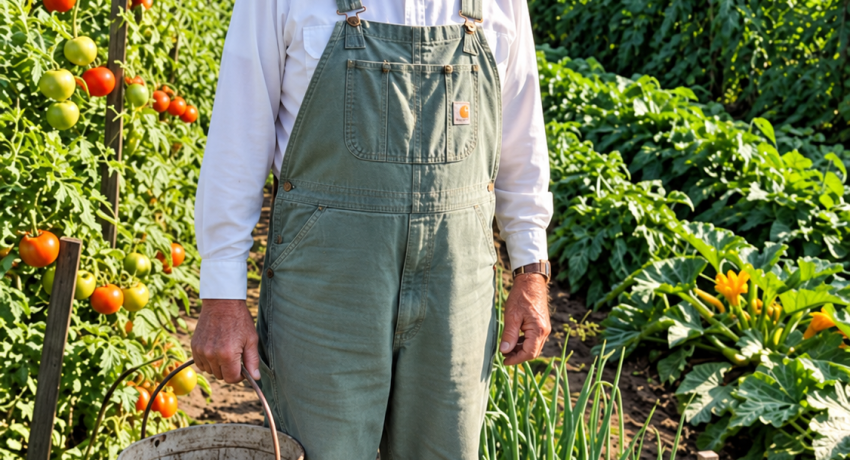
Beyond the porch stretched half an acre of the most magnificent vegetable garden I had ever seen. Nine rows of green beans, hundreds of tomato plants, potatoes, squash, cucumbers, carrots, onions, and tall stalks of sweet corn filled the neatly organized beds.
Not a single weed could be found.
My father, Arne Lindqvist, was seventy-nine years old. He had been born in that very house in 1947, and his father had grown up on the same land before him. After spending decades working at a paper mill and driving a school bus, Dad had dedicated his retirement years to gardening.
My mother, Marta, had passed away three years earlier following a short battle with pancreatic cancer. They had shared fifty-one years of marriage.
I had feared that losing her would break Dad’s spirit.
Instead, he began planting even more vegetables.
Far more than any one elderly man could ever consume.
I had once asked him why he needed hundreds of pounds of beans and thousands of tomatoes.
He had simply smiled and replied, “For people.”
At the time, I thought he was sharing the produce with neighbors and friends from church.
I had no idea how much those two words really meant.
Our new neighbor, Brent Hollis, had moved in a few months earlier. He bought the property next door, tore down the old farmhouse, and built a massive gray mansion with black-framed windows, a three-car garage, and a second-floor deck overlooking our backyard.
Brent had money, designer clothing, and a perfectly maintained lawn.
Unfortunately, he also had an issue with my father’s corn.
The tall stalks blocked part of the valley view from his deck.
Every Sunday when I visited Dad, I would spot Brent standing outside with his coffee, staring angrily at the garden.
Dad always paid him no attention.
On one occasion, he even offered Brent a basket of strawberries from the plants Mom had lovingly tended for thirty years.
“No, thanks,” Brent answered curtly. “I don’t really eat fruit.”
Dad simply nodded.
“Well, if you ever change your mind, the tomatoes should be ready soon.”
Now, with the county’s complaint in my hands, I knew exactly who had caused the problem.
“It’s Brent,” I said furiously. “He hasn’t even lived here for a year, and now he thinks he can make you tear out a garden that’s been part of this family for generations!”
Dad folded his glasses.
“Let’s wait and see what the inspector has to say.”
I wanted to hire a lawyer straightaway.
Dad, however, insisted that we hold off.
“Not everything can be rushed, Kristin,” he told me. “Sometimes you plant something, and then you have to let it grow.”
I couldn’t understand why he was so relaxed about the situation.
I certainly wasn’t feeling calm.
On Thursday, I took the day off work and arrived before the county inspector showed up.
Dad was already outside, harvesting beans.
The inspector, a young man named Tyler Ostrowski, arrived shortly before nine. He was courteous and professional, carrying a clipboard as he carefully examined the property.
He took photographs of the garden, measured its boundaries, and inspected the rows.
Eventually, he stopped beside the tomato plants.
“Mr. Lindqvist, how many hours do you spend looking after this garden?”
“Six or seven hours on most days,” Dad replied.
“Every single day?”
“Every day I’m physically able.”
Tyler seemed genuinely impressed.
But once we returned to the porch, his expression grew more serious.
“I’m sorry, sir. The zoning regulations were revised in 2019. Gardens exceeding a quarter of an acre now require a special permit. Your garden covers approximately half an acre.”
Dad nodded.
“My family has been growing vegetables on this land for generations.”
“I understand. Unfortunately, someone has submitted a complaint, so I’m required to issue a notice.”
“What happens now?” I demanded.
“You have thirty days to reduce the cultivated area or secure approval. The permitting process, however, could take up to six months.”
I was furious.
Thirty days?
My father was expected to destroy half of a garden that had lasted for generations simply because a wealthy newcomer didn’t like looking at corn?
Before I could say another word, Dad gently placed his hand on my arm.
Then he turned toward Tyler.
“Would you be able to come back on Saturday morning?”
Tyler looked confused.
“What time should I come?”
“Six o’clock.”
“Can I ask what for?”
Dad glanced toward the garden.
“There’s something I’d like you to see before you make your final decision.”
After thinking for a moment, Tyler agreed.
I asked Dad what he was planning.
He didn’t offer any explanation.
“Saturday will speak for itself,” he said.
That evening, I went next door to confront Brent.
He answered the door dressed in expensive golf clothes, holding a glass of wine.
“You’re the one who complained about my father’s garden,” I said.
“Yes, I am.”
“Why?”
“Because it’s unattractive. I paid a fortune for my property, and I shouldn’t have to wake up every morning looking at a farm.”
“That garden represents a seventy-nine-year-old man’s entire life’s work!”
“Then maybe he should have familiarized himself with the zoning rules.”
My hands began to tremble with anger.
“He even offered you strawberries!”
Brent rolled his eyes.
“Listen, your father is clearly operating some kind of business. I see him putting boxes into his truck before sunrise every week. He’s probably selling vegetables without a proper license.”
I looked at him in disbelief.
Boxes?
A truck?
Before sunrise?
I knew Dad sometimes delivered vegetables, but I had never asked him where he went.
When I got home and questioned him, he laughed softly.
“Selling vegetables? That’s hilarious.”
“Dad, where do you go on Friday mornings?”
He kept shelling peas without looking up.
“You’ll find out on Saturday.”
On Friday morning, I woke up at four-fifteen to the sound of his pickup truck starting.
From my bedroom window, I watched Dad load eleven cardboard boxes packed with fresh produce into his old green truck.
He covered everything with a tarp, climbed into the driver’s seat, and drove away.
Several hours later, he returned with an empty truck bed.
I spent the remainder of the day wondering what he had been keeping from me.
Saturday morning arrived under a dense layer of fog.
By five-thirty, Dad had brewed a huge pot of coffee in the same urn Mom used to take to church gatherings.
He was already busy among the rows of beans when Tyler arrived at six.
The inspector accepted a cup of coffee and stood beside me on the porch.
Across the fence, Brent observed everything from his second-floor deck, dressed in a dark blue bathrobe.
He appeared quite satisfied with himself.
Then headlights emerged from the fog.
An old red pickup pulled over beside the road.
A white truck stopped behind it.
Then another car arrived.
And another.
Within minutes, vehicles had filled the roadside.
Families stepped out carrying empty shopping bags, buckets, boxes, and laundry baskets.
Some were elderly.
Others were young parents accompanied by their children.
I noticed a man wearing work clothes, a woman dressed in medical scrubs, two teenage boys, and an older gentleman walking with a cane.
Without hesitation, they made their way directly into my father’s garden.
They seemed to know exactly where everything was.
The boys began picking corn.
An elderly man started digging up potatoes.
A mother helped her toddler gather strawberries.
A woman carrying a cane walked toward Dad, who handed her a bucket he had already filled with green beans.
Nobody exchanged money.
Nobody asked for anything in return.
Each family collected only the food it needed, making sure there was plenty left for the others.
Tyler lowered his clipboard.
“What exactly am I witnessing here?” he whispered.
My throat tightened with emotion.
Suddenly, I remembered asking Dad why he grew such enormous quantities of vegetables.
For people.
On the other side of the fence, Brent’s smile had disappeared.
He held tightly to the deck railing, watching the families move through the garden.
Then another vehicle approached.
A silver minivan pulled onto the roadside.
An elderly woman stepped out wearing a faded tan raincoat. Her gray hair was pinned back, and she carried two battered grocery bags.
She appeared uneasy.
Almost embarrassed.
She walked slowly toward the garden, keeping her eyes fixed on the ground.
Then she raised her head.
Her eyes met Brent’s across the yard.
She stopped so suddenly that one of her bags slipped from her hand and landed on the gravel.
Brent stood completely motionless.
For several seconds, neither of them moved.
Then Brent abandoned his coffee, hurried through his house, and emerged outside.
Still barefoot and wearing his bathrobe, he crossed the lawn, stepped over the fence, and rushed toward the woman.
“Mom?”
The elderly woman’s face crumpled with emotion.
“Brent?”
He looked utterly bewildered.
“What are you doing here?”
She glanced toward his enormous house.
“You live there?”
“Yes! Mom, that’s my house!”
“I had no idea,” she whispered. “You’ve never invited me over.”
Brent stared at the empty grocery bags in her hands.
Then he looked toward the garden.
Finally, he glanced at the families gathering vegetables.
A terrible realization began to sink in.
“Mom… are you coming here because you need food?”
She dropped her gaze.
“I’ve been visiting every Saturday for the past eighteen months.”
Brent stumbled backward in disbelief.
“But I send you money!”
“Two hundred dollars each month,” she answered. “And I’m grateful for it, sweetheart.”
“Then why do you come here?”
Her voice shook as she explained.
“My pension is eleven hundred dollars a month. My rent is eight hundred. My heart medication costs three hundred and forty dollars after insurance. Then I have utilities, insurance, and other expenses.”
She paused and swallowed.
“By the time everything is paid, there’s nothing left to buy food.”
Brent looked devastated.
“Why didn’t you tell me?”
“Because you worked so hard to leave our old life behind,” she whispered. “You built a successful company and bought that beautiful house. I didn’t want you to worry about me.”
“You’re my mother!”
“I know, sweetheart. But I didn’t want to bring back memories of the days when we had nothing.”
Dad walked over to them, carrying his worn-out bucket.
“Good morning, June.”
Brent turned toward him in surprise.
“You know my mother?”
Dad nodded.
“Of course I do. She prefers yellow squash and small red potatoes. She’s been coming here for a year and a half.”
Brent looked as though the ground had disappeared beneath his feet.
“I filed the complaint against your garden,” he admitted. “I told the county it was an eyesore. I wanted them to make you tear it out.”
“I know,” Dad replied softly.
“Did you know she was my mother?”
“No. I knew her as June, a widow who needed fresh vegetables. That was all I needed to know.”
Brent lowered himself onto the gravel.
He covered his face with his hands.
Then, in front of everyone, he began sharing a story none of us had expected to hear.
When Brent was a child, his family lived in a rundown trailer after his father suffered a disabling injury.
His mother grew beans because the family couldn’t afford enough food.
For years, Brent helped her work in the garden.
At school, other children made fun of his clothes and the simple bean dishes he brought for lunch.
They called him “Bean Boy.”
He made himself a promise that when he grew up, he would never be poor again.
He would never have dirt under his fingernails.
And he would never have to look at another vegetable garden.
“That’s why I built that house,” he said, pointing toward his mansion. “It represented everything I’d ever wanted. But every morning, I looked over here and saw the life I’d spent decades trying to leave behind.”
His voice cracked with emotion.
“And all this time, my own mother was getting food from the very garden I wanted destroyed.”
Nobody said a word.
Then my father carefully lowered himself onto the gravel beside Brent.
“Brent, there’s something I want you to understand.”
Dad explained that in 1982, the paper mill had laid off hundreds of employees, including him.
I was five years old at the time.
He had no income, a mortgage to pay, and a wife struggling desperately to keep food on the table.
One winter morning, Dad opened the front door and discovered a box sitting on the porch.
It contained potatoes, beans, flour, canned vegetables, and a ham.
A handwritten note inside said only:
From your neighbors. Pass it on.
The following Friday, another box appeared.
Then another one arrived the week after that.
The deliveries continued until Dad finally found another job.
He never discovered who had been helping them.
However, Mom suspected that the Swensons, who had owned Brent’s property before him, were responsible.
That spring, she asked Dad to make her a promise.
They would never let a struggling neighbor go hungry if they had the means to help.
So she made the garden bigger.
Every Saturday, she welcomed families who needed food and encouraged them to gather whatever they required.
Every Friday before sunrise, she delivered fresh produce to people who were too elderly, disabled, or embarrassed to come themselves.
She kept doing it for forty years.
Then cancer took her away.
Dad’s voice trembled as he continued.
“Before she passed, Marta made me promise that I would never stop those Friday deliveries.”
He looked across the garden.
“And I’ve kept that promise.”
I stood motionless on the porch, tears streaming down my cheeks.
My mother had spent forty years helping families who struggled to put food on their tables, and I had never fully understood the extent of her kindness.
Dad continued, explaining that the garden provided food for approximately forty families every Saturday. He also delivered produce to eleven households and a local church food pantry.
Tyler looked down at his clipboard.
Then he pulled out the partially completed violation notice.
He folded the paper and tucked it into his pocket.
“From a professional standpoint,” he said, “this is one of the best-maintained properties I’ve ever inspected. I’m going to look into the relevant community garden exemptions and help you obtain the proper permits for this operation.”
Dad thanked him.
Tyler shook his head.
“My grandmother relied on food deliveries when I was young. I understand how much a place like this can matter to people.”
Brent slowly stood up.
“I want to withdraw my complaint,” he said. “Effective immediately.”
Tyler assured him that he would bring the necessary paperwork on Monday.
Then Brent turned toward my father.
“I’m sorry, Arne. I can’t believe I behaved this way.”
Dad extended his hand.
“Give me a hand getting up, would you? These old knees aren’t as strong as they used to be.”
Brent gently helped him rise from the gravel.
Then he asked if there was anything he could do to make amends.
Dad picked up his battered metal bucket and passed it to him.
“The beans are over on the left. Your mother needs some, so start picking near the bottom of the plants.”
Brent paused uncertainly.
For thirty years, he had avoided going anywhere near a bean plant.
Now he stood holding the bucket, with his mother quietly watching from beside him.
At last, he nodded.
“Near the bottom.”
He walked into the garden, knelt in the damp earth, and began gathering beans.
For the first time in decades, he wasn’t trying to escape his past.
He was using it to do something meaningful.
The following Friday, I went along with Dad on his deliveries.
We set off before sunrise with eleven boxes of freshly harvested vegetables.
Our stops included an elderly widower who could barely walk, a struggling mother whose husband was in the hospital, several senior residents living in an apartment building, and a disabled veteran named Curtis.
Everywhere we went, people recognized my father.
They remembered my mother, too.
Curtis told me that she used to bring him a homemade peach pie every August.
“I still miss her,” he said.
I smiled through my tears.
“So do I.”
After completing the deliveries and leaving the remaining produce at St. Luke’s, Dad suddenly turned the truck in a different direction.
He drove us to the cemetery.
We stopped beside my mother’s grave.
Dad carried a small paper bag over to her headstone.
Inside was the finest tomato he had picked that week.
He carefully placed it on the stone.
“Eleven homes this week, Marta,” he whispered. “And forty-two families on Saturday. That’s our best result yet.”
He paused for a moment.
“And that boy next door is going to be all right. June’s son. He’s learning.”
Dad gently touched the headstone.
“I haven’t missed a single Friday, sweetheart. Not one.”
That was twelve months ago.
Today, the garden is officially known as the Marta Lindqvist Community Garden.
Tyler helped us obtain the necessary permit in just six weeks.
Brent withdrew his complaint and eventually surprised everyone by removing half of his expensive lawn to make room for additional growing beds.
He constructed a wooden gate connecting the two properties.
It sits a little crooked, but Dad absolutely loves it.
Before Thanksgiving, Brent’s mother moved into his house. She now looks after the squash plants and offers everyone advice on growing potatoes.
And Brent?
He drives while Dad guides him along the route, and he carries heavy boxes up staircases that my father can no longer climb comfortably.
Dad turned eighty this spring.
When he needed heart surgery, the entire community came together to tend the garden while he recovered.
Brent was there, too, working with soil beneath his fingernails.
Last Saturday, twenty-three vehicles arrived at sunrise.
Among them was a new family, standing uncertainly at the end of the driveway. A tired young couple had brought their little boy.
Brent walked over to greet them.
“Is this your first visit?”
The father nodded awkwardly.
“Someone told us we could come here for vegetables…”
“Absolutely,” Brent replied. “Come on in.”
He handed them a bucket.
The little boy gazed across the seemingly endless rows of green plants.
“Who does this garden belong to, mister?”
“Mr. Lindqvist and his wife started it.”
The boy thought about that for a moment.
“So, who are all those beans for?”
Brent smiled, crouched down to the child’s level, and gave him the same two-word answer my father had offered years earlier.
“People.”
The boy looked puzzled.
“People like us?”
“People just like you.”
Brent pointed toward the first row.
“The beans are on the left. Start by picking the ones near the bottom.”
As the boy hurried into the garden, I turned to look at my father.
He was kneeling among the bean plants he loved so much, quietly smiling.
For decades, my parents had believed that kindness should pass from one person to another without anyone expecting praise or a reward.
Now, the very neighbor who had once wanted their garden destroyed was helping it thrive.
At last, I understood why my father had never felt the need to explain who all those beans were meant for.
He wasn’t growing vegetables to demonstrate how generous he could be. He grew them because he remembered the pain of having nothing, and he never wanted anyone else to experience that hardship without support.









