 143 views
 Have you ever felt like you were the only sane person in a family where everyone else seemed convinced they deserved the lead role in a drama nobody else had agreed to join?
That’s pretty much my life.
My name is Evan.
I’m thirty-three, single, and painfully ordinary.
I work from home often enough to wear the same hoodie for three days in a row. I know my barista’s dog by name, and I’ve never posted anything on Instagram.
Yet somehow, I ended up caught in a real-life family disaster involving police officers, attorneys, forged legal documents, a lawsuit, and a betrayal I still sometimes have trouble believing actually happened.
I never wanted any of it.
All I did was inherit my grandparents’ house and try to honor their wishes.
Apparently, once money gets involved, being family doesn’t always mean very much.
Let me go back to the beginning.
My grandparents, Henry and Margaret, were old-fashioned in the best way.
They were married for fifty-seven years, raised three children, worked hard their entire lives, and almost never missed Sunday church.
For more than forty years, they lived in the same two-story colonial home.
Even after I grew up, walking through the front door still brought back the same familiar scents—cinnamon rolls, aged wood, furniture polish, and whatever Grandma happened to be preparing.
The house was never simply a piece of property to me.
It was a memory.
A tradition.
A place of safety.
It was where I spent nearly every Christmas morning until I turned twenty-five.
It was where Grandpa taught me to change a flat tire.
It was where Grandma taught me how to make lasagna from scratch.
More importantly, it was the one place where I could get away from the chaos that seemed to surround the rest of my family.
Because my mother and brother didn’t exactly share my grandparents’ sense of loyalty.
My mother, Diane, has always been complicated.
She had a way of making you feel responsible for almost everything, even when common sense clearly said otherwise.
She was never physically cruel.
Emotionally, though?
She could use guilt like a concert violinist.
My father left when I was ten, and somehow she managed to make me feel as if I had contributed to the destruction of their marriage.
Then there was my older brother, Caleb.
The golden child.
Caleb could make almost any mistake and somehow still come out looking like the victim.
When he quit college after two semesters, Mom claimed it was because traditional education wasn’t equipped to handle someone as intelligent as him.
When he totaled her car after drinking one night, she bought him another one.
Meanwhile, I once got grounded for forgetting to put the cap back on the toothpaste.
I learned early that I wasn’t really part of their little alliance.
Strangely enough, I never cared all that much.
Because I had my grandparents.
They understood me.
When they died within six months of each other, I was devastated.
Grandma passed away first, peacefully in her sleep.
Grandpa died not long after.
People said he simply didn’t know how to continue living without her.
At the funerals, Mom and Caleb displayed their grief as if they were competing for an award.
Crying.
Holding tightly onto each other.
Telling anyone who would listen just how devastating the loss had been.
I watched from several rows behind them and tried to stay quiet.
Because when Grandma was sick, I was the one taking her to medical appointments.
I picked up her prescriptions.
I stayed beside her.
I helped Grandpa make sense of the bills when everything became too overwhelming.
Mom and Caleb sent flowers.
I showed up.
That had always been the difference.
A few weeks after Grandpa’s funeral, his attorney called me to talk about the will.
I expected something sentimental.
Maybe Grandpa’s watch.
An old photograph.
A small personal keepsake.
I certainly never expected the house.
But that was exactly what he had left me.
It wasn’t divided among the family.
It wasn’t placed into some complicated trust.
The entire property, valued at roughly $1.2 million when the land and location were considered, had been left entirely to me.
There was just one complication.
Grandpa had an old line of credit attached to the property from home repairs and medical expenses.
Otherwise, the transfer was completely clear.
At first, I was shocked.
Then the guilt hit almost immediately.
I could already hear Mom’s voice in my head.
“How can you keep the entire thing? What about Caleb? What about the rest of the family?”
Grandpa’s attorney must have noticed the uncertainty on my face.
He leaned closer and told me something I would never forget.
“Your grandfather said you were the only one who consistently showed up. He believed you would take care of the house and honor what it represented.”
Something inside me settled after hearing that.
So that was exactly what I did.
I didn’t sell it.
I didn’t brag about it.
I quietly transferred the deed into my name.
I paid off the remaining debt with my savings and the money Grandpa had left in a separate account.
I kept the property taxes current.
Paid the insurance.
Repainted the fence.
Resealed the driveway.
Took care of every dull responsibility that came with owning an older home.
About a month later, I moved in.
Not because I wanted to prove to anyone that I had “won.”
It simply felt right.
Keeping the house alive felt like another way to preserve a part of my grandparents.
I didn’t immediately tell my family what the will actually said.
It wasn’t the kind of conversation I wanted to casually bring up during Sunday dinner.
For a while, they never asked.
Caleb apparently believed the estate was still going through probate and that the house would eventually be divided between us.
I didn’t correct him.
I assumed that eventually we would sit down like adults and talk about what Grandpa had truly decided.
Legally, everything had already been resolved.
Emotionally, though, I knew it was going to be a disaster.
I just had no idea how bad it would become.
Because Mom and Caleb didn’t wait for the facts.
They invented their own version.
It started with little comments.
One afternoon, I mentioned that I was repainting the upstairs bedroom.
Mom frowned.
“Don’t spend too much. We’ll probably redo everything properly when we sell.”
I looked at her.
“Sell?”
She stared at me as though I should have understood.
“The house. Obviously, we’ll all have to agree on a buyer, but it’s worth a fortune. Don’t become too attached.”
I nearly told her the truth right there.
Instead, I changed the subject.
Part of me hoped she would eventually ask what Grandpa had actually put in his will.
She never did.
Neither did Caleb.
They simply continued assuming.
Then they began showing up more often.
Caleb started visiting once or twice every week.
At first, he acted as though he was simply checking on me.
Before long, he was walking around the house criticizing everything.
“That paint color is going to hurt the resale value.”
“You shouldn’t replace those cabinets yet.”
“You need to think about the investment potential.”
One afternoon, he brought his girlfriend with him.
I caught her taking selfies in the living room.
She laughed.
“This lighting is going to look incredible once we open this wall. I already created a Pinterest board for the renovation.”
They talked as though I were only temporarily living in the property they expected to own someday.
Mom had her own way of doing the same thing.
She began bringing boxes of useless things from her apartment and leaving them in my basement.
“These belong here,” she said.
“It’s the family house.”
Then, one afternoon, I discovered Caleb in the garage holding a tape measure.
He was measuring the space and entering notes into his phone.
“What are you doing?”
He barely glanced at me.
“Thinking about turning this into a studio. Maybe even a guest house. Grandpa built this place well, but it needs to be modernized.”
Then he smiled.
“Don’t worry. You can keep your room for now.”
My room.
In the house that legally belonged to me.
I said nothing.
I went inside and locked the door after he left.
My hands were trembling.
That was when I finally understood that this wasn’t just confusion about the estate.
They didn’t consider me the owner.
They didn’t see me as the grandson who had cared for Grandma and Grandpa.
They saw me as an inconvenience.
A temporary barrier standing between them and money.
I knew I would eventually have to tell them the truth.
What I didn’t realize was that I would also have to defend my right to it.
A few days later, Mom sent me an unsettling text.
Don’t be surprised if things move quickly now. Just cooperate. It’ll be easier for everyone.
I replied with a question mark.
She never responded.
The message kept bothering me all night.
The next morning, I walked through the house, looking at old family photographs.
One showed me at seven years old, missing a front tooth and sitting on Grandpa’s lap while Grandma fixed my crooked bow tie.
Caleb stood off in the corner, looking bored.
Even then, we were different.
At exactly 11:42 the following morning, the doorbell rang.
Caleb was standing outside.
Mom stood behind him.
And beside them was a man wearing a cheap suit and carrying a manila folder.
He looked more like someone pretending to be a lawyer on television than an actual attorney.
Caleb smiled.
“Morning.”
I stared at all of them.
“What is this?”
Mom stepped forward.
“We didn’t want things to reach this point, Evan, but you’ve left us no choice.”
The man cleared his throat.
“Mr. Thatcher, I’m here representing the Thatcher family estate and facilitating a transfer of possession.”
He handed me the folder.
Inside were several loosely stapled pages filled with generic legal wording.
One page was titled NOTICE TO VACATE.
Another was labeled a provisional asset agreement.
Caleb’s name had been handwritten into a section marked new tenant.
I looked down at the documents.
Then I looked back at them.
“What is this?”
Mom clicked her tongue.
“Don’t make this harder than it needs to be. The house is being returned to the family, just as it should have been. The will was unfair. We spoke with someone and learned that we have more rights than we originally thought.”
She gave the fake attorney a proud nod.
Caleb smiled.
“You’ll be gone by the weekend.”
For a moment, the whole situation seemed completely unreal.
Apparently, they had convinced themselves that arriving with fake-looking legal documents would be enough to scare me out of my own property.
I didn’t shout.
I didn’t argue.
I simply handed the folder back to Caleb.
“You should probably find out whose name is actually listed on the title.”
He laughed.
“What title?”
I walked into Grandpa’s old office and came back with the certified deed.
County stamp.
Transfer date.
My legal name printed clearly across the document.
I handed it to their so-called lawyer.
His expression changed almost instantly.
He turned through the pages.
“This is…”
He looked at Mom.
She grabbed it from his hands.
“This isn’t final.”
“Yes, it is.”
“You can’t just—”
“It’s legally binding.”
My hands were shaking now, but I kept my voice steady.
“If you want to challenge Grandpa’s will, you can. But you are not evicting me from my own home.”
Silence settled over the porch.
Eventually, Caleb muttered,
“You always were a selfish little freak.”
Then they walked away.
No apology.
No effort to have a conversation.
Just anger.
I hoped that would finally be the end of it.
It wasn’t.
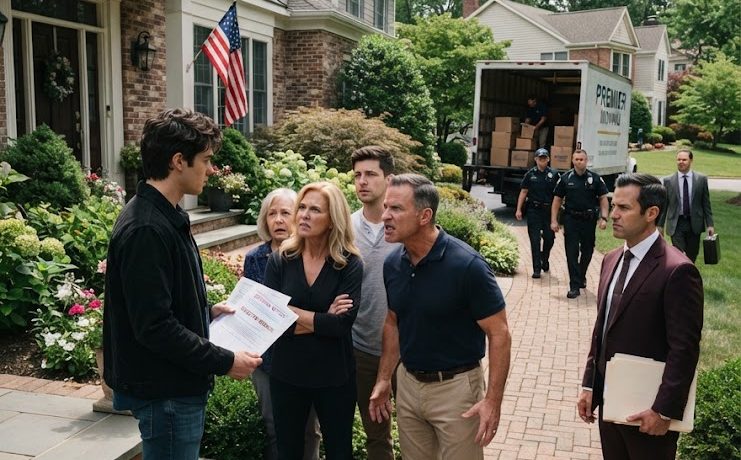
Two days later, I returned from the grocery store to find a moving truck parked in my driveway.
Two workers were carrying boxes marked CALEB—STUDIO EQUIPMENT.
For a moment, I genuinely thought they had the wrong house.
Then I noticed Caleb sitting on my porch swing, wearing sunglasses and sipping iced coffee as though the property belonged to him.
“What are you doing?”
He barely glanced in my direction.
“Taking what belongs to me.”
One of the movers looked toward me.
“You’re the property owner?”
“Yes.”
I pointed at the truck.
“Put everything back. He doesn’t live here.”
The mover looked uneasy.
“We’ve already unloaded half of it.”
“I don’t care. He’s trespassing.”
Caleb stood up.
“You think putting your name on a piece of paper makes you king? Mom and I were part of this family long before you started hovering around Grandpa.”
I stared at him.
“You barely visited them when they were in the hospital.”
“That’s not the point.”
It absolutely was.
I went inside, locked the door, and called the police.
They arrived within twenty minutes.
The movers were ordered to stop.
Caleb proudly pulled out the same ridiculous paperwork as before.
The officer looked at it and said,
“Sir, this appears to have been downloaded from a free template website. It isn’t enforceable.”
Caleb began arguing.
The officer warned him.
Eventually, Caleb left with the movers.
Before climbing into his car, he shouted,
“You just made a huge mistake, Evan.”
I remained in the driveway long after they were gone.
My chest felt tight.
My heart was racing.
Inside, I sat beneath my grandparents’ old clock on the floor and finally understood what was really happening.
They didn’t just want the house.
They wanted to remove me from its story.
They wanted to rewrite the past so that they were the devoted heirs and I was some opportunist standing in their way.
Worst of all, Mom appeared to believe her own version of events.
The woman who had raised me no longer looked at me as her son.
She looked at me as an obstacle.
The following day, I contacted a real lawyer.
His name was Jared Lancing.
Tall.
Sharp suit.
Quiet voice.
He spoke with the precision of a surgeon.
Jared went through everything.
The will.
The deed.
The fraudulent eviction attempt.
The moving truck.
Then he looked at me.
“You’re legally secure. They’re bluffing, and they’re doing a terrible job of it. But if you want this to stop, we should start creating a paper trail now.”
He recommended filing a protective order concerning the property harassment and notifying the county recorder’s office that fraudulent claims might be made involving the house.
“What happens if they keep escalating?” I asked.
Jared answered without hesitation.
“Then we’ll have evidence establishing a pattern.”
I followed his instructions.
Within days, local police knew about the dispute and had started making occasional checks on the property.
I didn’t tell Mom or Caleb.
Let them continue believing I was still the quiet younger brother who would eventually give in.
I was finished.
Four days later, they came back.
Again.
This time, they brought reinforcements.
I was eating leftover Thai food and watching an old episode of Frasier when I heard tires crunching over the gravel.
I looked through the window.
Another moving truck.
Caleb’s Mustang.
A silver sedan.
Mom stepped out wearing sunglasses even though the sky was overcast.
Beside her stood Uncle Frank.
I hadn’t seen him in years.
Frank was Grandpa’s younger brother.
When I was a kid, he was the “fun uncle.”
He gave me a Game Boy.
Let me watch movies I wasn’t supposed to watch.
But as I grew older, I discovered that the charm covered something else.
Shady loans.
Questionable business schemes.
Once, he even tried to sell one of Grandma’s antique jewelry boxes and claimed she had given him permission.
After that, he practically disappeared.
Now he was standing on my porch.
I didn’t open the door.
Caleb rang the bell twice.
Then he started pounding on it.
My phone buzzed.
Mom had sent me a text.
Come outside. Let’s make this easy.
Easy.
As if this entire mess were somehow mine to solve.
I called Jared.
“They’re back.”
“Who?”
“Mom. Caleb. Uncle Frank. Another truck.”
There was a brief pause.
“Call the police. I’m on my way over. Do not open that door.”
So I remained inside.
Through the glass, I could hear Caleb yelling.
“You’re squatting on a family asset! If you keep this up, you’re going to lose everything!”
Mom joined him.
“We’ll tell the court how you manipulated Grandpa. We’ll tell them you isolated him.”
That nearly made me laugh.
I had spent countless nights at the hospital with Grandpa.
Mom had spent some of those same weeks posting inspirational quotes from wellness retreats.
Then Frank tried taking a gentler approach.
“Come on, kid. You don’t want to go to war with your family. Walk away, and we’ll let you keep part of the inheritance.”
Let me.
Keep part of my own inheritance.
The entire situation felt like some awful stage play.
The police arrived roughly twelve minutes later.
Officer Reigns had already dealt with Caleb once.
He stepped out of his cruiser and said,
“I need everyone to leave the property.”
Mom immediately changed her tone.
“This is a family matter, officer. We have legal documents.”
He sighed.
“Ma’am, I’ve already seen those documents. The deed is in Evan’s name. You are trespassing right now. Please leave.”
Frank was the first to back off.
Caleb muttered something under his breath.
Mom turned toward the front door.
“You’ll regret this, Evan! Families don’t forget betrayal!”
Then they finally drove away.
That was what broke something inside me.
I thanked the officer.
Waited until everyone was gone.
Locked the door.
Then I completely broke down.
I sat on the kitchen floor and cried harder than I had in years.
Not because of the house.
Because I finally realized I had lost the family I had spent years hoping actually existed.
Somewhere deep down, I had always believed Mom might eventually value me more than money.
That Caleb might eventually calm down.
That if I explained things clearly enough, they would finally understand.
That illusion died right there on my kitchen floor.
For the next two days, I barely stepped outside the house.
I ignored messages.
Ignored work.
Barely slept.
The house suddenly felt enormous.
Every family photograph seemed to remind me that the people outside cared more about the building than they cared about me.
Around three in the morning on the third night, I wandered into Grandpa’s study.
I lowered myself into his old leather chair and opened a photo album.
Fishing trips.
Birthdays.
Christmas mornings.
Grandma smiling.
Grandpa holding an enormous fish.
Me sitting beside them.
Inside the front cover, Grandpa had written:
To Evan, may this house always be a home.
I cried again.
But this time, the feeling was different.
It wasn’t despair.
It was clarity.
I remembered why my grandparents had trusted me.
Not because I was smarter.
Not because I was somehow better than everyone else.
Because I had been there.
I sat beside Grandma even on days when she couldn’t remember who I was.
I helped Grandpa walk through his garden when his body was beginning to fail.
I showed up.
They hadn’t given me the house as some kind of reward.
They had left it to the person they trusted to take care of it.
The next morning, I began putting my life back together.
First, I replaced every lock.
Then I upgraded the security system.
Installed cameras.
Motion-activated lights.
A smart doorbell.
Nothing dramatic.
Just sensible precautions.
Then I turned my attention back to work.
I had been freelancing in digital marketing for years, but I had become comfortable.
I reached out to former clients.
Pitched new projects.
Within a week, I secured two new contracts.
One of them nearly doubled my monthly income.
Money meant options.
And after spending weeks feeling powerless, having options felt important.
Jared prepared a cease-and-desist letter stating clearly that any further harassment could result in litigation.
Then I began doing something even more important.
Living.
I joined a gym.
Enrolled in a cooking class.
Reconnected with my college friend Marcus.
He pulled me into trivia nights and weekend hikes.
I started accepting invitations.
Especially when part of me wanted to stay home and hide.
Slowly, the house began changing too.
I painted the living room a soft gray that Grandma would have loved.
Planted herbs outside.
Basil.
Mint.
Rosemary.
I adopted a three-legged mutt named Tucker.
Tucker barked like a security alarm whenever anyone came near the property.
He slept at the foot of my bed and snored like an old tractor.
For the first time since the inheritance mess began, I felt at peace.
Then a certified envelope arrived.
Inside was a letter from an actual law firm.
Caleb and Mom were contesting the will.
They claimed Grandpa had been manipulated.
They claimed I had isolated him.
They demanded the house, everything inside it, and even back rent for the period when I had supposedly denied them access to “family property.”
Now it was official.
They were suing me.
I called Jared.
“They filed.”
“I figured they might.”
“What happens now?”
His response was simple.
“Now we respond.”
I barely slept that night.
But fear wasn’t the main reason.
Something had finally become completely clear to me.
They had chosen court.
That meant facts would matter.
Documents would matter.
Dates would matter.
Evidence would matter.
No more emotional arguments.
No more Mom rewriting the past around the dinner table.
No more Caleb yelling louder and assuming volume made him right.
I turned Grandpa’s old oak desk into an evidence station.
The will.
The deed.
Tax receipts.
Insurance records.
Medical documents.
Hospital visits.
Text messages.
Emails.
Voicemails.
Everything went into organized folders.
Then Jared and I met.
He spent hours going through the case.
Finally, he leaned back in his chair.
“They don’t have much.”
“That’s good.”
“It’s better than good. Their claims actually give us opportunities.”
He wanted Caleb’s financial records.
If Caleb genuinely believed he owned a portion of the property, had he ever listed it as an asset?
Paid any taxes?
Covered insurance?
Contributed to maintenance?
Of course not.
Then Jared pulled out Grandpa’s hospital records.
I had been listed as the primary emergency contact.
I had signed his treatment paperwork.
Mom and Caleb had barely been present during his final weeks.
“We can find witnesses,” Jared said.
The hospice nurse remembered me.
So did the hospital staff.
Then Jared brought up something I had never heard about.
“A video.”
“What video?”
He almost smiled.
“The attorney who prepared your grandfather’s will contacted me. Apparently, Henry recorded a statement when he signed the final version.”
My throat went dry.
That afternoon, we went to the estate attorney’s office.
David Goldstein was in his late sixties, wore wire-rimmed glasses, and worked from an office that looked like it hadn’t changed since the 1980s.
He took an old USB drive from a drawer.
“Henry told me that if anyone ever challenged his decision, this should explain everything.”
He plugged it in.
Grandpa appeared on the screen.
He looked frail.
But his eyes were perfectly clear.
“If you’re watching this,” he began, “then something has probably gone wrong.”
He explained that he was mentally competent.
That he fully understood the will.
That nobody had pressured him.
Then he said words I will never forget.
“I’m leaving the house to Evan. Only Evan.”
He paused.
“Not because he asked for it. He never did. Because he was the person who kept showing up.”
Then he spoke directly to Mom.
And Caleb.
He explained that they had chosen not to be there when Grandma and Grandpa needed them.
He said Caleb needed to make his own way.
And that the house belonged to the person he trusted.
When the screen went black, I realized tears were running down my face.
“Can this be used in court?”
Goldstein looked at Jared.
Jared nodded.
“Absolutely.”
From that moment forward, I stopped feeling like I was trying to defend myself.
I was simply putting the truth on record.
We built a complete timeline of everything.
The fake legal documents.
The first moving truck.
The police report.
The second confrontation.
Mom’s texts.
Caleb’s threats.
Even an incident at a grocery store when he told me I was “squatting in his inheritance.”
Then I reached out to people who had known my grandparents.
Neighbors.
Church friends.
Their gardener.
The hospice nurse.
Stories started coming in.
One neighbor still had a note from Grandma mentioning that I had brought her tulips.
Their gardener remembered Grandpa talking about me.
Small details.
Nothing dramatic.
But together, they told a story.
A relationship.
A life.
Meanwhile, Mom’s new attorney proposed a settlement.
Equal division of the estate if I moved out within thirty days.
Jared answered with a single sentence:
My client declines.
Two days later, Mom left me a voicemail.
Her voice was cold.
“You think you’re better than us. You aren’t. You’re just hiding behind paperwork. Enjoy that empty house because no one will visit you when you’re old.”
I didn’t return the call.
I forwarded the voicemail to Jared.
Another piece of evidence.
The court hearing was scheduled for three weeks later.
I wore Grandpa’s navy suit.
The same suit he had worn in the video.
It needed a little tailoring, but I kept his small silver eagle pin on the lapel.
Jared met me outside the courthouse.
“You ready?”
I nodded.
“Yes.”
Inside, Mom and Caleb sat beside their attorney, Gregory Shaw.
He looked extremely confident.
The judge was Judge Kayla Stinson.
Short gray hair.
A direct manner.
The kind of person who looked like she had heard every terrible excuse imaginable.
Mom’s attorney spoke first.
He argued that Grandpa had been emotionally manipulated.
That I had isolated my grandparents.
That Mom and Caleb had been unfairly excluded from the estate.
Then Jared stood.
He didn’t raise his voice.
He simply said that we would present medical records, financial documents, witness testimony, and a direct statement from Grandpa explaining exactly why he had left the property to me.
The case continued for several hours.
First came the paperwork.
The will.
The notarized deed.
Proof that the debt had been paid.
The tax records.
Everything matched.
Then Caleb took the stand.
He portrayed himself as a devoted grandson who had unfortunately been unable to visit often because of work and personal difficulties.
He claimed I had deliberately damaged his relationship with Grandpa.
Jared allowed him to speak.
Then the cross-examination began.
“What was the last medication prescribed to your grandfather?”
Caleb blinked.
“I don’t remember.”
“What was the name of his primary physician?”
“I don’t know.”
“Who was his hospice nurse?”
Silence.
Jared remained composed.
“You testified that you had a very close relationship with him. Yet you cannot identify any of the people responsible for his care during his final months?”
Caleb glanced toward his attorney.
Then Anna took the stand.
Grandpa’s hospice nurse.
She spoke softly.
“Evan was there constantly. He took notes. Asked questions. Brought his grandfather coffee. Brought his grandmother crossword books.”
Jared asked,
“How often did you see the rest of the family?”
She paused.
“I don’t remember seeing them during that period.”
Then the video played.
Grandpa’s face appeared on the courtroom monitor.
The entire room fell silent.
He explained everything.
His mental condition.
His decision.
Why he trusted me.
Why he was leaving the house to me.
When the recording ended, even the judge remained quiet for several seconds.
Then she said,
“That is highly relevant evidence.”
But Jared wasn’t done.
He presented Mom’s messages.
The fraudulent notices.
The police reports.
Photographs showing damage from Caleb’s attempted move.
The invoices.
The threatening messages.
Then Jared filed a counterclaim citing harassment, interference with the property, legal expenses, and related damages.
Mom’s attorney objected.
The judge called for a recess.
Mom stormed into the hallway.
Caleb followed behind her.
I remained in my seat.
Ten minutes later, everyone returned.
Judge Stinson looked over her notes.
Then she spoke.
There was no convincing evidence that Grandpa had been pressured.
The will was valid.
The deed was valid.
The house legally belonged to me.
Mom’s attorney made one final request.
“Would the court consider some kind of shared-asset compromise?”
The judge cut him off.
“No.”
Then she turned her attention to Mom and Caleb.
Their repeated efforts to interfere with the property, falsely represent ownership, and harass me had created unnecessary legal expenses.
The court awarded $41,500 in damages.
That was slightly less than Jared had requested.
But far more than I had ever expected.
Then the judge closed the case.
It was finished.
Caleb later tried to delay paying.
Jared began the wage-garnishment process.
Mom sent one final message.
You turned your back on your family. Enjoy the house. Alone.
I never responded.
Not because I hated her.
Because I was finally exhausted from defending myself.
And she had been wrong about one thing.
I wasn’t alone.
I had Marcus.
I had neighbors who had quietly stood by me through everything.
I had Anna.
I had Tucker snoring beneath my desk.
And I had peace.
That weekend, I invited a few people over for dinner.
Nothing elaborate.
Six people.
Marcus brought wine.
Anna arrived with her husband.
Jared came by with his wife and child.
We grilled in the backyard beneath string lights I had finally put up.
At one point, I looked around.
People laughing.
Food spread across the table.
Tucker begging for scraps.
Warm light stretching across the yard.
And I realized something.
The house finally felt like home again.
Not because everything had gone back to the way it was when Grandma and Grandpa were alive.
It never could.
This was something different.
A new home built from old memories and new relationships.
Later that night, after everyone had gone, I locked the doors and switched off the lights.
As I walked past Grandpa’s study, I stopped.
His photograph was sitting on the shelf.
I looked at it and smiled.
“You were right,” I whispered.
“They didn’t win.”
Then I went upstairs.
For the first time in a very long while, the hallway felt peaceful instead of threatening.
The house was quiet.
The future finally felt like mine.
And that night, I slept without checking the windows.