 78 views
 For four years, my husband refused to let me throw away one particular box in our garage.
There was nothing remarkable about it.
It was simply an ordinary cardboard produce box, the kind grocery stores use to carry bananas.
Across one side, I had written a single word in thick black marker:
NEWBORN.
Inside were a handful of swaddle blankets, two tiny sleepers, socks small enough to fit a doll, and a knitted baby hat roughly the size of an orange.
The box rested on a metal shelf above James’s workbench, squeezed between a coffee can filled with screws and a case of drill bits.
Every few months, I would head into the garage looking for something and notice it sitting there.
And every time I saw it, I felt the same faint ache in my chest.
“We should donate those things,” I would tell James.
“Someone at church could use them. Or the women’s shelter. Somewhere out there is a mother who actually needs all of this.”
James always gave me the same response.
“Next month.”
He never argued with me.
He simply said it softly, with a final tone that made it obvious the conversation was finished.
But next month never arrived.
Then, on the last Saturday in April, I decided I had waited long enough.
Our three boys were at soccer with their grandfather.
James was working at a job site across town.
The house was unusually peaceful.
I went into the garage, brought over the step stool, climbed up, and pulled the box down.
I sat there with it balanced on my lap.
Then I opened it.
The first scent that reached me was cedar from the blocks I had placed inside years ago.
Beneath that was something faint.
Baby soap.
I lifted the tiny pink hat.
It fit entirely inside my palm.
I remembered exactly where I had purchased it.
At a craft fair seven years earlier.
I had been pregnant with our second child, Owen, and we hadn’t learned whether we were expecting a boy or a girl.
The woman who had knitted the hat must have been about eighty.
She held it up and asked,
“Girl?”
“We don’t know yet.”
She smiled.
“Buy it anyway.”
I laughed.
“What if it’s a boy?”
“Hats have a funny way of finding the right head.”
Owen turned out to be a boy.
Three years later, Sam was a boy too.
The hat went into the box.
The box went onto the shelf.
And eventually, James and I stopped talking about the daughter we had once imagined.
I was sitting there turning the little hat around in my hands when I heard his truck pull into the driveway.
James had come home early.
He walked in through the side garage door wearing his work boots, with sawdust still clinging to his shoulders.
Then he saw me.
The box was open on my lap.
He stopped immediately.
“What are you doing?”
“I’m donating it.”
He stared at me.
“James, it’s time.”
He didn’t answer.
Instead, he walked over and carefully took the box from my hands.
He placed the hat back inside.
Folded the cardboard flaps shut.
Climbed onto the stool.
And put the box back on the shelf.
“Not yet.”
I stared at him.
“Why?”
He kept one hand resting on the shelf.
“We’re not having a daughter. We already decided that. You were the one who said we had to stop.”
“I know.”
“Then why are you keeping this?”
His back remained turned toward me.
For a long moment, he didn’t move.
Finally, he said,
“Just not yet.”
Then he went inside to take a shower.
I stayed in the garage, staring up at that box and wondering what my husband was keeping from me.
I didn’t know it then.
But that was three weeks before the phone call that would change everything.
My name is Rachel.
James and I have been married for eleven years.
We have three sons.
Caleb is nine.
Owen is seven.
Sam is four.
They are noisy, messy, constantly hungry, endlessly energetic, and absolutely wonderful.
Shoes are always left in the middle of the hallway.
Someone always wants the last pancake.
They come inside covered in mud and look genuinely offended when I tell them to take their filthy clothes off on the porch.
I love those boys more than I could ever put into words.
I need to make that clear first.
Because what I’m about to tell you isn’t about wishing any of them had been different.
But I had always dreamed of having a daughter.
I think that dream started with my grandmother.
Grandma June.
My mother struggled with problems while I was growing up.
The kind of problems families often avoid talking about.
So Grandma June raised me for much of my childhood.
She was tiny, loud, funny, and spent twenty-two years working in my elementary school cafeteria.
She knew every child by name.
She also knew exactly which children arrived at school without money for lunch.
Somehow, those children always received an extra roll or another scoop of food without ever being made to feel embarrassed.
Every night before bed, Grandma brushed my hair.
One hundred strokes.
Then she braided it into a single long braid down my back.
As her hands worked, she told me stories.
Stories about Kansas.
Her mother.
Life on the farm.
Church picnics.
The afternoon my grandfather accidentally spilled lemonade across the dress she had spent months saving up to buy.
Sometimes she would tell me,
“One day, Rachel, you’ll have a little girl.”
Then she would gently pull on the end of my braid.
“You’ll braid her hair and tell her stories about me. That’s how I’ll stay around forever.”
Grandma June died when I was nineteen.
A heart attack.
She had been standing in her kitchen with soup cooking on the stove.
At her funeral, I stood beside her casket and made a quiet promise.
Someday, I would have a daughter.
And I would name her June.
I had chosen the name long before I met James.
Long before I had even met someone I wanted to marry.
June.
No middle name.
Grandma always said middle names were unnecessary.
“Nobody uses them unless you’re in trouble.”
When James and I were dating, I told him the story.
Our third date.
He didn’t laugh.
He simply nodded.
“June is a good name.”
Then he considered it for a moment.
“Strong name. Like a month nobody argues with.”
That might have been the moment I realized I was going to marry him.
Caleb came first.
I was twenty-eight.
The pregnancy was difficult.
I was sick nearly all the time.
Labor lasted thirty-one hours.
Eventually, Caleb’s heart rate dropped, and the doctors performed an emergency C-section.
But Caleb was born healthy.
Loud.
Perfect.
And screaming like a smoke alarm.
Two years later, Owen arrived.
That pregnancy was more difficult.
My blood pressure rose to dangerously high levels.
I spent the final six weeks on bed rest.
He arrived early through another C-section.
I lost a significant amount of blood.
While holding my hand in recovery, James said,
“Maybe we stop at two.”
He looked pale.
“Maybe two is enough.”
“I want one more.”
He looked at me.
I didn’t need to explain what I meant.
One more chance.
One final possibility for June.
Three years later, Sam was born.
And I nearly died.
There are parts of that day I can’t remember.
Chest pain.
A nurse suddenly looking frightened.
Someone yelling something I couldn’t make out.
Doctors rushing into the room.
Then nothing.
I woke two days later in intensive care.
A tube was down my throat.
James was asleep in a chair beside me, his head resting against my bed.
The doctors explained everything afterward.
Placental abruption.
Severe hemorrhaging.
My blood pressure collapsed.
For almost a minute, they couldn’t find a pulse.
They brought me back.
They saved Sam too.
He remained in the NICU for eleven days.
Then he came home crying just as loudly as his two brothers had.
Six weeks later, I went in for my postpartum appointment.
Dr. Levine had been my doctor throughout all three pregnancies.
She was kind but straightforward.
She never wasted words.
Before I had even taken my seat, she asked,
“Is James here?”
“He’s downstairs with Sam.”
“Go get him.”
My stomach sank.
“I’d rather both of you hear this together.”
James came upstairs carrying Sam’s car seat.
He set it on the floor and sat beside me.
Dr. Levine folded her hands.
“I’m going to be completely direct.”
She explained what had happened.
Three C-sections.
Scar tissue.
My blood pressure.
The damage to my heart.
The hemorrhage.
Then she said the sentence I still sometimes hear when I wake in the middle of the night.
“A fourth pregnancy would probably kill you.”
Probably.
Not might.
Not there’s a chance.
Probably.
“And even if it didn’t,” she continued, “you would likely spend much of the pregnancy in the hospital. You’d be separated from the three children you already have.”
Sam made a soft squeaking sound from his car seat.
I asked,
“Is there any possibility that another pregnancy could be safe?”
“No.”
I asked again months later.
Then I asked once more the following year.
Specialists?
New treatments?
Constant monitoring?
Her answer remained the same.
No.
On the drive home from that first appointment, James left the radio off.
Both hands remained firmly on the steering wheel.
He kept his eyes fixed ahead.
When we arrived home, he carried Sam upstairs and settled him into his crib.
Then he returned to the kitchen.
He stood behind me.
Wrapped both arms around me.
And held me tightly.
“I almost lost you.”
His face rested against my hair.
“I can’t go through that again, Rach.”
“I know.”
“The boys need you.”
“I know.”
That night, after everyone had gone to sleep, I went out to the garage.
I found an empty banana box.
Inside, I put everything I had ever purchased for the daughter we had once hoped we might have.
The pink hat.
A white sleeper decorated with yellow ducks.
Three floral swaddles.
Tiny socks.
I added cedar blocks.
Then I wrote NEWBORN across the side.
I intended to donate it the next day.
But when I came back inside, James was standing in the kitchen.
He had watched me through the window.
“What’s in there?”
“Old baby clothes.”
“What are you going to do with them?”
“Give them away.”
He stared at the box.
Then he took it from my hands.
“Let me keep it.”
“For what?”
He didn’t respond.
He carried the box into the garage and set it above his workbench.
That was four years ago.
When Sam was two, I brought up adoption.
It was late.
James was nearly asleep.
I stared up at the ceiling.
“Do you ever think about adopting?”
He stayed quiet for a while.
“Sometimes.”
“We could look into it.”
He turned toward me.
“Rach, we already have three kids under seven.”
“I know.”
“We have a mortgage. You still wake up from nightmares about Sam’s birth.”
He reached beneath the blankets and found my hand.
“Our boys need their mother more than we need a daughter.”
He was right.
And that was the hardest part.
So we stopped bringing it up.
Not because the dream had vanished.
Because sometimes a subject in a marriage doesn’t truly end.
You simply reach an unspoken agreement not to touch it anymore.
You go to soccer games.
School conferences.
Parties.
You watch superhero movies until everyone falls asleep on the couch.
Life keeps moving.
But sometimes I would see a woman braiding her daughter’s hair while waiting in a grocery store line.
And I would have to step into another aisle for a minute.
The box stayed above James’s workbench.
There’s something else you need to know.
James had a younger sister.
Mara.
She was twelve years younger than him.
Their father left when James was fourteen and Mara was two.
Their mother worked long shifts at a nursing home.
So, in many ways, James raised Mara.
He changed her diapers.
Walked her to kindergarten.
Taught her how to ride a bike.
When nightmares woke her, she went to James’s room.
Not their mother’s.
Mara was fourteen when I met her.
Sharp.
Funny.
A little reckless.
Purple streaks in her hair.
A nose ring she kept hidden from her mom.
She thought I was boring.
I adored her.
Then, around nineteen, Mara started taking pills.
It began after a car accident.
She injured her back.
A doctor prescribed pain medication.
The prescription ran out.
The dependence remained.
Within a year, she had gone from being an art student to sleeping on couches and calling James at two in the morning to ask for money.
James tried everything.
Money.
Rehab.
Late-night rescues.
Two treatment programs.
She left both before finishing them.
Then came Thanksgiving eight years ago.
James begged me to invite Mara.
“She says she’s doing better.”
I finally agreed.
She seemed almost normal.
Thin.
Restless.
But funny.
She sat on the living-room floor building Legos with toddler Caleb.
Helped with the dishes.
Complimented my stuffing.
The following morning, Grandma June’s ring was gone.
It was the only thing of hers I still had.
A thin gold band.
One dark red garnet set in the center.
My grandfather had given it to Grandma on their wedding day.
It wasn’t worth much in monetary terms.
Maybe a couple hundred dollars.
To me, it was priceless.
I kept it in the same structure and removed the link/artifact text:
I kept it in a small dish on my dresser.
The dish was empty.
I searched everywhere.
Under the furniture.
Inside drawers.
Coat pockets.
Across the carpet.
James searched too.
He didn’t say a word.
But I saw his expression.
He already knew.
That afternoon, he drove to Mara’s apartment.
Two hours later, he returned home.
He sat down on the edge of our bed.
Covered his face with his hands.
“She sold it.”
I couldn’t say anything.
“Pawn shop on Fourth Street.”
“How much?”
“Sixty dollars.”
Sixty dollars.
For the last thing I had left from Grandma June.
“Did you get it back?”
He shook his head.
“They’d already sold it.”
Something inside me broke.
I said the cruelest words I have ever spoken to my husband.
“I never want her inside this house again.”
“Rachel—”
“I never want her anywhere near our children.”
“Please—”
“As far as I’m concerned, you don’t have a sister anymore.”
James looked at me.
His face was covered in tears.
“It’s her or me.”
Even now, I hate thinking about those words.
I had made him choose between his wife and the little sister he had practically raised.
But I was furious.
Heartbroken.
The ring was gone.
I needed someone to blame.
James chose me.
For eight years, he never spoke to Mara.
At least, not as far as I knew.
Their mother died four years later.
Mara didn’t come to the funeral.
No one knew where she was.
One night James said,
“She’s probably dead.”
He said it almost without emotion.
Then he went into the garage and remained there until two in the morning.
So that became our life.
Eleven years of marriage.
Three sons.
One box above the workbench.
One sister whose name no one ever mentioned.
Then, five months before that phone call, James began acting strangely.
It started with phone calls.
His phone would ring.
He would glance at the screen.
His expression would shift.
Then he would say,
“Client.”
And step outside.
Then there were Tuesdays.
James was a finish carpenter.
Custom cabinetry.
Built-ins.
Staircases.
His work hours had always been predictable.
Home before five.
Suddenly, every Tuesday, he wouldn’t get home until eight or nine.
“Big project in Millbrook.”
Apparently, the client could only meet at night.
Then I began noticing money.
A hundred dollars.
Two hundred.
The amounts weren’t huge, but they were unusual.
“Materials,” he said.
He became distracted.
Exhausted.
Sometimes he would sit in his truck after getting home, the engine turned off, staring straight ahead.
One night around three, I woke up and realized his side of the bed was empty.
I found him in the garage.
Standing beneath the light.
Staring up at the box.
“James?”
He jumped.
“What are you doing?”
“Couldn’t sleep.”
Then he turned off the light.
“Come on.”
I barely slept after that.
I hate admitting what I started to suspect.
I thought he was having an affair.
Secret phone calls.
Late Tuesdays.
Unexplained money.
That distant look in his eyes.
Everything seemed to point in the same direction.
My best friend Dana told me to check his phone.
“I can’t.”
“Why?”
“Because if I’m wrong, I’ll have betrayed him.”
“And if you’re right?”
I couldn’t finish the thought.
I never checked.
Partly because James had always been the most honest person I knew.
Once, a cashier accidentally gave him five dollars too much change.
James drove forty minutes back just to return it.
But honest people can still keep secrets.
Sometimes they hide things for reasons you could never imagine.
The call came on a Tuesday in May.
A little after two.
I was cleaning the kitchen.
Sam was at preschool.
The older boys were still in class.
The radio was playing.
I was scrubbing dried oatmeal from a pot.
Then my phone rang.
James.
He almost never called while he was working.
He texted instead.
Short messages.
Running late.
Need milk?
Love you.
But he wasn’t texting.
He was calling.
I answered immediately.
“Is everything okay?”
For several seconds, the only thing I heard was his breathing.
Fast.
Uneven.
“Rach.”
“What happened?”
“I need you to come here.”
“Where?”
“I’m okay.”
“Are you hurt?”
“No. But…”
He took another breath.
“There’s a baby here.”
The water was still running.
The radio was still playing.
But everything else seemed to vanish.
“James.”
Silence.
“Whose baby?”
“Please just come.”
“Whose baby?”
“I can’t explain this over the phone.”
His voice cracked.
“I need you here.”
He gave me the name of the hospital.
St. Anne’s.
Across the river.
Forty minutes away.
Not the hospital we usually went to.
And nowhere close to Millbrook.
“I’ll call Dana to get the boys.”
“Rach—”
“What?”
He hesitated.
“Just drive carefully.”
Then the call ended.
I shut off the faucet.
Turned off the radio.
Called Dana.
Asked her to pick up all three boys.
“What happened?”
“I don’t know.”
I drove to the hospital wearing an old gray T-shirt stained with bleach.
Yoga pants with a hole in one knee.
Oatmeal on my sleeve.
And throughout the entire drive, the same thoughts kept racing through my mind.
Tuesdays.
The calls.
The money.
Millbrook.
There’s a baby here.
By the time I pulled into the parking lot, I had convinced myself of the worst explanation possible.
Another woman.
James’s baby.
And now he had called me because there was no longer any way to keep it hidden.
I sat behind the wheel, trembling, for five minutes.
Then I went inside.
The maternity ward was located on the fourth floor.
A young nurse at the front desk looked up when I gave her my name.
Her expression immediately softened.
“He’s at the end of the hall.”
I walked past rooms covered in balloons.
IT’S A GIRL.
IT’S A BOY.
Babies cried.
Families laughed.
Someone loudly announced a newborn’s weight over the phone.
Then I saw James.
At the very end of the hallway.
He was still wearing his tan work coat.
Sawdust clung to the sleeves.
He stood against the wall as though the building itself was keeping him upright.
He looked at me.
His eyes were red.
In eleven years, I had barely ever seen James cry.
Not when his mother died.
Not when Sam was rushed into the NICU.
Not even when the doctors were fighting to save my life.
But now tears were streaming down his face.
Behind him was a room with a large window.
Through the glass, I could see part of a hospital bassinet.
A striped blanket.
And one tiny fist lifted into the air.
“James.”
He stepped toward me.
“Whose baby is that?”
“Sit down.”
“No.”
“Rach—”
“Tell me whose baby that is.”
My legs gave way before my anger could.
I sat on the bench facing the nursery window.
James sat beside me.
He didn’t reach for me.
Instead, he leaned forward and covered his face.
“Her name is Mara.”
For a moment, I thought he was talking about the baby.
Then I understood.
“Mara?”
He nodded.
“Your sister?”
Another nod.
“The baby is Mara’s?”
“She had her this morning.”
His voice trembled.
“6:14.”
He swallowed.
“Six pounds, eleven ounces.”
I looked through the window.
A girl.
Then I turned toward my husband.
“Tuesdays.”
He looked directly at me.
“Tuesdays.”
Then he told me everything.
Mara had called him in December.
It was a number James didn’t recognize.
He almost let the call go unanswered.
When he picked up, she said,
“Jimmy. It’s me.”
Then she said,
“I’m clean.”
Fourteen months.
And she was pregnant.
She had been staying in a sober home.
Six women.
A house manager.
A curfew.
Drug testing.
Daily meetings.
She worked at a laundromat.
The baby’s father was gone.
Mara wanted nothing to do with him.
She was terrified.
“She said I was the only person who had ever truly taken care of her,” James told me.
So he began taking care of her again.
Every Tuesday.
Prenatal appointments.
Groceries.
Vitamins.
Clinic visits.
Ultrasounds.
“The money?”
“Food. Medicine. Clinic fees. A crib mattress.”
“The calls?”
“Mara.”
He wiped his face.
“She called every night. She said talking to me helped keep her from using.”
“Why didn’t you tell me?”
His expression crumpled.
“Because you told me I didn’t have a sister anymore.”
I looked away.
“And because Mara begged me not to tell you.”
“Why?”
“She thought you would hate her.”
His voice cracked.
“She said she would rather lose me all over again than have you find out and hate her.”
James had wanted to tell me.
Every Tuesday, he would come home and sit in the driveway, trying to figure out how to say it.
And every Tuesday, he remembered the look on my face the morning Grandma’s ring vanished.
Then I thought about the box.
“The baby clothes.”
James went completely still.
“You knew?”
“No.”
He quickly shook his head.
“No. I swear.”
“Then why did you keep it?”
He stared down at his hands.
“Because I couldn’t let it go.”
“What?”
“June.”
The daughter we never had.
“Every time you talked about giving that box away, it felt like burying her.”
He gave a single laugh.
It sounded shattered.
“I know it sounds ridiculous.”
“It doesn’t.”
The words came out before I realized I truly meant them.
Behind the glass, the baby’s tiny hand opened.
Closed.
Then opened again.
“Where’s Mara?”
James’s expression changed.
“She’s upstairs.”
“What floor?”
“ICU.”
The delivery had initially gone well.
Long.
Difficult.
But safe.
The baby was born crying.
Mara held her for twenty minutes.
She counted every finger.
Every toe.
James was the only person there.
Then Mara started bleeding.
Hemorrhage.
Just like me.
Doctors rushed her into surgery.
Her blood pressure plummeted.
Her kidneys began failing.
She was sedated and put on a ventilator.
“The doctor says the next twenty-four hours are critical.”
I closed my eyes.
I remembered machines breathing for me.
James asleep beside my hospital bed.
Then I pictured Mara.
Twenty-four years old.
Lying there alone.
“She made me promise something before surgery,” James said.
I opened my eyes.
He took both of my hands.
They were shaking.
What he told me next is something I still find difficult to repeat.
“Mara wants to know if you’ll raise her baby.”
I stared at him.
“If she dies tonight, she wants us to take her.”
My chest tightened.
“And even if she survives…”
James started crying harder.
“She still wants us to raise her.”
“Why?”
“She says she isn’t ready. She says she loves the baby too much to risk her future.”
He squeezed my hands.
“She said you’re the best mother she’s ever known.”
I couldn’t breathe.
Then he said,
“And she wants to know if you’ll let her name the baby June.”
I don’t remember what I said.
James says I stood.
Walked over to the nursery window.
Placed both hands against the glass.
The baby was lying in a plastic bassinet, wrapped in the hospital’s striped blanket.
Tiny.
Red-faced.
Dark hair poking out from beneath a white cap.
That hair.
Long enough to braid someday.
An older nurse came over.
“She’s a good baby.”
I barely registered her words.
“Can I hold her?”
The nurse looked at James.
He nodded.
“Come on, Mama.”
Mama.
She knew nothing about us.
Yet somehow, that word almost shattered me.
I washed my hands.
The nurse lifted the baby.
Placed her in my arms.
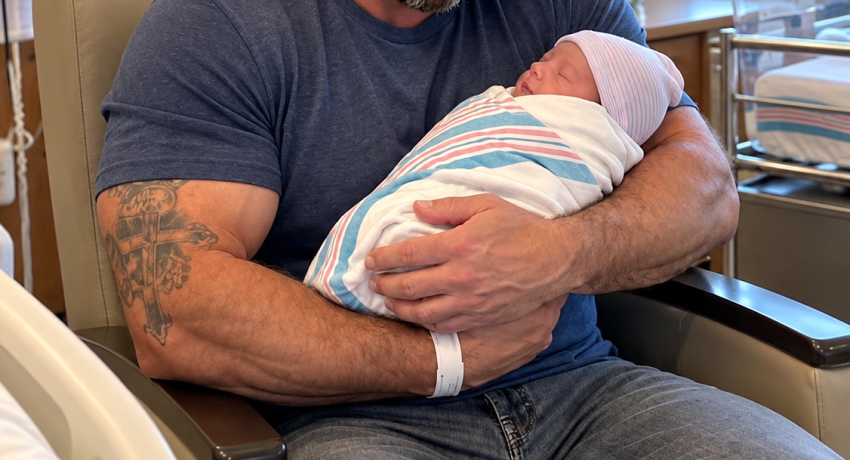
After raising three boys who had all been large newborns, this little girl felt almost weightless.
Like holding a bird.
She stopped fussing.
Opened her dark newborn eyes.
Then her tiny hand closed around the front of my stained gray shirt.
And held on.
I began to cry.
Not quietly.
Not gracefully.
Every tear I had held back after Dr. Levine said probably.
After putting the box away.
After Grandma June died.
All of it came pouring out at once.
James stood behind me.
Wrapped his arms around both of us.
His coat smelled of sawdust.
“Hi, June,” he whispered.
I didn’t correct him.
Then I asked to see Mara.
James tried to stop me.
“You don’t have to.”
“Yes.”
I did.
The ICU was on the sixth floor.
When the nurse asked whether I was family, James and I answered together.
“Yes.”
Mara’s room looked painfully familiar.
Machines.
Beeping.
Pale walls.
Ventilator.
An empty chair beside the bed.
She looked nothing like the girl I remembered.
The last time I had seen Mara, she had been thin and restless.
Hollow cheeks.
Bitten nails.
Eight hours after sitting on my floor building Legos with Caleb, she had sold my grandmother’s ring.
The woman lying in the hospital bed looked healthier.
Fuller face.
Clear skin.
Long dark hair.
Someone had brushed it and arranged it over her shoulder.
She looked like James.
I sat down.
I didn’t know what to say.
She was sedated anyway.
On the table beside her bed sat a plastic bag filled with her belongings.
Hair tie.
Recovery bracelet.
A small silver keychain.
And a tiny dark-blue velvet pouch.
James gestured toward it.
“She told me to give you this if something happened.”
I opened the pouch.
Something fell into my palm.
A thin gold ring.
One dark garnet in the center.
I stopped breathing.
Grandma June’s ring.
“How?”
James explained.
After Mara got clean, she returned to the pawn shop.
She asked for records.
She spent nearly two years tracking down the people who had purchased jewelry that week.
Eventually, she located the woman who had bought Grandma’s ring.
An older woman had given it to her granddaughter for her sixteenth birthday.
Mara went to their home.
She told them everything.
Her addiction.
Thanksgiving.
My grandmother.
The ring.
She offered every dollar she had saved.
Three hundred and forty dollars.
“The woman wouldn’t take it.”
“What?”
“She gave the ring back.”
“Why?”
James swallowed.
“She said a family ring belongs with the family it was made for.”
I stared at it.
Eight years.
I had believed it was gone forever.
“She’s had it since January,” James said.
“She wanted to give it to you herself after the baby was born.”
He looked toward Mara.
“She wrote you a letter too.”
I slipped Grandma’s ring onto my finger.
It still fit.
Then I reached for Mara’s hand.
“You have to wake up.”
The ventilator continued breathing for her.
“You hear me?”
No response.
“I’m not raising your daughter without you.”
The machines continued beeping.
“She has your hair.”
My voice cracked.
“You have to teach me how to braid it.”
I stayed there all night.
James moved back and forth between the ICU and the nursery.
Around two in the morning, he returned covered in formula.
He sat on the floor beside my chair.
Rested his head against my knee.
And fell asleep.
I held Mara’s hand.
Every hour, I whispered,
“Please wake up.”
At 5:47, just as dawn began turning the hospital windows gray, her fingers moved.
Three days later, the doctors removed the breathing tube.
Her kidneys began improving.
On the fourth day, she was moved out of intensive care.
The first thing Mara asked was,
“Where is she?”
James answered.
“Nursery. She’s perfect.”
Tears rolled into her hair.
Then she saw me standing in the doorway.
Fear crossed her face.
“Rachel.”
I sat beside her.
For a long time, neither of us said anything.
Then I lifted my hand.
Grandma June’s ring was on my finger.
Mara’s chin trembled.
“I’m sorry.”
Her voice was rough.
“I’m so sorry.”
“Mara—”
“I know it doesn’t make it right. I know I can’t undo what I did.”
“Mara.”
“I was sick. I don’t even remember taking it. That’s the worst part.”
“Mara, stop.”
She went still.
“You’re going to make me cry again.”
She stared at me.
“And I’ve been crying for four days. I’m dehydrated. The nurses are probably going to admit me next.”
A broken laugh slipped out of her.
Then I told her I had read the letter.
Four pages.
Careful handwriting.
She told me about addiction.
The pawn shop.
Recovery.
The laundromat.
Finding the ring.
And watching me with the boys years earlier.
At the end, she had written that she loved her baby enough to admit she wasn’t ready to be the parent her baby needed.
She wanted the child to have stability.
Brothers.
A mother who could show up every day.
She wanted her daughter to have me.
And she knew about Grandma June.
James had told her the story years ago.
She asked whether the baby could carry the name.
I looked at Mara.
“If James and I adopt her, you’re not disappearing.”
Mara stared at me.
“You hear me?”
She started crying.
“You’re her mother.”
I continued.
“I’ll be her mom. But you will always be her mother.”
Her mouth trembled.
“She will know who you are.”
I took her hand.
“She’ll know your name. Your face. Your story.”
Mara covered her mouth.
“You will come to birthdays.”
She cried even harder.
“Christmas.”
I squeezed her fingers.
“If you want to be part of her life, you’re going to be part of mine too.”
She couldn’t speak.
“And you’re going to stay clean.”
She nodded.
“Because she needs you.”
Another nod.
“And I need you.”
I managed a weak smile.
“I already have three boys and a husband who keeps cardboard boxes for four years. I need backup.”
Mara laughed through her tears.
“Okay.”
“One more thing.”
“Anything.”
“You’re going to teach me how to braid hair.”
She blinked.
“I don’t know how.”
“You have all that hair.”
“I put it in a bun.”
I stared at her.
“Well, then we’re both going to learn.”
Eight days later, we brought June home.
The legal process was anything but easy.
Social workers.
Temporary guardianship.
Court paperwork.
Home evaluations.
Eventually, kinship adoption proceedings.
A wonderful social worker named Mrs. Delgado came to inspect our home.
During the visit, Sam tried to show her every rock he owned.
One at a time.
Meanwhile, Caleb and Owen ran around the house chasing each other with foam swords.
Mrs. Delgado raised an eyebrow.
“Is it always this noisy?”
“No.”
I smiled.
“It’s usually worse. They’re behaving because you’re here.”
She laughed.
Her final report described us as a loving, energetic, stable household.
Before June came home, we gathered the boys around the kitchen table.
James explained that Aunt Mara had a baby.
Mara was sick.
And the baby would be coming to live with us as their sister.
Caleb frowned thoughtfully.
“Is she taking my room?”
“No.”
“Oh.”
He nodded.
“Okay then.”
Owen wanted to know when she could play soccer.
“She’s a newborn.”
“How small?”
“About the size of a loaf of bread.”
His eyes widened.
“So… not goalie yet?”
“Not yet.”
Sam stayed quiet.
He climbed down from his chair.
Wrapped both arms around my leg.
“Will she be your baby?”
“Yes.”
He buried his face against my knee.
“Am I still your baby?”
I lifted him into my lap.
Even though his legs were becoming far too long for it.
“You’ll always be my baby.”
“Even if there’s another baby?”
“Always.”
Then he looked up at me.
“Can I hold her?”
“Tomorrow.”
That night, once the boys were asleep, James and I went into the garage.
He pulled over the step stool.
Reached up.
And took down the box.
For the first time in four years, he willingly handed it to me.
I opened it.
Cedar.
Baby soap.
The blankets.
Sleepers.
Tiny socks.
And the little pink hat.
I held it in my palm.
The craft-fair woman’s words returned to me.
Hats have a way of finding the right head.
James sat beside me.
“I’m sorry.”
“For what?”
“The Tuesdays.”
He stared down at the floor.
“Mara. The lies.”
“I know.”
“I should have told you in December.”
“Yes.”
“I should have trusted you.”
“You should have.”
Then I sighed.
“But I don’t know whether I would have handled it well.”
He looked at me.
“If you had come home in December and told me Mara was back, pregnant, and needed you…”
I swallowed.
“I might have made you choose again.”
James said nothing.
“I’m sorry too.”
“For what?”
“For making you choose eight years ago.”
I looked down at Grandma’s ring.
“You raised her.”
He squeezed my hand.
“You were hurt.”
“I was.”
I looked at him.
“But being hurt didn’t make everything I said right.”
James slowly nodded.
“We both made mistakes.”
“Yeah.”
“But we got here.”
I looked toward the empty shelf.
“Tell me the real reason you kept the box.”
He was silent.
Then he said,
“When Dr. Levine told us another pregnancy would probably kill you, I sat alone in the hospital parking lot.”
He stared at his hands.
“I made a deal with God.”
I waited.
“I said I would give up the daughter.”
His voice shook.
“I’d give up June.”
He swallowed.
“I’d never ask again.”
Tears filled his eyes.
“Just let me keep Rachel.”
I stopped breathing.
“Let our sons keep their mother.”
He rubbed his face.
“I meant it.”
Then he glanced toward the box.
“But giving those things away felt like admitting I had completely stopped hoping.”
He gave a quiet laugh.
“I guess I never really did.”
I leaned against his shoulder.
“He was listening.”
June came home on a rainy Thursday.
James carried her in from the car.
All three boys were squeezed together at the front door.
“Quiet,” I warned.
They were not quiet.
They were never going to be quiet.
But they were gentle.
Caleb held her first.
Sitting perfectly straight.
A pillow tucked under his arm.
Thirty seconds later, he said,
“My arm’s tired.”
But I noticed how carefully he watched her.
Owen held her next.
He whispered nonstop.
Later, I asked what he had been saying.
“Soccer rules.”
“Why?”
“So she’ll be ready.”
Sam held her last.
He sat on my lap while I supported both of them.
He stared at her.
“She’s tiny.”
“She is.”
“Was I that tiny?”
“Smaller.”
He leaned forward.
Kissed her forehead.
Right beneath the pink knitted hat.
“Hi, June.”
Then he whispered,
“I’m your brother. I have rocks.”
After she recovered from the hospital, Mara entered a long-term treatment program.
Six months.
Strict schedule.
Counseling.
Recovery meetings.
She called every Sunday.
Sometimes she cried.
Sometimes she hardly spoke.
Sometimes she only asked me to put the phone close to June so she could hear her daughter breathing.
I sent pictures every day.
June sleeping.
Bath time.
Sam showing her his rock collection.
June wearing the pink hat.
By six weeks, the hat was already too small.
Mara printed every picture.
When James and I visited months later, her wall was covered from floor to ceiling.
Women in the program would walk past and ask about the pictures.
Mara always answered proudly.
“That’s my daughter.”
Then she pointed.
“That’s her mom.”
“That’s her dad.”
“Those are her brothers.”
No shame.
Only love.
I stood there looking at this young woman who had spent so much of her life battling herself.
And I understood something.
Giving June to us wasn’t easy for Mara.
It may have been the hardest thing she had ever done.
She loved her daughter enough to choose what she believed was right for her, even though it hurt.
I’m not sure I could have done the same.
The adoption became final the following spring.
On a Tuesday.
Of course it was a Tuesday.
We all went to the courthouse.
James wore his one good suit.
The boys complained about their button-down shirts.
Sam kept taking off his clip-on tie.
June was ten months old.
White dress.
Little yellow ducks on the collar.
Mara came too.
By then, she had been out of treatment for eight months.
Clean for two and a half years.
She had her own small apartment above a bakery.
She worked at a daycare.
And she wore a blue dress with her hair braided.
Badly.
We had been learning together.
Neither of us had gotten much better.
The judge was older.
White beard.
Half-moon glasses.
He looked over the paperwork.
Then he turned toward Mara.
“You are the birth mother?”
“Yes, sir.”
“And you support this adoption?”
“Yes.”
“Would you like to say anything?”
Mara stood.
She was trembling.
I took her hand.
“I’m not giving my daughter away.”
The entire courtroom became silent.
“I want that to be understood.”
Her voice cracked.
“I’m giving her to someone.”
She looked at me.
“There’s a difference.”
I started crying.
“I’m giving her to the best family I know.”
She squeezed my hand.
“And they’re allowing me to remain part of it.”
The judge took off his glasses.
Wiped them against his robe.
Then he signed.
“From this day forward, this child shall be legally known as June Hale.”
He smiled.
“Congratulations to the entire family.”
The gavel came down.
Sam jumped to his feet.
“WE WON!”
Everyone laughed.
Even the judge.
That night, I sat beside June’s crib.
She was sleeping with her arms stretched above her head.
Her dark hair had grown longer.
Long enough now.
Beside the crib stood a rocking chair James had built himself from cherry wood.
On the back, he had carved one word.
June.
Grandma’s garnet ring caught the soft glow of the nightlight.
I remembered the brush.
The hundred strokes.
Grandma’s hands moving through my hair.
Someday you’ll have a little girl.
You’ll braid her hair.
You’ll tell her about me.
And that’s how I’ll live forever.
I thought about Dr. Levine.
Probably.
James bargaining with God in a parking lot.
A cardboard box left untouched for four years.
Mara selling that ring for sixty dollars.
Then Mara clean, standing at strangers’ doors with three hundred and forty dollars in an envelope because she was determined to make amends for the worst thing she had ever done.
And I thought about myself.
Eight years spent keeping one door firmly closed because I believed I had every right to never open it again.
I had always pictured my daughter arriving in one specific way.
Through my body.
According to my plans.
She didn’t.
June came into my life through the one person I had promised myself I would never forgive.
She came on a Tuesday.
Through a phone call.
Across a hospital hallway I had been terrified to walk down.
Sometimes what you prayed for does arrive.
It just comes from a direction you never thought to search.
And sometimes accepting it means opening the very door you were certain should stay shut forever.
Last month, we finally gave away the cardboard box.
By then, it was empty.
June had outgrown everything.
I washed the sleepers.
Folded the swaddles.
Packed the tiny socks.
Added fresh cedar blocks.
Everything went back inside except the pink hat.
That stays in June’s memory box.
Beside her hospital bracelet and the first photograph ever taken of her with Mara.
James took the cardboard box to the women’s shelter himself.
“I kept it for four years.”
He picked it up.
“I should be the one to let it go.”
When he came back home, he walked into the kitchen.
Stood behind me.
Wrapped his arms around my waist.
Just as he had after Dr. Levine told us another child would not be safe.
“The woman at the shelter said there’s a nineteen-year-old mom there.”
I closed my eyes.
“She just had a baby girl.”
He rested his cheek against my hair.
“No family. Nothing for the baby. Not even a blanket.”
“The box?”
“Going straight to her.”
I smiled.
And once again, I remembered the old woman from the craft fair.
Hats have a way of finding the right head.
Tomorrow is June’s first birthday.
Mara is coming early to decorate.
She’s bringing a cake from the bakery underneath her apartment.
Dana is coming.
My mother is driving in from two states away.
It will be her first visit in years.
After the adoption, I called her.
I told her I was tired of keeping doors closed.
The boys have been preparing for weeks.
Caleb made a banner.
Owen wrapped a soccer ball with nearly an entire roll of tape.
Sam picked one rock from his collection.
Gray.
Smooth.
A white stripe around the middle.
He calls it his wishing rock.
He says he has been saving it for someone important.
After the cake and presents and noise and the inevitable argument over who gets the piece with the most frosting, Mara and I are going to sit June between us.
And once again, we’ll attempt to braid her hair.
We’re still terrible at it.
But we’re getting better.
And while our fingers struggle with those three tiny sections of dark hair, I’m going to tell June about a lunch lady who grew up in Kansas.
A woman who remembered every child’s name.
Who never let a hungry kid feel embarrassed.
Mara will tell her about the big brother who taught her to ride a bicycle in an apartment parking lot.
James will sit in the rocking chair he built and pretend his eyes aren’t watering.
And somewhere in all of that, Grandma June will still be here.
Just not in the way I once imagined.
In something better.