 325 views
 Seat 34A
“I’d like to change my seat, please.”
My grandmother said it so quietly that for a moment, I wondered if I had heard her correctly.
We were standing at the gate counter at Boston Logan. She held her boarding pass in one hand and clutched her worn brown leather purse tightly against her chest with the other.
I stood behind her carrying both of our bags and holding a cup of coffee that had already gone cold.
The agent looked at her.
Then she looked at me.
“Ma’am, you’re currently assigned to first class. Seat 3A.”
“I know,” Grandma said. “But I’d like 34A instead, if it’s still available.”
The agent stared at her briefly before beginning to type.
“It is available. However, if you voluntarily move to economy, we won’t be able to refund the difference in fare.”
“That’s completely fine.”
I stepped closer.
“Grandma, what are you doing?”
She didn’t respond.
A printer hummed behind the counter.
The agent passed her a new boarding pass.
Grandma examined it for several seconds before carefully placing it inside the side pocket of her purse.
Next to something old and yellowed that I only caught a brief glimpse of.
“Thank you,” she said to the agent.
“Grandma, that ticket cost me more than I even want to think about.”
“I know, sweetheart.”
“Then why would you give it up?”
She reached for my hand.
Her fingers were cold.
And that was all she was willing to tell me.
—
I should explain why that ticket meant so much.
My grandmother, Ruth Walsh, had just celebrated her eightieth birthday.
She still lived by herself in the small gray house in Dorchester where she had spent more than fifty years.
Every spring, she planted flowers.
She did crossword puzzles in ink.
And every Sunday evening at exactly six, she called me to make sure I was eating properly.
My name is Sam.
I was twenty-seven and worked as a nurse at Mass General.
Most weeks, I worked three twelve-hour shifts and picked up extra ones whenever I could.
After rent and student loans, there wasn’t much money left.
But I had spent nearly a year putting money aside for this trip.
A year earlier, on Grandma’s seventy-ninth birthday, I had asked what she wanted for her eightieth.
I expected something simple.
Dinner.
A sweater.
Maybe something for her garden.
Instead, she set down her fork and said,
“I want to go to San Francisco.”
I stared at her.
“San Francisco?”
“To see your mother.”
My mother had lived in California since before I was born.
I grew up in Oakland and only went back to Boston for nursing school.
I stayed because Grandma was by herself.
“You haven’t flown in decades,” I reminded her.
“Twenty-seven years.”
“Mom always comes here.”
“I know.”
“You told everyone you were never getting on another plane.”
Grandma calmly went back to eating.
“I changed my mind.”
Then she added,
“I want to leave March fourteenth. Flight 212. The morning flight.”
That made me stop.
“That’s very specific.”
“Yes,” she replied.
It was.
That evening, I looked up the flight.
Flight 212 still existed.
Boston to San Francisco.
Morning departure.
A different aircraft, but the same flight number and route.
I didn’t question her.
I simply began saving.
And when the time finally arrived, I booked her a first-class seat.
3A.
I wanted her to have everything.
Room.
Comfort.
A proper meal.
A seat that could recline nearly flat.
She was turning eighty and preparing to face something she had avoided for twenty-seven years.
I wanted the experience to be special for her.
Then I booked myself into 3B beside her.
The total cost made my stomach ache.
I charged it to my credit card anyway.
And now, standing at the gate, she had given up that expensive seat for 34A without even hesitating.
“You’re upset,” Grandma said as we waited to board.
“I’m not upset.”
“You’re a little upset.”
“I’m confused.”
She held onto my arm as we moved forward with the boarding line.
She now walked with a wooden cane, one with an old brass handle that had belonged to her mother.
“That seat was comfortable,” I said. “You’d have plenty of space. You could rest. Now you’re going to spend six hours cramped in economy.”
“I’ll survive.”
“The seats barely recline.”
“I don’t need them to.”
“Grandma.”
She gently patted my wrist.
“Sam, what you did for me was incredibly generous. I know how hard you worked to pay for those tickets. I know every extra shift meant another piece of this trip.”
Her clear blue eyes met mine.
“I’m grateful.”
“Then why switch?”
She paused.
“Because sometimes being comfortable isn’t what matters most.”
First class began boarding.
I glanced down at my ticket for 3B.
“Then I’ll switch too.”
“No.”
She said it with unexpected firmness.
“I want you to keep your seat.”
“I’m not going to let you sit by yourself.”
“Yes, you are.”
She squeezed my arm.
“Please, Sam.”
My grandmother almost never asked me for anything.
She would rather shovel snow from her sidewalk at seventy-eight than ask someone to help her.
If she was asking me to do this, there had to be a reason.
“Okay,” I said.
She smiled.
“Thank you.”
First class was every bit as luxurious as the advertisements promised.
Wide gray seats.
Real glassware.
Thick pillows.
A flight attendant offered me orange juice before takeoff.
I felt miserable.
Seat 3A remained empty until nearly the final passenger boarded.
Then a businessman wearing a gray suit dropped into it while speaking on his phone.
He never once looked toward the window.
I kept turning around, trying to catch a glimpse of economy.
A curtain blocked my view.
As we climbed above Boston, I pictured Grandma all the way back in row 34.
I started wondering about something I probably should have asked years ago.
Why had she stopped flying?
I only knew fragments of the story about my grandfather.
His name was Frank Walsh.
He had worked as an aircraft mechanic at Logan for thirty-four years.
According to Mom, he could listen to an engine and recognize a problem before anyone else noticed it.
He died the week I was born.
I was born on March thirteenth, 1999.
He died on March fourteenth.
Everyone told me it had been a heart attack.
That was basically everything I knew.
Whenever I asked about him as a child, Grandma would become quiet.
Mom usually changed the subject.
There was only one photograph of him inside Grandma’s house.
He was young in it, dressed in a sailor’s uniform and laughing at something outside the frame.
And then there were the silver wings.
A small, tarnished aviation pin had always been attached to Grandma’s purse.
When I was little, I used to run my thumb over it while sitting beside her at church.
One day, I asked where it came from.
“Your grandfather gave it to me.”
“Why?”
She thought for a moment.
“Because I was scared, and he wanted me to remember that I could be brave.”
I was six.
I accepted that explanation and eventually forgot about it.
Until Flight 212.
About two hours into the flight, I finally got up from my seat.
I walked through business class and into economy.
It felt like I had stepped onto an entirely different airplane.
The seats were more cramped.
The aisle was narrower.
Passengers were sleeping in uncomfortable positions, reading, watching movies, or trying to balance drinks on tiny tray tables.
I made my way all the way back to row 34.
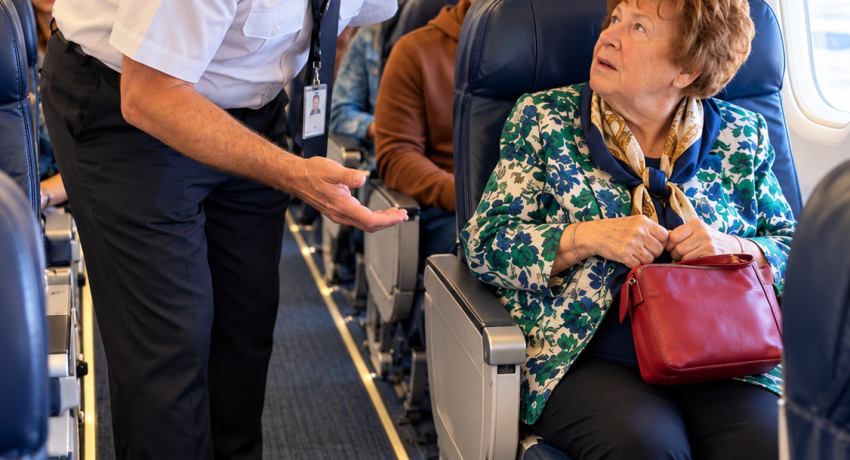
Grandma was sitting beside the window.
She was gazing out at the endless blue sky.
Her purse was clutched tightly against her chest.
Beside her was a red-haired boy who looked about eight or nine.
He had an airline badge hanging around his neck.
UNACCOMPANIED MINOR.
His name was Oliver.
He held a coloring book, but he wasn’t actually coloring.
His knee bounced nervously.
The aisle seat beside him was empty.
I crouched down next to them.
“You okay, Grandma?”
She turned toward me.
For one unusual moment, she looked completely lost.
Then she smiled.
“I’m fine.”
She wasn’t.
Her hands were trembling.
Her eyes appeared moist.
I’m a nurse.
I know what “fine” looks like.
This wasn’t it.
“Are you feeling sick?”
“No.”
“You’re shaking.”
“It’s just nerves.”
The boy sitting beside her looked up.
“I’m nervous too.”
Grandma immediately turned toward him.
Her expression softened.
“Are you traveling alone?”
He nodded.
“My mom put me on the plane in Boston. My dad’s meeting me in San Francisco.”
Then he admitted quietly,
“I don’t like it when the airplane shakes.”
“Neither do I,” Grandma told him.
Oliver looked surprised.
“You don’t?”
“No. But my husband used to repair airplanes. He taught me that turbulence is like driving over bumps in the road. The airplane is designed to handle it.”
“Did he fix this airplane?”
Grandma looked toward the window.
“Maybe.”
Then she smiled.
“Maybe he did.”
I watched the two of them for another minute.
“I’m okay now,” Grandma said. “Go enjoy your seat.”
She nodded toward Oliver.
“I have company.”
So I went back to first class.
—
Twenty minutes later, the cockpit door opened.
A younger pilot stepped into the galley.
He quietly spoke to one of the flight attendants.
She looked startled.
Then she pointed toward the back of the aircraft.
The pilot began walking toward the rear cabin.
Slowly.
He wasn’t simply making a routine cabin check.
He was looking for someone.
I don’t know what made me follow him.
I just did.
He passed row twenty.
Then twenty-five.
Thirty.
When he reached row 34, he stopped.
Grandma was still sitting beside the window.
Oliver had finally started coloring a purple dinosaur.
The pilot stared at my grandmother.
Then his eyes moved to her purse.
Then to the small silver wings attached near the zipper.
His entire expression changed.
He crouched beside her.
“Where did you get those?”
His voice sounded unsteady.
Grandma looked closely at him.
The pilot swallowed.
“Mrs. Walsh,” he said, “why did you choose seat 34A?”
I froze several rows behind them.
He knew her name.
Grandma’s chin began to tremble.
“Because that’s where he told me to sit.”
There was only one person she could have been talking about.
My grandfather.
A man who had been dead for twenty-seven years.
The pilot suddenly stood.
“Who told you?”
Grandma opened her purse.
Her hands shook as she reached into the side pocket.
She pulled out the yellowed paper I had noticed back at the gate.
An old boarding pass.
The thick cardstock type airlines used years ago.
Its edges had become soft and worn.
She handed it to him.
He unfolded it.
From where I stood, I could see the faded words.
FLIGHT 212
BOSTON — SAN FRANCISCO
MARCH 14, 1999
SEAT 34A
Passenger:
FRANK WALSH.
The pilot stared at it.
Then he turned the card over.
There was faded pencil handwriting on the back.
He read it.
His expression changed.
He turned toward the front of the aircraft.
“Carol,” he called. “Please bring the captain.”
—
The gray-haired flight attendant quickly made her way down the aisle.
“Danny? What happened?”
The pilot raised the old boarding pass.
She immediately covered her mouth with her hand.
“It’s her,” he said. “She’s sitting in 34A.”
Carol looked at Grandma.
Then she hurried toward the cockpit.
Danny crouched beside Grandma once more.
“I need to go back to the front so the captain can come down,” he said. “But before I leave, there’s something I need to tell you.”
Grandma carefully studied his face.
“You were the little boy.”
Danny went completely still.
“The boy who was sitting beside him.”
His eyes filled with tears.
He nodded.
Then he reached inside his shirt pocket.
He opened his hand.
Inside was another tiny set of silver wings.
They were exactly like the ones attached to Grandma’s purse.
“He gave these to me,” Danny whispered.
“I’ve carried them with me on every flight since.”
Grandma gently touched the pin.
“He had two,” she said.
Danny nodded.
“He told me.”
She gazed at the wings.
“When they gave me his belongings, that one was gone. For years, I wondered where it had ended up.”
“I tried to find you,” Danny said. “But I didn’t have enough information. Your husband only ever called you Ruthie.”
Grandma quietly began to cry.
Danny explained that one of the flight attendants had noticed the matching pin attached to her purse.
That was what had prompted him to come looking for her.
Then I asked the question neither of them had answered.
“Why are you on this flight?”
Danny looked at me.
“Every March fourteenth, the captain and I ask to be assigned to Flight 212.”
“Why?”
His eyes shifted toward Grandma.
“Because your grandfather died on this flight.”
He pointed toward the window.
“In that seat.”
—
I sat down in the aisle seat beside Oliver.
My hands were trembling.
“You told me Grandpa died of a heart attack,” I said.
“He did,” Grandma replied.
“Here?”
She nodded.
“Why was he flying to California?”
She looked straight at me.
“To meet you.”
I couldn’t say anything.
Grandma explained.
I had been born early on the morning of March thirteenth.
When Mom called Boston, Grandpa immediately said he was going to take the next available flight.
Grandma was supposed to go with him.
They had reserved seats 34A and 34B.
But the night before the flight, she became sick.
Frank wanted to stay home.
She insisted that he go.
At the gate, her unused seat was given to an eight-year-old boy who was traveling alone.
Danny.
Frank called her before boarding.
“He told me the boy looked frightened,” Grandma said.
“I told him to take care of him.”
Then she unfolded the old boarding pass.
There was a message written across the back.
She handed it to me.
The pencil marks had almost completely faded.
Ruthie —
We’re over the Rockies. Snow everywhere. Sun shining across the peaks. You should be here to see this.
Best view I’ve ever had.
I’m keeping the seat warm for you.
Next time, we’ll sit here together.
34A.
Promise me.
— F.
I read it twice.
Then a third time.
“You kept this all these years?”
“Every single day.”
“And you never flew again.”
She shook her head.
“I couldn’t.”
For twenty-seven years, Grandma had pictured Grandpa spending his final moments by himself.
She had blamed herself for getting sick.
She wondered if she would have noticed something sooner if she had been there.
Mom had kept most of the details from me because Grandpa had been traveling to California to meet me.
She never wanted me to grow up believing his death was somehow connected to my birth.
“It wasn’t your fault,” Grandma said.
“It wasn’t mine either.”
She looked down at the note.
“It was his heart.”
Then I finally understood why she had chosen this particular flight.
This particular date.
This particular seat.
“I’m eighty now,” she said. “I’m tired of being afraid.”
Her fingers gently followed Grandpa’s handwriting.
“He asked me to sit here someday.”
She gazed out through the window.
“I wanted to see what he saw.”
The cockpit door opened once more.
This time, the captain came down.
He was an older man with gray hair and four gold stripes on his shoulders.
He stopped beside row 34 and took off his hat.
“Mrs. Walsh, my name is Gene Holt.”
Grandma looked up at him.
“I’ve wanted to meet you for twenty-seven years.”
He explained that in 1999, he had been the first officer aboard Flight 212.
He had been the person sent out of the cockpit after the crew reported that a passenger in 34A was experiencing discomfort.
Grandma tightened her hold on my hand.
“Please tell me what happened.”
Gene sat down.
For twenty-seven years, Grandma had received nothing except an official letter.
No one had ever explained the complete story to her.
Gene took a breath.
“We were flying over Colorado.”
The morning sky had been clear.
The Rockies could be seen below.
A flight attendant contacted the cockpit and reported that the man in 34A was experiencing chest pain.
Gene went back to check on him.
Frank was pale and sweating.
Beside him was a frightened eight-year-old boy.
Danny.
The crew and a medical professional traveling on the plane tried to help while the pilots diverted toward Denver.
But Grandpa knew what was happening.
According to Gene, his main concern remained Danny.
“Make sure the boy is okay,” he kept saying.
Then Frank told Gene he had spent thirty-four years repairing airplanes at Logan.
He told him his wife’s name was Ruthie.
And he said,
“Tell her I’m sorry.”
Then,
“Tell her I saved her the window.”
Grandma covered her mouth.
Gene continued.
Frank reached into his work jacket.
He took out the silver wings he had worn for decades.
Then he gave them to Danny.
“You’re going to be a pilot someday,” Frank told him.
“Keep these. Be brave.”
Danny accepted the pin.
Frank closed the boy’s fingers around it.
That was one of the last things he ever did.
—
No one around us said a word.
Even the nearby passengers had stopped pretending they weren’t listening.
Gene told us they landed in Denver.
Afterward, he remained with Danny for hours until arrangements could be made to send him onward to San Francisco.
The little boy refused to let go of those silver wings.
Years later, Gene remained in contact with him.
Danny eventually decided that he wanted to become a pilot.
Gene helped him.
Recommended him.
Mentored him.
And when Danny eventually joined the airline, Gene requested him as his first officer.
Every March fourteenth, the two of them flew Flight 212 together.
For Frank.
“I’m retiring soon,” Gene told Grandma.
“This was supposed to be one of our final March fourteenth flights together.”
He placed his hand over hers.
“I always hoped we’d find you before then.”
Grandma’s eyes filled with tears again.
“He wasn’t alone?” she whispered.
Gene shook his head.
“No, ma’am.”
“He had people with him.”
Then he gave her a gentle smile.
“And he had a frightened little boy holding his hand.”
For twenty-seven years, Grandma had carried the image of Frank sitting alone in seat 34A.
Now, for the first time, that picture had changed.
Gene looked at her.
“If you had been sitting beside him that day, Danny probably would have been seated somewhere else.”
Grandma stared at him.
“Your husband gave that boy courage when he needed it most.”
Gene motioned toward the cockpit.
“And that boy is now flying the airplane you’re traveling on.”
—
Before heading back to the cockpit, Gene looked at Oliver.
“You’re traveling by yourself?”
Oliver nodded.
“First time?”
He nodded again.
Gene reached into his pocket and pulled out a modern plastic junior-pilot pin.
“These aren’t quite as impressive as the old silver ones.”
He pinned it onto Oliver’s shirt.
“But they still work.”
Oliver gave a nervous smile.
“Be brave,” Gene told him.
Then he headed back to the cockpit.
I didn’t return to first class.
I stayed in row 34.
Oliver sat in the middle.
Grandma remained by the window.
A short while later, the captain’s voice came through the speakers.
He told everyone that we were approaching the Rocky Mountains.
Then he briefly shared Frank Walsh’s story.
An aircraft mechanic who had spent thirty-four years helping keep airplanes safely in the air.
A man who had been traveling to meet his newborn granddaughter.
A man who had shown kindness to a frightened child sitting beside him.
Then Gene said,
“That frightened child is my first officer today.”
The entire cabin fell silent.
“And Mrs. Ruth Walsh is sitting in 34A today for the first time.”
Grandma placed her hand against the window.
Outside, the Rocky Mountains spread across the horizon.
Snow reflected the sunlight.
The peaks seemed to continue forever.
“This is the view he wanted you to see,” Gene said over the speaker.
Grandma stared outside for a long time.
Oliver leaned closer to the window beside her.
Instead of keeping the window she had waited twenty-seven years to see all to herself, Grandma moved closer toward the aisle.
“Come here,” she said to him.
“We can share it.”
And they did.
An eighty-year-old woman and a nervous red-haired boy sat close together beside the window in 34A.
Just as Frank had once sat beside another frightened child.
—
After we landed, the crew asked us to stay aboard for a few minutes.
Danny and Gene came out from the cockpit.
Danny walked back to row 34.
He knelt beside Grandma and opened his hand.
The old silver wings were resting in his palm.
“These are yours.”
Grandma looked at them.
Then she gently closed his fingers around the pin.
“No.”
Danny looked confused.
“Frank gave them to you.”
She smiled through her tears.
“He told you to be brave.”
Her eyes moved toward his pilot’s uniform.
“And you were.”
Danny lowered his gaze.
“He would have been proud of you,” she said.
Then she touched the matching wings attached to her purse.
“We’ll each keep one.”
“You keep his.”
“I’ll keep mine.”
Gene was standing behind him.
“Would you like to see the cockpit before you go?”
Grandma laughed.
“I’m eighty years old.”
“That sounds like a yes.”
She smiled.
“It is.”
Mom was waiting for us at baggage claim in San Francisco.
When she saw Grandma’s tear-swollen eyes, she hurried toward us.
“Mom? What happened?”
Grandma set her cane down.
She placed both hands against her daughter’s face.
“I sat in his seat.”
Mom froze.
“34A,” Grandma said.
“I saw the mountains.”
Mom’s eyes immediately filled with tears.
“And the pilots were there,” Grandma continued.
“The people who were with him.”
Then she smiled through her tears.
“The little boy grew up.”
“He’s a pilot now.”
“He flew me here.”
Mom stared at her.
Grandma whispered,
“He wasn’t alone.”
That sentence seemed to release something both women had been carrying for almost thirty years.
They embraced in the middle of the airport.
I wrapped my arms around them too.
Mom apologized for never explaining to me why Grandpa had been on that flight.
She had been afraid I would blame myself.
But now, the truth felt strangely simple.
Nobody had caused it.
Nobody needed to keep carrying the burden.
As Grandma had said,
“It was just his heart.”
—
We spent a week in California.
On our last evening, we sat outside Mom’s house in Oakland.
Grandma kept unfolding the old boarding pass.
She would read the faded pencil message.
Then fold it back up.
Mom eventually asked,
“Why did you finally decide to go back?”
Grandma touched the small silver wings attached to her purse.
Then she told us a story I had never heard before.
In 1966, when she was twenty years old, she took her first flight.
She was terrified.
A young sailor sat beside her.
His name was Frank Walsh.
He noticed that she was shaking and took two small silver wing pins from his pocket.
His father had given them to him when he was young.
Frank handed one to Grandma.
“I’ll wear one,” he told her.
“You wear the other.”
“That way, whenever you get scared, you’ll remember that someone else has the matching wings.”
“You won’t be alone.”
Grandma had carried those wings for sixty years.
Frank kept the matching pair for decades.
And when his own life reached its final moments, he gave his pair to a frightened child traveling alone.
That child carried them for twenty-seven years.
On every flight.
Until the day Grandma finally returned to 34A.
“I think I was waiting for someone to tell me he wasn’t alone,” Grandma said.
“I just didn’t realize that was what I needed.”
She looked toward the lights scattered across the Bay.
“And now I know.”
“He wasn’t.”
—
We flew back to Boston a week later.
This time, I booked economy.
Row 34.
Seats A and B.
I didn’t even look at the price of first class.
At the gate, an employee recognized Grandma’s name.
Captain Holt had left something for her.
An envelope.
Inside was a photograph.
Gene and Danny stood beside an airplane.
Danny held his hand out toward the camera.
The silver wings were resting in his palm.
On the back, someone had written:
Ruth —
Still keeping the seat warm.
Always.
— Gene & Danny
Grandma kept that photograph on her lap for the entire flight.
A year has gone by.
Gene has retired.
His final flight was Flight 212 from Boston to San Francisco.
Grandma and I were on board.
Row 34.
Danny was flying beside him.
When the plane landed, the airport greeted Gene’s final flight with the traditional water salute.
The passengers applauded.
Grandma cried.
I cried too.
Gene tried to thank everyone over the intercom but had to stop halfway through.
Danny eventually became a captain.
When he earned his fourth stripe, he sent Grandma a photograph.
The old silver wings were tucked inside his captain’s hat.
Grandma recently turned eighty-one.
She told me what she wanted for her birthday.
San Francisco.
March fourteenth.
Flight 212.
I booked the tickets right away.
Economy.
Row 34.
I didn’t even bother checking first class.
Because I finally understood.
I hadn’t wasted my money when I originally bought Grandma that first-class ticket.
That expensive seat simply wasn’t the one she needed.
For twenty-seven years, she had been afraid of flying.
Afraid to return to the skies.
Afraid to look at the mountains her husband had described.
Afraid of whatever truth was waiting for her in 34A.
What she needed wasn’t luxury.
She needed someone to help her step onto the airplane.
She needed to keep a promise written in fading pencil.
And she needed to discover that the man she loved had not spent his final moments alone.
I never got the chance to meet my grandfather.
But I think about him often now.
I think about an aircraft mechanic crossing the country to meet his newborn granddaughter.
I think about him reaching inside his jacket when he realized something was wrong.
Not to take something for himself.
But to give courage to the frightened child sitting beside him.
I think about that boy carrying those silver wings into adulthood and becoming a pilot.
And I think about Grandma returning to that same window twenty-seven years later.
Then making room so another nervous child could look out with her.
Airlines separate their cabins into classes.
First.
Business.
Economy.
Some seats have more space.
Some recline farther.
Some offer better meals and finer glasses.
But I learned something on Flight 212.
The best seat on an airplane isn’t necessarily the one with the highest price.
Sometimes it’s simply the place where someone makes sure you don’t have to face your fear alone.
My grandfather understood that.
Eventually, Grandma understood it too.
It just took me thirty-four rows to finally understand it.