
 167 views
There is a particular kind of sorrow that comes without making a sound.
It is not the kind of grief that fills hospital rooms, accompanies funerals, or dominates those first painful weeks when everyone knows your life has been changed forever.
I mean the kind of grief that lingers.
It waits until you are standing outside a church at a wedding, watching a five-year-old girl in a pink dress spin around the parking lot because she loves the little clicking sound her shiny shoes make against the pavement.
And then, suddenly, it finds you.
She would have fixed Margot’s dress.
She would have taken an unreasonable number of pictures.
She probably would have slipped into the bathroom for ten minutes to cry because her daughter looked so beautiful and she was overwhelmed with gratitude.
But Phoebe wasn’t there.
And she never would be again.
Three years had gone by since I buried my daughter, and I had finally learned not to resist those moments anymore.
You let the grief come.
You feel every bit of it.
Then you look at the little girl beside you and remember why you still need to be here, fully present.
Margot had been giving me reasons to stay present from the moment she was born.
At five years old, she also had very definite opinions about shoes.
“These are the best ones,” she announced that morning, holding up a pair of shiny black shoes decorated with tiny buckles. “They make a good sound.”
“They really do.”
“I’m going to be in Daddy’s pictures today.”
“You are.”
She gave me a serious look.
“Daddy said so.”
“Then Daddy said so.”
She had been looking forward to the wedding for two whole weeks.
She told the neighbors.
She told the woman who worked at the dry cleaner.
She even stopped one day to inform a neighbor’s dog that she would be appearing in her father’s wedding photographs.
That morning, her whole world seemed full of light.
And then someone stole a piece of that light from her.
Margot is my granddaughter.
She is Phoebe’s daughter.
And to me, that means she is living proof that my daughter once existed, that she loved, that she built a life, and that part of her remained behind in this world.
Margot has Phoebe’s eyes.
Exactly the same.
I see them every single time I look at her.
She has her father Emmett’s sturdy little frame and a fearless habit of running toward things rather than backing away from them.
But her laugh is completely her own.
It is the sort of laugh that makes everyone around her instinctively want to protect the person making it.
Margot was only two when she lost her mother.
She doesn’t truly remember Phoebe.
She knows her from pictures.
From stories told at bedtime.
From the small remarks I make whenever something brings Phoebe to mind.
“Your mother loved this.”
“Your mother used to say that.”
“Your mother once did exactly the same thing.”
I never wanted Phoebe to become some distant, mysterious person whom Margot felt afraid to ask about.
I wanted her mother to remain a real and recognizable part of her life.
For three years, Emmett and I worked together to make certain that happened.
And I had no intention of allowing anyone to take that away.
Emmett was twenty-eight when Phoebe died.
They had been married for only three years.
Suddenly, he was a widower, a single father, and the son-in-law of a man who had just buried his only child.
It would have been easy to let grief pull us apart.
Instead, it brought us closer.
He called me whenever Margot was sick and he couldn’t get away from work.
I called him whenever something happened that Phoebe would have thought was funny.
We established Sunday dinners because I had once read that rituals could help grieving children, and I decided Margot deserved as many dependable things in her life as we could give her.
Emmett was a good father.
He still is.
Naturally, he made mistakes.
So did I.
There is no handbook for raising a little girl while everyone around her is trying to survive their own grief.
But Emmett never walked away.
He showed up.
He remained.
So when he eventually told me that he had met someone, I wasn’t angry.
We were sitting in his kitchen after Sunday dinner when he finally said,
“I need to tell you something.”
“Okay.”
“I’ve been seeing someone.”
He studied my face carefully.
“How long?”
“Three months.”
“Tell me about her.”
Her name was Claire.
She was a third-grade teacher.
According to Emmett, she was warm.
Kind.
Patient.
And Margot had met her twice already and seemed to like her.
“Are you happy?” I asked.
“I think I am.”
Then he paused.
“Is that okay?”
“Being happy is always okay. Phoebe would have wanted you to be happy.”
And I meant every word.
I never wanted Emmett to remain trapped in grief for the rest of his life.
When he eventually chose to marry Claire, I supported his decision.
I went to the wedding because I genuinely wanted their marriage to work.
That part matters.
What happened afterward had nothing to do with jealousy or resentment about my daughter being replaced.
It had everything to do with a five-year-old girl wearing shiny shoes who had spent two weeks telling everyone she would be in Daddy’s wedding pictures.
I heard Claire distinctly.
The bridal suite door was partly open.
I had been searching for Margot, who had spent the previous hour with the bridal party because Emmett wanted her to feel like she belonged there.
Then I heard Claire say:
“You’re not the most important girl in your dad’s life anymore. Stay out of the family photos.”
I stopped where I was.
For a few seconds, nobody said anything.
Then Margot walked through the doorway.
She was already crying.
Not loudly.
It was the quiet, bewildered kind of crying children do when an adult says something cruel and they haven’t yet figured out what it means or how to handle it.
She walked over to a chair beside the window.
Sat down.
And looked down at her shoes.
The same shoes she had been so excited about that morning.
I needed a moment before I went to her.
Because she needed me to be calm.
Not to unleash everything I was feeling.
Finally, I sat beside her and wrapped my arm around her.
“Peanut, I’m right here.”
She rested against me.
For a while, neither of us spoke.
Then she whispered,
“Did I do something wrong?”
“No.”
“She said—”
“I heard her.”
Margot looked directly at me.
“And she was wrong.”
“But she’s going to be Daddy’s wife.”
“Yes.”
“So does that mean she’s more important now?”
I thought carefully about how to answer.
“Your father loves you in a way that he loves no one else. There is only one Margot. Nobody else can be his daughter. That place belongs only to you.”
“Even if he has a new wife?”
“Even if he had a hundred new wives. There would still be one place in his life that was made exactly for you.”
She sat quietly, thinking about that.
Then she asked,
“What about the pictures?”
“You’re going to be in them.”
“How do you know?”
“Because I’m going to make sure you are.”
She looked closely at me.
“Trust me?”
She nodded.
Then, a moment later, she asked if we could go outside because she wanted to hear her shoes against the pavement.
So we went.
She twirled around the church parking lot until she was laughing once more.
And as I watched her, I began figuring out what I was going to do.
I had the entire ceremony to think about it.
I sat in the third pew and watched Emmett and Claire exchange their vows.
I considered what would feel satisfying.
Then I considered what would actually be right.
Those two things are not always identical.
Margot was the child caught between everyone.
Whatever I chose to do had to protect her, not transform her father’s wedding into a battlefield.
I thought about Phoebe.
My daughter had never stayed silent when someone she loved was being treated badly.
But she also knew the difference between making a scene and actually accomplishing something.
She would have been furious.
But I believe she would have waited.
She would have made certain Margot was included in those photographs first.
Then she would have spoken up.
So that was exactly what I did.
Before the reception began, I went to find the wedding photographer.
Her name was Sofia.
I explained in simple terms that Margot was the groom’s five-year-old daughter and that she had been promised a place in the family photographs.
If anyone attempted to exclude her, I wanted to be informed immediately.
Sofia looked over at Margot in her pink dress.
“Absolutely,” she said. “She’ll be in every picture.”
And she was.
Margot stood beside her father.
She held his hand.
She smiled.
After getting tired of posing seriously, she started making silly faces.
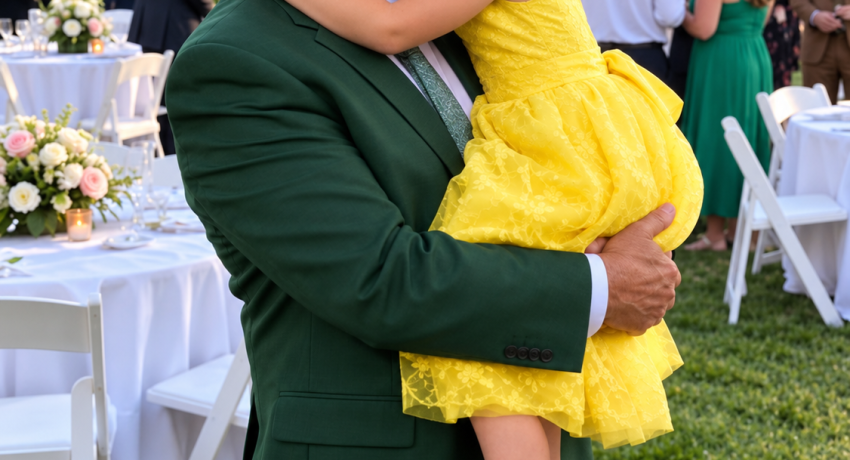
In one photograph, Emmett lifted her into his arms, and she laughed against his shoulder.
Sofia captured the moment perfectly.
I still have that photograph.
I always will.
Claire stood beside them.
She smiled.
If she noticed me watching her, she gave no indication.
The reception took place inside a restored barn decorated with string lights and round tables.
Weeks earlier, Emmett had asked me to give a toast.
I had already prepared one.
It was warm.
Appropriate.
It said something about hope, second chances, and new beginnings.
It was a perfectly acceptable speech.
I never gave it.
After the best man spoke, followed by a bridesmaid and then one of Claire’s relatives, the emcee called my name.
I stood up.
Margot was sitting nearby at the children’s table.
When she saw me raise my glass, she immediately lifted her cup of apple juice.
For a brief moment, I raised my glass toward her.
Then I faced the room.
“When my daughter Phoebe died, she left behind a husband who loved her and a little girl who still needed her.”
The room fell silent.
“Emmett, I’ve told you this before, but I want to say it again. The father you have been to Margot throughout these past three years is something I deeply admire.”
Then I stopped for a moment.
“I had prepared a different speech for today. It was perfectly appropriate. But something happened this afternoon that changed what I needed to say.”
The room grew even quieter.
“I watched a little girl wearing a pink dress learn, because of something an adult said to her, that perhaps she wasn’t as important as she had believed. That maybe she didn’t belong in the photographs she had spent weeks looking forward to.”
I looked straight at Claire.
She looked back at me.
“I want everyone in this room to understand something about Margot.”
Then I turned toward my granddaughter.
“She is five years old. She lost her mother when she was two. She has already been forced to understand absence in a way that no child her age should ever have to understand.”
Margot watched me without saying a word.
“She deserves to know every day that she is loved. She deserves to know that she belongs.”
Then I turned my attention back to Claire.
“She deserves to appear in her father’s wedding photographs. She deserves to step into this new chapter as part of the family, not as something discarded from the chapter that came before.”
Nobody moved.
“Claire, I’m going to ask something of you today, and I’m asking you in front of everyone because promises made publicly carry weight.”
Claire remained completely motionless.
“This little girl has already lost one mother. She should never feel as though she is losing another family simply because her father has remarried.”
I paused.
“She is in today’s photographs. I made certain of that. And I hope she appears in every photograph that comes after this.”
“Every Christmas.”
“Every birthday.”
“Every ordinary Tuesday.”
“Exactly where she belongs, right in the middle.”
I turned toward Emmett.
“You chose someone to build your life with. I believe you chose someone who is capable of loving your daughter.”
Then I lifted my glass.
“To Emmett and Claire. And to the family they are creating. May there always be enough space within it for everyone who belongs.”
I sat back down.
For three seconds, the entire room remained silent.
Then everyone burst into applause.
Later, Emmett came looking for me outside.
He stood next to me beneath the evening sky.
“You heard what she said to Margot.”
“Yes.”
“I didn’t know.”
“I know.”
He stayed silent for a moment.
Eventually, he asked,
“What am I supposed to do now?”
“Talk to your wife.”
“About the toast?”
“No. About Margot.”
I looked directly at him.
“Tell her what your daughter needs. Tell her what can never happen again.”
“She said something horrible to a five-year-old.”
“Yes. She did.”
Then I added something that mattered.
“But give her the chance to become better than what she did in that moment.”
He looked at me.
“Because the worst thing that could happen is Margot growing up believing her stepmother resents her. What she needs is someone who chooses her.”
“And if Claire doesn’t?”
“Then we handle that if it happens.”
An hour later, Claire came to find me.
I was drinking coffee while watching Margot dance barefoot across the floor.
Claire sat opposite me, still wearing her wedding dress.
“You heard me,” she said.
“Yes.”
“Through the door.”
“Yes.”
She looked down at her hands.
“What I said was awful.”
I waited.
“I’ve been afraid,” she admitted. “I know that doesn’t excuse it.”
She explained that everyone still talked about Phoebe.
Photographs of Phoebe were still displayed in Emmett’s home.
Phoebe was woven into every story about Margot.
And somewhere along the way, Claire had started feeling as though she was competing with someone who wasn’t even alive to compete with her.
“I took that insecurity out on a five-year-old,” she said.
“Yes.”
“That’s unforgivable.”
“No,” I told her. “It isn’t unforgivable. But it cannot happen again.”
She looked over at Margot.
“How do I make it right?”
“Apologize.”
“To Margot?”
“Yes. Tomorrow, when things are quiet.”
I leaned closer.
“Get down to her level. Tell her you said something wrong. Tell her you’re sorry. Don’t try to explain it away. Don’t blame the stress of the wedding. Just tell her you were wrong.”
Claire slowly nodded.
“What if she doesn’t forgive me?”
“She probably will. Children can be remarkably generous when adults give them sincere apologies.”
Claire watched Margot dancing.
“She’s beautiful.”
“Yes.”
“She has her mother’s eyes.”
“Everyone says that.”
Claire paused.
“I want to love her.”
I remained silent.
“I don’t know if I’m supposed to be her mother. Maybe that isn’t what she needs. But I want to be someone good in her life.”
“Then be that person.”
She looked at me again.
“It doesn’t take a title,” I continued. “It takes showing up. It means making her feel welcome. Today was a difficult beginning. It doesn’t have to define the rest of your relationship.”
After another moment, Claire said,
“Your speech put me on the spot in front of everyone I know.”
“Yes.”
“And you were right.”
That caught me off guard.
She was twenty-nine years old, still wearing her wedding dress, sitting across from a man twice her age who had just confronted her publicly about something she had done.
And she admitted it.
That meant something.
Then she asked me a question I hadn’t anticipated.
“Will you tell me about Phoebe?”
I looked at her.
“I’m not trying to compete with her,” Claire said. “But she is Margot’s mother. If I’m going to have a place in that little girl’s life, I think I should know who she was.”
So I told her.
I told her Phoebe noticed everything.
That she had a way of making people feel seen.
That she had strong opinions.
That she absolutely would have questioned Claire about what she intended with Emmett.
“She probably would have driven you crazy,” I said.
Claire almost laughed.
“And after that?”
“If she believed you were good for Emmett and good to Margot, she probably would have become your strongest defender.”
“Do you think she would have believed I was good enough?”
I thought about it.
“Today may have made that harder.”
Claire lowered her gaze.
“But Phoebe believed people could become better than their worst moment.”
Claire looked over at Margot.
“She’s incredible.”
“Yes.”
“Tell me more about her.”
So I did.
When the reception was over, Margot came over to me near the exit, carrying her shoes in both hands.
“You gave a speech.”
“I did.”
“It was about me.”
“Partly.”
She thought about that.
“Did it make Claire feel bad?”
I considered my answer before speaking.
“I think it helped her understand something.”
Margot nodded.
Then she asked,
“Grandpa?”
“Yes, peanut?”
“Am I the most important girl in your life?”
I bent down until our eyes were level.
My knees protested.
I ignored them.
“You are the most important person in my life. No conditions. No exceptions.”
“Even more than Grandma?”
“Your grandma would want you to be.”
“Even more than Mom?”
“Your mom would want that too. That’s what mothers do.”
She thought about it.
“Okay.”
Then she reached out her hand.
“Can we walk to the car?”
“Of course.”
“My shoes make a good sound in parking lots.”
“Give them to me. You walk.”
She handed me the shoes.
We walked beneath the spring night sky.
Halfway across the parking lot, she looked up at me.
“Grandpa?”
“Yes?”
“I was in the pictures.”
“You were.”
“Right in the middle.”
“Yes.”
“You promised.”
“I did.”
“You were right.”
“I usually am.”
She gave me a sideways glance.
“Sometimes.”
“Sometimes,” I admitted.
The following morning, Claire apologized.
Emmett told me about it afterward.
“She got down to Margot’s level and told her she had said something wrong.”
“What did Margot say?”
“She said okay.”
I smiled.
“Then she asked Claire if she wanted to see her shoes.”
I laughed.
“For twenty minutes,” Emmett added. “Claire now knows the different sounds made by patent leather, canvas, and rubber soles.”
“That’s valuable information.”
“With Margot, apparently it is.”
Then his voice softened.
“Howard?”
“Yes?”
“Thank you.”
“You don’t have to thank me.”
“I do. For making certain she was in those photographs. For being the person she knows she can always depend on.”
I thought about those words for a long time afterward.
I am sixty-eight years old.
I have buried my wife.
I have buried my daughter.
Loss has taught me what truly matters and what does not.
What matters is a five-year-old girl wearing a pink dress who has already experienced more loss than any child should.
A little girl who deserves to dance through parking lots.
To be included in family photographs.
To grow up knowing there is never any question about whether she belongs.
What doesn’t matter is whether protecting that truth made a wedding reception uncomfortable for a few minutes.
Phoebe would have approved.
Although, knowing my daughter, she probably would have said it much more loudly.
One year after the wedding, Claire sent me a photograph.
It showed Margot at a birthday party.
Emmett stood on one side.
Claire stood on the other.
Margot was directly in the middle.
Laughing.
Beneath the photograph, Claire had written:
“Our most important girl.”
I printed it.
Then I placed it on my refrigerator beside an old photograph of Phoebe.
I don’t think my daughter would have minded.
I think she would have understood.
I think she would have been relieved.
And I know I was.









