
 93 views
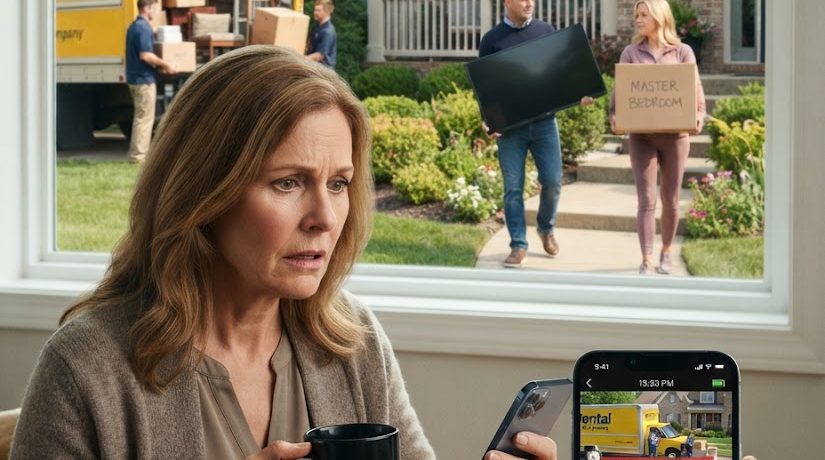
 At 10:14 on a sunny Saturday morning, I glanced at my phone and saw my ex-husband carrying a flat-screen TV into a house he had absolutely no permission to enter.
His new wife was right behind him.
She had a brass floor lamp in her hands.
My brass floor lamp.
I was four hours away, barefoot in my sister Rachel’s kitchen in Louisville, holding a mug of coffee halfway to my lips.
For a few seconds, my mind simply couldn’t process what I was watching.
Maybe I had selected the wrong camera.
Maybe the video feed was behind.
Maybe somehow I was looking at someone else’s house.
But I wasn’t.
The house belonged to me.
I had owned it for exactly eleven days.
It was a simple three-bedroom brick house in Worthington, just north of Columbus.
Nothing luxurious.
An old maple tree stood out front.
The oak cabinets looked like they had come straight from the 1980s.
The floors desperately needed refinishing.
But the price wasn’t what mattered.
What mattered was that I had purchased it on my own.
After twenty-seven years of marriage, putting my own name on that deed had felt like learning how to breathe all over again.
Mark and I had officially finalized our divorce in January.
By August, I was exhausted by the tiny apartment I had rented while we were separated.
So I bought the house.
I told Mark nothing.
I barely told anyone at all.
Rachel knew.
My twenty-eight-year-old daughter, Emily, knew I had been looking at houses, but she didn’t know I had already closed.
The flooring crew knew.
That was pretty much everyone.
I wasn’t keeping some scandalous secret.
I simply wanted one major decision in my adult life that wouldn’t instantly turn into something the whole family considered theirs.
PERSON DETECTED IN DRIVEWAY.
I opened the security-camera feed.
A yellow moving truck was slowly backing into my driveway.
The driver’s door swung open.
Mark stepped out.
Rachel leaned across the kitchen island.
“Are you expecting the flooring crew?”
“Maybe.”
Then I got a clear look at him.
Rachel walked around the counter.
“Is that Mark?”
“What is he doing at your house?”
“I was hoping you knew.”
Then the passenger door opened.
Vanessa stepped out.
Mark had married her five months after our divorce became official.
I had met her twice.
I had stopped wondering when their relationship had actually begun.
He wasn’t my problem anymore.
At least, that was what I kept telling myself.
Then Mark handed Vanessa a tall brass lamp.
A lamp I recognized from his old apartment.
He lifted a massive television out of the back of the truck.
Then came more boxes.
KITCHEN.
BOOKS.
Then one huge box marked:
MASTER BEDROOM.
Rachel kept staring at the screen.
“They’re moving in.”
“I can see that.”
The house wasn’t even ready for me to move into yet.
The floors had only just been sanded.
The painters were scheduled for Tuesday.
Most of my belongings were still sitting in storage.
Apparently, Mark had decided to get to my own moving day before I did.
Then he headed toward the side entrance.
I leaned toward the screen.
That door had a keypad lock so contractors could enter and leave.
Mark didn’t knock.
He didn’t look around for a spare key.
He simply went straight to the keypad.
Entered four numbers.
The light turned green.
Click.
Rachel looked at me.
“He knows your code.”
A chill ran through me.
I had never given it to him.
Not once.
Mark opened the door and held it open for Vanessa.
She stepped inside with the lamp, moving as though the house already belonged to her.
That was the moment I stopped being simply furious.
I felt violated.
I had found that house myself.
Signed for it myself.
Stood alone in the empty kitchen after closing and ate a sandwich over the sink because I didn’t even own a chair yet.
And now my ex-husband was walking through it as though his name were on the deed.
Another clip loaded.
Vanessa stood on my porch and said,
“Once the sectional is inside, I want to measure the windows for curtains.”
Rachel looked at me.
“Call him.”
My thumb paused above Mark’s name.
For twenty-seven years, this had always been my pattern.
Mark did something unreasonable.
I called him.
He gave me an explanation.
And somehow, by the time the conversation ended, I would be wondering whether I had overreacted.
Mark wasn’t someone who yelled.
He was far more difficult to argue with than that.
He was an explainer.
He had a way of turning broken promises, missing money, and blatant lies into innocent misunderstandings simply by talking long enough.
I closed his contact.
Instead, I pulled up the digital version of my deed.
There it was.
Clare Bennett.
Sole owner.
Then I called the police.
“My ex-husband and his new wife are moving furniture into a house that I legally own,” I told the dispatcher. “I’m four hours away. Neither one of them has permission to be inside.”
She asked if Mark lived at the property.
“No.”
Had he ever lived there?
“No.”
Was I the only legal owner?
“Yes.”
Then she asked something that made my stomach knot.
“Do you know how he got inside?”
I looked once more at the image showing his hand entering the keypad code.
“No,” I answered.
And suddenly, the moving truck wasn’t even the part that frightened me most.
The police arrived within twenty minutes.
I watched the entire thing through my cameras.
Mark and Vanessa were trying to push a massive gray sectional through my front door when the first police cruiser arrived.
An officer asked who owned the house.
“My ex-wife,” Mark answered immediately.
At least we were finally dealing with one fact that wasn’t being disputed.
Then he added,
“She knows we’re staying here temporarily.”
Vanessa looked at him.
“You told me she bought it as an investment property.”
That was the first time I realized she might not have known what was actually happening.
Mark quickly insisted that was exactly what it was.
The officer asked whether Mark had any ownership stake in the property.
“It’s complicated.”
Whenever Mark said something was complicated, it usually meant the straightforward truth would make him look terrible.
He launched into a lengthy explanation.
He claimed I had purchased the property with money from the marital home we used to share.
He said we had an understanding.
He insisted that he and Vanessa only needed somewhere to stay temporarily while moving between leases.
Then the officer called me.
I emailed him the deed.
Closing documents.
The divorce decree.
Everything.
He asked whether Mark had put any money toward buying the property.
“No.”
Did he have a lease?
“No.”
Had he ever been inside the house before?
“Not with my permission.”
The officer put me on speakerphone.
Mark immediately said,
“Clare, stop making this into something it isn’t.”
I stared at the camera feed.
There was a moving truck sitting in my driveway.
“You’re carrying bedroom furniture into my house, Mark. I know exactly what this is.”
“We just need somewhere to stay temporarily.”
“We never talked about that.”
Vanessa suddenly cut in.
“Mark, you told me she agreed!”
He snapped back at her.
“She did.”
“No,” I said. “I didn’t.”
The police couldn’t resolve every legal argument on the spot while standing in the driveway.
Mark had entered using a functioning access code and was claiming some nonexistent verbal agreement.
But one fact was undeniable.
I was the owner.
I told the officers he did not have my permission to stay there.
The move came to a halt.
Mark tried to frame it as a private family dispute.
The officer looked at him.
“She is your ex-wife.”
Rachel nearly choked on her coffee.
Then Mark tried a different approach.
He told everyone I was bitter.
Unstable.
Overreacting.
Vanessa stood several feet away.
Finally, she said,
“Just stop. You told me she knew.”
Mark looked at her and repeated something I had heard in one form or another for years.
“I warned you she gets like this.”
That hurt more than I expected.
He had already taught Vanessa to distrust me.
Any boundary I set would simply become evidence that I was the hysterical ex-wife he had portrayed me as.
The police remained there until Mark and Vanessa put everything back into the truck.
The lamp.
The television.
The boxes.
The sectional.
Then I drove home.
When I arrived in Worthington that afternoon, the driveway was empty.
For a moment, the house appeared peaceful again.
Then my neighbor Tom approached.
He was a retired engineer who spent most of his spare time tending to his plants.
“Quite a morning,” he said.
“That’s one way to put it.”
Then he paused.
“I assumed you knew he’d been here earlier this week.”
My stomach sank.
“When?”
“Wednesday.”
“Was he alone?”
Tom shook his head.
“No. He had a locksmith.”
I rushed to the side door.
Entered the contractor code.
Red light.
I tried again.
Red.
That was when everything clicked.
Mark hadn’t simply stumbled across an old password.
He had brought someone to my house days earlier and changed the lock.
This had been deliberate.
I immediately hired another locksmith.
When he took the lock apart, he confirmed that it was nearly brand new.
Inside, I discovered muddy footprints.
A deep scratch running across my freshly refinished floor.
A dent in the drywall.
Then I entered the kitchen.
A small wooden sign was sitting on my counter.
Home Sweet Home.
Vanessa had already begun decorating.
I photographed everything.
Then I paid to have every lock replaced and every code removed from the smart-home system.
That evening, sitting by myself on the floor of my empty living room, I began doing something I had spent years doing during my marriage.
I searched for some way this could somehow be my fault.
Had I accidentally told Emily?
Had Mark misunderstood something I had casually said?
Had I used an old code again?
Twenty-seven years with him had conditioned me to examine my own actions before questioning his motives.
The following morning, I began tracing exactly how Mark had discovered the house.
The flooring contractor gave me the first clue.
He mentioned that the entry code had been listed on the shared Google calendar.
I froze.
For years, Mark, Emily, and I had used a shared family calendar.
After the divorce, I believed I had removed Mark.
I checked.
He no longer had editing access.
But his old Gmail account still had permission to view events.
And there it was.
Worthington Floor Crew — Side Door: 0427.
That explained the code.
But it didn’t explain how he knew the address.
Then I remembered a photograph.
Eleven days earlier, Rachel had persuaded me to take a picture on the front steps after the closing.
Without thinking, I had uploaded it to an old shared family photo album.
I zoomed in.
The closing folder I was holding had my new address printed plainly on the tab.
No private investigator.
No hacker.
Just two pieces of outdated digital access I had forgotten to remove.
I spent the next two hours changing passwords everywhere.
Bank accounts.
Cloud storage.
Streaming accounts.
Everything.
I even removed Mark from our old grocery-rewards account.
If he was going to try taking my house, he definitely wasn’t keeping my fuel points.
Then my former mother-in-law called.
Diane and I had remained cordial after the divorce.
She sounded uneasy.
“Clare, I need to ask you something terrible.”
“Go ahead.”
“Did you conceal money from Mark during the divorce?”
I nearly let my phone fall from my hand.
“No.”
She exhaled.
Apparently, Mark had been telling the family that I had purchased my “secret house” with assets I had hidden from him.
His commissions had declined.
He and Vanessa were having financial problems.
Their lease was about to expire.
And Mark had convinced himself that because I was doing well after the divorce, some of that success somehow belonged to him.
Then Diane sent me screenshots.
The first message was from Mark to his sister.
It read:
Once we get inside, Clare won’t cause a scene. She hates conflict. She’ll let us stay until we figure things out.
I read it three times.
That hurt more than the damaged floor.
He hadn’t merely taken a chance on getting into my house.
He had taken a chance on me.
On twenty-seven years of knowing exactly how much I despised conflict.
He expected the woman I used to be to rescue him from the consequences of his own choices.
Then Diane sent another screenshot.
If Clare gets difficult, I’ll threaten to reopen the divorce and make her explain where the money for the house came from.
That was the moment my anger vanished.
Something colder took its place.
Focus.
I called my divorce attorney.
Susan Keller looked like somebody’s refined grandmother.
She was also absolutely terrifying.
I brought her everything.
The deed.
Bank statements.
Screenshots.
Closing paperwork.
She reviewed every date.
Every transfer.
Then she leaned back.
“Mark has no legitimate claim to the house.”
I finally let myself breathe.
“But,” she continued, “he can still file something ridiculous and make you spend money defending yourself.”
I hated hearing that.
So Susan sent him a formal cease-and-desist letter.
We also recorded every expense and every dollar of damage.
Locksmith.
Floor repairs.
Drywall.
Security modifications.
Total:
$2,740.
That evening, Vanessa called me.
She sounded completely different.
Quiet.
Unsure.
“Did you really purchase the house after the divorce?”
“Yes.”
“Mark told me the money was still jointly disputed.”
“It wasn’t.”
“He said you agreed that we could stay there.”
“I didn’t.”
She went silent.
Then she admitted that Mark had also been lying to her about his finances.
For the first time, I actually felt sorry for her.
Not enough to excuse her carrying furniture into my house.
But enough to understand what was happening.
I had once been the woman trying to explain Mark’s behavior, too.
A few days later, my daughter Emily came over.
“Dad shouldn’t have done it,” she said. “But why does everything have to turn into a war?”
That hurt.
“It became a war when he hired a locksmith to get into my house.”
She looked exhausted.
Then she said,
“Sometimes I feel like I have to choose between having a relationship with Dad and knowing the truth.”
I didn’t know what to say to that.
Then she called two days later.
Mark was planning to use Diane’s Labor Day cookout to tell the entire family that I had stolen money from him.
My first instinct was to stay home.
Then I read his message again.
Clare hates conflict.
She’ll let us stay.
He was still relying on the old version of me.
So I baked a cherry pie.
And I went to the cookout.
When I arrived, everyone was already there.
Mark.
Vanessa.
Emily.
Diane.
His sister.
His brother-in-law.
Family friends.
A jury.
Emily looked frightened when she saw me.
Diane glanced at the pie.
“You brought dessert?”
“I wasn’t raised by wolves.”
Mark seemed much less entertained.
“What are you doing here?”
“Enjoying a cookout.”
For twenty minutes, everyone acted as though everything was perfectly normal.
Then someone finally asked Mark about the Worthington house.
Mark began his speech.
He said we had built everything together.
That I had walked away from the marriage with a substantial amount of cash.
That I had secretly purchased a house.
That he and Vanessa only needed a place to stay temporarily.
Then I interrupted.
“What date was our divorce finalized?”
He said nothing.
Emily answered.
“January seventeenth.”
“And when did I close on the house?”
Again, Mark remained silent.
I pulled a document from my purse.
My closing statement.
“August third. Seven months later.”
I explained that the down payment came from my legally awarded half of the equity in our former home, along with my own income.
Mark became angry.
“But that money came from what we built together!”
“Yes.”
I looked directly at him.
“My court-awarded half of what we built together.”
Then Vanessa stepped forward.
“You told me she offered us the house.”
Mark turned to face her.
“I said she knew.”
“No. You said she offered it.”
Even I hadn’t heard that version before.
I told everyone about the locksmith.
His sister gasped.
Mark insisted it wasn’t breaking in because I had been away.
I answered,
“That is not how home ownership works.”
Then I played another piece of evidence.
My neighbor Tom’s doorbell camera had recorded Mark talking with the locksmith.
On the recording, his voice was perfectly clear.
“Once we’re inside, she’ll complain, but she’ll let it go. She always does.”
When the audio ended, nobody said a word.
Mark stared at my phone.
Then Vanessa looked at him.
“You knew she never agreed.”
“We were desperate!”
“You knew.”
She reached into her purse.
Pulled out the key to their apartment.
Placed it beside his beer.
“I’m staying with my sister.”
Mark looked horrified.
“What are you doing?”
“I need some time.”
Then, naturally, he pointed at me.
“This is what she wanted!”
Even then, somehow, it had to be my fault.
Vanessa looked at me.
Then she turned back toward him.
“No, Mark. This is simply what you never expected to happen.”
And she walked away.
Three weeks later, my attorney called.
Mark had given up.
He reimbursed the $2,740.
He abandoned his threat to challenge the divorce settlement.
No courtroom battle.
No judge.
Just paperwork.
The dates had exposed the lies.
Six weeks later, I finally moved into my house.
I hired movers with a plain white truck because I had developed a completely irrational hatred of yellow moving vans.
Rachel helped me unpack.
At one point, she heard me say,
“My house.”
Then she stopped.
“Say that again.”
I looked around.
The floors had been repaired.
The walls were freshly painted.
The locks belonged exclusively to me.
Every shared digital account was gone.
“My house.”
And for the first time, it genuinely felt that way.
The anxiety didn’t vanish overnight.
Every camera alert made my heart race.
Every unfamiliar car made me slow down.
Once, a yellow moving truck drove along my street, and I remained at the window until it was completely out of sight.
That’s something nobody tells you about finally standing up for yourself.
Creating boundaries doesn’t erase everything that happened before you learned to enforce them.
You can become stronger and still check the locks twice.
Both things can be true.
Later, Emily came over to help me paint.
Eventually, she apologized for saying that I had turned everything into a war.
“I was overwhelmed,” she said.
“I know.”
Then I understood something.
“You were asking me to be the reasonable one.”
She looked at me.
“Because you knew Dad wouldn’t be.”
Silence.
Then Emily said something I will never forget.
“I think sometimes I was asking you to lose quietly so I wouldn’t have to deal with his anger.”
That hurt.
But it was honest.
“And maybe,” I said, “I taught you that was normal because I did it for twenty-seven years.”
We continued painting.
Then she smiled.
“Are you mad at me?”
“I’ll put it on the calendar for Thursday.”
She pointed her paint roller at me.
“Not the shared calendar.”
We both laughed.
A few weeks later, I found an envelope in the mailbox.
It was from Vanessa.
Inside was a brief handwritten letter.
She apologized for entering my house.
She didn’t put all the blame on Mark.
She admitted that she had personally carried furniture inside.
She said that even though Mark had lied to her, she still had to take responsibility for her own actions.
There was also a cashier’s check.
$350.
Exactly the amount estimated for the drywall repair.
I never became friends with her.
I didn’t call her to make her feel better.
But I respected the apology.
And eventually, I stopped wondering whether she remained married to Mark.
His marriage was no longer my concern.
By Thanksgiving, the house finally felt like someone lived there.
Rachel came from Kentucky.
Emily decorated the refrigerator with a terrible glitter-covered turkey magnet.
Diane came over for dessert.
Mark was not invited.
Nobody argued about it.
Nobody whispered about him.
We ate too much.
Argued over the thermostat.
Spent fifteen minutes searching for Diane’s glasses before discovering they were sitting on top of her head.
It was wonderfully ordinary.
Then Diane handed me a hostess gift.
I opened it.
A small wooden sign.
Home Sweet Home.
I looked at her.
She whispered,
“Too soon?”
Then she began laughing.
So did I.
I hung it in the laundry room.
Not because I had suddenly developed a love for decorative signs.
Because the first time those words appeared inside my house, someone else had placed them there without asking me.
This time, I decided exactly where the nail would go.
That difference meant everything.
For most of my life, I believed a boundary only worked when the other person understood it.
If they agreed.
If they recognized that I was being reasonable.
I know better now.
They don’t need to understand your boundary.
They don’t have to like it.
They don’t have to agree with it.
They simply need to stop crossing it.
And if I’m being completely honest, Mark wasn’t entirely wrong about the person I used to be.
There was a time when I would have seen that moving truck, called him in a panic, listened to his explanation, worried about where he and Vanessa would stay, and somehow ended up apologizing for making things harder for them.
He built his entire plan around finding that woman again.
He was just eight months too late.
I still believe in forgiveness.
I still believe people are capable of changing.
And I still choose peace whenever that peace is worth protecting.
But I no longer believe being a good person means leaving the door unlocked.
And if I ever give someone another chance?
They absolutely will not be getting the code to my house.