
 116 views
Chapter 2 — The Signature I Never Gave
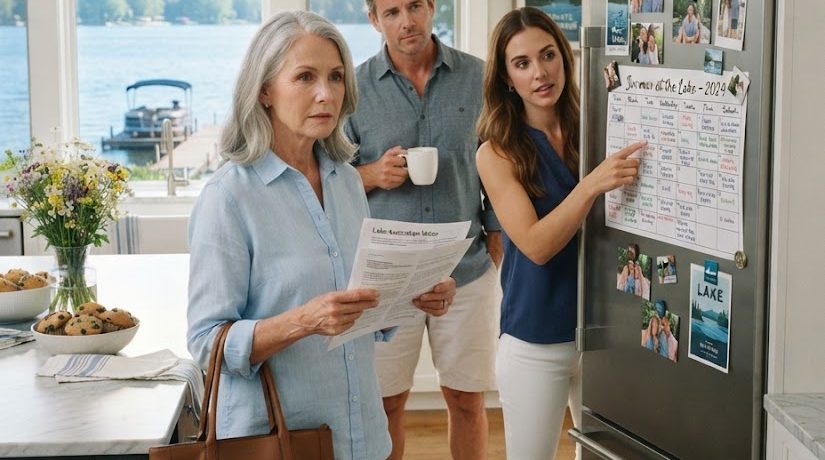
Ashley set a folder down beside the muffins on my kitchen table.
“Nothing complicated,” she said.
Then she opened it and pushed several pages across the table toward me.
My son Bradley, who had been gazing out at the lake, finally turned around.
“Mom, Ashley put a lot of work into this.”
That sentence alone should have made me suspicious.
People often point out how much effort someone has invested just before asking you to approve something you never wanted.
I sat down and examined the first page.
Whitcomb Lake Cottage Family Use Agreement.
The word family was repeated everywhere.
Guests were expected to clean up before leaving.
Bradley and Ashley would be responsible for overseeing maintenance.
No additional visitors without permission.
The upstairs bedroom would be designated for “primary family use.”
Any disagreements about scheduling would be settled by the “summer coordinators.”
I looked up.
“Who exactly are the summer coordinators?”
“Bradley and me.”
Of course.
I continued reading.
Then I reached one sentence that changed everything.
Owner occupancy should be scheduled in advance so it does not interfere with confirmed guest reservations.
Apparently, I was no longer Marianne Whitcomb.
I was merely “the owner.”
Ashley tapped the page.
“That’s only to prevent surprises.”
“In my own house?”
“Your cottage, yes. But everyone uses it.”
“No.”
The word came out softly.
Bradley sighed.
“Mom.”
“No. Not everyone uses this cottage. The people I invite use it.”
Ashley folded her arms.
“You’ve always said you wanted people to enjoy it.”
“I also want people to enjoy my china. That doesn’t mean the neighbors can come into my kitchen and take a plate.”
Bradley placed his father’s old sailboat mug down with slightly more force than necessary.
“Why are you making this ugly?”
I looked at him.
For one strange moment, I remembered all the different versions of my son.
Bradley at six with chicken pox.
Bradley at eleven, crying after his dog died.
Bradley at seventeen, asking us for money to fix his car.
Bradley at twenty-three, standing beside his father in a rented tuxedo on his wedding day.
Now he was fifty, standing in my kitchen and asking why I was being difficult simply because I objected to strangers staying in my home.
“I’m not making it ugly,” I said. “I’m realizing that it became ugly without me.”
Ashley started collecting the papers.
“Fine. We can talk about this another time.”
“No.”
She stopped.
“We’re talking about it now.”
I walked over to the refrigerator and took down the summer schedule she had taped there.
I folded it once.
Then I folded it again.
Ashley gave a quiet laugh.
It wasn’t openly cruel.
It was almost patient.
As though I were an elderly woman being unreasonable about something insignificant.
“Marianne, people have already made plans.”
I slipped the folded schedule into my purse.
“Then they can change them.”
Her expression changed.
Only a little.
But I noticed it.
Fear.
That caught my attention.
“Some people have already bought plane tickets,” she said.
“To stay in my house?”
Bradley rubbed his forehead.
“Mom, please don’t turn this into an ownership issue.”
I almost smiled.
“It is an ownership issue.”
Ashley picked up her bag.
“I knew this would happen.”
Bradley looked at her.
She shook her head.
“You told me she would understand.”
Another discussion about me had taken place without me.
I stood.
“I think breakfast is over.”
Bradley stared at me.
“You’re throwing us out?”
“I’m asking you to leave.”
“Mom—”
“Take the muffins.”
Ashley did.
Ten minutes later, their SUV vanished down the sandy road.
I remained alone in the kitchen.
Four small pieces of tape were still stuck to the refrigerator.
I carefully removed each one.
Then I grabbed my purse and drove to the county offices.
I told myself I only wanted to confirm something.
That wasn’t the truth.
Somewhere between pulling that schedule down and getting into my car, I had stopped checking.
I had started taking action.
At the property-records counter, a woman named Denise searched for my cottage address.
“You’re Marianne Whitcomb?”
“Yes.”
She asked me for identification.
Then she glanced at her screen again.
“You’re the sole titled owner.”
A wave of relief went through me.
It lasted maybe four seconds.
Then Denise frowned.
“Have you authorized anyone to operate a short-term rental from this property?”
I froze.
“No.”
“There’s a pending seasonal rental registration connected to this address.”
“A what?”
“It was submitted about six weeks ago.”
My hands suddenly felt cold.
“Who filed it?”
She paused.
“Whitcomb Lake Hospitality.”
I had never heard of it.
“There’s a contact person,” Denise added.
“Ashley Whitcomb?”
Her expression gave me the answer before she spoke.
She printed out the filing.
There was my cottage address.
Ashley’s email.
A proposed occupancy of ten people.
Weekly rentals.
Estimated seasonal revenue:
$24,000.
Then I reached the section marked:
PROPERTY OWNER AUTHORIZATION
My name appeared beneath it.
Marianne Whitcomb.
And underneath my name was a signature.
It was meant to look like mine.
It wasn’t.
Daniel used to tease me because the capital M in my signature always slanted too far to the right.
This one stood perfectly straight.
“I didn’t sign this.”
Denise became completely still.
“I understand.”
“No. I need you to understand precisely what I’m telling you.”
I pointed directly at the document.
“That signature is not mine.”
The next hour passed in a blur of forms, supervisors, identity verification, withdrawal requests, and paperwork recording the disputed signature.
From the parking lot, I called a locksmith.
Then I changed the cottage’s internet password.
Then I opened the smart-lock app Daniel and I had installed near the end of his life.
There were seven access codes listed.
I had created two.
Mine.
And Bradley’s.
The remaining ones were labeled things like:
MILLER FAMILY JULY
JEN + GIRLS
GOLF WEEKEND
MOM & DAD
I stared at them.
Then I removed every code except mine.
Bradley’s was the last one I deleted.
At 4:37, my phone began buzzing.
Ashley.
Then Ashley again.
Then Bradley.
Then unfamiliar numbers.
Messages followed.
Ashley says there’s a problem with our July booking.
Booking.
Not visit.
Booking.
Another message arrived.
We already sent the remaining $1,800. Please call us.
That was when the last illusion vanished.
Ashley hadn’t simply been filling my cottage with guests.
She had been filling it with paying customers.
By sunset, every unauthorized access code had been deactivated.
The rental registration had been frozen.
And every person who contacted me received the same response:
I am the owner of this property. I never authorized it to be rented. Please seek reimbursement from the person who accepted your money.
At 6:12, Denise called.
“My supervisor found something else connected to the property.”
My fingers tightened around the phone.
“What?”
“There’s another document.”
“What kind?”
“This one carries your son’s signature.”
And suddenly, I realized Ashley’s summer schedule had been only the first step.
## Chapter 3 — My Son Had Already Spent an Inheritance I Never Gave Him
I went back to the county office first thing Monday morning.
The good news was that ownership of the cottage had not been transferred.
The bad news was nearly everything else.
Bradley had signed an affidavit identifying himself as an “authorized family property representative.”
Attached were preliminary financing papers from a private lender.
My cottage address was listed in the collateral section.
I read it three times.
“What exactly is this?”
Denise answered cautiously.
“You’ll need an attorney to explain the legal consequences, but it looks like someone was investigating financing connected to the property.”
“My son.”
His signature was right there.
Bradley Daniel Whitcomb.
Daniel’s name was part of his.
For fifty years, seeing that had made me proud.
That morning, it didn’t.
There was also a copy of an old power-of-attorney document.
I knew that document.
Three years earlier, before undergoing knee surgery, I had given Bradley temporary authority to help manage bills and financial matters if I became unable to handle them myself.
Apparently, the authority was broader than I remembered.
Someone had recently used a copy in connection with the cottage.
I immediately called Margaret Ellis, the attorney who had handled Daniel’s estate.
After I finished explaining everything, she asked me three questions.
“Have you signed anything recently?”
“No.”
“Did you authorize Bradley to borrow against the cottage?”
“No.”
“Did you authorize Ashley to rent it?”
“No.”
“Good. Come to my office.”
By noon, Margaret had prepared a formal revocation of the old power of attorney and begun sending out notices.
Then she looked at me over the top of her glasses.
“Marianne, is Bradley having financial problems?”
“I don’t know.”
She pushed the financing paperwork across the desk toward me.
“People generally don’t try to gain access to someone else’s property when everything is going smoothly.”
I called Bradley.
“Where are you?”
“At work.”
“Leave.”
“What?”
“Meet me at the cottage. One hour.”
At 1:18, his SUV pulled up.
Ashley was with him.
Of course she was.
They walked onto the porch and stopped when they noticed the new lock.
“You changed the locks?” Ashley asked.
“Yes.”
Bradley stared at me.
“You locked me out?”
“No, Bradley. I stopped pretending that you live here.”
I held up the rental paperwork.
“Twenty-four thousand dollars.”
Ashley’s expression changed.
Bradley looked over at her.
That small reaction told me something important.
He knew part of it.
Maybe not everything.
I looked directly at Ashley.
“Tell him.”
She remained silent.
“Tell your husband why strangers were paying you to stay in my cottage.”
Bradley turned toward her.
“Ash?”
She looked irritated rather than embarrassed.
“It was going toward expenses.”
“What expenses?”
“Maintenance. Taxes. Improvements.”
“You have never paid my property taxes.”
“We bought the patio set.”
“The patio set cost nine hundred dollars.”
“It was eleven hundred.”
I almost respected the audacity.
Then Ashley finally said what was underneath everything.
“Bradley is your only son. Someday this cottage is going to belong to him anyway.”
Silence.
There it was.
Not the reservations.
Not the money.
Not the falsified authorization.
The assumption beneath all of it.
Someday this will belong to him anyway.
I looked at Bradley.
He couldn’t bring himself to meet my gaze.
“Is that really what you believe?”
“Mom—”
“You assumed I was already gone enough to start dividing up my summers.”
Ashley objected.
Bradley finally raised his eyes to mine.
“There’s more.”
“I know.”
Then I pulled out the financing documents.
The color drained from his face.
“What were you planning to borrow money for?”
He swallowed hard.
“Mom, I can explain.”
“Good.”
I opened the door.
“Explain.”
They walked inside.
For the first time in his life, my son stepped into the cottage as though he were a stranger who hadn’t been invited.
We sat around the kitchen table.
Bradley spoke first.
His business had lost one major client.
Then another.
He had borrowed against his own house.
After that, he relied on credit cards.
Then he put money into a development project that eventually stalled.
Ashley’s parents had helped them once.
Then they refused to do it again.
“How much debt?”
Bradley lowered his gaze.
“Two hundred and twelve thousand.”
I shut my eyes.
Ashley quickly interrupted.
“It isn’t all debt.”
“That usually means most of it is.”
“We had a plan.”
I looked directly at her.
“My house was the plan.”
Bradley admitted they had looked into borrowing against the cottage.
He insisted they had never actually finalized the loan.
“But you were considering borrowing against property that doesn’t belong to you.”
“I thought the power of attorney might give me permission.”
“You thought?”
He looked devastated.
“Mom, I was desperate.”
For the first time, something he said sounded entirely sincere.
It didn’t make it acceptable.
But it sounded honest.
Then Ashley spoke.
“Daniel would have helped us.”
Every muscle in my body tightened.
“Do not use my dead husband as an excuse for taking something from me.”
She fell silent.
“You knew Daniel when he was healthy enough to take you sailing,” I said. “You didn’t know him when he was sick. You weren’t beside him while he worried about leaving me vulnerable.”
Then I turned toward Bradley.
“But you were.”
I could see how much those words hurt him.
Then I noticed Daniel’s writing desk.
The bottom drawer was slightly ajar.
I never left it like that.
Inside were old insurance papers, tax records, photographs, and copies of our cottage documents.
The envelope containing those records was missing.
I turned around slowly.
“Who opened this?”
Neither of them answered.
“Bradley?”
His expression answered for him.
Ashley stood up.
“We needed the documentation.”
“You forced open your father’s desk?”
“It wasn’t breaking in.”
I pointed at the scratched brass lock.
“What would you call it?”
Then my phone rang.
Margaret.
I answered.
“Marianne,” she said, “I found the actual real-estate inquiry.”
“What inquiry?”
“Three weeks ago, someone reached out to a broker about getting your cottage ready for an off-market sale.”
I looked straight at Bradley.
Margaret went on.
“The broker’s notes describe the owner as elderly, recently widowed, and probably ready to simplify her estate before fall.”
My hand began to shake.
“Who contacted the broker?”
Across the table, Ashley shut her eyes.
That told me everything.
But Margaret said the words anyway.
“Your daughter-in-law.”
—
Chapter 4 — They Weren’t Waiting for Me to Die. They Were Waiting for Me to Become Convenient
I had always thought betrayal would feel hot.
Anger.
Screaming.
Something explosive.
Instead, actual betrayal felt freezing.
I stood inside the cottage Daniel and I had spent decades creating and stared at two people who had apparently been figuring out how to turn my life into cash.
Ashley was the first to defend herself.
“I only reached out to a broker for information.”
“About selling my house.”
“About finding out what it was worth.”
“You sent them photographs?”
She said nothing.
Suddenly, I remembered Ashley walking through the cottage with her phone two weeks earlier.
I had assumed she was taking pictures of the lake.
Bradley looked stunned.
“You told me you were only getting an estimate.”
Ashley snapped her attention toward him.
“Don’t act like you had no idea. You knew we needed options.”
I watched their marriage begin falling apart right there at my kitchen table.
Ashley turned back toward me.
“We were going to tell you.”
“When?”
“After summer.”
Of course.
After the profitable weeks.
After strangers had slept in my beds.
After her family had enjoyed July.
After golf friends had used Daniel’s dock.
After I had obediently shown up for my September time.
“What happened after summer?”
“We would have gone over the numbers with you.”
“What numbers?”
“The cottage is worth far more than you think.”
“I know exactly what my property is worth.”
“You’re seventy-one.”
The room became completely silent.
Even Ashley seemed to realize how terrible that sounded.
But she continued.
“You shouldn’t have so much money tied up in a place you mostly use by yourself.”
“What should I have instead?”
“A condo. Something that’s easier to manage.”
“Where?”
“Closer to us.”
“And what happens to whatever money is left?”
Neither of them said anything.
That told me enough.
“You both need to go.”
Ashley stared at me.
“Marianne—”
“Get out of my house.”
Bradley rose to his feet.
“Mom, please.”
“You too.”
They walked out.
The next morning, the phone calls started.
Ashley’s mother.
Bradley’s friends.
Or the attempted loan.
Or the broker.
Now the question became whether I was grieving too deeply.
Whether loneliness had affected my judgment.
Whether I had become unreasonable.
Whether I was making decisions based on emotion.
Margaret came to the cottage that afternoon.
We discussed legal protections.
The revoked authority.
The disputed signature.
Estate planning.
Then she said,
“You should think about revising your will.”
For years, Bradley had clearly been my main beneficiary.
Who else would I have named?
Maybe I had said “someday” far too often.
Someday Bradley will have this.
Someday Bradley will understand.
Someday his children will spend their summers here.
Perhaps I had talked about his future inheritance so casually that he had begun viewing it as something he already owned.
Margaret gave me one piece of advice.
“Never promise an inheritance simply to fix a relationship.”
That evening, Ashley’s parents, Patricia and Howard, arrived.
They had been scheduled for the week of the Fourth of July.
I didn’t ask them to come inside.
They told me Bradley was facing tremendous financial pressure.
I asked only one question.
“Did you pay Ashley for your July stay?”
Both of them froze.
“How much?”
Howard eventually answered.
“Three thousand dollars.”
“For six nights?”
Silence.
“Did Ashley tell you I had approved it?”
Patricia’s confidence vanished.
“She said everyone in the family had agreed.”
“I am the family member who owns the house.”
Howard looked genuinely stunned.
“We didn’t know.”
Then I asked,
“Did you know Ashley had contacted a broker?”
Howard looked at his wife.
Patricia remained silent.
Finally, she admitted,
“Ashley said once the cottage was sold, Bradley would be able to repay us.”
“How much does he owe you?”
“Eighty thousand.”
Suddenly, everything fell into place.
Their daughter had been renting my cottage to pay them back while secretly investigating the sale of my property to finish what they had started.
“It wasn’t supposed to happen this way,” Patricia whispered.
“No,” I said. “It was supposed to happen without anyone noticing.”
Later that night, Bradley called.
“Mom, I need to talk to you alone.”
He came after dark.
We sat together on the porch.
For several minutes, neither of us said anything.
Then he spoke.
“There’s something you don’t know.”
“I’m getting very tired of hearing that.”
“This started before Ashley.”
My chest tightened.
“What started before her?”
He stared toward the dock where Daniel used to sit.
“Dad talked to me about the cottage before he died.”
“What did he tell you?”
Bradley’s eyes filled with tears.
“He told me that someday this place would be mine.”
And for the first time, I wondered if the misunderstanding had begun long before Ashley ever opened the door to my refrigerator.
Chapter 5 — What My Husband Actually Left Behind
I didn’t sleep that night.
Daniel and I had been married for forty-three years.
Like every couple, we had things we kept private.
But I could never picture him giving away the cottage without first telling me.
The next morning, I called Margaret.
She went through Daniel’s estate records.
Then she discovered something.
A sealed photocopy of a letter.
Written across the front in Daniel’s handwriting were two words:
For Bradley.
My heart began pounding.
Bradley had been given the original after Daniel passed away.
Margaret still had the copy.
I opened it.
Daniel wrote that he loved his son.
That he was proud of him.
That he hoped Bradley would one day bring his own children to the lake.
Then he wrote about the cottage.
Bradley might receive it someday.
But only if I decided that was what I wanted.
Daniel had underlined one sentence.
The cottage belongs to your mother. Not later. Not temporarily. Entirely.
My eyes filled with tears.
Then I reached the final paragraph.
Daniel had written:
If you ever find yourself thinking more about what your mother may leave you than whether she is lonely, afraid, or loved, then I will have failed you somewhere. Do not inherit this cottage before she is gone. And do not make her feel gone while she is still sitting in it.
I cried.
Silently.
Daniel had seen the danger.
Not Ashley.
Not the debt.
Human nature.
That afternoon, I asked Bradley to come by alone.
I set the letter down on the kitchen table.
His face turned pale.
“You remember this?”
“Yes.”
“You received the original?”
“Yes.”
“Then why did you tell me your father promised you the cottage?”
“He did.”
“No. He said you might have it someday if I decided to give it to you.”
“That’s what I meant.”
“No. It’s not.”
Bradley began to cry.
I had seen my son cry only a few times during his fifty years.
This was different.
It wasn’t sorrow.
It was shame.
“Ashley kept telling me it was basically mine eventually.”
“And you wanted to believe her.”
“Yes.”
“Because you needed money.”
He nodded.
“And every time you needed more money, I became a little less real in your mind.”
“Mom, no.”
“Yes.”
I sat across from him.
“You didn’t want me dead. But you needed my future property badly enough that you stopped respecting the fact that I still owned it.”
He covered his face.
I wanted to comfort him.
My hands nearly reached for him.
Then I stopped.
Sometimes a parent’s instinct to comfort can shield an adult child from consequences they need to experience.
Bradley promised that he would repay every renter who had been charged without my permission.
He would sell his boat.
Then the truck.
He and Ashley would sell their house.
“We haven’t really been able to afford it for two years,” he admitted.
I thought about the remodeled kitchen.
The vacations.
The SUV.
The photographs.
I had confused spending with financial security.
People do that all the time.
Then I asked him plainly,
“Did Ashley forge my signature?”
“I don’t know.”
“That’s not enough.”
“I swear. I knew she was taking deposits. I thought she had gotten you to sign something.”
“You never asked.”
“No.”
“Why?”
“Because I didn’t want to hear you say no.”
The answer was so painfully honest that there was nothing left to conceal.
Then Ashley came in.
She stepped inside and noticed Daniel’s letter.
Bradley told her he had admitted everything.
The debt.
The rentals.
The financing.
Ashley looked straight at me.
“You got what you wanted.”
“What exactly was that?”
“My husband turning against me.”
Bradley told her to stop.
She wouldn’t.
Then she headed toward the door.
“Fine. But before the two of you decide I’m the villain, maybe Marianne should know who actually came up with the idea for September.”
Bradley froze completely.
I looked at him.
“What is she talking about?”
Ashley walked out.
I turned back to my son.
“Was September Ashley’s idea?”
“No.”
My chest tightened.
“Then whose idea was it?”
He looked at me.
“Mine.”
That wounded me more than almost anything else.
—
Chapter 6 — The September They Gave Me Became the Summer I Took Back
“Why?” I asked.
Bradley rubbed his hands over his jeans.
“Ashley originally wanted you to have two weeks in August.”
“How generous.”
“She wanted September for someone else. I changed it.”
“Why?”
He stared out toward the lake.
“Because Dad died in September.”
The anger I was carrying suddenly stopped.
“I thought you liked coming here then. You always said the lake was quieter after Labor Day.”
“It is.”
“So I told Ashley you wouldn’t mind.”
There are explanations that can make something understandable without making it right.
This was one of those.
“I told myself I was giving you the time you liked most,” he said.
“And everyone else received the time they wanted.”
“Yes.”
I looked at him.
“What should you have done?”
“Asked you.”
Two words.
The entire mess came down to those two words.
Asked you.
At the doorway, Bradley apologized.
I didn’t tell him I forgave him.
Sometimes forgiveness offered too quickly is only a way of making the discomfort disappear.
Instead, I said,
“I believe you’re sorry.”
For that moment, it was enough.
The following weeks were difficult.
The unauthorized renters demanded their money back.
Ashley refunded them.
Bradley sold his fishing boat.
Then he sold his truck.
Their oversized house was put on the market.
Ashley’s parents hired their own lawyer over the money they had loaned them.
For once, their problem was theirs to handle.
Margaret helped me place the cottage into a trust based on one simple rule:
No one would have control over my home while I was alive and capable of making my own decisions.
I changed my will as well.
Not out of revenge.
Bradley would no longer automatically receive the cottage outright.
The property would stay protected for a period of time after my death.
No immediate sale.
No borrowing against it.
No treating an inheritance like instant cash.
I stopped thinking of inheritance as either a reward or a punishment.
It was simply planning.
Living was something else.
Living required boundaries.
Bradley didn’t receive another key that summer.
Maybe someday.
But trust had to become meaningful again.
Ashley stayed away.
Her marriage to Bradley survived, barely.
I stayed out of it.
Their marriage was theirs.
Their debt was theirs.
Their embarrassment was theirs.
The cottage was mine.
Those distinctions brought me more peace than revenge ever could.
Then something happened that I never expected.
After canceling Ashley’s summer schedule, I remained at the cottage.
The entire summer.
June was mine.
July was mine.
August was mine.
One morning, I went swimming before anyone else along the road was awake.
At seventy-one.
The water was so cold that I gasped, then laughed.
In July, I invited my sister-in-law Ruth to stay for several days.
I invited her.
That difference mattered.
On the Fourth of July, during the week Ashley’s parents had expected to stay there, I hung Daniel’s old flag from the porch.
Then I invited Denise from the county office and her husband over for hamburgers.
When she arrived, she looked uncomfortable.
“I feel strange being here after everything.”
“You were invited.”
I smiled.
“That changes everything.”
In August, a violent storm swept across Lake Michigan.
The wind rattled the windows.
Lightning flashed across the water.
For the first time since Daniel died, I felt truly afraid inside the cottage.
Not helpless.
Afraid.
There is a difference.
At 12:43 in the morning, headlights appeared through the rain.
I stood behind the locked door until I recognized Bradley.
He rushed onto the porch, completely soaked.
“What are you doing here?”
“The west dock line.”
“What?”
“Dad always doubled it when storms came from this direction.”
I had forgotten.
Bradley hadn’t.
He grabbed Daniel’s old raincoat and spent twenty minutes outside in the storm securing the dock while I held a flashlight from the porch.
When he finally came inside, water streamed from his clothes.
I gave him a towel.
Neither of us said anything about the fact that he no longer had a key.
I made coffee.
He noticed Daniel’s cracked sailboat mug sitting beside the sink.
“I’m sorry I used that mug that morning.”
I looked at him.
“That wasn’t your biggest offense.”
He laughed.
I laughed too.
Something changed.
It wasn’t repaired.
But it shifted.
Families often assume that reconciliation means going back to the exact relationship they had before.
It doesn’t.
Sometimes the old pattern of relating is precisely what allowed the betrayal to happen.
Bradley and I couldn’t return to the way things had been.
So we started relating to each other differently.
He called before coming over.
Every single time.
He stopped referring to it as “our cottage.”
He called it “Mom’s place.”
At first, the words sounded intentional.
Eventually, they became natural.
He finished returning all the rental deposits.
He sent me proof without me having to ask.
He began working with a financial counselor.
After selling his house, he moved into a smaller home.
Ashley remained distant.
Whenever she spoke with me, she was polite.
That was enough.
I no longer needed closeness where respect had not yet been restored.
Then September arrived.
September 8.
My week.
According to Ashley’s old schedule.
I woke before dawn.
The cottage was cold enough that I pulled on Daniel’s gray sweater.
I made coffee and took it outside.
The lake was almost completely still.
No speedboats.
No children shouting from the docks.
No music coming from rental houses.
Only water.
Silver at first.
Then blue.
Then gold.
I settled into Daniel’s chair.
For thirty-one years, I had believed the cottage contained my memories because Daniel and I had created them there.
That morning, I realized something different.
The cottage didn’t hold my life.
I did.
The building was wood.
Nails.
Paint.
Glass.
A roof we had fixed more times than I could count.
The sacred part was never the property itself.
It was my right to choose what happened within the life I was still living.
Around nine, someone knocked.
Bradley was standing outside with a paper bag in his hand.
“Apple fritters.”
I glanced behind him.
No luggage.
No Ashley.
No assumptions.
Then he asked,
“Can I come in?”
Four simple words.
They nearly broke my heart.
Not because he had finally learned to ask permission before entering a building.
Because he had remembered that I was still here to give him an answer.
I opened the door.
“Yes.”
We drank coffee together on the porch.
After a while, Bradley looked out across the lake.
“Mom?”
“Yes?”
“I don’t want the cottage.”
I waited.
“Not in that way anymore.”
He swallowed.
“I want you to keep it for as long as you want.”
For a moment, I thought about reminding him that I never needed his permission.
Then I realized he already understood that.
That was the entire point.
So I simply said,
“Good.”
After he left, I went back inside.
The refrigerator door had been empty for months.
Then I opened the drawer beneath Daniel’s desk and discovered an old photograph.
Daniel and me.
Thirty-one years younger.
Standing outside the cottage during the summer we bought it.
The siding was peeling.
The roof looked awful.
Daniel had one arm wrapped around me.
We both looked exhausted.
And we were laughing.
On the back, Daniel had written:
**First summer. Marianne says this place will kill us. I think she secretly loves it.**
I carried the picture into the kitchen and stuck it onto the refrigerator with a crooked Michigan-shaped magnet.
Then I looked around.
My imperfect.
Drafty.
Expensive.
Beloved cottage.
June had been mine.
July had been mine.
August had been mine.
And September was mine too.
Not because Ashley had given it to me.
Not because Bradley finally understood.
Not because the county records had my name on them.
Because I was still alive.
Still capable.
Still standing inside the life Daniel and I had created.
Outside, Lake Michigan stretched beneath the morning light.
Daniel once told me that ugly places only needed someone stubborn enough to stay.
At the time, he was talking about the cottage.
At seventy-one, I finally understood what else he meant.
Families can become damaged in the same ways houses can.
Small leaks.
Unnoticed cracks.
Tiny trespasses everyone chooses to ignore.
And sometimes love doesn’t protect a family by keeping every door unlocked.
Sometimes love protects what is left by changing the locks.
Then, if someone eventually learns how to knock—
you get to decide whether the door opens.
I carried my coffee back onto the porch.
For the first time in years, I didn’t feel like Daniel’s widow, waiting for someone else to determine what the next chapter of my life would be.
I felt like Marianne Whitcomb.
Owner.
Mother.
Woman.
Still here.
And September, as it turned out, was beautiful.









