 391 views
 The delivery driver was already halfway to his van when I hurried to the doorway and called out to him.
“Excuse me! Are you absolutely sure these flowers are for me?”
He stopped, checked the clipboard under his arm, and then looked again at the label.
“Yes.”
“Then they’re yours, ma’am.”
He gave me a courteous but slightly confused smile, the kind a young deliveryman might give when bringing an extravagant bouquet to an elderly woman who obviously lives alone.
“Have a nice day.”
Then he climbed into his van and drove away down the street.
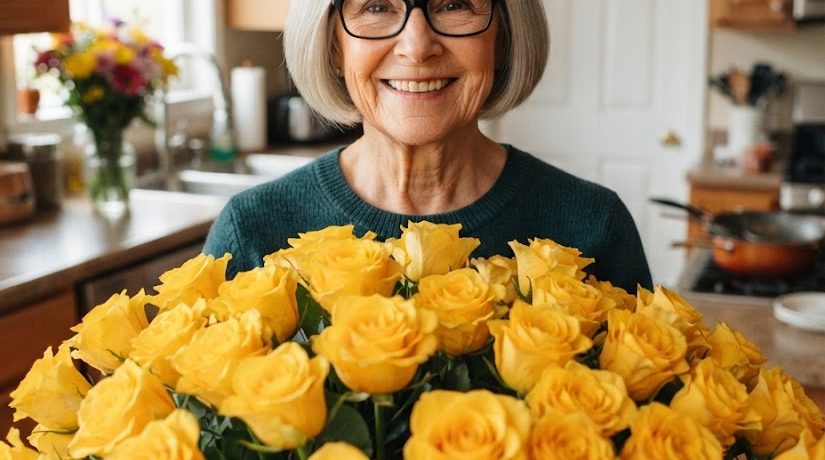
I stayed in the doorway, barely able to see over the enormous bouquet I was holding.
Yellow roses.
Dozens of them.
Their scent filled the cold morning air as I carried them inside and carefully set them on the kitchen table.
Something about the bouquet felt wrong.
So I counted them.
Then I counted them a second time.
Fifty-six.
My hand stopped around the final stem.
Fifty-six yellow roses.
Today would have been my fifty-sixth wedding anniversary.
For several moments, I simply stood there staring at them.
No one sent me flowers anymore.
Most of my closest friends were gone, and the few who were still alive certainly wouldn’t spend hundreds of dollars on such an elaborate arrangement.
I lived modestly on my retirement income.
And I had never purchased flowers for myself.
No.
This was not some random mistake.
Fifty-six was far too exact.
I pulled the largest vase I owned from beneath the sink.
It was an old crystal vase we had received as a wedding present, one I had barely touched throughout all those years.
I filled it with water and started arranging the roses.
Then something sharply scraped across my thumb.
“Ow.”
I quickly pulled my hand away, expecting to find a thorn.
But there wasn’t one.
Tucked deep among the fresh roses was something unusual.
Something yellow.
Something crumpled and faded.
Paper.
I carefully pulled it out.
It was meant to be a rose.
At least, that was what I assumed.
Someone had folded an old piece of yellow paper into the shape of a flower, but whoever had made it clearly had no skill at delicate crafts.
The petals were uneven.
One side drooped farther outward than the other.
The paper stem had been reinforced with an old strip of tape that had turned amber over time.
I almost laughed.
It was easily the ugliest paper rose I had ever seen.
Then I turned it over.
Near the bottom of the stem, written faintly in pencil, was a single letter.
J.
My breath caught.
I recognized that handwriting.
I could have recognized it after a hundred lifetimes.
James.
My husband.
The man who had vanished fifty-six years ago.
I collapsed into the nearest chair so suddenly that its legs scraped loudly against the kitchen floor.
One of the real roses tumbled from the table.
“No,” I whispered.
“That can’t be possible.”
But the flower was still in my hand.
Old.
Fragile.
Real.
And carrying James’s initial.
For the first time in decades, a question I had spent half my life refusing to ask suddenly returned.
Could James somehow still be alive?
James and I had been married for only two days when he left.
Two days.
Yet those two days somehow shaped the following fifty-six years of my life.
We were married in my parents’ backyard while he was home on leave.
There were twenty-three guests, folding chairs borrowed from the church, and a homemade wedding cake that leaned awkwardly to one side.
My mother cried through nearly the entire ceremony.
Later, James teased her while holding a paper cup filled with punch.
“Don’t cry, Mrs. Doyle. I’m only borrowing your daughter. I’m not stealing her.”
My mother raised the cake knife toward him.
“You bring her back happy, James. Otherwise, you’ll answer to me.”
James looked across the yard at me in my yellow dress.
“That’s the plan,” he said.
“That’s the whole plan.”
We spent two beautiful days pretending our future was certain.
We talked about buying a small house.
Having children.
Maybe getting a dog.
Building a porch where we could sit together when we were old.
On our first morning as husband and wife, James made the coffee far too strong but drank it anyway because he refused to admit he had ruined it.
We walked through the neighborhood hand in hand, feeling strangely grown-up because we were officially married.
Then the third morning arrived.
His leave was over.
I stood beside him at the old downtown train station wearing the yellow cotton dress he loved.
He always told me the color made me look like sunshine.
Before he boarded the train, he pulled me close.
“Next anniversary,” he whispered, “I’m buying you the biggest bouquet of yellow roses I can find. So many that you won’t even be able to see over them.”
I laughed.
“You’d better. I only married you for the flowers.”
James threw his head back and laughed.
That was the last time I ever heard that laugh.
Several weeks later, his unit came under attack overseas.
Some soldiers were killed.
Others vanished during the chaos.
James was officially listed as missing.
His closest friend, Adrian, eventually made it home.
One bleak afternoon, he sat across from me in my parents’ living room, his military cap tightly held between his hands.
For a long time, he couldn’t bring himself to look at me.
Finally, he spoke quietly.
“I saw the explosion, Mary.”
He swallowed.
“I’m sorry. I truly am. But I don’t believe James could have survived.”
No body was ever found.
Eventually, the official paperwork arrived.
Presumed dead.
Two words.
That was all I received after losing my husband.
Presumed.
Not confirmed.
Presumed.
It left the smallest crack for hope, and that tiny opening stayed with me for decades.
I never married again.
There were opportunities.
Kind men.
Good men.
My mother encouraged me to move forward while she was still alive.
My friends did too.
But some stubborn part of my heart remained at that train platform.
Maybe it was loyalty.
Maybe it was foolishness.
Or maybe you can’t truly close a door when no one ever gave you the chance to say goodbye.
Still, I built a life.
I worked as a bookkeeper for over thirty years.
Numbers became reassuring because they obeyed rules.
They always balanced correctly.
Life rarely did.
I bought a modest house by myself.
Paid the mortgage on my own.
Maintained a garden.
Loved my nieces, nephews, and eventually their children.
My life was peaceful.
Not unhappy.
But somewhere within it, there was always an empty chair.
Until this morning.
Until fifty-six yellow roses arrived for my anniversary.
And hidden among them was an awkward paper flower marked with James’s initial.
My hands shook as I searched through the bouquet once more.
This time, I discovered a small cream envelope tucked beneath the ribbon.
My name was written across the front.
Mary.
The handwriting wasn’t James’s.
Still, I opened it.
Inside was a card.
The first sentence made the entire room seem to tilt.
“Darling, you won’t believe why I had to disappear. Adrian lied to you.”
I read it twice.
Then a third time.
Adrian lied to you.
More instructions followed underneath.
“Act normally. If you still have the yellow dress, bring it. Take the roses to the old station at 11:00. Do exactly what I’m asking.”
I glanced at the kitchen clock.
10:17.
Forty-three minutes.
My first thought came from the twenty-three-year-old woman still living somewhere inside me.
James is alive.
My second thought was almost impossible to bear.
If James had truly been alive all these years, then every Christmas I spent by myself, every anniversary, every birthday, and every ordinary evening in my little house had happened while my husband was somewhere else.
Without me.
I stared at the card again.
Adrian lied.
Adrian had remained loosely connected to my life for decades.
He attended both of my parents’ funerals.
He sent Christmas cards every year until his hands became too unsteady to write.
And he was the man who had sat across from me when I was twenty-three and told me James was almost certainly dead.
I reached for the telephone.
Then stopped.
Act normally.
Why would James insist on secrecy?
Why not simply call me?
Why not come to my front door?
And if James hadn’t written these instructions, who else could possibly know about the yellow dress?
I hurried upstairs.
At the back of my closet was an old cedar chest.
Inside, underneath layers of tissue paper, was the dress.
The yellow fabric had faded with time, but there was no mistaking it.
I lifted it carefully.
Then my fingers discovered three uneven stitches along the side seam.
Suddenly, I smiled.
James had sewn those.
The night after our wedding, I had torn the dress on a nail sticking out from my parents’ porch.
James proudly declared that he could fix it.
He couldn’t.
His stitches zigzagged crookedly across the fabric, pulling one side into an ugly little wrinkle.
I laughed so hard that evening he threatened to divorce me before we had even reached forty-eight hours of marriage.
Now I stared at those crooked stitches.
Then I remembered the badly folded paper rose downstairs.
James had always been wonderful at anything that required strength.
Engines.
Tools.
Fences.
But anything involving patience or delicate hands?
He was hopeless.
Whoever had folded that flower had hands exactly like his.
At 10:42, I left the house.
The yellow dress was draped over one arm.
The enormous bouquet occupied the other.
The old train station was only a short distance away.
Passenger trains hadn’t stopped there in decades.
Eventually, the town restored the building as a historical site, but I had avoided it throughout my entire adult life.
I hadn’t stepped inside since the morning James left.
Until now.
I stood beneath the old station clock, clutching fifty-six roses in my arms.
For that brief moment, I was twenty-three again.
Not carefree.
Just frightened.
Exactly at eleven o’clock, an elderly man slowly stood from a bench against the far wall.
For one impossible second, my heart stopped.
He was frail.
Bent with age.
Very old.
For one reckless moment, I let myself hope.
Then he took off his cap.
“Mary.”
I knew him at once.
“Adrian?”
He carried an old olive-green military duffel bag.
James’s name was still visible across the worn fabric.
I almost let the bouquet slip from my hands.
“Mary, please—”
“Where is he?”
Adrian froze.
“Where is James?”
His eyes briefly shut.
And somehow, I already understood.
“Is he alive?”
I struggled to get the words out.
“No,” Adrian said.
“No, Mary. He’s not.”
I had spent fifty-six years believing my husband was dead.
That answer should not have shattered me.
But for forty-three minutes that morning, James had somehow come alive again.
And now Adrian had taken him from me a second time.
I pressed the card against Adrian’s chest.
“Then who wrote this?”
He looked down at it.
“I did.”
My stomach twisted.
“You wrote this?”
“Yes.”
“You pretended to be my husband and made me believe James was still alive?”
“I know what I did.”
“Why?”
“Because I needed you to come.”
“You could have called me.”
“You never would have come if you knew it was me.”
I stared at him in disbelief.
“You brought my husband back into my life for an hour just to get me here.”
His hands shook as they gripped the duffel strap.
“I’m sorry.”
“No.”
I lifted my hand.
“You don’t get to say that yet.”
Then I took the paper rose from my pocket.
“Where did this come from?”
Adrian reached for it.
I quickly pulled it away.
“Don’t touch it.”
His hand dropped.
“James made it.”
Everything inside me went silent.
“You told me James died in an explosion.”
Adrian turned his gaze toward the abandoned railroad tracks.
“That was the lie.”
My heart jumped once more.
He quickly shook his head.
“The attack was real. James was there. I was there too. But neither of us died in that explosion.”
“What happened?”
“We were captured.”
The station around me seemed to vanish.
Adrian went on.
“James had been seriously wounded before they took us. But he survived the attack.”
“How long?”
“A few weeks.”
A few weeks.
For fifty-six years, I had consoled myself with the belief that James had died instantly.
Quickly.
Without suffering.
That he never understood what had happened.
But he had lived for weeks.
He had been wounded.
Afraid.
Miles away from home.
And I had never known.
“You were there with him?”
“Almost every single day.”
I raised the paper flower.
“He made this while he was there?”
Adrian nodded.
“He found a small piece of yellow paper. After folding it, he held it up and said it was probably the ugliest flower anyone had ever made.”
Even with everything happening, a broken laugh slipped out.
“It is.”
“I told him the exact same thing.”
Adrian nearly smiled.
“He gave it to me a few days before he passed away. He made me promise that if I returned home and he didn’t, I would give it to you.”
Adrian’s voice grew quieter.
“He said, ‘I promised her yellow roses. This is the best I can do.’”
I looked at the crooked little flower.
James had made it specifically for me.
During the final weeks of his life.
“What happened to him?”
“He became weaker. His wound worsened, and there was no proper medical treatment.”
“That isn’t enough.”
I looked straight at Adrian.
“I’ve waited fifty-six years. Tell me how my husband died.”
Adrian clenched his hands.
Then he spoke.
“James made me promise him something.”
“What?”
“He told me that if I survived and he didn’t, I was supposed to tell you that he died in the original attack. Quickly. In the explosion.”
My mouth went completely dry.
“He asked you to lie?”
“Yes.”
“Why?”
“Because he loved you.”
I nearly laughed at how cruel that answer sounded.
Adrian continued.
“He didn’t want you imagining him wounded or held captive. He didn’t want you spending the rest of your life wondering what those weeks had been like. He wanted you to believe he died instantly.”
I took a step backward.
“So he decided what I was capable of handling.”
“He was twenty-three, Mary.”
“So was I.”
Adrian said nothing.
That was the part that hurt the most.
James had decided, because he loved me, that I was too fragile to hear the truth.
And by trying to protect me, he had taken something away that should have been mine.
The right to know the final chapter of my husband’s life.
“Did he ever talk about me?” I eventually asked.
Adrian’s expression became gentle.
“All the time.”
“What did he say?”
He glanced down at James’s duffel bag.
“That story will take longer than we have time to tell while standing here.”
“Then start walking.”
I pointed toward the outside.
“You’re going to tell me everything.”
We started toward a veterans’ center several blocks away.
Adrian carried James’s duffel.
I carried the roses.
Halfway there, I suddenly stopped.
“One more question.”
Adrian turned around.
“Did James ever change his mind?”
His eyes lowered.
That was all the answer I needed.
“Adrian.”
He remained silent.
“Did James ever tell you not to lie?”
At last, he whispered,
“Yes.”
My chest tightened.
“When?”
“Near the end.”
“What exactly did he say?”
Adrian looked as though all fifty-six years he had carried inside him had suddenly settled onto his shoulders.
“He said, ‘Tell her I was here.’”
My breath caught.
“He told me not to let you believe he simply disappeared. He wanted you to know that he survived the attack.”
Adrian wiped his eyes.
“And later, when the end was getting closer, he completely changed his mind.”
“What did he say?”
“He said, ‘Tell her everything, Adrian. I was wrong. She’s stronger than I gave her credit for. Tell her all of it.’”
I stared at him.
James had changed his mind.
James had wanted me to know the truth.
Yet Adrian had still gone home and lied.
“Why?”
Adrian looked away.
“Why didn’t you tell me?”
“At first, I convinced myself I was following his original wishes. I believed that was what he truly wanted, and that changing his mind near the end was simply fear.”
“And after that?”
He swallowed.
“When I arrived at your parents’ house, I had already practiced the story. The explosion. Quick. Painless.”
His voice became quieter.
“Then I saw you.”
He looked at me.
“You hugged me.”
I remembered.
Painfully, clearly.
“You thanked me for being there with James. For being his friend.”
My stomach twisted.
I had comforted the very man who was deceiving me.
“And after I left your house,” Adrian continued, “telling you the truth would have meant admitting that I had already lied. One month went by. Then a year. Then five. Every passing year made confessing harder.”
“So you kept lying for fifty-six years.”
“Yes.”
“You weren’t protecting me.”
He lowered his head.
“No.”
“You were protecting yourself.”
“Yes.”
“You let me thank you for all those years.”
His shoulders dropped.
Then he quietly said,
“There’s something else.”
I waited.
“I know where James is buried.”
Everything around me seemed to freeze.
“What?”
“I know where he’s buried.”
“How long have you known?”
He paused.
That pause told me everything.
“How long?”
“For years.”
Anger surged through me once more.
“Years?”
“Eventually, the records became accessible. His remains were identified and brought home.”
“And you never told me.”
“By then, telling you where he was meant I would have to explain everything else.”
I stared at him.
“For fifty-six years, I didn’t even have a grave.”
Adrian remained silent.
“No place where I could leave flowers. No place where I could sit beside him. No place where I could lay down my grief.”
“I was ashamed.”
“You made the decision again.”
My voice trembled.
“You decided what I had the right to know.”
I pointed toward him.
“James made that mistake when he was twenty-three and dying. You continued making the same decision for decades.”
Then I asked,
“Where is he?”
Adrian told me the name of a military cemetery just a few hours away.
Close enough that I could have gone there countless times.
“I can take you,” he said.
“No.”
Then I changed my mind.
“Yes. You can drive.”
He looked at me.
“But I’m the one making this decision. Not you.”
He nodded.
“I’m going to see my husband today.”
We drove for hours.
The world beyond the car windows looked completely different from the one James had known when he left.
The roads had changed.
New buildings stood everywhere.
Entire neighborhoods had been built where there had once been nothing but open fields.
Everything had continued moving forward.
Everything except the love I had carried for James.
That had stayed exactly where I left it.
On a train platform.
In a yellow dress.
After a long silence, I asked Adrian,
“Why today?”
His grip tightened around the steering wheel.
“Every year, I told myself I would tell you before the next anniversary.”
He paused.
“And every year, I failed.”
Then he slowly exhaled.
“Last week, I found out I have cancer.”
I looked at him.
“It’s advanced.”
For the first time that day, some of the anger inside me began to fade.
“I’m sorry.”
“Don’t be.”
He shook his head.
“I should have told you when I still had decades ahead of me to face the consequences. Telling you now because I’m afraid of dying with this secret isn’t bravery.”
He kept his eyes on the road.
“It’s simply a coward realizing he has no road left.”
I said nothing.
But for the first time, I realized Adrian was no longer running from what he had done.
At the cemetery, we walked through endless rows of white gravestones.
At last, Adrian stopped.
There it was.
A simple gravestone.
James’s name was engraved across it.
After fifty-six years.
Adrian stayed several steps behind me.
“Mary—”
“Go back to the car.”
He nodded.
“I need to be by myself.”
He walked away.
And at last, for the first time since James vanished, there was no one standing between my husband and me.
No official documents.
No story about an explosion.
No friend choosing which truth I was strong enough to hear.
Only James.
And me.
I slowly lowered myself to my knees and placed all fifty-six yellow roses beneath his name.
The huge bouquet he had promised me.
More than half a century late.
But finally, it had reached him.
Then I took the crooked paper flower from my pocket.
“You fool,” I whispered.
Tears filled my eyes as a small laugh escaped me.
“You wonderful fool. This truly is the ugliest flower I’ve ever seen.”
I placed my hand against the cold stone.
“I would have wanted to know.”
My voice shook.
“There was nothing I could have done to save you. I understand that. I couldn’t have traveled across the world and brought you home.”
I swallowed hard.
“But I could have known.”
I slowly traced his name with my fingertip.
“I could have carried the fear alongside you instead of carrying a lie.”
Tears rolled down my cheeks.
“It would have frightened me. Knowing you were alive somewhere and suffering would have been unbearable.”
I leaned closer to the gravestone.
“But I would have chosen the truth.”
I remained there for a long time.
I told James everything.
About my parents.
About the little house.
About my work.
About all those decades.
About how I never married again.
About how the yellow dress had stayed folded inside a cedar chest for all those years.
Eventually, it was time for me to go.
I left the fifty-six fresh roses lying across his grave.
But I took the paper flower with me.
That one belonged to me.
It was the only thing James had made for me during those final weeks.
When I returned to the car, Adrian was waiting, with my yellow dress folded carefully across his lap.
After I got inside, he quietly asked,
“Do you hate me?”
I thought about it carefully before replying.
“Today?”
I looked at him.
“Yes.”
He nodded.
“Today, I hate you quite a lot.”
He accepted my answer without arguing.
“But you also brought James back to me today.”
Adrian looked at me.
“The real James.”
I gently held the paper flower.
“The man who lived longer than I ever knew. The man who created this ridiculous little rose. The man who realized near the end that I deserved to know the truth.”
My voice became softer.
“You kept him away from me for fifty-six years. I don’t know if I’ll ever be able to forgive you for that.”
I turned my eyes toward the window.
“But today, you gave him back to me.”
Adrian remained silent.
“So ask me again another day.”
His eyes filled with tears.
“I will.”
We both knew there might not be many days left for him to ask.
That night, I came home completely exhausted.
It was nearly midnight when I entered my kitchen.
The crystal wedding vase sat empty on the table.
The fifty-six fresh roses were now resting beside James.
At 11:57, just three minutes before our anniversary ended, I carefully placed the single crooked paper rose inside the enormous vase.
Beside it, I set our wedding photograph.
James wearing his uniform.
Me wearing my yellow dress.
The two of us impossibly young.
Laughing.
One fragile little paper flower stood alone inside a vase meant to hold dozens.
It looked absurd.
And somehow, it was perfect.
I touched one faded petal.
“You were late,” I whispered.
“Fifty-six years late.”
I smiled through the tears in my eyes.
“You promised me yellow roses on our first anniversary, James. You certainly made me wait long enough.”
Then I looked at the ugliest and most precious flower I had ever owned.
“But it finally found its way to me.”
I gently touched the vase.
“You kept your promise.”
And after fifty-six years, the yellow rose had finally come home.