 196 views
 Six years after my husband and our three sons disappeared during a fishing trip, I still couldn’t bring myself to clear out their bedrooms. Then my daughter plugged in a phone Daniel had claimed he lost. Hidden inside was a video recorded the day before they vanished, along with one detail that sent us straight back to the lake and reopened the entire mystery.
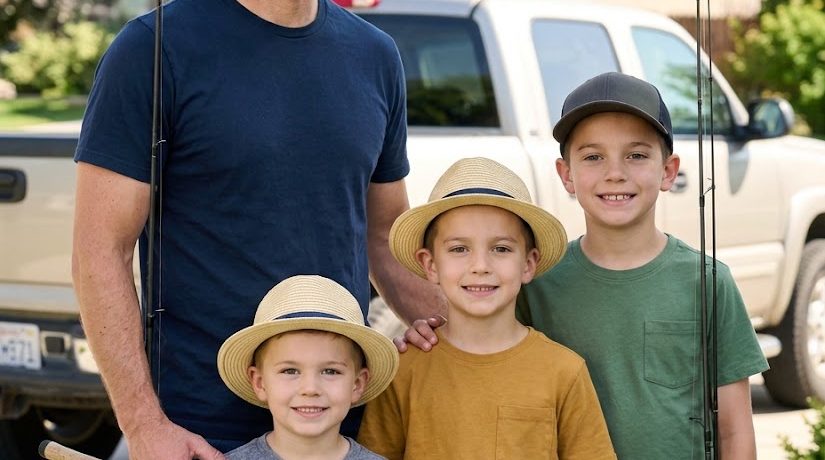
“Everyone look at me for three seconds.”
Daniel was checking the boat straps for what must have been the fourth time.
“Three seconds. That’s all I’m asking.”
“Dad’s squeezing me,” my youngest complained.
Daniel tightened his arm around the boy’s shoulders.
“Good. Maybe that’ll keep you still.”
The boys laughed.
I took the picture.
Click.
Daniel looked toward the truck.
“Life jackets?”
Three groans.
“Yes, Dad.”
“Whistles?”
The middle one rolled his head back.
“Dad.”
“Humor me.”
“They’re packed.”
Daniel nodded as though a matter of national security had just been confirmed.
That was my husband.
A full tank before every road trip.
The weather checked twice.
Then checked again because apparently the weather could change during the seventeen seconds since the previous check.
He had been fishing at that lake for three years.
He knew every launch point, every shallow section, and every spot where the current became unpredictable after heavy rain.
That morning, I kissed him and reminded the boys not to survive entirely on chips all weekend.
Daniel climbed into the truck.
“I know.”
He smiled through the open window.
“Miss me responsibly.”
“Go.”
The boys waved.
I took one final picture as the truck disappeared down the road.
I had no idea I had just captured an image of four people I would never see again.
Sunday evening, dinner sat untouched and grew cold.
At seven, I called Daniel.
No answer.
At 7:30, I called our oldest son.
The phone simply kept ringing.
By 8:00, I was irritated.
By 9:00, I was terrified.
At 10:15, I called the police.
The following morning, Daniel’s truck was discovered near the marina.
The empty boat trailer was still connected.
His wallet was inside the truck.
So were two jackets.
Several hours later, the boat was located on the opposite shore, completely empty and badly damaged.
For weeks, search teams scoured the area with divers, boats, helicopters, and volunteers searching along the shoreline.
They found nothing.
No trace of Daniel.
No trace of the boys.
Eventually, the official conclusion became the only explanation anyone could offer me.
Boating accident.
Powerful current.
Their bodies were presumed to have been carried away.
I nodded whenever people told me that.
I signed the paperwork.
Then I went home to three daughters and four empty seats around the table.
But one question never stopped eating away at me.
How?
Daniel was careful.
Almost painfully careful.
If the forecast looked dangerous, he canceled the trip.
If any equipment needed fixing, the trip could wait.
If one of the boys forgot his life jacket, Daniel would have driven all the way back home rather than launch without it.
So how could a man that cautious take all three of our sons onto a lake and never bring a single one of them home?
Nobody could answer me.
Dean tried.
Daniel’s brother was constantly around after the accident.
He changed a tire in the rain because I had forgotten that ordinary things like cars still needed attention even after your whole life had fallen apart.
He repaired a leaking faucet.
He brought groceries whenever I forgot to shop.
But every time I mentioned the lake, something changed in his expression.
“Andrea, you have to stop.”
“I just need to understand…”
“You can’t.”
“What if they missed something?”
“They searched for weeks.”
“What if Daniel came back because something went wrong?”
Dean would drag both hands across his face.
Then he would give me some variation of the same answer.
“You have three daughters who still need their mother.”
I hated hearing him say that.
Not because he was wrong.
But because it sounded so much like:
Forget the other four.
I never did.
Six years went by.
The girls grew up surrounded by the emptiness left behind.
One daughter went off to college.
Another learned how to drive.
Birthdays came and went.
Christmases passed.
School pictures changed year after year.
The bedrooms at the end of the hallway hardly changed at all.
Sophie became the one who finally said aloud what everyone else seemed to be thinking.
“Mom, we have to start going through their things.”
I looked at her.
She stood in the doorway of her brothers’ bedroom with an empty cardboard box in her hands.
“No.”
“Mom…”
“I said no, Sophie.”
“We’re not throwing anything away, Mom.”
“Then why are you carrying a box?”
“To donate the things someone else could use.”
I stared beyond her into the room.
That bedroom wasn’t a shrine.
At least, that was what I kept telling myself.
Yet so many things were still exactly where they had been.
A baseball cap remained hanging from one of the bedposts.
A pile of comic books still rested beside another bed.
A single sneaker had sat beneath a desk for six years because I couldn’t make myself move it.
Some foolish part of me had never stopped expecting to hear footsteps coming down the hallway.
Sophie spoke more quietly.
“They’re not coming back to get these.”
That broke something inside me.
She realized it immediately.
Her eyes filled with tears.
“I’m sorry.”
I turned my face away.
Then I reached for another box.
“Fine.”
She nodded.
We began sorting and packing.
Old clothes.
Books.
School supplies.
Things children outgrow when they are given the chance to keep growing.
After some time, I stepped away to start cooking.
Dinner was still several hours away, but I needed a reason to leave the room.
I couldn’t stand being in there anymore.
That afternoon, Sophie discovered the phone.
She walked into the kitchen carrying a black phone with a cracked corner.
“Mom?”
I looked up from the pile of old charging cords.
“Yes?”
“Was this Dad’s?”
My heart immediately began pounding.
I took it from her.
It was Daniel’s old phone.
The same one he had told me he lost almost a year before the fishing trip.
We had searched the car.
The garage.
The couch.
The junk drawers.
Eventually, we bought him a replacement.
“Where did you find it?”
“At the bottom of the electronics bin,” Sophie replied.
I turned the phone over in my hand.
It had no power at all.
Sophie found the right charger and plugged it in.
She sat beside it as though she were waiting for a heartbeat.
“Mom, what if there are pictures?”
I froze.
“Probably just old ones.”
“What if there are videos? Voice messages?”
I said nothing.
The phone eventually turned on.
It connected automatically to our home Wi-Fi.
A few minutes later, old photographs began appearing in the gallery.
Then Sophie opened it.
I couldn’t bring myself to look.
Not yet.
So I left her sitting at the table and went upstairs.
A few minutes later, I heard her running toward me.
“Mom…”
Something in her voice made me turn around.
Sophie was standing in the doorway of my bedroom, gripping the phone with both hands.
Her face was completely pale.
“What happened?”
She swallowed hard.
“There’s a video that synced from Dad’s account.”
My heart began pounding faster.
“What kind of video?”
“It’s from the day before the fishing trip.”
I moved toward her.
Sophie lowered her eyes to the screen.
Then she looked back at me.
“Mom, I know what really happened back then.”
I could only stare at her.
“What?”
“Dad wasn’t the only one involved,” she whispered. “Uncle Dean was there.”
She tapped the screen and pressed play.
Daniel appeared on the display.
He had placed his phone on the workbench while he inspected the fishing equipment.
He was alive.
Laughing.
Walking around the garage as though nothing terrible could ever be waiting for him.
I grabbed the bedpost for support.
Then someone stepped into the frame behind him.
Dean.
I stared at the screen.
“What is he doing here?”
Sophie said nothing.
In the recording, Dean said, “I’m not going, man.”
Daniel immediately looked up.
“What do you mean you’re not going?”
I turned toward Sophie.
“Going where?”
She whispered, “I think he means the fishing trip.”
My heartbeat quickened.
Dean had been invited.
For six years, he had never mentioned it to me.
The video continued.
Daniel tossed a life jacket onto the workbench.
“You need this weekend.”
Dean gave a bitter laugh.
“My girlfriend left me three months ago, Dan. Fishing isn’t going to make that better.”
Daniel looked directly at him.
“No. But staying by yourself won’t make it better either.”
Dean looked away.
Daniel lowered his voice.
“Come with us.”
“No.”
“All right.”
Daniel then picked up another life jacket.
He inspected the straps.
Then he said something that sent a chill through me.
“Kids don’t remember every expensive thing you buy them, Dean.”
He pulled firmly on the buckle.
“They remember whether you came back.”
My breathing stopped.
Daniel had said those words the day before he disappeared and never returned.
The video paused for a brief moment.
But that wasn’t what Sophie had wanted me to see.
She reached forward and skipped ahead.
“Mom, listen to what Dad says next.”
Daniel was still speaking with Dean.
“Fine. Don’t come fishing.”
Dean turned his gaze away.
Daniel tightened another strap on the life jacket.
“But come by Sunday night.”
“Why?”
“The boys are going to talk your ear off whether you want them to or not.”
Dean almost smiled.
Then the recording ended.
I stared at the dark screen.
Sophie opened another folder.
“Mom, Dad’s old phone was still linked to the same account as the replacement phone.”
She showed me a saved location.
It was a small outdoor-supply shop several miles away from Daniel’s usual route to the marina.
Timestamp: Sunday morning.
The day they disappeared.
“Why would he have gone there?”
Sophie shook her head.
“I have no idea.”
So we went.
—
An older employee examined the last picture I had taken in our driveway.
He studied the boys carefully.
Then he pointed.
“These three.”
My heart leaped.
“You remember them?”
“Hard to forget,” he replied. “They spent ten minutes arguing about the colors of the whistles.”
“Whistles?”
“Orange emergency whistles. Your husband bought one for each boy.”
That sounded exactly like Daniel.
Then the employee added, “And one more adult flotation vest.”
I frowned.
“He already had one.”
The employee shrugged.
“Said his brother might be joining them.”
For a moment, I forgot to breathe.
—
I drove directly to Dean’s house.
He opened the door and immediately saw my expression.
“What happened, Andrea?”
I held Daniel’s old phone up.
Dean looked as though he had just seen a ghost.
“You were supposed to go.”
Silence.
His eyes fell toward the phone.
“I changed my mind Sunday morning,” he finally said in a whisper. “I was heading toward the lake when emergency vehicles passed me.”
I held my breath.
His eyes filled with tears.
“I arrived after the search had already begun.”
“Why didn’t you tell me?”
“What difference would it have made?”
“I had the right to know, Dean.”
He lowered his gaze.
“For six years, I’ve wondered whether, if I had been on that boat, there might have been another adult there,” he admitted. “Maybe I could have done something.”
“And you decided I couldn’t handle knowing that?” I fired back.
“I thought you already had enough, Andrea.”
I stared directly into his eyes.
“You didn’t get to decide what I was capable of carrying.”
He flinched.
Then I told him about the extra flotation vest.
Dean looked up.
“He bought that for me?”
“Apparently.”
His face collapsed.
“I never even used it.”
That became the next mystery.
If Dean had never gotten onto the boat, where had the extra vest gone?
—
A retired search coordinator helped us go through the old recovery inventory.
Most of the equipment had been recorded without anyone knowing precisely what Daniel had taken with him.
Now we had a clearer picture.
The numbers didn’t add up.
The spare adult flotation vest was gone.
So was one orange whistle.
The coordinator stared at the report for a long moment.
Then he said, “There was another incident on that lake that afternoon.”
My stomach tightened.
“What incident?”
“Small boat overturned. An older man and his grandson.”
“Did they make it?”
“Both survived.”
I gripped the edge of the table.
“Who rescued them?”
He searched through the old report.
“It says another fishing boat reached them first. One adult. Several boys.”
A wave of dizziness swept over me.
Sophie whispered, “Mom…”
I already knew.
—
The grandfather still had the whistle when we met him.
Six years later, it was hanging from a nail in his garage.
Orange.
Cheap.
Daniel’s.
When I showed him the photograph from our driveway, he recognized them immediately.
“That’s them.”
My knees almost buckled.
He told us everything he could remember.
His boat had overturned when a storm arrived much faster than the forecast had predicted.
His grandson, Ben, had been struggling to keep his head above the water.
Then Daniel’s boat appeared.
The boys tossed flotation equipment toward them.
One of them kept shouting instructions.
“Both arms! Put both arms through!”
I covered my mouth.
Sophie squeezed my hand.
I knew that voice even without hearing it clearly.
My middle son used to shout those exact words whenever he helped his sisters put on their backpacks.
“Both arms.”
The grandfather gave a sad smile.
“That boy kept yelling until Ben had it secured properly.”
Another boat eventually arrived to help them.
Daniel waited until assistance was close.
Then he headed toward shore as the weather continued getting worse.
After that, the grandfather saw nothing more.
There was no unbelievable answer.
No secret survival story.
No miracle that returned my family to me.
Only the final known thing my husband and sons had done.
They had stopped.
Because someone needed their help.
—
Ben was eighteen now.
When he walked into the garage, I stared at him longer than I intended.
For six years, I had counted the children who never made it home.
Standing in front of me was one who had.
He barely remembered Daniel’s face.
But he remembered the shouting.
“Both arms.”
That was enough.
For years, the final hours of my sons’ lives had existed only inside my imagination.
Cold water.
Fear.
Panic.
Now I finally had one small piece of something different.
Their voices.
Their habits.
Them.
My boys had still been themselves during those final moments anyone could confirm.
Daniel had still been Daniel.
Checking the straps.
Thinking about safety.
Stopping because someone else was in danger.
It didn’t return what I had lost.
But it changed the picture of that final day I had carried in my mind for six years.
—
That evening, Sophie and I returned to the bedrooms.
Donation boxes were still scattered across the floor.
She touched one.
“Should we put everything back?”
I looked around.
For six years, I had held onto their belongings because some part of me believed that moving them meant moving farther away from the people they belonged to.
As though leaving a shirt inside a drawer could somehow keep a child closer.
As though leaving a room untouched could somehow keep time from moving forward.
But I finally saw it differently.
“No. We already started.”
I lifted a box.
“We’re finishing.”
Sophie nodded.
This time, when I folded one of the boys’ old sweatshirts and placed it into the box, I didn’t feel like I was making him disappear.
I was simply allowing an object to become an object again.
The memories weren’t inside the drawer.
They were inside me.
—
A few days later, we met Dean, Ben, and his grandfather beside the lake.
I brought along one of my sons’ fishing rods.
Ben stared at it when I held it out to him.
“He would have hated seeing a perfectly good rod sitting in a closet,” I said.
Ben accepted it carefully.
Dean stood next to me, staring out across the water.
“For six years, I kept thinking that empty spot on that boat was supposed to be mine.”
I looked at the orange whistle in the grandfather’s hand.
“Maybe not everything Daniel took with him ended up where he thought it would,” I said.
Dean’s eyes filled with tears.
Sophie quietly lifted her phone.
“Mom.”
I turned around.
For one painful second, I was back at that driveway six years earlier.
Daniel.
Three boys.
That final photograph.
Sophie studied the screen.
“Come closer.”
Dean stepped up beside me.
Ben was holding the fishing rod.
His grandfather placed a hand gently on his shoulder.
No one replaced anyone.
No one ever could.
But we were still connected through what happened that day.
Through a life jacket.
An orange whistle.
A choice to stop when someone else needed help.
Sophie smiled.
Click.
And this time, I didn’t wonder who might vanish after the picture was taken.
I simply allowed myself to be part of it.