
 68 views
 At my graduation dinner, Dad pushed my acceptance letter back across the table and told me I wouldn’t be attending the seven-year BS/MD program I had worked so hard to earn a place in.
Instead, he expected me to become engaged to his business partner’s son before the fall.
I thought Elliot was in on the plan—until he stared at the ring box and asked,
“What is that?”
Elliot didn’t reach for the box.
Neither did I.
For several seconds, the only sounds were the air conditioner humming and a waiter placing glasses on a nearby table.
My father, Richard Sloan, looked between Elliot and me.
“You two don’t need to make this dramatic.”
That was his first response.
Not surprise.
Not congratulations.
An instruction to keep everything under control.
I was eighteen and had graduated from high school earlier that afternoon.
Three weeks before, I had accepted a place in a seven-year BS/MD program two states away. If I maintained the required grades, I would move straight from undergraduate studies into the affiliated medical school.
I had wanted to become a doctor since I was twelve.
My father owned Sloan Med-Pack, a company that manufactured sterile packaging for surgical centers and hospital suppliers. My mother, Monica, had helped build it from twelve employees into a company with nearly ninety.
Healthcare was our family business.
For me, medicine had always meant something else.
I volunteered at a rehabilitation hospital, took every science class available to me, and spent two summers working in a university laboratory, doing whatever tasks they were willing to trust a teenager with.
When my acceptance email arrived, Mom cried.
Dad opened champagne.
For about two days, I believed they were proud of me.
Then the questions started.
Did I really have to leave the state?
Was seven years too restrictive?
Wouldn’t business offer me more flexibility?
Why not spend a year working at Sloan Med-Pack first?
I answered every question.
I thought we were simply talking about logistics.
I didn’t realize they were waiting for me to doubt myself.
The Hale family arrived twenty minutes after us.
Victor Hale had been Dad’s business partner for nearly fifteen years. His distribution company handled a significant portion of Sloan Med-Pack’s regional sales.
His wife, Diane, hugged me and handed me a silver pen.
Their son Elliot was twenty.
We had known each other since childhood through holiday gatherings, charity events, and family celebrations.
We were friendly.
Nothing more.
Elliot studied finance at Indiana University and had spent the previous summer working in his father’s warehouse.
That spring, Dad had started mentioning him more frequently.
“Elliot has a good head on his shoulders.”
“You two have always gotten along.”
“He understands the family business.”
I assumed Dad was trying to play matchmaker in an annoying but harmless way.
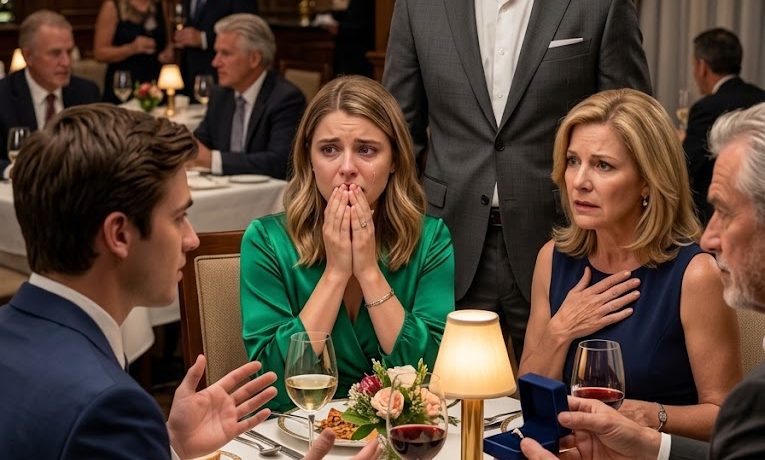
Then, somewhere between dinner and dessert, he asked the waiter to bring over a small velvet box.
He placed it directly in front of Elliot.
Victor stopped smiling.
Mom folded her hands in her lap.
Dad said, “We’ve spent years talking about keeping these families close. I think it’s time we started taking that seriously.”
My stomach tightened.
Elliot looked toward his father.
Victor said, “Richard.”
It sounded like a warning.
Dad continued anyway.
He talked about both companies entering a period of transition.
Victor was thinking about retirement.
Sloan Med-Pack needed stability in its distribution network.
According to Dad, the next generation should start building something together rather than waiting until our fathers were gone.
Then he said my university plans could wait a year.
I looked at Mom.
She wouldn’t meet my eyes.
That hurt more than the ring.
“Wait,” I said. “What does college have to do with this?”
Dad gave me the same expression he used during business meetings when he believed a question had already been settled.
“You don’t need to leave this fall.”
“I already accepted.”
“You can defer.”
“I don’t want to defer.”
Mom finally spoke.
“Avery, nobody is saying never.”
“Never what?”
“Never medicine.”
The words made my skin turn cold.
She said taking one year off wouldn’t ruin my future.
I could work at the family company.
Elliot and I could spend more time together.
If something naturally developed between us, we could make an announcement later.
I looked at the ring.
“That’s your idea of naturally?”
Elliot pushed the box away.
“I didn’t know about this.”
Dad frowned.
“Don’t be childish.”
Elliot’s expression hardened.
“I’m not being childish. You put a ring in front of me at dinner.”
Victor said, “Richard, we need to stop.”
That was when I understood that Dad had gone further than everyone else.
Even his own business partner looked uncomfortable.
I turned toward Mom.
“Did you know about the ring?”
She hesitated.
“Yes.”
“Did you know Dad planned to tell me I couldn’t go to college?”
“We discussed asking you to reconsider.”
“That isn’t what he said.”
Dad leaned forward.
“We are paying for your education.”
My hands went cold.
There it was.
Not advice.
Leverage.
I had received a significant merit scholarship, but my parents had always assured me they would handle the remaining tuition, housing, and fees.
Because I trusted them, I had never made a backup financial plan.
Dad said, “If you leave in August after we’ve told you this isn’t the right time, you’ll be going without our financial support.”
Mom quietly said his name.
He didn’t retract the statement.
I looked at her.
“Do you agree with him?”
She took too long to answer.
“I think your father is worried about what will happen to the company once Victor steps away.”
“That doesn’t answer my question.”
“I think family decisions affect more than just one person.”
Then I understood her position too.
She didn’t like the threat.
She probably didn’t approve of the ring either.
But she was still weighing my future against what the company needed.
I stood up.
Dad said, “Sit down.”
“I’m finished eating.”
“Avery.”
I picked up my acceptance folder.
Elliot stood as well.
Victor said, “Let her go.”
Dad looked furious.
Not because I was walking away.
Because the evening had stopped going according to his plan.
I stepped outside with trembling hands.
Before I could start the car, my phone buzzed.
Elliot.
I’m sorry. I honestly had no idea.
Then another message appeared.
Can we talk before our parents turn this into something neither of us ever agreed to?
I called him.
He picked up immediately.
“Please tell me you didn’t know about tonight either.”
“I knew Dad wanted me to spend more time with you. I had no idea there would be a ring.”
“Same here.”
That mattered.
Elliot explained that his father had spent years talking about keeping the two companies connected, but marriage had never been part of those conversations.
“I’m not marrying you to protect a distribution contract,” he said.
“Good. I’m not marrying you either.”
For the first time that night, I laughed.
The following morning, Dad was waiting for me in the kitchen.
He said I had humiliated him in front of Victor.
I replied, “You announced my future in front of other people without even asking me.”
He reminded me that he and Mom had paid for private school, tutoring, test preparation, and application fees.
I thanked him.
Then I told him that none of those things gave him the right to decide who I married or what career I pursued.
Mom asked whether I understood what was at stake.
Hale Distribution handled nearly forty percent of Sloan Med-Pack’s regional sales. Victor intended to step back within two years.
Dad was afraid Elliot might eventually move the business to another manufacturer.
“So you wanted to make losing us personally costly for him,” I said.
Dad didn’t deny it.
Then I asked the question that should have come first.
“Did Victor ever tell you that the contract depended on Elliot and me getting married?”
Silence.
Finally, Dad answered:
“No.”
The marriage idea had never come from Victor.
It had come from my father’s fear.
I opened my university account at the kitchen table.
My scholarship covered most of my tuition, but housing, books, fees, and the remaining tuition would still total roughly $12,000 during my first year.
Dad had made it clear he wouldn’t contribute.
Mom looked back and forth between us.
I said, “Okay.”
Dad almost looked irritated that I accepted his decision without arguing.
I had $4,700 saved from my summer jobs.
The university had already approved me for work-study.
I could apply for additional financial aid and, if necessary, take out a modest federal student loan.
It would be more difficult.
But I could make it work.
That afternoon, Elliot sent me a message.
My dad and I talked. He says the contract was never connected to us. He’s calling your dad tomorrow.
For weeks, my parents had made my education and marriage sound like the necessary price of keeping the company secure.
Now that explanation was falling apart.
The real issue was whether they would continue trying to dictate my future once they could no longer claim it was required.
Part 3
Victor called Dad the following morning.
I heard about it from Mom.
Victor made his position unmistakable.
The distribution agreement had never depended on our families becoming related.
Hale Distribution had its own contracts, customers, management, and every reason to continue doing profitable business with Sloan Med-Pack.
And even if Elliot eventually took over, Victor had never intended to use his son’s marriage as a business guarantee.
Dad didn’t call me afterward.
Mom did.
She asked if she could come by.
She arrived carrying the acceptance folder Dad had taken from the restaurant.
For a while, neither of us said anything.
Then she finally spoke.
“Your father handled this badly.”
“You knew.”
“I knew he wanted you to defer.”
“And what about the marriage?”
“I knew he hoped you and Elliot would become serious.”
“The ring?”
She looked down.
“Yes.”
Mom had spent twenty-five years helping build a company that provided jobs for dozens of employees and supported their families.
When Dad became afraid of losing part of the distribution network, she became afraid too.
It explained why she had made the choice she did.
It didn’t make that choice hers to make for me.
“I’m going to medical school,” I said.
She nodded.
“Your father still says he won’t pay.”
“I know.”
I had spent the previous night creating my own budget.
The scholarship covered most of my tuition.
My savings could handle the enrollment deposit, books, and part of my housing costs.
The financial-aid office told me I could request additional federal assistance and increase my work-study hours.
I had also contacted the program director and explained that my expected family contribution had suddenly changed.
Mom listened.
“You already worked all of that out?”
“I started.”
Two days later, the university revised my financial-aid package.
They added a small institutional grant and increased my work-study eligibility.
I accepted a federal loan to cover the remaining amount.
If I stayed in the program, I would graduate carrying some debt.
That scared me.
It still frightened me, but not as much as allowing someone else to decide whether I could pursue my education.
Dad didn’t speak to me for nearly two weeks.
Then he asked me to come to his office.
I went because I wanted one conversation where no one could later accuse me of simply walking away.
He started by saying:
“Victor made me look like a fool.”
I waited.
Then he corrected himself.
“I made myself look like a fool.”
That was an improvement.
He explained what had actually happened.
For almost a year, one of Sloan Med-Pack’s competitors had been trying to win over Hale Distribution.
Victor had never threatened to leave, but Dad became convinced that the partnership would weaken once Victor retired.
Instead of renegotiating the contracts or accepting that business relationships naturally change, Dad started searching for a way to make the partnership permanent.
To him, family meant permanence.
“So you chose me,” I said.
He rubbed his forehead.
“I convinced myself it could be good for you too.”
“Did you ever ask me?”
“No.”
Then I asked him why he was so opposed to my choosing medicine.
“It doesn’t bother me.”
“You spent months trying to convince me not to do it.”
“I spent months trying to keep you nearby.”
My acceptance letter had shattered another future Dad had envisioned—a future where I would eventually work alongside him and Mom.
“I treated what I wanted as though it was what the family needed,” he admitted.
“Yes.”
He still hated how rigid my program was.
I said, “Then don’t pay for it.”
He looked at me.
“I want you to help me because you genuinely want to, not because helping me gives you a vote.”
That ended our meeting.
It wasn’t warm.
But it was clear.
I moved into the dorm in August.
Mom came with me.
Dad didn’t.
That morning, he sent me one message.
Drive safely.
My first semester was more difficult than anything I had experienced in high school.
Chemistry moved incredibly quickly.
I earned a seventy-four on my first biology exam and called Mom from a stairwell in tears.
She didn’t tell me to come home.
Instead, she asked:
“Do you want advice, or do you want me to listen?”
That was different.
“Listen.”
So she did.
Elliot and I stayed friends.
Not romantically.
Our parents had attempted to transform an ordinary friendship into a business arrangement, and neither of us wanted that to determine what happened afterward.
Dad and I rebuilt our relationship more gradually.
At Christmas, he asked whether I wanted to see Sloan Med-Pack’s new clean-room expansion.
I said yes.
We walked across the production floor together.
He explained how a new sealing system worked.
I explained why certain packaging failures could have serious clinical consequences.
For the first time, our two worlds felt connected without either of them having to replace the other.
The business survived as well.
Dad and Victor renegotiated the pricing.
Sloan Med-Pack lost one small product line to a competitor but retained everything else.
Nobody needed to get married to save anything.
The company simply needed to compete.
Three years after that graduation dinner, I came home for Thanksgiving carrying a stack of flashcards because I had an exam the following week.
Dad found me studying at the kitchen table.
He picked one up.
“What’s this?”
“Cardiac pharmacology.”
He read the back.
“I don’t understand any of this.”
“Some days, neither do I.”
He laughed.
Then his expression became serious.
“I was wrong about something.”
I waited.
“I kept calling your program a risk because it wasn’t a future I understood.”
“That sounds about right.”
He nodded.
There was no dramatic apology.
Just a man finally acknowledging what he had done.
Later, Mom asked me to help arrange the table.
My old acceptance folder was no longer sitting on anyone’s desk.
It was stored in a box in my childhood bedroom alongside yearbooks and graduation cards.
I had never needed my parents to approve of the life I chose.
But eventually, they learned how to be part of it without trying to choose it for me.
And that was better.