
 124 views
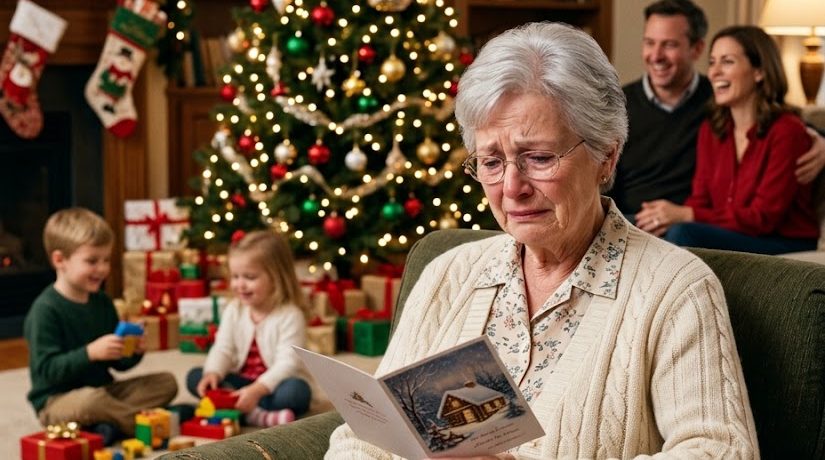
 The Christmas lights shimmered through my tears as I stared at the glitter-covered card trembling in my hands.
Red and green sparkles had scattered across my lap, while the cruel words seemed to burn into the paper.
Roses are red, violets are blue. We don’t want a sick grandma. Christmas isn’t for you.
Then the entire room burst into laughter.
My son David laughed so hard that he had to wipe his eyes.
His wife, Zuri, giggled beside him while her sister applauded as if she had just heard the funniest joke imaginable.
Even my grandchildren, Emma and Jake, laughed uncertainly.
But I noticed something in ten-year-old Emma’s expression.
Confusion.
The kind children show when they recognize that something is cruel, even though they don’t yet understand why.
“Oh my God, Zuri,” David said between laughs. “Mom’s face is priceless.”
I looked at my forty-two-year-old son and barely recognized the person sitting before me.
This was the boy I had raised mostly on my own after his father left when David was twelve.
I had worked double shifts.
Helped pay his college expenses.
And even helped him buy the very house where I was now sitting while everyone treated me like the family joke.
Zuri leaned against his chair, perfectly dressed and obviously delighted with herself.
“It’s only a joke, Myrtle,” she said sweetly. “You know we love you.”
“We just think Christmas would be easier if you spent it somewhere more suitable for someone with your condition.”
My condition.
Six months earlier, I had told them that I had been diagnosed with Parkinson’s.
I had expected concern.
Maybe even fear.
Instead, my illness had gradually become an excuse to treat me as though I were already incapable of managing my own life.
“What do you mean by somewhere more suitable?” I asked.
Zuri exchanged a glance with David.
“There are wonderful facilities,” she said. “Places where people like you can get the proper care.”
People like me.
She meant a nursing home.
“I’m still living independently,” I reminded them. “My doctor says I’m in the early stages.”
Zuri’s sister immediately joined in.
“But why wait until something serious happens? You spilled wine last week.”
A few drops.
That was all.
My hand had trembled while I poured an expensive bottle of wine I had brought specifically because Zuri wanted to impress her friends.
She had spent ten minutes loudly scrubbing the carpet while everyone watched.
David leaned forward.
“We’re worried about you, Mom. What if you fall next time? What if you forget to turn off the stove?”
His voice sounded caring.
But I knew my son.
He had spent his entire life learning how to disguise selfishness as reasonable concern.
I looked around the living room.
The Christmas tree in the corner was covered with ornaments that had once belonged to me.
My grandmother’s angel still stood at the very top.
Yet somehow, surrounded by pieces of my own family history, I felt like a complete stranger.
“I need some air.”
I stood carefully and walked outside.
No one followed me.
The cold air struck my face as I stepped onto the back porch.
Through the glass door, I could see them returning almost immediately to their celebration.
Zuri showed off a piece of jewelry.
The children played with their new toys.
David poured himself another drink.
The woman who had cooked their Christmas dinner and spent decades supporting them had walked away, yet their evening continued as though nothing had happened.
That was when something finally became clear.
I was no longer family to them.
I had become a future inconvenience.
A problem they wanted to move somewhere else before it disrupted their comfortable lives.
What none of them realized was that the “sick old woman” they were discussing had financial resources they had never taken the time to understand.
And much of that money was quietly helping fund the life they enjoyed.
The following morning, I sat by myself at my kitchen table.
David called.
I allowed the call to go to voicemail.
“Hey, Mom,” his message began. “About last night… Zuri’s joke was probably a little too harsh. But you know how she is. Anyway, maybe we should start looking into a few facilities. No pressure.”
I erased the message.
Then I switched off my phone.
For the next several days, I began making arrangements.
After my husband Harold passed away three years earlier, I discovered that he had left us in a much stronger financial position than I had ever realized.
There were investments.
A life insurance policy.
Rare coins.
Our mortgage-free home.
My pension.
I was financially secure on my own.
I had deliberately kept most of it private because I understood what money could do to families.
David already acted as though he had the right to question how I spent my money.
If he discovered the true size of my resources, his advice would quickly turn into entitlement.
Now I was thankful I had remained quiet.
I contacted James Morrison, the attorney who had handled Harold’s estate.
“I want to leave the country,” I told him.
James stared at me.
“Myrtle, are you sure? Considering your health—”
“I’ve never been more certain.”
After that, he made no attempt to change my mind.
We went over my will.
My accounts.
My healthcare arrangements.
My investments.
Then I started searching for a new place to live.
Portugal immediately stood out.
Good healthcare.
A reasonably affordable cost of living.
Mild weather.
A strong retiree community.
And, most importantly, distance.
Enough distance that nobody could simply drive to my home and dictate how I should spend the rest of my life.
Four days after Christmas, I opened a new bank account and transferred enough money to cover the cost of my relocation.
Then I started writing the letter I planned to leave behind.
I rewrote it seven times.
The first draft was angry.
The second was full of pain.
By the final version, I felt surprisingly calm.
On January 3, I packed two suitcases.
Almost everything else remained behind.
Family photographs.
China.
Furniture.
Even Harold’s reading glasses stayed exactly where he had left them.
At 6:30 that morning, a taxi carried me to the airport.
For one frightening moment during check-in, I nearly changed my mind.
I was sixty-five.
I had a progressive illness.
I was about to begin a new life in a country where I barely spoke the language.
Then I remembered the Christmas card.
David laughing.
Zuri watching my expression.
And I continued walking.
Before I left, I placed my letter on the kitchen table beneath Harold’s favorite coffee mug.
It read:
Dear David, Zuni, Emma, and Jake,
By the time you read this, I will already be starting another chapter of my life. Christmas made something very clear to me: my presence has become something you tolerate instead of something you value. So I have decided to remove the burden you seem to believe I have become.
I have arranged my own housing, medical care, and finances. I am safe.
Please understand that I am not leaving because I am angry. I am choosing to spend whatever time I have left surrounded by people who appreciate having me around instead of worrying that I might embarrass them.
The folder beside this letter contains information about several monthly expenses. James Morrison has the remaining legal details.
I hope that someday you understand this is not abandonment.
It is freedom.
Love, Mom.
What I intentionally left unexplained was what those “monthly expenses” really covered.
The mortgage assistance for David and Zuri’s house.
Property expenses for their vacation cabin.
Emma’s private school tuition.
Health insurance covering the entire household.
Several other smaller monthly payments.
For three years, I had quietly helped sustain their lifestyle.
And somehow, despite accepting all that assistance, they had convinced themselves that I was the burden.
By the time I arrived in Lisbon, my American phone showed fifty-three missed calls.
There were twenty-nine messages.
The first ones sounded worried.
Mom, where are you?
Then they became confused.
What does your letter mean?
Then frightened.
You can’t just disappear like this. What about your illness?
Then angry.
Stop playing games and come home.
But the most revealing messages appeared after they began going through the financial documents.
Zuni discovered that I had been contributing to their mortgage payments.
David learned that I was the policyholder responsible for their family health insurance.
They discovered that Emma’s tuition had been paid through an education account I had funded.
Suddenly, the “sick grandma” they wanted sent somewhere out of sight had become extremely important to them.
One late-night message from David said:
Mom, please. I’m sorry about Christmas. Zuri is crying. The kids miss you. Just tell us where you are and we can fix this.
Another message followed:
Myrtle, we haven’t always gotten along, but this is too much. Please call. We can work everything out.
Reading those messages hurt.
But beneath the sadness, I felt something else.
Relief.
For once, I was the one making the decision.
Not them.
My new apartment in Lisbon was small and bright, overlooking a peaceful square.
That first night, I stood on the balcony listening to street musicians and distant trams.
For the first time since Harold died, I fell asleep wondering what the next day might bring instead of fearing it.
Back in Connecticut, however, David was finally beginning to understand how much of his supposedly “independent” life had depended on me.
Mortgage records revealed years of payments connected to my financial support.
Insurance documents carried my name.
Education expenses traced back to accounts I had established.
Even the vacation property they enjoyed every summer had been purchased and maintained with my assistance.
According to James, when he finally sat down with them, David looked completely stunned.
“How much has she been paying?” he asked.
James placed a folder on the table.
“Approximately one hundred forty-four thousand dollars over three years, not including the eighty-thousand-dollar contribution toward the down payment on this house.”
David’s face went white.
Zuri burst into tears.
They had been preparing to send me away to a care facility while living in a home they might never have been able to afford without my financial support.
James explained that I wasn’t immediately ending every form of assistance because I refused to make my grandchildren suffer because of their parents’ cruelty.
But I had one condition.
I wanted to remain in contact with Emma and Jake.
Not David.
Not Zuri.
The children.
Three months later, Lisbon felt more like home than Connecticut had for years.
My neurologist even noticed that some of my symptoms had improved, which he believed was partly connected to lower stress levels and greater physical activity.
I walked more.
Ate healthier.
Made new friends.
Then I met Maria.
She was a grandmother who often brought several of her grandchildren to a small café near my apartment.
One afternoon, I noticed her granddaughter Anna struggling with mathematics.
I offered to help her.
That one afternoon soon became a regular routine.
Before long, I was tutoring several neighborhood children in English and basic math.
They started calling me A Americana—the American grandmother.
For the first time in years, people appreciated me for who I was rather than for what my money could provide.
Then James called.
“Myrtle, David and Zuri have hired a private investigator.”
My stomach tightened.
“For what?”
“To find you.”
Then he told me something even more disturbing.
They had contacted authorities and claimed that my Parkinson’s might have left me mentally incapable of making sound decisions.
They were attempting to portray my move as the choice of a confused elderly woman who needed to be brought back home.
That hurt more than I expected.
Even after everything that had happened, David still viewed me as someone he could control.
I instructed James to establish protected educational trusts for Emma and Jake.
Then I cut the remaining monthly financial support to David’s household in half.
“They’re likely to become more aggressive,” James warned.
“Let them.”
Several months after my departure, they finally located me.
I was sitting at the café helping Anna when I noticed an American man watching me.
He eventually approached.
“Mrs. Patterson? My name is Ryan Walsh. I’m a private investigator. Your son hired me.”
“I’m not missing.”
“I understand. He says he’s worried about your well-being.”
“I have an attorney. He knows exactly how to reach me.”
Walsh paused.
“Are you here voluntarily?”
I almost laughed.
“For the first time in years, I am.”
Eventually, he asked whether I would speak with David.
I agreed to one condition.
The conversation would take place there in public, with Walsh present.
The moment David heard my voice, he became furious.
“Mom, what are you doing?”
“Living.”
“In Portugal? You don’t know anybody there!”
I glanced around at Maria, Anna, the café owner, and the families who greeted me every week.
“I know plenty of people.”
Zuri joined the call.
“We’re sorry about Christmas. The joke went too far. But you can’t punish us forever.”
“This isn’t punishment.”
“Then what is it?”
“A choice.”
David’s tone became harder.
“If you refuse to come home voluntarily, I’ll have you declared incompetent. I’ll get guardianship if I have to.”
Something inside me suddenly became completely calm.
“David, if you do that, you’re going to learn exactly how competent I am.”
“What does that mean?”
“It means I have records of every dollar I’ve spent supporting you over the past three years.”
Silence.
Then he said something that finally erased whatever guilt I still carried.
“You’re my mother. Taking care of us is your job.”
“No, David.”
My voice remained steady.
“Helping you was my decision.”
I looked directly at Walsh.
“And now I’m making a different one.”
I told David that every form of financial assistance to his household would end immediately.
Mortgage assistance.
Insurance.
School expenses.
Everything.
The only exception would be the education trusts established for Emma and Jake, which their parents would never have access to.
David’s tone changed immediately.
“Mom, please.”
“I’m not finished.”
I told him that if he made another attempt to have me declared mentally incompetent, sent additional investigators, or tried to force me back to Connecticut, I would change my estate plans and donate whatever remained of my assets to charity.
Zuri began crying.
“We’ll lose the house.”
“Then maybe you should have thought about that before treating the person helping you keep it as though she were an embarrassment.”
David called it blackmail.
“No,” I answered. “It’s consequences.”
Then I told him something else.
“If you insist that I’ve been mentally incompetent, then perhaps my attorney should investigate whether I was competent when I gave you all that money.”
David went silent.
For once, my son had no response.
I returned Walsh’s phone to him.
“I’m living here by choice. I’m receiving proper medical care. I handle my own finances. And I have absolutely no intention of coming back.”
He nodded.
“I believe I have everything I need.”
Within the next twenty-four hours, James stopped every remaining automatic payment going to David’s household.
Two weeks later, I received a letter from Emma.
Her careful handwriting nearly broke my heart.
Dear Grandma Myrtle,
Dad says we have to move because money is tight. Mom cries a lot. I don’t understand everything that is happening, but I want you to know that I never thought you were strange or embarrassing. I loved having you visit. I hope you’re happy in Portugal. Maybe someday I can come see you.
Love, Emma.
P.S. Jake misses your cookies.
I cried while reading the letter.
Not because I wished I had stayed.
Because I finally understood that leaving David and Zuri did not mean abandoning my grandchildren.
Months later, Anna gave me a school assignment she had written about an important person in her community.
She had chosen me.
“You’re family now, A Americana,” she told me.
And somehow, that little girl understood something that had taken me sixty-five years to realize.
Sharing blood can make people relatives.
It cannot promise respect.
It cannot promise kindness.
And it certainly cannot promise love.
That Christmas card had said:
We don’t want a sick grandma.
In the end, I understood the cruelest part of it.
David and Zuri weren’t truly afraid of having a sick grandmother in their lives.
They were afraid of losing the healthy bank account that came with her.
I wanted something else.
I wanted people who enjoyed being around me without calculating what I could give them.
I wanted to wake up without feeling like I was an inconvenience.
I wanted the years I had left to finally belong to me.
And in a little café in Lisbon, surrounded by people who lovingly called me their American grandmother, I finally discovered what I had been searching for.
Eventually, the calls from Connecticut stopped.
David and Zuri finally realized their threats no longer worked.
Their guilt could no longer control me.
Their financial dependence was no longer something I had to carry.
And for the first time since Harold passed away, I was completely free.
It turned out that freedom was the most valuable gift I had ever given myself.