 138 views
 Part 1: Where They Had Really Been Going
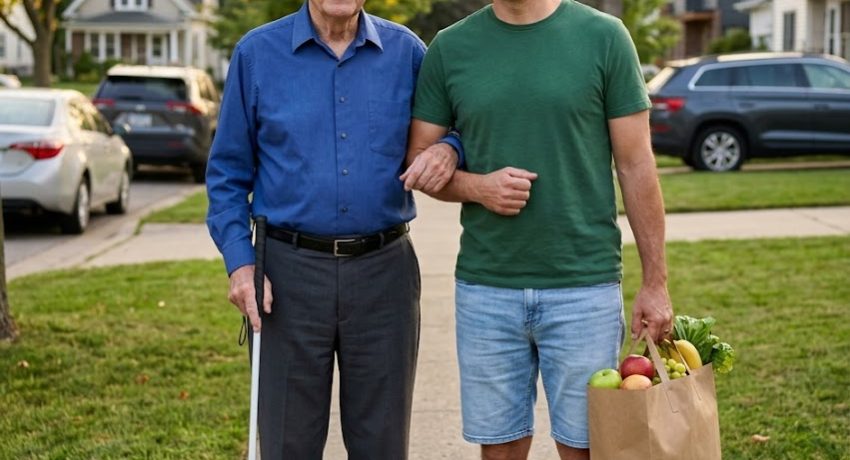
For eight years, I believed my father spent every Thursday going to medical appointments, picking up groceries, and sharing lunch with our neighbor, Ben.
I couldn’t have been more wrong.
Ten years earlier, my father had been diagnosed with glaucoma. By the time doctors discovered the condition, the damage was already extensive, and within two years he could barely see anything beyond faint shadows.
Even so, he refused to leave the home he had shared with my mother for decades.
“The hallway still has the dent from the day you crashed your bicycle,” he used to tell me. “Leaving this house would feel like losing another forty years with your mother.”
I lived nearly a thousand miles away with two children, a demanding career, and a busy marriage.
Dad managed most of his daily life independently, but he needed someone to drive him to medical appointments, the pharmacy, and the grocery store.
Ben, his retired neighbor and longtime friend, offered to help.
Every Thursday, I paid him to take Dad wherever he needed to go.
That arrangement gave me peace of mind.
Dad and I spoke every single day.
He told me about the meals he cooked entirely by touch, terrible audiobooks he couldn’t stop listening to, and endless games of checkers that Ben supposedly lost on purpose.
Sometimes I could hear Ben pulling into the driveway.
“Your royal limousine has arrived,” he would call out.
Dad always answered the same way.
“It smells like stale coffee and questionable life choices.”
Their laughter somehow made the miles between us feel much shorter.
Then one morning, my father passed away peacefully in his sleep.
The funeral felt like a blur.
People brought casseroles, shook my hand, and told me how proud Dad had always been of me.
But my mind kept returning to our final conversation.
“Thursday was productive,” he had said.
When I asked what he meant, he laughed and told me to stop interrogating an old man.
I promised I would call him the next day.
There never was a next day.
After the burial, I stayed beside his grave as a gentle rain began to fall.
Ben walked over carrying a sealed envelope with my name written across it in Dad’s uneven handwriting.
His hands shook as he held it out to me.
“Your father made me promise I’d tell you where we were really going.”
At first, I assumed he meant casinos, hidden diners, or some harmless adventure Dad had kept secret because he knew I worried too much.
Ben slowly shook his head.
“I wasn’t just driving him around. The places mattered… but what we were doing there mattered even more.”
Then he told me about Claire.
Claire was Ben’s only daughter.
They hadn’t truly spoken in years.
According to Ben, every conversation between them ended in an argument.
Dad noticed how quiet Ben became whenever I talked about my own children.
One Thursday, he finally asked what had happened.
Ben blamed Claire.
He insisted she was stubborn, rarely visited, and had built a life that no longer included him.
Dad refused to accept that explanation.
Eventually, Ben admitted the truth.
For years, he had criticized Claire’s career, her marriage, and even the way she raised her family.
He insisted he only acted that way because he missed her.
Dad didn’t let him hide behind that excuse.
“You’ve missed a lot of things,” Dad told him. “You missed your daughter… and you almost missed your chance to make things right.”
That very morning, Dad instructed Ben to drive them to the public library.
Part 2: Dad’s Secret Mission
At the library, a kind employee patiently taught Ben how to send photos, record video messages, and text without sounding critical or defensive.
Dad sat nearby, listening to everything.
Whenever Ben complained, Dad reminded him that Claire had spent years learning new things because she wanted to make her father proud.
Now it was Ben’s turn to learn something for her.
The following Thursday, they stopped at a bakery and bought everything they needed to make cinnamon rolls—the same recipe Ben used when Claire was a little girl.
They practiced together in Dad’s kitchen.
The first batch burned completely.
The second was still raw in the center.
Ben blamed the oven.
Dad blamed the man who forgot to set the timer.
Then came the apologies.
Ben recorded one while sitting in the car.
Dad made him erase it.
He tried again during lunch.
Dad deleted that one too.
Finally, Ben threw up his hands.
“What exactly do you want me to say?”
Dad answered without hesitation.
“Stop explaining yourself. Tell her why she matters.”
Inside the envelope Ben gave me were several letters.
He had read every one of them aloud to Dad.
Dad pointed out which sentences sounded dishonest, which ones were excuses, and which words finally revealed Ben’s true feelings.
The last letter contained no corrections.
Dad told him it was finally ready.
Even then, Ben still couldn’t bring himself to send it.
So Dad gave him one last instruction.
After he was gone, I was supposed to make sure Ben finished what they had started together.
Anger immediately rose inside me.
I had buried my father less than an hour earlier, and now Ben was placing another responsibility on my shoulders.
I pushed the envelope back toward him.
“I can’t do this today.”
Ben nodded quietly.
“There’s another letter,” he said. “That one is for you.”
I couldn’t refuse one final message from my father.
So I opened it.
Dad wrote that Ben had given him freedom every Thursday without ever making him feel helpless.
Ben described every curb, every doorway, every meal, and every person they passed so Dad always knew exactly what surrounded him.
He waited patiently through every appointment but always allowed Dad to speak directly with the doctors himself.
He offered help without ever making Dad feel incapable.
Dad explained that helping Ben rebuild his relationship with Claire was simply his way of returning that same dignity.
Then I reached the sentence that completely broke me.
You probably think I was keeping a secret from you.
I was.
I was hiding how useful I still felt.
I read those words three times.
Those Thursday outings had given my father much more than transportation.
They had given him a reason to keep moving forward.
Even after losing his eyesight, he was still mentoring, guiding, and helping another person. Though his vision had faded, he found a new way to make a lasting difference in someone else’s family.
I looked over at Ben.
“I’ll go with you,” I told him. “But I won’t speak on your behalf. I’ll simply stand beside you, just as you stood beside my father.”
The following morning, we drove three hours to Claire’s home.
Throughout the journey, Ben practiced what he wanted to say.
Every version began with regret but eventually turned into an explanation of why he wasn’t completely at fault.
Each time, I stopped him.
“That’s an excuse.”
By the fourth attempt, he looked ready to throw the letter out of the car window.
Instead, I locked it inside the glove compartment.
When we finally arrived, Claire answered the door wearing gardening gloves.
She had Ben’s eyes.
She also had the same determined expression.
“You should have called first,” she said coolly.
Ben nearly turned around and walked away.
Standing beside him, I quietly repeated the words my father had once given him.
“Tell her why she matters.”
Part 3: One Thursday Call
Ben handed Claire both the letter and a box of freshly baked cinnamon rolls.
“I spent years protecting my pride,” he said quietly. “I kept waiting for you to come back because admitting I had hurt you meant admitting I was wrong.”
He paused before continuing.
“I was wrong. And even worse… I made you feel as though you didn’t matter.”
Claire didn’t hug him.
She didn’t forgive him.
For several long moments, it looked as though she might simply close the door.
Instead, she opened the box and breathed in the scent of the cinnamon rolls.
“They might taste terrible,” Ben admitted. “Your father refused to finish even one.”
Claire looked over at me.
“My dad helped him with this?”
I nodded.
“That sounds like him,” she replied with a faint smile. “This stubborn old man never would’ve apologized on his own.”
She stepped aside and opened the gate.
The three of us sat together on the porch for nearly two hours.
Ben told her everything.
The library lessons.
The bakery visits.
The failed apology recordings.
The afternoons spent rewriting letters around my father’s kitchen table.
I shared stories about my daily phone calls with Dad, his terrible jokes, and the empty chair that still sat waiting inside his house.
Talking about him somehow eased the weight of my grief.
Eventually, Claire returned carrying a small wooden box filled with unsigned postcards she had received over the past several months.
One of them read:
Your father remembers far more than he knows how to say.
Another simply said:
He still makes terrible cinnamon rolls.
A third read:
Pride is exhausting. I think he’s finally growing tired of carrying it.
Ben stared at the postcards in complete disbelief.
He hadn’t written a single one.
My father had.
He had quietly been helping both of them move toward reconciliation.
Claire pressed Ben’s letter gently against her chest.
“I can’t pretend everything is fixed,” she said softly. “I still don’t trust you.”
Ben nodded.
“You don’t have to.”
She studied him for a long moment.
“One phone call every Thursday,” she finally said. “Let’s start there.”
“I will,” Ben promised.
On the drive home, Ben apologized for continuing to accept the money I paid him after their Thursday trips had become something much more personal.
He explained that my father believed I would grow suspicious if the arrangement suddenly changed.
Even at the very end, Dad had been quietly looking after both of us.
The following Thursday, I was still sorting through his tools and clothes, each one carrying a familiar scent that made the house feel both comforting and painfully empty.
At exactly nine o’clock, Ben’s car pulled into the driveway.
He had arrived out of habit.
I was already waiting for him on the porch with two cups of coffee.
“I assume the royal carriage still runs on Thursdays,” I said with a small smile.
Ben looked toward the window of my father’s now-empty house.
“The carriage feels much emptier these days.”
Even so…
We decided to take the drive anyway.
He drove past the library, the bakery, and my father’s medical clinic.
Then the car speakers chimed as his phone rang.
Claire’s name appeared on the dashboard.
Right on schedule.
Ben reached toward the answer button but paused, quietly rehearsing what he wanted to say.
I gently placed my hand on his wrist.
“No rehearsing.”
He gave a small nod before answering the call.
“Hello, Claire.”
His voice trembled.
For a brief moment, the silence inside the car felt overwhelming.
Then Claire answered.
“Hello, Dad.”
Ben let out a slow breath, as though he had been holding it in for years.
I glanced toward the empty passenger seat where my father should have been and unfolded his letter one last time.
During the final years of his life, he had shown everyone that losing his eyesight had never meant losing his purpose.
Every Thursday, he quietly helped a stubborn father find his way back to his daughter.
And by doing that, he also showed me how to continue helping others, even after he was gone.