 156 views
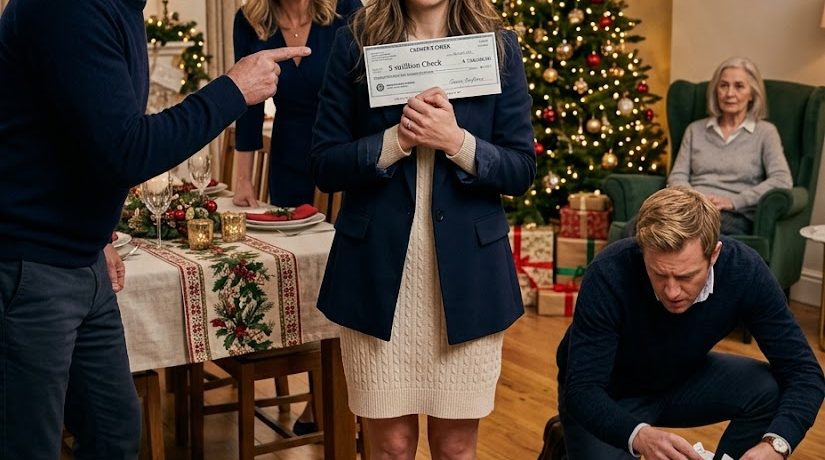
 At our Christmas dinner, Grandma Evelyn Whitaker presented each member of the family with a check worth $5 million.
For a few moments, absolute silence filled the room.
Then my older brother, Marcus, exploded with laughter so hard he almost tipped over his wineglass. My cousin Brittany smacked the table, laughing as she said, “Grandma, this is hands down your funniest prank yet.”
Without giving his check more than a quick glance, my father tossed it beside his dinner plate.
“It’s clearly fake,” he said with a dismissive scoff. “Don’t be ridiculous.”
Grandma stayed seated at the head of the long dining table, wearing her red cardigan, with her silver hair neatly pinned above her ears.
She didn’t smile.
She offered no explanation.
She simply observed everyone with calm blue eyes that somehow made the room feel even colder than the winter air outside.
I was her youngest granddaughter—thirty-two years old, divorced, and juggling two jobs in Denver just to keep up with the rent on my tiny apartment. Post-
Throughout the evening, I had listened as relatives proudly talked about promotions, brand-new houses, and luxurious vacations. My father introduced me as “the one who’s still trying to figure life out,” as though my divorce had permanently branded me as the family failure.
So when Grandma placed the check in front of me, I didn’t laugh.
Pay to the order of: Claire Whitaker. Five million dollars.
Her fingers shook ever so slightly as they rested against my wrist.
“Don’t misplace it, Claire.”
I looked directly at her.
“Grandma, what is this?”
“A choice,” she answered quietly.
My father let out a frustrated snort.
“Mom, honestly. Don’t encourage her.”
Grandma slowly turned toward him.
“Richard, you’ve never been comfortable with things you can’t control.”
The room grew silent once more, but only for a moment.
Then the laughter came back, louder and even more mocking.
Marcus held his check up over his head.
“Should I hang this on my wall or try cashing it at a gas station?”
Brittany folded hers into a paper airplane and launched it across the dining room. It landed squarely in the bowl of mashed potatoes.
My aunt Linda simply shook her head.
“Mom, if you were going to joke around, you could’ve at least made it believable. Five million dollars for everyone? Seriously?”
Grandma didn’t try to defend herself.
Instead, she quietly asked Rosa, her housekeeper, to bring out dessert.
I carefully folded my check and tucked it into the inside pocket of my coat.
My father noticed immediately.
“Claire. Don’t tell me you’re actually keeping that.”
I kept my eyes on my plate.
“It has my name on it.”
“That’s embarrassing,” he replied. “You’re an adult.”
Grandma looked in my direction, and for the first time that evening, I noticed something hidden behind her expression.
It wasn’t amusement.
It wasn’t uncertainty.
It was urgency.
The following morning, I drove to First Mountain Trust Bank with the check safely stored inside a folder.
I expected the teller to politely smile and explain that my grandmother had simply made some sort of mistake.
Instead, she looked over the check and her smile disappeared.
She called the branch manager, a tall man named David Callahan.
He examined the check, looked at me, then stared back at the check again.
The color immediately drained from his face.
He escorted me into a glass-walled office and quietly shut the door behind us.
“Ma’am,” he said in a hushed voice, “we need to talk.”
PART 2
David Callahan didn’t sit down right away.
He stayed on his feet, gripping the check carefully with both hands as though it were an important piece of evidence.
“Is something wrong?” I asked.
He glanced through the office’s glass wall toward the lobby before lowering the blinds.
“Where did this check come from?”
“My grandmother gave it to me last night.”
“Evelyn Whitaker?”
I nodded.
His expression grew tense.
“Mrs. Whitaker has been one of this bank’s private clients for almost twenty years.”
My stomach sank.
“So… the check is actually real?”
David finally lowered himself into the chair across from me.
“Yes,” he replied. “The check is genuine.”
The words hit me so unexpectedly that I let out one small, nervous laugh. Nothing about the situation was amusing, but my mind didn’t know how else to react.
He slid the check back across the desk toward me, keeping one finger resting lightly on one corner.
“There’s something important you should know. This check wasn’t written from a regular personal account.”
“It’s connected to a trust.”
“What trust?”
“The Whitaker Family Preservation Trust.”
I stared at him in confusion.
“I’ve never heard of that.”
“That doesn’t surprise me,” he said cautiously. “The trust instructions clearly stated that none of the beneficiaries were to be notified until Mrs. Whitaker personally began distributing the funds.”
“Beneficiaries?” I echoed. “Does that mean everyone’s checks were genuine?”
“Yes.”
Images instantly flashed through my mind—Marcus laughing uncontrollably, Brittany tossing hers into the mashed potatoes, and my father throwing his away as casually as a used napkin.
David leaned closer.
“Ms. Whitaker, the moment your grandmother handed out those checks, she triggered a specific provision within the trust. Every recipient has seventy-two hours to either deposit the check or officially decline it. If no action is taken within that time, the inheritance is forfeited.”
A chill ran through my body.
“Forfeited… to whom?”
“To the beneficiaries who accepted their distributions.”
My throat suddenly felt tight.
“Grandma knew they would all laugh.”
David remained silent.
His silence gave me all the confirmation I needed.
He opened another folder and carefully removed several documents signed by Grandma.
“There’s something else. About six months ago, your grandmother updated the trust. She attached competency evaluations from two physicians, a recorded affidavit, and a personal letter explaining why she made those changes.”
“Why would she need to do that?”
David shifted uneasily.
“She believed her children were trying to pressure her into changing her estate plan.”
My father’s words echoed inside my mind.
Don’t encourage her.
I folded my hands together beneath the desk.
“What kind of pressure?”
“I’m not authorized to make accusations,” David replied. “However, Mrs. Whitaker documented multiple attempts to gain control over her assets, including efforts to move her into a managed-care facility and limit her access to her own finances.”
My mouth became dry.
“My father told us she was getting forgetful.”
David’s expression softened.
“The medical evaluations say otherwise.”
He slid a sealed envelope across the desk.
My name was written neatly across the front in Grandma’s elegant handwriting.
For Claire only.
My fingers trembled as I opened it.
Inside was a short handwritten letter.
Claire, if you’re reading this, it means you were the only one who listened before making a judgment. That matters far more than money. Do not call your father first. Do not place your trust in anyone who mocked something they didn’t understand. Come see me today. Bring this letter with you. There are things I need to tell you before they discover the truth.
I stood so abruptly that my chair scraped loudly across the floor.
David rose to his feet as well.
“Ms. Whitaker, there’s one more matter you should know.”
I paused.
“Your father contacted the bank about thirty minutes ago.”
I froze.
“What did he want?”
“He asked whether anyone had attempted a significant transaction involving Evelyn Whitaker’s accounts. He claimed he had financial power of attorney.”
“Does he?”
David’s expression hardened.
“No,” he answered. “He does not.”
PART 3
I drove straight to Grandma’s house with the bank envelope resting on the passenger seat while my phone kept vibrating nonstop inside the cup holder.
Dad called first.
Then Marcus.
Then Aunt Linda.
Then Dad again.
I ignored every single call.
By the time I reached Grandma’s Cherry Creek neighborhood, snow had started falling. A soft blanket of white covered the lawns and rooftops, making every home appear calm and untouched.
Grandma’s two-story brick house stood at the end of a peaceful cul-de-sac. Dark green shutters framed the windows, and a Christmas wreath still hung on the front door.
There were already two vehicles parked in the driveway.
My father’s black Lexus.
Aunt Linda’s silver Mercedes.
My stomach knotted.
I parked along the curb, slipped Grandma’s letter inside my coat, and headed toward the front door.
I could already hear raised voices coming from inside.
“You humiliated every one of us!” my father yelled.
Grandma answered in an even, controlled voice.
“No, Richard. You humiliated yourselves.”
Using the key she had given me years earlier, I unlocked the door and walked in without knocking.
Every head turned toward me.
My father stood in the foyer with his coat still on. His face was flushed with anger.
Aunt Linda stood beside him with folded arms and tightly pressed lips—the exact expression she wore whenever a restaurant brought her the wrong salad dressing.
Marcus leaned against the staircase, pretending to focus on his phone, though the stiffness in his posture gave away his uneasiness.
Grandma sat beside the fireplace in her wingback chair with a plaid blanket covering her lap.
Rosa stood quietly behind her, watchful and protective.
Dad’s eyes immediately settled on the folder in my hand.
“Where have you been?”
“At the bank.”
Marcus finally looked up.
Aunt Linda’s expression changed before anyone else’s.
Only for a second.
Fear hidden beneath irritation.
Dad gave a short laugh.
“Claire, don’t tell me you actually tried to cash that ridiculous check.”
“It was real.”
The entire room fell silent.
The only sound came from the crackling fire.
Marcus slowly lowered his phone.
“What?”
“It was real,” I repeated. “Every single check was genuine.”
Grandma briefly closed her eyes, almost as though she had been waiting for those words.
Aunt Linda stepped forward.
“That’s impossible.”
“No,” Grandma replied. “It isn’t.”
Dad pointed directly at me.
“You deposited it?”
“Not yet. The bank manager explained the trust first.”
The color drained from my father’s face.
It wasn’t shock.
It was recognition.
The moment I noticed it, I wondered how many times I had mistaken his fear for confidence.
“What trust?” Marcus demanded.
Grandma looked at him calmly.
“The trust your grandfather and I created before most of you learned just how costly your opinions would become.”
“Mom,” Dad warned.
“No,” she answered firmly. “For years you’ve talked over me. Today, you’re going to listen.”
Aunt Linda let out a dismissive laugh.
“This is ridiculous. You’re not thinking clearly.”
Grandma turned toward Rosa.
“Would you please bring the folder from my desk?”
Rosa nodded and quietly walked down the hallway.
My father immediately started toward the desk, but I stepped directly into his path.
He glared at me.
His eyebrows lifted slightly.
He wasn’t used to hearing me say that.
I had always been the quiet daughter—the peacemaker, the one who apologized first and tried to calm his temper before it erupted.
Even after my divorce, when I came back to Denver with almost nothing, I accepted every criticism from him as though it came from concern instead of judgment.
But standing between him and Grandma’s papers, I realized the money hadn’t changed who I was.
It had only shown me how much I had already endured.
Rosa returned carrying a blue folder.
Grandma opened it and pulled out a thick stack of paperwork.
“Six months ago,” she said, “Richard and Linda brought me documents they wanted me to sign. They told me they were for tax planning. In truth, signing them would have given the two of them shared control over nearly everything I owned.”
Aunt Linda’s voice immediately became sharper.
“That’s a complete distortion of what happened.”
Grandma paid no attention to her.
“When I refused, Richard began telling people that I was becoming confused. Linda contacted my doctor twice. Marcus, you even mailed me brochures for assisted-living communities and described them as ‘options.’”
“Dad said you were forgetting things.”
Grandma looked directly at him.
“Did I forget your birthday?”
“No.”
“Did I forget paying off your graduate school loans after you promised to pay me back?”
He lowered his eyes.
“Did I forget lending you ninety thousand dollars to start your business before you later told your mother it had been a gift?” Mother
His face flushed bright red.
Dad interrupted.
“This isn’t the time to revisit old family issues.”
Grandma’s tone turned firmer.
“This is exactly the right time.”
She handed the first document to me.
“Claire, read it.”
It was a signed report from a neurologist confirming that Evelyn Margaret Whitaker was mentally competent, financially informed, and fully capable of making her own independent decisions.
The second report had been written by a psychiatrist.
The third came from her estate attorney.
Aunt Linda spoke in a whisper.
“You planned all of this.”
Grandma looked at her daughter.
“Yes.”
Dad’s jaw clenched tightly.
“You set a trap for your own children.”
“No, Richard. I gave everyone exactly the same gift. You decided its value before you understood what it really was.”
Marcus stepped forward.
“Wait… if we threw our checks away—”
“You have until tomorrow night,” I said quietly. “Seventy-two hours from the moment Grandma handed them to you.”
Marcus swore under his breath and hurried toward the dining room.
Grandma stopped him with a single sentence.
“The housekeeper already cleaned everything.”
He froze where he stood.
Aunt Linda turned to Rosa.
“Where are the checks?”
Rosa remained completely calm.
“The garbage was picked up this morning.”
Marcus looked like he was going to be sick.
“Mine landed in the mashed potatoes.”
“And then you laughed,” Grandma reminded him.
Dad turned toward me.
“You should have called us.”
“Grandma specifically told me not to.”
“She’s manipulating you.”
Grandma let out a dry, humorless laugh.
“That accusation sounds very familiar.”
Aunt Linda grabbed her purse.
“I’m calling my attorney.”
“Please do,” Grandma answered calmly. “Mine is already expecting your call.”
Everyone started talking at once.
Marcus demanded another check.
Linda threatened to challenge the trust in court.
Dad accused Grandma of tearing the family apart. Familyconflict resolution
Rosa repeatedly asked everyone to lower their voices.
I remained beside the fireplace, watching the people who had always seemed so confident and powerful suddenly become desperate and frightened.
Then the doorbell rang.
The sound immediately silenced everyone.
Rosa answered the door and returned with a woman dressed in a navy coat, carrying a leather briefcase.
She introduced herself as Patricia Bell, Grandma’s estate attorney.
My father’s face immediately darkened.
“You called her?”
“I contacted her last night,” Grandma replied.
Patricia placed her briefcase on the coffee table.
“Mrs. Whitaker requested that I be present for today’s meeting.”
Linda’s voice instantly became gentler.
“Patricia, surely you realize this is simply a family matter.” Familyconflict resolution
“It became a legal matter the moment you attempted to gain control of your mother’s property under false pretenses,” Patricia answered.
Linda didn’t respond.
Patricia removed several copies of the trust summary from her briefcase and handed them around the room.
Mine was the last one she gave out.
“The terms are very clear,” she explained. “Every beneficiary received a legitimate cashier’s check drawn from the trust’s distribution account. Accepting the distribution requires either depositing the check or submitting written acknowledgment before the deadline. Failure to respond, destroying the check, or refusing it is legally treated as rejection.”
Marcus’s voice shook.
“But… we didn’t know.”
Patricia looked at him over the top of her glasses.
“Mrs. Whitaker personally handed you a check with your name and an exact dollar amount printed on it. You chose not to verify whether it was authentic.”
Dad threw the paperwork onto the coffee table.
“This is heartless.”
Grandma rested her hands peacefully on the blanket across her lap.
“What was heartless was telling my grandchildren I was losing my mind simply because I refused to give you my passwords.”
“I was trying to protect you!”
“You were trying to protect your inheritance.”
The words hit the room hard enough that no one spoke.
At that moment, Grandma looked older.
Not weak.
Simply tired of living among people who saw her age as something they could take advantage of.
She reached over and gently took my hand.
“After Claire’s divorce, she came to visit me every Thursday. She didn’t come because she expected money. She came because she noticed I was lonely.”
My eyes filled with tears.
Dad muttered under his breath, “She’s always been good at making herself look like the victim.”
Grandma tightened her grip on my hand.
“Richard,” she said calmly, “you need to leave my house now.”
He stared at her in disbelief.
“You can’t be serious.”
“I am.”
“This is my family home.”
“No,” Grandma replied. “It belongs to me.”
Patricia stood up.
“Mr. Whitaker, Mrs. Whitaker has asked you to leave the property. I strongly suggest you cooperate.”
For the first time I could remember, my father looked around the room and realized no one was willing to rescue him from the consequences of his own actions.
Marcus was the first to leave, rushing outside to search his car, hoping his check had somehow ended up in one of his coat pockets.
Aunt Linda followed close behind, already speaking anxiously into her phone.
Dad lingered for a few more moments, staring at Grandma as though expecting her to change her mind.
She never did.
At last, he looked at me.
“You actually think this makes you special?”
I met his eyes without looking away.
“No. I think it makes me careful.”
Without another word, he walked out.
As soon as the front door closed, Grandma released a slow breath.
The house fell silent except for the crackling fireplace and the steady ticking of the grandfather clock in the hallway.
I knelt beside her chair.
“Grandma, why didn’t you tell me any of this?”
“Because I needed to see how each of you would respond without anyone telling you what to do.” Her eyes filled with tears, but her voice remained steady. “Money doesn’t change a person’s character, Claire. It reveals it.”
Patricia explained what would happen next.
That same afternoon, I deposited the check under the bank’s direct supervision, and the funds were transferred into a protected account.
Grandma also appointed me as temporary trustee over another portion of her estate.
Not because I had suddenly become rich.
Because she trusted me to honor her wishes.
The next twenty-four hours were filled with chaos.
Marcus insisted his check had been stolen, but the bank required evidence he couldn’t provide.
Aunt Linda’s lawyer sent a threatening letter. Patricia responded by submitting Grandma’s medical evaluations along with the recorded affidavit.
My father once again claimed he had authority over Grandma’s financial accounts. The bank flagged the request and documented everything.
By the time the deadline expired, only two checks had been accepted.
Mine.
And Rosa’s.
Everyone was stunned except Grandma.
After my relatives had left on Christmas night, Grandma had quietly given Rosa a check as well.
Rosa burst into tears and tried to refuse it at first. Then she carefully placed it inside her purse because, as she later explained, “When someone gives with sincerity, the respectful response is to accept.”
Grandma included Rosa because she had cared for her for twelve years—through Grandpa’s passing, surgeries, and countless holidays when the family claimed they were too busy to visit. Familyconflict resolution
When Marcus found out, he texted me.
So the maid gets five million dollars while I get nothing?
I deleted the message.
One week later, Grandma moved into a smaller condominium downtown.
It had a doorman, beautiful mountain views, and a guest room she insisted would always be waiting for me.
Rosa bought a house just three miles away and continued visiting Grandma every Sunday, no longer as her employee but as family by choice.
Dad challenged the trust in court.
He lost.
The judge reviewed the medical evaluations, the recorded affidavit, the attorney’s documentation, and the bank records.
Grandma was ruled fully competent, and the trust remained valid.
My father’s false claim of holding power of attorney only weakened his case.
So did the emails Patricia presented, including one written by Aunt Linda.
If Mom signs before Claire gets involved, we can keep this clean.
That single sentence became the centerpiece of the entire lawsuit.
After the hearing ended, Dad approached me outside the courthouse.
He looked older.
Not humbled.
Simply defeated.
“You ruined this family,” he said.
For years, I had hoped he would someday say something that sounded like love.
An apology.
Approval.
Anything at all.
Standing on those courthouse steps, I finally accepted that I might never hear those words.
“No,” I answered. “Grandma simply told the truth. The truth destroyed the lie.”
He looked at me as though I had spoken a language he didn’t understand.
Then I turned and walked away.
I never became careless with the money.
I paid off my debts, bought a modest townhouse, and left my second job behind.
I continued working, but I joined a nonprofit legal clinic that helped elderly people protect themselves from financial exploitation.
Patricia introduced me to the clinic’s director.
For the first time in years, I woke each morning feeling useful instead of feeling like I was falling behind everyone else.
Grandma lived for another three years.
They were peaceful years.
We kept our Thursday lunches, except now she chose restaurants with white tablecloths and always ordered dessert before the main course.
Sometimes she talked about Grandpa.
Sometimes she talked about business.
Sometimes she admitted how frightened she had been when her own children began treating her like an obstacle standing between them and their inheritance.
“I kept asking myself,” she told me one day, “whether I had failed as a mother.”
“And what did you decide?”
She watched the snow drifting past the window.
“I decided that grown adults are responsible for the people they choose to become.”
Grandma passed away at the age of eighty-nine.
Her funeral was well attended, yet quiet.
Marcus came.
Linda came.
Dad came.
They sat together in the second row, politely greeting people who knew nothing about what had really happened.
I delivered the eulogy.
I never mentioned the checks, the lawsuit, or the trust.
Instead, I spoke about Grandma teaching me how to make pie crust, remembering the names of waiters and bank tellers, and believing that giving someone your full attention was one of the purest expressions of love.
After the service, Rosa stood beside me in the cemetery holding a single white rose.
“She knew you would hold on to it,” she said.
“The check?”
Rosa gently shook her head.
“No. Your dignity.”
Many years have passed since that Christmas dinner, yet a framed copy of the check still hangs on the wall of my office.
Not because of the money.
Because of what it taught me.
To people who mock anything beyond their control, a folded check can look like nothing more than a joke.
To those who mistake cruelty for strength, a quiet woman can appear weak.
And an elderly woman wearing a red cardigan can sit at the head of a Christmas table, quietly watch everyone reveal their true character, and change the future of an entire family without ever raising her voice.