
 80 views
Four Below
Part One: The Chain
The chain looked brand new. That was the first detail that caught my attention as I stood on the frozen gravel yard at Halvorsen Propane on a cold, gray Tuesday morning in late November. I had my thermos in one hand and the keys to the bobtail truck in the other. The chain was galvanized steel, still gleaming, with a price label from Fleet Farm in Virginia attached to one of its links. It had been wound three times around the outlet valve of our large white storage tank and secured with a brass padlock about the size of my fist.
I stood there staring at it for several minutes. My breath formed clouds in the freezing air. The wind blowing in from the lake cut straight through my Carhartt coat as if I weren’t wearing one. Somewhere along the county road, a logging truck shifted into a lower gear.
There were thirty thousand gallons of propane inside that tank. Meanwhile, twenty-six farm tanks along my delivery route were already below twenty percent, and the first severe freeze of the season was only four days away.
My name is Marit Halvorsen Dahl. I’m forty-four years old. I handle deliveries and bookkeeping for Halvorsen Propane, a small family-owned propane business located three miles outside Cook, Minnesota, on the Iron Range, in the state’s far northeastern corner, where endless pine forests stretch toward Canada and winter can last seven months.
My grandfather, Arvid Halvorsen, established the business in 1971. He financed it with a bank loan, purchased a used storage tank from a refinery in Superior, and started out with a secondhand delivery truck that had a dented fender. Before that, he’d spent eleven years working as an iron miner at the Minntac pit. A cave-in eventually damaged his back, forcing the company to buy him out. Since he could no longer work underground, he began supplying propane to farmers, mining families, and widows living along the rural roads of St. Louis County. They needed reliable heat and didn’t want to travel forty miles to Virginia just to get it.
He operated the business for forty-four years. Two winters ago, at the age of ninety-one, he passed away in his favorite chair beside the woodstove in the small house next to the plant, with the weather radio playing.
He left the business equally to my cousin Knute and me.
Part Two: Grandpa’s Route
I spent my childhood riding along on that delivery route.
My mother was Grandpa’s daughter, and she worked night shifts as a nurse at the hospital in Virginia. Because of that, I spent summers and school holidays riding in the passenger seat of Grandpa’s old International bobtail truck. I was eight, ten, twelve years old, with my feet dangling above the floor. He let me check the gauges on the farm tanks and record the gallon amounts on delivery slips in my neat schoolgirl handwriting. Sometimes, he’d even let me hold the hose while he hooked it up.
He knew every customer personally. He remembered more than just the names listed on their accounts. He knew their children’s names and their dogs’ names. He knew who had fallen behind on payments because the mine had announced another round of layoffs and who was too proud to admit they were struggling.
“Heat isn’t something extra up here, Marit,” he once told me. We were sitting inside the International with the heater running loudly, parked outside a small farmhouse near Orr where an elderly woman lived by herself. It was January, and the temperature had dropped to thirty-one below zero. “Around here, having heat can mean the difference between surviving and not.”
That day, he filled her tank to eighty percent. She was three months behind on her payments. He never mentioned the debt. Instead, he wrote PAID on the delivery ticket and slipped it into her mailbox.
Part Three: The Business
I moved back to Cook when I was twenty-six, after spending six years working in hotel bookkeeping in Minneapolis. By then, my mother was ill. Grandpa was eighty, his back was causing him increasing pain, and his longtime delivery driver was preparing to retire.
So I earned my commercial driver’s license and hazmat endorsement. I began handling deliveries and took responsibility for the books. Grandpa continued coming into the office every morning at six, sitting at his oak desk with a cup of coffee and the weather radio, right up until the end.
We’re a small operation. We serve four hundred and twelve customer accounts throughout the northern half of St. Louis County. Our customers include dairy and beef farmers, hobby farmers, and families whose fathers work at the taconite facilities in Minntac and Hibbing Taconite. There are elderly widows living along remote roads and young couples who purchased inexpensive land and built their own homes. Many use what Grandpa called the budget plan: they make small monthly payments throughout the year, even during summer, so the bill doesn’t become overwhelming when January arrives.
We have never earned much money. That has always been the case. But no customer on our route has ever been left without heat.
Knute is my first cousin. His father, my uncle Lars, was Grandpa’s son. He drowned in Lake Vermilion when Knute was twelve. Knute is forty-seven now. Like me, he grew up in Cook, just three miles away. We spent our childhood riding bicycles, fishing, and getting ourselves into trouble together.
During his twenties, he worked at the propane plant for a while, installing and repairing tanks. After that, he left for a position at the casino in Tower. Later, he sold snowmobiles in Ely. Then he went through a stretch without a job. When Grandpa died and Knute inherited half the business, he returned to the plant.
From his very first week back, he couldn’t stand the place.
Part Four: The Offer
In September, I received a phone call from a man in Duluth.
He represented Northland Energy Partners, a large regional propane supplier and one of the biggest operators in the Upper Midwest. The company had forty locations spread across Minnesota, Wisconsin, and Michigan’s Upper Peninsula. For the previous five years, they’d been purchasing small family-owned propane businesses throughout the Iron Range.
They made an offer of four hundred and ten thousand dollars for Halvorsen Propane. The deal included the plant, the storage tank, the bobtail truck, and all four hundred and twelve customer accounts.
Knute was eager to accept.
“That’s two hundred and five thousand dollars apiece, Marit,” he told me. We were sitting in the small office at the plant, facing each other across Grandpa’s oak desk. “Do you understand what that would mean? I could clear all my debts and finally make a fresh start.”
“What about the people we serve?” I asked.
Knute shrugged. “They’ll still have propane. Northland has plenty of trucks.”
“Northland doesn’t offer budget plans,” I replied. “I contacted three of their customers in Hibbing. They have to pay the full amount when the propane arrives, either in cash or by card. There are no exceptions. They add a forty-dollar charge if your tank is below ten percent when they make a delivery. And they won’t serve anyone whose account is more than ninety days overdue.” I looked directly at him. “By February, half our customers could lose their service, Knute. Signe Aho is ninety-one years old. She pays twenty dollars a month.”
“That’s not our responsibility,” Knute said.
“It was Grandpa’s responsibility,” I answered. “For forty-four years.”
“Grandpa’s gone,” Knute replied.
I refused. I kept saying no throughout September and October. I said no when Knute brought the purchase agreement to my house and spread it across my kitchen table. I said no when the Duluth representative, a man named Craig Westlund, drove to Cook in a spotless silver pickup and invited me to lunch at the café on River Street. I even said no when Knute phoned me at eleven at night.
Because the business was divided equally between two owners, both of us had to agree before it could be sold. Grandpa had arranged the ownership that way deliberately.
Part Five: The Phone Call
On Monday evening, during the week before Thanksgiving, Knute called me at nine-thirty.
“The guy from Duluth will be here Saturday,” he said. “Ten in the morning. We’re signing the papers. Northland’s final offer is four hundred and ten thousand, paid in cash, with closing in two weeks.”
“I’m not putting my signature on anything, Knute,” I replied.
“I figured,” he said. “That’s why I chained up the tank.”
At first, I didn’t understand. “What are you talking about?”
“I put a chain around the outlet valve,” Knute explained. “This afternoon. There’s a padlock on it. You won’t be able to fill the bobtail.”
I lowered myself into a chair at the kitchen table.
“Knute,” I said carefully, “we have twenty-six customers whose tanks are below twenty percent. The forecast says it’ll be four below by Saturday morning. The first hard freeze is coming.”
“I know,” he replied. “I’ve been checking the forecast too.”
“You can’t do something like this,” I told him.
“Legally, half of what’s in that tank belongs to me, Marit,” Knute said. His voice remained emotionless. “I have the right to decide what happens to my half.” Then he added, “Sign the agreement on Saturday, or spend the entire winter staring at that tank.”
Then he ended the call.
I remained at my kitchen table for a long time, still holding my phone.
I eventually found out from his former wife that Knute was four months behind on the mortgage for his own house along the lake road. The bank had issued its final warning in October. He was facing the possibility of losing the house before Christmas. His casino job had ended badly. The snowmobile dealership had shut down. His wife had left him two years earlier and moved to Duluth with their children.
That explains some of what was happening. I want to be fair to my cousin, because we’re family, and we rode our bicycles together when we were ten.
But it doesn’t make what he did acceptable.
Part Six: Rolf
My husband, Rolf, was working overnight shifts that week at the Minntac facility in Mountain Iron. He’s a crusher operator. At midnight, during his break, I called him.
I explained everything: the chain, the padlock, Knute’s phone call, and his threat: Sign or spend the winter staring at that tank.
There was a long pause. I could hear the crusher machinery rumbling behind him.
“I’m coming home,” Rolf said. “I’ve got bolt cutters in my truck. I’ll break that chain tonight.”
I desperately wanted him to do it. God knows how badly I wanted that chain gone.
But I’d managed the business’s books for eighteen years. I understood exactly what could happen.
Half the propane in that tank legally belonged to Knute. If Rolf cut the chain, Knute could contact the sheriff and accuse us of damaging his property and taking his share of the inventory. It could become a legal battle. The attorney in Virginia later called it a partition action. Two business partners fighting over shared property. A court could spend the entire winter sorting things out, possibly even longer. Until the matter was settled, nobody might be able to access that tank.
And my customers needed propane this week. They couldn’t wait until next spring.
“Please don’t cut it, Rolf,” I told him. “If you do, this becomes a court battle, and nobody will get propane until April.”
“So what are you going to do?” Rolf asked.
I stared through the kitchen window into the darkness. Snow had begun falling beneath the yard light.
“I’m going to call Einar,” I said.
Part Seven: Einar
Einar Lindqvist is seventy-seven years old. He spent thirty-six years driving my grandfather’s delivery route, from 1974 until his retirement in 2010. He was the person who taught me how to reverse a bobtail into a farmyard during a snowstorm, back when I was twenty-six and scared to death.
These days, he lives by himself in a small white house in Cook, on a street behind the Lutheran church. He has a woodstove and a gray cat named Pelle. His wife passed away four years ago. His knees trouble him, he wears a hearing aid, and his voice sounds rough, like gravel rattling around in a bucket.
He knows every road throughout northern St. Louis County. Every farm. Every propane tank. He remembers which driveway has a culvert you could slide into unless you approach it at a wide angle. He even knows which dogs are likely to bite.
I phoned him at ten that evening and explained the entire situation.
He remained silent for quite a while. I wondered whether his hearing aid had stopped working.
“Einar?” I asked. “Are you still there?”
“I’m here,” he answered. “Just thinking.”
Then he spoke a name.
“Ingrid Saari.”
“Who?” I asked.
“Ingrid Saari,” Einar repeated. “She operates Saari Fuel in Littlefork, seventy miles north along Highway 53. Her father opened it the same year your grandpa started his business.” He paused briefly. “She owes your grandfather a favor from years ago. She’ll sell propane to you.”
“Einar,” I said, “I don’t have enough money to pay for an entire load in advance. Twenty-seven hundred gallons would cost nearly five thousand dollars.”
“Charge it to your credit,” Einar replied. “You’ll find a way to handle it.” Then he added, “Come get me in Cook at six tomorrow morning. I’m going with you.”
“Einar, you’re seventy-seven,” I reminded him. “What about your knees?”
“My knees have been seventy-seven for an entire year,” he said. “They’ve learned to live with it. Six o’clock, Marit.”
Then he hung up.
Part Eight: The Highway
I collected him at five-fifty the next morning in the bobtail. It was still dark, and snow was blowing sideways through the headlights.
Our bobtail is a 2009 Peterbilt, fitted with a three-thousand-gallon tank on the back. It’s painted white, with HALVORSEN PROPANE — COOK, MN — SINCE 1971 printed in blue lettering across the doors. It was the last truck Grandpa ever owned. He had purchased it brand new the year before Einar retired.
Einar was waiting on his front porch, wearing his old blue Halvorsen Propane parka with patches sewn onto the elbows. He also had a stocking cap and his own thermos. He slowly made his way down the steps, gripping the railing, then hauled himself into the passenger seat with a grunt.
“Good morning,” he said.
“Morning,” I answered.
We headed north along Highway 53.
The distance from Cook to Littlefork is seventy miles. The highway runs north through Orr, past the turnoff to Pelican Lake, and continues through endless stretches of black spruce, tamarack bogs, and birch trees. Every twenty miles or so, there’s a gas station, and occasionally a mailbox marks the end of a long dirt driveway. With the darkness and blowing snow, the trip took us nearly two hours.
Einar was mostly quiet. On the straight sections, he held my coffee so I could keep both hands on the steering wheel through the curves. Whenever I wanted a drink, he’d offer me the thermos cup without needing me to ask.
Somewhere beyond Orr, as the sky began turning gray above the spruce trees, he spoke.
“Your grandfather and I traveled this highway in 1989. We were driving a truck just like this one. It was January. Forty below zero.”
“What were you doing?” I asked.
“Ingrid’s plant had burned down,” Einar explained. “Her father had just passed away. She was twenty-six years old, the same age you were when you returned home.” He gazed through the window at the dark trees. “It happened on Christmas Eve. The storage tank caught fire because of an electrical problem in the pump house. She had a hundred and eighty customers up here, but suddenly she had no propane, no storage tank, and the temperature was forty below.”
He stopped talking for a moment.
“Your grandfather and I delivered propane to her for three months,” Einar continued. “We made the trip from Cook every other day. Seventy miles each way. We kept doing it until her replacement tank was installed in April.” He took a drink of coffee. “He never charged her anything for transporting it. He only asked her to pay for the propane itself.”
Part Nine: Ingrid
Saari Fuel sits on a hill along the northern edge of Littlefork. There’s a large white storage tank, a red office building, and a sign out front that someone painted by hand. Ingrid Saari was standing in the yard when we arrived at seven-fifty. She’s sixty-two years old, short and sturdy, with cropped gray hair tucked beneath a fur-lined hat. She wore a canvas jacket and insulated bib overalls.
She crossed the frozen gravel and stopped beside the bobtail. Einar lowered his window.
“Einar Lindqvist,” she called out. “You old goat. I figured you’d be dead by now.”
“Not yet,” Einar answered. “Ingrid, I’d like you to meet Arvid’s granddaughter. This is Marit.”
Ingrid raised her eyes toward me through the windshield. She studied my face for quite some time.
“You have his eyes,” she said.
Then she gestured toward the loading rack beside her storage tank.
“Bring her in,” she instructed. “Let’s get her filled.”
Filling the truck with twenty-seven hundred gallons took forty minutes. Ingrid operated the pump herself while I stood nearby in the freezing air, shifting my feet to keep warm. Einar remained inside the cab with the heater running because of his knees.
Once the loading was finished, Ingrid headed into her small red office. I followed her inside and pulled out my credit card.
“Ingrid, thank you. I honestly can’t explain how much this means…”
She raised one hand to stop me.
“Go sit in the truck,” she said. “I’ll bring the delivery ticket out to you.”
I returned to the bobtail and climbed into the cab. With the engine running, I watched the office door while Einar sat beside me holding his thermos.
A few minutes later, Ingrid stepped outside with a delivery ticket in her hand. Instead of coming to my window, she walked over to Einar’s side of the truck.
He rolled down the window, and she passed him the ticket. They spoke briefly, but I couldn’t make out their conversation.
Then Einar carefully climbed out of the cab. He walked around the front of the bobtail and crossed the frozen gravel toward my door, using the bumper to steady himself as he went.
I lowered my window.
He extended the ticket toward me. I reached out with my gloved hand, and he placed it in my palm. Then he gently closed my glove around the paper with both of his large, weathered hands and kept them there for a moment.
“Look at it later,” he said. “When you’re finished driving.”
I couldn’t wait. I unfolded it and read it immediately.
It was an ordinary carbon-copy delivery ticket, with SAARI FUEL — LITTLEFORK, MN printed across the top. The quantity was twenty-seven hundred gallons. Ingrid had listed the price per gallon, charging exactly what it had cost her. There was no additional markup or extra charge.
At the bottom, beneath the section marked TOTAL DUE, she had crossed out the amount and handwritten a message.
Arvid hauled for me 72 days in 1989. Never charged a dime. This is load #1 of 36. — I.S.
After reading it, I had to turn my face away.
I stared through the driver’s side window at the black spruce trees covering the hill behind Ingrid’s plant, not wanting Einar to see my expression. I sat inside my grandfather’s truck, the engine running and the heater roaring, clutching the ticket against my chest.
“Thirty-six,” I finally whispered. My voice sounded unfamiliar.
“Thirty-six deliveries,” Einar said softly. “That’s how many trips we made in 1989. She remembered every one.”
Part Ten: Eleven Stops
We headed south along Highway 53 with twenty-seven hundred gallons of propane in the tank. By ten-thirty, we had reached my first delivery stop.
It was the Brekke dairy farm on County Road 24, eight miles west of Cook. Halvor Brekke, who was seventy-four, and his son Tom milked sixty Holsteins in a red barn originally built by Halvor’s grandfather in 1921. Their farmhouse and milk house both depended on propane for heat. Their tank gauge showed fourteen percent.
When he heard the truck approaching, Halvor stepped out of the barn wearing his chore coat. He watched as I backed the bobtail into the yard, climbed down, and pulled out the delivery hose.
“Marit,” he said. “I heard Knute put a chain around the tank.”
“He did,” I answered while attaching the nozzle to Halvor’s fill valve.
“Then where did you get this propane?” Halvor asked, glancing at the truck.
“Littlefork,” I replied. “Ingrid Saari supplied it.”
Halvor studied me for a long moment. Then he looked toward Einar, who was sitting inside the cab.
“Your grandfather delivered propane to Ingrid back in 1989,” Halvor said slowly. “I remember that. It was Christmas Eve.”
Einar Lindqvist is seventy-seven years old. He spent thirty-six years delivering propane along my grandfather’s route, beginning in 1974 and continuing until his retirement in 2010. He was the person who taught me how to reverse a bobtail into a farmyard during a snowstorm, when I was twenty-six and absolutely terrified.
He now lives by himself in a little white house in Cook, on a street behind the Lutheran church. There’s a woodstove inside and a gray cat named Pelle. His wife passed away four years ago. His knees are in poor condition, he wears a hearing aid, and his voice sounds like gravel tumbling around inside a bucket.
He knows every road across northern St. Louis County. Every farm. Every propane tank. He remembers which driveway has a culvert that could send you sliding if you don’t approach it wide enough. He also knows which dogs are likely to bite.
I phoned him at ten that night and explained what had happened.
He didn’t speak for a long while. I wondered if perhaps his hearing aid wasn’t switched on.
“Einar?” I asked. “Can you hear me?”
“I’m here,” he answered. “I’m thinking.”
Then he mentioned a name.
“Ingrid Saari.”
“Who is that?” I asked.
“Ingrid Saari,” he repeated. “She runs Saari Fuel up in Littlefork, seventy miles north along Highway 53. Her father opened his business the same year your grandpa opened his.” He paused. “She owes your grandfather a favor from many years ago. She’ll sell you propane.”
“Einar,” I said, “I can’t afford to pay for a whole load in advance. Twenty-seven hundred gallons would cost nearly five thousand dollars.”
“Put it on credit,” he replied. “You’ll work something out.” Then he continued, “Pick me up in Cook at six tomorrow morning. I’m coming with you.”
“Einar, you’re seventy-seven years old,” I reminded him. “Your knees aren’t in good shape.”
“My knees have been seventy-seven for a whole year,” he said. “They’ve gotten accustomed to it. Six o’clock, Marit.”
Then he ended the call.
Part Eight: The Highway
I arrived to pick him up at five-fifty in the morning in the bobtail. It was still dark, and the snow was blowing sideways through the headlights.
Our bobtail is a white 2009 Peterbilt with a three-thousand-gallon tank mounted on the back. The doors carry blue lettering that reads HALVORSEN PROPANE — COOK, MN — SINCE 1971. It was the final truck Grandpa purchased. He bought it new the year before Einar retired.
Einar was waiting on his front porch, dressed in his old blue Halvorsen Propane parka, with patches covering the elbows. He had a stocking cap on his head and carried his own thermos. He slowly descended the steps, gripping the railing, and climbed into the passenger seat with a grunt.
“Good morning,” he said.
“Morning,” I replied.
We pulled onto Highway 53 and headed north.
The journey from Cook to Littlefork covers seventy miles. The highway passes north through Orr, goes by the turnoff for Pelican Lake, and continues through endless stretches of black spruce, tamarack wetlands, and birch trees. There is little along the way except a gas station every twenty miles or so and the occasional mailbox marking the end of a long dirt driveway. Because of the darkness and heavy snow, it took us nearly two hours.
Einar didn’t talk much. On the straight stretches, he held my coffee so I could keep both hands on the steering wheel while navigating the curves. Whenever I wanted a drink, he quietly offered me the thermos cup without waiting for me to ask.
Somewhere north of Orr, as daylight began spreading a gray color across the spruce trees, he spoke.
“Your grandfather and I traveled this same highway in 1989. We were in a truck much like this one. It was January, and forty below.”
“What happened?” I asked.
“Ingrid’s propane plant burned down,” Einar said. “Her father had just died. She was twenty-six at the time, the same age you were when you returned home.” He looked out at the dark forest. “It happened on Christmas Eve. An electrical fire started in the pump house, and the storage tank caught fire. She had a hundred and eighty customers up here, but no propane, no storage tank, and temperatures sitting at forty below.”
He fell silent briefly.
“Your grandfather and I transported propane up here for her for three months,” Einar continued. “We drove up from Cook every other day, seventy miles each way. We kept making those trips until her replacement tank was installed in April.” He took a sip from his coffee. “He never charged her a cent for the transportation. She only had to cover the propane itself.”
Part Nine: Ingrid
Saari Fuel is a modest propane facility on a hill at the northern edge of Littlefork. It has a large white storage tank, a red office building, and a handmade sign out front. Ingrid Saari was waiting in the yard when we arrived at seven-fifty. She’s sixty-two, short and strong-looking, with short gray hair tucked beneath a fur-lined hat. She wore a canvas jacket and insulated bib overalls.
She crossed the frozen gravel and stopped beside the bobtail. Einar lowered his window.
“Einar Lindqvist,” she called out. “You old goat. I thought you’d be dead by now.”
“Not yet,” Einar replied. “Ingrid, I’d like you to meet Arvid’s granddaughter. This is Marit.”
Ingrid looked up at me through the windshield and studied my face for a long moment.
“You have his eyes,” she said.
Then she gestured toward the loading rack beside her storage tank.
“Pull her in,” she instructed. “Let’s fill her up.”
It took forty minutes to load twenty-seven hundred gallons. Ingrid operated the pump herself while I stood beside her in the cold, stamping my feet to keep warm. Einar stayed in the cab with the heater running because of his knees.
Once the truck was loaded, Ingrid went inside her small red office. I followed her and took out my credit card.
“Ingrid, thank you. I can’t begin to tell you how much this means…”
She raised her hand.
“Go wait in the truck,” she said. “I’ll bring the ticket out to you.”
I returned to the bobtail and climbed into the cab. I sat with the engine running, watching the office door. Einar was beside me, holding his thermos.
After a few minutes, Ingrid came outside carrying a delivery ticket. She didn’t approach my window. Instead, she walked around to Einar’s side.
He lowered his window, and Ingrid handed him the ticket. They spoke briefly, although I couldn’t hear their conversation.
Then Einar slowly climbed down from the cab. He made his way around the front of the bobtail and crossed the frozen gravel toward my door, holding onto the bumper to keep his balance.
I rolled down my window.
He held out the ticket. I reached for it with my gloved hand, and he placed it in my palm. Then he used both of his large, old hands to fold my glove closed around the paper and held it there for a moment.
“Read it later,” he told me. “When you’re not behind the wheel.”
I couldn’t wait. I opened it and read it right away.
It was an ordinary carbon-copy delivery slip, with SAARI FUEL — LITTLEFORK, MN printed across the top. The quantity was twenty-seven hundred gallons. Ingrid had listed the cost per gallon, charging me exactly what she had paid. There was no markup and no additional amount.
At the bottom, beneath the heading TOTAL DUE, she had crossed out the figure and written a message by hand.
Arvid hauled for me 72 days in 1989. Never charged a dime. This is load #1 of 36. — I.S.
I read the message and had to turn away.
Through the driver’s side window, I stared at the black spruce trees on the hill behind Ingrid’s plant, not wanting Einar to see my expression. I remained in the cab of my grandfather’s truck, with the engine running and the heater roaring, holding the ticket against my chest.
“Thirty-six,” I finally whispered. My voice barely sounded like my own.
“Thirty-six trips,” Einar said quietly. “That’s how many runs we made in 1989. She remembered every single one.”
Part Ten: Eleven Stops
We drove south along Highway 53 with twenty-seven hundred gallons of propane in the tank. By ten-thirty, we had reached the first customer on my route.
It was the Brekke dairy farm on County Road 24, eight miles west of Cook. Halvor Brekke, seventy-four, and his son Tom milk sixty Holsteins in a red barn built by Halvor’s grandfather in 1921. They use propane to heat both their home and their milk house. Their tank gauge showed fourteen percent.
When he heard the truck, Halvor stepped out of the barn wearing his chore coat. He watched me reverse the bobtail into the farmyard, climb down, and pull out the delivery hose.
“Marit,” he said. “I heard Knute put a chain around the tank.”
“He did,” I replied, fastening the nozzle to his fill valve.
“Then where did you get this propane?” Halvor asked, looking at the truck.
“Littlefork,” I told him. “Ingrid Saari supplied it.”
Halvor stared at me for a long moment. Then he glanced toward Einar, who was sitting in the cab.
“Your grandfather hauled propane for Ingrid in ’89,” Halvor said slowly. “I remember it. Christmas Eve.”
I supplied roughly two hundred gallons to each customer. I couldn’t fill their tanks completely because there simply wasn’t enough propane. Twenty-six customers had less than twenty percent remaining, and I had only twenty-seven hundred gallons in the bobtail. Two hundred gallons would provide about three or four weeks of heat, enough to survive the freezing temperatures and make it into December.
We completed eleven deliveries on the first day. The Brekke dairy. A young couple with a newborn in a home they’d constructed themselves on Ash River Trail. A retired teacher in Orr. A cattle farmer near Angora. A mining family living in a trailer outside Britt. And a small hobby farm with goats, run by a woman who made cheese.
By three in the afternoon, the bobtail was completely empty.
That evening, at nine o’clock, Einar called Ingrid Saari.
“She told us to come back tomorrow,” he said after ending the call. “Six in the morning. Same arrangement.”
“That’s load number two,” I said.
“Load number two,” Einar repeated.
Part Eleven: Twelve Stops
On Thursday, we made the trip to Littlefork again before sunrise. Ingrid filled the bobtail once more and handed Einar another delivery ticket. It read Load #2 of 36.
We completed twelve deliveries that day.
By Thursday afternoon, people had begun coming outside to greet the truck.
I’d pull into a farmyard, and the kitchen door would swing open before I had even applied the parking brake. Someone would emerge wearing a coat over their pajamas, holding a baby, or carrying a cup of coffee for me.
News had spread. That’s how things work on the Range. People talked at the café on River Street in Cook, the Cenex station in Orr, the Lutheran church in Tower, and the bar in Britt. The story was everywhere: Knute Halvorsen had chained the tank. Marit was bringing propane from Littlefork. Einar Lindqvist was riding along. Seventy miles each way.
During my seventh delivery on Thursday, I stopped at a little farmhouse along a gravel road outside Cook. A ninety-one-year-old widow named Signe Aho came out onto her porch wearing a housedress, cardigan, and slippers. She was using a walker.
She had been part of Grandpa’s budget plan since 1978. Twenty dollars each month. She had never once missed a payment.
She waited on the porch while I filled her tank. The gauge had dropped to eleven percent. When I finished, I walked up the steps to hand her the delivery ticket.
She reached for my hand and placed something in my palm. It was a twenty-dollar bill, folded into quarters.
“Signe,” I said, “you don’t owe me anything. Your account is paid up.”
“This is for the trip,” she replied. “Seventy miles. Money for gas.”
“Signe, I really can’t…”
“Don’t argue with me,” she interrupted. “I’m ninety-one years old. I’ve earned the privilege of winning an argument.”
She folded my fingers around the twenty-dollar bill, just as Einar had closed my glove around Ingrid’s ticket.
I slipped that twenty-dollar bill into the bobtail’s sun visor. It’s still sitting there.
Part Twelve: Knute’s Office
That afternoon, at four-thirty, the bobtail was empty once again. The light was already fading to blue over the snow when I drove back to the plant.
The chain was still wrapped around the tank. It was brand new, galvanized steel, with the Fleet Farm price sticker still attached.
Knute’s truck was parked in the yard. The light was on inside the small office.
I parked the bobtail, crossed the frozen gravel, and knocked on the office door.
Knute was sitting behind Grandpa’s oak desk, in Grandpa’s chair, with the weather radio playing just as it had when Grandpa was alive.
He looked up as I entered. He looked awful. He hadn’t shaved, his eyes were bloodshot, and a pile of unopened envelopes sat on the desk in front of him. The bank’s logo was visible in one corner.
I stayed standing.
“Remove the chain, Knute,” I said. “There’s still time to make this right.”
He stared at me for a long moment. His eyes moved over my Carhartt coat, which smelled of propane, and my face, red and weather-beaten after two days on the road.
“Twenty-three customers have received deliveries so far,” I said. “Three more are scheduled for tomorrow. Ingrid Saari is selling to me at cost. Einar is coming along. We’re driving seventy miles each way, twice a day.” I looked straight at him. “Everyone across the Range knows what you’ve done, Knute.”
He remained silent.
“Signe Aho gave me twenty dollars for gas,” I continued. “She’s ninety-one years old.”
Knute shut his eyes.
“He’s still coming Saturday,” Knute finally said in a very quiet voice. “The man from Duluth. Ten o’clock. At my house on the lake road.”
“I’m not signing anything,” I replied.
“I know,” Knute said. His gaze shifted toward the stack of bank envelopes. “But he’s still coming.”
I turned and walked out of the office.
Part Thirteen: Tove
Friday morning arrived clear and bitterly cold. The sky was a deep, pale blue. Frost covered every field, fence post, and birch branch, making the entire landscape glitter. At sunrise, the temperature in Cook was six below zero. The weather radio predicted it would fall to four below by Saturday.
It was our third load from Littlefork. I had three more stops remaining on my list.
My final delivery was to Tove Lindahl’s farm.
Tove is thirty-four years old. Six years ago, she and her husband, Jens, purchased forty acres of cutover land along a gravel road north of Cook. They built a small house themselves, equipped with a woodstove and propane backup heating. Their red barn houses a few beef cattle and several chickens.
Jens works on a pipeline crew in North Dakota’s Bakken oil fields. His schedule is three weeks on the job followed by one week at home. He was away that week.
Tove has three children. Annika is nine, Nils is seven, and little Britta is four.
Their propane gauge showed nine percent.
I drove the bobtail into their yard at ten o’clock. Before I had even brought the truck to a complete stop, the children came racing out of the house. They wore snow pants, boots, and mismatched mittens, with their breath forming little clouds in the freezing air.
They hurried ahead of me across the frosty yard toward the gray propane tank beside the red barn. When they reached it, they stopped, pointing excitedly and jumping up and down.
They had decorated the tank with sidewalk chalk. Pink, blue, and yellow writing, in three different sizes of children’s handwriting, covered almost the entire side.
THANK YOU MARIT FOR OUR HEAT
Beneath the words, they’d drawn a picture using yellow and white chalk. It showed a large white truck with blue lettering on its side. Next to it stood a stick-figure woman with a yellow ponytail.
My ponytail. I always tie my hair back beneath my stocking cap.
Tove came out behind the children, wearing a parka over her pajamas and holding a cup of coffee.
“They made it last night,” she explained. “After supper, in the dark, using a flashlight. I told them you might not be able to come because the plant was shut down.” She swallowed. “Annika insisted you’d show up. She said Marit always comes.”
I lowered myself onto my knees in the frost beside the tank. I couldn’t stop myself.
Little Britta came over and leaned against me. Nils followed her. Annika stood a little farther away, nine years old and already feeling too grown-up for hugs. But when I opened my arm toward her, she came closer too. I knelt there in the frozen yard, holding all three children.
“Will our house stay warm?” Nils asked. He was seven, had a runny nose, and wore his hat crookedly. “Mom said it might get cold.”
“Your house will stay warm,” I assured him.
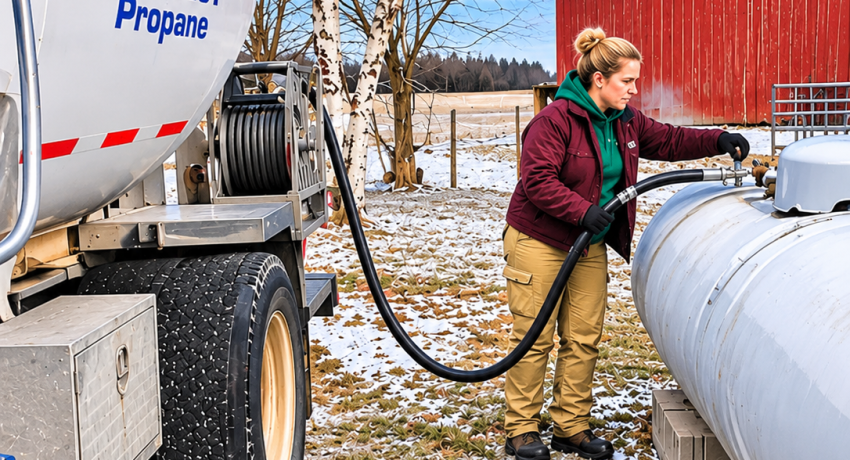
Then I got back to my feet. I pulled the hose from the bobtail and attached the nozzle to their fill valve.
I watched the gauge needle slowly rise. Nine percent. Fifteen. Twenty. Thirty.
The children stood beside me, watching every movement of the needle and holding their breath.
Part Fourteen: Saturday
At six on Saturday morning, the temperature in Cook was four below zero. The sky was clear and still, the stars were still visible, and the snow squeaked beneath our boots.
Every one of the twenty-six homes had heat.
At a quarter before ten, Einar and I drove to Knute’s house along the lake road.
I wasn’t sure why I had decided to go. I had no intention of signing the agreement, and I’d already told Knute that. I’d also made that clear to the man from Duluth over the phone. Still, I couldn’t bring myself to stay away.
Einar insisted on coming along. “I want to see his face,” he told me, “when you tell him no.”
Knute’s home is a small brown log house beside Lake Vermilion, at the end of a long gravel driveway winding through the pine trees. It had belonged to his father. Uncle Lars built it in 1978, one year before he drowned in that lake.
A spotless silver pickup with Duluth dealer plates was parked in the yard. Beside it stood a man wearing a brand-new tan canvas coat and holding a clipboard. He was Craig Westlund from Northland Energy Partners. He looked to be in his forties, clean-shaven, with neatly styled hair and new boots that had clearly never been near a farmyard.
Knute stood on his front porch wearing his Halvorsen Propane jacket. He wasn’t doing anything in particular. He simply stood there with his hands tucked into his pockets.
Along the shoulder of the lake road, near the bottom of Knute’s driveway, pickup trucks were lined up with their engines running in the cold.
Their exhaust rose in white clouds through the still, blue morning air. The engines stayed on to keep the truck cabs warm.
I counted them.
Eleven.
I hadn’t contacted anyone. Not a single person. I had no idea they were coming.
But I recognized those trucks. Every one of them belonged to someone I’d been delivering propane to for eighteen years.
There was Halvor Brekke’s old Ford, with dairy feed sacks in the bed. Tove Lindahl’s Chevy, with three children’s car seats inside. The retired teacher from Orr. The cattle farmer from Angora. The young couple from Ash River Trail with their newborn. The woman who kept goats and made cheese.
And at the very end of the line was a small blue Buick I had never seen before. An elderly woman sat in the passenger seat, wrapped in a quilt, while a young man drove.
Her grandson.
Signe Aho. Ninety-one years old.
Part Fifteen: Halvor
The man from Duluth had also noticed the pickup trucks. He looked puzzled.
“Mrs. Dahl,” Craig Westlund said as Einar and I stepped out of my truck. “I wasn’t expecting this. Is something happening here?”
“I’m honestly not sure,” I answered.
Then the driver’s door of Halvor Brekke’s old Ford swung open. Halvor climbed out. He was seventy-four, dressed in his chore coat, feed-store cap, and barn boots.
For a moment, he stood at the bottom of Knute’s driveway, looking up toward the house, at Knute standing on the porch, and at the man from Duluth holding his clipboard.
Then he pulled off one of his gloves.
And began walking across the yard toward the man carrying the clipboard.
He moved forward at a slow pace, like an elderly dairy farmer carefully crossing icy gravel. Each step was deliberate. Behind him, the doors of the other pickups began swinging open. People climbed out and stood beside their vehicles in the freezing air, watching.
Halvor stopped in front of Craig Westlund and extended his uncovered hand.
“I’m Halvor Brekke,” he introduced himself. “Brekke Dairy, County Road 24. I’ve been buying propane from Halvorsen since 1971.”
Craig glanced at the offered hand before shaking it somewhat hesitantly.
“Craig Westlund,” he replied. “Northland Energy.”
“I know exactly who you are,” Halvor said. “You’re here to purchase Arvid Halvorsen’s plant for four hundred and ten thousand dollars.”
“That was… yes, that was the arrangement,” Westlund answered.
Halvor slowly nodded.
“Well,” he said, “we’d like to present a different offer.”
Part Sixteen: The Counteroffer
Westlund looked at him in surprise. “We?”
Halvor turned and pointed toward the eleven pickups parked along the roadside, with their owners standing nearby in the cold.
“We held a meeting,” Halvor explained. “Last night, in the basement of Our Savior’s Lutheran Church in Cook. Forty-one people showed up.” He glanced toward Knute, who remained on the porch. “We found out Knute is behind on his house payments. We also heard that he needs to sell.”
Knute stood motionless on the porch.
“Here’s what we’re proposing,” Halvor continued. He reached inside his chore coat and pulled out a folded sheet of paper. It was lined notebook paper covered in handwriting. “There are forty-one of us contributing money. Some can put in quite a bit, while others can only manage a little. We’re raising enough to purchase Knute’s half of the plant.”
He unfolded the paper.
“Our offer is two hundred and five thousand dollars,” Halvor said. “Exactly what Northland was going to pay him. Half of the four-hundred-and-ten-thousand-dollar deal.”
He turned toward Westlund.
“We intend to establish a cooperative,” Halvor explained. “It’ll be called the Halvorsen Propane Cooperative. The customers will own Knute’s half, while Marit retains hers. She’ll continue managing the business just as she always has, including the budget plans.”
Westlund studied the paper in Halvor’s hand. Then he glanced at the eleven pickups before looking back at me.
“Mrs. Dahl,” he asked slowly, “were you aware of this?”
“No,” I answered. I couldn’t manage to say anything else.
Then the passenger door of the little blue Buick at the end of the line opened.
Signe Aho’s grandson helped her climb out. He unfolded her walker and placed it on the frozen gravel. Slowly, one careful step after another, she made her way up the driveway in a long wool coat and knitted hat, with the quilt still draped around her shoulders.
Everyone waited for her in silence. Not a single person spoke.
It took her four minutes to reach Halvor and the man from Duluth. When she finally arrived, she stopped to catch her breath.
She reached into her coat pocket and pulled out a small, well-worn envelope. Then she handed it to Halvor.
“Five hundred dollars,” Signe said. “It’s the money I’ve saved for my burial. I’ve been putting it aside since 1993.” She turned toward me. “Arvid kept my tank full every winter for forty-four years. On Thursday, Marit came out in the dark to fill it again. I’d rather be buried in a plain pine box while my house stays warm than have an expensive funeral after freezing in my own home.”
Part Seventeen: Knute
Knute finally stepped down from the porch.
He crossed the frozen yard slowly, keeping his hands inside his jacket pockets. He stopped beside Halvor, Signe Aho, and the man from Duluth.
He looked toward the eleven pickups along the road and the people gathered beside them. He saw Tove Lindahl standing with her three children in their snow pants, the young couple from Ash River Trail with their baby secured in a car seat, and the retired teacher from Orr.
His eyes settled on the envelope in Halvor’s hand. Signe Aho’s burial savings.
Then he turned to face me.
“Marit,” he said, his voice sounding strained. “How many?”
“How many what?” I asked.
“Customers,” Knute clarified. “How many tanks did you fill this week?”
“Twenty-six,” I replied. “Every customer who was below twenty percent.”
“From Littlefork?”
“Ingrid Saari supplied it,” I said. “She charged me her cost. Three loads, seventy miles each way.” I looked directly at him. “Einar held my coffee.”
Knute turned his attention to Einar, who was standing beside my truck in his old blue Halvorsen Propane parka, its elbows covered with patches.
“Einar,” he said. “You really traveled seventy miles each way? Twice a day? With your knees like that?”
“Six trips,” Einar answered. “Four hundred and twenty miles altogether. My knees are doing fine.” He paused before continuing. “Your grandfather and I made that journey thirty-six times in 1989, helping Ingrid after her plant burned down.” He looked straight at Knute. “You hadn’t even been born yet.”
Part Eighteen: The Key
Knute remained silent for a long time.
The pickup trucks continued idling along the road. Their exhaust drifted straight upward into the calm blue sky. Across Lake Vermilion, the newly formed ice boomed and cracked, just as it does during the first truly cold mornings.
Then Knute slowly pulled his right hand from his jacket pocket.
He was holding a little brass key.
He raised it so everyone could see. It was the key that opened the brass padlock securing the chain around the tank’s outlet valve.
“I put that chain on Monday,” Knute said. He wasn’t addressing me directly. Instead, he spoke to everyone gathered around the pickups. “Two days before the freeze. I knew which customers were running low. I’d checked the delivery schedule. I knew what the weather forecast said.” His voice began to break. “And I went ahead and did it anyway. I wanted to force Marit to sign.”
Nobody responded.
“Because I’m four months behind on this house,” Knute continued. He glanced toward the small brown log house his father had built. “The bank is going to take it at Christmas. My dad built it in 1978, the year before he went through the ice.” He swallowed hard. “I couldn’t bear to lose it. I thought selling the plant would give me enough to save it.”
He looked at Signe Aho, the ninety-one-year-old woman standing in the cold and leaning on her walker.
“I was trying to save my father’s house,” Knute said, “while putting all of you at risk of freezing in your own homes.”
He walked over to me and extended the brass key.
“Take it, Marit,” he said. “Remove the chain.”
I looked down at the key in his hand, then raised my eyes to my cousin’s face.
“No,” I replied.
Knute stared at me.
“You were the one who put it there,” I said. “You should be the one to take it off.”
Part Nineteen: The Chain
We all headed back to the plant together. Fourteen pickups formed a line behind us, along with my truck and Craig Westlund’s spotless silver pickup from Duluth, which he brought along at the very end because he wanted to witness what happened.
We pulled into the frozen yard at Halvorsen Propane and parked beside the huge white storage tank and the little office where Grandpa used to sit every morning with his coffee and the weather radio.
Everyone climbed out and gathered in a half circle around the tank, standing together in the cold.
Knute approached the outlet valve. The shiny new galvanized chain was still wound around it three times. The brass padlock remained in place, with the Fleet Farm price sticker still attached to one of its links.
He inserted the key into the lock and turned it.
It snapped open.
He pulled the chain away from the valve. One loop. Then another. Then the third. It dropped into his hands with a heavy metallic clatter, cold against his fingers.
He stood there, holding it for a moment.
Then he turned and passed the chain to Halvor Brekke.
“Put it up in the office,” Knute said. “Above Grandpa’s desk. I want to see it every single day.”
Part Twenty: Craig Westlund
The man from Duluth had remained beside his silver pickup at the edge of the yard throughout everything. He said nothing. He watched Knute remove the chain and saw Halvor’s notebook page, bearing the forty-one names, being passed around.
When everything was finished, he crossed the yard and came over to me.
“Mrs. Dahl,” he said. “I think it’s time for me to return to Duluth.”
“I’m sorry you had to make such a long drive,” I replied.
He glanced around the yard. At the enormous white tank. At the small office with its weather radio. At the eleven farmers, widows, and young parents standing in the cold, their breath visible in the air as they talked and laughed. At Tove Lindahl’s children, racing around the storage tank in their snow pants.
“I’ve purchased nineteen family-run dealers over the past five years,” Westlund said. “Across the Range and throughout northern Wisconsin.” He shook his head. “Not once has anyone come out to meet me. Never. The owners signed the papers, and the customers received a letter in the mail.”
His eyes settled on Halvor, who was still holding the chain.
“I grew up in Hermantown,” he continued. “My grandfather owned a small farm. Forty acres. He got his propane from a family business in Proctor.” He paused briefly. “When I was fourteen, they sold to a large company. Grandpa’s bill increased by forty percent that first winter. He couldn’t afford it, so they stopped bringing fuel in February.”
He looked back at me.
“That spring, he moved in with us,” Westlund said. “He never returned to the farm.”
He extended his hand, and I shook it.
“Best of luck, Mrs. Dahl,” he said. “I genuinely mean that.”
He climbed into his spotless silver pickup and drove away along the county road, heading toward Highway 53 and Duluth.
Part Twenty-One: The Cooperative
The Halvorsen Propane Cooperative officially came into being in January. A lawyer from Virginia prepared all the paperwork without charging us. He was one of our customers, living out on Lake Vermilion. By the time the documents were filed, we had forty-seven members. More people continued to join.
They purchased Knute’s half of the business for two hundred and five thousand dollars. A few members contributed ten thousand each, while others put in as little as fifty dollars. Signe Aho contributed her five hundred.
I retained my half. I continue to drive the delivery route, and I still handle the bookkeeping.
Signe Aho’s budget payments remain twenty dollars a month. And nobody along our route is ever left without heat.
The difference now is that the customers own a share of the plant. During the annual meeting in the basement of Our Savior’s Lutheran Church in Cook, they get to vote on important decisions. They decide the price per gallon, the rules for the budget plans, and whether we should purchase another bobtail truck.
During the cooperative’s first year, everyone unanimously agreed on one rule. No customer, regardless of how overdue their payments might be, would ever have their service cut off between November and April.
Part Twenty-Two: Knute
Knute used his two hundred and five thousand dollars to clear the entire mortgage on his father’s log house along the lake road. He paid every bit of it and managed to keep the property.
He still had some money remaining, around eighty thousand dollars, which he deposited in the bank.
Then, one morning in February, he showed up at the plant office at six o’clock. I was at Grandpa’s oak desk, drinking coffee and listening to the weather radio.
He stood in the doorway wearing his Halvorsen Propane jacket.
“Marit,” he said. “Are you looking for another driver?”
I stared at him.
“Einar won’t be able to ride along with you forever,” Knute said. “His knees are getting worse. And handling four hundred customers by yourself is too much. You know that.”
“I can’t offer you much money,” I told him. “The cooperative decides what everyone gets paid.”
“I understand,” Knute replied. “I’ll accept whatever they decide.”
He has been driving the second route ever since. In March, the cooperative purchased another bobtail, a used 2014 Kenworth. Knute handles the southern part of the county, including Britt, Angora, Gilbert, and Biwabik. I cover the northern section: Cook, Orr, Littlefork, and Ash River.
He has turned out to be a good driver. He treats the older customers with patience and remembers the names of their dogs.
Last month, he told me he had written PAID on a delivery ticket for a young family in Biwabik after the father lost his job at the mine. He then slipped the ticket into their mailbox.
“Grandpa used to do things like that,” he said.
“I remember,” I told him. “I used to ride along with him.”
Part Twenty-Three: The Chain
The chain now hangs on the wall of the plant office, directly above Grandpa’s oak desk. It is brand-new galvanized steel, looped three times around a nail. The brass padlock still hangs from it, and the Fleet Farm price sticker remains on one of its links.
Beneath it, Halvor Brekke mounted a little wooden sign he had made in his barn. The letters were carved by hand and painted white.
NOBODY ON THIS ROUTE GOES COLD.
Beside the sign, there is a framed delivery ticket. It is a carbon copy from Saari Fuel in Littlefork.
Arvid hauled for me 72 days in 1989. Never charged a dime. This is load #1 of 36. — I.S.
Ingrid Saari never lost track of the number. That winter, she supplied me with propane at cost thirty-six separate times whenever our tank ran low before the regular supply truck arrived. Every ticket carried the same message at the bottom, with the load number increasing each time.
Load #2 of 36. Load #3 of 36.
The final ticket arrived in March. Einar came with me to collect that load, his knees covered with a heating pad.
Load #36 of 36. Paid in full, Arvid. Thank you. — Ingrid.
Part Twenty-Four: Tove’s Tank
It is November again, one year later. The first serious freeze is expected on Saturday. The weather radio is predicting six below.
Last week, I stopped at Tove Lindahl’s farm during my usual route. Jens was back from North Dakota and splitting firewood out in the yard. As soon as the children heard the bobtail approaching, they came racing outside.
Annika is ten now. Nils is eight. Britta is five.
They ran ahead of me across the frosty yard toward the gray propane tank beside the red barn. Then they stopped and pointed at it.
They had written on the tank again, using sidewalk chalk in pink, blue, and yellow.
THANK YOU MARIT FOR OUR HEAT
This time, beneath the drawing of the white truck and the stick woman with the yellow ponytail, they had added another vehicle. It was a smaller truck, drawn in green chalk, with a stick figure of a man with a beard standing beside it.
There was also a third tiny stick figure sitting in the passenger seat of the white truck, holding something.
“Who’s that?” I asked, pointing toward it.
“That’s Einar,” Nils answered. “He’s holding your coffee.”
“And that one is Knute,” Annika added, pointing at the bearded figure beside the green truck. “He brought our propane in September when you were sick. He told us a story about your grandpa.”
I lowered myself onto my knees in the frost beside the tank and studied the drawings for a long while. Three trucks. Three little people. And those words, carefully written in a nine-year-old’s handwriting.
Then little Britta came over and rested against my shoulder, just as she had done the year before.
“Will our house be warm?” she asked. “When it gets cold?”
I wrapped my arm around her.
“Your house will be warm,” I told her. “It always will be.”
Then I got back to my feet. I pulled the hose from the bobtail and secured the nozzle to their fill valve.
And I stood watching as the needle slowly climbed.









