
 143 views
My daughter Karen used her airline miles to buy me a first-class ticket.
I told her it was a waste of miles.
She reminded me that I was seventy-six years old and traveling across the country to bury her father. She said if I used the word “waste” one more time, she would end the call.
So I stopped saying it.
My name is Evelyn. Evelyn Mae Pruitt.
I was married to Walter Pruitt for fifty-three years.
Most people called him Walt. The Navy called him Chief. And the boys at Hickory Ridge High School in Chesapeake, Virginia, knew him as Mr. P.
He served twenty-two years in the Navy before retiring as a chief petty officer in 1987. After that, he spent another twenty-one years teaching wood shop at Hickory Ridge.
“I’ve spent half my life telling young men what to do,” he said on the day he accepted the job. “I might as well get paid for doing it a second time.”
In 2009, we relocated to Mesa, Arizona, because of my arthritis. My doctor believed the dry climate would make my hands feel better, and he was right. There were mornings when I could open a pickle jar on my own for the first time in years.
But the move did nothing for Walt.
Every day we lived there, he missed the ocean. In the evenings, he would stand in the backyard, gaze at the brown mountains and cactus, and shake his head.
“Evvie,” he would tell me, “this place is a beach somebody forgot to finish.”
Still, he remained there. For my sake. He spent seventeen years living somewhere he never truly loved because the climate helped my hands.
That was the kind of man Walt was.
He passed away on a Tuesday in October.
He was sitting in his recliner in the living room, with the Sunday crossword resting on his lap and a pencil tucked behind his ear. He worked on the Sunday crossword throughout the entire week. He always said something that good shouldn’t be rushed.
It was his heart. The doctor told me he probably hadn’t felt anything.
I was in the kitchen preparing his grilled cheese sandwich. White bread with American cheese, cut diagonally from corner to corner, just the way he liked it. I called out to ask whether he wanted tomato with it.
He never responded.
And somehow, I knew.
After fifty-three years together, you learn these things. You recognize the sound of silence. You know when a man simply hasn’t heard you and when he’s no longer there to hear you at all.
I switched off the burner. I dried my hands on the dish towel. Then I stood in the kitchen doorway for a long while before finally walking into the room.
His eyes were closed. His glasses rested high on his forehead. The pencil was still tucked behind his ear. Seventeen across was only partly completed. A six-letter word meaning “steadfast.”
He had written as far as L-O-Y-A.
Later, I completed the answer for him. I used a pen and sat at the kitchen table at two in the morning, unable to sleep.
LOYAL.
Walt had always told me he wanted to return to Virginia when his time came.
He wanted his final resting place to be the Albert G. Horton Jr. Memorial Veterans Cemetery in Suffolk, close to his parents. He wanted the Navy to give him a proper military funeral, complete with Taps, the rifle salute, and the folded flag. He repeated this wish so often over the years that Karen would sometimes roll her eyes.
“Yes, Daddy. We know. The Navy. A proper ceremony. You’ve told us forty times.”
“Forty-one now,” Walt would reply.
So the funeral home in Mesa arranged to send him ahead of me. He traveled in an airplane’s cargo hold to Norfolk. They told me it was a routine arrangement and assured me he would be treated with care.
Karen lives in Virginia Beach. She’s fifty-one years old, and she handled all the arrangements on that side. The church, the cemetery, the Navy honor detail, the reception, and the flowers. Every evening, she called me to review everything on the list.
My only responsibility was to get myself from Phoenix to Norfolk by plane.
That was all I needed to do.
“Mama, are you certain you don’t want me to fly out and bring you here?” Karen asked during a phone call three days before the trip.
“I’m sure, sweetheart. I can manage getting on a plane alone.”
“You’ve never traveled by yourself.”
That made me pause.
She was correct. In all my seventy-six years, I had never once flown alone. Walt and I had always traveled together. Every wedding, every graduation, every funeral, and every Christmas trip back to Virginia.
For more than fifty years, he always took the middle seat so I could sit by the aisle and have room for my knees.
He never complained about it. Not even on the flight to Seattle for his cousin’s wedding, when we were squeezed between me and a man who ate an entire bag of onion rings before falling asleep against Walt’s shoulder.
“It’s all right, Evvie,” he had said, brushing the onion ring grease from his sleeve. “The poor fellow’s tired.”
“I’ll manage just fine,” I assured Karen.
“I’m moving you to first class.”
“You’re doing what?”
“Upgrading your ticket. I’ll use my miles. I’ve got a hundred and twenty thousand just sitting there. You’re going to be seated at the front.”
“Karen, that’s such a waste.”
“Mama.”
“That’s a perfectly good hundred and twenty thousand miles…”
“Mama. You’re seventy-six years old. You’re traveling across the entire country to bury Daddy. If you use the word waste one more time, I’m ending this call.”
I didn’t mention it again.
That Thursday morning, my neighbor Rosalind drove me to Phoenix airport. She had lived next door to us for fifteen years. Over the previous eleven days, she had brought me four casseroles. I had put three of them in the freezer.
She walked with me all the way to the security line.
“Call me as soon as you land,” she said. “And if anyone gives you a hard time, you call me.”
“Rosalind, nobody is going to bother an old woman like me.”
“You’d be surprised,” she replied.
She gave me a hug. Then she remained beside the rope, watching as I went through security. Each time I looked back, she waved. She kept waving until I turned the corner near the shoe bins and disappeared from view.
I had never traveled in first class before.
When my row was called, I stood and made my way down the jetway with passengers wearing suits and carrying expensive luggage. I felt as though I had somehow slipped into a party where I didn’t belong.
My assigned seat was 3D. An aisle seat, naturally.
It was a wide, comfortable gray seat with its own small reading light. A blanket had been folded inside a plastic bag, and a little pillow rested on the seat. There was more space for my knees than I’d ever experienced on an airplane.
I settled into the seat and thought, Walt would have loved this.
Then another thought came to me: Walt would have called it a waste.
I nearly laughed.
The flight attendant standing near the front entrance was young, perhaps twenty-four. She had a high blond ponytail, bright pink lipstick, and a name tag that read KAYLA.
She was cheerful and efficient, with the confidence of someone who had spent her whole life being told she was excellent at her job.
Before the plane had even left the gate, she offered me a glass of orange juice. An actual glass.
I accepted because I wasn’t quite sure what else I was supposed to do.
The passenger assigned to seat 3C, beside the window, boarded shortly after me.
He looked around fifty and wore a navy-blue suit without a tie. He had a silver watch, a haircut that probably cost sixty dollars, and a leather laptop bag.
He opened his laptop before he had even settled completely into his seat. He gave me a brief nod, the kind people exchange in an elevator. Then he put in a pair of small white earbuds and began typing.
That was fine with me. I wasn’t expecting anyone to make conversation.
I was holding my purse on my lap.
Inside it was Walt’s folding wooden ruler.
If you’ve never seen one, it’s a carpenter’s measuring rule. When fully extended, it measures six feet. It folds into a little stick about eight inches long, with small brass hinges spaced every six inches, making it easy to carry in a shirt pocket.
Walt had owned and carried that same ruler for forty years.
The wood had darkened to the color of strong tea from the oils on his hands. The printed numbers had become almost impossible to see in the spots where his thumb usually rested. One of the brass hinges was slightly loose and made a clicking sound whenever you folded it.
At the very end, he had carved the initials W.P. into the wood with a nail. He did it when he was nineteen, aboard a destroyer named the USS Barry, back in 1965. It was his first ship.
I discovered it in his shirt pocket.
The day after he died, the funeral home in Mesa handed me his belongings in a brown paper bag. His wallet, wedding ring, reading glasses, watch, and the shirt he had been wearing, neatly folded.
I opened the shirt. There, tucked inside the front pocket, was the ruler.
He had been carrying it when he died. Sitting in his recliner, working on the crossword, with a carpenter’s measuring rule in his pocket. As though he might suddenly need to measure something at any moment.
Since then, I hadn’t been able to leave it behind.
I slept with it on my nightstand. I kept it in my apron pocket while preparing coffee. I held it in my lap when the Navy casualty officer called me.
And now it rested inside my purse, on my lap, in seat 3D.
The plane lifted off, and Phoenix slowly disappeared beneath us. The brown mountains. The cactus. The swimming pools scattered across people’s backyards, looking like tiny blue squares.
A beach somebody forgot to finish.
Somewhere above New Mexico, I reached into my purse and took out the ruler.
I simply wanted to hold it.
I opened one section, then another, just as Walt used to do whenever he was measuring something while his mind wandered elsewhere. He would stand in the garage, holding the ruler partly unfolded, studying a piece of wood and humming to himself.
I opened a third section. The loose hinge made its familiar clicking sound.
And then I began to cry.
I wasn’t making a scene. I want to be clear about that. I’ve spent a lot of time thinking about it since then.
I wasn’t sobbing or carrying on. I was simply an elderly woman sitting in a gray airplane seat, with a wooden ruler resting on her lap and tears streaming down her cheeks that she couldn’t stop.
I pulled a tissue from my purse and kept dabbing my eyes.
Eleven days had passed.
For eleven days, I had held myself together.
I stayed composed while speaking with the funeral home in Mesa, when the young man asked whether I preferred mahogany or oak. I kept my voice steady with the Navy casualty office while spelling out Walt’s service number. I remained strong for Rosalind and her casseroles. I managed to hold myself together when neighbors stopped by, stood awkwardly in the doorway, and struggled to find the right words.
I stayed strong while packing my suitcase, too. My black dress. My nice shoes. And Walt’s dress blues, which Karen wanted him to wear for the viewing. I spread the uniform across our bed and pressed it myself. I carefully cleaned the brass buttons with a soft cloth and straightened the ribbons above the left pocket. I folded the jacket exactly as he had shown me back in 1974, when I was a young Navy wife who didn’t know the first thing about it.
Then I shut the suitcase and pulled the zipper closed.
And still, I hadn’t cried.
I suppose that somewhere at thirty-four thousand feet above New Mexico, my body finally decided it had done enough being strong.
The man sitting in 3C removed one of his earbuds.
He turned to look at me.
I noticed him watching and tried to compose myself. I pressed the tissue more firmly against my eyes.
But the tears wouldn’t stop.
He watched me for several more seconds. Then he reached up and pushed the call button above his seat.
Ding.
Kayla appeared almost immediately.
“May I help you, sir?”
He leaned in her direction and lowered his voice. But not enough to keep me from hearing. The first-class cabin was a small space.
“Is there somewhere else she can sit? Or could I be moved? I’ve got a presentation to finish before we land, and she’s been crying for twenty minutes. I paid for this seat so I could get some work done.”
Kayla glanced over at me.
I lowered my eyes toward my lap.
I looked at the ruler, the tissue, and my hands. They were old, covered in spots, and bent at the knuckles. They were holding a piece of wood that still carried a faint sawdust smell if you lifted it close to your nose.
“I’m very sorry, sir,” Kayla told him.
Then she crouched beside my seat. Her expression was bright and carefully pleasant.
“Ma’am,” she asked, “are you doing all right? Is there anything I can bring you?”
“I’m all right,” I replied. “I’m sorry. I’m so sorry. I’m traveling to my husband’s funeral.”
Her expression shifted.
I believe she felt sorry for me. Truly, I do. I’ve thought about that moment many times, and I believe there was genuine sympathy somewhere behind her expression.
But I also understand that she was twenty-four. A premium-class passenger had made a complaint. And somewhere in a training room, someone had probably instructed her on exactly how to handle complaints from people paying for premium seats.
“Actually,” Kayla said cheerfully, “we have a little extra room toward the back of the aircraft. It may be more private for you there. You could have an entire row to yourself. Would that make you more comfortable?”
I should have refused.
Karen told me afterward that I should have said no. She was furious when she heard what happened. She said, “Mama, that was your seat. I paid for it. You had every right to stay there.”
She was correct. I understand that.
But I grew up in Portsmouth, Virginia, with a mother who believed there was nothing worse a woman could do than inconvenience someone else. Don’t make a fuss, Evelyn. Don’t cause a scene. Don’t put anybody out.
And I was exhausted.
The man in 3C had already put his earbud back in. He had turned toward the window and resumed typing, as though the issue had been settled.
So I answered, “All right.”
Kayla picked up my purse while I carried the ruler.
Together, we walked down the aisle, passing through the small curtain separating first class from the rest of the plane. We went past row after row of passengers who looked up from their phones, books, and little screens.
They glanced at me.
At my face.
At the tissue in my hand.
Then they quickly returned their attention to whatever they had been doing.
An airplane aisle feels incredibly long when everyone has just watched you cry.
Row 32 was the final row on the plane.
The seats couldn’t recline because they were directly against the back wall. Both restrooms were just behind me. Every few minutes, one of the doors would swing open and slam shut, followed by the terrible vacuum-like roar of the toilet. WHOOSH.
The air carried the smell of blue cleaning chemicals mixed with burnt coffee from the small galley.
Somewhere around row 28, a baby was fussing. Not exactly crying, just making that exhausted, unhappy noise babies make when they’re too tired to fall asleep.
“There we are,” Kayla said as she placed my purse on the middle seat. “A nice quiet spot. I’ll bring you some water.”
She returned with a small plastic cup of water and a little packet of pretzels.
Then she headed back toward the front of the plane, disappearing through the curtain.
She never returned.
I took the window seat.
I placed the ruler on the tray table and folded it closed again, one section at a time. Click. Click. Click. Just as Walt did when he had finished measuring something and reached a decision.
Then I rested my forehead against the cold plastic beside the window.
Texas stretched out beneath us. Brown, flat, and seemingly endless. Roads looked like pencil marks, and farms appeared as little squares.
And I continued crying.
This time, I didn’t even bother reaching for the tissue.
I found myself thinking about the middle seat.
Fifty-three years of Walt sitting in the middle.
Fifty-three years of that big man squeezing himself into the narrowest seat on an airplane, his knees pressed close to the tray table and his elbows tucked in, all so I could sit beside the aisle.
And on the very first flight I had ever taken without him, I found myself in the last row of the plane, beside the restrooms, all alone.
I couldn’t tell you how long I stayed there.
Perhaps an hour. Long enough for my neck to become sore from leaning against the window. Long enough for the baby in row 28 to finally fall asleep.
Then I heard the drink cart rattling down the aisle.
A different flight attendant was pushing it. She was older than Kayla, perhaps around sixty. She was short and sturdy, with closely cropped gray hair and reading glasses hanging from a beaded chain around her neck. Her name tag read DENISE.
She gave a passenger in row 30 a ginger ale and handed someone in row 31 a cup of coffee.
Then she noticed me.
She studied me for a long moment.
Then she stopped the drink cart by applying its brakes. Walking around the side of it, she came over and sat down in the aisle seat of my row.
Right there, in the middle of serving drinks.
I’m fairly certain that wasn’t permitted under some airline rule.
“Sweetheart,” she asked, “what are you doing all the way back here?”
I wiped my cheeks.
“You were sitting in 3D,” Denise continued. “I checked the passenger count before we left the gate. Pruitt. Seat 3D. I remember seeing your name.”
“The gentleman needed to get some work done,” I explained.
For a moment, she said nothing.
Her lips pressed into a very thin line.
“Kayla mentioned that you’re traveling to a funeral,” she said.
“My husband’s,” I replied. “He’s being laid to rest on Saturday at the veterans cemetery in Suffolk. He was a Navy chief.”
Denise’s expression changed.
“My father was a Navy chief, too,” she said softly. “Thirty years. Norfolk to Rota, then Pearl, and eventually back to Norfolk. He was a boatswain’s mate.”
She reached across and placed her hand over mine on the armrest.
“What was your husband’s name, sweetheart?”
“Walter Pruitt,” I answered. “Walt.”
“Where did he serve?”
I told her.
He had served mostly aboard destroyers. The Barry was his first ship, when he was nineteen. After that came the Mitscher, followed by the Richard E. Byrd. His final eight years were spent at the Norfolk Naval Shipyard in Portsmouth, where he trained young sailors in the machine shop.
Then I began telling her about his years teaching wood shop, too. Once I started talking about Walt, I found I couldn’t stop. Denise simply listened.
I told her about the twenty-one years he spent at Hickory Ridge.
I described the boys who would visit our house on Saturdays to use Walt’s table saw in the garage. I’d walk outside with a pitcher of lemonade and find six teenage boys gathered around the machine, all wearing their safety glasses and standing as quietly as churchgoers while Walt cut a piece of wood.
I told her about the birdhouses. Walt built one for every person on our street in Chesapeake. Not a single one was the same. For the widow who lived at the end of the block, he made a birdhouse shaped like a lighthouse because her husband had once worked as a lighthouse keeper in North Carolina.
And then I told her about the wheelchair ramp.
One summer during the 1990s, a boy in Walt’s fourth-period class had a father who was left paralyzed after a drunk driver caused an accident on I-64. The family had very little money and couldn’t afford to make their home accessible. They had no way to get the father in and out of the house.
Walt devoted that entire summer to building a wheelchair ramp for them. He used pressure-treated pine and included a railing and everything else they needed. Every weekend, from June through August, he worked on it. He would leave our house at seven in the morning with his toolbox and a cooler, then return after sunset.
He told me he was helping a friend build a deck.
He never mentioned the real reason to anyone. Not to me. Not to the school. Not even to the boy.
I didn’t learn the truth until the following year, when the boy’s mother sent a card to our home. It was addressed to Mrs. Pruitt. She had assumed I already knew what Walt had done.
Thank you and your husband for building the ramp, she wrote. My Jerry goes out onto the porch every evening now and watches the sunset. He says it’s the first thing in a long time that has made him feel like a man again.
I sat at the kitchen table and cried as I read it.
When Walt came home that evening, I held the card up for him to see.
“A deck?” I asked.
He glanced at the card, then looked at me.
“Well,” he replied, “you could say it’s a kind of deck.”
Denise listened to the entire story.
Not once did she interrupt me. She never checked her watch or turned her attention toward the drink cart.
When I had finally told her everything, she remained seated beside me for a long moment, still holding my hand.
Then she gave it a firm squeeze.
“Stay right here,” she said.
I assumed she meant it in the usual way people say, don’t worry about a thing.
I didn’t realize she intended me to take her words literally.
Later, Denise explained what she had done.
She pushed the drink cart straight back to the front of the aircraft without stopping to serve another row. She parked it in the forward galley.
Then she went to speak with Kayla.
According to Denise, it wasn’t a particularly friendly conversation.
“I told that girl,” Denise recalled a few days later, “that in my thirty-four years of working on airplanes, I’ve moved plenty of people from their seats. Drunks, people who wanted to fight, even a man who brought a live chicken aboard in 1993. But never once have I moved a grieving widow to the back of an aircraft just so some man in a suit could finish his PowerPoint presentation. And I made it clear that it wasn’t going to happen again while I was on duty.”
After that, Denise picked up the interphone in the galley, the small telephone used to contact the cockpit.
She informed the captain that a passenger aboard was traveling to attend a military funeral. She explained that flight crews liked to know about situations like that. Sometimes the captain would make an announcement. Sometimes the airline arranged flowers. On other occasions, the ground crew at the destination airport would perform a water salute on the runway.
Then she gave him the name.
Pruitt. Walter Pruitt. Navy chief. Chesapeake, Virginia.
The captain remained silent on the other end of the line for quite some time.
Denise later told me she thought the connection might have dropped.
Then he asked her to spell the surname.
P-R-U-I-T-T.
Next, he requested the passenger manifest.
She carried it to the cockpit entrance. The captain opened the door and accepted the clipboard from her.
According to Denise, he studied the page for a full minute without speaking. His eyes remained fixed on one particular line.
PRUITT, EVELYN M. Seat 3D. PHX–ORF.
Then he turned to his first officer and said, “Your airplane.”
The first officer answered, “My airplane.”
The captain unfastened his seat belt and stood up.
I knew nothing about any of this.
I was still sitting in row 32, my forehead resting against the window. I could hear the restroom door slamming and watch as Texas gradually gave way to Louisiana.
What I did notice was that the airplane suddenly became quieter.
People talk about an entire airplane falling silent. I had never believed it could happen until I experienced it myself.
But it did.
The change began near the front, spreading backward like a wave. First, the conversations stopped in one section, then the next, and then another. Passengers began turning around in their seats and leaning into the aisle.
Someone around row 20 asked, “Is that the pilot?”
I lifted my head from the window.
Then I looked toward the aisle.
He was tall, with dark hair that was beginning to turn gray around the sides. He wore a white uniform shirt with four gold stripes on each shoulder and a pair of silver wings above his left pocket. He looked to be about forty-five.
He moved slowly down the aisle.
His eyes traveled from one row to another, studying each passenger’s face as though he were searching for something he had lost.
When he reached row 31, he spotted me.
And stopped.
I didn’t recognize him. I want to make that perfectly clear.
I looked at his face, but nothing seemed familiar. Not even the slightest feeling of recognition.
My first thought was that something had gone wrong with the aircraft. My second was that something had happened to Walt’s body aboard another plane in the cargo hold. My third thought was Karen.
My heart began beating faster.
The captain removed his hat.
I hadn’t even realized pilots still wore hats. It was black, with a polished brim and gold leaves decorating it. He held it against his chest with one hand.
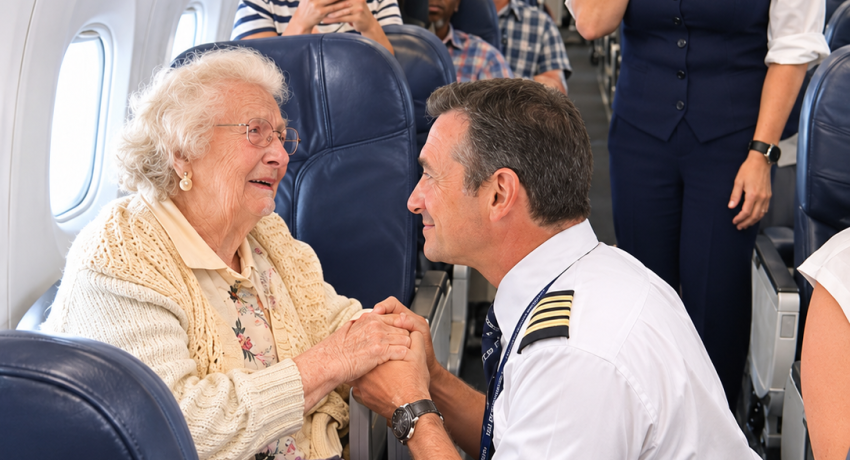
Then, right there in the airplane aisle, beside the empty space where the drink cart had been, and in front of a hundred and sixty passengers, the captain lowered himself onto one knee beside my seat.
“Mrs. Pruitt,” he said.
Then he spoke more softly.
“Evvie?”
Nobody had called me Evvie in eleven days.
Walt was the only person who ever used that name.
Only Walt. For all fifty-three years of our marriage. My mother called me Evelyn. My sister called me Ev. Karen called me Mama. The neighbors knew me as Mrs. Pruitt.
But Evvie was a name that belonged only to Walt.
I stared at the unfamiliar man kneeling beside me.
“Do I know you?” I asked.
“No, ma’am,” he replied. “You don’t.”
He swallowed before continuing.
“But I ate the lunches you made for me all winter.”
He reached toward me and took my hand.
His hand felt warm and steady. He held mine gently between both of his, with the same care someone might use when picking up a small bird they’d found on the ground.
“My name is Marcus Hale,” he said. “You might not remember me, but your husband taught me shop class at Hickory Ridge. In 1997.”
His voice began to crack.
“I’m alive today because of him.”
He began explaining everything right there.
He remained on one knee in the aisle, while the restroom door continued banging behind us and the baby in row 28 woke up and started fussing again. Around us, passengers throughout the back of the plane leaned closer, listening to every word.
When Marcus was sixteen, his stepfather forced him out of their home.
It happened in January 1997. They had gotten into a terrible argument. His stepfather had been drinking. For the first time in his life, Marcus had stood up to the man because he had shoved Marcus’s mother against the kitchen counter.
In response, his stepfather grabbed Marcus by the collar and threw him through the front door into the snow.
His mother didn’t intervene.
She simply stood in the kitchen doorway and watched.
“She didn’t even look at me,” Marcus said. “She just stared at the floor.”
All he had was a backpack, a jacket that wasn’t warm enough for the weather, and eleven dollars in his pocket.
He had absolutely nowhere to go.
So he headed to the one place that had ever made him feel at home.
The woodshop at Hickory Ridge High School.
He knew the rear entrance near the loading dock never shut properly. Everyone in shop class knew about it. A little jiggle was all it took to make the door swing open. Walt had been submitting repair requests for two years, but it still hadn’t been fixed.
That night, Marcus walked four miles through the snow to reach the school. He gave the back door a shake, and it opened.
He settled down beneath the large workbench at the rear of the shop. He made a bed from a heap of sawdust and covered himself with a canvas drop cloth.
The temperature outside was twenty-two degrees. The school’s heating system had been turned down for the night. He said he could actually see his breath in the cold.
Walt discovered him at six-thirty the following morning.
Six-thirty was when Walt arrived at school every day. He had kept that routine for all twenty-one years he worked there. He liked to get the coffee ready, inspect the saws, and sweep the floor before the boys arrived at seven-forty.
He entered through the same faulty back door and switched on the lights.
That’s when he noticed a pair of sneakers sticking out from beneath the workbench.
“He never called the principal,” Marcus explained. “He didn’t contact the police. He didn’t call my mother either.”
He shook his head.
“He simply knelt down and peered underneath the bench at me. He stayed there looking for a long moment. Then he said, Son, that drop cloth is covered in linseed oil. You’re going to smell like a cutting board all day.”
I covered my mouth with my free hand.
“After that, he got to his feet,” Marcus continued, “walked out to his truck in the parking lot, and returned carrying a sleeping bag.”
I recognized that sleeping bag.
It was green, an Army-surplus model. Walt had kept it behind the seat of his truck from 1985 until the day we sold the vehicle. You never know when you’ll get stranded somewhere, Evvie, he used to tell me. It’s there for emergencies.
During the winter of 1997, it vanished from the truck. I asked him about it once, sometime in February. He told me he’d loaned it to someone.
I hadn’t given it another thought.
“Mr. P. let me stay there until April,” Marcus said.
“He found an old Army cot somewhere and brought it in. He placed it in the supply room at the back of the shop, behind the lumber rack, where no one would notice me. He ran an extension cord back there so I could use a space heater. He even handed me his own key to the rear entrance, so I wouldn’t have to force the door open anymore. He told the janitor I was his assistant and that I stayed after school every evening to help him with projects.”
He gave a laugh, though his voice was thick with tears.
“The janitor was named Mr. Gaines. He’d often say, Mr. P., that boy puts in more work than anyone else in this whole building. And Mr. P. would answer, He certainly does, Ernie.”
“And every morning without fail,” Marcus continued, “he showed up carrying two lunches.”
He was crying now, too. A grown man with four gold stripes on his shoulders, kneeling in the aisle of the airplane he commanded.
“Two brown paper lunch bags. Every day. Ham and Swiss on rye with yellow mustard. An apple. Two oatmeal cookies wrapped in wax paper.”
He paused to catch his breath.
“And there was always a note,” he said. “Written on a napkin in his tiny handwriting. Every single day. Eat the apple first. Finish your algebra. Stand up straight, sailor.”
I remembered those lunches.
Of course I remembered them.
I was the one who had prepared them.
The memory suddenly came rushing back as I sat there in row 32.
It was a Tuesday morning in January 1997. Walt came into the kitchen dressed for work while I was preparing the coffee. He stood beside the counter for a little while, absentmindedly fiddling with the sugar bowl.
“Evvie,” he said, “I’ve been feeling hungrier at work lately. You know how it is when you get older. Would you mind fixing me two lunches instead of just one?”
I stared at him.
“Two lunches?”
“Only for a little while.”
“Walter Pruitt, you’re fifty-one years old. There’s no reason you need two lunches.”
“I’m still growing,” he replied.
I laughed and agreed.
From then on, I prepared two lunches every morning. Ham and Swiss on rye with yellow mustard, an apple, and two oatmeal cookies wrapped in wax paper. I packed everything into two separate brown paper bags.
From January through April.
I assumed he was eating both lunches himself.
I used to joke with him about it.
“Pretty soon, Walt, you’ll have to get your work trousers let out,” I’d say as I handed him the two bags by the door.
“I’ll have you know,” he’d reply, “my metabolism is exceptionally fast.”
By March, I began adding extra cookies because I thought he must be working so hard that he needed more food. I started packing four cookies, putting two in each bag.
That evening, he came home and said, “Evvie, thank you for the extra cookies.”
I answered, “You’re welcome, sweetheart. You must be absolutely starving at that school.”
Then he said softly, “Someone is.”
I didn’t understand what he was trying to tell me.
I never asked him to explain.
He kept the truth from me.
For twenty-nine years, he never said a word.
“I used to wonder who was making those lunches,” Marcus said, still holding my hand. “I knew it couldn’t be him. I’d watched him attempt to make a sandwich in the teachers’ lounge. He actually spread mustard on the outside of the bread.”
Despite all the tears, I burst out laughing there in row 32.
“He did exactly the same thing at home,” I said. “I finally banned him from the kitchen in 1978.”
“The cookies were the best food I’d ever tasted,” Marcus said. “My mother never baked anything. Not even once. I started saving one cookie each day to eat at night, when the supply room got especially cold. I’d lie on that cot with the space heater running, slowly eating an oatmeal cookie and thinking, Somebody made this. Somebody made this for me, and they don’t even know who I am.”
“In April, Mr. P. found me somewhere else to stay,” Marcus continued. “He arranged for me to live with a foster family called the Okonkwos. They lived in Chesapeake. They were wonderful people. Mrs. Okonkwo worked as a nurse. Mr. P. personally went to see the social worker. He drove me to my first meeting with the family and waited in his truck in their driveway for two hours while I was inside, just in case things didn’t work out.”
He brushed the tears from his face with the back of his wrist.
“But they did,” he said.
“He helped me join the Navy,” Marcus said.
“He personally drove me to the recruiting office on Military Highway during the week I turned eighteen. He waited in the reception area wearing his old chief’s windbreaker. He also wrote me a recommendation letter for the officer program. It filled an entire page, front and back, in that same tiny handwriting. I’ve kept a copy all these years.”
He glanced around the cabin, looking at the passengers who had gathered their attention on us.
“I spent twelve years flying P-3 Orions out of Jacksonville, hunting submarines across the Atlantic. After that, I left the Navy and joined this airline. I’ve been flying here for twelve years now.”
Then he turned his eyes back to me.
“Every time I take off,” he said, “I can hear his voice in my head. Stand up straight, sailor.”
Then he reached inside his shirt pocket.
Just behind his silver wings.
He pulled out a long, narrow, brown object.
A folding wooden ruler.
It was old and darkened from years of handling, with small brass hinges.
“Mr. P. gave this to me when I graduated from high school,” Marcus said. “It was 1999. After the ceremony, he came over to me in the parking lot and placed it in my hand. He told me, Every man ought to know how to measure twice.”
I opened my hand.
Walt’s ruler was still resting there. I’d been holding it the entire time Marcus spoke. My grip had been so tight that my knuckles had turned white.
Marcus lowered his eyes toward it.
He noticed the initials W.P. scratched into the end, written in the same rough, uneven lettering Walt had carved with his fingernail back in 1965.
Marcus reached toward it and touched the mark with one finger. He did it so gently, almost as if he were touching the face of a sleeping baby.
For a long while, he remained silent.
“I sent him a letter every Christmas,” Marcus finally said. “Did he ever mention that to you?”
I slowly shook my head.
“He received Christmas cards from so many boys,” I said. “Every year there were dozens. He kept every one of them in a shoebox in the garage, on the shelf above the table saw. I never knew which card came from which boy.”
“I’m the one who wrote from the Navy,” Marcus said. “First from Jacksonville, and later from here. I was the one who always signed my cards, Your Assistant.”
I laughed.
I simply couldn’t help myself.
For twenty-five years, I’d been reading that same Christmas card. Every single year, it was a plain card with a little airplane printed on it. It never included a name. It only said, Merry Christmas, Mr. P. — Your Assistant.
And every Christmas, I’d hold it up at the kitchen table and ask, “Walt, who in the world is this assistant of yours?”
Each time, Walt would simply smile, take the card from me, and place it inside the shoebox.
“Good kid,” he’d say. “Just a good kid.”
Marcus rose to his feet.
His knee made a loud cracking sound, enough to make a man sitting in row 30 wince.
He looked down the length of the cabin at all the passengers facing us. Tears were running down people’s cheeks. A woman in row 29 was openly crying into a napkin. A large man wearing a Cowboys jersey in row 27 was wiping his eyes with his sleeve while pretending nothing was happening.
Then the captain lowered his gaze toward me again.
“Mrs. Pruitt,” he asked, “may I know why you’re sitting all the way back here?”
I didn’t want to say anything.
I didn’t want anyone getting into trouble. Not even the man in 3C. Not even Kayla.
Don’t cause a scene, Evelyn.
But Denise was standing behind the captain in the aisle. She had been there the entire time, near row 30, watching with her arms crossed.
She spoke on my behalf. Softly, without adding anything, just explaining what had happened.
The man in 3C. His call button. His complaint. I paid for this seat so I could get some work done. Kayla’s response. Somewhere nice and private. And then row 32.
I saw Captain Marcus Hale’s jaw tighten.
He didn’t say a word to me about it.
He simply gave a single nod.
Then he put his hat back on and headed toward the front of the aircraft.
About ten minutes later, a chime sounded through the speakers.
Ding-dong.
Then I heard his voice.
“Ladies and gentlemen, this is your captain speaking. My name is Marcus Hale.”
The entire cabin fell silent.
“This isn’t something I usually do,” he began. “In twelve years of flying, I’ve never done it before. But we have someone very special traveling with us today, and I’d be grateful if you would give me a minute of your time.”
He explained what had happened.
He didn’t share every detail. He left out the stepfather, the freezing snow, and his mother standing in the kitchen doorway with her eyes fixed on the floor.
But he told everyone that I was traveling to Virginia to lay my husband to rest. Chief Petty Officer Walter Pruitt of the United States Navy, a man who had served his country for twenty-two years.
He explained that my husband had taught him woodworking when he was in high school.
He also told them that, at sixteen, when he had nowhere else to turn, Chief Pruitt discovered him sleeping beneath a workbench. He gave him somewhere safe to stay and made sure he had two lunches every day throughout the winter.
And he had never told anyone about it.
“I’m the captain of this aircraft today,” Captain Hale said. His voice broke over the intercom, in front of all one hundred and sixty passengers. “And I have this job because a man once found a boy sleeping beneath a workbench and chose to help him.”
He paused for a moment.
“Mrs. Pruitt was the person who prepared those lunches,” he continued. “Every single one of them, all winter long. She had no idea who would be eating them. I want her to know now. Thank you, ma’am. Those were the finest lunches I’ve ever had.”
For a moment, there was silence.
I could hear the steady rumble of the engines.
Then his voice came through again. This time, it sounded firmer.
“Mrs. Pruitt was originally assigned seat 3D,” he announced. “She will be returning to that seat.”
He paused again.
“Thank you, everyone,” he said.
Click.
Kayla walked down the aisle toward me.
Her cheeks were red and blotchy. Her pink lipstick had smudged, and her ponytail was beginning to come undone.
She lowered herself beside my seat. She was the second person to kneel in that aisle within fifteen minutes.
“Mrs. Pruitt,” she said, her voice trembling. “I’m truly sorry. I didn’t… I should have… I should have asked what you wanted. I should have allowed you to cry. I’m so, so sorry.”
I looked at her.
At that young woman, only twenty-four years old. Someone’s daughter. A girl who had probably spent her whole life being told she was good at her job, only to discover in front of an entire airplane that doing your job well and treating people well aren’t always the same thing.
“I understand, sweetheart,” I told her. “Now help me get up. These knees aren’t as strong as they used to be.”
She picked up my purse.
Denise took hold of my arm.
Together, they escorted me up the aisle toward the front of the airplane.
Someone in row 30 began applauding.
It was a young woman holding a little boy on her lap. He looked about three and was wearing dinosaur pajamas. She started clapping, and the little boy joined in because he didn’t understand what was happening, but he enjoyed clapping.
Then the passenger sitting beside her began.
After that, people in row 29 joined in.
The applause spread through the cabin like a wave, moving from one row to the next. The same passengers who had kept their eyes on their phones when I walked past them an hour earlier were now clapping. Some had even risen to their feet in the aisle.
The large man wearing the Cowboys jersey in row 27 was applauding so enthusiastically that his entire row seemed to shake.
A young soldier in uniform stood up completely in row 18. He removed his cap and placed his right hand over his heart. He remained standing at attention in the aisle until I had walked past him.
An elderly man in row 12 wore a black baseball cap with the words VIETNAM VETERAN embroidered in gold. As I passed, he reached out and gently touched my sleeve.
“May God bless the Chief, ma’am,” he said.
“And may God bless him,” I replied.
I could barely make anything out.
The tears had returned, but this time they felt different. I hadn’t cried this way in eleven days. These were tears that released something inside me rather than keeping all the pain bottled up.
When we reached the front, Denise drew back the curtain for me.
Almost as if she were opening a theater curtain.
The man in 3C was sitting perfectly still.
His laptop was shut. His earbuds had been removed and were resting on the tray table. Both his hands lay flat on either side of them, and he was staring down at them.
His face had turned ashen.
He didn’t raise his eyes when I took my seat.
I settled back into 3D.
Kayla brought me another orange juice, this time served in an actual glass.
I hadn’t asked for it. I didn’t even want one. I wasn’t sure why she had brought it. Perhaps she simply felt she needed to offer me something.
I thanked her and drank it anyway.
The man in 3C never glanced in my direction again during the rest of the flight.
Not even once.
I didn’t look at him either.
I rested Walt’s folding ruler in my lap. It was closed. Click, click, click.
Through the window, I watched the coastline appear beneath us. Gray and green, surrounded by water. Chesapeake Bay. The James River. The shipyard. All the small boats gathered around the harbor at Little Creek.
The water, just as Walt had always longed to see.
It was the gentlest landing I had ever experienced.
I didn’t even realize the wheels had touched the ground until the engines began roaring.
Once the aircraft reached the gate, the seat belt sign switched off and passengers began getting to their feet. Then the cockpit door opened.
Captain Hale stepped out.
He stood in the small doorway at the front of the cabin and shook the hand of every passenger as they departed. He thanked each person for choosing to fly with them.
When my turn came, he didn’t offer me his hand.
He wrapped his arms around me instead.
“Saturday,” he whispered into my ear. “St. Luke’s?”
“Ten in the morning,” I answered. “How did you find that out?”
“Denise asked your daughter’s name when you checked in. I called her from the cockpit twenty minutes ago.”
I looked at him in disbelief.
“You called Karen? From the cockpit?”
“I asked her whether there might be room for one more pallbearer,” Marcus replied.
Karen was waiting at the bottom of the escalator at Norfolk International.
Her husband, Dave, was with her, along with both of my grandsons, Tyler and Josh. They were seventeen and fifteen, all long legs, elbows, and oversized feet.
When Karen spotted me at the top of the escalator, her expression crumpled.
She hurried up the final three steps against the flow of people coming down, threw her arms around me, and held me tightly. Just as she had when she was eight years old. Just as she used to cling to me whenever Walt shipped out for six months and she cried at the pier.
“Mama,” she whispered against my shoulder. “Mama, a pilot called me from the airplane.”
“I know, sweetheart.”
“He told me Daddy had saved his life.”
“I know.”
“Did you know about that? Did you ever know?”
“No,” I answered. “I was the one who made the lunches, but I never knew.”
We were standing near baggage carousel four, waiting for my suitcase to arrive. Walt’s dress blues were inside, carefully folded just as he had taught me to fold them.
Dave had gone to retrieve the car. The boys were busy arguing over something on one of their phones.
Then I sensed someone standing behind me.
I turned around.
It was the man from 3C.
He had removed his suit jacket and was carrying it folded over one arm. His tie was missing, and the top button of his shirt was undone.
Standing close to me beneath the harsh fluorescent lights of the baggage claim area, he looked older than he had aboard the plane. Dark circles shadowed his eyes, and he appeared as though he hadn’t slept for an entire week.
“Ma’am,” he said. “I’m sorry to interrupt you.”
Karen immediately moved forward, placing herself between us. I noticed her chin lift. It was Walt’s expression, exactly the way his chin used to rise.
“You,” she said.
“Karen,” I said, resting my hand on her arm. “Let him speak.”
“I came over because I wanted to apologize,” the man said. “What I did was wrong. It was heartless. I knew it was wrong even as I was doing it, but I went ahead anyway. I’m sorry.”
I studied his face for quite a while.
“Why were you in such a rush?” I asked.
I wasn’t trying to be unkind. I genuinely wanted to understand.
He turned his eyes away, looking toward the baggage carousel and the suitcases circling around it.
“My father is in hospice care,” he said. “In Virginia Beach. They called me yesterday morning. They told me he probably only has until this weekend. Maybe even tomorrow.”
He swallowed hard.
“My sister and I have been talking on the phone for the past two days,” he continued. “We’ve been trying to arrange everything. At the same time, I had this presentation to finish. A major one, for a client in Denver. Ninety slides. There was no way to reschedule it. I thought that if I could get it finished on the plane, I could walk into the hospice room tonight, sit beside my father, and forget about everything else. No work. Nothing. Just spend time with him.”
His voice began to tremble.
“And then you were sitting beside me, crying,” he said. “You were holding that ruler, and I just couldn’t… I’ve been keeping everything bottled up since Phoenix. Since yesterday. I haven’t shed a tear. I couldn’t sit there listening to someone else cry. I just couldn’t handle it.”
He looked directly at me.
“I was angry with you,” he admitted, “because you were able to do what I couldn’t.”
I remained quiet for a little while.
The carousel continued turning. A woman reached for a pink suitcase. A man picked up a set of golf clubs.
Then I opened my purse.
I pulled out one of the funeral programs. Karen had sent them to me by email. On Monday afternoon, I had printed a whole stack at the public library in Mesa because our home printer had run out of ink, and I didn’t know how to replace the cartridge. Walt had always taken care of that.
The cover showed Walt wearing his dress uniform. The photograph had been taken in 1979 aboard the Richard E. Byrd in Norfolk. He was smiling at the camera as though someone had just told him a wonderful joke.
Walter Thomas Pruitt. Chief Petty Officer, USN (Ret.). 1946–2026.
I extended the program toward the man from 3C.
“Saturday morning at ten,” I told him. “St. Luke’s Episcopal Church in Norfolk. You’re under no obligation to attend.”
He looked down at the program.
“But if you need a place to sit for a while afterward,” I added, “we’ll have ham biscuits.”
He accepted it.
He held the program in both hands, the same way Marcus had held my hand aboard the airplane.
His eyes rested on the photograph of Walt smiling aboard the destroyer in 1979.
“Go and see your father,” I said. “Forget about finishing that presentation.”
He raised his eyes toward me.
“Just go sit beside him,” I continued. “Take his hand and stay with him. That’s all. That’s all that matters right now.”
His name was Brian.
He introduced himself as Brian Kessler and shook my hand. His hand felt cold, and it was trembling.
Then he nodded and hurried away in the direction of the rental car desks.
I watched him leave.
When he was about halfway across the baggage claim area, he stopped. He lifted his folded suit jacket and pressed it against his face. His shoulders began to shake.
Right there in the middle of Norfolk International Airport, surrounded by people waiting for their luggage, he stood crying into his jacket.
Then, after a while, he continued walking.
Karen slipped her arm around me.
“Mama,” she said softly. “You invited that man to Daddy’s funeral.”
“I did.”
“Even after the way he treated you?”
“Your father would have done the same,” I said. “You know he would.”
Karen stayed quiet, thinking about it for a moment.
“Yeah,” she finally said. “Daddy would’ve offered him the middle seat.”
Walt’s viewing took place Friday evening at a funeral home in Norfolk.
He was dressed in his Navy uniform, the same one I’d carefully pressed in Mesa and packed into my suitcase for the journey across the country. His ribbons were neatly arranged above the left pocket. His brass buttons gleamed, and the chief’s anchors were displayed on his collar.
He looked like Walt. Almost exactly. Calm and peaceful, with just a hint of sternness, as though he might suddenly tell someone to stand up straight.
Visitors arrived throughout the evening.
Neighbors from our former street in Chesapeake came by. So did the elderly widow who lived at the end of the block. She was ninety-one and arrived leaning on her grandson’s arm. She told me she still had the lighthouse-shaped birdhouse Walt had made for her. It was still hanging outside, and a family of wrens had been living in it for twenty-two years.
Old Navy companions came, too. Men in their seventies and eighties, wearing faded baseball caps bearing the names of their former ships. USS Mitscher. USS Barry. They approached the casket and stood there saluting.
Then came former students from Hickory Ridge.
They were no longer young boys. They had grown into men in their thirties, forties, and fifties. Some had gray hair, others were bald. They arrived with wives and children, and a few even brought their grandchildren.
The visitors kept arriving, one after another, throughout the evening. Each one shook my hand and shared a memory about Walt.
He showed me how to operate a lathe.
He let me have lunch in the shop every day during my freshman year because I didn’t have a single friend.
When my car broke down and my wife went into labor, he drove me to the hospital.
He agreed to co-sign the lease on my first apartment.
He came to my father’s funeral. Not one other teacher showed up, but he did.
A man named Jerry Dixon also came. He was in a wheelchair, which his son was pushing.
He was the father of the boy who had received the wheelchair ramp. His son, I mean, was the student from Walt’s fourth-period class. He was fifty-one years old now, and his father, Jerry, was eighty-three. He was still in his wheelchair, and he was still alive.
Jerry rolled straight over to me and gently took my hand.
“That ramp,” he said. “It’s still there at my house, on the porch. It’s been there for thirty years. I’ve had someone inspect it twice. The man told me it was the finest ramp he’d ever seen. Said they don’t make them like that anymore.”
“No,” I replied. “They certainly don’t.”
At around eight that evening, Captain Marcus Hale arrived.
He was wearing a dark suit and had a woman beside him. She was small, with dark skin and gray hair, probably in her seventies. She wore a church hat and had warm, gentle eyes.
“Mrs. Pruitt,” Marcus said. “I’d like you to meet Mrs. Grace Okonkwo. She was my foster mother.”
Mrs. Okonkwo reached out and held both my hands.
“Your husband spent two hours sitting in his truck in my driveway,” she told me. “It was April 1997. I could see him through my kitchen window. At first, I thought he might be a police officer. I kept glancing outside while Marcus sat at my table, eating my jollof rice and looking absolutely terrified.”
She gently squeezed my hands.
“When Marcus eventually went outside to tell him everything was going to be okay,” she continued, “your husband shook his hand and then drove away. He never came inside. Not even once. He said it wasn’t his home. He said Marcus needed a family now, not a shop teacher.”
She smiled, her eyes filling with tears.
“He was mistaken about that,” she said. “Marcus needed both.”
That Saturday morning, six men carried Walt’s casket out of St. Luke’s.
Three were former students from his shop classes at Hickory Ridge. Their hair had turned gray over the years. One of them was a large man named Calvin, with a beard reaching down to his chest. His own grandson, an eight-year-old boy wearing a small clip-on tie, was sitting in the front pew.
Another pallbearer was Karen’s husband, Dave.
A young sailor from the Navy honor detail was the fifth. He was nineteen, exactly the age Walt had been when he served aboard the Barry.
The sixth was Captain Marcus Hale.
He wore his complete airline uniform: a white shirt, black jacket, and four gold stripes on each sleeve. His hat rested beneath his arm, while the silver wings on his chest reflected the sunlight coming through the church entrance.
He had arranged time off so he could attend. He had changed his entire flying schedule, giving up four days of flights. Denise told me afterward that he had phoned the chief pilot at home on Friday morning and said, I’m not flying on Saturday. Find someone else. I don’t care who.
Denise attended as well.
She wore a navy blue dress and had her reading glasses hanging from their beaded chain. She took a seat in the pew directly behind me.
Throughout the entire service, she kept one hand resting on my shoulder.
At the cemetery in Suffolk, the Navy carried out every part of the ceremony exactly as it should have been.
Just as Walt had requested. Just as he’d reminded us forty-one different times.
It was a cool, overcast morning in October. A light breeze drifted in from the water, and the trees along the cemetery’s edge were beginning to change color.
The bugler played Taps, all twenty-four notes. Each note was slow, and the final one seemed to linger in the air long after it had ended.
The rifles fired three separate volleys. Seven sailors, twenty-one shots. Each burst made me jump.
Afterward, two sailors stepped forward and lifted the flag from Walt’s casket. They folded it thirteen times, carefully and precisely. Each fold was sharp and deliberate, corner meeting corner, until the flag became a neat triangle displaying only the blue field and white stars.
One of the sailors, the young nineteen-year-old, knelt before me on the grass.
He gently placed the folded flag across my lap.
Then he recited the words they always say.
“On behalf of the President of the United States, the United States Navy, and a grateful nation, please accept this flag as a symbol of our appreciation for your loved one’s honorable and faithful service.”
His voice trembled slightly when he said faithful.
I placed both hands over the flag.
Steadfast, I thought. Six letters.
LOYAL.
I noticed Brian standing at the rear of the gathering.
He was beside the parked cars, near the edge of the cemetery road. He was wearing the same navy suit he’d had on during the flight and was standing by himself.
He had driven from his father’s bedside in Virginia Beach just to be there for an hour. His father was still holding on, he told me later. He was still breathing. Brian had left his sister sitting with him and made the forty-minute drive to Suffolk.
He didn’t approach the grave. He remained near the cars, standing quietly with his hands clasped in front of him.
Every time the rifles fired, he flinched.
After the third and final volley, he lifted his eyes and looked across the crowd.
Then he gave me a small nod.
I returned it.
Once the ceremony had ended and people began making their way back toward their cars, Marcus approached me.
He lowered himself onto one knee on the grass in front of my folding chair.
Just as he had done in the airplane aisle.
His knee cracked once again.
“There was something I never got to tell him,” he said quietly. “Not properly. Not face-to-face. Sending Christmas cards just isn’t the same as saying it to someone.”
“He knew, Marcus,” I told him.
“How can you be sure?”
“Because every one of your cards was signed Your Assistant,” I said. “You did that for twenty-five years, and he saved every single card. He put them all in a shoebox on the shelf above the table saw. Marcus, your husband never held on to anything. He’d throw birthday cards away the very next day. He even tossed his own medals in the trash in 1987. I had to retrieve them myself.”
I smiled.
“But your cards? He kept every one.”
I reached into my purse.
I took out Walt’s folding wooden ruler.
I opened one section and then folded it closed again. Click.
The same little motion Walt always made when he had finished something and reached a decision.
Then I placed it in Marcus Hale’s hand.
He didn’t respond.
He simply lowered his eyes and stared at it. For what seemed like forever.
At the W.P. carved into its end. By a nineteen-year-old sailor. Using a fingernail. Aboard a destroyer named the Barry. In 1965.
His hand was trembling.
Then he slipped it into his shirt pocket. Just behind the silver wings. Beside his own.
And he placed his palm over both.
Brian’s father passed away the following Tuesday.
Brian sent me a letter. He addressed it to Karen’s home because he didn’t have my address. Karen forwarded it to me in Mesa.
Dear Mrs. Pruitt,
My father passed away Tuesday morning at 4:15. I was holding his hand when it happened. I never completed the presentation. I called the client in Denver and explained that I needed another week. They said that was fine. I can’t understand why I ever assumed they wouldn’t.
I spent four days sitting beside him. I shared things with him I had never said before. I apologized for not calling more often. I told him I loved him. I don’t think I had spoken those words aloud since I was ten years old.
By then, he could no longer speak. But he squeezed my hand.
I’m not sure I would have done any of that if you hadn’t told me to go and sit with him. I suspect I would have finished the deck. Then I would have sat in the parking lot responding to emails before going inside for twenty minutes. And by then, it would have been too late.
Thank you for the ham biscuit. It was the finest thing I’d eaten all week.
I’ve arranged a permanent upgrade for you. Whenever you fly again, you’ll always have a seat up front. I organized it through my company. Please don’t tell me it’s unnecessary.
Brian Kessler
That final part made me laugh when I finished reading.
Karen must have mentioned it to him.
I returned to Mesa toward the end of October.
Karen wanted me to relocate to Virginia Beach and stay with her and Dave. She had already prepared an entire room for me. She’d painted the walls blue, my favorite color.
I told her I would give it some thought.
I’m still considering it. I’m seventy-six years old. There’s still time to make up my mind. Not much, perhaps. But enough.
Rosalind came to collect me from Phoenix airport. Naturally, she had brought a casserole.
“How did everything go?” she asked as we drove away.
“Someone gave me a hard time,” I replied.
She turned toward me.
“I warned you,” she said.
“Then a pilot got down on one knee right there in the aisle,” I told her.
She nearly drove straight into a pole.
The first place I went after arriving home was the garage.
The heat was intense. Even in October. Mesa is always hot.
Walt’s table saw remained where he had left it. An old bedsheet covered it. His workbench was still there, along with his tools hanging on the pegboard. Each tool had a black-marker outline around it, showing exactly where it belonged.
On the shelf above the table saw sat the shoebox.
An old Florsheim shoe box. Size eleven. Gray, with tape holding its corners together.
I brought it down and settled onto Walt’s stool beside the workbench. Then I lifted the lid.
It was packed full. Hundreds of cards. Christmas greetings. Birthday wishes. Thank-you messages. Postcards sent from Japan, Germany, and Iraq. Wedding announcements. News of new babies. Thirty years’ worth of boys.
I read every single one.
It took me three hours.
I came across all twenty-five of Marcus’s cards.
They were simple cards, each with a small airplane printed on the front. Every one carried the same signature.
Merry Christmas, Mr. P. — Your Assistant.
They had been carefully arranged in sequence. Walt had sorted them by year, from 2001 through 2025, and secured the stack with a rubber band.
Inside the very first card, the one dated 2001, I discovered something else.
A napkin.
An ordinary paper napkin. Its color had faded to yellow, and age had made it soft as fabric. It was folded into quarters.
I carefully opened it.
Written in Walt’s tiny blue-ink handwriting were four words:
Eat the apple first.
Marcus must have kept it from the winter of 1997. Then, when he sent Walt his first Christmas card from flight school in Pensacola, he had tucked it inside.
There was also a message written inside that first card. The handwriting was different. It belonged to Marcus. It was neater than Walt’s, the handwriting of a young man.
Mr. P., I saved every napkin. All 63 of them. This is the very first one. I wanted you to have it back. I’m going to become a Navy pilot. I still eat the apple first every single day. — Your Assistant.
I remained there in the warm garage, sitting on Walt’s stool, holding that little napkin in my hands.
And I wept. For the first time since Saturday.
It wasn’t the kind of crying I’d done on the airplane. Nor was it the kind I’d held inside for eleven days.
It was the good kind.
Afterward, I took a Christmas card from the kitchen drawer. Nothing fancy. There was a small bird on the front.
I settled at the kitchen table, the same place where I had filled in seventeen across at two in the morning using a pen.
And I began to write.
Dear Marcus,
Merry Christmas.
I discovered the napkin. I’m mailing it back to you. I believe it should be kept in your shirt pocket. Beside the ruler.
I hope you’ll join us for Christmas dinner this year, if your flight schedule allows. At Karen’s home in Virginia Beach. December 25th, at two o’clock. Please bring Mrs. Okonkwo. And bring Denise along too, if she’s willing to come.
I’ll prepare a lunch for you to take on your flight home.
Ham and Swiss on rye. An apple. Two oatmeal cookies wrapped in wax paper.
You already know which one comes first.
— Evvie
I closed the envelope and sealed it.
Then I attached a stamp.
I walked down the driveway to the mailbox through the dry desert warmth. I passed Walt’s truck and the cactus he always referred to as “the world’s ugliest Christmas tree.”
I raised the little red flag.
High above me, an airplane was ascending from Phoenix Sky Harbor. It turned toward the east, banking over the mountains and heading in the direction of the water.
I stood beside the driveway, shielding my eyes with one hand as I watched it disappear into the distance.
Just as Walt had always loved doing.
I kept watching until it became nothing more than a tiny silver dot.
On its way home.









