
 135 views
The stranger placed the box on the table between my red carnations and the coffee I hadn’t touched.
It was a little blue cardboard box, the kind with a separate lid that slips over the top. One corner had become soft and fuzzy with age, just as cardboard does when it has been held and handled for years.
“I promised someone,” he said. “Whatever happened, I had to make sure this reached you.”
His hands trembled. Mine did too. But my hands had been unsteady since 1963, so that wasn’t anything new.
I lifted my eyes from the box and studied his face.
Then I forgot how to breathe.
He had Benjamin’s blue eyes. Not simply blue, but that very same shade, like the deep end of a swimming pool. His smile was crooked in exactly the same way, rising a little higher on the left than on the right. And there was that tiny dimple in the center of his chin. The one I used to press with my thumb when I was seventeen, as though it were a little switch that could turn him on and off.
It felt as if the boy I’d once loved had stepped out of my memories, somehow aged by sixty years without me.
“Who are you?” I asked.
Before he had a chance to reply, the bell above the entrance rang.
My niece Wren hurried inside. Her coat had slipped halfway off one shoulder, and she still had her car keys clutched in her hand. She looked like someone who had carefully arranged a plan, only to become frightened by it while sitting in the parking lot.
She noticed us and froze.
I turned toward her.
“You knew about this,” I said.
Wren approached the table and stopped beside it. She didn’t take a seat.
“Aunt Isobel,” she began. “I knew a man had discovered something that could possibly be yours.”
“Could possibly be.”
“I wanted to be certain,” she explained. “Before giving you a reason to hope again.”
I drew the box closer across the table with both hands.
“I’ve been carrying my own hope for sixty-two years,” I told her. “You didn’t have to decide when I was ready to hold it again.”
Wren’s expression dropped. Slowly, she pulled out the chair beside me and sat down.
“You’re right,” she said. “I’m sorry.”
The stranger lowered his gaze toward the tabletop. He looked like someone who had accidentally stepped into the middle of a family disagreement and wished the floor would swallow him.
“Please open it,” he said softly. “Go ahead, ma’am.”
I’d been sitting in that coffee shop for twenty minutes when he arrived.
The previous evening, Wren had phoned me. Something about her manner seemed unusual. She sounded far too cheerful.
“Why don’t we have coffee tomorrow before you head out to the tree?” she’d suggested. “The Marigold, on Fifth. Ten o’clock. I’ll pay.”
“You can’t stand the Marigold. You always complain that their muffins taste like sawdust.”
“I’ve decided I like their muffins.”
I should have realized something was going on. Wren hadn’t changed her mind about anything in forty-two years. But I was exhausted, it was June fifteenth, and that particular date always made me feel as though part of me was somewhere else.
So I went. As usual, I first stopped at the florist on the corner and purchased my carnations. Twelve red ones, wrapped in white paper. I ordered a coffee I had no intention of drinking, chose a seat by the window, and waited for Wren.
Instead, a man wearing a blue windbreaker entered. He scanned the room, spotted me, and turned pale.
He remained near the doorway for almost a minute. Finally, he walked directly over to my table and asked whether I was Isobel Carver.
I told him I was.
He sat down and placed the box on the table.
And that brings us to where we are now.
I raised the lid.
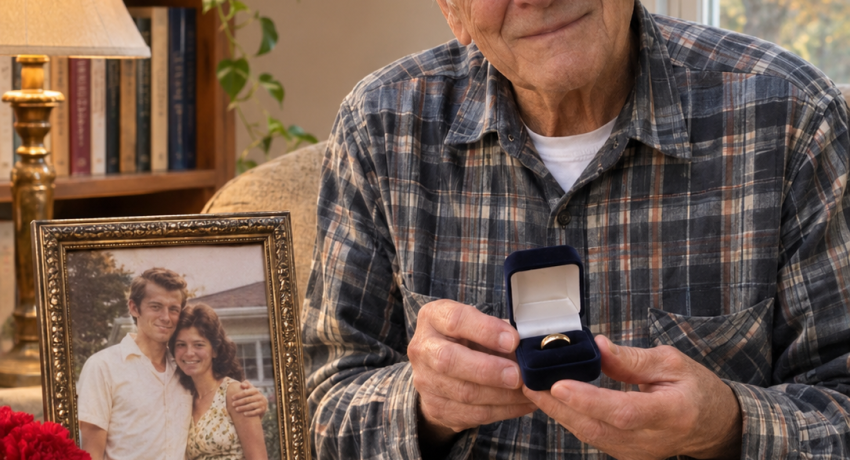
Resting on a layer of yellowed tissue paper was a silver ring.
It wasn’t a diamond. Benjamin had never been wealthy enough to buy diamonds, and I had never wanted one anyway. It was a narrow silver band with a small, flat area on its surface. Two pairs of initials had been engraved there in tiny letters: B.H. and I.C.
A man at the pawnshop on Delaware Street had engraved them for an additional two dollars. I’d stood beside Benjamin at the counter, watching him work. Benjamin had paid the extra two dollars in quarters.
Beneath the ring lay a photograph, so faded that its yellow coloring had nearly turned white.
It showed me at eighteen, wearing that dress, standing beneath the willow tree in Miller’s field. Benjamin stood behind me, his arms wrapped around my waist and his chin resting on my head. He was laughing at something beyond the camera’s view.
I knew exactly what had amused him. His cousin Danny had been struggling with the camera and had dropped the lens cap into a puddle.
I turned the picture over.
There was Benjamin’s handwriting, with its terrible slant. His mother used to say it looked like a fence leaning in a storm.
Isobel, I will come home to you.
Seven simple words.
The chair beneath me seemed to move. The entire room tilted slightly, perhaps two degrees, before becoming still again.
I placed my palm against the table.
At the table beside us, a little girl was sitting with her mother. She looked about six or seven. A paper cup of chocolate ice cream was melting in front of her, and there was chocolate smeared across her chin.
She glanced up at me.
Then she climbed down from her chair, took two small steps toward our table, and held out a clean napkin.
“Here,” she whispered.
I accepted it and pressed it against my mouth.
And if you want to know what finally broke me, it wasn’t the ring. It wasn’t the photograph or those seven words.
It was a little girl I’d never seen before who had decided that someone she didn’t know needed a napkin.
I began sobbing. Right there inside the Marigold, while the espresso machine hissed and a song by the Eagles played over the radio.
The girl’s mother murmured, “I’m sorry,” and gently brought her back to their table.
“Please don’t be,” I managed to say through the napkin. “Thank you, sweetheart.”
The little girl smiled, chocolate still visible on her teeth.
The man sitting across from me leaned closer.
“My name is Edward,” he said. “Benjamin is my father.”
The espresso machine, the two women near the counter debating a lemon bar recipe, and the traffic moving along the avenue—
Everything seemed to fade into the distance.
I looked at him once more, taking in every detail.
Benjamin’s eyes. His dimple. The familiar way he sat, with one shoulder slightly higher than the other.
He was Benjamin’s son.
“No,” I said.
Edward remained still.
“My Benjamin died in Vietnam,” I told him.
“He was listed as missing,” Edward replied carefully. “Eventually, they presumed he was dead. But those are two different things, ma’am.”
“His mother came to my porch wearing her housecoat and told me he was gone.”
“I know.”
“Then what are you trying to tell me?”
Edward drew a breath.
“My father survived,” he said. “He was seriously injured. Another military unit found him a considerable distance from where he was supposed to be. He didn’t have his identification tags, and he couldn’t tell anyone who he was. It took years for them to establish his identity. By the time his records were finally put right, his mother had died. And the address the army had on file for her belonged to a house that had changed owners twice.”
I wish I could explain what hearing that does to someone.
For sixty-two years, I had built the whole inner part of my life around one unshakable belief. Benjamin Hale never returned home.
That was the wall everything rested against. Every other part of me leaned on it. My entire life had been constructed around that wall.
Now this weary man in a windbreaker was telling me that the wall had never existed in the first place.
Benjamin had been alive. Somewhere beneath the very same sky. Breathing the same air and watching the same moon landing on a television somewhere, on the night I watched it with my father.
And every June sixteenth, while I stood at the florist’s counter ordering red carnations for someone I believed was buried in the ground, he had been somewhere out there.
“Where has he been all this time?” I asked.
Edward glanced toward Wren.
“Don’t look at her,” I told him. “Look at me. I’m eighty years old, young man. Nothing you tell me can break me in a way that a telegram hasn’t already tried.”
He met my eyes.
“My father suffered a serious head injury during the war,” he explained. “It permanently affected his memory. He lost nearly everything from his life before the injury. And over the past few years, dementia has taken away much more.”
I sat quietly with that information.
“He forgot me,” I said.
“He forgot almost everything from before the injury. His childhood, his mother’s face, the street where he grew up. He couldn’t even remember his own middle name until 1971, when the records finally arrived.”
A laugh escaped me.
It was a single, harsh sound, coming from me in the middle of a coffee shop, with a crumpled napkin clenched in my hand.
“That sounds like a remarkably convenient explanation,” I said. “After sixty-two years.”
“There’s nothing convenient about it,” Edward replied quietly. “It’s simply the truth. And I’ve hated it for my entire life.”
He placed a folder on the table beside the box.
It contained several documents. Military service records. A discharge report from a veterans’ hospital in Ohio. And a photocopy of a document titled casualty status correction, dated 1971. Its stamp was so faded that I had to angle the paper toward the window to make it out.
I held it up toward the light.
HALE, BENJAMIN THOMAS. Previously reported missing in action, presumed deceased. Status corrected: Living.
Thomas. His middle name had been Thomas, after his grandfather.
I’d known that since I was sixteen. He hadn’t discovered it until 1971.
“How did you manage to find me?” I asked.
“The photograph showed me what you looked like and included a willow tree,” Edward explained. “There was also an old page from a high school yearbook inside the box. Roosevelt High, class of ’63. Your name was printed beneath your picture. Isobel Carver. Someone had even drawn a heart around it with blue ink.”
I closed my eyes.
“After that, I searched for your name,” Edward continued. “I came across a newspaper story from a couple of years ago. It was about a woman who had spent forty-one years reading to children at the same hospital every Thursday.”
I opened my eyes and turned toward Wren.
“I contacted the hospital’s volunteer department,” Edward said. “They wouldn’t share your phone number, but they gave me your niece’s. You had listed her as your emergency contact.”
Wren sat with her hands twisted together in her lap.
“He contacted me three weeks ago,” she explained. “At first, I nearly ended the call. I assumed it was some sort of fraud. I asked him to send me copies of every document. Then I contacted the veterans’ office myself. I also spoke with a man in Ohio who had worked at the hospital where your friend was treated.” She turned toward me. “Once I was sure everything was genuine, I told him about the willow tree. I explained that you visit it every year, always on the same date.”
I lowered my eyes to the carnations resting on the table inside their white paper wrapping.
It was June sixteenth. I’d completely lost track of the date. Yesterday had been the fifteenth.
Benjamin would have turned eighty today.
He had turned eighty today.
Throughout my life, people have asked me one particular question.
Some ask with genuine kindness. Others ask as though they’re wondering why a house has remained vacant for so many years.
Isobel, why didn’t you ever marry? Didn’t you want children? Didn’t you feel lonely?
The truth was always straightforward. But nobody seemed willing to believe it.
I never stopped loving Benjamin.
We first met during eleventh grade at Roosevelt High School. It happened in a hallway when a textbook fell to the floor.
I realize how ridiculous that sounds. It’s such an ordinary way to meet someone that I’ve always felt slightly foolish whenever I tell the story.
It was my chemistry textbook. As I rounded the corner near the gym, it slipped off the stack in my arms and slid across the floor. A dark-haired boy stepped right onto it.
“Oh, no,” he said, looking down. “I’ve murdered your book.”
“You haven’t murdered it. You just stepped on it.”
He picked it up. A dusty sneaker mark covered part of the front.
“It’s gone,” he declared. “I’m terribly sorry for your loss.”
I laughed. I simply couldn’t stop myself.
He handed the book back to me. “Benjamin,” he introduced himself. “Ben Hale.”
“Isobel.”
“That’s quite a long name,” he said. “Would it be all right if I called you Belle?”
“No,” I answered.
From that day forward, he called me Belle. He continued calling me that for as long as I knew him.
In eighty years, nobody else has ever used that name for me. Not my mother, not my sister, and not another person alive.
Every afternoon, he worked at his uncle’s garage on Delaware Street. Each morning, he’d arrive at school with traces of motor oil beneath his fingernails, no matter how thoroughly he’d washed them. Academically, he wasn’t particularly successful. He failed chemistry two times.
But he had an extraordinary ability to listen. I’ve come to understand that this quality is far less common than being good at chemistry.
He would sit opposite me in the school cafeteria and ask how my day had gone. Then he’d pay attention to every word I said. He’d ask follow-up questions and remember the details when we spoke the next day.
No one had ever treated me that way before. Not even my own mother.
At the far end of Miller’s field, beyond the point where the sidewalk ended, stood a willow tree. It was an enormous old weeping willow, its branches drooping all the way to the grass. Standing beneath it felt like stepping into a room made entirely of green.
That tree became our special place. That’s how things become yours when you’re seventeen. No official agreement, just complete certainty.
We made all our plans beneath its branches.
We imagined a house with a porch. A wide porch, with a swing.
Four children. Then three. Eventually, we decided we’d have “however many show up.”
We also planned to get a dog. Benjamin wanted to call it Rooster, although he never offered a convincing explanation.
“Why Rooster?” I’d ask.
“Because it’s a good name.”
“For a chicken.”
“For a dog that believes it’s a chicken,” he would reply with complete seriousness.
I never managed to understand his reasoning.
We purchased the ring in May, during our senior year. It came from the pawnshop on Delaware Street, three doors away from his uncle’s garage. The price was eleven dollars, with another two dollars for the engraving.
He never dropped to one knee. Instead, he stood on the sidewalk outside the shop, holding the ring in his open palm as a bus passed nearby.
“This isn’t an engagement ring,” he explained. “I don’t have enough money for one. It’s a promise ring. It means I’ll buy you an engagement ring someday. Eventually.”
“That’s quite a few promises for one little ring.”
“It’s a sturdy ring,” Benjamin replied. “It can handle them.”
Then his name was selected for military service.
His notice arrived in the mail on a Tuesday. I remember because Tuesday was meatloaf night at our house, and I couldn’t bring myself to eat a single bite.
He was ordered to report on June seventeenth, the day after he turned eighteen.
“Well, happy birthday to me,” he said, standing on my porch with the folded letter in his hand. He attempted a smile, but it didn’t last.
On June sixteenth, his birthday, he took me to the little store on the corner of Elm Street. He wanted to buy me flowers. The only ones available were red carnations sitting in a bucket beside the register. They were already beginning to wilt.
He purchased one and tucked it behind my ear.
“There,” he said. “Now you’re official.”
That evening, we went to the willow tree.
We stayed beneath its branches until the edges of the sky began turning gray.
I wore my yellow dress. It was probably the ugliest outfit I owned. It had belonged to my cousin Patricia, and it was too loose around the shoulders, with a collar that never stayed properly in place. But Benjamin had once told me I looked like sunshine walking around in it.
So there was no other dress I could have worn that night.
We spent the entire night talking. Sometimes about important things, sometimes about absolutely nothing. We talked about Rooster and the porch swing.
At around three in the morning, he suddenly became quiet.
“I’m frightened, Belle,” he admitted.
“I know.”
“I’m really scared.”
“I’m scared too,” I told him. “Being courageous means being terrified and still finding the strength to go ahead.”
He looked at me.
“Where did you hear that?”
“I just thought of it. Right now.”
“That’s a good one,” he said. “A really good one. Can I remember it?”
“It’s yours,” I replied.
He took both my hands in his because they wouldn’t stop trembling.
“No matter how much time passes,” he promised, “I’ll find my way home to you.”
“Do you promise?”
“I promise.”
He pulled the photograph from his shirt pocket. It was the picture Danny had taken that afternoon, the one from the day he’d dropped the lens cap. Benjamin had taken it to the drugstore and had it developed using their one-hour service.
Leaning over his knee, he wrote something on the back in his dreadful handwriting.
Isobel, I will come home to you.
“So you won’t forget,” he said.
“I could never forget.”
“Then I suppose it’s for me, so I won’t forget,” he answered.
He slipped the photograph back into his shirt pocket alongside the ring. He told me he’d keep both items with him and that they would protect him.
At six in the morning, he walked me home and kissed me on the front porch.
At eight, his uncle drove him to the bus station.
I didn’t go along. Benjamin had asked me to stay behind. He wanted his final memory of me to be standing on the porch, not crying at the bus station.
So I remained on the porch in my yellow dress, with a carnation tucked behind my ear, watching his uncle’s truck disappear down the street.
He sent me eleven letters.
They arrived every few weeks at first, then became less frequent. They were brief, and somehow his handwriting became even worse. He wrote about the unbearable heat, the insects, and a boy from Tennessee named Earl who snored like a passing freight train.
He never mentioned anything frightening or terrible. Not a single time.
Every letter ended with the same words.
Still coming home. — B.
Eleven months after he’d left, his mother appeared on my front steps.
It was eight in the morning. I was sitting at the kitchen table, eating toast. I heard someone approaching the porch and looked through the screen door.
There she stood.
Mrs. Hale, wearing her pink housecoat decorated with tiny flowers. Her hair was still wrapped in curlers, and she held a piece of yellow paper tightly between both hands.
I knew what had happened before she even spoke.
My toast slipped from my fingers.
“Isobel,” she said through the screen door. Her voice was barely audible. “Isobel, sweetheart.”
Missing in action.
Then, after several months that remain only as scattered memories, another telegram arrived.
Presumed dead.
I was nineteen years old.
And somewhere inside me, a decision quietly took shape.
There was no dramatic moment. I didn’t make some grand promise or collapse beside a grave. There wasn’t even a grave to visit. Nothing had been left behind to bury.
I simply continued getting up every morning, unable to picture anyone else occupying the chair opposite mine.
Then thirty years passed. After that, another thirty.
Afterward, Mrs. Hale and I began having tea together every Sunday. We continued that routine for five years. We’d sit in her kitchen on Pine Street, talking about Benjamin. She showed me photographs from his infancy and told me stories, including the time he managed to get his head trapped between the banister rails.
She died in 1969. Her heart gave out.
At her funeral, Benjamin’s uncle took my hand and said, “You were wonderful to her, Isobel. You were the only person who kept visiting.”
Someone purchased her house that autumn. Three years later, another buyer took ownership.
Then, in 1971, a letter from the army arrived at that address. Its stamp was so faded that it could only be read by holding it toward the window. Whoever received it had no idea who Benjamin Hale was, so they threw it away.
My father was concerned about me. He never openly admitted it, but I knew he worried.
In 1972, a pleasant man named Gerald Pruitt asked me to marry him. He worked as an accountant. He was thoughtful, had a wonderful laugh, owned a station wagon, and remembered to bring roses to my mother on her birthday.
I turned him down.
That evening, my father asked me to sit with him at the kitchen table.
“Isobel,” he began. “Benjamin is gone. You understand that. Gerald is a decent man. You could build a happy life together.”
“I understand, Daddy.”
“Then why won’t you?”
I held his gaze for a long moment.
“Because whenever I imagine the person sitting across from me, I still see Benjamin. Gerald deserves better than that. It wouldn’t be right to spend his entire life occupying a place that belongs to someone else.”
My father didn’t try to change my mind. He simply nodded and gently patted my hand.
Two years later, Gerald married a woman named Barbara. They eventually had four children. I attended their wedding and felt genuinely happy for him. I truly did.
But there’s something I always wish people would understand. When they hear that I never married, they imagine a lonely woman spending her days in a dark room with the curtains drawn.
That was never how I lived.
I found other ways to let my love flow.
For twenty years, I taught Sunday school at First Methodist. I also managed a food pantry in the church basement for eleven years. Every Saturday morning, we distributed canned beans, boxed macaroni, diapers, and other essentials.
When my sister Carol’s marriage ended in 1998, I helped bring up her two daughters. Wren was fifteen at the time. She lived in my spare bedroom for two years while finishing high school. After classes, she’d sit at my kitchen table and tell me about every boy who had ever treated her badly.
Today, she’s forty-two. Every Sunday, she calls me with the concerns that come with being forty-two: her mortgage, her manager, and her son’s upcoming driving test. I love hearing every single one of them.
Then, in 1984, I began volunteering at the children’s hospital downtown.
Back then, it was the old brick building with radiators that clanged throughout the winter as though someone were striking them with a hammer.
I spent Thursday afternoons reading stories to the children.
I’ve continued doing it every Thursday I’ve been well enough for the past forty-one years. I’ve been there through two new hospital buildings and four different volunteer coordinators. Even when I broke my wrist in 2006, I kept reading. I held the book with my left hand while a nurse turned the pages for me.
I’ve read Charlotte’s Web aloud approximately two hundred times. I know the exact page where I should slow my reading. I know which children need me to position the book so they can see the illustrations, and which ones need me to hold their hands instead.
I remember a boy named Teddy from 1991. He was eight years old and had leukemia. During one month, he asked me to read Charlotte’s Web to him eleven times.
Whenever we reached the part where Charlotte dies, he’d interrupt me.
“Wait. Stop. Start again.”
So I’d return to the beginning of the chapter and read it all over again. He would listen with his breath held, as though there might be a different ending this time.
There never was.
And neither was there for him.
I still have the bookmark he made for me. It’s a piece of construction paper with a spider drawn on it in purple crayon.
In 1994, I received the Volunteer of the Year award. There’s a plaque for it, but I keep it tucked away in a drawer because I feel embarrassed by the attention.
None of those experiences took Benjamin’s place. Nothing ever could.
But loving him had filled me with more affection than one person could possibly keep to herself. I needed somewhere to direct it.
So, for six decades, I shared it with others, one handful at a time.
And every June sixteenth, I purchased red carnations.
Those were the flowers available at the little store on his birthday, the day before he left for military service. He’d placed one behind my ear and said, There. Now you’re official.
I’d carry the flowers to the willow tree in Miller’s field. The field has become a public park now, complete with benches, a playground, and a paved jogging path. But the city kept the willow. Back in 1988, when the park was being planned, I wrote to the city and asked them not to remove it. I can’t say whether my letter made a difference. I like believing it did.
Every year, I sat beneath that tree on the grass for an hour and told Benjamin about everything he’d missed.
The moon landing. Color television. My father’s funeral. Wren’s wedding. Personal computers, which he probably would have disliked. Mobile phones, which he would have wanted to take apart.
I spoke to him as though he could hear every word.
It never occurred to me that he might actually be somewhere he could hear me.
“Why now?” I asked Edward at the Marigold. “Why didn’t you come last year? Why not thirty years ago?”
“Because my father asked me to find you,” he replied. “It happened last month.”
My fingers tightened around the little girl’s napkin.
“Did he say my name?”
Edward nodded. I watched his jaw move as he struggled to find the words.
“I moved him into a full-time care facility in May,” he explained. “Looking after him at home had become more than I could handle. While clearing out his room, I discovered this box inside a locked drawer in his dresser. He’d kept that drawer locked for as long as I can remember. Honestly, I always thought it contained tax documents.”
“Did he remember what was inside?”
“Not everything. He remembers things in fragments. Some days are better than others.” Edward’s voice became thinner. “But he picked up the box. He became very upset. Then he experienced one of those moments the doctors call lucid intervals. We just call them good minutes.”
“And what happened?”
“He looked directly at me,” Edward said. “His mind was perfectly clear. Then he said, Belle must have the box.”
The room seemed to tilt once more.
There had only ever been one person in the world who called me Belle.
“Is he being looked after properly?” I asked. “Is the place safe?”
“Yes. It’s a good facility, near Willow Falls. I spent four months checking everything before moving him there.”
“Is he dying?”
Edward’s expression tightened completely. Beneath his carefully controlled manner, I could see something else.
“His condition is getting worse,” he answered. “That’s what the doctors tell me. That’s the expression they use.”
And in that moment, I finally understood who was really sitting across from me.
Edward wasn’t simply a man bringing me an unbelievable gift. He was a son watching his father slip away, completing one final task for him because it was the last thing he could still do.
Wren reached across and gently rested her hand on my arm.
“We can drive you home, Aunt Isobel,” she said. “You can have some time to yourself. There’s no need to rush into a decision.”
Edward carefully lowered the lid of the box.
“You don’t need to make up your mind today,” he said.
“No,” I replied.
Wren looked at me with a puzzled expression. “No?”
I lifted the lid again. I placed the ring back inside its tissue wrapping, closed the box, and laid my palm firmly over it.
“For sixty-two years, I’ve been speaking to that man as though he could hear me from beneath a tree,” I said.
My hands continued to tremble. But for once, my voice remained steady.
“If he’s near enough to hear me now, I’m not going to waste another day.”
I turned toward Edward.
“Please take me to him,” I said.
The drive north took two hours. Wren followed behind us in her own car, while I traveled with Edward.
Throughout the journey, I kept the little blue box resting on my lap.
I asked my questions one at a time, in the order I felt able to face them.
“Did he ever talk about me? Even once?”
“He remembers emotions much more clearly than details,” Edward explained. “That’s always been true, even before the dementia started. Some nights, he’d become restless and sit up in bed, talking about a girl wearing a yellow dress. A girl whose hands kept trembling. He never knew her name. My mother always thought he was having a dream.”
I watched the guardrails slip past outside the window.
“Those were my hands,” I whispered. “The ones that shook.”
“I realized that about ten minutes after seeing the photograph.”
“I chose yellow because he once told me I looked like sunshine walking around. It gave him a little courage, too.” I smoothed the napkin across my knee. “He needed every bit of courage he could find that night. And so did I.”
“Were you brave?”
“Not in the slightest,” I answered. “I was terrified out of my mind. I kept smiling all night because I didn’t want him to notice.”
Edward let out a brief, unexpected laugh.
“My father always told me that courage meant being frightened out of your mind and doing it anyway,” he said. “He repeated it every year on my first day of school. Every single one, even when I was in high school. I was mortified.”
I turned to study his profile.
“He got that from me,” I said. “I told him those exact words beneath the willow tree, at three in the morning.”
Edward remained silent for some time.
When I glanced at him again, his eyes were full of tears. He kept his gaze fixed firmly on the road.
Somewhere beyond the second rest stop, the afternoon sunlight fell across his face in a particular way. For a brief moment, I couldn’t separate the man beside me from the young boy in my photograph.
I had to turn toward the window.
For perhaps four seconds, I allowed myself to imagine that he was our son. Mine and Benjamin’s. The child Edward might have been if the plans we made beneath that tree had come true.
Four seconds. Then I forced the thought away.
Finally, I asked the question I had been avoiding ever since we left the coffee shop.
“Did he get married?”
Edward’s hands shifted slightly on the steering wheel.
“Yes,” he answered.
It shouldn’t have hurt as much as it did.
He had been missing for sixty-two years. He had no memory of me or even any knowledge that I was still alive. There was no sensible reason for that single word to strike me like a slap.
But it did.
“What was her name?” I asked.
“Dorothy. She was a nurse at the rehabilitation hospital in Ohio where the Army sent him. She spent two years helping him. Teaching him to walk again, work on his speech, and rebuild his memory. When he first arrived, he couldn’t keep the events of a single day straight. By lunchtime, he would have forgotten what he’d eaten for breakfast.”
“Did she know about me?”
“She knew there had been someone before the war. Sometimes he talked in his sleep. And every June, he would become sad without understanding the reason.” Edward paused for a moment. “During the summer, she would sometimes bring him red flowers. Usually carnations. She never understood why he liked them so much. She just knew he did.”
I covered my mouth with my hand.
“Did he love her?” I asked.
Edward took a long time to respond. I appreciated that silence. A quick reply would have been dishonest, whichever way he answered.
“Yes,” he eventually said. “Perhaps not in the way you’re imagining, but he did. She helped him become himself again. And he understood what she had done for him. He never forgot it. They spent fifty-one years married.”
And so.
He had survived. He had married someone else. Somewhere in an Ohio kitchen, he had held another woman’s hand and made promises about their future. And she had given him the chance to have one.
I wanted desperately to feel bitter toward her.
I sat quietly with that feeling, the box resting on my lap, and tried to hold on to it.
But I couldn’t.
What I kept seeing instead was a young woman standing in a hospital corridor beside a wounded man who couldn’t remember the year. A man who couldn’t even recall having breakfast.
And she had chosen to stay with him.
“Is she still alive?” I asked.
“She died five years ago. Cancer.”
“I’m sorry,” I said. “I really am.”
“She was a wonderful woman,” Edward replied. “The finest person I ever knew.”
“Then I’m thankful to her,” I said. “And I want that to be known.”
The words were difficult to say. I had to force them past the sharp ache inside my chest.
That was how I knew I meant every one of them.
The care facility was a low brick building with a garden at the front. Rose bushes grew nearby, a birdbath stood among them, and wind chimes hung from someone’s porch.
Inside, it carried the familiar smell of places like that: coffee, floor polish, and a faint sweetness beneath it all.
A staff member met us near the elevator. Her name tag read Marisol. She looked to be around forty, with kind eyes that carried the weight of long days.
“He might not know who you are, Isobel,” she told me gently. Somehow, hearing it said so kindly made it even harder. “Please don’t pressure him. Don’t test his memory or ask him questions to see what he remembers. If he becomes distressed, we’ll need to bring the visit to an end. It isn’t meant as a punishment. We’re simply trying to do what’s best for him.”
“I understand,” I replied.
I didn’t truly understand. Still, I nodded.
Then I found myself standing in the corridor outside his room.
Room 114. His name was printed on a small card inside a plastic holder. Ben H.
Suddenly, every bit of courage I had seemed to disappear through the bottoms of my shoes.
For sixty-two years, Benjamin Hale had remained eighteen in my mind. He had dark hair that refused to stay in place, strong shoulders from lifting transmissions at his uncle’s garage, and warm hands that used to hold my cold ones.
But behind that door was an eighty-year-old man sitting in a wheelchair. A man who might not even remember my name.
“What if there’s nothing left of what we shared?” I whispered.
Edward’s expression softened, almost breaking.
“You don’t have to go inside,” he said. “No one would think any less of you. I mean that.”
Wren reached for my hand and held it tightly.
“You’ll always know you made it here,” she said.
I looked at them both.
“No,” I replied. “I didn’t travel two hours just to lose my courage outside a hallway.”
Then I opened the door.
He was sitting in a wheelchair beside the window, a plaid blanket spread across his legs. He was watching a bird feeder outside. A bright red cardinal had landed on it.
Then he turned toward us.
His hair had turned white and grown thin. His face was marked with wrinkles, and some of its features had softened with age. His shoulders looked narrow beneath a gray cardigan.
But his eyes were still the same blue. They hadn’t lost their color at all.
My heart recognized him three full seconds before the rest of me could catch up.
“Dad,” Edward said quietly. “Someone has come to visit you.”
Benjamin looked in my direction.
He gave me a polite smile, the kind you might offer a mail carrier.
“Are you one of the nurses?” he asked.
I don’t know how to explain what happens inside someone when a moment like that arrives. The closest I can come to describing it is this.
Something within me that had stood upright for sixty-two years slowly and quietly lowered itself into a chair.
“No,” I said. “My name is Isobel.”
“Isobel,” he repeated, trying the name out carefully, as though it belonged to a language he had never spoken before.
There was nothing. Not even the smallest sign of recognition.
I lowered myself into the chair beside him. I rested the blue box on my lap and opened it.
“This is something that belongs to you,” I told him.
He studied the ring for a long while. Then he reached out and gently touched the silver with the tip of one finger.
“Pretty,” he said.
Edward began moving closer, but I raised my hand to hold him back.
I wasn’t going to let anyone shield me from the truth. The truth was what I had come for. I had waited sixty-two years to discover any part of it. I wasn’t going to turn away simply because the answer wasn’t the one I had hoped to receive.
“Do you remember a willow tree?” I asked.
Benjamin frowned and turned his eyes toward the window.
“What about a yellow dress?” I asked.
His fingers began tapping rapidly against the blanket, forming a small, anxious rhythm.
Marisol appeared in the doorway.
“That’s enough for today,” she said quietly.
I made it as far as the wall outside his room before leaning against it.
Wren wrapped both arms around me. She held me the way you hold someone when there are no words that can make things better.
“Oh, Aunt Isobel.”
“He came home,” I whispered against her shoulder. “But the part of him that remembered me never came back.”
Edward stood several feet away, one hand covering his eyes.
“I’m sorry,” he said. “I’m so terribly sorry. I thought… I honestly don’t know what I expected.”
I pulled myself upright and wiped my face with the crumpled napkin I had brought from the coffee shop two hours earlier.
“Would it be all right if I came back?” I asked.
Edward looked at me in disbelief.
“You still want to come?”
“I’m not sure what I want,” I answered. “But I know I’m not ready to walk away. Those are two different things, and I’m too old to pretend they aren’t.”
I returned two days later.
The following week, I visited twice. After that, it simply became part of my routine.
Wren drove me in the beginning. She started taking Tuesdays off from work without ever explaining the reason to her boss.
Eventually, I figured out the bus system. I had to take two buses, changing downtown at the station on Grand Avenue. The driver on the second bus was a large fellow named Lou. He had a gray beard and wore a Cubs baseball cap. By my third week, he knew exactly where I needed to get off. By the fifth, he was stopping right beside the care home’s entrance instead of at the corner, saving me the extra walk on my troublesome knee.
“Going to see the same guy?” Lou asked one afternoon as I stepped down.
“The same guy,” I replied.
“How long have you been visiting him?”
I considered the question before answering.
“Since 1961,” I told him.
Lou studied me through his large rearview mirror. Then he gave his Cubs cap a little tip.
“Well,” he said. “You tell him I said hello.”
I quit carrying the ring with me. I also stopped asking, do you remember?
I eventually realized those words were really a test. And he had spent forty years being judged by tests he had never agreed to take.
So I began reading to him instead.
For four decades, I had read stories aloud to frightened children. It turned out that the same ability worked just as well here.
The first book I brought was Charlotte’s Web. It was simply a habit. After that, I brought western novels because Edward told me Benjamin had enjoyed them. Later, I chose a book about birds because of the feeder outside his window.
Sometimes he listened, his head leaning slightly in my direction. Other times, he drifted off to sleep. Occasionally, he watched the birds, and I couldn’t tell whether a single word I read was reaching him.
Once, he told me I had “a nice voice for the afternoon.”
I have chosen to consider that one of the greatest compliments I have ever received.
One Tuesday in August, while I was halfway through a chapter, he turned toward me and smiled.
“Dorothy,” he said.
The name hit me like a sudden splash of icy water.
I didn’t correct him.
But somehow, he noticed my reaction. People like him often understand much more than others give them credit for. His smile disappeared, and his hands became motionless on the blanket.
“I keep losing people,” he said softly. “Inside my mind. And in real life, too.”
I closed the book, keeping one finger between the pages so I wouldn’t lose my place.
“Then I’ll introduce myself again whenever I need to,” I said. “I’m Isobel, and I’m very happy to be here with you.”
He reached across and gently patted my hand.
“Isobel,” he repeated. “That’s a lovely name.”
A few weeks later, on another afternoon, I was reading him a western. A cowboy in the story was delivering a long speech to a sheriff.
Suddenly, Benjamin raised his hand toward the book.
“That guy sure does talk a lot,” he remarked.
I immediately closed it.
“You once spent the whole night talking,” I said.
“Did I?”
“Beneath a willow tree. You kept talking until morning.”
He considered that carefully, drawing his eyebrows together.
“Guess I was trying to win over some girl,” he said.
“You certainly were.”
“Did it work?”
“For sixty-two years,” I answered.
Benjamin smiled.
It was that familiar crooked smile, with the left side lifting a little higher.
Then he turned back toward the bird feeder, as though he had just made an ordinary joke on an ordinary afternoon.
I sat there with my hand covering my mouth for quite some time.
Near the end of October, Edward caught up with me in the hallway after a visit.
“This is painful for you, Isobel,” he said. “I can see it every time you come out of his room.”
“It is,” I admitted.
“Maybe you should visit less frequently.”
I turned and looked him directly in the face.
“You were the one who found me at a coffee shop,” I said. “You placed a box on my table. And now you’re asking me to vanish?”
“That isn’t what I…” He rubbed his jaw. “I just can’t stand watching you fall apart every time he forgets who you are.”
“That choice isn’t yours to make, sweetheart.”
His expression tightened. Then something inside him gave way, and the words came pouring out before he could stop them.
“My mother is gone,” he said. “My father is dying. I can’t take on your sorrow as well as my own. There’s no space left in me. I don’t have the…”
He fell silent.
He looked shocked by what he had just said.
And I understood him completely. I had lived with that particular kind of fear for most of my life.
He wasn’t trying to push me away. He was frightened of having to lose one more person.
“I’m not expecting you to look after me,” I said, softening my voice. “I’ve been taking care of myself for eighty years. I’ve become pretty capable at it.”
“I only want to keep him safe.”
“And I want to care for him,” I replied. “Those two things can exist together.”
I placed my hand over his.
“I won’t put him through memory tests,” I promised. “I won’t ask him to choose between your mother and me. She deserves the place she had in his life. I would never take even a little of that away from her. All I want is to sit beside him while there’s still someone there for me to sit beside.”
Edward nodded.
Then he pressed the base of his palm against his eyes.
“Okay,” he said. “But you don’t have to go through all of this by yourself, either. It works both ways.”
After my visits, Edward and I began meeting for coffee. We went to a diner across the street called Peg’s.
I heard about his former wife, Karen, who had left him in 2009 but still spoke with him every few weeks. He told me about his daughter, Nora, who was twenty-four, lived in Denver, and worked at an animal shelter. I also learned about his career. He had gone into insurance, following his father’s footsteps after the garage.
“Benjamin sold insurance?” I exclaimed. “Benjamin Hale? He really became an insurance salesman?”
“He did it for thirty years. Why?”
“He couldn’t even manage long division,” I said.
Edward laughed so loudly that the waitress came over to make sure everything was all right.
I discovered that he couldn’t prepare a single meal, but he was exceptionally good at making pie crust. His mother had taught him. Dorothy’s pie crust.
“Would you make one for me sometime?” I asked.
“Would you prefer cherry or apple?”
“Which one did he like?”
“Cherry,” Edward replied.
“Then cherry it is,” I said.
The following Tuesday, Edward brought the pie in a foil pan. It was still warm.
We shared it with Benjamin in his room, using plastic forks. Benjamin ate two slices and managed to spill cherry juice on his cardigan.
“This is delicious,” he said. “Really delicious. Who made it?”
“I made it, Dad,” Edward answered.
Benjamin looked at him for a long moment.
“It tastes like home,” he said.
Edward had to step out into the hallway for a few minutes afterward.
In November, Edward organized a trip outside the care home.
Making it happen required an enormous amount of effort. There was paperwork to complete, approval from the doctor to obtain, a wheelchair-accessible van to arrange, and a nurse who had to accompany us. Forty minutes of preparation for just one hour beneath a tree.
“Are you certain you want to do this?” Marisol asked him. “It could upset him. Sometimes unfamiliar surroundings are difficult for him.”
“I can’t say I’m certain,” Edward replied. “But I think it’s worth giving it a try.”
It was one of those clear, chilly Midwestern days when the sky seems freshly washed.
The willow had turned golden. Its leaves were falling in long yellow strands, drifting onto the brown grass like ribbons.
Wren had driven there separately. She stayed near her car, her coat zipped all the way up to her chin.
Edward guided the wheelchair across the grass until they reached the foot of the tree. He locked the brakes, then walked about twenty feet away and turned his back toward us. It was the closest thing to privacy he could offer.
I lowered myself onto the grass.
At eighty, getting down onto the ground is no small undertaking. I didn’t care.
I reached into my coat pocket, took out a red carnation, and placed it in Benjamin’s hand.
He gently stroked one of the petals with his thumb and forefinger.
“We once stayed right here together until the sun came up,” I told him.
He glanced down at the flower.
“You held both of my hands,” I continued. “They just wouldn’t stop trembling.”
His eyes gradually turned toward me.
“And you promised that you would come home to me.”
His breathing began to change. I noticed a slight pause, followed by breaths that grew slower and deeper.
He slowly raised one hand and touched the little dimple on his chin.
Then he looked directly into my eyes.
Something stirred behind those blue eyes. It was like a light suddenly appearing at the far end of a dark corridor.
“Belle?” he whispered.
I covered my mouth with both hands.
“You remember who I am,” I whispered.
“You had on yellow,” he said.
I laughed. The sound came out broken, mixed with tears, and far louder than seemed appropriate in a public park.
“That was the most dreadful dress I owned, Benjamin.”
“You looked beautiful,” he replied.
Behind us, Edward turned completely around and leaned one hand against the roof of the van to steady himself. Near her car, Wren stood with both hands covering her mouth.
I slipped my hand beneath his and held it tightly.
“You made it home,” I said.
He studied me for a long moment. His expression reminded me so strongly of the boy I had loved that I could barely draw a breath.
“No,” he said quietly. “I believe you’re the one who came looking for me.”
That moment of clarity lasted perhaps four minutes.
He asked whether I had managed to improve my chemistry grade. I told him I had earned an A. He replied, “Good. I never managed that.” Then he wanted to know if the little shop on Elm Street still sold carnations. I explained that it had become a nail salon. “What a shame,” he said.
Then he asked whether Rooster had turned out to be a good dog.
I wasn’t sure how to answer, so I simply said, “He was the best dog.”
“I always knew he would be,” Benjamin replied.
After that, something changed in his expression, like a cloud passing in front of the sun. By the time Edward and the nurse had helped him back into the van, he was asking the nurse what they were having for lunch.
It didn’t matter to me.
I have gone over those four minutes in my mind more times than I could ever count. I’ll remember them until the day I die.
After that, we stopped trying to recover the life we had missed.
It wasn’t waiting somewhere for us. It never had been.
Instead, we created something much smaller together. And somehow, it was enough.
I read stories to him. He held my hand, even when he couldn’t always remember the reason he was holding it.
Eventually, I realized that I didn’t need him to understand why. The important thing was that we were holding hands.
On Christmas Day, Edward brought a little Christmas tree into his room. It was a tabletop tree, roughly two feet tall, decorated with white lights. Wren arrived with cookies. Marisol brought a Santa hat and placed it on Benjamin’s head. He kept it on for the entire afternoon and appeared quite delighted with himself.
I had brought him a gift, wrapped in green paper.
Inside was a little toy dog, a brown-and-white stuffed animal I had bought from the gift shop at the children’s hospital.
Benjamin took his time unwrapping it. Once it was open, he lifted the toy and examined it.
“What should we call him?” he asked.
“You get to choose,” I told him.
He stared at the little dog for a long moment.
“Rooster,” he decided.
Edward carefully placed his coffee cup down.
“Why Rooster, Dad?” he asked.
Benjamin looked at him as though the answer couldn’t possibly be more obvious.
“Because he believes he’s a chicken,” he explained.
I laughed so hard that I had to grab the arm of my chair to steady myself. After sixty-two years, I finally had the answer. And it was every bit as silly as I had always imagined.
On a gloomy afternoon in January, he suddenly asked me, “Did you ever feel lonely?”
I put my book aside.
“Sometimes,” I answered. There was no reason to pretend otherwise with someone who could sense the truth.
“Was it because of me?”
“Not entirely because of you.”
Then I began telling him everything.
I spoke about the children’s hospital and all those Thursday afternoons. I told him about Teddy and the eleven times he had asked me to read Charlotte’s Web. I mentioned the food pantry in the church basement. I told him about Wren staying in my spare bedroom when she was fifteen and sharing stories about every boy who had ever treated her badly. I talked about four decades spent comforting other people’s children as they drifted off to sleep listening to my voice.
“Loving you filled my life with more love than I could possibly keep to myself,” I told him. “So I shared it with others. Every bit of it. For sixty years. There’s hardly a part of that city that hasn’t received some of it.”
Benjamin gently tightened his fingers around mine.
I couldn’t tell how much of what I said he understood.
But he squeezed my hand.
At 4:50 in the morning on March ninth, Edward called.
“Isobel,” he said. “I think the time has come.”
Wren arrived in my driveway eleven minutes later. She had placed a blanket in the back seat for me. She had also prepared a thermos of coffee without waiting for me to ask.
She made the two-hour journey in just one hour and forty minutes. I never mentioned how fast she was driving.
Benjamin was lying in bed.
His breathing had become faint, slow, and strained. Edward sat beside him on one side, holding his father’s hand between both of his own.
Someone had placed a red carnation in a glass of water on the windowsill.
I later learned it was Marisol. She had noticed that I brought one with me every time I visited, so she had purchased one on her way to work that morning.
The stuffed dog, Rooster, was tucked beneath Benjamin’s arm.
I settled into the chair on the opposite side of the bed and opened our book. It was Charlotte’s Web. We had started reading it again in February. Benjamin had always liked the pig.
By the second page, my voice was already breaking.
Edward gently took the book from me and continued reading.
When he could no longer keep his voice steady, Wren reached over and took the book from him. She carried on reading. A woman who had never known Benjamin before that June, reading to him because someone needed to continue.
Just before sunrise, Benjamin opened his eyes.
He looked toward his son.
“My boy,” he whispered.
Edward leaned close to his father. “I’m here, Dad. I’m right here with you.”
Then Benjamin slowly turned his head toward me. His hand shifted a few inches across the blanket, reaching in my direction.
I took it and held it firmly.
“Still shaking,” he whispered.
“Just a little,” I replied. “You should have seen how badly they shook sixty years ago.”
His gaze drifted toward the window. Outside, the sky had taken on the soft colors of the inside of a seashell, with shades of pink and gray and golden light along the edges.
“Is it sunrise?” he asked.
“Yes.”
He remained silent for a little while.
“Did I finally get home?” he asked.
I lifted his hand, brought it to my cheek, and held it there.
“You did, Benjamin,” I told him. “You made it home.”
His eyes returned to my face and rested there.
They were clear.
“Belle,” he whispered.
“I’m right here.”
He smiled.
Then his fingers relaxed inside my hand, and he was gone. It happened just as the morning light crossed the bed and fell across his face.
I kissed the back of his hand.
“You kept your word,” I whispered. “It just took us much longer than either of us expected.”
I attended his funeral intending to remain at the back of the church.
That seemed like the proper place for someone like me. No etiquette guide has a section explaining where a woman belongs when she was the love a man had before the war.
The service took place at a white wooden church in Willow Falls, topped with a tall steeple. Every pew was occupied. Some people had traveled from Ohio. There were neighbors, former colleagues from his insurance office, and members of the church where he had served as a deacon for twenty-two years. One man stood to speak about how Benjamin had repaired his lawnmower every spring for fifteen years without ever accepting payment.
“He always said it reminded him of something,” the man explained. “But he could never quite remember what.”
I chose a place near the back entrance. I was quite comfortable sitting there.
Then Edward walked all the way down the aisle to find me.
Everyone turned their heads.
“Come and sit beside me,” he said. “You deserve to be near the front.”
I went with him to the second row and took the seat between him and Wren.
When Edward’s moment to speak arrived, he stood at the front of the church with a red carnation in his hand.
He looked across the congregation, filled with people who had known Benjamin Hale for half a century. They remembered him as an insurance salesman, a church deacon, and the man who repaired everyone’s lawnmowers.
“My mother gave my father a life after the war,” Edward began. “She helped him rebuild himself when there was almost nothing left. She loved him for fifty-one years. Nothing I say today takes even the smallest part of that away from her.”
He walked over and placed the carnation beside Benjamin’s photograph. It was taken on his seventieth birthday, when he had been wearing a paper party hat and smiling broadly.
Then Edward faced the congregation again.
“There is also a woman sitting in the second row who held on to the love he had known before the war,” he said. “She carried it for sixty-two years, without a single piece of evidence that it was worth holding on to.”
He looked directly at me.
“It was,” he said.
Several weeks later, in April, Edward drove up from Willow Falls. He met Wren and me beneath the willow tree.
The tree was beginning its usual spring transformation. Fresh leaves had appeared, so pale and green that the branches seemed to glow from within.
Edward placed the blue box in my hands.
“I want you to keep this,” he said. “It’s what he would have wanted. He told me himself. Belle must have the box.”
I lifted the lid.
Inside lay the silver ring and the old, faded photograph, with those seven words written on its back.
There was another photograph, too.
It showed Benjamin sitting in his wheelchair beneath the golden branches in November. I was kneeling beside him in the grass, my hand resting beneath his. We were looking at each other like two teenagers in love.
Wren had taken the picture on her phone from about forty feet away. Neither Benjamin nor I had realized she was there.
I studied the photograph for a long time.
“That’s the two of us,” I said.
“That’s you,” Wren replied.
I slipped the ring onto a delicate silver chain and fastened it around my neck.
I have worn it every day since.
Then I took out the carnations I had brought with me.
And for the first time in sixty-two years, I did something I had never done before.
I divided them among us.
One flower for Edward. One for Wren. And one for me.
Together, we placed them at the foot of the tree. Three pairs of hands laying them down.
Afterward, we stood quietly for a while. Not one of us spoke.
And the silence felt perfectly natural.
Edward calls me every Sunday now, after Wren has finished her call. He says he prefers being second because Wren gets all my complaints out of the way, leaving me in a much better mood when he rings.
He visited for Thanksgiving. He brought a cherry pie made with Dorothy’s crust, and he brought Nora, his daughter, all the way from Denver.
She is Benjamin’s granddaughter, and she has the same dimple in her chin.
By her second day, she was calling me Aunt Isobel. Nobody had told her to do it. It simply came naturally to her.
On her final evening, she joined me on my porch swing. It was my small porch and my modest swing, nothing like the grand one Benjamin and I had once imagined. But it was still a porch with a swing.
“Dad told me you were my grandfather’s first love,” she said.
“I was.”
“And he was yours.”
“My only love.”
She fell silent for a moment before asking, “Do you think it was worth it? Spending your whole life waiting for someone who never came back?”
I considered her question. These days, I take my time thinking things through. There’s no reason to hurry anymore.
“I didn’t spend my entire life waiting,” I said. “I lived my life. I simply never stopped loving him while I was living it. Those are two very different things.”
Nora nodded.
Then she rested her head against my shoulder, just as Wren used to do when she was fifteen. We gently rocked back and forth on the porch swing, watching the streetlights flicker on along the road.
I’m eighty-one years old now, and I still spend every Thursday reading to children at the hospital. I’m reading Charlotte’s Web once more. I know the exact page where I need to slow my voice down.
Lou is still driving the second bus. A few months after the funeral, he once asked how my man was doing.
I told him the truth.
He pulled the bus to the side of the road, right there on Grand Avenue. Then he turned around in his seat and removed his Cubs cap.
“I’m sorry, Isobel,” he said.
“Thank you, Lou.”
“Did you get a chance to tell him?”
“Tell him what?”
“Whatever it was,” Lou replied. “Whatever you’d been waiting all those years to say.”
I reached up and touched the ring hanging from the chain around my neck.
“I told him he had finally made it home,” I said.
Lou gave a small nod, put his cap back on, and guided the bus into traffic again.
This is what I have come to understand. I’ve spent an entire year thinking about it.
For most of my life, I believed Benjamin would never return home. I found a way to accept that loss using the only method I knew. I took all the love he had left behind and poured it into other people’s children. Week after week, for forty years.
Then, somehow, he found his way back for nine months.
Long enough to speak my name beneath the tree that belonged to us.
Long enough to explain why he had named the dog Rooster.
Long enough to ask whether he had finally come home, giving me the chance to answer yes.
Long enough to give me a family I never expected to have.
On June sixteenth this year, I returned to the willow carrying my carnations.
But this time, I had company.
Edward drove up to meet us. Wren came along, and Nora flew in from Denver. Even Marisol joined us on her day off, bringing her two young boys.
There were twelve carnations altogether. I passed them around, giving one to each of us. The boys wanted extra flowers, so they received two apiece.
Together, we placed every flower at the foot of the tree.
Afterward, we settled onto the grass beneath its green branches and shared cherry pie from paper plates. I told them everything Benjamin would have missed over the past year.
They listened to every word.
I had reached the age of eighty before I finally stopped leaving flowers beneath that tree all by myself.
Some promises need far more time to come true than we ever expect.
But they still matter.









