
 170 views
“My Brother Told Me, ‘Dad Is Gone. This Is No Longer Your Home,’ When I Returned From His Funeral Still Wearing My Pilot’s Uniform. My Clothes Were Thrown Across the Yard.”
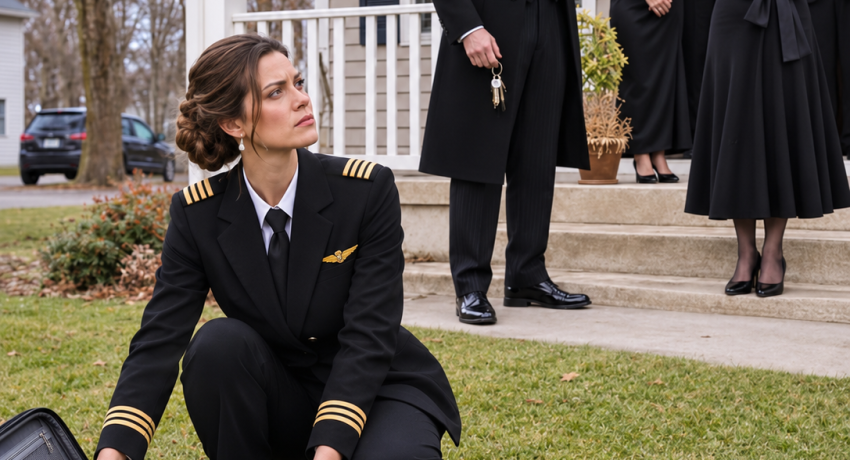
“Dad is gone. You don’t belong in this house anymore,” my brother declared as I came back from Dad’s funeral, still dressed in my pilot’s uniform. My belongings had already been tossed across the front lawn, and my aunt stood next to him, convinced I had nowhere else to turn. I didn’t argue with either of them. Instead, I quietly collected my things and packed my suitcase. They thought they had removed me from everything my father had spent his life building—but they had missed one crucial detail. Neither of them knew that Dad had left his entire $9.5 million estate to me…
The Grass Strip Behind the Cabin
At seven that morning, before Dad’s funeral, I was standing in my Columbus hotel room, fastening the little gold wings above the pocket of my pilot’s uniform, when a lawyer called with news that nearly all of his estate would be mine.
My name is Reagan Holloway. I was thirty-two and working as a cargo pilot out of Indianapolis. Early departures, unexpected radio communications, and making important decisions while everyone else was asleep were all part of my daily routine. But when a woman named Judith Marsh introduced herself as the attorney handling Dad’s estate, my legs suddenly felt weak, and I lowered myself onto the mattress.
“Your father instructed me to get in touch with you as soon as possible following his death,” she explained.
Her calm voice was accompanied by the faint sound of papers being moved.
“Is there a problem?” I asked.
It was a ridiculous thing to ask when Dad was already gone. I had spent the entire night looking at my funeral clothes, unable to escape the thought that he would never wear another suit. Nothing felt right.
“Your father made changes to his estate plan several months ago,” Judith explained. “You have been designated as the primary beneficiary. This covers the family residence, his controlling ownership stake in Holloway Woodland Retreats, and the Hocking Hills property. The estate is presently valued at roughly nine and a half million dollars, although outstanding debts, taxes, ownership documentation, and probate matters still need to be handled.”
For a few moments, I wasn’t sure I had understood her correctly. Nine years of uncomfortable holiday gatherings and brief, strained phone conversations had taught me to expect very little closeness from Dad. I had returned to Ohio believing he had died disappointed in me. Now, a woman I had never met was telling me that he had placed his life’s work in my hands.
My older brother, Wade, had spent almost twenty years working beside Dad and had always appeared to be the obvious person to take over. Our family had treated that outcome as certain for so long that even I had stopped thinking about whether anything else was possible.
“Your father made other arrangements for him,” Judith said. “We’ll go through those once the documents have been examined with the family.”
I walked over to the window and watched vehicles moving through the gray morning light. An open suitcase rested on the other bed, while my black shoes were arranged neatly on the carpet. Everything about that ordinary hotel room suddenly seemed disconnected from the conversation unfolding over the phone.
“There has to be some kind of mistake.”
“There isn’t.”
“He always wanted Wade to manage the company. That was his plan.”
Judith paused, then continued in a softer voice.
“Reagan, there is another matter you should be aware of. Your father was worried about how Wade might behave toward you following the funeral.”
My reflection in the window showed a perfectly composed uniform, but my face told a different story.
“What are you saying?”
“I’m saying that I don’t want you signing anything, handing over keys, or agreeing to leave any property belonging to your father before we’ve had an opportunity to meet. If anything happens, contact me immediately.”
“Did Dad tell you there might be trouble?”
“He told me it was possible.”
I wanted to understand why Dad had shared his concerns with an attorney instead of discussing them with me. Why had he changed his will so recently? And why was I only now discovering that our years of silence might have meant something different?
But instead, I said, “We’re laying him to rest this morning.”
“I understand,” Judith answered. “I’m sorry, Reagan. I wish things had happened differently. Your father was very clear about what he wanted.”
After the call ended, I remained beside the window, holding my phone tightly. Before long, I would be standing next to Wade and Aunt Rhonda while people spoke about Gordon Holloway as someone who always knew when to say what mattered.
That wasn’t the father I had known during the previous nine years.
Dad was sixty-eight when he died from heart failure. By that point, Holloway Woodland Retreats had become a familiar name throughout Ohio, even among people who had never met the man behind it. The company managed woodland properties, vacation cabins, and outdoor destinations throughout Hocking Hills. Its branding appeared on roadside wooden signs and in brochures handed to visitors. Families spent weekends exploring the hemlock-covered cliffs. Couples reserved cabins in October to enjoy the brilliant red and golden autumn leaves. Dad knew every building and could tell you which access roads collected water after heavy rain.
Before establishing the business, he had been a flight instructor.
When I was young, I was fascinated by that part of his life. I loved his folded aviation charts, photographs of him standing beside small planes, and the careful way he followed routes across maps. He taught me how the markings and lines represented paths through the air. Sometimes, he explained the symbols on his study desk, although I was too young to remember the technical explanations. What I remembered most was how patient he was. Those afternoons in his study felt very different from the difficult conversations that came later, when the family company seemed to determine what our futures should look like.
“You don’t fight the airplane,” he once told me. “You pay attention to what it’s telling you.”
He gave up teaching before I was old enough to fly alongside him. As the company grew, it began taking up nearly all his time. By the time I reached high school, people knew him more as a successful businessman than as a pilot. Wade naturally found his place in that world.
Seven years older than me, Wade seemed to share an understanding with Dad that nobody else could quite match. He enjoyed visiting the properties, reviewing contracts, and discussing maintenance matters over dinner. His summer jobs at the cabins had taught him how to deal with guests and contractors. He could look at a damaged porch and immediately estimate what repairs would be needed. Dad respected his practical abilities.
I made an effort to contribute, too. I enrolled in business administration because that was the future everyone expected me to pursue. Dad had already imagined a position for me in the company. As far as he was concerned, joining the family business was simply what would happen.
But I struggled to convince myself that it was the life I wanted. I honestly tried to follow the path that had been prepared for me, even though another dream kept returning to my thoughts.
Then I started taking flying lessons.
The first time I took control of an aircraft on my own, everything suddenly seemed to fall into place. Far below, roads and fields formed recognizable patterns, and the plane responded to my concentration. The training was challenging, but it never felt like the surrender I associated with my business studies. I didn’t dislike the company. I simply couldn’t imagine spending my future running it.
The distance between Dad and me began with one conversation in his office. I was nineteen and doing my best to hide how nervous I felt. He was sitting in the same place where he had once taught me to read aviation charts.
“I’m leaving the program,” I told him.
He raised his eyes from a stack of invoices. “Leaving to do what?”
“I want to pursue aviation. I want to become a professional pilot.”
He carefully placed his pen on the desk. “Reagan, you already have a future waiting for you here. Why would you throw that opportunity away?”
Every explanation I had practiced disappeared when I saw how disappointed he looked.
“Because I’ve wanted to fly ever since I was a little girl, Dad.”
“Wanting something and making an entire life out of it are two different things.”
“I understand that. That’s why I’m taking my training seriously.”
“What about your degree?”
“I can finish another way later if I have to.”
He moved his chair back and looked out through the window. Outside, Wade was walking across the driveway toward one of the company trucks, carrying a folder under his arm. Dad watched him for several seconds.
“Your brother has spent years learning how this business works,” he said. “There was a place here for both of you.”
“I know.”
“Do you really? You have a secure future here. You have a company your family worked hard to build. Most people would appreciate having an opportunity like that.”
“I do appreciate it. But being thankful for something doesn’t mean I want to spend my whole life doing it.”
My answer came out more sharply than I intended, and I could see him tense.
“Well,” he finally said, “I suppose you’ve already made up your mind.”
He never turned back toward me.
A few weeks later, I left Columbus to pursue my aviation career. I hoped that proving myself through hard work would eventually help him understand. Once I earned my qualifications and found a job, surely he would realize I wasn’t turning my back on him. I was following the part of his own history that had once made his eyes light up.
Instead, the distance between us continued to grow. Every conversation that ended badly made starting another one more difficult, until even simple questions seemed to bring our disagreement back to life.
Our calls became shorter and increasingly uncomfortable. He rarely showed any interest in my work. After exchanging a few words about the weather or our health, we usually had nothing left to say.
“Are you still flying?” he would ask.
“Yes, Dad.”
“All right. Then keep flying.”
At first, I interpreted his words as irritation. Eventually, I heard them as resignation, until I could no longer decide which feeling hurt more.
He didn’t attend my graduation. Even so, I kept looking through the audience until the ceremony began. I walked across the stage to receive my qualification and posed for a photograph. That evening, I called him.
“I’ve completed it,” I told him.
“That’s good.”
I waited for him to say something more.
“I’ll be starting my new position next month.”
“Then you’ll have plenty to keep you occupied.”
“Yes.”
“Make sure you’re careful up there.”
It was probably the closest he ever came to saying the words I had spent so long hoping to hear. At the time, it felt painfully inadequate.
I built my career in Indianapolis, becoming skilled at overnight flights, harsh winter weather, and schedules that made maintaining ordinary friendships difficult. Bringing aircraft safely to their destinations on time became a quiet accomplishment I took pride in. Even through the most exhausting shifts, I never wished I had accepted Dad’s offer to join the company.
Still, every professional achievement left something unresolved inside me. After a particularly challenging landing, I would feel the urge to call him. I wanted him to understand what those flights demanded of me. Above all, I wanted to hear that he was proud. I could feel confident about the career I had chosen while still wishing the person who first introduced me to the sky could share in my happiness.
Back in Ohio, Wade became an essential part of the retreat business. Whenever I visited, he treated my decision to leave as proof that our family roles had always been settled.
“Dad needs someone who’s actually around,” he once remarked during a holiday visit.
“I understand.”
“I’m only saying that someone has to keep the business running.”
“I never claimed otherwise.”
He shrugged. “You chose your path.”
He wasn’t entirely wrong, although the way he said it still hurt.
Dad’s sister, Aunt Rhonda, was even more direct. She constantly complimented Wade for his dedication and regarded my aviation career as an ongoing act of rebellion.
“Your father created something for his children,” she once told me. “Only one of you remained to value it.”
I chose not to argue. Instead, I drove home earlier than planned, telling myself that I had outgrown the need for their approval.
The truth was that I still wanted it.
Eventually, Dad’s heart condition became more serious.
Wade called to tell me he had been admitted to the hospital. His voice was as detached as someone giving an update about a schedule change.
“How serious is it?” I asked.
“Serious enough that you should come if you’re planning to.”
I rearranged my work schedule and drove to Ohio. When I reached the hospital, Dad looked frail. The energy he had carried for decades had been replaced by the effort of breathing and staying awake.
He recognized me, then noticed the uniform jacket I was carrying.
“You came,” he said.
“Of course I did.”
I stayed beside his bed for two days. The monitors recorded things neither of us knew how to discuss. Nurses came in at regular intervals, and he often slept for hours. Whenever he was awake, we avoided the subjects that mattered most and talked about ordinary things instead.
“How’s Indianapolis?” he asked.
“Cold.”
“Ohio’s cold too.”
“I’ve noticed.”
The corners of his mouth lifted slightly.
I told him about an aircraft that had been delayed because of maintenance. He fell asleep before I could finish. I tried again later.
“Dad, there’s something I want you to understand—”
He shifted against his pillow. “Reagan, you don’t need to—”
Then a coughing spell interrupted him, and by the time it ended, he was too exhausted to continue.
I wanted so badly for him to understand that choosing aviation had never meant rejecting him. I wanted to ask why he had grown so distant. More than anything, I needed to know whether anything I had accomplished had ever made him proud.
But every chance seemed to disappear. I kept telling myself there would be another visit when he felt stronger, and perhaps we could finally have the conversation that had been waiting for nine years.
When it was time for me to leave, I leaned over his bed and kissed his forehead.
“I’ll come back,” I promised.
His hand moved gently over mine. “Keep flying.”
I walked away hearing the same familiar distance in his voice.
Three days later, he died. There was no better afternoon, no conversation brought to completion, and no chance to explain what the words we had left unsaid had really meant.
When I returned to Columbus for the funeral, grief and regret became impossible to separate. I believed he had died disappointed in me, leaving our strained relationship permanently unresolved. I had no idea he had been arranging for Judith Marsh to contact me.
After my conversation with Judith, I decided not to wear my black suit. Instead, I put on my pilot’s uniform. I wasn’t trying to send a message to anyone. It simply felt like the most honest way to represent myself. Even if Dad had never approved of my career, I wanted to say goodbye as the person I had become.
The church was already crowded when I arrived. Several rows were filled with employees from the retreats. Property owners, contractors, and people I vaguely remembered from childhood gathered near the entrance. They spoke about Dad’s sound judgment, dedication, and remarkable memory for places he hadn’t visited in years.
Wade and Rhonda were standing near the front. Dressed in a dark suit, he accepted condolences with the weary expression of someone preparing to take over.
His eyes moved toward my uniform.
“Couldn’t you have worn something black?” he asked when I approached.
“This is what I decided to wear.”
“Of course it is.”
Aunt Rhonda glanced at the wings above my pocket before looking away. “Today isn’t the time to make a statement, Reagan.”
“I’m not making a statement.”
I almost told them what Judith had revealed, but her warning stopped me. Instead, I signed the register and found a seat.
The funeral service described a father I recognized only in certain ways. He was generous, demanding, reserved, loyal, and stubborn. One former employee remembered Dad checking a road damaged by a storm before sunrise. A friend spoke about his years teaching people to fly. Hearing that brought a lump to my throat.
Wade gave the final tribute. He talked about learning the business from Dad and carrying on the work they had built together. The meaning was clear to everyone. Wade had stood beside Dad during the company’s most challenging years, and those gathered seemed to accept that he would naturally continue what their father had started. Behind me, Rhonda let out an approving sigh.
I kept my hands folded together.
A bitter November wind blew through the cemetery. As I stood near the coffin, I watched the reality of his death settle over the mourners. Wade held Rhonda’s arm. Neither of them looked in my direction.
I remained after most people had left. I wanted to say goodbye privately, but I couldn’t find the right words. I touched the wings above my pocket.
“I really did keep flying,” I whispered.
The wind carried my words away.
Dad’s house seemed even quieter than the church. Neighbors and company employees had filled the dining table with food. People moved around quietly, carrying paper plates and speaking in low voices. His coat was still hanging near the back entrance. His glasses remained beside the chair where he usually sat.
I had left a few of my belongings upstairs the night before. My plan was to collect them after the gathering and return to my hotel. Judith hadn’t mentioned when the will would be read. She had only told me to contact her if any trouble came up.
Wade avoided me for the first hour. When the last employees had finally left, he appeared in the kitchen doorway holding a set of keys.
“We need to talk about something,” he said.
“What is it?”
“The house. I’m taking charge now, and I need room to organize everything.”
Judith’s warning immediately came back to me. “The estate hasn’t been settled yet.”
His expression tightened. “I’ve been managing Dad’s affairs for years. You wouldn’t know that because you were never here.”
“I’m not questioning who stayed here. I’m saying the estate hasn’t been settled.”
Aunt Rhonda came in behind him carrying an empty serving dish. “Wade already has enough responsibilities. You don’t need to make things harder for him.”
“I’m only going upstairs to get my suitcase and return to the hotel. There’s nothing difficult about that.”
“Good,” Wade replied. “Then get it done now.”
I went upstairs. Almost everything from my childhood had disappeared from my old bedroom, apart from my open suitcase. I packed the clothes I had brought for Dad’s hospital stay and the days that followed.
A door opened and closed downstairs. Wade came up the stairs, and I heard hangers scraping against one another.
I turned and saw him holding my uniform jacket.
“Hand that over,” I said.
He threw it onto the bed. “You’ve got ten minutes.”
“Wade, what has gotten into you?”
“My problem is that I’ve spent twenty years helping keep Dad’s company running, while you showed up for two days and walked around dressed in a pilot costume.”
“This isn’t a costume.”
“Call it whatever you want. Just pack.”
Before I could stop him, he grabbed a stack of folded clothes and carried them outside. I hurried after him.
“Put those back.”
He stepped through the doorway and threw the clothes onto the lawn.
I stood there, stunned. A breeze caught the sleeve of a sweater and dragged it across the grass.
Rhonda remained on the porch, her arms crossed. She didn’t make any effort to stop him.
“Are you actually doing this?” I asked.
“You made your choice,” Wade replied. “Go back to that life. This house belongs to the family members who stayed.”
His confidence made it clear that he had already decided how everything would turn out. He expected to inherit both the house and the business. Rhonda would get the room she had been promised. My role was apparently to attend the funeral, accept their decision, and disappear.
I finished packing and carried my suitcase outside. More of my clothes were scattered across the lawn. Wade leaned against the railing with a smug smile, as if he had won an argument I had never agreed to have.
“Want me to drive you to the bus station?” he asked.
Rhonda laughed.
I shut my suitcase and stood up. My knees were stained green from kneeling on the grass to collect my clothes.
“No,” I replied. “I’ll call someone.”
When I reached the edge of the driveway, I called Judith.
“They threw my belongings onto the lawn,” I told her.
I managed to keep my voice steady, even though my hands were trembling.
“Where are you right now?” she asked.
“Outside the house.”
“Stay right there. I’ll be there in ten minutes, and I’m bringing the paperwork.” She paused briefly. “Reagan, your father anticipated that this could happen. He told me—and these are his exact words—‘If Wade does this on the day of the funeral, don’t let Reagan argue with him. Let him finish.’”
I closed my eyes.
Dad had always been more comfortable preparing for a confrontation than facing one directly. The thought hurt so much that I nearly laughed.
“He knew Wade might throw me out?”
“He thought Wade could attempt it. Your father wanted everything to be clear, including what happened and who was responsible for the decision.”
“I don’t understand any of this.”
“I know. I’ll explain as much as I can once I get there.”
Eleven minutes later, Judith pulled up in a gray sedan. Dressed in black, she stepped out carrying a leather case. Her gaze shifted from me to my suitcase and then to the clothes scattered across the grass.
Wade straightened on the porch.
“Judith,” he said. “This really isn’t a good time.”
“Mr. Holloway, I’d like everyone to come inside, please. Your father instructed me to read the will today.”
His smile disappeared slightly. “Today? We just buried him.”
“He was very clear about his wishes.”
Rhonda stepped forward. “Couldn’t this wait until the family has had some time to grieve?”
Judith looked toward my belongings lying on the lawn. “Mr. Holloway expected that postponing this meeting could lead to further complications.”
Wade’s expression hardened. “I’m his son. I’ve worked alongside him running this company for twenty years. There’s nothing here that Judith needs to get involved in.”
“Then you should have no difficulty reviewing the documents.”
Her composed manner carried an authority of its own. She was there to carry out Dad’s wishes, not to take part in the disagreement Wade thought he had already settled.
We went inside.
Dad’s study smelled of paperwork, furniture polish, and the cedar scent of his desk. The old aviation chart was still hanging in its frame on the wall. Wade settled into Dad’s leather chair, a place Dad had never allowed him to occupy while he was alive. Rhonda sat stiffly on the sofa, clearly eager to get everything over with.
I stayed beside the window. My uniform trousers were still damp, with streaks of grass staining the knees.
Judith placed her briefcase on the desk but remained standing. She arranged several folders in a neat row. Then she took out a small recording device.
Wade glanced at it. “What’s that for?”
“Your father recorded a statement three months ago. He requested that we play it before reading the documents.”
“He was ill three months ago.”
Judith looked directly at him. “He was still mentally capable of making his own decisions.”
She pressed the button.
A short electronic hiss came from the device before Dad’s familiar, weakened voice filled the room.
“If you’re listening to this, I’m gone, and one of my children has already done something I hoped they wouldn’t.”
Wade went completely still.
On the recording, Dad paused to catch his breath.
“Wade, you’ve been working with me for twenty years, and I love you. But last spring, I discovered a second set of financial records. Four hundred thousand dollars had been transferred from the company into an account under your name. I gave you six months to return the money. You never did.”
Rhonda turned to look at Wade.
The mantel clock ticked three times.
“That’s not true,” Wade said. His voice broke on the final word. “He was confused. He was ill.”
Judith lifted a folder. “Your father’s doctor confirmed that he was fully competent when he made the changes. I also have the forensic accountant’s findings.”
“You have no idea what that money was meant for.”
“You’ll have the chance to explain that through the procedure your father put in place.”
“There was never a second set of books.”
Judith rested one hand on the folder, which was still closed. “The report covers that matter. I recommend that you hear the remainder of your father’s recording.”
She pressed the button again.
Dad’s voice continued.
“Reagan, if you’re hearing this, there’s more I owe you than I can put into this recording. I’ve written you a letter. Judith will hand it to you in private.”
The recorder stopped.
Silence filled the room.
I stared at the device, almost wishing his voice would come through again. He had known about the missing money. He had expected Wade to try to force me out. He had preserved evidence and left me a personal message. While I had interpreted his brief phone calls as signs of disapproval, he had been making arrangements to place everything he had built in my hands.
There was no sense of victory in that discovery. My grief was simply changing in ways I couldn’t keep up with.
Wade pushed himself out of Dad’s leather chair.
“Dad and I dealt with company finances together all the time,” he said. “He knew how things worked. Someone is twisting this.”
“Please sit down, Mr. Holloway,” Judith said.
“You can’t tell me what to do in my father’s house.”
“Who owns this house is one of the issues we’re here to establish.”
He turned toward me. “You knew about this.”
“I received a call this morning.”
“And you just stood there while I—”
He stopped before finishing the sentence.
“While you did what?” I asked.
His eyes dropped to the grass stains on my knees.
Judith opened the first folder. “Your father instructed me to read the provisions following the funeral and the playing of his recorded statement. We can proceed now, or we can wait until additional representatives are present. Either way, the terms remain the same.”
Wade sat down again, careful to avoid Dad’s leather chair.
Judith began reading in a steady, precise voice. She showed no emotion and added no drama. That composure made every sentence feel even more significant.
The family home would belong to me. The Hocking Hills property and the controlling interest in the retreats were mine as well. Their estimated value was $9.5 million, before accounting for liabilities, taxes, title confirmation, and probate.
Wade was allowed to keep his job and receive a salary, but his work would be subject to oversight. Dad had also established a smaller trust for him, to be distributed over ten years. If Wade contested the will, he would forfeit that trust.
Rhonda was to receive the lakeside cabin she loved, along with monthly financial support.
She looked at Judith in disbelief. “The cabin by the lake?”
“Yes.”
“Wade told me the house would be his. He said I could have the room at the back once he finished renovating it.”
Judith checked the papers. “Your father did not leave the family home to Mr. Holloway.”
Rhonda turned toward Wade, her expression showing disappointment rather than surprise. She had ridiculed me because she believed Wade’s plans included a place for her. A few lines in a legal document had destroyed that expectation. The room she had imagined occupying in the future Wade had promised her was no longer his to give away.
Wade jumped to his feet so suddenly that the chair scraped loudly against the floor.
“This is ridiculous. She hasn’t worked for this company in nine years. She knows nothing about running it. She’s just a truck driver with wings.”
“I’m a cargo pilot,” I said softly.
“It’s the same thing.”
“Mr. Holloway,” Judith said, “take your seat.”
He ignored her. “You can’t simply give it all to her. I’ve devoted my entire life to that business. Every storm, every burst pipe, every guest calling at two in the morning—I was the one who showed up. She was in Indianapolis pretending to be a pilot.”
In the past, that remark would have made me defend my profession. But after hearing Dad’s recorded message, I felt no urge to justify myself.
“You also transferred four hundred thousand dollars out of the company,” Judith replied. She tapped the folder once. “Your father decided to give you another opportunity rather than report the matter to the authorities. I suggest you recognize what a generous decision that was.”
Wade stared at her. Then he looked at me, and his expression changed. The anger was still there, but something else had surfaced beneath it.
Fear.
“I have to leave,” he muttered.
He walked out before Judith could respond. The front door slammed behind him.
Rhonda stayed where she was, her hands tightly clasped. She glanced toward my suitcase, which was still outside on the porch.
“I had no idea about the money,” she said.
“I didn’t either.”
“He told me Gordon had promised him everything.”
“He told me the house belonged to the family members who stayed.”
Her gaze moved to my uniform and the grass stains on my knees. When she spoke again, her voice was unusually quiet.
“I shouldn’t have laughed.”
“No,” I answered. “You shouldn’t have.”
She appeared to be waiting for me to make her feel better. I didn’t. A moment later, she left without another word.
Judith remained beside the desk until the door closed. She let out a breath, gathered the documents into a stack, and took out a cream-colored envelope.
Dad’s familiar slanted handwriting was on the front, addressed to me.
For nine years, I had kept his cards because seeing his handwriting gave me a connection to him without forcing us into difficult conversations. Looking at it now was painful.
Judith extended the envelope toward me.
“Your father asked me to deliver this to you privately.”
I took it but left it sealed.
“Why didn’t he tell me any of this?”
“I can’t speak on his behalf. What I can tell you is that he was very clear about his wishes. He understood the value of the estate, the accusations concerning the company’s money, and the consequences his decisions would have.”
“Did he ever talk about me?”
Judith’s expression softened. “You should read the letter.”
She placed her business card beside the folders. “I’ll give you some time alone. There’s no need to settle every practical matter today. Actually, I would advise against it. Speak with me before making any decisions concerning the business, the house, or Wade’s position.”
I nodded.
As she reached the doorway, she paused. “Your father didn’t want what he left you to become something that made you feel trapped. I can tell you that much.”
Then she left me by myself.
I lowered myself into Dad’s leather chair. It creaked beneath my weight. For several minutes, I simply held the unopened letter. Inside were words from a man who would never be able to hear my response. Part of me resented him for that. Another part was afraid of discovering a side of him that might not fit with the father I remembered.
Finally, I broke the seal.
Reagan,
I was a stubborn man. I knew that about myself, and I allowed it to cost me nine years with my daughter.
When you told me you wanted to become a pilot, I felt like I was losing you to something I couldn’t understand. That fear belonged to me, not you. I should have told you how I felt. Instead, I said, “Keep flying,” and ended the call. You deserved more than that.
I paused and covered my mouth.
Nothing in his study had changed: the framed aviation chart, the neatly arranged books, and the worn impressions his wrists had left on the desk. I had always believed his experience in aviation made his rejection intentional. His letter told a different story. What I had understood as a final judgment of my choices was actually a breakdown in communication, driven by fear and stubbornness. Aviation had changed since the days he knew. Instead of admitting that he was afraid of my independence, he had hidden that fear behind criticism.
I read on.
“There’s something I want you to know. I kept a record. Every flight you posted about, every route you took, every landing. I downloaded one of those flight-tracking apps and followed your little plane across the map at night. I knew when you flew to Memphis, when you went to Louisville, and when you passed through that storm over Kentucky last March. I stayed awake until you were safely on the ground.”
My eyes filled with tears. I pictured Dad following the little aircraft symbol across a screen in the darkness. I remembered his call after the Kentucky storm. I had been exhausted from flying through dangerous weather and let the phone ring twice before answering.
“Are you still flying?” he had asked.
“Yes, Dad.”
“Good. Keep flying, then.”
I had taken his words as another criticism. In reality, he had simply wanted to know that I had landed safely.
I continued to the next lines.
“I never told you how proud I was because I didn’t know how to say it. So I’ll tell you now. I’m proud of you, Reagan. More proud than I’ve ever been of anything I’ve built.”
“I left you the company not because I expect you to run it, but because I believe you’re the person who can be trusted with it. You turned away from the easier path and chose something difficult for the right reasons. That’s what this place needs. If you decide to sell it, then sell it. If you want to keep flying, carry on. I only want you to make the choice you believe is right.”
Your loving father,
Dad
Below his signature was a postscript.
“The cabin at the back of the Hocking Hills property has a level field behind it, just long enough for a small aircraft. I had it cleared two years ago. I always hoped you might land there one day.”
I read those words three times.
At first, I cried over his apology. Then I cried thinking about all those nights he had secretly watched my flights, unable to express how much he cared. Finally, I grieved for all the years we had lost and could never get back.
I rested my head on his desk and cried harder than I had at the funeral.
By the following morning, my clothes were no longer scattered across the lawn. After Judith left, I had carried everything into my old bedroom. The estate was still subject to probate, and Dad’s trust did nothing to make the accounts, paperwork, or decisions ahead any simpler.
I stood in the kitchen with Judith’s business card and Dad’s letter beside me. I had barely slept. Every room seemed to challenge something I had believed about my past with new information.
Judith returned before noon. We sat at the same place where Wade and I had once done our homework. She explained the difference between the estate’s valuation and available cash, controlling ownership and unrestricted authority, and Dad’s recorded accusations versus the documented accounting evidence.
“Your father gave you authority,” she said. “He didn’t leave you with a situation that’s already been resolved.”
“What will happen to Wade?”
“That will depend partly on what Wade chooses to do. The will allows him to remain employed on a salary under supervision. It also provides him with the trust, as long as he doesn’t challenge the will. The company still needs to deal properly with the missing funds. Your father established the arrangement, but you’ll have decisions to make within those boundaries.”
“He wanted to give Wade another opportunity.”
“That seems to be the case.”
I remembered Wade’s expression while the recording played. The missing money, my clothes thrown outside, and years of being compared with him still made me angry. But I also remembered the relationship we had shared before the business came between us. Wade had taught me how to ride a bicycle. Once, during a storm, he had stayed outside my bedroom until I felt better. His betrayal hadn’t erased those memories. It had made the pain more complicated.
“I don’t know how to operate the business,” I said.
“Your father was aware of that.”
“Then why did he leave it to me?”
Judith glanced toward the study. “He explained that in his letter. Trust and practical experience aren’t the same thing. Experience can be acquired or brought in by hiring someone.”
I gave a tired laugh. “That sounds exactly like something he’d say after refusing to tell me directly.”
“Perhaps.”
For the first time, Judith almost smiled.
I didn’t rush into a decision about selling the company. Dad’s permission to do so meant a great deal. Returning to my flying career in Indianapolis wouldn’t mean I had betrayed him. His letter had made that clear. Keeping the business simply because I felt guilty would have repeated the same mistake he had made by confusing obedience with love.
I started by learning about the estate and everything that came with it.
Over the following weeks, I traveled between Ohio and Indianapolis. I continued my cargo flights and used my days off to visit the retreats. The company office was surprisingly modest. Near the properties stood a practical building filled with wall maps, stacks of repair requests, and muddy boots beside the back entrance.
The work was real and straightforward. One cabin needed a replacement water heater. A gravel road had been washed away in places. Guests needed clean rooms, sturdy porches, and someone available when a lock failed in an emergency. Longtime employees watched me carefully, uncertain whether I planned to sell the business or pretend I already knew how to run it.
I did neither.
“I understand risk management and making decisions under pressure,” I told them at my first meeting. “But I don’t know this business yet. I’m going to learn from the people who already understand it.”
Wade sat at the far end of the table. He had agreed to remain in his salaried position under Dad’s supervision. He looked thinner than he had at the funeral. We hadn’t had a private conversation since the will was read.
After the meeting, the employees filed out. Wade remained in his chair.
“Are you going to fire me?” he asked.
“Not today.”
“That doesn’t answer my question.”
“It’s the answer I can give you right now. Dad gave you an opportunity to remain here. Judith is dealing with the legal matters concerning the money. I’m not going to make decisions in this office just to get back at you.”
His jaw tightened. “So I’m supposed to thank you?”
“No. You’re expected to do your job while following the supervision Dad required.”
He studied me for a moment, then stood. “You won’t make it six months.”
“Maybe I won’t. But while I’m here, the company has to come before our disagreement.”
He walked away without another word.
For the next six months, I learned about the business I had turned away from when I was nineteen. That didn’t mean Dad had been right to expect me to give up aviation. The company itself had never been the problem. I had connected it with the pressure he put on me, while he had mistaken my desire for independence as a rejection of him.
The maintenance team taught me which roofs were vulnerable to heavy snow and which roads were damaged during storms. I reviewed occupancy reports, property documents, and Dad’s old notes. I became familiar with the seasonal patterns. Summer meant long working days and families eager to explore the trails. Autumn brought visitors hoping to see the changing leaves. Winter required preventing frozen pipes, dealing with icy roads, and keeping empty cabins protected.
I began to understand that the company was much more than a financial figure. It represented forests, employees’ salaries, aging decks, reservation systems, and workers putting in sixty-hour weeks during July so visitors could enjoy the fog drifting across the hillsides.
To my surprise, I started caring about it.
Not in the same way I cared about aviation. The two didn’t have to compete. Flying represented height, precision, and constant movement. The retreats connected my responsibilities to a single place. Both required attention and discipline. Both punished overconfidence. In either environment, pretending to know more than you did could put other people at risk.
For a year, I continued flying my cargo route while managing the company. Eventually, I cut back to part-time flights. Later, I handed my route over to a younger pilot I had mentored. That wasn’t an admission that Dad had been right. I made the decision freely, after the retreats had become meaningful work rather than an obligation imposed on me through his legacy.
I hired Marian Ellis as general manager. She was reserved and direct, with twenty years of experience managing state parks. She was more concerned about employees and the condition of the land than the size of her office.
“What do you want this place to become?” she asked me.
I looked through the conference-room window at a row of bare trees.
“Something that’s managed properly,” I said. “Something honest. A place that’s still operating when the people who work here are ready to retire.”
“And what will your position be?”
“I’m still working that out.”
She seemed to appreciate an honest admission of uncertainty more than an answer based on false confidence.
Wade’s responsibilities remained limited and subject to monitoring. At first, he spoke only when a work matter required it. Gradually, he began repaying the missing money from his trust without needing repeated reminders. Returning the funds didn’t erase what he had done. It did show that he was accepting the will and the restrictions Dad had put in place.
Sometimes, I caught him looking at me from across the office, and I couldn’t work out what his expression meant. Was it resentment, jealousy, or guilt? I didn’t ask. I had learned that silence wasn’t enough to tell me what someone was feeling.
Almost a year after the funeral, Wade knocked on my office door one October afternoon.
I was going through maintenance plans, with Dad’s letter tucked inside my jacket. I didn’t carry it around as often anymore, except when I was having a difficult day.
“Can I talk to you for a moment?” Wade asked.
He stood in the doorway, one hand resting against the frame.
“Sure.”
He stepped inside but remained standing. Outside, the hills were changing into their autumn shades.
“There’s something I need to say,” he began.
I waited for him to continue.
“I threw your belongings onto the lawn because I was frightened. Dad had discovered what I’d done, and I thought that if I could get you out of the house, I might be able to get ahead of everything.”
His gaze dropped to the floor.
“How would making me leave have helped you get ahead of it?”
“I’m not sure. I thought the house would belong to me. I thought the company would be mine too. If you were gone, maybe I could control when everyone found out what had happened. Maybe I could make people believe Dad hadn’t been thinking clearly toward the end.” He swallowed. “It doesn’t seem logical now. But on that day, it seemed logical to me.”
There was nothing new in his confession. He was simply putting a name to the fear I had seen when the will was read.
“And what about Aunt Rhonda?”
“I told her Dad had promised me the house. I said she would have a room there. She trusted what I told her because I believed it myself.”
“You allowed her to laugh at me.”
“I did.”
For the first time, he raised his head. His eyes were filled with tears.
“I was wrong, Reagan. About the money. About you. About everything. I’m sorry.”
I had spent years imagining what it would feel like to hear my family acknowledge how unfairly they had judged me. Yet the moment itself felt subdued and unfinished. His apology couldn’t bring Dad back, undo the money he had taken, or make the memory of my clothes scattered across the lawn disappear. But it gave me the freedom to choose what happened next.
“I’m not ready to pretend everything is okay,” I said.
“I understand.”
“Because it isn’t. Returning the money doesn’t make it okay, and being scared doesn’t excuse the way you treated me.”
“I understand that too.”
My eyes moved toward the maps on the wall. Dad had given Wade an opportunity, not complete forgiveness. I could offer him the same chance without pretending that trust had already been rebuilt.
“But I’m willing to try again,” I said, “provided you’re prepared to take it one step at a time.”
He nodded. “I can do that.”
Healing took time. Neither of us could erase years of comparisons or what had happened on the day of the funeral simply by promising to speak more kindly to each other.
For several months, most of our conversations concerned the business. Gradually, though, we began discussing other things. We learned to disagree without questioning one another’s loyalty. Wade stopped acting as though his years of service gave him authority over everyone. I stopped expecting a single apology to repair an old rivalry and a more recent betrayal.
It took two years before sitting down to dinner together felt natural. Certain subjects still needed to be approached carefully. We couldn’t go back to the innocence of childhood. Instead, we were two adults finding out whether a damaged relationship could be put back together.
That spring, Rhonda sent me a handwritten apology. She made no attempt to defend herself. She admitted that she had believed Wade because his story supported the prejudice she already held against me. She also acknowledged how hurtful and cruel her laughter had been.
Along with the letter, she sent a jar of homemade blackberry preserves.
I kept both. I spread the preserves on toast and ate them without making any comment. Forgiveness didn’t always require a dramatic declaration. Sometimes, it simply meant holding on to the jar.
With Marian and me overseeing things, the business continued to develop without turning into a personal monument to me. That was never what I wanted. Dad’s name remained on the signs. Wade continued working within the boundaries Dad had established. And I kept flying often enough to make sure the sky remained part of my life.
On a bright morning in June, I rented a single-engine Cessna in Indianapolis.
The skies were clear, and the weather was peaceful. After completing the aircraft inspection, I climbed inside, settled into the pilot’s seat, and started the engine. As the propeller began turning, that familiar sense of concentration returned. Once airborne, my attention narrowed to the task immediately in front of me.
I pointed east toward Hocking Hills.
Below me, green and golden fields stretched into the distance. Roads curved through the hills, cabin rooftops appeared among the trees, and a creek reflected the sunlight like a ribbon of silver.
I could now appreciate the property from a completely different viewpoint. I knew which roads were prone to flooding, which cabins were booked first in October, and where employees parked during the busiest summer season. Looking down from above, I finally understood what Dad had envisioned: the shape of the land and everything it could offer, rather than simply its financial value.
At the far end of the property stood an old cabin. Beyond it was the level stretch of ground he had mentioned, a field suitable for landing a small airplane. He had cleared it two years before his death and never told me about it.
I circled once to check the ground and assess the wind. Then I lined the aircraft up for its approach.
The ground drew closer beneath me. I made the necessary adjustments and kept the plane steady. Its tires touched the grass gently, and I brought it to a stop facing the cabin, with trees standing on either side.
Once I switched off the engine, the silence returned little by little. The propeller slowed first, followed by the fading vibrations. Somewhere beneath the aircraft, the cooling metal made a few faint clicking sounds.
I placed my hands in my lap and sat quietly.
For nine years, I had believed that one perfect conversation could somehow make everything right between us. I would explain myself, he would finally understand, and all the pain would disappear. But he died before we could reach that kind of honesty. What I had left was far from perfect: a letter, a business, Wade’s gradual attempt to make amends, and a landing field that carried a little hope.
I stepped out of the cockpit and walked toward the cabin. The grass brushed against my boots. From the top step of the porch, I looked back at the Cessna resting exactly where Dad had imagined it would be.
His letter, folded and unfolded countless times, was still in my jacket pocket. I no longer needed to take it out and read it. Every sentence had become part of my memory.
The wind moved gently through the branches. Somewhere in the distance, a door closed, and then the hills grew quiet again.
I imagined Dad checking my flight tracker late at night. I remembered his final words to me in the hospital and how completely I had misunderstood them.
Keep flying.
They had never meant that he was turning away from me. They were simply the closest thing to a blessing he had known how to give.
I looked across the field he had prepared for me.
“I made it down, Dad,” I whispered.
Above me, the leaves rustled softly as the afternoon went on.









