
 87 views
“He’s not my daddy! I want my mommy!”
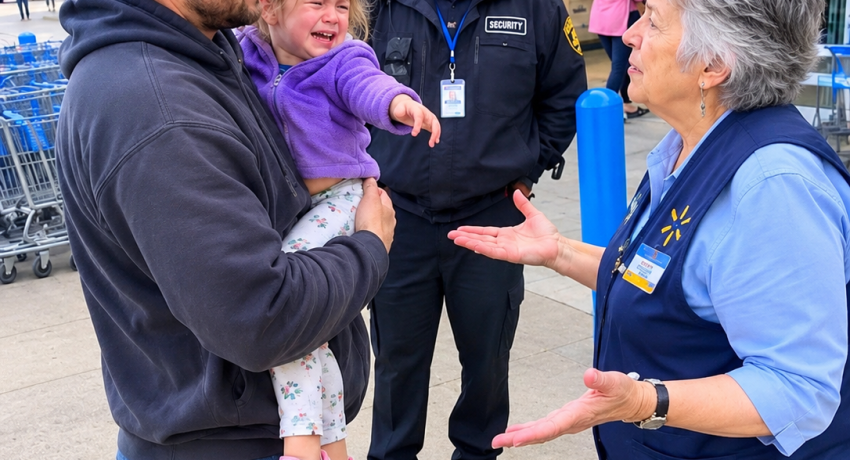
The little girl looked no older than three. She was sobbing uncontrollably, struggling to catch her breath as her tiny chest rose and fell rapidly. Her face was flushed, covered in tears, and filled with a level of terror I hadn’t witnessed in many years. Both her little hands were gripping the front of my blue work vest, holding on as tightly as she possibly could.
The man holding her tightened his grip and pulled her closer to his chest. He was tall and slender, probably around thirty-five, wearing a gray hoodie and a baseball cap pulled down over his forehead. A rough beard covered his face, and his eyes seemed unable to settle on anything for long. He offered me a smile, but there was no warmth in his eyes.
“She’s just tired,” he said. “I’m her father. Now, please get out of the way.”
My name is Mavis Keller. I’m sixty-seven years old, and that Tuesday afternoon in March, I was working as a greeter at a large retail store on Rogers Avenue in Fort Smith, Arkansas. I’d held that position for nine years. My usual spot was beside the automatic entrance, where I stood in my blue vest and comfortable shoes from eight in the morning until four in the afternoon, five days a week, greeting everyone who came inside and wishing them well as they left.
Before taking that job, I had spent thirty-one years delivering mail for the United States Postal Service. For most of that time, I worked a route through the Park Hill neighborhood. I knew every dog, every front porch, and every widow who waited beside her mailbox simply because she wanted someone to talk to. When I turned sixty, I retired, thinking I would appreciate the peaceful life. My husband, Lloyd, had passed away from a heart attack two years earlier, and our son lived in Denver, calling us—or rather, me—every Sunday. I managed to spend only about four months alone in our house on North Thirty-Second Street before the silence became too much to bear.
That was when I decided to find a job welcoming customers. It wasn’t an impressive position, but I enjoyed it more than I could ever explain. I loved meeting people. I enjoyed seeing the older gentlemen who stopped by every morning to buy coffee and a newspaper, the young mothers pushing carts loaded with diapers, and the teenagers who pretended to ignore me but still managed to say goodbye.
I always carried a roll of yellow smiley-face stickers in my vest pocket. I purchased them myself from Dollar General, getting five hundred stickers on each roll. Whenever a child entered the store, I would bend down as much as my knees allowed and offer them one. Some children recognized me after seeing me every week and came running through the entrance, searching for their stickers before their mothers had even picked up a shopping cart. A little boy named Tavion had collected so many that he covered his entire lunchbox with them.
Most of my working days followed the same familiar routine. And honestly, that was exactly how I liked things.
Until one Tuesday afternoon in March, when an ordinary day suddenly became something I would never forget.
It was shortly after three in the afternoon. Rain had been falling since morning, the cold, gloomy kind of spring rain that seemed to soak everything. The floor near the entrance was slippery from the water customers had tracked inside. I was standing beside the automatic doors, using a mop to clean up a puddle, when I noticed a man moving quickly toward the exit while carrying a little girl.
She had curly brown hair gathered into two puffs on top of her head and wore bright pink rain boots decorated with tiny white hearts. Her purple raincoat was on, but its hood was resting down behind her. She was also screaming at the top of her lungs.
Initially, I assumed she was simply throwing a normal childhood tantrum. Goodness knows I had witnessed countless ones during my nine years working near those doors. Children become exhausted, hungry, or overwhelmed when shopping in crowded stores. They cry, and their parents carry them outside, looking embarrassed and apologizing to anyone nearby.
But then I heard the words coming out of her mouth.
“You’re not my daddy! I want my mommy! You’re not my daddy!”
Something about the sound of her voice immediately made me suspicious. It didn’t sound like an ordinary tantrum. I had raised one son and helped bring up four grandchildren, so I understood the difference. A tantrum usually comes from anger. This little girl wasn’t angry. She was absolutely frightened.
I leaned the mop against the wall, walked closer, and reached into my vest pocket for my stickers. I pulled one from the roll and held it out toward her.
“Hello, sweetheart,” I said softly. “Would you like a smiley-face sticker?”
Rather than accepting the sticker, she reached out and clutched my vest.
The man gave me an uncomfortable smile. “She’s going through a difficult phase,” he explained. “Please excuse us.” He then attempted to walk around me.
Her little fingers were tangled in the material of my vest. When the man started moving, she refused to release her grip and pulled me along with them. I took one step before stopping and firmly planting my feet. I stayed near the entrance, positioning myself between him and the glass doors.
“Sir,” I said, “she seems very frightened. Could you please tell me her name?”
His expression immediately shifted. His smile disappeared entirely, as though someone had switched off a light.
“Get out of my way,” he ordered.
“What is her name?”
He paused briefly. It couldn’t have been more than two seconds, but I was watching him closely, and I noticed his hesitation.
“Quinn,” he finally answered. “Her name is Quinn. I’m her father.”
I glanced down at the little girl. She had buried her face against my vest, and I could feel her entire body trembling through the fabric.
“Quinn, sweetheart,” I asked gently. “Is this man your daddy?”
She raised her head and shook it desperately from side to side. Her movements were so forceful that her curly hair bounced with every shake.
“No! He took me! He took me from Miss Corliss’s!”
My stomach immediately twisted with worry.
The man adjusted her position in his arms, and her fingers slipped away from my vest. “She’s only three years old,” he insisted. “She has no idea what she’s talking about.” Then he leaned closer to me, close enough that I could smell the cigarettes on his breath. Lowering his voice until it was almost a whisper, he threatened, “Move, or I’ll move you myself.”
I was scared. I’m not going to pretend otherwise. I stand just five feet two inches tall, and arthritis affects both my knees. This man was about a foot taller than me and nearly thirty years younger. Still, I refused to move out of his way.
“I’m going to call my manager over,” I told him. “We just need to make sure everything is okay.”
I reached for the small radio attached to my vest, pressed its button, and requested that a manager come to the front entrance. A few moments later, Mr. Darby appeared.
Chapter Two: Step Aside
Kyle Darby was thirty-five years old and worked as our assistant store manager. He had been employed at our location for approximately a year. He was a decent young man. He had a wife, a newborn baby, and a district manager constantly putting pressure on him. Most of the time, he seemed more worried about customer complaints than anything else. When he hurried down the main aisle toward us, his tie swinging as he walked, the first person he focused on was the man, not the little girl.
“Is something wrong here?” he asked.
The man immediately reached into his pocket with his free hand, pulled out his wallet, and presented a driver’s license. It was an Arkansas license bearing his photograph and a name I would discover later: Wade Harlan. Before Mr. Darby had even finished examining it, the man took out his phone, opened a photograph, and held it up for him to see. The image showed him standing in a hospital room, holding a newborn baby wrapped in a pink blanket.
“See?” he said confidently. “That’s my daughter. This was taken the day she was born. This woman is harassing me. She grabbed my child.”
“I never grabbed anyone,” I protested. “She was the one who grabbed me.”
Mr. Darby looked over the driver’s license and studied the photograph. He glanced at the man’s face and then back at the picture. Quinn was still crying, although her sobs had become quieter. Her face remained buried against the man’s shoulder, while her little pink rain boots slowly kicked against his side.
Then Mr. Darby turned around and looked directly at me.
“Mavis, step aside,” he instructed. “You’re making the store look bad.”
“But she’s telling me he took her from somebody else’s house,” I explained. “She mentioned Miss Corliss. She said he took her from there.”
“Mavis.” His tone had become noticeably harsher. A few shoppers had stopped nearby and were watching us. “Move.”
With great reluctance, I stepped out of the way. Even knowing how everything eventually turned out, I would regret taking that step for the rest of my life. I remained standing with my back against the cold glass, watching as the man carried Quinn through the automatic doors and into the rain. Just as they passed through the entrance, she lifted her head from his shoulder and turned to look directly at me.
Her brown eyes were enormous, filled with tears and fear.
She didn’t utter a single word.
She simply stared at me.
But I couldn’t simply forget what I had heard. Spending thirty-one years delivering mail teaches you to pay attention to the smallest details. You notice when a porch light remains on for three consecutive nights. You notice when newspapers begin accumulating outside someone’s door. You learn to recognize when something just doesn’t seem right.
I decided to follow him, keeping a safe distance between us. I walked through the doors, stepped into the rain, and crossed the soaked parking lot behind him. I pulled out my phone, an old-fashioned flip phone my son had repeatedly urged me to replace. I held it up just as my granddaughter had taught me.
Before he could drive away, I managed to capture a photograph of his face when he turned around and glanced back toward the store. I also photographed the little girl sitting inside the car, a silver Nissan sedan, with her small face pressed against the rear window. Finally, I took a picture of his license plate as he backed out of the parking space. The rain made the photographs somewhat blurry, but every number on the plate was still readable.
After that, I called 911.
Standing in the middle of the parking lot, getting completely drenched as the rain soaked through my blue vest, I explained everything to the dispatcher. I described a little girl, approximately three years old, with curly hair and pink rain boots. I told her about the man who claimed to be the child’s father and the little girl who insisted he wasn’t. I mentioned Miss Corliss’s name, described the silver Nissan, and carefully read out the license plate number twice. I spoke slowly and clearly, just as I used to when giving addresses to the dispatch office during my years at the post office.
The dispatcher wanted to know which direction the vehicle had taken. I explained that he had headed north along Rogers Avenue, toward Interstate 540. She informed me that an officer would arrive to collect my statement and instructed me to remain there.
I wasn’t completely certain that I had understood what was happening. Perhaps the man really was her father. Maybe the little girl was simply exhausted. Perhaps I had misunderstood everything and accidentally made an already frightened child even more terrified. But there was one thing I knew for certain: a terrified little girl had begged me not to let that man take her away, and I hadn’t managed to prevent him from leaving.
About forty minutes later, an officer arrived. He was a young man with a shaved head, and his name was Officer Delgado. He took out a small notebook and carefully recorded everything I told him. I also emailed him the photographs from my phone, although it took me three attempts to get them sent successfully. Once he finished writing everything down, he looked at me for several seconds.
“You did the right thing, ma’am,” he said softly. “Whatever happens.”
The next morning, Mr. Darby summoned me to his office.
It was a small room at the back of the store, just beyond the employee break room. There was a metal desk, a computer, and a workplace safety poster hanging on the wall. He didn’t invite me to take a seat. Instead, he stood behind his desk holding a sheet of paper, looking unusually pale.
The man had contacted corporate headquarters to file a complaint. The previous evening, he had called the customer service department and accused a store employee of physically preventing him from leaving, grabbing his daughter, following him into the parking lot, photographing him and his child without consent, and making a false report to the police. He also announced that he intended to take legal action.
“Corporate contacted me at seven this morning,” Mr. Darby explained, avoiding eye contact. “They reviewed the security recordings. You positioned yourself in front of the exit after I instructed you to move. You followed a customer outside to his vehicle. You took photographs of a minor.” He placed the paper on his desk. “That’s three separate violations of company policy, Mavis. Your employment is terminated, effective immediately.”
I remained standing inside that tiny office, still wearing my blue vest. Nine years. Nine entire years spent welcoming customers, saying hello and goodbye, and giving little children yellow smiley-face stickers.
“Mr. Darby,” I asked, “did they find the little girl? Is she okay?”
For the first time, he raised his eyes and looked directly at me. Something crossed his face. I believe it was shame.
“I don’t know,” he answered. “Nobody has told me.”
After spending nine years greeting customers, I had lost my job because I tried to protect a frightened child. I removed my blue vest, folded it neatly, and placed it on his desk. Before doing that, however, I took the roll of smiley-face stickers out of its pocket. Those belonged to me. I had purchased them with my own money.
Chapter Three: What the Police Said
I couldn’t sleep that night. The following night was no different. I spent hours sitting at my kitchen table on North Thirty-Second Street, staring at a cup of coffee that had gone cold. Lloyd’s old radio was playing gospel music quietly in the background, but my thoughts kept returning to that little girl. I remembered her pink rain boots, her tiny hands gripping my vest, and the way she had looked at me as she disappeared through the automatic doors.
On Thursday afternoon, my phone suddenly rang. A woman introduced herself as a detective with the Fort Smith Police Department. Her name was Detective Renee Holloway, and she explained that she was contacting me regarding the report I had filed on Tuesday.
“Is she okay?” I asked before she had a chance to continue. “The little girl, Quinn. Is she safe?”
Detective Holloway remained silent for a moment. “Ma’am, there isn’t much information I can share with you,” she replied. “The investigation is still open, and a minor is involved. However, I can confirm one thing. The child is safe, and she’s currently with her mother.”
I dropped heavily into my kitchen chair and covered my mouth with one hand.
“Your call came through approximately four minutes after another report had been made,” the detective continued cautiously. “The photographs you provided helped us identify and locate the vehicle. An Arkansas state trooper pulled it over on Interstate 40, close to the Oklahoma state line, roughly an hour later.” She stopped briefly. “I’m probably not supposed to share that much information, but I thought you deserved to know.”
“Was he actually her father?” I asked. “Was he telling the truth about being her dad?”
There was another pause.
“I’m unable to discuss that with you, ma’am,” she replied. “I’m sorry.”
“Is he in jail?”
This time, the silence lasted even longer.
“No, ma’am,” she eventually answered. “Not at the moment.” I could hear something in her voice, perhaps frustration or disappointment. “It’s a complicated situation. That’s all I can tell you.”
After ending the call, I remained seated at my kitchen table for a very long time. The little girl was safe. She had been reunited with her mother. Nothing else mattered nearly as much as that. I had lost my job, had no idea how I would break the news to my son, and couldn’t imagine how I would spend my days now that I was no longer working. But Quinn was back home with her mother. And if I ever found myself in that situation again, I would stand in that doorway and do exactly the same thing.
I honestly believed that was where the story ended.
I was wrong. It was only the beginning.
Chapter Four: The Envelope
Three weeks later, someone knocked on my front door at seven in the morning.
A young man stood outside. He was polite, dressed in a windbreaker, and asked whether I was Mavis Ellen Keller. After I confirmed that I was, he handed me a thick white envelope.
“Ma’am, you’ve been served,” he announced.
Before I could ask him anything, he turned around and walked back to his car.
I carried the envelope inside and opened it at the kitchen table. It contained a thick bundle of documents, thirty-one pages in total, fastened together with a staple in the corner. Across the top of the first page, printed in large black letters, were the words: IN THE CIRCUIT COURT OF SEBASTIAN COUNTY, ARKANSAS. WADE A. HARLAN, PLAINTIFF, V. MAVIS E. KELLER, DEFENDANT.
He was taking me to court.
I went through the documents three separate times. Most of the legal terminology was unfamiliar to me. Defamation. False imprisonment. Intentional infliction of emotional distress. Invasion of privacy. The lawsuit claimed that I had knowingly and maliciously accused him of kidnapping his own daughter when the accusation was completely false. It alleged that I had physically prevented him from leaving a public establishment. It also claimed that I had taken photographs of him and his child without authorization and handed those pictures over to the police, resulting in an Arkansas state trooper stopping him at gunpoint on the interstate in front of his daughter.
According to the lawsuit, he had experienced public humiliation, emotional suffering, damage to his reputation, and financial losses because of my actions.
On the final page, I noticed the amount he was demanding.
He wanted two hundred and fifty thousand dollars.
I sat at Lloyd’s old kitchen table, holding those documents in my trembling hands.
Two hundred and fifty thousand dollars. I didn’t have anything close to that amount. I had never possessed that kind of money in my entire life. My postal pension provided approximately eighteen hundred dollars each month, and my Social Security payments added another thirteen hundred. The house was mine, the same home Lloyd and I had completely paid off in 2009. On a good day, it might be worth around one hundred and ten thousand dollars.
I also had forty-one thousand dollars saved in an account at Arvest Bank. That money was supposed to cover my funeral expenses someday and help pay for my grandchildren’s college education.
If I lost the case, I could lose my house. They could take everything I owned.
I picked up my phone and called my son in Denver. Ray worked as a pharmacist and regularly put in twelve-hour shifts. In all his life, I had never called him during working hours. When he answered immediately, I could hear the worry in his voice.
“Mama? What’s happened?”
I explained everything from the beginning. I told him about the little girl, what had happened at the entrance, my conversation with Mr. Darby, losing my job, and finally receiving the envelope. Until that moment, I hadn’t told him anything about the incident, not even that I had been fired. I had felt too embarrassed to bring it up.
He remained silent on the other end of the phone for quite some time. Eventually, he spoke.
“Mama, you need to get a lawyer. Today.”
“I don’t have enough money to hire an attorney, Ray.”
“I’ll cover the cost.”
“You have three children and a mortgage to worry about.”
“Mama,” he replied, “you stood in a doorway to protect a little girl you had never met. Now I’m going to stand up for you.”
Chapter Five: Harold
I refused to let Ray spend his money hiring an attorney for me. Fortunately, I didn’t need to.
The following Sunday, after attending church at First Baptist on Grand Avenue, I was sitting in the fellowship hall with a cup of coffee and a slice of pound cake that I couldn’t bring myself to eat. That’s when Harold Vaughn came over and took the seat across from me. Harold was seventy-nine years old and had been attending our church for fifty years. He had worked as an attorney in Fort Smith for forty-six years, handling mostly real estate matters, wills, and the occasional lawsuit. He retired seven years earlier when his wife became ill. She passed away last spring.
He had already heard about my situation. In fact, everyone at church knew. Fort Smith might have a population of ninety thousand, but First Baptist felt like a little community of its own.
“Mavis,” he said, “I heard you’ve found yourself in a bit of trouble.”
I nodded because I couldn’t find the words to respond.
“Have you hired an attorney?”
I shook my head.
He placed his coffee cup on the table. “Well, you have one now.”
“Harold, I don’t have the money to pay you.”
“I never said you had to,” he answered. “My license is still active. I’ve still got my law books, and I can manage about twenty productive hours every week.” He gave me a small smile. “Besides, I’ve been bored out of my mind since Margaret died. Bring those documents to my house tomorrow morning. Ten o’clock. We’ll go through them at my kitchen table.”
On Monday morning, Harold sat at his kitchen table wearing his reading glasses, with a yellow legal pad beside him, and examined every single page of the lawsuit. He wrote down notes and asked me what seemed like a hundred questions. What exactly had I said to the man? Had I touched him at any point? Had I put my hands on the child? Who had made the first physical contact? How long had I remained in front of the doorway? Had I ever actually used the word kidnapping?
“No,” I answered. “I never called it kidnapping. I didn’t use that word even once. I simply told the 911 dispatcher what the little girl had said. That he wasn’t her daddy and that he had taken her from Miss Corliss’s.”
Harold slowly nodded and recorded my answer.
“Let me explain something, Mavis,” he said when we finished. He removed his reading glasses and looked at me. “Under Arkansas law, making an honest report to the police is generally protected. We call it privileged communication. Someone cannot sue you for defamation simply because you contacted 911 and honestly described what you witnessed and heard.”
“Then what reason does he have for suing me?”
Harold studied the lawsuit for several moments before answering. “I’m not entirely sure yet,” he said. “But after practicing law for forty-six years, I’ve learned something. Not everyone files a lawsuit because they expect to win. Sometimes they bring legal action simply to punish someone. Sometimes it’s about frightening another person into keeping quiet.” He pointed his pen toward the final page. “He’s demanding two hundred and fifty thousand dollars from a sixty-seven-year-old retired postal worker. That’s more than a lawsuit. It’s a warning.”
“A warning to whom?”
He didn’t respond to my question. Instead, he quietly put his glasses back on.
Harold submitted a motion requesting that the judge dismiss the case, arguing that my police report was protected by the legal privilege given to people who report incidents to law enforcement. The judge was Patricia Haskins, a woman who had served on the Sebastian County bench for twelve years. She reviewed the motion carefully, but in June, she rejected it.
Harold explained the decision to me while we sat at his kitchen table. Wade Harlan’s attorney had argued that the lawsuit involved more than my 911 call. He claimed I had physically prevented his client from leaving the store, grabbed his daughter, and refused to let him go. According to his argument, those actions amounted to false imprisonment, regardless of what I had later reported to the police. The judge determined that these facts were disputed and would need to be resolved by a jury.
“So we’re actually going to court for a trial?” I asked.
“Yes, we’re going to trial,” Harold confirmed. “It’ll take place in October.” He looked at me over his glasses. “Mavis, I need to be straight with you. There’s no way to predict what a jury will decide. The security footage shows you standing in front of the entrance after your manager instructed you to move. It also shows the little girl holding on to your vest. Unfortunately, there’s no audio. The jury might watch it and see a grandmother trying to protect a frightened child. Or they might decide you’re simply a nosy person who refused to stay out of someone else’s affairs.”
Chapter Six: The Deposition
In August, I had to give a deposition.
That’s simply a formal legal term for answering questions under oath before a trial takes place. Mine was held in a conference room at the law office of Wade Harlan’s attorney. It was a large firm in downtown Fort Smith, on Garrison Avenue, with glass walls and expensive leather chairs. His lawyer was named Brent Talley. He was around fifty years old, had silver-colored hair, and spoke in a smooth, almost soothing voice. He treated me with remarkable politeness. Somehow, that frightened me more than an openly rude attorney would have.
Harold remained seated beside me throughout the entire meeting. The previous evening, he had advised me to tell the truth, respond to questions as briefly as possible, and never make guesses about anything.
Mr. Talley questioned me for three and a half hours.
He wanted to know how many years I had worked at the store. He asked about the training I had received and whether store policy allowed employees working as greeters to physically stop customers from leaving. He questioned me about whether I had ever received any training related to identifying child abductions. He also wanted to know whether I had known Mr. Harlan before that afternoon, whether I had ever encountered him previously, and whether I knew the little girl.
Eventually, he asked whether a three-year-old might tell her father, “You’re not my daddy,” simply because she was upset that he was making her leave the store.
“Anything can happen,” I replied. “But I’ve raised a son and helped bring up four grandchildren. I understand the difference between a child who’s angry and one who’s frightened. That little girl was terrified.”
“But you’re not a child psychologist, Mrs. Keller,” he pointed out.
“No, sir,” I answered. “I’m a grandmother.”
He smiled. Under the table, Harold gently placed his hand on my arm.
Wade Harlan was also present. He sat at the far end of the long conference table beside his attorney. This time, he wore a neatly pressed shirt and tie. His face was clean-shaven, and his hair had been cut short. He looked nothing like the man I’d encountered in the gray hoodie. Instead, he could easily have passed for a Sunday school teacher. Throughout the entire three-and-a-half-hour deposition, he never spoke once. He simply kept his eyes on me.
When the questioning finally ended and we began gathering our belongings, he stood up and walked around the end of the table toward me. Harold immediately stepped between us without saying a word.
Wade stopped walking. Looking past Harold’s shoulder, he fixed his eyes on me and gave me the same smile I remembered from the store. It was the same expression that never reached his eyes.
“You should have stayed out of other people’s business, Mrs. Keller,” he said in a low voice. “If you had, you’d still have your job.”
Then he turned and walked away.
Mr. Darby gave his deposition the following week. Harold attended the meeting, but I stayed home. When he returned, he told me that Mr. Darby had testified that he instructed me to move three separate times. According to his testimony, I refused twice. He also confirmed that the little girl had been holding on to my vest and that Mr. Harlan had presented a legitimate driver’s license along with a photograph showing him holding a newborn baby.
“Did he seem sorry?” I asked. “Mr. Darby, I mean.”
Harold considered the question before answering. “He looked like someone who hasn’t been sleeping properly since March,” he said. “But he told the truth. Every single detail. Even the things that didn’t make him look good.”
Chapter Seven: Miss Corliss
I couldn’t get that little girl out of my thoughts.
Throughout the summer, while Harold worked on preparing our case for trial, my mind kept returning to her. I remembered those pink rain boots, her curly hair in two little puffs, and the frightened expression on her face as she looked at me through the glass doors. The detective had confirmed that Quinn was safe and staying with her mother. But nobody would share any additional details with me. Neither the police nor the prosecutor’s office would say anything more. Harold had contacted both departments, but they had explained that the matter was confidential because it involved a minor.
So I decided to do what I had always done during my years delivering mail whenever something seemed suspicious. I began asking questions and looking for answers myself.
Miss Corliss’s. Those were the exact words Quinn had shouted. He took me from Miss Corliss’s. I searched through the phone book and looked online, with help from my granddaughter during a video call. Eventually, I found someone named Corliss Washington who operated a licensed home daycare on North O Street, approximately two miles from the store. The business was called Little Lambs Child Care, and it accepted children ranging from six weeks to five years old.
One Tuesday afternoon in September, I drove over to the address. The property was a small yellow house surrounded by a chain-link fence. There was a swing set, a sandbox, and a plastic playhouse designed to look like a castle in the yard. Several children were outside playing. A woman who appeared to be around sixty was sitting on the front porch steps, keeping an eye on them. She was heavyset, had gray hair arranged in braids, and wore a whistle attached to a lanyard around her neck.
I stopped beside the gate. She raised her head, looked directly at me, and her expression suddenly changed.
“You’re the woman,” she said. “The lady from the store.”
I nodded.
She slowly rose from the porch steps and made her way toward the gate. For several moments, she simply stood there, studying my face. Then she unlatched the gate, invited me inside, and led me over to the porch swing. While the children continued playing in the yard, she sat down and began telling me everything she was able to share.
“He showed up on a Tuesday,” she explained. “It was around two-thirty in the afternoon, and it was raining. He knocked on my door and told me he was her father and had come to collect her early because she had a doctor’s appointment. He showed me his driver’s license. His name was listed on her birth certificate. He even knew her birthday and middle name.” Corliss shook her head. “I’d never seen that man before. Her mother has always been the one to pick her up. But he had the documents, and Quinn carries his last name on my sign-in records.”
“You allowed him to take her,” I said. I wasn’t blaming her. I was simply trying to understand what had happened.
“She started screaming,” Corliss replied, her voice cracking. “The moment she saw him, she screamed. She ran away and hid behind my couch. He went over, picked her up, and she was kicking and crying as hard as she could. I told him to wait because I wanted to call her mother first. But he said he’d already spoken to her mother and that everything was arranged. Then he simply walked out of my house carrying her. Before his car had even reached the corner, I was already on the phone with her mother.”
She raised one hand and wiped the tears from her eyes.
“Her mother contacted the police. Later, they informed me that someone else had called them too. A woman working at a store had reported the incident and provided a license plate number.” She turned toward me. “That woman was you.”
“Is Quinn okay?” I asked. “Is she really safe?”
Corliss remained silent for quite some time.
“She survived,” she eventually said. “She’s with her mother. That’s everything I can tell you. They don’t come here anymore. Her mother withdrew her from the daycare the following week, and they moved somewhere else. I have no idea where they went. She refuses to tell anyone. She’s absolutely terrified.”
“What is she afraid of?”
Corliss turned her attention toward the children playing outside in the yard.
“Him,” she answered. “She’s been frightened of that man for three years.”
Before heading home, I asked Corliss whether she could give me a piece of paper. She went inside and returned with a yellow sheet of construction paper from her craft table and a crayon. Those were the only supplies she had available. I sat on her porch swing and began writing a letter to a woman I had never met.
I can’t remember the exact words I used. It was something along these lines:
Dear Quinn’s mama. My name is Mavis Keller. I’m the woman from the store. I want you to know that your little girl crosses my mind every single day. I’m sorry I couldn’t stop that man at the entrance. I truly tried. I’m facing a lawsuit now, but please don’t worry about that. That’s my problem, not yours. I only wanted you to know that somebody stood up for Quinn. May God bless both of you.
When I finished, I folded the letter, took a yellow smiley-face sticker from my roll, and placed it on the front to hold it closed. Then I handed it to Corliss.
“If you ever get the chance to see her again,” I told her, “or find some way to make sure she receives this.”
Corliss accepted the letter and held it against her chest. She didn’t make any promises.
Chapter Eight: The First Day of Trial
The trial opened on a Monday morning in mid-October at Courtroom 2 of the Sebastian County Courthouse on South Sixth Street. The courthouse was an old limestone structure with tall windows, wooden benches for visitors, and a large brass seal representing the State of Arkansas hanging behind the judge’s bench.
I wore my Sunday church dress, a navy-blue outfit decorated with tiny white flowers. Ray had flown in from Denver the previous evening and was sitting in the front row of the gallery behind me with his wife. Nearly half the congregation from First Baptist had come to support me. They occupied three entire rows of benches. Some familiar faces from my former workplace were there too, including the older gentlemen who regularly came in for coffee and a young mother named Shaniqua. Her son, Tavion, had a lunchbox decorated with the smiley-face stickers I used to give him.
Harold sat beside me at the defense table wearing a brown suit that looked as though it was at least thirty years old. His yellow legal pad, reading glasses, and several folders tied together with string were arranged in front of him. Once we were seated, he gently patted my hand and reminded me, “Take a breath, Mavis.”
On the opposite side of the aisle, Wade Harlan sat beside his attorney, Brent Talley, at the plaintiff’s table. He had chosen a navy suit with a white shirt and red tie. His hair was neatly arranged, and he looked like someone preparing to run for city council. He didn’t even glance in my direction.
The morning was devoted to selecting the jury. Twelve people had been brought together from different parts of Sebastian County. Among them were a schoolteacher, a truck driver, a retired nurse, a young man employed at the Gerber plant, and several others. Mr. Talley questioned them about their beliefs concerning personal responsibility, while Harold asked whether any of them had grandchildren.
Following the lunch break, the attorneys delivered their opening statements. Mr. Talley spoke first.
Standing before the jury box in his expensive suit, he presented his version of events. He described a devoted father who had arrived to collect his young daughter for a medical appointment. He explained that they had stopped at a large retail store so he could purchase a snack for her. The little girl, he claimed, was simply a tired and irritable toddler having an ordinary tantrum, something children her age did all the time.
Then, according to his account, a meddlesome store greeter decided to interfere in their family business. She stood in front of the exit, physically grabbed his daughter, and prevented him from leaving. After that, she followed him into the parking lot, secretly photographed him and his child, and contacted the police to falsely accuse him of being a kidnapper.
“Because of Mrs. Keller,” Mr. Talley continued, “my client was stopped on Interstate 40 by an Arkansas state trooper who approached with his firearm drawn. This happened directly in front of his three-year-old daughter. He was placed in handcuffs beside the highway while his little girl watched everything. And even now, she continues to suffer nightmares because of that experience.”
He turned his attention toward me, and every member of the jury followed his gaze.
“Mrs. Keller will tell you that she was only trying to help someone,” he said. “But having good intentions does not give anyone permission to ruin another person’s reputation. That is precisely what this case concerns.”
He returned to his seat. Wade Harlan lowered his eyes toward his hands on the table. His shoulders moved slightly, almost as though he were struggling to hold back tears.
Harold slowly rose from his chair. He fastened the buttons on his old brown jacket, walked toward the jury box, and prepared to address the jurors.
But he barely had an opportunity to begin.
Because at that very moment, a young woman sitting in the last row of the courtroom stood up.
Chapter Nine: Kendra
At first, I hadn’t noticed her. What caught my attention was the sudden silence spreading throughout the courtroom behind me. It was an unusual, unexpected quiet. Then I heard Ray softly say, “Mama,” and I slowly turned around in my chair.
A young woman was standing in the final row of benches, close to the large wooden entrance doors. She appeared to be around twenty-six or twenty-seven years old. She was petite and slender, with brown skin and dark hair pulled tightly into a bun. She wore a simple black dress without any jewelry. Both her arms were wrapped around a manila folder, which she held tightly against her chest as though it were a protective shield.
Pinned to the front of her dress, directly above her heart, was a yellow smiley-face sticker.
Judge Haskins raised her head from the bench and peered over her reading glasses.
“Ma’am,” she said. “Court is currently in session. Please take your seat.”
The young woman remained standing. She didn’t move from the back of the courtroom. I could see her entire body trembling, from her shoulders all the way down to her knees. She first looked toward the plaintiff’s table. Wade Harlan had turned around in his chair, and all the color had suddenly drained from his face.
Then her eyes found me.
“Your Honor,” she began. Her voice was quiet, but it carried clearly through the entire old courtroom. “My name is Kendra Lowe. I’m Quinn’s mother.”
The courtroom immediately burst into commotion. People sitting in the gallery turned around and began whispering to one another. Someone from First Baptist loudly exclaimed, “Lord Jesus!” Mr. Talley jumped to his feet so quickly that his chair toppled over behind him.
“Your Honor, I object!” he shouted. “This individual isn’t included on any witness list. This is an intentional interruption of—”
Judge Haskins struck her gavel against the bench. Once, then again. The courtroom gradually fell silent.
She studied Kendra Lowe for several long moments through her glasses. Then she turned toward Mr. Talley before shifting her attention to Harold.
“Counselors,” she instructed, “both of you, come forward to the bench.”
Next, she addressed the jury.
“Ladies and gentlemen, we’re taking a brief recess. Please follow the bailiff into the jury room. Do not discuss anything about this case.”
The jurors stood and began filing out of the courtroom. Leon, the bailiff, was a large man with gray hair. He walked toward the back of the room and positioned himself beside Kendra Lowe. He never laid a hand on her. He simply remained there, standing protectively beside her.
Harold and Mr. Talley approached the judge’s bench. They spent quite some time speaking with her in quiet voices, but I couldn’t hear a single word of their conversation. I remained seated at the defense table, my hands folded together, watching the young woman standing in the back row with that smiley-face sticker pinned to her dress.
She was watching me too.
Tears were running down her cheeks, but she wasn’t making a sound. Then she slowly raised one hand and touched the sticker on her chest, almost as though she wanted to make certain I had noticed it.
My sticker. The one I had included with the letter, written on a sheet of yellow construction paper while sitting on Corliss Washington’s porch swing.
Wade Harlan was looking at her as well. He had twisted around completely in his chair. The color had drained from his face. He clutched the edge of the plaintiff’s table so tightly that his knuckles had turned white.
Fifteen minutes later, Judge Haskins announced a recess until the following morning. She asked Harold and Mr. Talley to meet her in chambers. She also requested that Kendra Lowe join them.
Chapter Ten: What Kendra Said
I didn’t know what happened inside the judge’s chambers. Harold explained it to me later that evening, sitting around his kitchen table with Ray and me.
Kendra Lowe had arrived carrying a manila folder. Inside were three documents. The first was a certified copy of a custody order issued two years earlier by the Domestic Relations Division of the Sebastian County Circuit Court. It awarded Kendra sole legal and physical custody of Quinn Harlan Lowe. Wade Harlan was permitted supervised visits only, lasting two hours every other Saturday at a visitation center approved by the state. The order also clearly stated that he could not take the child from her school, daycare, or home without the mother’s explicit written permission.
The second document was a copy of a protective order issued fourteen months earlier. It had been granted after Wade Harlan appeared at Kendra’s apartment at two in the morning and kicked her door in. The order covered both Kendra and Quinn. It had expired eleven days before Wade showed up at Little Lambs Child Care. Kendra had already submitted a request to renew it, but no hearing date had been set.
The third item was a thick collection of printed text messages. They were messages Wade Harlan had sent to Kendra Lowe, hundreds of them spanning two years. Harold didn’t tell me the contents of most of those messages. He mentioned only one, which Wade had sent three days before the incident at the store.
You’ll never see her again. I’ll take her somewhere you’ll never find her.
“He intended to take her to Oklahoma,” Harold said in a low voice. “Then he planned to keep going west. The state trooper discovered a duffel bag in the trunk containing her clothes. There was also two thousand dollars in cash and a birth certificate.” He removed his glasses and rubbed his tired eyes. “Mavis, if you hadn’t reported that license plate, he could have crossed the state border before anyone even knew where he’d gone.”
I was unable to say anything. Ray reached over and put his arm around me.
“Then why wasn’t he charged?” Ray asked. “Why didn’t they put him behind bars?”
Harold let out a long sigh. “The protective order had expired,” he explained. “He’s listed on the birth certificate, and the custody order hadn’t been entered into the state’s crime database yet. That was a clerk’s mistake. He also told the trooper that he had permission to take her. And Kendra refused to testify.” He turned toward me. “She was terrified. He had threatened her, telling her that if she ever went to court against him, he’d track her down and finish what he’d started. The prosecutor’s office believed it couldn’t build a case without her testimony. So they released him.”
“And after that, he filed a lawsuit against me,” I said slowly.
“Yes, and then he sued you,” Harold replied. “He demanded two hundred and fifty thousand dollars. He did it in an open courtroom, knowing she’d eventually hear about it.” He shook his head. “I believe he wanted her to understand what happens to anyone who stands in his way, Mavis. Even a sixty-seven-year-old grandmother who gives a child a sticker.”
Sitting at Harold’s kitchen table, I remembered Wade Harlan’s expression during the deposition and the words he’d directed at me. You should have minded your own business, Mrs. Keller.
“Then what made her come forward?” I asked. “If she was that frightened, why did she show up today?”
Harold opened his briefcase and pulled something out. He placed it carefully on the table in front of me.
It was a sheet of yellow construction paper, folded in half. It was worn and creased, as though someone had handled it over and over again. The crayon writing had become blurry and smudged. The yellow smiley-face sticker that had once held it closed was missing. I knew exactly where that sticker had ended up.
“She presented this to the judge,” Harold explained. “She said Corliss Washington found her at a women’s shelter in Van Buren in August and handed it to her. According to Kendra, she’s read your letter every night since then. She told them she couldn’t sleep because she kept imagining an older woman being dragged into court and sued simply for standing in a doorway to protect her little girl.” He gently tapped the paper. “She said that if Mrs. Keller could stand up to him with nothing more than a sticker, then she could face him with a folder full of evidence.”
Chapter Eleven: Afterward
On Tuesday morning, before the jury returned to the courtroom, Brent Talley rose in Courtroom 2 and asked the judge to dismiss the lawsuit. He requested dismissal with prejudice, which Harold later explained meant Wade could never bring the same case again. Talley spoke in a dull, exhausted tone and never once looked toward his client.
Wade Harlan was nowhere to be seen at the plaintiff’s table. He hadn’t shown up.
Judge Haskins approved the request. Afterward, she looked down at me from the bench, peering over her glasses for several seconds.
“Mrs. Keller,” she said. “I don’t normally make personal remarks from the bench, but today I’m going to make an exception.” She removed her glasses. “Thank you.”
Those were her only words. She struck her gavel, and the case was finished.
Eleven days later, Wade Harlan was arrested at a motel in Sallisaw, Oklahoma. The morning after the trial concluded, Kendra Lowe went to the Sebastian County Prosecuting Attorney’s office and announced that she was prepared to testify. The prosecutor charged Wade with interference with court-ordered custody, an Arkansas felony when a child is taken toward another state, as well as violating the conditions of his supervised visitation. A judge renewed the protective order and extended it for ten years. Wade pleaded guilty in February. He is now serving a four-year sentence at the Department of Correction in Pine Bluff.
In November, I received a call from the store.
It wasn’t Mr. Darby calling. A woman from the corporate office in Bentonville contacted me instead. She was a vice president of some department, and her voice sounded extremely cautious. She explained that the company had been informed of the lawsuit’s outcome. They had also taken another look at the circumstances surrounding my termination. She said the company had determined that my actions reflected its organizational values, even though they hadn’t followed the exact wording of its policies. They wanted to offer me my position back, along with back pay covering March through November. The amount was fourteen thousand, three hundred dollars.
I spent quite a while considering the offer.
“At last, I think I’d like to return,” I told her. “But there’s one thing I’d like to request.”
“What would that be, Mrs. Keller?”
“I want the company to revise its policy,” I replied. “The next time a greeter encounters a frightened child, they should be able to contact a manager and call the police without risking their job. I’d like the employees to receive proper training, too. They should learn what warning signs to notice and how to recognize the way a frightened child behaves or sounds.” I paused for a moment. “I’d also like the policy to have a name, something people will remember.”
She didn’t answer immediately. There was a long silence before she finally said she’d look into it.
The Saturday before I returned to work, Mr. Darby came to my house. He stood outside on the front porch wearing a windbreaker, his hands tucked into his pockets. He didn’t ask whether he could come inside.
“Mavis,” he began. “I’ve been thinking about that day every single day since March. I keep seeing you step aside. I keep remembering that little girl looking back at you through those doors.” He swallowed before continuing. “I have a daughter now. She’s seven months old. And I can’t stop wondering what would happen if it were her. What if someone told the person greeting customers to step aside?”
“You told the truth during your deposition,” I replied. “Harold told me. You didn’t leave out even the details that made you look bad.”
“That was the least I could do,” he said.
I studied him for a while. He was still a young man who had made a poor decision because he was afraid of his supervisor, and he had carried the weight of that decision ever since.
“Kyle,” I said. “Why don’t you come inside and have a cup of coffee?”
Chapter Twelve: A Smiley Face
I returned to work on the first Monday of December. It was the same store on Rogers Avenue, with the same automatic entrance doors. I wore the same blue vest, only now it had a fresh name tag with MAVIS printed in white letters. The familiar roll of yellow smiley-face stickers was still tucked into my pocket.
The coffee men applauded when I walked in. After school, Shaniqua brought Tavion along, and he hurried over to me carrying his lunchbox. He proudly showed me that he’d left an empty spot on it for another sticker. Kyle Darby was standing at the far end of the main aisle. He gave me a nod, and I returned it.
There was also something new hanging on the break room wall. Inside a frame was a revised company policy, distributed by corporate to every store throughout the region. It stated that whenever an employee noticed a child who appeared distressed and indicated that the accompanying adult was not their parent or guardian, the employee must immediately inform a manager and contact law enforcement. It also made clear that no employee could face disciplinary action for making a report in good faith. At the top of the document, printed in bold, was its official name.
THE KELLER PROTOCOL.
I remained in the break room, reading those words three times before returning to my position by the entrance.
Two weeks before Christmas, on a chilly Saturday morning, a young woman walked through the automatic doors with a little girl holding her hand.
The child wore a red winter jacket and a knitted hat topped with a pom-pom. Her feet were covered by bright pink rain boots decorated with tiny white hearts. They were one size larger than the pair she’d worn before. Her curly brown hair was gathered into two little puffs that showed beneath her hat.
She paused just inside the entrance and raised her eyes toward me.
I recognized her before I could even explain to myself how I knew. My hand instinctively reached into the pocket of my vest.
“Hello, sweetheart,” I said. My voice trembled. “Would you like a smiley-face sticker?”
At first, she didn’t reach for it. She simply stood there in her pink boots, studying my face for a long moment, just as she’d done through the glass that day in March. Then she turned toward the woman beside her and looked up at her mama.
“Is that her?” she asked. “The sticker lady?”
Kendra Lowe stood behind her, dressed in a gray wool coat. One hand covered her mouth as she nodded.
“Yes, baby,” she answered. “That’s the lady who refused to move.”
Quinn turned her attention back to me. Then she released her mother’s hand and walked over. With both hands, she caught hold of the front of my blue vest, just as she had on that earlier day. But there were no tears this time. Instead, she wore a wide smile, showing the little gap where a four-year-old’s teeth were missing.
“Mommy told me you stayed in the doorway for me,” she said. “Even when that man told you to move.”
I couldn’t find any words. All I could do was nod.
Then Quinn did something that will stay with me for the rest of my days. She reached inside the pocket of her red coat and brought out a small item. It was a sheet of stickers, but these weren’t smiley faces. They were gold stars, the kind teachers hand out to students. Using her tiny fingers, she carefully peeled one away. Her tongue poked out from the corner of her mouth as she concentrated on getting it loose.
Then she stretched up and pressed the star onto my blue vest, directly above my heart, beside my name tag.
“This is for you,” she said. “Because you were brave.”
I lowered myself onto my knees as far as my old joints would allow, right there in the entrance while shoppers continued walking in and out around us. I pulled a yellow smiley face from my roll and placed it on the front of her red coat.
“And this one is for you,” I told her. “Because you were the brave one first.”
Kendra was in tears. So was I. The coffee men sitting at the table near the front had fallen silent and were watching us. One of them even removed his cap.
Quinn wrapped her arms around my neck in a quick, tight hug, the way little children do. Then she reached for her mother’s hand again and tugged her toward the shopping carts. She was already talking excitedly about Christmas gifts, her new preschool, and her new teacher, Miss Tamara, who owned a hamster. When they reached the end of the main aisle, Quinn turned around and waved enthusiastically with her entire arm.
I waved back at her.
I still wear that gold star every day. It remains attached to my vest, just above my heart and next to my name tag. Every so often, someone asks me about it. Usually, it’s one of the newer greeters, young employees who have only recently started working at the store. They notice the star and want to know why I wear it.
I explain everything. I tell them about a little girl wearing pink rain boots and a man who ordered me to move. I tell them about the manager who instructed me to step aside, and the step I took that I still regret. I tell them about a young mother who stood up at the back of a courtroom, clutching a folder against her chest as though it were a shield, even though she was more terrified than anyone else in that room.
Then I share the one lesson I’m certain of after sixty-seven years of life, thirty-one years delivering mail, and nine years standing at that entrance.
If a child tells you she’s frightened, take her seriously. If someone orders you to step aside, stop and consider who you’re making room for. And when you cannot prevent something from happening, at the very least, remember to record the license plate.
After that, I take a roll of yellow smiley-face stickers from my pocket, hand it to them, and send them out to their places by the door.









