
 35 views
The freezing weather arrived during the third week of January, rolling in from Saskatchewan on Tuesday night with the force of a freight train. By Wednesday morning, Bismarck radio was reporting temperatures of thirty-one below along the roads east of Harvey, with windchills reaching fifty-five below. In weather like that, your nostrils stick together, and touching a car door handle makes your fingers burn. In this part of North Dakota, conditions like these can be deadly.
Mom didn’t answer her phone Wednesday evening. At first, I wasn’t worried. She was eighty-two and often nodded off while watching Lawrence Welk reruns on public television. Sometimes she left her phone in the bedroom. I called at nine, then tried again at nine-thirty. There was still no answer.
On Thursday evening, she didn’t pick up again. I called six or seven times before deciding to contact the Schmidts, her nearest neighbors, who lived two miles down the gravel road. Their line was busy, even when I tried again. Standing in my Bismarck kitchen with the phone in my hand, I could feel my heartbeat racing.
My husband, Steve, operates a snowplow for Burleigh County. During major storms, the crews can stay on duty for several days. He’d been clearing roads since Tuesday afternoon, catching short periods of sleep in his truck at the county garage between shifts. I called him.
“Go,” he told me. “I can’t leave work. Take the Suburban. Fill up in Washburn. Bring the emergency kit and the spare blanket. Call me once you arrive.”
“Go, Connie,” he added. “I’ll be praying for you the entire way.”
I set off from Bismarck by myself for the 115-mile journey. I followed Highway 83 north, then turned east onto Highway 200, passing through Turtle Lake and McClusky. Above the open prairie, the vast black sky was scattered with stars that looked like broken pieces of glass. My headlights reflected a bluish glow off the snowbanks along the road. I saw just one other vehicle the entire night.
Mom’s farm is twelve miles east of Harvey, North Dakota. Eight of those miles are along a gravel section-line road beyond the paved highway. During winter, the county sometimes clears that stretch only once a week.
Grandpa had settled on the property in 1912. The farm covered 320 acres of wheat fields, sunflowers, and pastureland. A two-story white farmhouse with green shutters stood near a red barn with a collapsed section of its northern roof. Grandma had planted a windbreak of caragana and ash trees. Beside the house was a white 500-gallon propane tank resting on concrete blocks, shaped like an enormous capsule.
Natural gas service has never extended to these farms. Homes in Wells County depend on propane, heating oil, or wood for warmth. Cooperative delivery trucks travel along the gravel roads throughout winter to bring fuel. When a tank runs dry, the furnace stops working. At thirty below, the pipes can freeze within hours. Before long, the people inside may freeze as well.
I reached the yard at eleven-twenty. The outdoor light was on, but the kitchen window was dark. I parked near the back entrance, picked up my blanket and flashlight, and stepped out of the vehicle. The cold hit me like a brick wall. Before I had walked three steps, tears had formed and frozen on my eyelashes.
As usual, the kitchen door was unlocked. I stepped inside and immediately noticed that the furnace wasn’t running.
That furnace had been there since 1987. Throughout winter, it normally rumbled in the basement like a sleeping animal, switching on and off every few minutes. But tonight, there was no sound. Only the ticking of the wall clock broke the silence. It was the old Westclox with a rooster printed on its face, which Dad had bought at the Harvey hardware store in 1970 and hung above the kitchen table. That ticking was the only noise in the house. I could see my own breath in the kitchen.
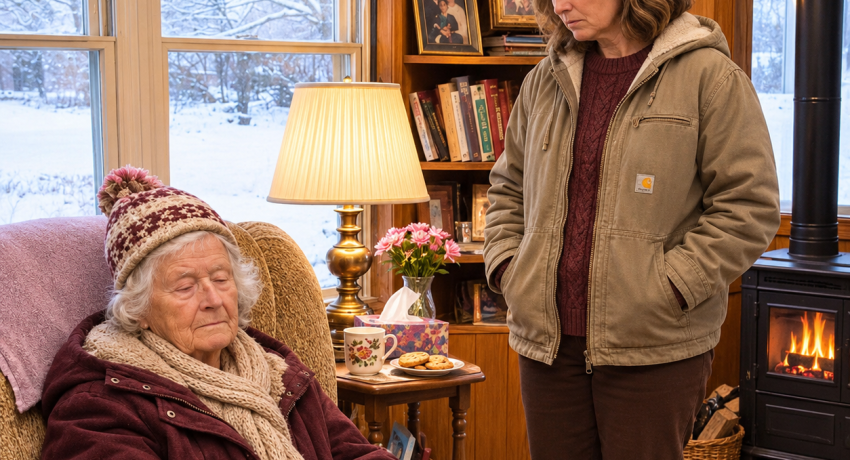
I walked across the kitchen and into the living room, leaving snowy footprints on the linoleum. That’s where I found Mom asleep in Dad’s old brown La-Z-Boy beside the picture window. The chair’s right arm had cracked vinyl, and its reclining handle often got stuck. Dad had sat in that chair almost every evening for thirty-four years. After he passed away, Mom started using it.
She was dressed in her long brown wool winter coat, the one with the big buttons and imitation-fur collar. She had worn it to church every winter since 1995. Now it was fastened all the way up to her chin. A red-and-green knitted hat with a pom-pom covered her white hair. My niece had made it for her two Christmases earlier.
Grandma Heinz’s crocheted afghan, made in 1974, was spread across Mom’s lap. Its orange, brown, and gold pattern was as familiar to me as my childhood. Her gloved hands were resting together on top of it.
Ice had formed on the inside of the windows rather than the outside. Thick frost crystals, resembling white feathers, covered the glass and obscured the yard light beyond the picture window.
I stood motionless in the doorway, still wearing my red parka. My car keys were dangling from my fingers, melted snow had dampened my shoulders, and my flashlight beam was directed at the floor. For one terrifying moment, I thought she might be dead.
Then I noticed the afghan move slightly with the rise and fall of her breathing. I finally let out the breath I’d been holding.
The thermostat near the hallway was an old, round, beige Honeywell model with a pointer you adjusted using your thumb. It was set to 58 degrees, but the mercury thermometer below it, which showed the actual room temperature, read 51.
Mom was eighty-two and had lived by herself ever since Dad died four years ago. She had always refused to move into town or stay with one of us. Her response never changed: she had been born in that farmhouse, married there, raised four children there, and planned to die there.
Standing in that living room at fifty-one degrees, I knew one thing for certain. This couldn’t be how it happened. Not tonight.
Part Four: Why I Didn’t Call
I didn’t immediately call my sister from the doorway, and there was a reason for that.
My name is Connie Weber. I’m fifty-four and the second of four children: Pam, me, Rob, and Dean. Pam, the oldest, lives in Harvey, only twelve miles from Mom. She’s spent her entire married life there and works as a receptionist at the clinic. Her husband, Mark, drives a truck for the grain elevator. Because she lives closest, Pam takes care of most of Mom’s everyday needs.
I’m a payroll clerk for a school district in Bismarck. Rob runs a farm near Rugby, roughly an hour north, while Dean sells agricultural equipment in Fargo. We’re spread across the region, balancing jobs, mortgages, kids, and grandchildren. Pam handles the regular responsibilities because she’s nearby.
Every October, Rob, Dean, and I each send Pam $250 to pay for Mom’s propane. We made that arrangement four years ago, after Dad died, during the funeral luncheon in the church basement. Pam offered to manage the account with the cooperative. Rob said we should all contribute. Dean asked, “Two-fifty from each of us? Pam pays the same amount?” She nodded.
Together, our four payments added up to $1,000. That was supposed to cover a fall delivery and another refill after Christmas. We’d followed this arrangement for four years. I had never asked her to show me a receipt. Pam was my sister, and she was the one who drove out every Sunday, took Mom to appointments in Harvey, bought her groceries, and collected her prescriptions. She was present when the rest of us couldn’t be.
That’s why I didn’t call her that night. It wasn’t because I distrusted her. If I phoned around midnight and told her Mom was freezing, Pam would rush onto dangerous roads in thirty-one-below weather. She’d arrive upset and apologetic, an argument would break out, and Mom would still be cold afterward.
There was another reason, too, although I wouldn’t discover what it was for another ten minutes.
Part Five: Five Percent
I left Mom sleeping and went back through the kitchen, carrying my flashlight to inspect the propane tank outside. Snow came up to my knees, and the wind blowing across the fields felt like knives against my skin. Before long, I could no longer feel my face.
The tank’s gauge was mounted beneath a metal cover on top. Its round face looked like a car speedometer, with numbers running from zero to one hundred to show how much fuel remained. Snow and ice had covered it. I brushed away the snow with my glove, then used my car key to scrape the ice off the glass. Under the flashlight, I could see the needle resting at five percent, barely above the red warning area.
Since the tank held 500 gallons, that meant only twenty-five gallons remained. With temperatures so far below zero and an older furnace, that small amount might last a day, or possibly even less. As the fuel level drops, pressure decreases, leaving the furnace short of propane until its flame eventually goes out. That was why the house had become so cold.
My hands trembled as I stared at the gauge, and the freezing weather wasn’t the only reason.
When I returned to the kitchen, I began searching through the refrigerator. Mom had covered its surface with her grandchildren’s school photographs, church newsletters, a Harvey Farmers Elevator calendar, and coupons she hadn’t used. Beneath a magnet shaped like an ear of corn was a pink carbon-copy delivery slip from the Harvey cooperative.
The ticket was dated October 19. It listed a delivery of 200 gallons, with Pamela Ruff named as the customer for Elsie Heinz. The tank level after delivery was recorded as 47 percent.
I looked at it twice. Two hundred gallons.
Although the tank had a capacity of 500 gallons, safety regulations meant it could only be filled to eighty percent, leaving room for the propane to expand. If the tank were empty, a normal full delivery would be around 350 to 400 gallons. So 200 gallons amounted to roughly half a fill.
I worked out the cost. The previous October, propane in Wells County had been selling for approximately two dollars a gallon. Four hundred gallons would have cost $800, leaving another $200 for a smaller refill after Christmas. Our combined contribution of $1,000 should have been enough to pay for both deliveries. But the 200 gallons on that receipt had cost just $400, and there was no record of another delivery afterward.
I went through the calendars, church notices, and coupons, hoping to find another ticket dated December or January. I couldn’t find one.
Part Six: Mom Wakes Up
I went back to Dad’s recliner, knelt in front of Mom, and gently placed my hand on her knee over the afghan.
“Mom,” I whispered. “Mom, wake up. It’s Connie.”
Her eyes gradually opened. At first, she looked disoriented, then blinked as she recognized me.
“Connie?” she murmured. Her voice sounded weak and raspy. “What are you doing here? It’s the middle of the night.”
“You weren’t answering your phone,” I explained. “For two nights. I became worried.”
She glanced at the windows covered in frost, then noticed the visible breath in the room. At last, she looked directly at me. I couldn’t tell whether she noticed my fear, my anger, or the pink delivery receipt I was holding. Her expression shifted, and her gloved fingers wrapped firmly around my wrist.
“Don’t you go after your sister,” she warned.
I looked at her in disbelief.
“Mom—”
“Don’t start blaming Pam,” she repeated. Her hold on my wrist was stronger than I expected. “She’s already got enough to deal with.”
“Mom, the tank is down to five percent,” I told her. “It’s only fifty-one degrees in this house. You’re sitting here wearing your winter coat.”
“I’m all right,” she insisted.
“You’re not all right. Your hands are freezing.”
I took her hand in mine. Even through the knitted glove, it felt icy.
“Pam’s husband had surgery on his back,” Mom said. “Back in September. Did you know about that?”
I did. Mark had suffered two ruptured discs while lifting a grain auger at the elevator. He’d undergone surgery at Trinity in Minot, and Pam had told us about it over Thanksgiving.
“He hasn’t been able to work since then,” Mom continued. “Not even one day. The elevator doesn’t offer disability benefits. They’re getting by on Pam’s paycheck from the clinic.”
She looked down at our hands.
“Pam says propane costs a lot this year,” Mom added softly.
Then she tried to smile.
“I don’t mind keeping the house a little cool,” she said.
Part Seven: The Phone Call
I didn’t argue with her. It was almost midnight, the propane gauge was at five percent, and the furnace could shut down completely at any moment.
I called the Harvey co-op’s emergency number, but all I got was a recorded message. Eventually, someone picked up at 12:40. His voice sounded tired and annoyed.
“Harvey Farmers Co-op, emergency line.”
“My name is Connie Weber,” I said. “My mother is Elsie Heinz. She lives east of town on 64th Street. Her propane tank is down to five percent, and her furnace is barely running. She’s eighty-two years old.”
There was a brief silence.
“Elsie Heinz,” the man repeated. “Art Heinz’s wife?”
“Yes.”
“Ma’am, this is Duane Kessler,” he said. “I’ve been delivering propane out there for twenty-two years. I knew your father.”
His sleepy tone suddenly changed.
“Is she all right?” he asked. “Is she staying warm?”
“She has her coat and hat on,” I replied. “The temperature inside is fifty-one degrees.”
He didn’t speak for a moment.
“I can’t bring the truck out tonight,” he finally said. “The roads are blocked by snowdrifts. The county won’t clear 64th Street until morning. I’ll come out first thing, as soon as I can get through.”
“Thank you,” I said.
“Until then,” Duane advised, “set the thermostat down to fifty-five. I know it sounds strange, but it’ll help stretch the fuel that’s left. Move her into the warmest room and shut the doors to the others. Do you have a space heater?”
“I’m not sure.”
“Check the basement,” Duane suggested. “Art always kept one down there. A small electric heater he used for the well pump.”
I discovered the dusty heater behind the water softener. Its little heating element began glowing orange. I carried it upstairs, plugged it in beside Dad’s recliner, and closed the doors to the kitchen, dining room, and hallway to keep the warmth in one area. I wrapped the afghan around Mom’s legs and laid my red parka over her.
After that, I sat on the floor with my back against the recliner’s vinyl upholstery and stayed awake until morning.
Part Eight: Morning
At seven, I heard the county snowplow scraping along the gravel on 64th Street. Its flashing orange light moved across the frosted windows before the vehicle came into view.
At ten-forty, I called the co-op’s main office. Marlene answered. She had been working at the front desk there since I was in high school.
“Connie Heinz!” she exclaimed. “Duane told me what happened. He’s loading the truck right now. How is your mother?”
“Cold,” I replied.
“There’s something I need to ask you, Marlene,” I continued. “About Mom’s propane account. Whose name is listed on it?”
She paused.
“The account is registered under Pam’s name,” Marlene explained. “Pamela Ruff. She opened it after your father died. She’s listed as the billing contact.”
“Can I switch it?”
There was another pause.
“Well,” Marlene replied carefully, “we only need one name on the account for billing purposes. Whoever is handling the payments. If Pam approves, or if you’d rather open a new account under your name and close hers, we can arrange that.”
“I want to open a new account,” I said. “Under my name. Today.”
Marlene didn’t ask any questions. After working behind that desk for thirty years, she had probably seen her share of complicated family situations.
“All right, honey,” she said. “I’ll get it arranged.”
Pam was my sister, and Mom had pleaded with me not to confront her. But someone needed to take responsibility for the propane bills. I made up my mind that it would be me.
Part Nine: The Driver
Duane pulled in at about two o’clock. He was sixty-one, with a gray beard, a Harvey Hornets stocking cap, and a face weathered by three decades of North Dakota winds. He backed his large white delivery truck beside the tank, got out, and knocked on the kitchen door.
Mom opened it, still wearing her brown coat and red-and-green hat. When Duane saw her, he took off his cap.
“Mrs. Heinz,” he said. “I’m sorry it took me so long to get here.”
“Oh, Duane,” Mom replied. “You shouldn’t have driven out in weather like this. It isn’t even that cold inside.”
He looked past her at the frost covering the kitchen windows. Without saying anything, he nodded and went back to his truck.
He filled the tank to eighty percent, delivering 375 gallons at $2.09 per gallon. The total on the delivery ticket came to $783.75. Standing at Mom’s kitchen counter, I paid approximately $784 with my card while Duane operated a payment reader he pulled from his coat pocket.
Then I brought up another matter.
“Duane,” I said, “can you put the tank on keep-full?”
He turned to look at me.
“Keep-full?” Mom asked. “What does that mean?”
“It’s an automatic delivery service,” Duane explained. “We install a small monitor on the tank. It sends a signal to our office, and when the level drops to thirty percent, we send someone out to refill it. You don’t need to call us or remember to schedule anything.”
He looked back at me.
“The charges go to whoever holds the account,” he added. “Each time we make a delivery.”
“Then put it on keep-full,” I said. “Under my name.”
He gave a nod.
“Yes, ma’am.”
From that day forward, the cooperative would monitor the tank. No one would have to remember to arrange another delivery.
Part Ten: Seventy
Once Duane had left, I walked over to the round Honeywell thermostat and moved the setting up to seventy degrees.
Downstairs, the furnace clicked. After a brief pause, there was a gentle whump as the burner ignited. I felt a vibration beneath my boots, as if the farmhouse were finally drawing a breath again. The fan came on, pushing warm air through the floor vents. The familiar smell of dust, aging metal, and winters from my childhood filled the room.
Mom was still sitting in Dad’s recliner, wrapped in her coat and wearing her hat. When she heard the furnace running, she closed her eyes.
An hour later, the temperature inside had climbed to sixty-eight degrees. The frost on the windows began to disappear, leaving thin trails of water running down the glass.
Mom slowly got to her feet, steadying herself against the arm of the chair because her knees were bad. She took off her knitted gloves and set them on the end table. Then she removed her red-and-green hat. Her white hair was flattened and full of static, so she ran her palm over it to smooth it down.
After that, she unbuttoned her brown coat and pulled down the zipper. She walked across the living room into the kitchen, stopped at the hooks beside the back door, and hung the coat there.
She placed one hand on it.
“I’d forgotten,” she said softly, “how this feels.”
Part Eleven: The Text
That evening, Mom went to bed in her warm bedroom, tucked beneath two quilts. I sat at the kitchen table and sent messages to Rob and Dean, leaving Pam out. I told them the propane tank had been filled and asked them to send their contributions next October to me instead. I would explain the situation when we met at Easter.
Dean called less than a minute later.
“Connie, what happened? Is Mom all right?”
“She’s fine,” I replied. “She’s warm and sleeping.”
“What do you mean, she’s warm?” Dean asked. “Was she freezing?”
I hesitated.
“Dean, I’ll explain everything when we see each other at Easter. In person. I don’t want to discuss it over the phone.”
He fell silent.
“Does this have something to do with Pam?” he asked.
“At Easter,” I repeated.
Rob was out feeding the cattle when I sent my message. He called at around ten that night, which was typical of him.
“I saw your text,” he said. “What’s happening?”
“Mom’s warm,” I told him. “The tank is full, and we’ve put it on automatic delivery. The account is in my name now.”
He said nothing for a moment. Rob has never been a man of many words. Of all of us, he takes after Dad the most.
“Was she cold?” he finally asked.
“Yes,” I answered.
“How cold?”
“The house was fifty-one degrees,” I said. “She was sleeping in her coat.”
I heard him let out a long breath on the other end.
“All right,” Rob said. “Easter.”
Then he hung up. Both of my brothers knew Mom was warm now. Everything else could wait until we were together.
Part Twelve: Pam
Pam called five days later, on Thursday. I was at my desk in the Bismarck school district office, working through payroll. When her name appeared on my phone, I almost let it go to voicemail, but eventually answered.
“The co-op called me,” Pam said without even greeting me. “They told me Mom’s tank had been taken off my account.”
“That’s right,” I replied.
“And put under your name.”
“Yes.”
A long silence followed.
“You went behind my back,” Pam said.
Her voice trembled, although it didn’t sound entirely angry.
“I went to the co-op,” I answered.
She didn’t respond. I could hear her breathing, phones ringing at the clinic, and someone calling out her name in the background.
“Pam,” I said, “I found Mom sitting in her coat, in Dad’s chair. The propane tank was down to five percent. The temperature inside the house was fifty-one degrees.”
There was no answer.
“Pam.”
She ended the call. We would not speak to each other again for eleven weeks.
Part Thirteen: Eleven Weeks
Those eleven weeks felt unbearable. I called Mom every evening. She was safe and warm, and the automatic monitor was doing its job. In February, Duane came to refill the tank without anyone having to request a delivery.
“Pam still visits on Sundays,” Mom told me in February. “She brings my groceries and takes me to church.”
“Does she ever mention me?” I asked.
Mom paused.
“No,” she replied.
After Steve came home from the cold spell, I lay beside him at night, staring up at the ceiling. My mind kept returning to that pink delivery receipt showing only 200 gallons. Rob, Dean, and I had each sent Pam $250 every October, feeling good about ourselves for helping take care of Mom.
I couldn’t stop doing the math. The three of us had sent $750, but only $400 had gone toward propane. Where had the remaining $350 gone? And had Pam ever put in the $250 she had promised?
One evening in March, Steve tried to bring it up.
“Have you considered calling her?” he asked.
“She hung up on me.”
“That happened eight weeks ago.”
“She betrayed our trust first,” I said. “She took our money and left Mom to freeze.”
Steve didn’t say anything for a moment.
“Connie,” he finally asked, “are you certain that’s what happened?”
I started to answer, but the words wouldn’t come.
“No,” I eventually admitted. “I’m not certain.”
“Then perhaps,” Steve said softly, “you should find out what really happened before Easter.”
But I never called. My pride, anger, and hurt kept me from reaching out. As the second-oldest sibling, I had always watched Pam take charge, convinced she knew what was best and could manage Mom’s affairs because she lived nearby, while the rest of us simply sent money. I wasn’t willing to make the first move.
Part Fourteen: Easter
As we did every year, we went back to the farm for Easter. Our family had always gathered there, even when Dad was still alive. Once, when Dean was in a Fargo hospital recovering from appendicitis, we had brought Easter dinner right to his hospital room. Somehow, we always managed to be together.
Steve and I left Bismarck on Saturday afternoon. Nearly all the snow had disappeared, apart from dirty remnants in the ditches and along the shaded northern side of the shelterbelt. The fields were dark with mud, and geese were heading north beneath a wide blue sky. In the sunlight, Mom’s propane tank looked freshly painted white, and the keep-full monitor flashed green.
She welcomed us through the back door wearing a blue cardigan, an apron, and slippers. There was no coat or hat. I glanced at the kitchen thermometer. It read seventy-one degrees.
By noon on Sunday, everyone had arrived. A ham was roasting in the oven, with scalloped potatoes and green bean casserole alongside it. Rolls were rising under a towel on the counter. Mom had prepared two kuchens, one peach and one prune, following the German custard-pie recipe her mother had taught her in that very kitchen back in 1950.
Rob and Dean sat at the table drinking coffee. Rob had driven over from Rugby with his wife, Linda. Dean had come from Fargo with Kelly and their two teenagers, who were now sitting in the living room absorbed in their phones. Steve was watching a Twins spring-training game with Rob’s son.
Mom was settled in Dad’s recliner beside the sunny window. The familiar afghan rested across her knees because she enjoyed having it there. She wasn’t chilly. She didn’t need a hat or a coat.
Pam was the last to arrive.
Part Fifteen: What Pam Brought
I recognized the sound of her tan Chevrolet Malibu as it entered the farmyard. Its windshield was cracked. The back door opened, and Pam appeared in the kitchen doorway.
At fifty-seven, she looked much like Mom had at that age: short, solidly built, with practical gray hair cut close to her head. She was dressed for church in a white blouse and navy skirt. I had never seen her look so worn out. Mark hadn’t come with her.
She carried a cardboard box, with a faded red Folgers coffee can balanced on top. It was the large, three-pound size. She walked into the kitchen and set both items on the table in front of us. The conversation stopped immediately.
Dean lowered the fork he had been using to sneak a taste of kuchen. Rob put down his coffee cup. Mom turned around in her chair near the window.
Pam glanced at Mom, then at me. She drew a slow breath.
“I have something I need to say,” she began. “Before we eat. Before anyone says grace.”
Nobody moved.
“Connie has spent eleven weeks waiting to explain what happened in January,” Pam said, looking at Rob and Dean. “I’m going to tell you all myself, because this is something I need to own.”
Part Sixteen: The Coffee Can
Pam lifted the lid off the Folgers can. Inside were several bundles of money, with fives, tens, and twenties held together by rubber bands. She emptied the bills onto the kitchen table, right in front of the platter of ham.
“Seven hundred and fifty dollars,” Pam said.
Her voice sounded almost calm.
“That’s the money you three sent me in October. Two hundred and fifty dollars apiece. It was supposed to pay for Mom’s propane.”
Then she turned toward me.
“I used four hundred dollars for the delivery,” she explained. “Those 200 gallons. I spent what was left on our mortgage, our electricity bill, and Mark’s prescriptions.”
Rob’s expression didn’t change. Dean sat with his mouth slightly open.
“And my own contribution,” Pam continued. “My two hundred and fifty dollars. I never put it in. I didn’t have the money.”
She pushed the pile of bills toward us.
“It’s all here,” she said. “Every dollar. And the four hundred I paid for that delivery, too. I’m returning everything so Connie can get back the money she charged to her card.”
“Where did you get all this?” I asked quietly.
She looked directly at me.
“I sold my sewing machine,” she answered. “The Bernina Grandma Heinz left me. I also sold the quilt rack Dad built for me. And Mark’s deer rifle.”
“I’ve also been working Saturday shifts at the Cenex in Harvey,” she added. “Running the register. I’ve been doing that since January.”
Mom made a faint, troubled sound.
“Pammy,” she said. “You sold your grandmother’s machine?”
Pam didn’t turn toward her. She kept looking at me.
“You were right, Connie,” she said. “You were right to take over the account. You were right to contact the co-op. And you were right to put it under your name.”
She swallowed hard.
“I was the one who allowed Mom to go cold,” she said. “It wasn’t you. It wasn’t the co-op. It was me.”
Part Seventeen: The Box
Pam then opened the cardboard box. It was packed with receipts and hundreds of papers, folded, stacked, and held together with clips and rubber bands. Pink carbon delivery slips were mixed in with pharmacy receipts, their thermal printing almost completely faded, along with handwritten records. Resting on top was a cheap green spiral notebook from a dollar store.
She opened it and placed it in front of Rob. It was a ledger filled with her neat handwriting, listing dates and expenses going back four years, starting the month after Dad’s funeral.
March 2022: prescriptions from Harvey Drug, $86; groceries for Mom, $112.
April 2022: repairs to the northern roof by the Schmidt boys, $340.
May 2022: fuel for Mom’s eye appointment in Minot, $45.
June 2022: batteries for her hearing aids, $28.
July 2022: repairs to the well pump, $610.
The entries continued across page after page. Rob turned through them slowly while Dean leaned over his shoulder to read.
October 2023: a new pair of glasses for Mom, $290.
December 2023: groceries for Christmas, $180.
February 2024: a replacement furnace igniter, $415.
August 2024: dental treatment, $1,100.
On the final page, Pam had worked out a total and circled it twice: $14,860.
Nobody said a word. Rob flipped back through the first entries, turned to the last page, then went through them again.
“Pam,” he finally said, his voice hoarse. “What am I looking at?”
“That’s how much I’ve spent on Mom,” Pam replied. “Out of my own money, since Dad died. And that doesn’t include propane.”
She looked around at all of us.
“I’m not expecting any of you to reimburse me,” she said quickly. “That’s not what I want. That’s not why I brought all this.”
“Then why did you bring it?” Dean asked.
She looked at him for a moment before replying.
“Because every October, each of you sent me $250,” she said. “Year after year. And you believed that meant Mom was being taken care of.”
Pam placed her hand on the notebook.
“This,” she said, “is what taking care of Mom actually looks like.”
Part Eighteen: The Truth
“I’m not trying to make anyone feel guilty,” Pam said. “That’s not my intention. I wanted to look after her. She’s my mother, and I live just twelve miles away. Who else was going to do it?”
She turned toward me.
“But Mark was injured in September,” she continued. “He needed surgery, and the elevator doesn’t provide disability benefits. Since then, we’ve been getting by on my paycheck from the clinic.”
Her voice began to falter.
“We were two months behind on our mortgage by October,” she said. “I’d never fallen behind on a payment in my entire life.”
“When your money arrived,” she continued, “I sat at my kitchen table with those $750 in front of me. Then I looked at the mortgage notice. I looked at Mark’s pain medication, which cost us $300 even after insurance.”
She shut her eyes.
“So I called the co-op and ordered 200 gallons,” she said. “Not 400.”
“I thought it would get us through January. I figured I’d find a way to cover the rest by then. I thought Mark might return to work. I thought I could pick up some overtime at the clinic.”
She opened her eyes again.
“Then that cold spell hit, and the propane disappeared twice as quickly as I’d expected.”
Dean finally spoke.
“Why didn’t you tell us?” he asked. “Pam, why didn’t you just call?”
Pam let out a short laugh. It was a painful, broken sound.
“What was I supposed to say?” she asked. “That I’d used Mom’s propane money to pay our mortgage? That I couldn’t afford to look after Mom anymore? That I was the oldest, lived closest to her, and was letting everyone down?”
She shook her head.
“I was ashamed, Dean. That’s why.”
“I was going to call the co-op in January,” Pam continued. “When the cold weather started, I planned to order another delivery and put it on my credit card. I actually had the phone in my hand.”
Then her eyes moved toward Mom, who was sitting in Dad’s recliner beside the window, her blue cardigan showing above the afghan.
“And then Mom called me,” Pam said softly.
Part Nineteen: Mom
Everyone turned toward Mom. She sat quietly, her hands folded together on the blanket, looking out across the fields.
“Mom?” I said.
She took a moment before answering.
“ I told her not to,” Mom finally said.
Her voice was soft, but there was no uncertainty in it.
“I knew about Mark’s operation,” Mom continued. “I knew they were behind on their mortgage. Pam tried to keep it from me, but I’m her mother. I knew what was happening.”
She turned toward her children.
“When the temperature started dropping, Pam called me,” she said. “It was Monday, before the really bad weather arrived. She told me, ‘Mom, I’m going to order another propane delivery. I’ll put it on my credit card.’”
Mom looked at Pam.
“And I told her no.”
Pam stood beside the table, crying quietly with her arms wrapped tightly around herself.
“I told her to save her money for her own home,” Mom said. “I have plenty of blankets. I have my coat. I’ve survived winters much colder than this. I was born in 1943, in a house where a coal stove provided the heat.”
She slowly shook her head.
“I made her promise me,” Mom said. “I told her not to order any more propane and not to tell any of you.”
I stared at her in disbelief.
“You really did that?” I asked. “You allowed yourself to freeze?”
Mom met my eyes without looking away.
“I wasn’t freezing, Connie,” she replied. “I was uncomfortable. There’s a difference.”
“The house was fifty-one degrees,” I said. “There was frost forming on the inside of the windows.”
She remained quiet for a while before speaking.
“I’m eighty-two years old,” she finally said. “My daughter was at risk of losing her home. Her husband could barely walk, and she was sitting at her kitchen table crying because she couldn’t afford my propane.”
She looked over at Pam.
“I would rather spend a week wearing my coat,” Mom said, “than see my daughter lose everything she has.”
At last, I understood why Mom had pleaded with me not to confront Pam that January evening, when I found her in Dad’s chair wearing her coat and hat. It wasn’t Pam who had kept the truth from Mom. Mom herself had demanded that everything remain a secret.
Part Twenty: The Kitchen Table
For several minutes, nobody said a word. The ham remained on the counter, and the rolls continued rising beneath their towel. The Twins game played on in the living room, but no one was watching. Steve and the children stood gathered in the kitchen doorway. Above our heads, the rooster-shaped Westclox clock kept ticking.
Rob was the first to move. He picked up Pam’s green ledger and slowly examined the expenses from all four years until he reached the final number, circled twice: $14,860. He closed the notebook, placed it on the table, and looked at his sister.
“Fourteen thousand dollars,” he said quietly. “You spent that over four years, and all we gave you was three thousand.”
Pam didn’t answer.
Rob reached into his back jeans pocket and pulled out his old-fashioned carbon-copy checkbook. He still handled all his payments by writing checks. He clicked his pen.
“Rob,” Pam began. “No, that’s not why I—”
“Please, Pam. Let me,” Rob said.
He filled out the check, tore it from the book, and placed it on top of the notebook. Even from where I stood, I could make out the amount: $3,715.
“That’s my part,” Rob explained. “One-quarter of what you paid. And it includes the $250 a year you shouldn’t have had to contribute yourself.”
He looked toward Dean, who was already pulling out his phone.
“I don’t carry a checkbook,” Dean said. “Pam, send me your Venmo details.”
“Don’t,” Pam said. “Both of you, stop.”
Her crying grew heavier.
“I didn’t bring all this here because I wanted you to pay me back,” she said. “I wanted you to see what was happening.”
“We see it,” Rob replied.
He stood and walked around the table toward his sister. Rob is six-foot-three and built as solidly as a grain bin. I hadn’t seen him hug anyone in public since Dad’s funeral. But now he wrapped both arms around Pam.
“I’m sorry, Pammy,” he murmured. “I’m sorry we left you to handle all of this by yourself.”
Part Twenty-One: Me
Then I stood up and walked around the kitchen table. I stopped in front of Pam, struggling to find the right words. For eleven weeks, I’d been angry. I’d spent countless nights calculating the missing money, convincing myself she had taken our contributions and left Mom to suffer in the cold. I had believed it without question.
“Pam,” I said.
She lifted her head. Her eyes were swollen, and tears covered her cheeks.
“I’m sorry I went behind your back,” I told her.
She shook her head.
“You didn’t go behind my back,” she replied. “You contacted the co-op. That’s exactly what you told me on the phone.”
A faint smile almost crossed her face.
“You were right,” she said. “I hung up because I knew you were right.”
“I should have called you,” I said. “That night, while I was standing in the doorway. I should have called you before doing anything else.”
“Why didn’t you?” Pam asked.
I remembered standing in Mom’s freezing living room, wearing my red parka and holding my keys, with frost covering the windows around me.
“Because I was afraid,” I admitted. “I thought calling you would lead to an argument. And even after we finished arguing, Mom would still be cold.”
I paused to catch my breath.
“And because I’d already blamed you,” I said. “I had made up my mind before I knew the whole story.”
She looked at me without speaking.
“I understand,” she said.
Then she pulled me into a tight embrace, just like she used to when we were little girls. Whenever I fell off the hay wagon or got stung by a wasp, Pam would carry me back into this same kitchen. Her clothes smelled of the clinic, with a mixture of hand sanitizer and coffee.
“Thank you,” she whispered near my ear. “Thank you for going out there.”
Part Twenty-Two: The Plan
We didn’t sit down to Easter dinner until three o’clock. By then, the ham had dried out, and the rolls had risen too much and collapsed. Nobody seemed to mind.
We settled around the kitchen table with Pam’s green notebook, Rob’s checkbook, and a legal pad Dean had found in the junk drawer. Together, we worked out a sensible arrangement.
Mom’s propane would remain on automatic keep-full service, with the account registered in my name. However, the cost of every delivery would be divided equally among the four of us. Duane would send the invoice to me, and I would work out everyone’s share before texting my siblings. Pam would start paying her portion again once Mark returned to work. Until then, the other three of us would cover it.
Rob volunteered to visit on the first Sunday of every month. He would drive over from Rugby with groceries and take care of any repairs that needed doing. Dean agreed to come on the third Sunday, bringing his children from Fargo for the three-and-a-half-hour drive each way. He said his teenagers needed to learn how to spend time talking with their grandmother instead of constantly looking at their phones.
I would make the 115-mile trip from Bismarck on the second and fourth Sundays, with Steve coming along whenever he could. Pam was welcome to visit whenever she wanted.
“Or take a Sunday off,” Rob said. “You’ve already done more than enough Sundays for all of us.”
We also decided to establish a joint account at the bank in Harvey to cover Mom’s expenses, including prescriptions, eye appointments, hearing-aid batteries, roof repairs, and well-pump maintenance. All four of us agreed to deposit $100 each month.
Pam would oversee the account because she understood Mom’s needs better than anyone, but every sibling would receive a monthly statement by email.
“Not because we think you can’t be trusted,” Dean explained. “It’s because you shouldn’t have to keep track of that notebook all by yourself.”
Part Twenty-Three: Mom’s Rule
Before we sat down to eat, Mom introduced one final condition. She had been listening from Dad’s recliner as her four grown children discussed everything over a legal pad. When we finished, she cleared her throat.
“I have something I want to say,” she announced.
We all turned toward her.
“I’m the one who made Pam promise,” Mom said. “I’m the one who told her not to order another delivery. I’m the one who sat in my own house wearing my coat and pretending everything was all right.”
She looked at each of us in turn.
“That was a mistake,” she continued. “I thought I was helping Pam, but all I was doing was keeping things hidden. Just like she was.”
“So I have one rule,” Mom said. “From this day forward, nobody in this family hides anything about money. Not propane bills. Not mortgage payments. Not back surgery.”
She looked at Pam.
“If someone is struggling, they have to speak up. They have to say it out loud, right here at this table.”
Then she turned her eyes toward me.
“And if one of you discovers that somebody else is struggling,” she added, “you tell the rest of the family before contacting the co-op.”
I laughed.
“Yes, ma’am,” I replied.
Mom slowly pushed herself up from the recliner, using its arm for support, and walked over to the back door. Her old brown wool coat was still hanging on the hook where she’d left it in January. She took it down, held it briefly, and passed it to Pam.
“Take this to the church rummage sale,” Mom said. “I’ve got a newer coat in the closet. I don’t need this anymore.”
Pam glanced down at it.
“Mom,” she said, “you’ve worn that coat to church for thirty years.”
“I know,” Mom replied. “And I spent two weeks wearing it around my living room last January.”
She reached out and gently touched Pam’s cheek.
“I don’t want to be reminded of that every time I walk past the door,” she said.
Part Twenty-Four: The Sewing Machine
That Easter had taken place in April. In May, Mark went back to work at the grain elevator on light duties. He still couldn’t lift anything heavier than twenty pounds, but he could sit in the scale house and weigh the trucks. By June, Pam had given up her Saturday shifts at Harvey’s Cenex.
Then, in July, a large cardboard package arrived at Pam’s home in Harvey through UPS. There was no return address. She called me that evening, sounding unusually unsettled.
“Connie,” she said. Her voice sounded strange. “Did you send me a package?”
“No,” I answered. “Why?”
“It’s Grandma’s sewing machine,” Pam said. “The Bernina. The one I sold back in February.”
She started crying.
“Someone bought it back,” she explained. “From the woman in Minot I sold it to. They sent it to me with a note.”
“What does the note say?” I asked.
She was quiet for a moment before answering.
“Keep-full,” she said.
“That’s all?”
“That’s all,” Pam replied. “Just those two words, written in handwriting I don’t recognize.”
I contacted Rob and Dean separately. Neither had arranged it. Steve also said he knew nothing about the package. When I asked Mom, she went silent.
“I have no idea what you’re talking about,” she said.
Then she quickly changed the subject to the weather.
I found out what had really happened in September. One Thursday morning, while I was visiting the farm, Duane arrived to refill the propane tank. He leaned against his truck, lit a cigarette, and started talking.
“That was your mother,” he said. “She was behind the sewing machine.”
I stared at him.
“She called me in June,” Duane explained. “She wanted to know if I knew the woman in Minot who’d bought an old Bernina last winter. Turns out she’s my wife’s cousin. Small world.”
He shrugged.
“Your mother paid her $400 to get it back,” he said. “She used the money she’d saved from selling eggs and asked me to drop it off at the UPS store in Harvey.”
Duane took another drag from his cigarette.
“She told me she wanted her daughter to have the machine again,” he said. “And she said keep-full should work both ways.”
Part Twenty-Five: October
October arrived once more. The wheat and sunflowers had been harvested, and the shelterbelt trees had turned golden before losing their leaves. Flocks of geese traveled south across the sky, their long formations changing shape throughout the day.
The propane tank was sitting at seventy-eight percent, and its little monitor continued flashing green.
Last week, while sitting at my desk in Bismarck, I checked my phone and noticed three Venmo payments.
Rob Heinz had transferred $250, with the message “Propane.”
Dean Heinz had sent another $250, writing “Propane — Mom’s warm.”
The third payment came from Pam Ruff. It was $250, with the message “My share. Finally.”
I stared at her note for quite some time. Then I opened her Venmo profile and sent the same $250 straight back, adding the message, “Your Sundays. Four years’ worth. A little at a time.”
She called me two minutes later.
“Connie,” she said. “What is this?”
“Keep-full,” I replied. “It works both ways.”
She didn’t say anything at first. Then she burst into a genuine laugh, the same familiar laugh from our childhood, when we shared an upstairs bedroom in the farmhouse and whispered to each other after the lights went out.
“You’re impossible,” she said.
“I got it from Mom,” I replied.
Part Twenty-Six: Thanksgiving
We returned to the farm for Thanksgiving, just as we always did. A turkey roasted in the oven, while Mom’s pumpkin and peach kuchens cooled on the counter. Outside, the temperature had dropped to eight below zero, and strong winds swept across the harvested fields.
Down in the basement, the furnace ran steadily, rumbling every few minutes like an animal asleep beneath the house. The thermostat inside showed seventy-one degrees.
Pam was the last to arrive. This time, Mark came with her. He moved slowly and leaned on a cane, but at least he was walking again. Pam carried a sewing-machine case and placed it at the far end of the kitchen counter.
“I’m going to make Mom a new afghan,” she announced. “I’ll work on it this winter using Grandma’s machine.”
Mom sat in Dad’s recliner beside the window, wearing her blue cardigan. She had no coat or hat on. She glanced from the sewing machine to Pam but said nothing. There was no need.
After dinner, the dishes had been washed, the children were in the living room, and the men had fallen asleep while watching the Lions game. I found Mom standing near the kitchen’s back door, looking at the hooks on the wall.
Her newer winter coat hung there, navy blue and filled with down. All four of us had bought it for her the previous Christmas, although she hadn’t worn it until that autumn.
The old brown coat was no longer there. A young farm wife from Fessenden had purchased it for five dollars at the Lutheran church rummage sale in May.
“Mom?” I asked. “Are you all right?”
She turned toward me.
“I’m warm,” she said.
She seemed almost surprised as she said it, as though she were only just realizing it herself.
Then she looked beyond me through the kitchen window. Outside, beneath the yard light, the large white propane tank stood while wind-driven snow swirled around it. Its little monitor flashed green.
“Nobody has to remember anymore,” she said softly.
She was right. The cooperative kept track of the propane level, Duane came out whenever it needed filling, and the bill was sent to me so I could divide the cost among the four siblings. No one had to remember to call and arrange another delivery.
But that wasn’t really what kept Mom warm. It was the shared account at the Harvey bank, with all four of us able to see how the money was spent. It was the Sunday schedule pinned to the refrigerator beneath the seed-corn magnet. It was the green notebook Pam no longer had to manage alone.
More than anything, it was the rule Mom had announced at Easter from Dad’s recliner beside the window: whenever someone is struggling, they must speak up at the family table.
Later that night, after everyone had gone to bed, I remained seated by myself at the kitchen table. Only two sounds filled the quiet: the ticking of the old rooster-faced Westclox above me and the low rumble of the furnace beneath the floor.
I sat listening for a long time. First came the soft whump as the burner ignited, followed by warm air flowing through the floor registers. It sounded like a home that someone was finally making certain would never run empty.









