
 135 views
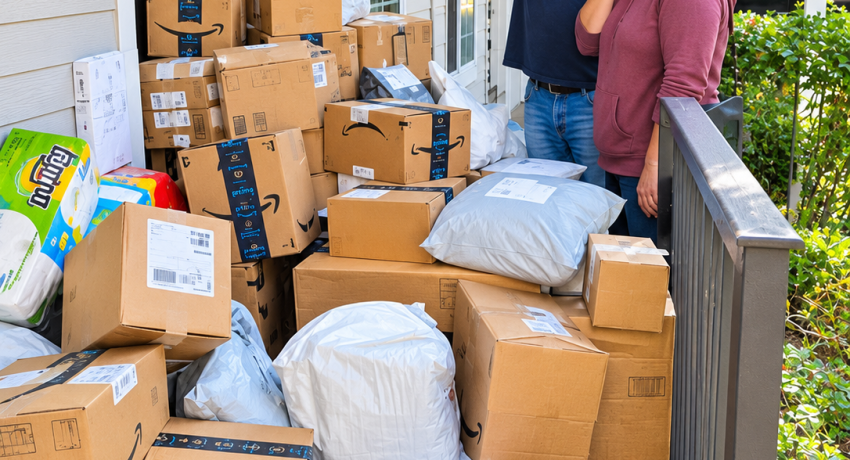
Packages were everywhere.
Boxes were piled up along the wall outside her apartment. Shopping bags covered the welcome mat, while smaller padded envelopes had been squeezed into every available space between them, as though someone had tried to cram as many deliveries as possible into the narrow hallway.
My brother suddenly stopped on the top step, and I nearly bumped straight into him.
“What in the world?” Ben whispered.
I stepped around him and froze.
There must have been thirty packages, possibly even more. They occupied the entire carpeted area outside apartment 4C. One enormous box was propped against the doorframe. A department store shopping bag had fallen onto its side, with a piece of white tissue paper poking out.
Our mother had been gone for seven days.
Yet someone had been buying things.
Mom wasn’t someone who spent money on unnecessary things. You need to understand that, otherwise none of what happened will make sense.
She wore sweaters she’d knitted two decades ago. The brown couch we’d grown up jumping on was still in her living room, complete with a burn mark on the left arm from the year Ben attempted to make s’mores using a candle. She continued using her grandmother’s dishes, decorated with tiny blue windmills, because, as she always said, “There’s nothing wrong with something that’s perfectly good.” When her toaster stopped working, she repaired it with a paper clip and used it for another six years.
“Maybe someone sent her gifts to express their sympathy?” Ben suggested.
I crouched down and examined the closest label.
“No,” I replied. “These came from stores.”
I picked up another package and checked its label, then examined a third.
Nearly every single delivery carried her name. Ruth Callahan, 4C.
Our mother’s name, printed clearly on one package after another.
I reached into my coat pocket and took out her keys. They were attached to a key ring with a tiny plastic strawberry Ben had given her when he was seven.
“I’m going to open one,” I said.
Let me explain how we got here.
My name is Claire, and I’m thirty-four years old. My brother Ben is thirty-eight. Our father walked out when I was three and Ben was seven. After that, it was just the three of us. Mom spent twenty-six years working at the county library. She brought us up in a small rented house on Hadley Street. Once we had both grown up and moved away, she relocated to this apartment on the fourth floor of a brick building along Crestview Avenue.
She had lived there for fifteen years. She always said it was just the right size. “Two bedrooms,” she’d tell us. “One for me and another for whichever one of you turns up hungry.”
Around two years earlier, her heart began to fail.
At first, the changes were gradual. Walking upstairs became exhausting. Eventually, she needed to pause on the landing. Then her ankles started swelling, and the doctor explained several medical terms that I had to research afterward. Soon, there were medications, doctor’s visits, and even more appointments.
We understood that her condition was deteriorating. We weren’t completely unaware of what was happening.
Still, neither of us thought we’d lose her this quickly.
She was admitted to the hospital toward the end of September. She remained there for nearly three weeks.
Even while lying in that hospital bed, with tubes attached to her arm and a monitor beeping beside her, she continued acting like our mother.
“Claire,” she said one afternoon, “I hope you’re eating something other than sandwiches.”
“I eat plenty of other things.”
“Give me an example.”
I paused to think. “Soup.”
“From a can?”
“It’s still soup, Mom.”
She shut her eyes and let out a disappointed sigh, as though I’d somehow let down every woman in our family for the past four generations.
A moment later, she opened her eyes and turned toward my brother, who was slumped in the plastic chair beside the window.
“And Ben, you look completely worn out. Have you been getting any sleep?”
“I’m sleeping just fine.”
“You’ve got dark circles under your eyes like a raccoon.”
“Appreciate that, Mom.”
We both laughed. Ben and I sat there laughing in that hospital room. Our mother was lying in a bed with a failing heart, yet her biggest concerns were whether I was eating properly and why Ben looked so tired.
That was exactly who Mom was.
She also made sure to give us instructions about her apartment.
She did this on one of her last good days, when she was sitting upright in bed and sipping apple juice through a bendable straw.
“The spare keys are in the kitchen drawer,” she told us. “The drawer beside the stove. They’re with the rubber bands.”
“All right, Mom.”
“And don’t get rid of Grandma’s plates.”
“We would never throw away Grandma’s plates.”
“Ben probably would.”
“I absolutely would not!” Ben protested from his chair.
“You tried donating them to Goodwill back in 2009.”
“I was moving! I thought we had extra ones!”
“There is no such thing as having extra windmill plates,” Mom replied before taking another sip of apple juice with a look of complete dignity.
I assured her that we’d handle everything. I promised we’d look after it all. I said those things as though we were talking about something that would happen sometime in the future. As though she’d be back home in a week, showing us where everything belonged.
I simply hadn’t imagined having to do it without her.
She passed away on a Tuesday morning, shortly after six. Ben was beside her. I was downstairs in the cafeteria buying coffee. It’s something I’ve had to learn to live with.
Her funeral took place on Saturday. The library closed early so her former colleagues could attend. Almost everyone from the building came. Mrs. Okafor, who lived across the hall, baked a lemon cake so enormous that two people had to carry it inside.
Then, the following Tuesday, exactly seven days after Mom’s death, Ben and I drove over to Crestview Avenue. The trunk was packed with empty cardboard boxes because we’d decided it was time to begin sorting through her belongings.
We remained in the parking lot for ten minutes, neither of us making a move to get out.
“Do you really think we’re ready for this?” Ben asked.
I raised my eyes toward the fourth floor and looked at her kitchen window. The blinds were partly open, just as she’d always kept them, allowing the afternoon sunlight to reach her spider plant.
“No,” I answered. “But we need to begin somewhere.”
Ben climbed out first. He gathered the empty boxes from the trunk and held them against his chest like a shield.
“Let’s go,” he said.
Together, we climbed the stairs. Mom had walked up and down those same steps every day for fifteen years, even during the times when her heart forced her to stop at every landing.
And then we reached her floor.
That’s when we stopped.
I was still crouching in the hallway, clutching her strawberry keychain and pulling the packing tape off the nearest package.
It was an ordinary medium-sized cardboard box. Taking one of her apartment keys, I used its edge to cut through the tape before opening the flaps.
Inside was a mixing bowl, carefully wrapped in brown packing paper.
It was made of blue ceramic, a deep shade of blue resembling the sky just before nightfall. The inside had a glossy finish, and a thin white stripe circled its rim.
I carefully lifted it out with both hands.
At the bottom of the box, underneath where the bowl had been resting, was a card inside a white envelope.
I recognized the handwriting immediately, even before turning the envelope around. The letters were curved and slightly shaky toward the ends, and every letter i had a little circle above it. It was the very same handwriting she’d used on every lunch bag, permission slip, and birthday card throughout my childhood.
For Claire’s birthday. Please open on the day.
My birthday was only three weeks away.
The envelope hadn’t been sealed. Its flap was simply folded underneath.
I knew I was supposed to wait. The message clearly said so. But I was sitting on the floor in a hallway, just one week after losing my mother, holding a blue mixing bowl. I couldn’t bring myself to wait another three weeks to hear from her.
I carefully pulled the card out.
My sweet Claire,
I hope I’ll be there to make your birthday pancakes. But if that isn’t possible, I want you to have this.
You always adored the blue bowl we used when you were a little girl. I accidentally broke it years ago, and I could never find another one quite like it.
At last, I found one.
Love, Mom.
I felt as though I couldn’t draw another breath.
I remembered that bowl. I hadn’t given it a thought in twenty years, but reading those words brought the memory rushing back. I could picture the old blue bowl sitting on the kitchen counter in our Hadley Street house. Every birthday morning, Mom would mix pancake batter in it. She’d let me taste whatever remained on the spoon. I’d sit on the counter wearing my pajamas, swinging my little legs while watching the batter swirl around.
She accidentally dropped the bowl when I was eleven. It broke into pieces across the kitchen floor. I cried harder that day than I had when our hamster died.
For years afterward, she’d searched for another one. She checked garage sales and antique stores. I’d completely forgotten about it. But she’d never given up looking.
Ben moved closer to me.
“What does it say?”
I handed him the card. He took it and read it once. Then he went through it again, taking his time.
“She ordered this for your birthday?”
I nodded. Tears were dripping onto the bowl. I brushed them away with my sleeve, as if they could somehow leave marks on it.
“She knew,” I murmured.
“Knew what?”
I glanced at all the packages surrounding us. Some were stacked beside the wall, others crowded around the entrance. There were more than twenty still waiting to be opened.
“She knew there was a chance she wouldn’t make it back home.”
We remained seated on the hallway floor for what felt like forever. I honestly couldn’t tell you how much time passed.
The bowl rested in my lap. Ben sat against the wall with his knees drawn up, looking at the packages as though they might suddenly begin speaking.
Mom had never mentioned that she was preparing for the possibility of her death.
Not a single time.
Whenever we visited her at the hospital, she always found something ordinary to discuss. The weather. Whether Thursday would bring rain. How Mrs. Okafor’s grandson had managed to get into college. Whether Ben had finally repaired the leaking faucet in his kitchen.
“It’s still dripping, isn’t it?” she’d ask.
“It’s hardly dripping anymore.”
“Benjamin.”
“It’s all right, Mom.”
I’d assumed she was simply trying to remain cheerful. She wanted to keep our conversations pleasant and prevent us from feeling discouraged.
But now I couldn’t stop wondering how much she’d concealed from us. And how long she’d been carrying it alone.
“Do you think we should open another package?” Ben asked softly.
I lowered my eyes to the birthday card resting in my lap. Please open on the day.
“I don’t think we should,” I replied. “Some of these might be intended for a later occasion.”
He slowly nodded.
“Fair enough,” he said. “At least let’s bring everything inside before someone decides to take it.”
We started moving the packages into the apartment.
It took six trips for each of us. Ben handled the larger boxes while I carried the shopping bags.
The apartment still smelled like her. Lavender soap, aging books, and that familiar scent that was simply Mom. It reminded me of a sweater that had gone through the washing machine a hundred times.
Her reading glasses were resting on the little table beside the couch. They were folded neatly on top of a library book. The return date was only two days away. I reminded myself to take it back. It’s strange how your mind focuses on such insignificant things when the important ones are too painful to face.
Her knitting basket was beside her favorite chair. A partly completed sweater was resting on top. It was dark green, with one sleeve finished. Her knitting needles were still pushed through the yarn, exactly where she’d stopped working.
On the kitchen counter was her favorite coffee cup. It was white, with a small chip in the handle and faded red lettering that read WORLD’S OKAYEST MOM. Ben had bought it for her as a joke when he was nineteen. She’d been drinking from it every morning ever since.
A dried coffee stain was still visible around the bottom.
I stood at the kitchen entrance, staring at that mug. For a moment, I honestly thought my knees might give way.
Ben walked in behind me carrying several boxes. He noticed what had caught my attention. He didn’t ask anything or say a word. As he passed, he simply placed a hand on my shoulder.
Then he silently carried the remaining packages into the living room and arranged them in a neat row against the wall beneath the window.
We counted all the deliveries.
Twenty-eight in total.
Most had arrived while Mom was spending her final weeks in the hospital. They’d been left outside her apartment for several days. A few had small notes attached from the building manager explaining that they’d been kept at the front office before being brought upstairs that morning.
“She probably placed these orders before she was admitted,” Ben said.
I examined several of the delivery labels. Some showed order dates from early September. Another had been ordered toward the end of August.
“A few of these were ordered nearly a month ago,” I said. “Before she went into the hospital. Before her condition even became serious.”
Ben turned toward me.
“She’d already started preparing,” he said. “Before either of us had any idea.”
That evening, I returned to my own apartment, but sleep wouldn’t come.
I lay in bed, staring at the ceiling, unable to stop thinking about August.
I’d accompanied Mom to her cardiologist’s appointment that month. I’d spent an hour sitting in the waiting room, responding to work emails on my phone. When she finally came out, she seemed unusually quiet. I asked her what the doctor had told her.
“Oh, nothing different,” she’d replied. “Keep taking my medication. Put my feet up. Stay away from too much salt.”
“That’s all?”
“That’s all, sweetheart. Now let’s go have lunch. It’s my treat.”
We drove to the diner on Fourth Street. She ordered a grilled cheese sandwich and a strawberry milkshake. An entire milkshake. She almost never ordered those. She always complained that spending four dollars on one was a waste of money.
But that afternoon, she finished every drop.
At the time, I’d found it a little unusual. I was so caught up with work that I hadn’t given it another thought.
Now, lying awake in the darkness, I finally understood what the doctor must have told her that afternoon.
And I began to understand how she’d responded to the news.
She’d treated herself to a strawberry milkshake. Then she’d returned home and started placing shopping orders.
We returned to the apartment the following day, and then again the day after that.
Our first genuine discovery came on Thursday, inside her kitchen drawer.
The drawer beside the stove. The one with the rubber bands. Exactly where she’d told us we’d find the spare keys.
The keys were inside. Lying beside them was a folded piece of lined paper.
I opened it carefully.
At the top, written in her familiar, looping handwriting, were the words: Packages for Claire and Ben.
Underneath was a list containing dates, shop names, and brief descriptions of different purchases.
Claire’s birthday: blue bowl.
Ben’s birthday: woodworking tools.
Christmas: two packages. (One each. NO PEEKING.)
Ben — Feb. Scarf. He never wears one.
Thanksgiving: pans. Claire’s turn to host.
At the very bottom of the page, there was a final note with two lines drawn beneath it:
Open together: last.
Ben was looking over my shoulder as I read the list. His eyes stopped at the second entry.
“Woodworking tools?” he asked.
“You used to build furniture.”
“That was a long time ago.”
“So what?”
He didn’t respond. Instead, he walked toward the window and stared out at the parking lot.
Ben had once been incredibly talented. I mean genuinely talented. During his twenties, he worked in a cabinet-making shop. On weekends, he’d drive around visiting construction sites and estate sales, collecting discarded pieces of old wood. Barn planks. Damaged church pews from a church that had shut down. Even an old oak door salvaged from a schoolhouse that had been demolished.
He could transform all of it into something wonderful. Dining tables. Bookshelves. Rocking chairs. He’d even made a beautiful rocking chair for Mom, where she spent every evening sitting until the problems with her back became too painful.
He used to dream about starting his own workshop. Nothing fancy, just a small place where he could make custom furniture. He’d even chosen a name for the business: Callahan & Sons. He didn’t have any sons, but he always said the name sounded traditional and dependable.
Then the cabinet shop went out of business, and he lost his job.
Eventually, he found other employment. He started working in warehouse logistics, where the pay was better. But the shifts lasted ten hours, sometimes twelve. By the time he returned home, he was so exhausted that he’d sometimes fall asleep while sitting upright.
His woodworking equipment ended up in his garage. It had remained there ever since, collecting dust beneath a blue tarp.
Mom never stopped asking him about his projects whenever they saw each other.
“Have you made anything lately, Benny?”
“I’m too busy, Mom.”
“Too busy to do something that makes you happy?”
“I’m too busy to do anything at all.”
“Perhaps she was hoping you’d give it another try,” I said.
Ben shook his head, still facing the window.
“She shouldn’t have wasted her money on me.”
That was such a typical thing for Ben to say.
There was something I had never told anyone, something Ben had never openly discussed either. For the past year, he’d been covering most of Mom’s grocery expenses. He’d also been paying for some of her medications. I’d discovered the receipts once while looking through her purse. Each one had his initials written in her handwriting, followed by the words B paid.
He’d continued helping her even when his own finances were stretched thin. Even when his car desperately needed new brakes and he’d kept driving it with faulty ones for two whole months.
“She wanted to do it,” I told him.
He said nothing.
His eyes remained fixed on the window.
We agreed to arrange the packages according to their dates. We’d open the ones meant for occasions that had already passed, along with anything we couldn’t identify.
Some were easy to connect to the list she’d left behind. There was a collection of nonstick baking pans intended for Thanksgiving. A heavy gray wool scarf inside a gift box, with Ben — February written across its lid. There was also a package containing Christmas decorations, little glass birds with actual feathers for tails. We placed that one aside without opening it.
However, several packages didn’t correspond to anything on her list.
One contained fabric. There were several yards of cotton material, matching spools of thread, and three sewing patterns inside their original paper envelopes. They were all designs for simple dresses.
Another box held a watercolor painting set. It wasn’t an inexpensive children’s kit. It was a proper artist’s set, stored in a metal case, with twenty-four small blocks of paint, two quality brushes, and a pad of heavy watercolor paper.
A third package contained a wooden birdhouse-building kit. It was designed for someone to assemble themselves, complete with a small roof, a circular entrance, and a tiny wooden perch.
Ben lifted the birdhouse kit and examined it.
“Did Mom suddenly decide to take up a dozen different hobbies?” he asked.
I reached for the fabric.
It was a lovely piece of soft cotton, white with tiny yellow flowers scattered across it. Perhaps daisies. Small yellow centers surrounded by delicate white petals.
My stomach suddenly felt tight.
I recognized that design.
Back when I was a teenager, sewing had been my favorite thing to do. Mom owned an old Singer sewing machine that she’d inherited from her own mother. When I turned twelve, she taught me how to operate it. After that, I became completely obsessed. I turned old curtains into skirts, made bags from discarded jeans, and created blouses using leftover fabric scraps from the craft store’s remnant section, where everything cost a dollar per yard.
Most of my creations were pretty awful. The seams were uneven, the hems went crooked, and the buttons never quite matched their buttonholes.
But Mom saved every single thing I made.
My dream had been to become a fashion designer. I filled entire sketchbooks with clothing designs. I enrolled in every art class my high school offered. Eventually, I applied to a design program in Chicago and was accepted.
Then I considered the tuition. I thought about Mom’s salary from the library. In the end, I chose the state university and studied business administration instead. It seemed like the sensible decision.
After graduating, I accepted an office position handling scheduling for a medical supply company. The salary was dependable, the job included health insurance, and everything was perfectly acceptable.
I kept promising myself that one day I’d return to sewing.
Then Mom became ill.
My evenings gradually filled with driving her to medical appointments, collecting her prescriptions, sitting beside her in waiting rooms, and washing her clothes whenever she couldn’t manage to carry the laundry basket downstairs to the basement.
My sewing machine eventually ended up inside the hallway closet, tucked behind the vacuum cleaner.
I hadn’t used it once in two years.
“Claire?” Ben called.
I realized I’d been standing there motionless, still holding the fabric.
I turned it around so he could get a better look.
“I made Mom an apron using this exact pattern,” I told him. “It was when I was sixteen. This is the same fabric.”
He studied it briefly before smiling.
“The one with the crooked pocket?”
“She wore that apron for years.”
“She always claimed the pocket was meant to be crooked,” Ben said. “She even told Aunt Linda it was an intentional design feature. Linda actually believed her.”
I laughed.
But halfway through my laughter, the tears started coming again. I couldn’t hold them back. They escaped in little bursts, almost like hiccups.
Mom had remembered something I’d nearly forgotten about myself.
She must have searched everywhere for that material. Somewhere online, most likely, sitting in front of her old laptop with her reading glasses perched at the end of her nose. Somehow, she’d managed to find the exact fabric pattern from an apron I’d made when I was sixteen.
Ben put the birdhouse kit down, walked over, and wrapped an arm around my shoulders.
We remained there in the living room, surrounded by twenty-eight packages, while I cried against his shoulder.
By Saturday, we finally gathered the courage to begin sorting through Mom’s bedroom.
I’d been putting it off. I think Ben had been avoiding it too. We kept finding excuses to organize the kitchen or deal with the hallway closet instead.
But eventually, there was no more avoiding it.
Her bed was neatly made. Naturally. She had made her bed every morning for as long as I could remember, including the morning she was taken to the hospital. The quilt was perfectly straight, and her pillow still held a small indentation.
On the bedside table sat a lamp, a glass of water with a thin layer of dust on its surface, a bottle of hand cream, and a little spiral notebook with a green cover.
Ben picked up the notebook.
He opened it and started looking through the pages.
“Shopping lists,” he said. “Delivery dates, too. And order reference numbers.”
He turned several pages.
Then he suddenly stopped.
“Claire,” he said. “You need to see this.”
Scattered among her shopping lists, written in the margins in her familiar looping handwriting, were little observations.
Things she’d written about us.
Ben keeps saying he’s okay, but he looks exhausted.
Claire hasn’t talked about sewing for months.
Ben fell asleep in the chair again. Third visit in a row.
Claire spent the entire time answering work emails at Dr. Mehta’s. She didn’t even look up when they called my name.
I read that last entry twice. I could feel my face growing hot.
Then I noticed another note written by itself near the bottom of a page:
They keep asking what I need. I wish they’d tell me what they need.
I lowered myself onto the edge of her bed.
I read those words over and over again.
I turned to the next page.
Ask Ben about his workshop.
Look for Claire’s old drawings. (Hall closet? Box marked SCHOOL?)
Yellow daisy fabric — found it! $6.49/yd. Order 3 yds.
Blue bowl — keep searching. (Check estate sale site again.)
Watercolors — for me. It’s my turn.
Birdhouse — build with Ben in spring. If I’m home.
I covered my mouth with one hand.
There were many more entries. Entire pages filled with little reminders about our birthdays, our favorite meals, and the things we enjoyed. She’d even written down Ben’s fondness for burnt toast, something that had always horrified her, and my awful habit of having cereal for dinner. There were things we’d said during hospital visits that I couldn’t even remember mentioning.
One particular visit came back to me as I read through her notes.
It had been a Wednesday afternoon. I’d arrived directly from work, still wearing my employee lanyard. Mom was sitting upright in her hospital bed when she suddenly asked, “Are you still drawing clothing designs, sweetheart?”
“Not much anymore,” I’d replied.
“How come?”
“Things get busy, Mom.”
She’d watched me silently for quite a while. There was disappointment in her expression. Not anger, just sadness. The same look she’d given me years ago when I’d brought home a B-minus on a test I hadn’t bothered studying for.
I’d assumed she was simply feeling nostalgic. Maybe getting older had made her think more about the past.
But now, sitting on her bed with that notebook resting in my hands, I finally understood.
She’d been concerned about me.
Beside the date of that hospital visit, she’d written: Not much anymore. Things get busy. — C. Below it, the words were written with such pressure that the pen had nearly torn through the paper:
That’s not good enough.
Ben carefully took the notebook from my hands.
He lowered himself onto the bed beside me.
“She paid attention to everything,” he said.
“Apparently, she did.”
He turned another page.
Then I noticed his expression suddenly change.
“What is it?” I asked.
He didn’t respond. Instead, he handed the notebook back and pointed toward the top of the page.
There, written neatly in her best handwriting, as though she’d taken extra care to get every word right, was a sentence:
They’ve both been putting their lives on hold. I don’t want them doing that forever.
I glanced toward her empty side of the bed. Toward the little hollow in her pillow.
She had been the one suffering from the illness. She had been the one facing death.
Yet she’d spent whatever energy she had left worrying about the way her condition was affecting us.
Ben leaned forward, resting his elbows on his knees while staring down at the carpet.
“There’s something I never told you,” he said.
I waited for him to continue.
“I turned down a job offer last spring,” he explained.
I looked at him in surprise. “What job?”
“A really good one. Assistant manager at a custom furniture company in Grand Rapids. They specialize in expensive, high-quality pieces. Dining tables, built-in bookshelves, things like that. Someone there had come across photographs of my old work online and contacted me.” He shrugged. “The salary was better, the hours were more reasonable, and I’d actually be working with wood again. They even said I’d have the opportunity to create some of my own designs.”
“Ben, why on earth didn’t you accept it?”
“Because it was in Grand Rapids, Claire. Three hours away.” He turned and looked directly at me. “I couldn’t walk away while Mom was sick.”
I just stared at him.
“You never mentioned any of this,” I said.
“Neither did you,” he replied.
“Neither did I what?”
“Tell me you stopped applying to design schools.”
My cheeks grew warm.
“How did you find out about that?”
“Mom told me,” Ben explained. “It was last year. She said you were considering going back to school. Maybe enrolling in a part-time course with evening classes. She was absolutely thrilled about it. She brought it up at least three different times.”
“I was,” I admitted quietly. “I’d completed the application and even chosen the work for my portfolio. Then her appointments started becoming more frequent. After that, she lost the ability to drive. I kept thinking, how could I attend classes three evenings every week when she needed me on Tuesdays and Thursdays?”
“So you never submitted the application.”
“I never submitted it.”
Ben lowered his eyes and stared at his hands.
“I honestly thought you were managing fine,” he said.
“I thought you were doing fine too.”
We remained seated on our mother’s bed.
For months, we’d kept checking on each other, asking whether either of us needed anything.
Are you okay?
I’m fine. How about you?
Yeah, I’m doing fine.
It happened during every phone conversation, every hospital visit, and every time we crossed paths in the parking garage. No matter what was happening, we’d always given each other the same answers.
And neither of us had been telling the truth.
Suddenly, I remembered something Mom had said during one of her final visits in the hospital. It was late in the evening. Ben had gone downstairs to move his car, and I was adjusting her pillow.
She reached out and gently grabbed my wrist.
“Claire,” she said, “you and Ben don’t need to hide everything from each other just to protect one another.”
I dismissed it. “We don’t do that, Mom.”
“Oh, yes, you do,” she replied. “You’ve been doing it ever since you were children. Both of you believe that telling the other person when something is wrong will only make things harder. That’s not true. Sharing the burden makes it easier to carry.”
I smiled and encouraged her to get some rest.
I hadn’t truly understood what she was trying to tell me.
But now, her words meant something entirely different.
“She knew we’d both been pretending everything was okay,” I said.
Ben slowly nodded.
“She’d known all along,” he replied.
Our first genuine argument happened that Sunday.
It started over the dishes.
We were standing in the kitchen, emptying her cupboards. Ben wrapped the dishes in newspaper and placed them into boxes labeled DONATE. I did exactly the same thing, except my boxes were marked KEEP.
After roughly an hour, I noticed something. My KEEP boxes were overflowing, while his DONATE boxes were barely half-full.
That was because I kept removing things from his boxes.
“Claire,” he said, “you can’t seriously keep her can opener.”
“Why shouldn’t I?”
“Because you’ve already got one.”
“But this one belonged to her.”
“It’s just a can opener. It barely works. You have to turn it in the opposite direction.”
“That’s how she always used it.”
He lifted another box. “What about her measuring cups? You’ve got your own. And all these dish towels? You already have six. What about that spatula with the melted handle?”
“I’m keeping those too.”
“Where exactly do you plan to store everything? You live in a one-bedroom apartment. Your kitchen is practically the size of a bathtub.”
“I’ll find somewhere.”
“Claire.”
“I am not putting her belongings in a dumpster, Ben!”
The words came out far louder than I’d intended.
He lowered the box onto the floor.
“I never said anything about a dumpster,” he replied quietly. “I said we could donate them. Someone else might actually need them.”
“I don’t want anyone else using her things! I want them to stay hers!”
My voice broke. I turned away and stared through the kitchen window so he wouldn’t see my expression.
Ben remained silent for quite some time.
Finally, he said, “They’re not hers anymore, Claire. That’s what makes all of this so difficult.”
I left early that afternoon without saying goodbye.
I sat inside my car in my own parking lot, with the engine switched off, for twenty minutes. My phone vibrated. Ben had sent me a message.
I’m sorry. Really sorry. I shouldn’t have spoken to you that way.
I left it unanswered.
About an hour later, another message came through.
You can keep the can opener.
Sitting alone in my car, I suddenly burst out laughing. Then I spent some time crying before finally replying.
I’m sorry too. I’ll reconsider the spatula.
We discovered the letter on Monday evening.
We’d returned after work to finish clearing out the kitchen. Neither of us mentioned what had happened on Sunday. We simply acted as though everything was normal. That’s how the Callahan family handles things. Mom used to joke that we could argue over breakfast and be happily passing the butter to one another by lunchtime.
Her old recipe binder was sitting on the shelf above the stove. It was a battered three-ring folder, falling apart at the edges and stuffed with handwritten notes, index cards, and pages torn from magazines.
I pulled it down to pack it away. As I held it, the binder suddenly opened.
It landed on the recipe for birthday pancakes.
There was her handwriting, a grease mark in one corner, and a tiny drawing of a smiling sun.
Behind the plastic cover, tucked directly behind the recipe, I spotted an envelope.
Written across the front were the words:
For my two favorite people. Read together.
Ben was standing across the kitchen, carefully wrapping drinking glasses in newspaper. He noticed my expression and immediately put down the glass in his hands.
“What happened?”
I raised the envelope so he could see it.
He walked over and took the seat beside me at the kitchen table. Her kitchen table. The very same table where we’d done our homework back on Hadley Street. The old ink marks from my glitter pens were still visible in the wood.
I slowly opened the envelope. My fingers were trembling.
Inside were three pages of paper, folded into thirds. Every word was written in her handwriting.
I began reading aloud.
My precious Claire and Ben,
If you’re reading these words, I hope you’re sitting beside each other. And I also hope you haven’t had an argument over who gets Grandma’s plates.
Ben let out a quiet laugh before turning toward me.
“We actually fought over a can opener,” he said.
“Be quiet,” I replied, although I couldn’t help smiling.
Then I continued reading.
I imagine the packages must have caught you by surprise. I’ve been arranging them for quite some time. Since August, actually. Since Dr. Mehta sat me down and explained some things I chose not to share with either of you.
I’m sorry for keeping it from you. I want you to understand my reasons. It wasn’t that I didn’t trust you. Quite the opposite. I knew exactly how you would react. You would abandon everything, put your own lives aside, and devote yourselves entirely to looking after me. I’d already watched both of you do that for two whole years.
So instead, I ordered myself a strawberry milkshake. Then I returned home and started writing a list.
I paused, unable to continue for a moment.
“The diner,” I whispered. “That day in August. She finished the entire milkshake.”
Ben gently tightened his fingers around mine.
I continued reading.
Initially, my only intention was to make sure you would still have birthday and Christmas presents for the occasions I might not be around to celebrate. That was all I had planned. A mixing bowl for Claire. Some woodworking tools for Ben. A few things to put beneath the Christmas tree.
But as I spent more time thinking about it, I came to understand that leaving you presents wasn’t really the most important thing I wanted to do.
What I truly wanted was to help you remember the people you used to be, before caring for me became the center of your lives.
I stopped reading.
I simply couldn’t go on.
Ben reached across the table, took my hand once more, and held it tightly. He didn’t offer any words. He just stayed there, holding my hand.
After a little while, I gathered myself and continued.
Claire, I haven’t forgotten the first dress you ever made. You were thirteen years old. It was purple with orange polka dots, and honestly, it was the ugliest dress I’d ever laid eyes on. But you were so delighted with it that you wore it to the grocery store, even though one sleeve was two inches longer than the other. When the cashier complimented it, you proudly told her that you’d made it yourself. You stood there with your back straight and your head held high.
I want you to feel that proud of yourself again.
Ben, I still remember the little wooden shelf you made for me when you were fourteen. You spent three weekends working on it in the garage. You kept insisting that it was perfectly straight and level.
It wasn’t. My spice containers slid toward the left for eleven whole years.
I kept it anyway. It’s still in the hallway closet. You can take it home. Perhaps you can make it level this time.
Ben made a strange noise, somewhere between laughter and a sob. He brushed his face with the back of his hand.
I know both of you have sacrificed things because you wanted to stay close to me. Ben, I know about the opportunity in Grand Rapids. Your friend Danny mentioned it during the Fourth of July picnic. He assumed I’d already heard about it.
Claire, I know about your application too. I discovered it in your car when you took me to my eye appointment. Everything was completed. The postage was on it. But you never put it in the mail.
I love you both for making those sacrifices. I love you more deeply than I could ever put into words.
But I don’t want you spending the rest of your lives trying to prove your love for me by refusing to follow your dreams.
My voice completely gave out.
I placed the letter on the table. My eyes were so full of tears that I couldn’t make out the writing anymore.
Ben picked it up and began reading the final page himself. His voice sounded strained and unsteady. It trembled as he spoke, but he continued.
You don’t need to hold on to every single thing in this apartment. Most of these belongings are just objects. Keep Grandma’s dishes, the recipe binder, and whatever brings happiness to your heart. Give everything else to someone who could use a can opener.
A strange noise escaped my throat, somewhere between laughing and crying.
“How could she possibly know?” I whispered.
“She knew everything,” Ben answered, continuing to read.
You shouldn’t feel guilty about laughing, celebrating, or enjoying yourself. You don’t need to feel bad if an entire day passes and you suddenly realize you haven’t thought about me. That doesn’t mean you’ve forgotten me. It means you’re living your life. And that’s exactly what I want.
You also don’t have to pretend everything is fine simply because you don’t want the other person to worry. I watched both of you doing that for two whole years. It hurt my heart even more than the illness had already hurt it.
Look after yourselves. And always look after one another.
I’ll always be your mother, whether you’re making pancakes in my kitchen or creating entirely new lives somewhere far away.
I love you both more than you could ever imagine.
Mom.
P.S. Ben, please repair that faucet.
Neither of us said anything for several minutes.
The refrigerator was humming in the background. Someone was moving around in the apartment upstairs. Outside, a car passed with its radio playing.
Ben carefully refolded the letter along its original creases. He slipped it back into the envelope and placed it on the table between us.
“I always believed that moving away would mean abandoning her,” he finally said.
I turned toward him.
“You mean Grand Rapids?”
He nodded.
“Even after she became ill, she kept encouraging me to apply for different positions,” he explained. “She’d send me advertisements for jobs. Furniture workshops, restoration businesses, places in other states. I thought she simply didn’t understand how serious her condition had become. How sick she really was. I assumed she believed she had plenty of time left.”
“She understood,” I replied.
“She understood more than I ever did,” Ben said.
My eyes wandered toward the yellow daisy fabric, which was still folded on the kitchen counter where I’d left it.
“I kept telling myself I’d return to sewing once things finally calmed down,” I said.
“What about now?”
“I honestly don’t know.”
He nodded.
“Neither do I.”
For the first time, neither of us tried to pretend we had everything figured out.
We simply remained seated together at her kitchen table. The room was dark because neither of us had bothered getting up to switch on the light.
After some time, Ben stood up and headed toward the hallway closet.
I could hear him moving things around inside. Coats rustled, the vacuum cleaner shifted, and a box of Christmas lights was pushed aside.
A moment later, he returned carrying a small wooden shelf.
It was made of pine, roughly two feet in length, with a pair of little brackets underneath. Someone had painted it white years ago, although the paint had gradually worn away along the edges.
He placed it on the kitchen table. Then he reached for a marble from the bowl on the counter. Mom always kept a bowl full of marbles there, although none of us had ever understood why.
He positioned the marble on top of the shelf.
Slowly, it began rolling toward the left. It traveled all the way to the edge.
Clink.
Ben watched it for a moment.
Then he suddenly burst into laughter. He laughed so uncontrollably that he had to sit down. He continued laughing until tears started running down his face. Eventually, the laughter disappeared, leaving him crying with his head buried in his hands.
I stood up and wrapped my arms around my older brother.
And this time, he allowed me to hold him.
Before heading home that evening, we returned to the list Mom had left behind.
There was still one instruction we hadn’t followed.
Open together: last.
We searched through the remaining packages in the living room using a flashlight. The ceiling lightbulb had burned out, and neither of us had remembered to purchase a replacement.
Toward the bottom of the stack, tucked behind the Christmas decorations, we discovered a large cardboard box. It was noticeably heavier than all the others.
Across its top, written in black marker in Mom’s familiar handwriting, were the words:
CLAIRE & BEN. TOGETHER.
We brought the box into the kitchen and placed it on the table.
Ben turned to look at me.
“You open it,” he said.
I sliced through the tape.
Inside were a bag of flour, a bag of sugar, a box of baking powder, a small bottle of quality vanilla extract, a tin of cinnamon, and a little jar of genuine Vermont maple syrup, the expensive variety, tied with a ribbon around its neck.
There were two matching aprons, blue and white striped. One had CLAIRE stitched onto the pocket in yellow thread. The other had BEN.
At the very bottom, wrapped in tissue paper, was a small photograph in a frame.
I recognized the picture as soon as I laid eyes on it.
It had been taken in the kitchen on Hadley Street one Saturday morning. I must have been about six, and Ben was ten.
I stood on a step stool beside the stove, wearing pajamas decorated with cartoon cats. There was a large patch of flour on my nose.
Ben stood beside me, holding a wooden spoon above his head like a sword, pretending to be a pirate. His hair stuck up at the back, and one of his front teeth was missing.
Mom stood between us in her bathrobe, laughing with her head tilted back and her eyes squeezed shut. She was laughing so hard that I could almost hear the sound just by looking at the picture.
I hadn’t seen that photograph in twenty years. I hadn’t even realized she still had it.
Beneath the picture was another note.
Do you remember Saturday mornings?
You two were always arguing about who got to stir the pancake batter. Afterward, you’d eat so many pancakes that neither of you had any room for lunch.
I hope you make them together again someday.
And if the first batch gets burned, make sure you blame Ben.
Ben burst out laughing.
“She never forgot that,” he said. “Not once. For thirty years.”
When Ben was nine, he’d decided to prepare Mother’s Day breakfast without waking Mom. He dragged over the step stool, found the mixing bowl and took out the frying pan. What he didn’t know was that the pan needed oil, or that the burner shouldn’t be turned all the way up.
Every pancake he made ended up burned. The smoke alarm started blaring. Mom rushed out of her bedroom in her nightgown, waving a dish towel toward the ceiling. There was Ben, standing in a cloud of smoke, holding a spatula with a blackened pancake stuck to it.
“Happy Mother’s Day,” he’d announced.
From that day on, she brought it up every single year.
I picked up the aprons and held one out toward him.
“Want to give it a try?”
Ben glanced around the apartment. His eyes moved over the boxes that were only half packed, the empty bookshelves, and the dark living room where the lightbulb had burned out.
“Now?” he asked.
“Why not?”
He studied me for a moment.
Then a smile spread across his face.
“Okay,” he said.
We took Mom’s old frying pan from the cupboard. It was made of cast iron, black and as heavy as a brick. She had cooked with it every Saturday for thirty years.
I retrieved the blue bowl from the box I’d packed on our first day there. My birthday bowl.
“Your birthday hasn’t come around yet,” Ben said.
“She wouldn’t mind,” I replied.
“No, she wouldn’t,” he said.
Ben measured out the flour while I prepared the batter in the blue bowl. We put on our aprons. His hung too short, while mine was much too long. We looked completely ridiculous.
We disagreed over the amount of milk. The recipe card called for one and a quarter cups, but Mom had always added “just a little extra splash.” Neither of us could agree on what counted as a proper splash.
“Claire, that’s a whole flood. It isn’t a splash.”
“She always made them thin.”
“She made them fluffy.”
“They were thin and fluffy.”
“You can’t have both.”
Ben decided the frying pan wasn’t hot enough and turned the burner higher.
“Ben, don’t.”
“It has to get hot.”
“That’s exactly what you said in 1997.”
“I was nine years old!”
“And you’re still hopeless in the kitchen!”
Naturally, the first pancake burned.
It started smoking. The bottom turned completely black while the middle remained uncooked. Ben tried to flip it with the spatula, but it landed halfway off the pan and folded in on itself like a miserable little blanket.
We stood there staring at it.
Then we both burst into laughter.
I laughed so hard that I had to sit on the kitchen floor. Ben rested against the counter, covering his face with one hand. The smoke alarm began screaming. He grabbed a dish towel and waved it toward the ceiling, just as Mom always had, which sent me into another fit of laughter.
Mrs. Okafor, who lived across the hall, knocked on the door to check that nothing was burning.
“It’s only Ben,” I called through the door. “He’s making pancakes.”
“Oh, honey,” Mrs. Okafor answered. “Your mother told me all about that.”
For a little while, the kitchen seemed just as it had always been.
There was batter spread across the counter, flour dusting my apron, and Ben turning pancakes in the pan, gradually getting the hang of it. The air smelled of butter and cinnamon, and the small window above the sink was growing cloudy with steam.
For a few precious minutes, it was as though we were back on Hadley Street on a Saturday morning.
Then my eyes drifted toward the kitchen table.
Toward Mom’s chair. The one nearest the window, with the cushion she had sewn herself. The chair no one else had ever used.
It was empty.
The laughter disappeared from me in an instant.
Ben saw the change in my face. He lowered the burner, walked over, and sat down on the floor next to me, still holding the spatula.
“I miss Mom,” he said.
“I miss her too.”
We remained there quietly.
After a moment, he stood up. He placed the two nicest pancakes on one of Grandma’s windmill-patterned plates, drizzled some of the Vermont maple syrup over them, and brought the plate to my place at the table.
“I think she’d be glad we’re doing this,” he said.
I glanced at the photograph we had placed beside the stove. Mom stood there in her bathrobe, laughing.
“She’d be telling you to turn the heat down,” I said.
“She always did,” Ben replied.
We sat at Mom’s kitchen table and ate our pancakes. We used her plates, and the photograph sat nearby as if keeping us company.
I took my usual seat. Ben sat in his.
We kept Mom’s chair vacant. Neither of us mentioned it. There was no reason to.
For the first time since the funeral, I could talk about Mom without feeling as though every memory meant saying goodbye to her all over again.
We remembered how badly she sang along to the radio in the car. We laughed about the Halloween when she dressed up as a library book, but nobody could figure out what she was meant to be. We also remembered the time she drove four hours through a snowstorm to bring me soup when I caught the flu during my freshman year of college.
“Was it canned soup?” Ben asked.
“Homemade,” I answered. “She brought it in a thermos. She stayed for two nights and slept on my roommate’s beanbag chair.”
“That sounds like her.”
We stayed at the table until nearly eleven. Afterward, we cleaned the dishes and carefully dried Grandma’s windmill plates.
I didn’t keep the spatula with the melted handle.
I put it in the DONATE box.
During the weeks that followed, we opened the remaining packages according to the dates Mom had written down.
On my birthday, Ben showed up at my apartment at eight in the morning. He brought the cast-iron skillet with him. I prepared pancake batter in the blue bowl, adding that little extra splash of milk. The pancakes turned out thin and fluffy.
“All right,” Ben admitted as he chewed. “You were right.”
“I know.”
We spent the rest of the morning going through a shoebox filled with Mom’s old pictures. There she was at nineteen, wearing a polka-dot dress on some beach. Another showed her holding newborn Ben, wrapped in a hospital blanket. In one, she was behind the front desk at the library, sticking her tongue out at whoever was taking the picture.
Later that evening, after Ben had gone home, I walked over to the closet in my hallway.
I shifted the vacuum cleaner out of the way.
Then I pulled out my sewing machine.
In the beginning, I only worked on repairs. I fixed a shirt with a ripped sleeve, replaced a broken zipper on a pair of pants, and finally shortened the hem of a skirt that had been waiting for attention for an entire year.
At first, it felt unfamiliar. Almost as if my hands had forgotten how to speak the language.
But little by little, the movements came back.
A week later, I discovered my old sketchbooks. Mom had been right about where they were. They were tucked inside a box in my closet labeled SCHOOL.
I opened one and found page after page of drawings. Dresses, coats, and even a wedding gown with sleeves covered in tiny buttons. There were notes written in the margins in my teenage handwriting. Raise the waistline. Try making this green.
I spent three hours sitting on my bedroom floor, turning through those pages.
Then I picked up a pencil and a clean sheet of paper.
And began drawing again.
The weekend after Thanksgiving, Ben started clearing out his garage.
He told me about it during a phone call. He had removed the blue tarp, cleaned and oiled his old tools, and swept the floor. He had also found a chair at an estate sale on the north side. It was a damaged oak rocking chair that someone had left near the curb with a sign reading FREE.
“It’s pretty beat up,” he explained. “Some of the back spindles are split, and there’s hardly any finish left.”
“Do you think you can repair it?”
He paused briefly.
“Yeah,” he answered. “I believe I can.”
He also opened his birthday gift ahead of time. It contained the woodworking tools: a quality set of chisels in a canvas roll, a hand plane, and a small brass level.
He sent me a picture of the level. A marble rested exactly in its center, completely motionless.
Beneath the picture, he had written: At last.
Neither of us transformed our lives all at once.
I continued going to my office job every morning. Ben kept working his ten-hour shifts at the warehouse. We still had bills to pay, car payments to make, and laundry to get through.
And there were still days when grief made even the simplest tasks feel impossible.
One such day came in December while I was at the grocery store. I was standing in the baking aisle when a woman who looked about Mom’s age reached around me to grab a bag of flour. She wore a knitted green sweater, exactly like the unfinished one Mom had left in her knitting basket.
I abandoned my shopping cart in the middle of the aisle, walked out to my car, and sat there for thirty minutes.
Ben experienced something similar at work. A woman called the office to ask about the arrival time of a delivery. She was someone’s mother, confused about the address. Her voice was gentle and soft. Ben later told me he had to place her on hold and spend ten minutes alone in the bathroom.
But something had changed.
I called him from the grocery store parking lot.
“I’m having a hard time,” I said as soon as he answered.
“All right,” Ben replied. “I’m having one too, actually. Today hasn’t been good.”
“Could you come over?”
“I’m on my way.”
We no longer put off being happy as though we had to earn the right to enjoy our lives.
We also stopped pretending everything was fine when it wasn’t.
It might sound like a minor change, but it wasn’t. Learning to do that was the most difficult thing either of us had ever faced. And it took Mom’s death for us to understand it.
I imagine she would have hated that it took losing her to teach us. But I think she would have been relieved that we finally learned.
At Christmas, we opened the two presents Mom had left beneath the tree, one for each of us. We gathered at Ben’s house on Christmas morning and had pancakes before opening them.
My gift was a pair of high-quality fabric scissors. They were heavy, with black handles, the expensive kind I had always wanted but never purchased because they cost forty dollars.
A note was fastened to one of the handles. For cutting out your first dress. May it not be your last.
Ben’s present was a small wooden sign, hand-painted and slightly uneven. Mom must have bought an unfinished one at the craft store and painted it herself.
The sign read: CALLAHAN & SONS.
Ben kept it resting in his lap for quite a while, unable to find the words.
“She still remembered the name,” he eventually said. “I told her about it when I was twenty-three. I’d completely forgotten I’d ever mentioned it.”
“She never forgot a thing,” I replied.
Two packages remained unopened: the watercolor paints and the birdhouse kit.
They weren’t meant for either of us. They were gifts Mom had chosen for herself.
Watercolors — for me. Now it’s my turn.
Birdhouse — make it with Ben in spring. If I’m home.
For a long time, neither of us knew what to do with them. They stayed on Ben’s dining table for several weeks.
Then, sometime in January, he called me.
“I’ve been thinking about the birdhouse,” he said.
“All right.”
“She wanted us to put it together in the spring. I think I should go ahead and build it.”
“Okay.”
“And I think we should put it somewhere she could see it.” He stopped for a moment. “You understand what I’m saying?”
I understood perfectly.
In March, when the first genuinely warm Saturday arrived, Ben and I drove to the cemetery.
It was a little cemetery on a hill just beyond town. An old maple stood about twenty feet from Mom’s grave, its branches spreading over the row where she was buried.
Ben had assembled the birdhouse in his garage. He’d followed every step in the kit’s instructions before tossing them aside and making a few personal additions. He’d built a small porch across the front and fashioned a miniature shingled roof from leftover cedar.
He had asked me to paint it.
I used Mom’s watercolors. I knew they weren’t exactly made for painting wood, but that didn’t matter to me. I covered the birdhouse in a soft blue shade, the same color as her bowl. Then I added little yellow daisies around the small circular entrance.
The cemetery caretaker gave us permission to hang it from the maple tree, provided we didn’t hammer any nails into it. Ben secured it with a loop of flexible wire.
We stood beneath the branches, looking up at our work.
“It’s leaning,” I said.
Ben tipped his head to one side.
“That’s part of the design,” he replied.
A few weeks afterward, on a Thursday evening, Ben phoned me.
I was sitting at my sewing table. I’d turned the small dining space in my apartment into a work area. The yellow daisy fabric was spread across the table. I’d cut it using my new scissors and had been sewing it every evening for the past two weeks.
“Hi,” Ben said.
“Hi.”
“I’ve been considering applying for another job,” he told me.
I set my pins down.
“Somewhere different?”
“Grand Rapids,” he said. “That furniture company. I gave them a call just to ask about things. The man I spoke to remembered me. He said they’re growing and will need someone starting in the fall.”
“Ben.”
“I haven’t made up my mind,” he added quickly. “It’s three hours away. You’re here, and I just don’t know whether…”
“Mom would want you to give it a shot,” I interrupted.
He didn’t say anything for a moment.
“I know,” he finally replied.
“And I want you to go for it too,” I said. “I’ll be okay. Really okay, not just telling everyone I am. I’ll visit you, and you’ll come back for pancakes.”
“Once a month?”
“Every month. And I expect a dining table. A proper one, made from some old wood.”
He chuckled.
“It’s a deal,” he said.
After a brief silence, he asked, “What are you working on?”
I glanced down at the yellow daisy material covering my table.
It was a dress. A simple design, knee-length, with short sleeves and a small scoop neckline. It was the first complete project I’d made from beginning to end in nearly two years.
That same week, I’d also submitted an application for an evening design course at the community college. It was the program I’d never gotten around to applying for before. Classes were scheduled to begin in the fall.
I’d used one of Mom’s stamps to mail the application. I’d discovered a book of them in her desk drawer.
“Something Mom would have liked,” I said.
“Are you going to make the pocket crooked?”
“Only if you want me to end this call.”
He laughed.
I laughed with him.
I put on the dress for the first time on the first Saturday in June.
Ben was moving that day. He’d accepted the job in Grand Rapids.
I helped him pack his truck. His tools were all carefully wrapped in old blankets. He loaded Mom’s rocking chair, which he’d taken from her apartment and repaired. He also brought along the little white shelf he’d built when he was fourteen. He’d restored that one as well, sanding it smooth, correcting the unevenness, and giving it a fresh coat of paint.
In the driveway, he placed a marble on top to demonstrate.
It stayed perfectly still.
“Finally,” I said.
“Only thirty years behind schedule,” Ben replied. “She’d probably say that’s still on time.”
“She’d say it was twenty-nine years and fifty-five minutes late.”
He burst out laughing.
Before he climbed into the truck, we stood together in his empty kitchen and prepared pancakes one last time. We used the blue bowl and the cast-iron skillet.
He burned the first pancake.
I’m almost certain he did it deliberately. He’d turned the burner all the way up while I wasn’t paying attention.
“Blame Ben,” he announced, holding the charred pancake up on the spatula.
“I always do,” I replied.
We ate our pancakes standing beside the counter because his dining table was already packed inside the truck.
Afterward, he gave me a long hug in the driveway.
“Call me,” he said. “Whenever you’re having a hard time.”
“I will. You do the same.”
“And I mean when you’re genuinely not okay,” he said. “Not when you’re pretending.”
“I understand, Ben.”
He climbed into the truck and lowered the window.
“Claire,” he called.
“What?”
“You look good in that dress.”
“I made it myself,” I told him.
Then I straightened my back and stood tall.
Mom had left us twenty-eight packages.
In the beginning, I believed they were her way of saying farewell. A final collection of gifts for the birthdays and holidays she knew she wouldn’t be here to celebrate.
But with every package Ben and I opened, I came to understand what she’d really wanted.
She never expected us to spend the rest of our lives clinging to everything she’d left behind. Not the can opener, not the spatula, and not even the empty chair.
She wanted us to continue creating things.
Clothes. Shelves. Pancakes. Even the ones we burned.
She wanted us to go on building memories, to keep being there for each other, and to stop pretending everything was all right when it wasn’t.
And somehow, even after she’d passed away, she’d managed to teach us one more time how to do that.
The blue bowl is still with me. I keep it on my kitchen counter beside the windmill plates.
On the first Saturday of each month, Ben makes the three-hour drive back home. Sometimes I make the three-hour trip to see him instead. We take turns.
We make pancakes.
We disagree about how much milk to use.
The first pancake always gets burned.
And every time, we put out three plates.









