
 328 views
I sent my son to the school fair expecting him to come home with a satisfied stomach, a couple of inexpensive toys, and plenty of stories about the games.
Instead, his teacher phoned me, crying.
“Khloe, Morgan is all right,” Mrs. Coleman said immediately. “But I need you to come to the school.”
I gripped my phone tightly.
“What’s happened?”
“Did you give him fifty dollars this morning?”
Her voice was shaking.
“You really need to see what he’s done with that money.”
Twenty minutes later, I rushed toward the gym, where she was standing and dabbing her eyes.
“Please don’t be alarmed,” she told me.
“That’s difficult when you’re standing here crying.”
She looked through the doorway.
“I’ve been teaching for years, and I’ve never seen anything quite like this.”
I walked inside.
A crowd of children had gathered around a folding table. Several shelves at the prize booth nearby were almost completely bare.
And standing behind the table was my eleven-year-old son, wearing a slightly crooked paper crown.
A handwritten sign above his head read:
FREE PRIZES.
Someone in the crowd grumbled about the wait.
Morgan raised both hands.
“Please, one at a time! I’m only one person!”
I turned to his teacher.
“Please tell me my son hasn’t started some kind of unauthorized toy business.”
She laughed despite her tears.
“No. What he’s done is much more wonderful.”
For years, it had been only Morgan and me.
He was still young enough to hug me outside school, although he usually looked around afterward to check that none of his friends had seen anything embarrassing.
We had a little tradition at dinner: we each shared the best and worst moments of our day.
Morgan often attempted to renegotiate the rules.
“I did well on my science quiz, and we got extra recess.”
“That’s two positive things,” I would remind him.
“You made the rules. You’re allowed to make them better.”
He always had something to say.
For the past two weeks, his favorite topic had been the school fair.
“They’re going to have pizza, games, prizes, and cookies bigger than my hand.”
“Sounds like a very demanding academic program.”
“It’s an important school event, Mom.”
The night before the fair, I discovered him sitting on his bedroom floor, with twelve dollars separated into tidy little piles.
“What are you working out?”
“My budget.”
“Very sensible.”
“I have enough for pizza and two games.”
“What about that famous cookie?”
He let out a disappointed sigh.
“I don’t have enough money for it.”
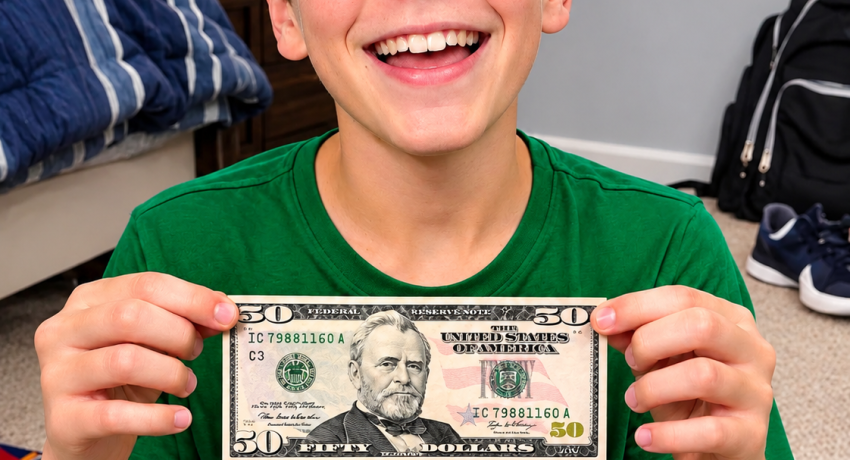
I reached into my wallet and gave him a fifty-dollar bill.
For a few seconds, he just looked at it.
“Is all this for me?”
“Every dollar.”
“What can I spend it on?”
“Whatever makes you happy.”
He examined the bill.
“What happens if I make a poor decision?”
“Then we’ll consider it a costly learning experience.”
He wrapped his arms around me.
“You’re the best mom ever.”
“I’m the only mom you’ve got.”
“That doesn’t affect the rankings.”
The following morning, he slipped the money into his backpack with the care of someone carrying a priceless treasure.
“Don’t spend every penny on cookies,” I called as he got out of the car.
He flashed me a grin.
“I can’t promise something that unreasonable.”
Now I was standing inside the gym, watching him organize a queue of excited children.
When Morgan spotted me, his shoulders suddenly slumped.
“Mom? What are you doing here?”
“Your teacher called me.”
He glanced at Mrs. Coleman.
“I was going to explain everything tonight.”
“Explain what?” I asked. “Why are you wearing a crown and handing out stock?”
“It’s not stock.”
“Then what is it?”
He looked toward a little girl standing beside the table.
“Can I have a minute? Hannah is next.”
Mrs. Coleman placed a gentle hand on my arm.
“Let him finish first.”
I moved aside.
Hannah was wearing a yellow sweater and holding her hands close together. She glanced at the children waiting behind her before lowering her eyes.
Morgan leaned toward her.
“Are you ready?”
“I’m not sure.”
“We practiced this. There’s no need to hurry.”
A boy farther back gave an impatient sigh.
Morgan immediately stood up straight.
“No making people rush. That’s our rule.”
The line grew quiet.
Hannah took a deep breath.
“Why did the cookie visit the doctor?”
Morgan opened his eyes wide.
“I don’t know. Why?”
“Because it was feeling crummy.”
He brought his palm down on the table.
“Fantastic! That was a really good one!”
The children around them burst into laughter.
Hannah’s expression softened. Her shoulders relaxed, and a smile appeared on her face.
Morgan reached for a stuffed rabbit.
“You’ve won a prize.”
“Really? For me?”
“Of course, for you.”
“Can I take it home?”
“That’s generally how prizes work.”
She embraced the rabbit, then stepped closer and wrapped her arms around Morgan.
He stood completely still.
“Well, that was an unexpected bonus hug.”
I covered my mouth to keep from laughing.
Next to me, Mrs. Coleman brushed away another tear.
“Hannah only transferred to this school last semester,” she explained softly. “She’s struggled with speaking in front of other children.”
On the other side of the gym, two girls came over to compliment Hannah on her rabbit.
A few moments later, she walked away with them toward one of the games.
“She’s been hoping to make friends for such a long time,” her teacher said.
I watched Morgan greet the next child in line.
“So what happened to the fifty dollars?”
Mrs. Coleman smiled.
“That’s exactly how all of this began.”
She guided me toward the bleachers.
The fair had started after lunchtime. Some activities were free, but children needed money or tickets to enjoy certain games, buy food, and collect prizes.
Some students had plenty of spending money. Others had arrived with barely anything.
Hannah had used her three dollars on games before she spotted the stuffed rabbit.
A volunteer had allowed her to hold it, but she didn’t have enough tickets to claim it and take it home.
Morgan noticed her putting it back.
“So he purchased it for her?” I asked.
“That was his initial idea.”
“His initial idea?”
“Then he realized Hannah wasn’t the only child feeling disappointed.”
Before she could tell me more, Principal Harris walked over to join us.
“Your son has given all of us something worth thinking about.”
“Apparently, I’m the last one to find out what that is.”
He laughed.
“Let Morgan tell you. He should have the chance to explain it in his own words.”
I glanced from one to the other.
“Is keeping secrets part of the school curriculum now?”
As the fair began coming to an end, Morgan finally stepped away from his table.
He came over with a paper bag in his hand.
“Greetings, Your Majesty,” I said.
He straightened his crown.
“It’s an official leadership role.”
“Who voted for you?”
“Nobody else wanted the job.”
I extended my hand.
“Now, let’s talk about your spending.”
His grin faded a little.
“I used the money.”
“Every single dollar?”
He nodded.
“What did you spend it on?”
He opened the bag.
Inside were two small toy cars and a plastic dinosaur.
I stared at them.
“Those three things cost fifty dollars?”
“No! They’re just what I have left.”
“What happened to the rest?”
He passed me a receipt showing stuffed animals and small toys.
The amount at the bottom came to exactly fifty dollars.
“Come sit with me,” he said.
There was something about his tone that made me stop joking.
We sat down on the bleachers, and he took off his paper crown.
“You told me to spend the money on something that would make me happy.”
“I did.”
“I already had everything planned. Pizza, a cookie, and maybe one of those giant pencils.”
“Those sound like excellent priorities.”
“Then I noticed Hannah holding the rabbit.”
He ran his fingers along the edge of his paper crown.
“She looked so disappointed when she had to put it back.”
“So you decided to help her?”
He nodded.
“Then Oliver wanted a toy car. Ben was interested in the dinosaurs. And there were other kids who were just standing around watching everyone else.”
Some children had already spent all their tickets. Others hadn’t brought any money to spend.
“I didn’t want anyone to spend the entire fair feeling left out.”
I looked at Mrs. Coleman.
“He asked if he could purchase a collection of prizes,” she explained. “We helped him talk to the volunteers.”
Morgan gestured toward the receipt.
“That’s what I bought with the fifty dollars.”
“And where did the table come from?”
“The volunteers said I could borrow it.”
“What about the crown?”
“It’s important to look the part.”
I burst out laughing.
He seemed a little more comfortable.
“We needed a way to stop everyone from grabbing the toys, so I came up with a joke contest.”
“What happened if someone’s joke wasn’t funny?”
“They still received a prize.”
“Then what made it a contest?”
He paused to think.
“Maybe it was really just a joke celebration.”
The children could share jokes, pull funny faces, or answer silly questions. Those who didn’t feel comfortable performing could simply pick out a toy.
“It wasn’t about making anyone earn the right to get something,” Morgan explained. “It was about everyone having fun together.”
“What did you do when you ran out of toys?”
“We didn’t stop.”
Mrs. Coleman nodded.
“Some children remained there even after they’d already picked up their prizes. They wanted to listen to the next joke.”
I looked over at his little table.
Fifty dollars hadn’t purchased a large number of toys.
But it had brought children together for something enjoyable.
“There’s one more thing you should know,” Mrs. Coleman added.
Morgan let out a groan.
“Please don’t turn this into a big deal.”
“It’s important.”
Earlier, Hannah had started telling her joke but suddenly gone silent. A few children had laughed awkwardly, and one boy had told her to hurry up.
Morgan had stopped the activity.
“She needed a little time,” he explained.
Hannah had wanted to walk away, so he suggested they practice somewhere away from the line.
They quietly went through the joke together.
Then they said it again.
And then they gave it one more try.
“She already knew the joke,” Morgan said. “She just needed everyone to stop looking at her for a moment.”
I felt a lump forming in my throat.
“And then I showed up?”
He nodded.
Mrs. Coleman smiled.
“You saw what happened after that.”
Morgan carefully watched my expression.
“Mom, please don’t start crying too.”
“I’m trying not to.”
“Your eyes don’t seem to be listening.”
I laughed and drew him into a hug.
For once, he hugged me back without looking around to see whether anyone was watching.
Before we headed home, Principal Harris came over with a suggestion.
“We’d like to set up a free prize table at upcoming school fairs. It would give every child a chance to enjoy something.”
Morgan looked up at him.
“You really mean it?”
“With donated toys and volunteers, I believe we can make it happen.”
He also asked whether I would consider joining the parent committee.
“I’m working during most school activities,” I explained.
“We could organize some meetings online.”
I remembered Hannah holding her rabbit close.
“I’d be happy to get involved.”
Morgan quickly raised his hand.
“What about me?”
The principal suggested, “You could serve as our student adviser.”
Morgan stood up straighter.
“Would I get an office?”
“No,” I replied.
“How about a badge?”
“We can talk about that.”
“What about a parking space just for me?”
“You still ride in my car.”
“Maybe for now.”
During the drive home, he grew quiet.
After a while, he asked, “Are you mad at me?”
“Why would I be?”
“Because of the money. I didn’t really buy anything for myself.”
“Did you enjoy your day?”
He nodded.
“It was a great day.”
“Then you spent it exactly as I hoped you would.”
Relief spread across his face.
“But you did have lunch, right?”
“I ate the sandwich you packed. Oliver gave me some of his pizza, too.”
“That’s good.”
“And Hannah’s mom bought me a cookie.”
I glanced over at him.
“Was it one of those giant ones?”
He held his hands far apart.
“Huge.”
Naturally.
At dinner, Morgan refused to take off his paper crown.
Apparently, his leadership duties didn’t end when the school day was over.
“What was the best part of your day?” I asked.
“When Hannah finally told her joke.”
“And what was the most difficult part?”
He lowered his eyes.
“Knowing I couldn’t afford enough prizes for everyone.”
I reached across the table and gently held his hand.
He had done something wonderful, but he was still focused on what he hadn’t been able to accomplish.
“My favorite part,” I told him, “was watching how much you care about everyone around you.”
He groaned.
“Please don’t tell people that.”
“I might have a T-shirt made to celebrate it.”
“Mom.”
“Maybe with your picture printed on it.”
“Definitely not.”
Then he smiled.
“Can I choose one more best moment?”
“That would break our rule.”
“You’re the one who makes the rules. Change them.”
“All right. What else?”
“The cookie.”
I laughed so hard that I nearly dropped my fork.
The next Monday, Mrs. Coleman sent me an email with a photograph attached.
Morgan was standing behind his table, his crown leaning to one side. Hannah stood next to him, proudly holding her rabbit.
The message below the photograph said:
“Thank you for raising a child who pays attention to those who are often left out.”
I printed the picture and placed it on the refrigerator.
Morgan noticed it when he came home that afternoon.
“Seriously?”
“Would you like me to put it in a gold frame?”
“You wouldn’t dare.”
“Don’t be so sure.”
He shook his head and walked away.
But before leaving, he turned around, glanced at the photograph, and smiled.
Over the following weeks, the parent committee started making arrangements.
One family volunteered to gather toys. Another offered to coordinate free activities. The school agreed to supply the necessary materials.
We decided to call it the Second Chance Table.
When I shared the news with Morgan, he almost dropped his spoon into his cereal bowl.
“Is my table coming back?”
“This time, you’ll have plenty of help.”
“Can I be in charge?”
“You can certainly help run it.”
He paused to consider that.
“I have one condition.”
“What is it?”
“No one should have to tell a joke if they don’t feel comfortable.”
“That’s agreed.”
“But people can still tell really bad jokes.”
“Those are especially welcome.”
At the following fair, families contributed so many toys and games that the table was no longer relying on a single boy’s allowance.
Hannah joined Morgan in organizing the prizes.
She also arrived with cards filled with jokes she’d written herself.
Mrs. Coleman shared another photograph.
This time, both children were smiling and laughing.
That evening, Morgan returned home with an enormous cookie.
He set it down on the kitchen table in front of me.
“This is for you.”
“What did I do to deserve that?”
He shrugged.
“Because you’re my favorite mom.”
“I’m still your only mom.”
He snapped the cookie into two pieces and gave one to me.
“That’s still true.”
I’d given him fifty dollars so he could enjoy an afternoon at the school fair.
Instead, he’d spent it making sure other children could have a wonderful time, too.
And months later, we were still enjoying the happiness that had grown from that simple decision.









