
 68 views
Dinner Is Where the Cook Says It Is
Part One: The Steps
Every autumn, the threshing dinner was prepared with food from my garden and the preserves I had put away.
And every autumn, my mother-in-law claimed in front of the eighteen-man crew that she had prepared everything herself.
She welcomed them from the farmhouse steps.
It happened the same way each year. On the second Saturday of August, at exactly noon, when the whistle from the old steam engine sounded and the men came up from the oat field, their shirts soaked with sweat and bits of chaff caught in their hair.
Faye stood at the top of the porch stairs wearing her flower-print apron. Her white hair had been carefully curled at the beauty salon in Eldora. She had even put on lipstick.
She lifted one hand to shield her eyes from the bright sunlight.
“I’ve been in the kitchen since four this morning,” she announced.
I was standing directly behind her, carrying the roasting pan.
Inside were forty pounds of beef. It was chuck roast that I had started cooking at five that morning, slowly braising it with onions, carrots, and a pint of tomatoes I had canned myself. The pan was so heavy that my arms trembled. Even through the dish towels wrapped around the handles, the heat was burning my hands.
I stood behind her on the porch, struggling to hold it.
Not a single man acknowledged me.
Their attention was fixed on Faye. They removed their caps and wiped the sweat from their faces with red handkerchiefs.
“That smells wonderful, Faye,” said Dale Kruse, who had been farming the land to the east for fifty years.
“You’ve outdone yourself once again,” one of the Vogel boys remarked.
“You’re an angel, Faye,” Harold Mertz added. “An absolute angel.”
Faye smiled proudly and adjusted her curls.
“Oh, stop that,” she replied. “Go wash your hands. The food will get cold.”
The men headed toward the hand pump beside the windmill to clean up.
I walked past Faye, carrying the heavy roasting pan through the screen door, along the hallway, and into her dining room. I placed it on a trivet in the middle of the long dining table. Around it were my green beans, sweet corn, bread-and-butter pickles, and freshly baked dinner rolls.
I kept my mouth shut.
I had been living through this routine for eleven years.
Part Two: The Half Acre
My name is Sheila Hemmingsen, and I am forty-three years old.
I married Roy Hemmingsen when I was thirty-two. Around here, that was considered getting married rather late. In Hardin County, Iowa, most girls marry the boy from the neighboring farm before they turn twenty-two.
But I hadn’t grown up on a neighboring farm. I came from Des Moines. Before meeting Roy, I had spent nine years teaching home economics in Ames. We first met at a church supper in Iowa Falls.
Roy was a reserved, gentle man with large hands and a neck permanently browned by the sun. He asked me what ingredients I used in my potato salad. I explained the recipe. The following week, at another church supper, he asked me the exact same question, even though I was certain he remembered the answer.
We got married in June, and the following month I moved to the farm.
Actually, there were two farms. Roy and I lived in a small white house on the eastern eighty acres. About a quarter mile up the gravel driveway stood the original farmhouse, the large home where Roy had grown up. His parents, Earl and Faye, still lived there.
Behind our little white house was half an acre of land.
When I first arrived, the ground was covered in weeds, and an old, rusted hog feeder sat in the middle of it. That first autumn, Roy used his tractor to pull the feeder away. The following spring, I worked the soil and prepared it for planting.
I have tended that garden every year since.
I grow just about everything.
Three varieties of green beans. Two rounds of sweet corn, planted three weeks apart so the entire crop doesn’t become ripe at the same time. Forty tomato plants. Cucumbers for making pickles. Beets, carrots, onions, potatoes, peppers, squash, and pumpkins growing in the corner beside the fence.
Each summer, I preserve two hundred quarts of food.
I’m not exaggerating that figure. Two hundred quarts. I keep an exact count.
Sixty quarts of green beans. Fifty quarts of tomatoes. Thirty quarts of pickles. Twenty quarts of beets. Forty bags of sweet corn, cut straight from the cob and frozen. Applesauce made from the old trees near the grove. Peach jam. Strawberry jam. Rhubarb sauce.
Throughout August, I spend hours standing beside my stove with the windows open, the canner bubbling away, and sweat running down my back. I keep doing this day after day for six straight weeks.
Downstairs in our basement, my jars cover the shelves from floor to ceiling. Every single one has a masking-tape label written in my own handwriting.
Part Three: The Threshing Bee
Every August, the Hemmingsen family holds its annual threshing bee.
The tradition dates back to 1948.
Most farmers in this area stopped threshing oats the traditional way nearly sixty years ago. Modern combines took over, and hardly anyone wanted to spend their days stacking bundles by hand and feeding them into an old threshing machine.
But Earl’s father, Arnold, had held on to a 1928 Case threshing machine in the large barn. He also kept a 1916 Avery steam engine to power it. Every August, he brought the old equipment out so the neighbors could watch a few acres of oats being threshed the way it had been done in earlier times. It was something he did to preserve the memories of the past.
After Arnold passed away, Earl continued the tradition.
Over the years, the event grew into something special. People travel from different parts of Hardin County to attend. They set up lawn chairs along the fence and watch the work. Children climb onto the old tractors.
And there are eighteen men assigned to the crew.
Some pitch bundles, while others haul them. One man feeds the separator. Another operates the engine. Someone drives the grain wagon, while another works on the straw stack, getting covered in chaff as he goes. Some are older men who have been doing this since childhood. Others are younger men experiencing the work for the first time.
They begin at seven in the morning and continue until all the oats have been threshed, usually sometime between four and five in the afternoon.
At noon, however, everyone takes a break for dinner.
The threshing dinner.
Around here, the word dinner means the midday meal. It’s the largest meal of the day. There must be meat, potatoes, vegetables, bread, and pie. The portions need to be generous enough to keep eighteen hardworking men satisfied through a long, hot August afternoon of handling oat bundles.
For thirty years, Faye had been responsible for preparing it.
Then, eleven years ago, I married Roy.
During the first August after our wedding, Faye phoned me.
“You’ll be helping with the threshing dinner,” she informed me. It sounded more like an instruction than a question.
“Of course,” I answered.
That first year, I shared the work with her.
I prepared the green beans and baked the dinner rolls. I also spent time peeling potatoes in her kitchen while she handled the roast, gravy, and pies.
By the second year, Faye’s arthritis had become more troublesome. I took care of the green beans, rolls, potatoes, and gravy.
When the third year arrived, I was preparing the entire meal.
Part Four: Eleven Years
By the third year, Faye had completely stopped preparing the threshing dinner.
She never made an announcement about it. She simply quit doing the cooking.
The week before the event, she would telephone me and say, “You’ll take care of the beef again this year, won’t you, Sheila? My hands have been giving me so much trouble.”
The next day, another call would come. “And don’t forget the beans. You know how much the men enjoy yours.”
After that came the potatoes, gravy, corn, rolls, pickles, and pies.
By the fifth year, every part of the meal was my responsibility.
I prepared everything myself, in my own kitchen, at our little white house on the eastern eighty acres.
Every green bean served at that table came from my garden.
I planted them on the half acre behind our house. I gathered them early in the morning while the dew was still on the leaves. Then I snapped them on the back steps and canned them in July.
The sweet corn came from my second planting. Every year, I carefully planned the timing so it would be ready during the week of the threshing bee.
The tomatoes used in the beef came from my own jars. So did the pickles and beets. The applesauce was mine, too. Every bit of it.
The beef came from one of our own steers.
Roy and I raise four steers annually in the pasture behind the barn. Each spring, we take two of them to the locker plant in Iowa Falls. One is for our family, and the other is reserved for the threshing dinner.
The processing bill alone came to two hundred dollars. That covered the cutting, wrapping, and freezing.
I paid that expense from our grocery budget.
I also baked all six pies. The apples came from the trees beside the grove. The cherries came from the jars I had preserved in June. I made sour cream raisin pie, too, because Dale Kruse requests it every single year.
The six dozen dinner rolls were mine as well. I got out of bed at two in the morning to prepare the dough and give it enough time to rise.
On threshing day, I began working at four in the morning.
I loaded everything into the back of Roy’s pickup truck. The beef in its roasting pan. Large pots of potatoes, beans, and corn. Trays of dinner rolls covered with dish towels. And all six pies in their tins.
Then I drove the truck a quarter mile along the gravel lane to the main farmhouse.
I carried the food into Faye’s kitchen.
The beef went into her oven to stay warm. I placed the potatoes on her stove and arranged the pies across her kitchen counter.
Then, at noon, when the whistle sounded, Faye would remove the roasting pan from her oven.
Part Five: Faye’s Part
Faye’s contribution was carrying a single roasting pan.
She had to walk about forty feet, from her oven to the porch steps.
That was the full extent of her work. She waited until the whistle blew and the men began returning from the field. Then she slipped on her oven mitts and lifted the roasting pan out of the oven.
She carried it through the kitchen, along the hallway, and out through the front door.
Finally, she stepped onto the porch.
And she would pass the pan to me.
Then she would announce, “I’ve been cooking since four.”
The first time she made that statement, I wondered whether I had heard her correctly.
The second time, I convinced myself she might be making a joke.
By the fifth year, there was no longer any doubt about what she was doing.
And then there was the matter of simply being seen.
That was the other part of Faye’s contribution. She made sure she was standing on the porch steps when the men returned from the field. She stood at the head of the dining table when everyone sat down. She positioned herself beside the pies whenever someone asked who had baked them.
She was always there when the men finished washing their hands and called out, Thank you, Faye. You’re a saint.
Part Six: Why I Never Said a Word
You might be wondering why I never spoke up.
I’ve spent eleven years asking myself that very question.
While standing beside my stove in August as the canner bubbled away. While kneading and punching down bread dough at two in the morning. While standing behind Faye on the porch, struggling to hold forty pounds of hot beef that was burning my wrists.
Why didn’t I simply speak up?
This is the reason.
There is no easy way to correct your mother-in-law.
Not in a community like ours. Not in Hardin County, Iowa, where families have known one another for four generations. Where the Hemmingsens have been hosting the annual threshing bee since 1948.
And certainly not in front of eighteen hungry men.
The moment I said something, I would become the difficult one.
I could picture the whole scene perfectly.
“Actually, Faye, I was the one who made that.”
Eighteen men would turn toward me. Then they’d glance at Faye. After that, they’d lower their eyes toward their boots.
And then the gossip would begin.
The story would spread from the threshing bee to the co-op, from there to the café in Eldora, then to the Lutheran church, and eventually to every kitchen table in the county before Sunday was over.
Roy’s wife caused a scene at the threshing bee.
That was the version everyone would remember.
Not that Faye had been claiming credit for Sheila’s cooking for eleven years.
Instead, the story would be that Roy’s wife had made a scene.
The woman from the city. The Des Moines girl who married later than most. The outsider who supposedly didn’t understand how people did things around here.
So I stayed silent.
And I continued preparing the meals.
Part Seven: Roy
Roy knew what was happening.
He wasn’t foolish. Every August, he watched me wake up at four in the morning. He helped load the roasting pan into the pickup. He had seen the rows of jars filling the shelves in our basement.
But Roy was Earl’s son, and Earl was a man of very few words. He was probably the most silent person I had ever met. During the eleven years I had known him, I could count perhaps a hundred things he’d said that weren’t related to the weather or the price of beans.
Roy had inherited his father’s silence.
“Mom hasn’t had an easy life,” Roy told me once. It was our fourth year. We were lying in bed after the threshing dinner, and I was crying into my pillow, trying not to let him hear me.
He heard me anyway.
“Her mother-in-law treated her terribly,” he explained. “Grandma Hemmingsen. Mom rarely talks about those days, but Dad told me about it once.”
“What did he tell you?”
Roy remained silent for quite a while.
“He said Grandma made Mom’s life miserable,” he finally replied. “For twenty years, right up until she passed away.”
“That doesn’t give Faye the right to treat me the same way,” I said.
“I know,” Roy answered. “I understand that.”
He reached over and wrapped his arm around me in the darkness.
“I’m sorry, Sheila,” he whispered. “I just don’t know what I can do to make things right.”
Part Eight: Megan
Our daughter, Megan, arrived during the second year of our marriage.
She’s nine years old now. She inherited Roy’s sunburned nose and my stubborn nature. Ever since she was old enough to walk, she’s been helping me in the garden.
And she’s the one who noticed what was happening before anyone else.
She was seven at the time. It was threshing bee day. That morning, she’d come along with me at four o’clock to help load the pickup. She had carried the jars of pickles and helped with the dinner rolls.
At noon, she was standing beside me on the porch when Faye greeted the crew at the steps.
“I’ve been cooking since four this morning,” Faye announced.
Megan turned her eyes toward me.
She didn’t ask anything. She simply looked up at me, her forehead slightly creased in confusion.
Later that evening, when I was putting her to bed, she finally asked me about it.
“Mom,” she said. “Why did Grandma tell everybody she had cooked the food?”
I struggled to find an answer.
“Grandma’s hands hurt, sweetheart. She isn’t able to cook the way she used to,” I explained.
“But she told them she made it,” Megan replied.
“I know.”
She paused to consider what I’d said.
“That’s lying,” she finally declared.
“It’s a little complicated, honey,” I told her.
“No, it isn’t,” Megan insisted. “You made the food, and she told everybody she made it. That’s a lie.”
I couldn’t think of anything to say.
I pulled the covers up around her, kissed her goodnight, and switched off the light.
Then I remained standing in her doorway for quite some time.
My seven-year-old daughter had recognized in a single afternoon something I had spent nine years refusing to acknowledge.
Part Nine: The Winter I Quit
Then came one winter when I finally decided I was done staying silent.
It was January, the eleventh winter since we’d married. The fields were covered in frozen white snow. The wind swept fiercely across the farmland. I was downstairs in the basement, counting my preserved jars.
There were two hundred and four quarts, stacked from the floor all the way to the ceiling.
I stood in front of those shelves, reading the labels in my own handwriting. Green beans, July 14. Tomatoes, August 3. Beets. Pickles. Applesauce.
And my thoughts returned to the threshing bee.
I remembered standing behind Faye on that porch, holding forty pounds of beef while the hot handles burned my wrists.
I remembered Harold Mertz praising her and calling her a saint.
I remembered Megan, at seven years old, looking at me and saying, “That’s a lie.”
I thought about Megan at nine, watching me repeat the same routine. Watching and learning from my example.
Learning that when someone takes credit for something you’ve worked hard to accomplish, you simply stand behind them and keep your mouth shut.
I couldn’t allow her to grow up believing that was how she should behave.
I didn’t start an argument with Faye.
I want to make that perfectly clear. I didn’t telephone her. I didn’t challenge her to her face. I didn’t discuss it with anyone.
Instead, I decided to take a different approach.
Part Ten: The Machine Shed
We had a machine shed behind our property.
It stood beyond the half-acre garden, a large gray metal building measuring forty by eighty feet. It had two sliding doors at the front and a concrete floor.
During winter, Roy stored the tractor inside, along with the planter and hay rake. There were also about thirty years’ worth of odds and ends his father had passed along to him.
That spring, I asked Roy if he would clear the building out.
He stared at me as though I’d suddenly gone crazy.
“You want me to clean out the shed?” he asked. “Sheila, why would we do that?”
“I’ll explain everything,” I replied. “But first, you have to give me your word that you won’t tell anybody. Not your mother, not your father, not the Vogel boys, and nobody else.”
Then I explained my idea.
We sat at our kitchen table one cold evening in March. The wind was blowing outside, rattling the windows as I talked.
Roy listened quietly without interrupting. Once I’d finished, he leaned back in his chair and looked at me.
“You want to relocate the threshing dinner,” he said slowly.
“Yes.”
“Move it out of Mom’s farmhouse?”
“Yes.”
“And hold it in our machine shed?”
“That’s right.”
Roy remained silent for several minutes.
“Mom is going to be furious,” he eventually said.
“She probably will be,” I answered.
He turned toward the window. Beyond the darkness, the yard light illuminated the machine shed.
“The threshing bee itself still takes place at the home farm,” he pointed out. “The old engine is in Dad’s barn, and the oats are growing on his land.”
“I’m aware of that,” I said. “The threshing bee will remain exactly where it is.”
I reached across the table and took his hand.
“But there’s no reason the dinner has to be held there.”
Roy looked directly at me.
“The meal can be served wherever the cook decides,” I told him. “And I’m the cook. I’ve been doing all the cooking for eleven years.”
Roy sat quietly, thinking it over.
Then a smile slowly spread across his face. It was the same gentle smile that had first made me fall in love with him at that church supper in Iowa Falls.
“All right,” he said. “Let’s get that shed cleaned out.”
Part Eleven: On the Sly
Roy and I spent the entire summer getting the shed ready.
We worked secretly, almost like two mischievous teenagers.
Most of our work happened in the evenings. After finishing the chores and eating supper, once Megan had gone to bed, we’d close the large shed doors so nobody passing along the gravel road could see what we were doing.
We removed thirty years of accumulated junk. An old cultivator. A damaged hay rake. A stack of rusty fence posts. Seventeen coffee cans filled with bent nails. There was even a 1974 Chevy pickup without an engine that Roy’s uncle had abandoned there back in 1991.
Roy used the tractor to drag it outside. We sold the old truck for scrap metal and received two hundred and forty dollars.
That money went toward buying the plywood.
We covered the concrete floor with plywood sheets.
Roy and I spent hours down on our knees, fastening three-quarter-inch plywood to wooden sleepers with screws. We wanted a level, comfortable floor that would stay warm and wouldn’t become damp.
Next, we painted everything using gray porch paint.
Then we installed the lighting.
Roy ran a fresh electrical line from our house. We hung strands of white café lights across the rafters, running them back and forth until we had twenty strands hanging overhead.
The first evening we switched them on, we stood in the middle of the shed, gazing up at the lights for a long while.
“Sheila,” Roy said softly. “It looks like a wedding reception.”
We also needed tables.
We borrowed eight long folding tables from the Lutheran church in Eldora. They were the ordinary kind, with metal legs and imitation wood tops. We approached Pastor Lindgren in June and told him we needed them for a family reunion.
He didn’t question us. He simply replied, “Just make sure you return them clean.”
I made the tablecloths myself.
They were red gingham. I purchased forty yards of fabric from the store in Iowa Falls. When the woman at the counter asked what I planned to make, I told her they were for curtains.
For three evenings in July, I sat at our kitchen table sewing. I waited until Megan was asleep and the day’s canning work was finished. I made eight tablecloths, carefully hemming all four edges by hand.
Only Roy and our daughter, Megan, knew what we were planning.
We finally let Megan in on the secret in June.
She was nine years old and became so excited that she could hardly sleep. She helped us paint the floor and put up the lights. In the evenings, she’d sit on the kitchen floor while I worked on the tablecloths, passing me pins whenever I needed them.
“Grandma is going to be really surprised,” she said.
“Yes, she certainly is,” I replied.
“Are you going to tell her about it?” Megan asked.
“No,” I answered.
She paused and thought about my response.
“Does that mean we’re lying?” she asked.
I stopped sewing and placed the fabric down.
“No, sweetheart,” I explained. “We’re keeping a secret. A lie is when you tell somebody something that isn’t true. A secret is simply when you choose not to tell them something.”
Megan considered that explanation for quite a while.
“Grandma has been telling lies,” she finally said. “But you’ve been keeping a secret.”
“That’s right,” I replied.
“And now we’re keeping a secret from her, too.”
I couldn’t help laughing.
“Something along those lines,” I said.
Part Twelve: The Saturday
The threshing bee continued to take place at the home farm.
That August, on the second Saturday of the month, the day unfolded just as it always had. The same tradition that had continued uninterrupted since 1948.
At six in the morning, Earl started the old Avery steam engine outside the large barn. Thick black smoke poured from its chimney, and the whistle echoed loudly across the surrounding farmland.
By seven, all eighteen crew members had arrived. They wore their usual work clothes and seed-company caps, with pitchforks resting across their shoulders.
The wagons used to haul the bundles headed out toward the oat field.
The men tossed the bundles onto the wagons, which then carried them back to the threshing machine. From there, the workers lifted the bundles and fed them into the separator.
The old Case machine thundered into action. Chaff scattered through the air. Straw shot from the blower and landed on the growing stack, while clean oats poured from the chute into the grain wagon.
Visitors watched from lawn chairs arranged along the fence. Children scrambled onto the old tractors.
Faye remained on her porch.
Wearing her flower-patterned apron. Her hair carefully curled. Smiling and waving at the visitors.
Waiting for me to arrive with the dinner.
Part Thirteen: Roy Walks the Crew
At eight-thirty, Roy went around to speak with the crew.
He approached each man individually.
First, he walked into the oat field where the men were hauling bundles. Then he went over to the threshing machine, where the feeders were busy working. After that, he climbed onto the straw stack.
He made sure to speak to every single worker. All eighteen of them.
And he gave each man the same straightforward message.
“We’re having dinner at our place this year,” Roy announced. “In the machine shed, down the lane. At noon.”
The men would stare at him, looking puzzled.
Then Roy would explain the rest.
“Sheila’s been doing the cooking.”
He spoke my name.
One time to every man.
Eighteen separate times. Out in the oat field. Beside the separator. On top of the straw stack. Near the steam engine.
Sheila’s been doing the cooking.
For the first time in eleven years, someone had actually spoken my name at the threshing bee.
Some of the men offered no response. They simply gave a nod and returned to tossing bundles.
Others glanced up the lane toward Faye standing on her porch. Then they looked at Roy before lowering their eyes to their boots.
Dale Kruse studied Roy for quite some time.
“Your place?” Dale asked slowly. “Not your mother’s house?”
“Our place,” Roy replied.
Dale remained quiet for a few seconds.
Then he gave a single nod.
“See you at noon,” he said.
Part Fourteen: Four in the Morning
I woke up at four o’clock.
And this time, that statement was actually true in the way I wanted it to be.
For eleven years, I’d gotten up at four every threshing bee morning. But Roy was the only person who knew. Faye was always the one who claimed it.
This year, I spoke those words to myself. I stood in my dark kitchen beside the stove, with the oven light glowing and the radio tuned to KWMT broadcasting from Fort Dodge.
I have been cooking since four.
The forty pounds of beef had been slowly braising since five. It sat in my large blue roasting pan with onions, carrots, and two pints of tomatoes from my own canning shelves.
Twenty pounds of potatoes had been peeled the previous evening and left soaking in cold water inside the refrigerator.
I took six quarts of green beans from my jars and prepared them with bacon and onions.
The sweet corn came from my second planting. I went out that morning before sunrise, carrying a flashlight, and picked fifty ears.
I had six dozen dinner rolls to prepare. I’d gotten up at two to start the dough and give it time to rise.
There were six pies. Apple, cherry, and sour cream raisin.
Bread-and-butter pickles. Pickled beets. Applesauce.
And ten gallons of iced tea.
At eight o’clock, Megan came downstairs wearing her pajamas.
“Mom,” she asked. “Are you frightened?”
I was busy stirring the gravy and didn’t turn around.
“Yes,” I answered.
Part Fifteen: The Open Doors
At eleven, I stood in the wide-open entrance of our machine shed.
Roy had pushed both sliding doors completely aside. The entire forty-foot opening was exposed.
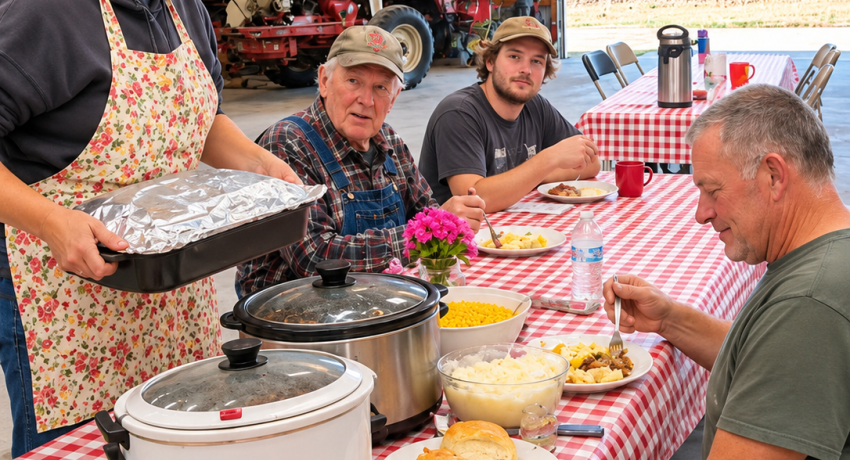
Inside, eight long tables were arranged in two straight rows down the center of the building. Each one was covered with red gingham tablecloths and set with plates and silverware borrowed from the church.
White café lights hung across the rafters, shining even though it was still daylight.
At the far end stood a long table for serving the food. My blue roasting pan. My cooking pots. My six pies arranged in a neat row.
Beyond the opposite end of the shed, the golden oat field stretched into view.
Roy’s oats. Fully ripe and swaying gently beneath the August sunshine. Farther away, a quarter mile up the gravel lane, stood the home place. The large barn. And the dark smoke rising from the steam engine.
I could hear the threshing machine roaring in the distance.
And I was terrified.
I stood beneath the open doors wearing my apron, my hands trembling.
I couldn’t stop imagining that the men might drive straight to Faye’s farmhouse out of habit.
Eighteen tired, hungry men would finish working at noon, head toward their trucks, and start their engines.
Then they would turn right and drive up the lane to the home place, just as they had done for thirty-four years.
I was frightened that I’d be left standing in an empty shed.
Eight beautifully arranged tables. Red tablecloths. White lights. Forty pounds of beef.
And not a single guest.
Eleven years of cooking were depending on what happened along that one gravel lane.
Roy walked over and stood beside me.
He had returned from the threshing bee at eleven. Chaff covered his clothes, and his face was red from the sun.
He reached for my hand.
“They’re coming,” he assured me.
“You can’t possibly know that.”
“No, I can’t,” Roy admitted. “But I personally told every man. And I made eye contact with each one when I told him.”
Megan came out of the house wearing a freshly washed dress. It was blue with tiny white flowers. She had braided her own hair.
She came and stood on my other side, taking my free hand.
The three of us remained together in the open entrance of the machine shed.
Waiting.
Part Sixteen: Noon
Then noon arrived.
The steam engine’s whistle sounded.
I heard it from a quarter mile away. That same long, piercing blast that announced the crew’s midday break.
The threshing machine gradually fell silent.
I stopped breathing for a moment.
At first, nothing seemed to happen.
Thirty seconds passed. Then a full minute. From the direction of the home place, I could hear distant voices. The men were laughing and chatting with one another.
I could make out Faye standing on her porch. She looked tiny from where I was.
She was positioned at the top of the steps, wearing her familiar flowered apron.
Waiting.
Then I heard an engine turning over.
A pickup truck came around and entered our lane.
It was Dale’s old, rust-covered Ford.
A brown-and-tan 1979 F-150. There was more rust than paint left on it. The windshield was cracked, and a Hardin County Farm Bureau sticker remained attached to the rear bumper.
The truck moved slowly along the gravel, kicking up a small cloud of dust behind it.
Then it turned into our driveway.
Another truck followed.
The Vogel boys’ blue Chevrolet.
Then another one.
Harold Mertz’s white Dodge.
And then another.
Soon, an entire line of trucks was making its way down the lane, raising clouds of dust as they followed one another, almost like vehicles in a funeral procession.
Every single truck turned into our property.
Not one continued up the road toward Faye’s farmhouse.
I remained in the open entrance of the shed, watching them approach.
Eleven trucks. Eighteen men.
Roy squeezed my hand so tightly that it hurt.
Megan was bouncing excitedly beside me.
Dale Kruse brought his rusty Ford to a stop next to the shed. He switched off the engine and climbed out.
He was seventy-eight years old. He had been part of the threshing crew since 1958, and both of his knees had been replaced.
He stopped in front of the open doors and removed his seed cap.
His eyes moved across the eight tables. He noticed the red gingham cloths, the white lights hanging overhead, and the large blue roasting pan at the far end.
Then he turned his attention toward me.
“Well, would you look at that,” Dale said.
He slowly shook his head.
“Well, Sheila,” he repeated.
Part Seventeen: Whose Food
The men took their seats.
I brought out the food.
Megan served the iced tea.
Eighteen men gathered around eight long tables inside our machine shed. Red gingham covered the tables, white lights glowed above them, and the golden oat field could be seen through the open doors.
I brought out the beef first. The large blue roasting pan containing all forty pounds.
This time, I didn’t cover my wrists with dish towels. I wore a proper pair of oven mitts.
I placed the pan on the table in front of Dale.
He raised his eyes and looked at me.
Next came the potatoes. The gravy. The green beans cooked with bacon. The sweet corn. The dinner rolls arranged in baskets and covered with dish towels. Then the pickles, beets, and applesauce.
Megan walked along the rows of tables carrying a large glass pitcher of iced tea. She carefully filled everyone’s glass without spilling even a single drop.
Then Harold Mertz picked up an ear of corn.
He examined it before looking in my direction.
“Did this corn come from your garden, Sheila?” he asked.
Suddenly, everyone around the table stopped talking.
“Yes, it did,” I answered. “I grew it on the half acre behind our house.”
Harold continued looking at the ear of corn for several moments.
Then he nodded.
“That’s mighty good corn,” he said.
A moment later, one of the Vogel boys reached for a green bean.
“Are these your beans, Sheila?”
“They are,” I replied. “I canned them myself back in July.”
Then Ed Larson raised a pickle in his hand.
“Did you make these pickles?”
“Yes, they’re mine.”
Next, a young man I didn’t recognize spoke up. Perhaps he was one of the Kruses’ nephews visiting from Ames. He was holding a dinner roll.
“Ma’am,” he asked. “Were these made by you?”
“I got up at two in the morning to make sure the dough had time to rise,” I answered.
He looked down at the roll he was holding.
“These are the finest rolls I’ve ever tasted,” he said.
The questions continued down both long rows of tables, with each man taking his turn.
They wanted to know who had prepared the food.
The beef. From the steer we raised ourselves in the pasture behind the barn.
The beets. Grown on my half acre.
The applesauce. Made from the old apple trees beside the grove.
The gravy. Prepared by me.
Every man offered me his thanks.
And they used my name.
“Thank you, Sheila.”
“Thank you, Sheila.”
“This is delicious, Sheila.”
“You’ve really outdone yourself, Sheila.”
Eighteen men.
Eighteen separate acknowledgments.
I remained at the end of the serving table, holding my oven mitts, while tears streamed down my cheeks.
For once, I didn’t bother trying to hide them.
Megan walked over and stood next to me. She slipped one arm around my waist.
“Mom,” she whispered. “They finally know.”
Part Eighteen: The Doorway
Then I turned around carrying another pan of corn.
It was the second batch, freshly taken from the stove.
As I turned away from the serving table, I noticed someone standing in the entrance.
It was Faye.
She was standing in the open doorway of our machine shed.
Her familiar flowered apron was on. Her white hair had been arranged in curls, and she was wearing lipstick.
She had walked the entire quarter mile down the lane. Despite the August heat and her painful hip.
Her hands were empty.
Back at her farmhouse, her own stove was sitting unused, growing cold.
The atmosphere inside the shed began to change.
The silence didn’t happen immediately. The men sitting at the closest tables noticed her first and stopped their conversations. Those behind them followed. Within moments, the entire building had fallen silent.
Eighteen men sat with their forks suspended halfway to their mouths, staring at Faye in the doorway.
Then their eyes shifted toward me, standing there with the pan of corn.
Nobody spoke.
I had no idea how to respond.
I stood holding the corn. Faye remained in the doorway. Thirty feet separated us.
And between us lay eleven years of history.
Then Earl came forward and stood beside her.
Part Nineteen: Earl
My father-in-law, Earl Hemmingsen, is seventy-six years old.
He’s a tall, slender man whose shoulders have become slightly stooped with age. His hands are large, just like Roy’s. His face is deeply lined, resembling the dry bed of a creek. Since 1971, he’s worn the same pair of bib overalls to every threshing bee.
Ever since his father passed away, Earl has operated the steam engine himself every year.
His clothes and skin were still covered in coal dust. His hands were black, his face was black, and soot had settled into the wrinkles around his eyes.
In all the thirty years I’d known him, I had never heard Earl deliver a speech.
Not at Roy’s wedding. Not during Megan’s baptism. Not even at his own fiftieth-anniversary celebration in the church basement, when the entire congregation kept shouting for him to say a few words. He had simply shaken his head and returned to his chair.
Earl was not a man who gave speeches.
He talked about the weather, the cost of beans, and occasionally, when he felt like it, the steam engine.
He stepped inside the machine shed.
He passed Faye and walked beyond the first row of tables.
Then he made his way down the narrow aisle between the tables, wearing his soot-covered overalls while eighteen men watched him.
He stopped at the head of the second table, directly in the center of the building, beneath the white lights.
He reached for a spoon.
It was an ordinary stainless-steel spoon from the church’s silverware collection.
He tapped it twice against a coffee cup.
Clink. Clink.
Instantly, the entire shed became quiet.
The men lowered their forks.
Megan placed her pitcher on the table.
Faye remained motionless in the doorway.
Earl turned his eyes directly toward me.
Ignoring his own wife standing nearby.
Part Twenty: What Earl Said
For several seconds, Earl remained completely silent.
He stood in the middle of the machine shed, holding a spoon in one hand and a coffee cup in the other. His eyes stayed fixed on me. His face was dark with coal soot, and his eyes looked exhausted.
Finally, he placed the cup down.
He cleared his throat.
“I’m not a man who talks very much,” Earl began.
His voice was deep and gravelly, like an old gate that hadn’t swung open in years.
“Most of you already know that.”
A few of the older men smiled.
“But there’s something I’ve got to say,” Earl continued. “And it’s something I’ve kept inside for eleven years.”
He looked straight at me.
“Actually, it’s been thirty-four years,” he added.
Not a single person moved.
“I’ve been eating this dinner every August since I was a young boy,” Earl said. “My mother prepared it first. After that, my wife took over. Then my son’s wife began making it.”
He glanced around the room.
“And during all those years,” Earl continued, “not once did anyone give the proper woman the credit she deserved.”
The entire shed fell completely silent.
“For twenty years,” Earl said, “my mother told the threshing crew that she was the one preparing the annual dinner.”
His gaze shifted toward the doorway, where Faye was standing.
“That wasn’t true,” he said softly. “Faye was the one doing the cooking. My wife. From the day we married in 1972 until my mother passed away in 1992. Every August, Faye got out of bed at four in the morning. She preserved the beans. She baked the rolls.”
He paused and swallowed.
“And my mother would stand on those porch steps and tell every man in the county that she had done all the work herself.”
I turned my head toward Faye.
She was standing in the doorway with one hand covering her mouth.
“I never spoke up,” Earl continued. “Not a single time. For twenty years, I allowed my mother to take that recognition away from my wife. I couldn’t figure out how to correct my own mother, especially in front of eighteen hungry men.”
His eyes dropped toward his boots.
“I kept telling myself it wasn’t important,” he said. “I convinced myself that Faye didn’t care.”
Then he lifted his head.
“But she did care,” Earl said.
“When my mother finally passed away,” Earl continued, “Faye got her opportunity at last. She got to stand on the porch. She finally received the appreciation she had been waiting for. Twenty years she’d waited for that moment.”
His eyes returned to me.
“Then her hands started getting worse,” he said. “She couldn’t manage the cooking anymore. And that’s when Sheila came along and took over everything.”
He slowly shook his head.
“But Faye couldn’t bring herself to step aside,” Earl said. “She couldn’t give up the only recognition she’d ever received.”
He turned once more toward his wife, who remained in the doorway.
“So she treated Sheila,” Earl said, “the very same way my mother had treated her.”
A small, painful sound escaped Faye’s mouth.
“And I stood by and allowed it to happen again,” Earl continued. “For another eleven years. Every August, I stood beside that steam engine and watched my son’s wife carry forty pounds of beef up the porch steps behind my wife. And I never opened my mouth.”
His voice began to break.
“That’s thirty-one years I’ve spent keeping quiet,” he said. “Thirty-one years of watching the wrong woman receive the thanks. Twice over.”
He turned toward me.
Then he removed his seed cap. His gray hair was damp with sweat and covered in soot.
“Sheila,” he said.
“Thank you,” Earl continued.
“For eleven years of threshing dinners. For the beef, the green beans, the corn, and the rolls you’ve prepared.”
He glanced across the eight tables, taking in the red gingham cloths and the white lights above us.
“And for all of this,” he added.
Then he faced the men.
“This dinner,” Earl announced, “was prepared by Sheila Hemmingsen. Every single bite. For the past eleven years.”
He paused before continuing.
“Before Sheila, Faye Hemmingsen was the one who cooked it for twenty years. All while my mother claimed the recognition.”
He looked toward the doorway.
“I’m sorry, Faye,” he said quietly. “I should have spoken up back in 1972.”
Then he turned his attention toward me again.
“And I’m sorry, Sheila,” Earl added. “I should have said something during your very first year.”
He placed his cap back on his head.
Then he took his seat.
He picked up his fork.
Part Twenty-One: Faye
For a long while, nobody moved.
Eventually, Faye stepped inside the shed.
She walked slowly, favoring her painful hip. She made her way between the tables, passing eighteen men who deliberately avoided looking in her direction.
She continued down the entire aisle until she reached the far end of the building.
The serving table.
And me.
She stopped right in front of me.
I was still carrying the pan of corn.
Her eyes settled on it.
“That’s the second crop,” she said softly.
Her voice trembled.
“The one you planted three weeks after the first one, so it would be ready during the week of the threshing bee.”
I looked at her in surprise.
“You noticed that?” I asked.
“I noticed everything,” Faye replied. “Every year. The tomatoes in the beef. The bacon in the beans. The sour cream raisin pie Dale always asks for.”
Her gaze shifted to the jars of pickles lined up on the serving table. My handwriting was on the masking tape labels.
“I saw it all,” she said. “I just never found the courage to admit it.”
Her eyes began to fill with tears.
“Earl’s mother stood on those porch steps for twenty years,” Faye said. “And every year, I stood behind her with the roaster in my hands. Every year, the men thanked her.”
Her voice cracked.
“I was twenty-two when it happened the first time,” she continued. “I went into the bathroom and cried. Earl’s mother came looking for me. She told me to wash my face and quit making a fuss.”
“Then she passed away,” Faye said. “And at last, I got to stand on those steps. At last, the men thanked me. It was the happiest day of my life.”
She lowered her eyes to her hands. They were swollen and twisted by arthritis.
“Then my hands started getting like this,” she said. “I couldn’t grip a paring knife anymore. I couldn’t knead bread. Then you came along. Young, healthy, and strong, with your garden, your canning jars, and your home economics degree.”
She raised her eyes to meet mine.
“And I thought, She’s going to take it away,” Faye said. “The one thing I’ve ever been recognized for.”
“So I claimed it before you could,” she admitted.
I remained silent.
I couldn’t find the words.
“What I did was wrong,” Faye said. “I knew it was wrong every year. I’d stand on those steps and announce that I’d been cooking since four in the morning, and all I could hear was Earl’s mother speaking through me.”
She brushed away her tears.
“And I couldn’t bring myself to stop,” she said.
“I’m sorry, Sheila,” she continued. “I’m sorry for all eleven years.”
Part Twenty-Two: What I Said
I placed the pan of corn on the serving table.
Then I pulled off my oven mitts.
I looked at my mother-in-law, standing inside my machine shed in her flower-print apron. Her hair was carefully curled, and her lipstick was now smeared from crying.
I looked at her hands, swollen and twisted with arthritis.
I thought about the twenty years she’d spent standing behind someone else on those porch steps, holding a roasting pan that burned her wrists.
“Faye,” I said. “Who made the pie crust?”
She looked at me, confused.
“What?”
“The crust for the pie,” I explained. “The sour cream raisin pie Dale asks for every year.”
Faye said nothing.
“That’s your recipe,” I told her. “You gave it to me during my first year, written on a recipe card in your own handwriting. It called for lard instead of shortening and a little vinegar.”
I met her eyes.
“I’ve followed that recipe every year since then,” I said. “I haven’t changed a single thing.”
Faye covered her mouth with one hand.
“And the beef,” I continued. “The beef braised with tomatoes. That recipe came from you too. You told me that first August, ‘Always add a pint of tomatoes to the chuck roast, Sheila. Earl’s mother never did it that way. That’s what gives the gravy its flavor.’”
By now, Faye was crying openly.
“I never thought you remembered that,” she whispered.
“I remember every detail,” I replied.
I turned away from her.
I picked up a pie. The sour cream raisin pie, made with Faye’s crust.
Then I faced the room, looking toward the eighteen men seated at the eight long tables.
“This pie,” I announced loudly enough for everyone in the shed to hear, “has been made using Faye Hemmingsen’s pie crust recipe. She’s been making it since 1972.”
I lifted the pie for everyone to see.
“And all these years, nobody has ever thanked her for it.”
The entire shed fell silent.
Then Dale Kruse pushed back his chair and stood.
He was seventy-eight years old, had two artificial knees, and still had chaff caught in his hair.
He removed his cap.
“Faye,” he said. “I’ve been eating that pie every August for fifty years.”
He looked directly at her.
“Thank you,” he said.
Harold Mertz stood next.
“Thank you, Faye.”
Then the Vogel boys rose.
After them came Ed Larson.
Then the young man from Ames, who had never attended a threshing bee before and knew nothing about its history.
“Thank you, ma’am,” he said.
One after another, all eighteen men spoke.
Thank you, Faye.
Thank you, Faye.
Thank you, Faye.
Faye stood in the center of my machine shed, weeping.
Part Twenty-Three: Two Chairs
Eighteen men were seated around eight tables.
At the end of the second table, beneath the bright white lights, sat two vacant chairs. I’d placed them there that morning without really knowing why.
Megan pulled one of the chairs out.
She looked at her grandmother.
“Grandma,” she said. “Come sit down. You’ve walked all the way over here.”
Faye glanced at the chair.
Then she looked at me.
Megan pulled out the other chair.
She turned toward me.
“Mom,” she said. “You sit down too. You’ve been on your feet since four o’clock.”
For eleven years, I hadn’t taken a seat at the threshing dinner.
Not even once.
Faye and I finally sat down.
Beside each other, at the end of the second table, underneath the white lights.
Megan brought a plate to each of us. She filled them with beef, potatoes, beans, and corn. Then she poured a glass of iced tea for each of us.
Not a single drop spilled.
Earl was seated across the table.
He glanced at his wife, then at me.
He didn’t say a word.
He’d said enough for one day.
Instead, he simply passed us the rolls.
Part Twenty-Four: The Dishes
After dinner, the men returned to the threshing bee.
At one o’clock, the steam engine’s whistle sounded. They continued threshing until four-thirty. Every bundle was processed. Earl said it was the finest oat harvest in ten years.
When the men came back down the lane at five to collect their trucks, Dale Kruse paused at the entrance to the shed.
I was inside, washing dishes in a large tub of hot water on the serving table. Faye stood next to me, drying them.
She hadn’t left. She’d stayed the entire afternoon.
“Sheila,” Dale called. “Faye.”
We both turned toward him.
“Same time next year?” he asked. “Here at this place?”
Faye and I exchanged a glance.
“Here,” Faye answered.
Dale nodded.
“I’ll bring my wife’s rhubarb dream bars,” he said. “She’s wanted to bring something for twenty years. Nobody ever invited her.”
Part Twenty-Five: Every August
That happened three years ago.
The threshing bee still takes place at the home farm.
Earl still gets the old Avery steam engine running at six every morning. Thick black smoke still pours from its stack. Its whistle still echoes across the surrounding farmland.
The eighteen men still throw bundles into the 1928 Case separator.
But the dinner is now held in our machine shed.
There are eight long tables borrowed from the Lutheran church, covered with red gingham tablecloths. White lights hang across the rafters.
And there’s a sign.
Roy made it during the second year. He used an old piece of barn wood and burned the lettering into it with a wood-burning tool he bought at the hardware store in Iowa Falls.
It hangs above the large sliding doors.
THRESHING DINNER
Cooked by Sheila & Faye
Since 1972
These days, Faye comes down to our house at four in the morning.
Every second Saturday in August.
She isn’t able to do much cooking anymore. Her hands grow weaker every year. She can’t grip a paring knife or knead bread.
But she can sit at my kitchen table and tell me whether the gravy tastes right.
And she can still roll out pie dough. Slowly, using her knuckles, just as she’s done since 1972.
I prepare the beef, beans, corn, rolls, pickles, and beets.
Faye prepares the crust for the sour cream raisin pie.
At noon, when the whistle blows and the trucks make their way down the lane, we stand together in the open doorway of the machine shed.
Shoulder to shoulder.
The men walk in and take their seats. Megan pours the iced tea. She’s twelve now, and she still doesn’t spill a drop.
I bring out the beef. Faye carries the pie.
And every year, before anyone begins eating, Earl stands up.
He picks up a spoon and taps it twice against a coffee cup.
Clink. Clink.
The entire shed falls quiet.
He no longer gives a speech.
He simply says two things.
“This meal was prepared by Sheila,” he announces. “The pie crust belongs to Faye.”
Then he takes his seat, and the men thank us.
Both of us.
By our names.
Last August, after dinner was finished, the dishes were washed, and all the trucks had driven away, I found Faye standing in the open doorway of the machine shed.
She was alone, gazing across the golden oat field and beyond it, up the lane toward the old home place. Toward the porch steps that had once been hers.
The sun was setting, and the white lights behind her were glowing beneath the rafters.
“Faye?” I asked. “Are you all right?”
She kept looking outside without turning around.
“I was remembering Earl’s mother,” she said quietly. “Standing on those steps.”
She fell silent for a long while.
“I wish someone had built me a shed back in 1972,” she said.
I moved to stand beside her.
For a little while, neither of us spoke.
Then I reached for her hand. The twisted, swollen hand that could no longer grip a rolling pin, so she used her knuckles to roll out pie dough instead.
“Someone did,” I told her. “It just took fifty years to happen.”
Faye laughed, then began to cry. Before long, she was doing both at once.
We stood there in the open doorway of my machine shed, her wearing her flower-print apron, while the golden field before us slowly faded into darkness.
A few minutes later, Megan stepped out of the house.
She had an old recipe card in her hands. It was stained with lard and marked with little splashes of vinegar. The handwriting belonged to Faye, dated 1972.
Pie Crust. For Sour Cream Raisin. Use lard instead of shortening. Add a little vinegar. Handle the dough gently.
“Grandma,” Megan said. “Could you teach me how to make this next year?”
Faye studied the card for quite some time.
Then she glanced at me.
Finally, she turned toward her granddaughter.
“Only if you write your own name on it,” she said. “Whenever you make it. Every single time.”
Megan paused to consider that.
“Grandma’s crust,” she said thoughtfully. “Mom’s filling. My pie.”
She raised her eyes.
“Would that be lying?” she asked.
Faye smiled.
“No, sweetheart,” she answered. “That’s what makes a family.”









