
 143 views
When my eighty-two-year-old mother stopped picking up her phone during a severe cold spell in North Dakota, I drove 115 miles through the freezing night to make sure she was safe. What I found nearly shattered my heart.
She was curled up in my late father’s recliner, dressed in her winter coat, gloves, and woolen hat. Ice had formed on the inside of the windows, and the propane tank was nearly drained. For four years, my siblings and I had relied on our oldest sister to use the money we sent her to keep Mom’s home heated.
But when I came across the most recent fuel receipt, I knew something wasn’t right. My first thought was that my sister had stolen from us. Eleven weeks later, during Easter dinner, she showed up with a coffee tin full of money and a cardboard box packed with receipts. What she told us brought everyone in the family to tears.
By Wednesday morning, the temperature around Harvey, North Dakota, had fallen to thirty-one degrees below zero. With the wind chill, it felt more like fifty-five below.
That was the sort of cold that could turn even a minor problem into a life-threatening situation.
My mother didn’t pick up the phone on Wednesday evening.
Initially, I didn’t think much of it.
Mom was eighty-two and regularly dozed off in her favorite chair while watching reruns of old television shows.
Every now and then, she’d leave her phone in another room.
However, when Thursday arrived and she still hadn’t answered, I started to panic.
I called her over and over.
There was no response.
I attempted to contact her closest neighbors, but couldn’t get through to anyone there either.
My husband, Steve, was working his shift on a county snowplow and couldn’t leave his job.
When I reached him by phone, he immediately realized how serious things might be.
“Connie, take the Suburban. Top off the gas tank, pack the emergency supplies, and be careful on the road. Let me know as soon as you get there.”
So I drove out of Bismarck and set off on the 115-mile trip by myself.
The roads were almost completely empty.
My headlights illuminated the towering snowbanks, while the frozen countryside stretched endlessly around me.
I arrived at Mom’s farm a little after eleven that night.
Our family had owned that land since 1912.
It was an aging two-story farmhouse surrounded by open fields, an old barn, and several rows of trees planted many years ago to shield the property from the wind.
A large white propane tank stood beside the house.
That tank was the farmhouse’s only source of heat.
I pulled up near the kitchen entrance and rushed indoors.
The first thing I noticed was that something wasn’t right.
The furnace had gone quiet.
Our old heating system had always made plenty of noise. When I was growing up, its familiar rumbling could be heard throughout the house.
But that night, there was nothing.
Only the steady ticking of an old clock in the kitchen.
I could see my breath in the air.
“Mom?” I shouted.
Nobody answered.
I made my way into the living room.
And that’s where I found her.
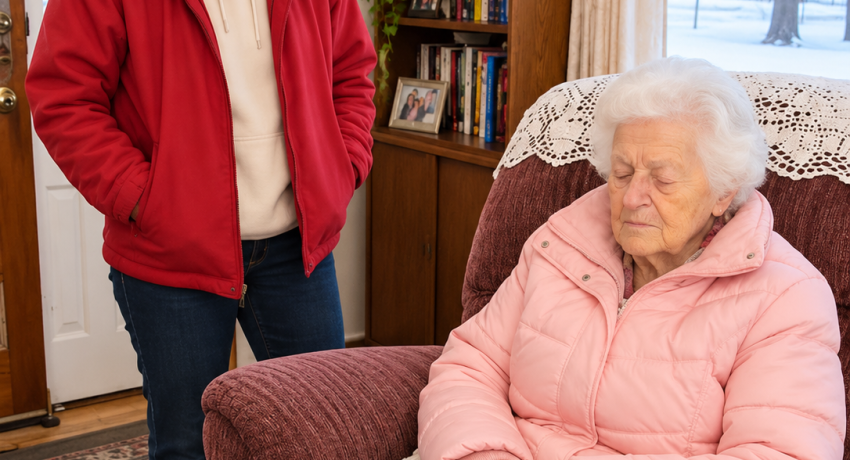
She was sitting in Dad’s old brown recliner.
She had on her heavy winter coat, a knitted hat, and gloves.
A crocheted blanket was spread across her legs.
Behind her, frost covered the inside of the large picture window.
For a horrifying second, I thought she had died.
Then I saw the blanket move faintly with her breathing.
Relief nearly brought me to my knees.
The thermostat was showing fifty-eight degrees, but the room itself was only fifty-one.
My eighty-two-year-old mother was sleeping in all her winter clothing because the house she lived in had become painfully cold.
I couldn’t make sense of it.
My name is Connie Weber. I’m fifty-four years old and the second child in a family of four.
Pam is our eldest sister.
I’m next, followed by our two brothers, Rob and Dean.
Pam lives in Harvey, just twelve miles away from Mom’s farm.
I live in Bismarck, Rob runs a farm near Rugby, and Dean has a job in Fargo.
Since Pam lives nearest to Mom, she has traditionally taken care of most of her daily responsibilities.
She handles the grocery shopping, schedules her medical visits, and keeps an eye on the house.
When Dad passed away four years ago, we decided to divide Mom’s propane costs among ourselves.
Each October, Rob, Dean, and I would send Pam $250.
Pam was expected to put in an additional $250 of her own.
That gave her a total of $1,000 to pay for heating fuel.
We depended on her to organize the propane deliveries.
For four years, none of us ever asked her to show us the receipts.
Why would we have?
She was our sister.
But as I stood inside that freezing house, I began to understand that something had gone seriously wrong.
I picked up my flashlight and stepped outside.
The freezing wind blew straight through my jacket as I made my way across the snow toward the propane tank.
I cleared the ice away from its gauge.
Then I looked at the reading.
Five percent.
There was barely five percent left in a tank that held 500 gallons.
In weather that cold, the situation was extremely dangerous.
I rushed back indoors and began looking through the papers attached to Mom’s refrigerator.
Beneath a magnet, I discovered a propane delivery receipt dated October 19.
According to the document, Pam had ordered just 200 gallons.
The bill came to approximately $400.
Yet my brothers and I had given her a combined $750.
Including her own promised contribution, the total budget should have been $1,000.
I searched the refrigerator for another delivery slip.
I couldn’t find one.
No refill in December.
Nothing delivered in January.
Not a single additional receipt.
What had happened to the money we had sent?
I went back into the living room and carefully woke Mom.
“Mom, it’s Connie.”
She slowly opened her eyes.
“Connie? Why are you here so late?”
“You haven’t answered your phone for two days. I got worried about you.”
Her gaze moved toward the window covered in frost.
Then she noticed the receipt in my hand.
Her face changed immediately.
She reached out and grabbed my wrist.
“Please don’t cause problems with your sister.”
I looked at her in disbelief.
“Mom, the propane tank is almost empty. You’re sleeping with your coat on!”
“I’m fine, sweetheart.”
“No, you’re not.”
She looked down.
Then she brought up something I had nearly forgotten.
Pam’s husband, Mark, had undergone an operation on his back in September.
He hadn’t been able to return to work afterward.
The two of them had been getting by on Pam’s relatively small salary as a receptionist.
“They’ve been having a hard time,” Mom murmured. “And propane costs so much this year.”
She attempted to give me a reassuring smile.
“I can manage being a little cold.”
But I could clearly see how much she was trembling.
Whatever had happened to the money, there was no way I could sort it out that night.
My immediate priority was making sure she was safe.
I contacted the local propane cooperative.
After several unsuccessful attempts, a driver named Duane Kessler finally picked up the emergency line.
He had known our family for many years.
When I told Duane what was happening at Mom’s house, his tone immediately turned grave.
“Is Elsie staying warm?”
“She’s sitting inside wearing her winter coat,” I answered. “The temperature indoors is fifty-one degrees.”
Duane went quiet for a moment.
He couldn’t get the propane truck down the snow-covered road that night, but he assured me he would come as soon as the county plow made the route passable.
Until then, he advised me to save whatever fuel remained and use a small electric heater if one was available.
I remembered Dad used to keep a portable heater in the basement.
I searched behind the water softener and eventually found it.
I brought it upstairs, set it at a safe distance from Mom’s chair, and shut the doors to the rooms nobody was using.
After that, I placed another blanket around her shoulders.
I also handed her my winter parka.
Then I settled on the floor next to her recliner.
I stayed awake all night.
Whenever the furnace made even the slightest sound, I listened anxiously, afraid it might quit working altogether.
Outside, the wind roared across the open fields.
Inside, I kept my eyes on my mother’s breathing.
At daybreak, I heard the county snowplow clearing the road.
It was the most comforting sound I had heard throughout the entire night.
Later that morning, I called the propane cooperative again.
That’s when I discovered that Mom’s propane account was listed under Pam’s name.
I asked the receptionist if I could assume responsibility for the account.
She told me I could open a new one in my own name.
So that’s exactly what I did.
I officially took over the account.
By the afternoon, Duane finally pulled up with the propane truck.
When he saw Mom standing in the doorway with her coat and hat on, his face filled with sadness.
“Mrs. Heinz, I’m so sorry I wasn’t able to reach you sooner.”
Mom assured him that she was perfectly fine.
But Duane noticed the frost covering the windows.
He replenished the tank to eighty percent capacity.
That meant adding 375 gallons.
The final charge was $783.75.
I paid the entire amount with my credit card.
Afterward, I asked him whether the cooperative offered automatic fuel deliveries.
Duane told me they could fit the tank with a monitoring device that would notify them whenever the propane level fell to thirty percent.
They would then arrange a refill automatically.
There would be no need for anyone to remember to place an order.
“Put us on the program,” I told him. “Send every bill to me.”
Once he had driven away, I raised the thermostat to seventy degrees.
The furnace suddenly came roaring back to life.
Warm air began circulating throughout the farmhouse.
For the first time since arriving, I finally felt able to relax and breathe.
Within an hour, the temperature inside had climbed considerably.
Mom slowly pulled off her gloves.
Next, she removed her knitted hat.
At last, she slipped out of the heavy brown coat she’d been wearing inside.
She walked into the kitchen and hung it on its familiar hook.
For a little while, she simply stood there.
Then she said softly,
“I’d forgotten just how lovely it feels to have a warm home.”
That evening, I sent messages to Rob and Dean.
I explained that Mom’s propane tank had been refilled and that any future contributions toward heating costs should be sent straight to me.
Both of my brothers called right away.
They wanted an explanation of what had happened.
I assured them Mom was safe and told them we’d go over everything together in person at Easter.
However, I didn’t reach out to Pam.
Five days afterward, she called me.
“The cooperative told me you transferred Mom’s propane account into your name,” she said instead of offering a greeting.
“That’s right.”
“You did that without even telling me.”
I paused to collect my thoughts.
“Pam, I found Mom asleep in her winter coat. The house was fifty-one degrees, and there was hardly any propane left.”
She didn’t respond.
“Pam?”
The call suddenly ended.
We had no further contact for eleven weeks.
As the weeks passed, my frustration continued to build.
I kept thinking about the October receipt.
Rob, Dean, and I had sent Pam $750.
Yet she had bought only $400 worth of propane.
What had happened to the other $350?
Had she ever paid her promised share?
I began imagining that she’d spent Mom’s heating money covering her own household expenses.
And the thought that she had allowed our elderly mother to endure freezing temperatures was something I struggled to forgive.
One evening, Steve asked me if I had thought about getting in touch with her.
“She hung up on me,” I answered.
“Connie, are you certain you know the full story?”
I started to respond.
Then I stopped.
Because I didn’t.
I knew what the receipt said.
I knew Mom had been left in a freezing house.
But I didn’t have all the answers.
Even so, I was still far too upset to call Pam.
So I waited for Easter.
Every year, our family celebrated Easter together at Mom’s farmhouse.
That year, we followed the same tradition.
Steve and I left Bismarck on Saturday and drove to the farm.
Most of the snow had disappeared, and the fields were beginning to thaw.
When we arrived, Mom welcomed us wearing a blue cardigan.
She wasn’t wearing a coat.
There were no gloves on her hands or a winter hat on her head.
The house felt pleasantly warm.
By Sunday afternoon, everyone had gathered except Pam.
A ham was cooking in the oven.
The table was filled with potatoes, green bean casserole, warm homemade rolls, and Mom’s traditional German pastries.
Rob and Dean were sitting at the kitchen table, drinking coffee.
Then we heard a vehicle pulling into the driveway.
Pam walked inside carrying a cardboard box.
A large, faded red coffee tin was balanced on top.
She looked completely worn out.
Mark hadn’t come with her.
Without exchanging any greetings, she placed both items on the kitchen table.
“I have something I need to explain,” she said.
Everyone went quiet.
She turned toward my brothers.
“Connie has been waiting eleven weeks to explain what happened in January. But I want everyone to hear it directly from me.”
Then she lifted the lid of the coffee tin.
Inside were bundles of paper money held together with rubber bands.
She tipped the contents onto the table.
“Seven hundred and fifty dollars,” she announced.
“That’s the amount the three of you sent me last October.”
She paused and swallowed.
“I used four hundred dollars to pay for Mom’s propane.”
My chest tightened.
“The remaining money went toward our mortgage, electricity bill, and Mark’s medication.”
Nobody said a word.
“And I never put in my own $250. I simply couldn’t afford it.”
Pam pushed the money across the table toward me.
“I’ve managed to replace every dollar. I want you to take it.”
I looked down at the cash.
“How did you manage to get all this money?”
Her eyes began filling with tears.
“I sold Grandma’s Bernina sewing machine.”
Mom let out a quiet gasp.
Pam went on.
“I sold the quilt rack Dad made for me, too, along with Mark’s hunting rifle. Since January, I’ve also been picking up extra shifts at the gas station on Saturdays.”
Her voice began to crack.
“I know what I did was wrong. I know Mom suffered in that cold house. You were right to take charge of the propane account.”
I couldn’t find anything to say.
But Pam still had more to show us.
She opened the cardboard box.
It was filled with piles of receipts.
There were hundreds of them.
Resting on top was a green spiral-bound notebook.
She placed it in front of Rob.
“There’s one more thing everyone needs to look at.”
Rob opened the notebook.
Inside were detailed records, carefully arranged and covering the previous four years.
Mom’s medications.
Grocery purchases.
Repairs to the roof.
Batteries for her hearing aids.
Eye doctor visits.
Furnace maintenance.
Well pump repairs.
Dental bills.
Every page listed expenses Pam had personally covered since Dad passed away.
At the bottom of the last page, one figure had been circled twice.
$14,860.
Rob stared at the amount.
“Pam, what exactly is this?”
“That’s the total I’ve paid for Mom’s expenses out of my own pocket,” she explained. “It doesn’t include the propane.”
Dean leaned closer to get a better look.
Almost fifteen thousand dollars?”
Pam nodded.
“I’m not expecting any of you to reimburse me. That’s not the reason I brought these records.”
“Then what is?” he asked.
She glanced around the table.
“Because every October, the three of you sent me $250 each and assumed that meant all of Mom’s needs were taken care of.”
She rested her hand on the notebook.
“But this is what looking after Mom has really involved.”
Nobody had an answer.
Pam explained that she had never considered caring for our mother a burden.
She lived nearby, and she genuinely loved helping her.
But everything became more difficult after Mark hurt his back in September.
He was unable to work.
They began falling behind on their mortgage.
His medications cost a great deal, even with insurance coverage.
By October, Pam was frightened that they might lose their house.
“When your money arrived, I sat at the kitchen table staring at it,” she said.
“I knew Mom needed propane. But I also knew we were already two months behind on our mortgage.”
She started crying.
“So instead of ordering four hundred gallons, I bought only two hundred.”
She had assumed that amount would last until January.
She thought Mark might be able to return to work by then, or that she could pick up enough overtime to afford another delivery.
Unfortunately, neither of those things happened.
Then the severe winter weather set in.
The propane supply ran down much faster than she had anticipated.
“Why didn’t you come to us and ask for help?” Dean demanded.
Pam brushed the tears from her cheeks.
“Because I was embarrassed.”
She lowered her gaze.
“I’m the eldest. I’m supposed to be the dependable one, the person who looks after everyone else.”
Her voice began to shake.
“How could I possibly admit that I couldn’t even afford to keep Mom’s house warm?”
At last, I understood just how much pressure she had been under.
Still, there was one thing I couldn’t stop wondering.
“Pam, why didn’t you arrange another propane delivery when the freezing weather arrived?”
She glanced toward Mom.
“I did try.”
Everyone turned to look at our mother.
She remained quietly seated in Dad’s old recliner, gazing out at the fields through the window.
After a moment, she finally spoke.
“I asked Pam not to order another delivery.”
I looked at her in disbelief.
“What?”
Mom brought her hands together.
“I knew Mark had undergone surgery. I also knew they were having trouble keeping up with their mortgage.”
She turned toward Pam.
“When the temperature started dropping, she called and offered to purchase more propane using her credit card.”
Mom stopped for a moment.
“But I refused. I told her not to.”
“Mom!” I cried out.
She continued in a steady voice.
“I told her to keep that money for her own home. I had blankets, warm clothing, and my winter coat.”
I could hardly process what she was saying.
“You knowingly allowed the house to become that cold?”
Mom met my eyes.
“Connie, my daughter was at risk of losing her house. Her husband was unable to work. She was scared and completely worn out.”
Her eyes began to water.
“I believed wearing my coat for a few days was a small sacrifice if it helped her get through that difficult time.”
Pam broke down in tears.
Mom gently reached over and took her hand.
“I made her promise she wouldn’t order more propane or tell any of you what was happening.”
All at once, I remembered the night I had discovered Mom in the freezing house.
I remembered how tightly she’d held my wrist and pleaded with me not to go after Pam.
She hadn’t been making excuses for someone who had abandoned her.
She had been trying to shield another one of her daughters.
And Pam had been left to deal with the guilt by herself.
For eleven weeks, I had convinced myself that my sister had knowingly left our mother without heat.
But the reality was much more complicated.
Pam had made a serious error in judgment.
Mom had made a mistake of her own.
And the rest of us had allowed one person to shoulder almost every responsibility without ever checking whether she could cope with it.
For several minutes, the entire room remained silent.
Then Rob picked up the green notebook.
He carefully turned through the pages once more.
Eventually, he took out his checkbook.
“Rob, please don’t,” Pam said. “I didn’t bring all this here because I wanted money.”
He didn’t listen.
He wrote a check and set it on the table.
$3,715.
“This covers my portion of the expenses you’ve been paying,” he told her.
Dean immediately pulled out his phone.
“I’ll transfer my share as well.”
Pam started crying even harder.
“Please stop. I don’t want any of you to repay me!”
Rob rose from his chair and walked around the table.
He’s a tall, broad-shouldered, quiet man who seldom displays his feelings.
But that afternoon, he put his arms around our oldest sister.
“I’m sorry, Pammy,” he whispered. “We never should have left you to handle everything by yourself.”
Then I got up.
For eleven weeks, I had been preparing in my mind everything I wanted to tell Pam.
I had pictured myself confronting her.
Asking for answers.
Accusing her of misusing our money.
But when I looked at how exhausted she appeared, all the anger I had been holding onto disappeared.
“Pam,” I said quietly, “I’m sorry.”
She shook her head.
“You had every reason to be angry with me.”
“I should have spoken to you rather than jumping to conclusions.”
She looked directly at me.
“And I should have been honest with you.”
Then she pulled me into a hug.
It was just like the hugs she used to give me when we were little girls and I fell or hurt myself.
I wrapped my arms around her.
“I love you,” I whispered.
“I love you too, Connie.”
After eleven long weeks, we finally felt like sisters again.
We didn’t sit down for Easter dinner until almost three in the afternoon.
The ham had dried out a little, and the rolls had risen more than they should have.
Nobody seemed to mind.
Instead, we gathered around Mom’s kitchen table and worked out a new arrangement.
The propane service would continue through automatic deliveries using my account.
All four of us would divide the costs equally.
While Mark was recovering and unable to work, the three of us would pay Pam’s share.
We also arranged a schedule for visiting Mom.
Rob would stop by on the first Sunday of every month.
Dean would take the third Sunday.
Steve and I would handle the second and fourth Sundays.
Pam could come over whenever she wished, without feeling that the entire responsibility rested on her shoulders.
We opened a joint bank account specifically for Mom’s expenses.
Every sibling would deposit $100 each month to cover groceries, medications, household repairs, and other essential costs.
Pam would oversee the account because she knew Mom’s everyday requirements better than the rest of us.
However, everyone would receive copies of the account statements.
“It’s not that we doubt you,” Dean explained. “It’s that you shouldn’t have to manage all of this without anyone helping you.”
Before we started eating, Mom introduced one final family rule.
“From this day forward, nobody in this family keeps their financial problems a secret.”
She looked around at each of us.
“If someone is struggling, they need to speak up and tell the rest of us before the situation becomes impossible to handle.”
We all promised to follow that rule.
Afterward, Mom walked over to the kitchen doorway and took her old brown winter coat off its hook.
She handed it to Pam.
“Take this to the church’s charity sale.”
Pam looked surprised.
“Mom, you’ve had that coat for thirty years.”
“That’s true,” Mom answered. “And I spent two weeks wearing it inside my own house last January.”
She gave a faint smile.
“I believe it’s time to part with it.”
By May, Mark had recovered enough to return to a light-duty position at work.
In June, Pam no longer needed to work her additional Saturday shifts.
Then July brought an unexpected surprise.
A large parcel was delivered to her house.
Inside was Grandma’s old Bernina sewing machine.
The very same machine Pam had sold to replace the money spent on propane.
She called me right away.
“Connie, was this your doing?”
“No. What happened?”
“Somebody bought Grandma’s sewing machine back!”
She was already crying.
“There was a message tucked inside.”
“What did it say?”
“Only two words.”
She paused briefly.
“Keep-full.”
I called Rob.
Then I contacted Dean.
After that, I asked Steve.
Not one of them admitted to arranging it.
When I questioned Mom, she quickly steered the conversation elsewhere.
We didn’t discover who was responsible until September.
I was visiting the farm when Duane came by to refill the propane tank.
During our conversation, he casually brought up the sewing machine.
“That was your mother’s doing,” he said.
I looked at him, stunned.
“Mom?”
He nodded.
“She got in touch with me because your wife’s cousin had bought the machine. Your mother paid $400 to bring it home.”
I could barely believe what I was hearing.
“She used the money she had saved by selling eggs,” Duane said.
Then he gave me a smile.
“She told me that keeping things full should go both ways.”
I stood there, unable to speak.
Mom had sacrificed her own comfort to keep Pam’s home safe.
And now, without telling anyone, she had used her savings to return something meaningful to her daughter.
That was the kind of person she had always been.
By October, the fields had been cleared of their crops.
The trees around the farm were glowing with golden leaves.
Flocks of geese headed south beneath the vast North Dakota sky.
The propane tank was close to eighty percent full.
Its automatic monitoring system flashed green.
One afternoon, while I was at work in Bismarck, three payment alerts appeared on my phone.
Rob had transferred $250.
Dean had transferred $250.
Then a payment from Pam came through.
$250.
Her message read:
“My contribution. At last.”
I looked at it for quite a while.
Then I opened my phone and sent the same amount straight back to her.
I wrote:
“For all the Sundays you spent looking after Mom. A small thank-you for four years of care.”
Pam called me almost instantly.
“Connie, why would you do that?”
I smiled.
“Keep-full, Pam. Remember? It goes both ways.”
She remained silent for a few seconds.
Then she burst out laughing.
A warm, honest laugh.
The same kind I remembered hearing when we were children.
“You really are impossible,” she said.
“I got it from Mom.”
That Thanksgiving, the whole family gathered at the farmhouse again.
Outside, the temperature had dropped below zero once more.
Inside, however, the furnace was running smoothly.
The thermostat showed seventy-one degrees.
Mom was relaxing in Dad’s recliner, dressed in her blue cardigan.
No coat.
No winter hat.
No gloves.
Pam arrived with Mark, who was moving carefully with the help of a cane.
She had Grandma’s sewing machine with her.
“I’m going to make something special for Mom this winter,” she said.
Mom looked at the sewing machine.
Then she looked at Pam.
Neither of them spoke.
There was no need.
Later that evening, after we finished dinner, I spotted Mom standing near the kitchen doorway.
Her eyes were on her new navy winter coat.
“Is everything all right?” I asked.
She smiled.
“I’m warm, Connie.”
Then she turned her gaze toward the white propane tank outside the window.
Under the yard light, its automatic monitor was flashing green.
“Now nobody has to keep track of it anymore,” she said softly.
She was right.
The cooperative was monitoring the fuel level now.
Duane brought propane whenever the tank needed topping up.
Everyone contributed their fair share toward the bills.
But that wasn’t the only thing keeping Mom warm.
She was warm because her children had finally begun sharing the responsibility of looking after her.
Because Pam was no longer struggling under a huge pile of expenses recorded in a green notebook that nobody else had ever seen.
Because we had discovered that pride and keeping quiet could be every bit as dangerous as a winter storm.
And because we had made a promise together around the kitchen table.
If anyone in our family ever faced hardship, they would never have to go through it by themselves.
That night, once everyone had gone to sleep, I remained sitting quietly in the kitchen.
The old rooster clock continued ticking against the wall.
Below the floorboards, the furnace started up with its familiar rumbling sound.
Warm air moved throughout the house.
I closed my eyes and listened.
For years, we had assumed that sending money was enough to fulfill our responsibility.
But genuine love meant much more than sending a check now and then.
It meant paying attention, being truthful, and being present when someone needed you.
My mother had almost frozen because we were all trying to protect one another while hiding what was really happening.
Now we finally understood.
A family remains warm not because one person gives up everything, but because everyone shares the burden.
And for the first time in many years, our family was finally keeping each other full.









