
 153 views
I had been retired for barely two days when my daughter-in-law announced that my new lakeside cabin would be the perfect summer getaway for her parents.
She told me to prepare the bedrooms for their arrival, then casually suggested that I could always sell the property if I had a problem with the arrangement.
Apparently, forty-one years of hard-earned savings, peaceful mornings by the lake, and the fact that my name alone appeared on the property deed meant absolutely nothing once she decided my home could serve her purposes.
I didn’t argue or remind her who the actual owner was. I didn’t even raise my voice.
Instead, I quietly made a phone call, put together a thin folder of documents, and waited outdoors until their SUV pulled into my driveway as if the property already belonged to them.
At sixty-four, I had finally retired and purchased the cabin for one reason: to enjoy the simple pleasure of breathing without interruption.
That was all I had ever wanted. I wasn’t dreaming of a luxurious retirement, an enormous mansion, or some extravagant escape designed to impress everyone who saw it. I wanted no lavish lifestyle or millionaire’s retreat. All I needed was wooden floors beneath my feet, fresh air drifting in from the lake, a cup of coffee slowly losing its warmth, and mornings peaceful enough to quiet the constant ringing that forty-one years inside a steel mill had left in my ears.
For most of my working life, noise had surrounded me: roaring furnaces, beeping forklifts, metal grinding against metal, and workers yelling over machinery because nobody could get anything poured, cut, lifted, or repaired by speaking softly.
Even after my last day at the mill, I woke up twice in my city apartment, convinced that the factory whistle was blowing. But there was nothing except the refrigerator humming and my upstairs neighbor scraping something across the floor at 12:38 a.m.
That was why discovering a three-bedroom log cabin with a green metal roof, a stone fireplace chimney, and an aging wooden dock that needed sanding made the choice so simple.
The place carried the scent of fresh cedar, old lake water, and hard work. Its exterior needed another coat of stain, the boathouse door refused to open smoothly, and the wooden steps creaked whenever I walked across them. I loved every imperfection. It felt reassuring to know exactly what needed fixing. A home requiring maintenance never pretends to be something different, and after spending decades listening to empty promises above the roar of factory machinery, I appreciated that honesty.
My son, Elliot, understood just how important the cabin was to me. His mother had walked away when he was thirteen, leaving me to raise him alone without ever asking him to take sides.
I prepared his lunches before sunrise, watched his games in freezing temperatures while wearing my work boots, taught him to change the oil in an old pickup truck, and attended parent-teacher meetings with the smell of the steel mill still clinging to my clothes. Balancing fatherhood with overtime shifts had left me little room to feel proud of myself. But every small responsibility mattered: keeping food on the table, showing up at school whenever he needed me, and making it home even after exhausting days at work.
When Elliot married Sienna seven years earlier, I made a genuine effort to establish a good relationship with her. I ignored her remarks about my apartment being industrial vintage without the intentional design, my restored maple dining table looking overly rustic, and my supposedly respectable occupation, which she described in a way that made it sound useful but hardly impressive.
I rarely responded to any of it. Unfortunately, people who have never had to pay for what they take sometimes interpret another person’s silence as permission.
Just thirty-six hours after settling into my new home, I was sitting on the dock at 6:17 on Thursday evening when Sienna called.
She immediately announced that she and my son had decided her parents would be spending the summer at my cabin.
She added that if I wasn’t happy with their decision, I could simply sell the property and return to somewhere I could actually be useful.
The lake water gently moved against the rocks. Somewhere beyond the reeds, a loon was calling, and the coffee in my cup had already turned cold.
I asked her just one question.
Had Elliot agreed to this?
She responded that her husband understood how family sometimes demanded sacrifices.
Unlike certain people, apparently.
Then she began listing her expectations. Her parents were arriving on Friday. I could collect them if transportation was necessary. Beverly had back problems, so she would need the master bedroom, while Gordon required a separate room for his paperwork. I was expected to empty the closets and stay out of their way.
These weren’t polite requests. They were instructions. A request recognizes that another person has the freedom to decide. An order assumes that the person receiving it is nothing more than another piece of household furniture.
I chose not to argue. A reasonable person usually understands a straightforward refusal. Someone who feels entitled to everything will simply treat it as the beginning of a dispute. I decided that showing them the facts would be far more effective.
At 7:04 p.m., I contacted the county clerk’s office to verify the officially recorded deed. By 7:41, I had printed the closing documents, property-tax receipt, and ownership records. Every document confirmed the same thing: there was only one legal owner, and that was me.
I also printed Sienna’s message from 8:12 p.m.
Don’t make everyone uncomfortable over a couple of unused bedrooms.
At the top of a legal pad, I wrote a sentence in bold black ink:
My property cannot be reassigned to someone else.
By Friday afternoon, I hadn’t prepared a single guest bed. Nothing had been removed from the closets, and the master bedroom remained locked. On the kitchen table, I had placed a slim blue folder containing the property deed, tax bill, insurance documents, printed copies of her messages, and an unsigned rental agreement listing the market-rate terms I knew they would never agree to.
Surprisingly, my hands remained perfectly steady. For a brief moment, I felt the urge to yell about every exhausting hour spent beside those furnaces, every weekend sacrificed, and every tired evening meal I had eaten while standing over the kitchen sink. I wanted her to realize that I hadn’t spent four decades working on concrete floors just so her parents could treat my hard-earned peace and quiet as extra storage space for themselves.
But anger is a costly way to spend the peace and quiet you’ve worked so hard to achieve. Even if I screamed until my voice gave out, I’d still have the same ownership papers and the same unwelcome guests standing in my driveway. I decided the documents could communicate what my frustration never could.
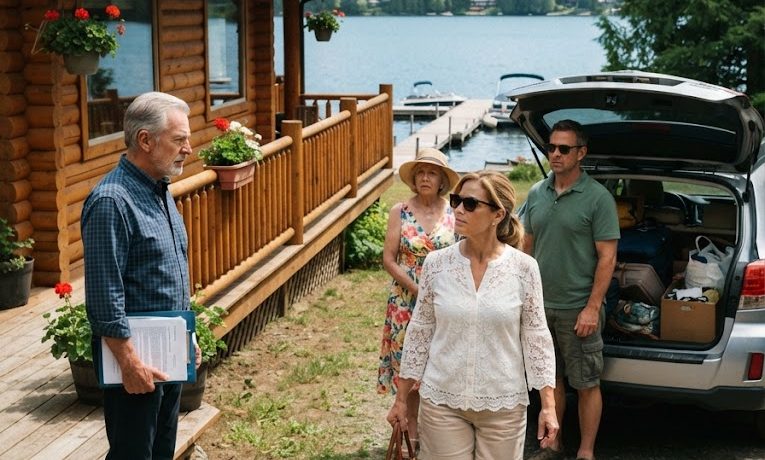
I slipped into my old denim jacket, picked up the folder, and stepped outside onto the porch.
The afternoon warmth still lingered on the driveway. A little American flag beside the mailbox fluttered sharply in the wind, while the screen door let out a squeak as it swung against its spring.
At exactly 4:26 p.m., an SUV turned in from the road.
Sienna was sitting in the passenger seat, wearing sunglasses and smiling even before the vehicle came to a complete stop. Beverly sat in the back with a travel pillow wrapped around her neck, while Gordon held a cardboard office box against his chest, seemingly convinced that someone had already arranged a place for everything inside.
The rear hatch opened, exposing two suitcases.
Sienna climbed out, glanced toward the cabin behind me, and announced:
Perfect. You’ve got everything ready.
I opened the blue folder on the porch railing. For the first time in seven years, her self-assured expression began to disappear before I had even said a word.
PART 2
I opened the deed and turned it toward Sienna, Beverly, and Gordon, making sure they could clearly see my name as the sole registered owner, along with the county seal and the property’s official description.
Nobody spoke. The water gently moved against the stones below the lawn, and the screen door creaked behind me.
Eventually, Sienna called the entire situation ridiculous, insisting that family members shouldn’t need legal paperwork to deal with one another.
I placed the property-tax receipt in front of her, followed by the insurance document and a printed copy of her message:
“Don’t embarrass everyone over empty rooms.”
Beverly glanced at the message, and her expression shifted even before Sienna’s did. She had arrived carrying luggage and a travel pillow, not expecting to discover that her daughter’s plans had been preserved in writing.
Gordon lowered his cardboard box onto the gravel with a dull thump. Instead of looking directly at me, he turned toward his daughter-in-law.
His reaction told me something important. Sienna had clearly presented a different version of events during their drive. Perhaps she’d claimed that I had offered the accommodation, that Elliot had arranged everything, or that I was simply being difficult but would eventually come around.
Whatever explanation she’d given them, it certainly hadn’t included official property records or printed copies of her own messages.
I placed the unsigned rental agreement on top of the other documents. The conditions were straightforward: rent at the current market rate, a security deposit, clearly established dates, and no automatic right to use the bedrooms or storage areas. Nothing in the agreement suggested that my property could become a family vacation destination simply because somebody else found the idea convenient.
Sienna stared at the documents as though I had physically struck her.
But I hadn’t. There was an important difference. I wasn’t trying to hurt or punish anyone. I had simply presented the truth for everyone to see.
She accused me of humiliating her parents. I calmly explained that I hadn’t been the one who brought them into an uncomfortable situation in the first place. That was as sharp as I allowed my response to become.
Beverly then asked Sienna, in a quiet voice, what Elliot had actually agreed to. Sienna paused before answering, and that brief hesitation communicated more than any lengthy explanation from me ever could.
Her phone suddenly vibrated. Elliot’s name appeared on the screen between us.
Sienna tried to move away, but the porch offered very little space, and the truth was already out in the open.
I suggested that she put the call on speaker. When she remained where she was, I reached out my hand. Perhaps because everyone was watching, she eventually passed the phone to me.
I answered by calling my son’s name. Elliot sounded confused and wanted to know why Sienna had been calling him repeatedly while he was driving home from work.
I asked him the same question I had put to her the night before. Had he agreed to let Beverly and Gordon stay at my cabin throughout the summer?
A moment of silence followed. It wasn’t the pause of someone caught in a lie. Instead, it sounded like a man trying to piece together what he believed his wife had previously told him.
Then he answered.
No.
One simple word changed the atmosphere completely.
Sienna’s face lost its color. Beverly closed her eyes, while Gordon picked up his cardboard box and held it against his chest, no longer making any attempt to approach the cabin entrance.
Elliot asked what was going on. I didn’t exaggerate or turn the situation into a dramatic story. I read Sienna’s message aloud, then shared the opening condition of my rental agreement and explained that her parents’ luggage was already sitting in my driveway.
Nobody spoke. I could hear vehicles passing on Elliot’s end of the call, while on my side, all I could hear was my own breathing.
For years, I had done everything possible to keep Elliot from being forced to take sides between adults. His mother’s departure had already shown me how unfairly grown-ups could make children carry the burden of their decisions.
But Elliot was no longer thirteen. He was an adult now, both a husband and a son, caught in a situation his wife had attempted to arrange without telling him the complete truth.
He asked to speak to Sienna. I handed the phone back, and she moved away from the porch. We didn’t need to hear their conversation to understand what was happening. Her body language revealed enough.
At first, she remained stiff, holding her chin high with one hand resting on her hip, as though confidence alone could somehow resolve the situation. Gradually, her arm fell to her side. She turned away from her parents and said Elliot’s name in a voice noticeably quieter than anything I had ever heard from her.
Beverly sat down on the edge of the SUV’s seat and began rubbing the bridge of her nose.
Eventually, Gordon turned toward me and explained that he had been under the impression that I wanted some company and that everything regarding their stay at the cabin had already been arranged.
I believed what he told me. Not because I thought he deserved unquestioning trust, but because the embarrassment on his face appeared genuine. Someone deliberately telling a lie usually makes an effort to control their expressions. Gordon simply looked completely still.
I expressed my regret to them for the way they had been misled into this situation, while firmly explaining that the cabin was not available for their stay. I could understand how uncomfortable it must have been for two people to arrive believing something that wasn’t true without taking responsibility for the false impression someone else had created. Both things could exist at the same time. Showing compassion didn’t require me to surrender my boundaries.
It had taken sixty-four years of living to finally understand that lesson.
Sienna returned with her phone in her hand. However, she offered no apology. Some people find it impossible to admit they’ve done something wrong while the consequences are still unfolding. Doing so would require them to accept that they had taken a risk with someone else’s life and lost.
She simply told her parents that it was time to leave. She didn’t say another word to me.
Beverly slowly rose from her seat. Gordon carried his cardboard box back to the SUV, and the suitcases followed. The rear hatch came down with a soft but unmistakably final thud.
Just before climbing into the passenger seat, Sienna looked toward the blue folder. I kept my hand resting on top of it, not to intimidate her, but to make one thing clear: those documents remained legally valid, regardless of how she felt about them.
Their SUV backed out of my driveway at 4:58 p.m. I remember the exact time because only thirty-two minutes had passed since their arrival. In less than an hour, a plan built on entitlement had met a single folder of paperwork and completely collapsed.
Once the vehicle disappeared, Elliot was still on the phone. He said my name in the same way he had as a little boy whenever he realized he’d overlooked something important.
I explained that I wasn’t expecting him to punish his wife for my sake. All I wanted was for him to understand that I was an individual with my own life, choices, and boundaries. There was a significant difference between those two things.
He told me he understood. I believed him, although rebuilding trust after a family conflict isn’t something that happens with the flick of a switch. It’s more like repairing a damaged dock, replacing one broken board at a time.
That evening, I secured the screen door and settled at the kitchen table, leaving the folder open in front of me.
To my surprise, the cabin didn’t feel as though the incident had spoiled it. I had expected Sienna’s demands to linger in every room and destroy my first week of retirement. Instead, my home seemed even more protected than before.
Maybe standing up for something you value without treating others cruelly makes it feel even more like your own.
I placed the deed back inside the folder, slipped it into the drawer beside the stove, and prepared another cup of coffee despite the late hour. Even retirement hadn’t managed to change all my old routines.
Outside, the lake had turned a deep shade of blue. A truck drove past without stopping. Nobody entered my driveway, demanded that I empty a closet, or described my peaceful home as nothing more than a collection of unused bedrooms.
Over the next few days, Elliot came to visit by himself. He brought along a toolbox and some sandwiches from a roadside diner.
We knew we couldn’t resolve everything in a single conversation. The men in my family had never been particularly good at putting their emotions into words across a kitchen table.
Instead, we worked together, smoothing the dock and securing the loose screws in the porch while discussing a few difficult matters along the way. Having something practical to do with our hands helped whenever the conversation became uncomfortable. Neither of us felt compelled to explain every moment of silence.
He told me that Sienna had described me as lonely and supposedly eager to have people share my cabin. She had also made him believe that refusing her plan would negatively affect Beverly’s health and create embarrassment for the entire family.
I listened carefully before telling him that getting married didn’t give him an obligation to let his wife disregard his father as though he didn’t matter.
He made no attempt to argue with me. For our first day, that was enough.
Sienna kept her distance for two weeks. When she finally showed up again, she was standing outside without her sunglasses. She seemed younger somehow, not exactly kinder, but no longer hiding behind the confident exterior she usually wore.
Her apology wasn’t perfect, which is often how sincere apologies sound.
She explained that she had been under pressure trying to handle several issues simultaneously. Her parents had their own concerns, she said. She also admitted that speaking to me the way she had was completely wrong.
I accepted her acknowledgment of that mistake, but I didn’t treat her explanations as excuses. There was an important difference between the two.
People who have taken more than they should sometimes attempt to return what they’ve taken by wrapping it in a collection of explanations. Those explanations may help clarify why something happened, but they don’t make the wrongdoing disappear.
I told her she was welcome to visit whenever she was invited. Beverly and Gordon could also come over for dinner sometime, as long as everyone understood that they would be visiting as guests. However, nobody would be staying in my cabin for the entire summer.
She nodded without offering another carefully prepared response. At that moment, it was the closest thing to a new beginning that we could manage. Whether our relationship improved beyond that would depend on time and whether she learned that being family didn’t mean having unlimited access to everything I owned.
PART 3 (END)
By the time my first month of retirement came to an end, we had finished sanding the dock until its surface was smooth. Elliot also helped me apply a fresh coat of stain to the cabin’s exterior siding.
Beverly mailed me a short letter expressing her embarrassment and apologizing for arriving without first speaking to me personally. Gordon sent back the unsigned rental agreement with a dry remark that seeing the market rental price had increased his respect for me more than he had expected.
That made me laugh. It was the first genuinely funny moment throughout the entire incident.
I held on to the blue folder, not because I was expecting another attempt to take over my property, but because it reminded me of an important lesson I had almost forgotten.
A person who values peace still needs the courage to stand firm. A peaceful home still needs a door that its owner has the right to lock. And decades of hard work don’t suddenly become everyone’s shared property simply because somebody uses the word family convincingly.
These days, I spend most mornings sitting on the dock with a cup of coffee in my hands. The wooden boards feel smoother beneath my boots, and although the porch steps still make noises, they no longer creak quite as loudly.
Elliot sometimes comes by to visit, occasionally bringing lunch with him. On other days, we barely exchange a few words and simply allow the peaceful lake to fill the silence. I’m perfectly happy with that arrangement.
I didn’t spend forty-one years working just to retire and spend my days winning arguments with relatives. I retired because I wanted to enjoy the simple pleasure of hearing myself breathe.
And ever since that Friday, nobody in my family has referred to my home as a collection of empty rooms again.