
 63 views
I discovered it in her checkbook on the night I returned home.
I wasn’t snooping around. I want to make that clear. It was nearly midnight, Grandma had already gone to bed, and I couldn’t fall asleep because my body was still operating on a different time zone halfway across the world. So I headed into the kitchen to get a glass of milk. Her checkbook was lying open on the table beside the sugar bowl, exactly where she always left it.
She still pays people with checks. Actual paper checks. She writes them in blue ink using the same slanted cursive taught in Missouri schools back in 1955. Every Sunday after church, she sits down with a pencil and a calculator about as big as a paperback novel to balance her checkbook.
As I poured my milk, I happened to glance at the register. Just a quick look.
Then I put the milk jug down and pulled out a chair.
The records covered eleven months, reaching all the way back to last August, the same week I had left for deployment.
Most of the transactions were ordinary expenses for a seventy-eight-year-old widow living on a limited income. Ameren Missouri, $84. Cedar Ridge Water, $31. Walmart pharmacy, $12. Church donation, $20, every single week without fail.
But once every month, written in that familiar slanted blue handwriting, was another entry:
Ray. 400.
I flipped to the next page.
Ray. 400.
Another page.
Ray. 400.
It appeared every month throughout my entire absence. Eleven payments in total. Beside the first one, someone had added a small pencil note: lawn.
I remained seated at that kitchen table for quite some time.
Grandma receives $1,106 each month from Social Security. I know the exact amount because I helped her arrange the direct deposit when I was sixteen. That’s her entire income. Grandpa’s railroad pension stopped when he passed away because he had chosen the larger payout, and nobody had explained what that decision would mean for her.
Just $1,106.
And my uncle had been collecting $400 of that money. Over one-third of her monthly income. He had been doing it every month for nearly an entire year.
All for mowing a quarter-acre lawn.
I started calculating the total in my head. I didn’t want to think about it, but the numbers kept coming. Eleven months multiplied by four hundred dollars came to $4,400.
While serving overseas, I had earned some additional money because of my deployment. There was hostile fire pay, family separation pay, and the tax exemption. I had managed to save nearly everything. My plan was to spend part of those savings repairing the hole in Grandma’s back porch roof and perhaps buying her a comfortable new recliner. Her old chair tilted toward one side and made a squeaking noise whenever she sat down.
Yet while I was away, she had been handing her own son more money each month than she spent on electricity, water, and groceries combined. All so he could mow her lawn.
I shut the checkbook and placed it neatly beside the sugar bowl, just the way she preferred. After washing my glass, I left it in the dish rack.
Then I stepped onto the back porch and stood outside in the darkness wearing nothing but my socks, staring out across the yard.
That yard held most of my childhood memories.
It was where I first learned to throw a football. Beneath the redbud tree in the corner, I buried two dogs and a hamster. When I was nine, I fell out of the oak tree near the fence and broke my arm. Grandma drove me all the way to the hospital in Rolla wearing her nightgown, with curlers still in her hair.
It was also the same yard where I stood with my hands buried in my pockets on the afternoon someone told me about my father.
I couldn’t see much in the darkness, but I could smell the grass. It had that stale, unpleasant odor of grass cut with a dull mower blade, with clumps of clippings left behind to decay.
My grandmother’s yard had never smelled that way when Grandpa was still alive. It hadn’t smelled that way during the years I lived there, either.
Chapter Two: Eggs
On Saturday morning, Grandma made me eggs.
She had gotten out of bed before I did, which somehow surprised me even though it shouldn’t have. Ever since childhood, she’d been waking up at 5:15, a habit she developed while growing up on a dairy farm outside Licking. When I finally walked into the kitchen at 6:30 wearing my sweatpants, she was already at the stove in her blue housecoat. Bacon was sizzling in her cast-iron skillet, and the radio was broadcasting the farm report.
“There’s my Marine,” she called without looking back. “Come sit down. The coffee’s ready.”
I took a seat, and she placed a cup in front of me. Black coffee with one spoonful of sugar. She still remembered exactly how I liked it.
Her name is Opal Gaines. She’s only four feet eleven inches tall and probably weighs around ninety pounds, unless she’s carrying a cat. Her hair is completely white, and every Saturday evening she rolls it into pink foam curlers so it’ll look presentable for Sunday church. Brown age spots cover her hands, and they tremble slightly these days, but she still managed to crack the eggs with one hand, just as she’d always done.
“Over easy?” she asked.
“Yes, ma’am.”
“All right, all right. I just wanted to make sure you hadn’t changed your mind.” She turned the eggs over with a quick movement of her wrist. “Being in the Marines hasn’t made you switch to scrambled eggs, has it?”
“No, ma’am. That’s practically all they give us. I’ve been looking forward to over easy eggs.”
She laughed, and I loved hearing that sound. It had been eleven months since I’d last heard it in person. The only time before that was during a Christmas phone call with such a terrible connection that I could barely hear her.
She placed my breakfast in front of me. Two eggs, four slices of bacon, a biscuit covered in melting butter, and a spoonful of her homemade blackberry preserves.
I finished everything in roughly four minutes. Grandma remained beside the counter, watching me eat with her arms folded and a smile on her face.
Eventually, I put my fork down.
“Grandma,” I asked, “who has been mowing the grass?”
Her expression suddenly tightened, like a screen door being pulled shut.
Just like that. One moment, her face was open, warm, and full of smiles. The next, everything changed. Her expression tightened, and I could almost see her shutting something away behind her eyes. Locking it in place.
“Your uncle has been taking care of it,” she replied.
She turned toward the stove again. Picking up the skillet, she began scraping its surface with a spatula, even though there wasn’t a speck of food left on it.
“How much are you paying him?” I asked.
She remained silent. Instead, she stared through the window above the sink, looking out toward the yard.
“Families are supposed to help one another, Hunter,” she said.
“But he’s charging you four hundred dollars, Grandma.”
She froze. The scraping stopped, and her hand remained motionless.
“You looked through my checkbook,” she said softly.
“It was sitting open on the table. I wasn’t trying to snoop. I promise.”
She put the skillet down, turned on the kitchen faucet, and let the water run, although there wasn’t a single dish that needed washing. She held her hands beneath the stream.
“He’s my son, Hunter,” she said.
“I understand that.”
“He’s been going through a difficult time. Money has been tight for him. Sheila keeps pressuring him about finances. He needs the work.”
“Grandma, that’s four hundred dollars every month. One-third of your entire Social Security check.”
She shut off the faucet without turning toward me.
“I’m not going to start a family feud over some grass,” she said.
That was the end of the conversation. She wiped her hands with the kitchen towel and hung it over the oven handle, carefully folding it into thirds as she always did.
After that, she walked into the living room, lowered herself into her crooked recliner, and switched on the television.
I remained at the kitchen table, staring at my empty plate, finally understanding what was happening.
She had quietly paid him for all eleven months. She hadn’t mentioned a word about it during our phone calls. It never appeared in her letters, either. She wrote to me every week, filling three pages front and back with stories about church potlucks, the neighbor’s cat, and the doctor’s latest comments about her blood pressure.
She had already lost one son. My father, Danny Gaines. He was thirty-four when he died on Route 63 during an icy January night, eleven years earlier.
She would rather let someone take advantage of her than risk losing her only remaining son.
I didn’t argue with her.
There was no reason to. I recognized that expression. I’d seen it once before at my father’s funeral. My mother had stood beside his grave and announced that she was moving to Kansas City with her new boyfriend. She wasn’t even certain she wanted to take her ten-year-old son along.
Grandma had immediately stepped beside me and placed a hand on my shoulder.
“He’ll stay with me,” she declared. Just like that. Her expression had closed like a screen door, and nobody dared challenge her.
So I chose not to argue this time, either.
I went to my bedroom and changed my clothes.
Chapter Three: The Blade
The only clean clothes remaining in my seabag were my physical training uniform.
I’d spent three days traveling. From the ship to the port, then from the port to a base, followed by a charter flight, another flight to Camp Lejeune, a trip from Lejeune to Raleigh, then Raleigh to St. Louis, and finally a drive to Cedar Ridge in a rented Corolla. Every piece of clothing I owned smelled like jet fuel and the inside of a duffel bag.
The PT uniform was the exception. Green Marine Corps running shorts and a tan T-shirt bearing the eagle, globe, and anchor on the front. I’d washed them in a hotel bathroom sink in Spain and hadn’t worn them again.
I pulled them on, tied my running shoes, and grabbed some work gloves from the drawer beside the back door. They were Grandpa’s old leather gloves, stiff and hard like pieces of cardboard.
Then I headed outside to the shed.
The shed belonged to Grandpa. Walter Gaines had constructed it himself in 1971, using lumber he salvaged from a barn being demolished along Highway 72. His old pegboard still covered the back wall, with every tool hanging in its proper place. He had drawn black outlines around each one so everyone would know exactly where it belonged.
Grandma had never allowed anyone to rearrange a single item on that board. Not once in the fourteen years since Grandpa passed away.
The lawn mower sat in the corner. It was a red Snapper push mower, probably twenty years old. Grandpa had purchased it brand-new from Western Auto in Rolla, back when that store was still operating in Rolla. He had cared for that machine as lovingly as someone would look after a vintage automobile.
I pulled it out into the daylight.
Its condition was awful.
Old grass covered the mower deck in thick layers of green and black buildup, and the smell was terrible. The air filter was so clogged with dirt that it had turned the color of a muddy puddle. When I pulled out the dipstick, the oil looked thick and black like tar. There was barely enough left to coat its tip.
I carefully tilted the mower onto its side and inspected the blade.
It was about as sharp as a butter knife. I ran my thumb along its cutting edge, but it didn’t catch against my skin at all. Several dents from rocks were visible, and one end had a slight downward bend that would cause the entire blade to shake whenever it rotated.
No wonder the lawn had that awful smell. A blunt blade doesn’t properly slice grass. It tears it apart, ripping off the tops and leaving behind rough, brown edges. Within a day, the entire lawn ends up looking unhealthy.
He hadn’t changed the oil even once. Not during those eleven months. For all I knew, he’d never changed it at all.
Four hundred dollars every month.
I started working.
First, I disconnected the spark plug wire. Grandpa had taught me that safety rule when I was eleven, and I could practically imagine him coming back from the grave to give me a whipping if I ever forgot it. Using a socket wrench from the pegboard, I removed the blade. I secured it in Grandpa’s bench vise and began sharpening it with his large flat file. I used long, steady strokes, exactly as he’d shown me, until the cutting edge turned silver and became sharp enough to shave the hair from my arm.
Next, I suspended it from a nail to check its balance. One end dropped lower than the other, so I continued filing down the heavier side until the blade hung evenly.
I used a putty knife to remove all the buildup from the mower deck. Then I knocked the dirt out of the air filter against the shed wall. I poured the old oil into a coffee can and replaced it with fresh oil from a jug I discovered on the top shelf. It was Grandpa’s oil. According to the faded price sticker, he’d purchased it in 2009. It was still perfectly usable. Oil doesn’t spoil when its container remains properly sealed.
By the time I finished, sweat had soaked through my tan shirt, even though it was only 8:15 in the morning.
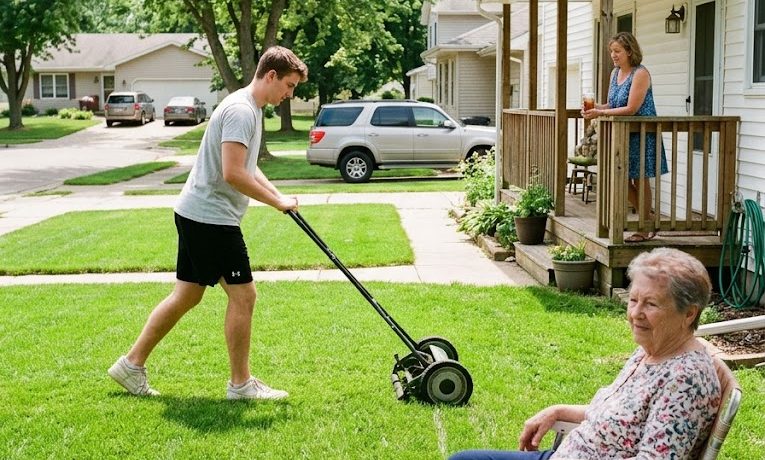
As I wheeled the mower out of the shed, I noticed Grandma sitting on the porch.
She had brought her old aluminum lawn chair out from beside the back door. It was the one with green-and-white plastic webbing, most of which was still intact except for a section that had broken along one side. She had positioned it at the top of the porch steps, facing directly toward the yard.
She sat there wearing her blue housecoat, her hands resting together in her lap.
She didn’t say a word. She simply watched me.
The way she watched me reminded me of when I was eleven years old.
It had been the summer following my father’s death. My mother had moved to Kansas City, and I was staying in the back bedroom that had once belonged to Dad. His high school football trophies were still displayed on the shelf.
I barely spoke that summer. I hardly cried, either. Most days, I simply sat in front of the television without paying attention to what was playing.
One Saturday in June, Grandma walked into the living room, switched off the television, and stood in front of me with her hands resting on her hips.
“Go put your shoes on,” she ordered. “I’m going to show you how to mow the lawn.”
“Grandpa always did that.”
“Your grandfather is gone,” she replied. “And your daddy is gone, too. Somebody in this family needs to learn how to mow a straight line. Now go get your shoes.”
She taught me beneath the blazing summer sun, keeping one hand over mine on the mower handle.
“Start by going all the way down the long side,” she explained. “Go from one fence to the other. When you turn around, overlap the previous strip by about the width of your hand. Keep the wheel aligned with the edge of the line you’ve already cut. Look toward the far end instead of staring at your feet. Your feet will go wherever your eyes lead them.”
My first attempt looked crooked as a snake.
“Try again,” she said.
The second line came out slightly straighter.
“Again.”
By the time that summer ended, I had learned to mow the entire yard in perfectly straight lines, so neat they looked as though someone had measured them with a ruler. The grass formed alternating dark and light stripes depending on the direction in which the blades were bent.
“That’s it,” Grandma said the first time I finally got it right. She was sitting in that same lawn chair. “Now you’ve learned something your daddy knew. Something your grandpa knew, too. And now it’s yours.”
Chapter Four: Miss Edna
I started by mowing Grandma’s lawn.
The front, the sides, and the backyard. I worked from fence to fence, keeping the mower wheel aligned with the previous strip, looking straight ahead at the opposite end, and allowing my feet to follow my eyes.
The sharpened blade made a beautiful singing sound. That’s the only way I can describe it. A dull blade produces a deep, strained noise, almost like it’s choking. A sharp blade creates a clean, high-pitched hum, sending fine green clippings spraying into the air.
Perfectly straight stripes. Dark and light. Dark and light.
After finishing the backyard and coming around the side of the house, I stopped to admire the front lawn. It looked like a professional baseball field. The stripes stretched all the way to the street, as straight as a strand of fence wire.
Grandma was still sitting on the porch. She hadn’t changed her position.
She didn’t say anything, but she gave me one small nod.
I switched off the mower, and the sudden silence seemed to echo in my ears. I wiped the sweat from my face with my sleeve.
Then I glanced farther down the street.
Grandma’s house is on Locust Street, on the eastern side of Cedar Ridge, Missouri. The town has a population of around four thousand and something. It’s a short dead-end road with only ten houses, five on either side. Most are small ranch-style homes, along with a couple of older two-story farmhouses. They were all built during the 1950s and 1960s by men who worked at the shoe factory, the railroad, or the quarry.
Most of those men have passed away by now.
I mentally counted the properties. There were nine other homes besides Grandma’s. Most belonged to widows. Miss Edna Pruitt. Mrs. Halloway. Mrs. Dorothy Banks. Old Mrs. Kessler, who had to be around ninety-five. Then there was Mr. Archie Coleman, who wasn’t a widower but had been legally blind ever since his diabetes became severe.
And every single lawn along that street had grown out of control. The grass was tall, rough, and brown at the tips, with weeds spreading everywhere. Dandelions, clover, and foxtail grass had grown nearly to knee height along the fences.
It stirred up an anger inside me that I couldn’t quite put into words.
When I was growing up, Locust Street had been the most beautiful street in all of Cedar Ridge. The men took great pride in maintaining their lawns. They would mow on Saturday mornings, then gather along the curb in the afternoon with cans of Busch beer, discussing whose grass looked the best. Grandpa had even won the garden club’s Yard of the Month award three summers in a row.
Now the entire street looked abandoned, as though nobody lived there anymore.
I turned around and glanced at Grandma sitting on the porch.
She was staring down the street as well.
I pushed the mower toward the house next door.
Miss Edna Pruitt lived in a small yellow house with green shutters. She was eighty-one years old. For thirty-eight years, she’d worked as a third-grade teacher at Cedar Ridge Elementary. She had taught me, just as she’d taught my father before me. Whenever someone scored a perfect hundred on a spelling test, she used to hand out butterscotch candies.
She was sitting on her porch in a wooden chair with a straight back, holding a large metal bowl in her lap while snapping fresh green beans. The moment she noticed me approaching her driveway with the mower, her hands stopped moving.
“Hunter Gaines,” she called out. “Is that really you?”
“Yes, ma’am.”
“Well, look at you! Wearing those shorts and back home from overseas.” She examined me from head to toe over her glasses. “You’ve gotten bigger.”
“The Marines make sure we get plenty to eat, ma’am.”
“That much is obvious.” Her eyes moved toward the mower, then over to her overgrown lawn before returning to me. Her expression shifted, and I noticed a certain hesitation.
“I don’t have much money to pay you, sweetheart,” she said.
“I’m not here for money, Miss Edna.”
“Well, I’d still want to pay you something.” She placed her bowl of beans beside her. “But I should be honest with you. I can’t afford very much. Your uncle was charging quite a lot.”
I froze.
“My uncle?” I asked.
“Raymond.” She nodded. “He stopped by this spring. Told me he was mowing your grandmother’s lawn and offered to take care of mine, too. He said I couldn’t keep allowing the grass to grow like this because the city would send me a notice.” She shook her head. “He wanted two hundred dollars every month for a yard this size.”
“Did you give him the money?”
“Just for two months,” she answered. “April and May. After that, I had to stop. My medication became more expensive, and my insurance plan changed in January. I simply couldn’t manage it anymore.” She lowered her eyes toward her hands. “He wasn’t particularly pleasant about it. He warned me I’d regret it once the city started fining me.”
Ray had been taking money from her, too.
I stood in her driveway wearing my Marine PT shorts, feeling the sweat drying against my back. Something inside my chest suddenly turned cold. It was the same chilling feeling I’d experienced overseas, sometimes just before everything went wrong.
Two hundred dollars. From a retired teacher who used to reward children with butterscotch candies.
“I’m not taking any money from anyone today, ma’am,” I told her.
She studied me through her glasses for quite a while.
“You were always such a kind boy,” she finally said. “Even back when you couldn’t spell ‘necessary.'”
“That hasn’t changed, ma’am. I still can’t spell it.”
She laughed, picked up her bowl again, and returned to snapping the beans.
“All right, go ahead, then,” she said. “Just be careful around the roses beside the fence. Herbert planted those back in 1972.”
I started mowing her lawn, taking extra care along the fence so the mower wouldn’t damage Herbert’s roses. I gathered the thickest piles of grass clippings into a heap near the curb so they wouldn’t end up covering and suffocating the lawn.
When I finished, her yard had the same beautiful pattern of alternating stripes. Dark and light.
Miss Edna rose from her chair and walked over to the edge of the porch. She stood there examining the lawn for several moments before placing one hand on the railing.
“Herbert would’ve been pleased with that,” she said softly.
Chapter Five: Sweet Tea
News spreads faster than a lawn mower.
That’s true in just about every place, but especially on a dead-end street in a small Missouri town during a Saturday morning in July. By the time I finished mowing Miss Edna’s backyard, I had already noticed curtains shifting in windows all along Locust Street. A screen door opened with a squeak across the road. A moment later, another one followed.
A woman walked across the street toward me, carrying a large plastic pitcher filled with ice that rattled as she moved.
She was younger than the other residents, probably around sixty. Her hair was short and gray, reading glasses rested on top of her head, and she wore medical scrubs decorated with little cartoon cats. It took me a moment to recognize her. Loretta Simms. She worked as a nurse at the county clinic and had given me my kindergarten vaccinations.
“You look like you could use a drink,” she said, pouring a generous amount of sweet tea into a large plastic cup.
I emptied the entire cup in one gulp. It was so sugary that my teeth practically ached, but it was the most delicious thing I’d tasted in the past year.
“Thank you, ma’am.”
“Don’t thank me,” Loretta replied, filling my cup again. “Your grandmother deserves the credit. She’s the one who contacted me.”
I glanced toward Grandma’s porch. She was still sitting in her lawn chair and raised one hand slightly when she saw me looking.
“She called you?”
“She told me her grandson was back home from the Marines, mowing the grass, and might appreciate something cold to drink.” Loretta glanced farther down the street. “She never mentioned that you were planning to mow Edna’s yard, too.”
She paused for a moment before speaking more quietly.
“He was charging those elderly women money,” she said. “Your uncle. Were you aware of that?”
“I’m beginning to find out,” I answered.
“He started going door to door in April. He told everyone the city was getting strict about overgrown lawns. According to him, they’d be charged fifty dollars every day if they didn’t keep their grass trimmed. Then he offered to handle the mowing himself.” She shook her head. “Two hundred dollars, sometimes two-fifty. He charged Mrs. Banks three hundred because her property is larger.”
“Was any of that true? The city’s threats?”
“There’s a local ordinance,” Loretta explained. “It says grass can’t exceed twelve inches. But the city sends a written warning first and gives homeowners ten days to take care of it. Nobody gets charged fifty dollars a day right away. I even contacted city hall myself to confirm it.”
“Did you explain that to the women?”
“I spoke to a few of them.” She let out a sigh. “But he’s Opal’s son. And at first, he acted like a gentleman. Besides, these women are frightened, Hunter. Most of them survive on just a few hundred dollars more each month than your grandmother receives. When they get a letter from the city, they start imagining they’ll lose their homes.”
I looked along Locust Street again, noticing the untidy lawns and the curtains shifting behind the windows.
“Some of them paid him for a month or two before they simply ran out of money,” Loretta continued. “After that, he quit showing up. The grass kept growing, and now they’re all terrified the city will take action against them.” She turned toward me. “That’s why every single one of them is watching you through their windows right now.”
I finished my second cup of tea and placed the plastic cup on the railing of Miss Edna’s porch.
Then Loretta asked me something.
“Are you planning to mow the entire street?”
I looked at the untended lawns stretching down the road. Nine other homes, or ten if I included Grandma’s. Almost every house belonged to a widow. The dry grass was shedding seeds that drifted through the hot summer breeze.
I remembered the checkbook entries. Ray. 400. Ray. 400.
I also remembered Miss Edna telling me, “I can’t pay you much, honey.”
“Yes, ma’am,” I replied. “I think that’s exactly what I’m going to do.”
Loretta broke into a wide grin.
“Well, good for you!”
She turned and marched straight down the middle of Locust Street, carrying her pitcher of tea and calling out in the loud, commanding voice she used at the clinic. She was practically loud enough to wake the dead.
“Dorothy! Margaret! Irene! Archie! Come outside! Opal’s grandson is mowing the entire street, and he’s doing it for free! He just needs some tea!”
Chapter Six: Ten Yards
Ten lawns under the Missouri sun in July.
Unless you’ve experienced a Missouri July yourself, there’s no easy way to describe it. The humidity makes the air feel so heavy and damp that breathing is like pulling air through a hot towel. At ten in the morning, the temperature had already reached ninety-one degrees. By noon, it climbed to ninety-six. The cicadas singing in the oak trees were so deafening that their noise nearly drowned out the mower.
I’d served in a desert overseas, where temperatures reached 115 degrees even in the shade. But believe me when I say Missouri in July feels worse. At least the desert has dry air.
By the time I reached the third lawn, my tan shirt was completely soaked, turning almost dark brown. I pulled it over my head, squeezed the sweat out over the curb like someone wringing a dirty dishcloth, and put it back on while it was still wet. It provided some relief, but only for about four minutes.
The women began coming out of their houses.
I hadn’t expected that. I’d assumed they’d remain indoors with their air conditioners running, watching through their curtains. Instead, they started appearing one after another. Slowly, some using canes, others leaning on walkers, and a few carrying folding chairs.
Mrs. Dorothy Banks was the first to approach, bringing a plate of oatmeal cookies covered in plastic wrap. Next came Mrs. Margaret Halloway, an eighty-six-year-old woman who still drove her 1994 Buick to the Piggly Wiggly every Tuesday. Then Mrs. Irene Kessler, who was ninety-five, was brought to the end of her driveway in a wheelchair by her great-granddaughter.
Finally, Mr. Archie Coleman appeared, holding his white cane and carefully tapping his way down the front steps.
“Where’s that Marine?” he shouted. “I want to shake that boy’s hand! I can’t see him, but I sure want to shake it!”
By the time I reached the fifth property, someone had arranged a row of folding chairs beneath the enormous oak tree in Mrs. Banks’s front yard. Every one of the women had gathered there, almost as if they were watching a parade.
Loretta made sure my tea never ran out. Mrs. Banks kept bringing more cookies. Whenever I finished a strip of grass near the oak tree, somebody would offer me something. Another cookie, a cold washcloth to cool the back of my neck, or a slice of watermelon.
And they kept talking.
Most of their conversations were with one another, but they spoke loudly enough for me to hear above the mower. Before long, they were reminiscing about their husbands.
“Clarence would’ve finished this lawn before seven in the morning,” Mrs. Halloway remarked. “That old Toro of his used to wake up the entire neighborhood.”
“Herbert used to trim the edges with a pair of scissors,” Miss Edna added. “He’d get down on his hands and knees to do it. I always thought he was out of his mind.”
“Walt Gaines had the finest lawn in Cedar Ridge,” Mrs. Banks said. “Three years in a row.”
“Four,” Grandma called from her porch next door. “1988, too. They awarded it to the Hendersons because they felt sorry for them. Walt never forgave them for that.”
The entire group of women burst into laughter.
Then the conversation turned to my father.
“Danny used to mow my lawn when he was twelve years old,” Mrs. Kessler said in her soft, fragile voice. “He charged me two dollars. Then he’d take the money to the drugstore, buy himself a Coke and a candy bar, and come back to share half of his candy bar with me.”
“He was such a wonderful boy,” Mrs. Banks said.
“He grew into a wonderful man,” Miss Edna added.
“Hunter, you look so much like him,” Mrs. Halloway called toward me. “Standing out there in those little shorts. You’re the spitting image of Danny.”
I had to turn my back for a moment and pretend something was wrong with the mower.
Grandma never got up from her chair.
She remained seated in that damaged lawn chair at the top of her porch steps throughout the entire morning. She didn’t join the other women beneath the oak tree. She didn’t shout anything from the porch. She simply sat with her hands resting together in her lap.
Her eyes never left me.
Whenever I reached the end of a row and turned the mower around, I’d glance toward her, and she’d be watching. Through every yard and every pass, she kept her eyes on me as I made those straight stripes, alternating between dark and light, all the way down Locust Street.
When I reached approximately the seventh lawn, a skinny teenager came riding up on a bicycle. He looked about fifteen, with long hair, a backward Cardinals cap, and a cellphone sticking out of his back pocket. He stopped beside the curb and stood watching me for a while.
After I switched off the mower to empty its grass bag, he approached.
“Are you mowing Mrs. Banks’s yard?” he asked.
“That’s right.”
“I used to mow hers, too.” He scraped his shoe against the curb. “Your grandma’s yard as well. And Miss Edna’s. I did it for a couple of months.”
I stopped what I was doing.
“You did?”
“Yeah, I worked for Ray.” He shrugged. “He gave me twenty-five dollars for each yard. I’d mow them on Saturdays using his mower. Well, actually, it was your grandpa’s mower. Ray would bring it over and come back to collect it afterward.” He glanced at the Snapper. “That thing was so blunt I felt like I was just smashing the grass instead of cutting it.”
“Twenty-five dollars for each lawn?” I repeated.
“Yep. Ray told me he had the agreements with the homeowners and that I was only responsible for doing the actual work. Like a subcontractor.” He scratched the side of his neck. “Then he quit paying me in May. He said the ladies weren’t giving him their money anymore, so I stopped working.”
“What’s your name?”
“Tyler. Tyler Simms.”
“Simms? Are you Loretta’s grandson?”
“Yeah.” He glanced toward his grandmother, who was busy pouring tea for Mr. Archie. “She’s been arguing with Ray about it for months. He just told her to stay out of his business.”
I studied Tyler. A fifteen-year-old kid who had been doing all the actual mowing, earning twenty-five dollars per lawn, only to eventually stop receiving even that.
Meanwhile, Ray had been collecting four hundred dollars from my grandmother for a lawn he hadn’t even bothered to mow himself.
“Tyler,” I said. “Do you have anything planned right now?”
“Not really.”
“There’s a rake in my grandfather’s shed. It’s hanging on the pegboard, over on the left side. You’ll recognize it because its outline is marked in black.” I pointed toward the shed. “Go grab it and rake up the grass behind me. I’ll give you twenty-five dollars for each yard.”
“But you said you weren’t charging anyone.”
“I’m not asking the homeowners for money,” I explained. “I’m paying you. That’s not the same thing.”
He smiled, dropped his bicycle onto the grass, and hurried toward the shed.
Chapter Seven: Raymond
A little after one in the afternoon, a pickup truck slowed down at the entrance to Locust Street.
I recognized the sound before I actually saw the vehicle. It was a deep, rattling diesel engine, the kind of noise you could practically feel vibrating inside your chest. A moment later, the truck turned the corner.
It was Ray’s pickup. A massive white Ram 3500 Cummins, fitted with a lift kit, shiny chrome running boards, and tires worth more than my first car. The truck was polished so thoroughly that sunlight bounced off its hood and struck my eyes from nearly half a block away.
I knew that truck well. Grandma had mentioned it in a letter back in October. Your uncle bought himself a brand-new truck. It’s enormous. He brought it to church and parked across two spaces, so the pastor had to speak to him about it.
I switched off the mower.
He drove slowly down Locust Street, barely moving faster than five miles per hour, as though he were participating in a parade. I watched him turn his head from one side to the other, inspecting the lawns.
Every property along the street now had freshly cut stripes. Dark and light, perfectly straight. Thanks to Tyler, the grass clippings had been gathered into tidy piles beside the curb. Mrs. Banks’s roses had been carefully edged around, and the walkway in front of Mr. Archie’s house had been swept clean.
The women sitting beneath the oak tree suddenly fell silent. Every one of them. Mrs. Halloway placed a hand against her chest, while Miss Edna lowered her cup of tea.
Ray stopped his truck right beside the curb, directly in front of me. He lowered the window, allowing a blast of cold air from his air conditioner to hit my face. Country music was playing inside.
Raymond Gaines was fifty-one years old. He had inherited Grandpa’s physical build, broad and heavy around the shoulders, along with his nose. But his face was nothing like Grandpa’s. Grandpa’s face had always been broad, simple, and calm. Ray’s expressions were constantly changing. He smiled frequently and talked endlessly. Whenever he saw my father, he used to smack him so hard on the back that it left a red mark.
His eyes moved over my sweat-soaked PT shorts. Then he glanced along the street before looking back at me.
“Well, look who’s finally home,” he said. “Our war hero.”
“Hello, Uncle Ray.”
“Did you mow the entire street?” he asked.
“Yes, sir.”
He looked at the lawns once more. I could practically see him counting them.
“Who’s paying you to do all this?” he asked.
“Nobody,” I answered.
He stared at me. His smile remained, but something behind his expression suddenly became motionless.
“Nobody?” he repeated.
“That’s right. I’m not charging anyone, Uncle Ray. It’s only grass.”
He began calculating the situation in his head. I could see it happening as the realization slowly spread across his face, like a cloud moving over an open field.
Ten lawns. All freshly mowed. Completely free. Done by his nephew wearing Marine Corps running shorts, right in front of every widow living on the street.
Nobody on Locust Street would ever agree to pay him two hundred dollars a month for lawn care again.
His smile disappeared.
“Now, wait a second,” he said. His voice suddenly changed, becoming louder and overly cheerful, the way a salesman speaks when trying to convince someone to buy something. “Hold on there, Hunter. You don’t understand the entire situation. You’ve been away for a whole year.”
“I’ve been gone for eleven months.”
“These ladies wanted me to take care of their lawns,” he continued. Leaning farther out of his window, he raised his voice so everyone sitting beneath the oak tree could hear. “They came to me asking for help. I was doing them a favor. Your grandma included. She offered.”
“She offered you four hundred dollars every month.”
“That’s right, she offered,” Ray insisted. “I never demanded anything. She wanted to help me financially. You can ask her yourself.”
That was when Grandma’s voice suddenly came from the porch.
“Raymond.”
She didn’t raise her voice or shout. In all the years I’d known Opal Gaines, I had never once heard her yell.
But her voice carried across the entire street. It traveled over the freshly cut lawns, through the noise of the cicadas, and straight into the open window of that polished pickup truck.
“Raymond,” she called again.
And there stood a grown man inside an expensive, spotless truck, turning his head like a nine-year-old boy who had just dragged muddy shoes across his mother’s kitchen floor.
He looked toward the porch.
Grandma was on her feet. It was the first time I’d seen her standing all day. She was at the top of the porch steps, still wearing her blue housecoat, with one hand gripping the railing for support.
“Switch off that truck,” she ordered. “Then come up here.”
Ray glanced at me. He looked toward the women gathered beneath the oak tree, then turned his attention back to his mother.
Finally, he switched off the engine.
Chapter Eight: What Grandma Said
The quiet that followed was overwhelming.
When a Cummins diesel engine shuts down, it’s as though every vibration in the entire world suddenly disappears. Even the cicadas seemed to stop making noise. The country song playing inside the truck ended abruptly in the middle of a lyric.
Ray opened his door and climbed down from the shiny chrome running board. He wore a pair of jeans, a Bass Pro Shops polo shirt, and sunglasses hanging from a cord around his neck. He crossed Grandma’s front lawn, walking over the fresh stripes I’d just made, and stopped at the bottom of her porch steps.
He didn’t climb them. Instead, he remained standing below, looking up at her.
I walked behind him and stopped a few feet away, just at the edge of the grass.
“Mama,” Ray began, “I don’t know what he’s been telling you…”
“He hasn’t said anything to me,” Grandma replied. “He’s been busy mowing lawns.”
“Then what’s all this supposed to mean?”
Grandma studied him for a long moment, keeping one hand firmly on the railing.
“I raised two sons in this house,” she said. “You and your brother. Two boys.”
“I know that, Mama.”
“Danny used to mow Irene Kessler’s lawn for two dollars. Afterward, he’d come home with half his candy bar saved for her.” She looked down the street toward Mrs. Kessler, who was sitting in her wheelchair at the end of her driveway. “Do you remember that?”
Ray said nothing.
“You used to mow lawns, too,” Grandma continued. “Remember? You took care of the Pruitts’ yard and the Bankses’ yard. Herbert gave you a dollar and fifty cents, and you’d go spend it on baseball cards at the Rexall.”
“Mama…”
“Your father taught both of you how to do it. Right out there in the yard. He showed you how to make straight lines.” She pointed toward the freshly mowed stripes. “He always used to say that a man who cuts crooked lines will tell crooked stories. Do you remember him saying that?”
Ray’s face had turned red. It wasn’t the redness of anger. It was something different.
“I remember,” he answered quietly.
“For eleven months, I’ve given you four hundred dollars every month,” Grandma said.
“You offered to help me.”
“I did,” she replied. “I really did offer. Last August, you came to me and told me Sheila was giving you trouble. You said you were falling behind on the payments for your truck. You promised you’d take care of my lawn if I could give you a little financial help. And I agreed.”
She stopped speaking for a moment.
“I agreed because you’re my son,” she explained. “I’ve already had to bury one of my boys. I’d rather live without things myself than see you struggling. That’s the honest truth.”
Behind me, I heard one of the women sitting beneath the oak tree let out a quiet gasp.
“But Raymond, you never actually mowed my lawn. Not even once,” Grandma continued.
Ray visibly recoiled.
“Tyler Simms was the one cutting it,” Grandma said. “Loretta’s grandson. A fifteen-year-old boy working on Saturday mornings with your father’s old mower, the same one you never bothered to change the oil in. I watched him through my window every single time. Did you honestly think I wouldn’t notice?”
Her gaze moved beyond Ray toward the skinny teenager wearing the backward Cardinals cap, who was standing near the curb holding Grandpa’s rake.
“And you stopped giving that boy his money in May,” she added. “Loretta told me everything.”
Ray turned around to face Tyler. The boy lowered his eyes toward the ground.
“Then there’s what happened next,” Grandma continued, her voice becoming softer. “You went to Edna.”
Ray turned back toward her.
“You approached Edna Pruitt,” Grandma said. “The very woman who taught you how to read. She stayed after school with you every afternoon when you were in third grade because you struggled to sound out words. She never charged your father a single penny for all that extra help.”
Under the oak tree, Miss Edna covered her mouth with her hand.
“After that, you went to Dorothy. Then Margaret. Then Irene. You frightened them by claiming the city would charge them fifty dollars every day. These are the same women who brought food to this house for an entire month after your brother passed away.”
By then, Grandma was gripping the porch railing with both hands.
“I could have accepted you taking money from me,” she said. “I’m your mother, and that’s something I can deal with. But you went after those women, Raymond.”
Ray remained completely silent.
He stood at the foot of the porch steps, wearing his Bass Pro shirt, his head hanging low. His broad shoulders had slumped forward. He looked more defeated and smaller than I’d ever seen him.
For several long moments, nobody spoke.
Eventually, Ray broke the silence. He was speaking to the ground beneath his feet.
“I got laid off, Mama.”
Grandma became completely motionless.
“It happened in August,” Ray explained. “At the plant. They shut down the production line I was working on and let forty of us go.” He struggled to take a breath. “I never told Sheila. I didn’t tell anybody. Every morning, I’d put on my work boots, leave the house, drive around all day, and return home at five like I’d been working.”
“Raymond.”
“I still had the truck payment,” he continued. “Eleven hundred dollars every month. Then there was the mortgage, Sheila’s car, and everything else. I just couldn’t bring myself to tell her. I couldn’t.” His voice cracked. “Danny would’ve known how to handle it. Danny always knew what to do. But I’m just… I’m the one who’s still here.”
At last, he raised his eyes toward his mother. They were filled with tears.
“So I came to you,” he said. “Because you’ve always been there for me. You’ve never told me no.”
Chapter Nine: The County Collector
After Ray finished speaking, nobody along Locust Street said another word.
Grandma slowly descended the porch steps, taking them one at a time while holding the railing. Ray reached out to help her, and she accepted his hand.
When she finally reached the bottom, she stood directly in front of her son, who towered over her by a foot and a half. She stretched upward and gently placed her hand against his cheek.
“You should have come to me and told me the truth,” she said.
“I was embarrassed.”
“I understand that.” She gently patted his cheek. “But feeling ashamed doesn’t give you the right to take money from widows, Raymond.”
She turned toward the large oak tree and looked at all the women sitting in their folding chairs.
“Raymond is going to return every penny he took from you,” she announced. “Every last cent. Isn’t that right, Raymond?”
Ray looked around at the women. Miss Edna. Mrs. Banks. Mrs. Halloway. Mrs. Kessler, sitting in her wheelchair.
“Yes, ma’am,” he answered quietly.
“He’ll begin paying everyone back next Saturday.”
“Yes, ma’am.”
“And there’s Tyler Simms,” Grandma added. “You still owe that young man his money for May and June.”
Ray shifted his attention toward Tyler. The boy looked straight back at him.
“Yes, ma’am,” Ray replied.
I assumed that would be the end of everything. I honestly thought it was over.
I imagined we’d all go inside for lunch, Ray would return home and finally tell Sheila the truth, and he’d begin searching for another job on Monday. I believed the entire problem had been about the lawns.
But then Monday morning arrived, and I discovered the envelope.
It was tucked inside the drawer of the small telephone table in the hallway, underneath the phone book. Grandma had asked me to look for her reading glasses, so I opened the drawer and spotted it.
It was a white envelope from the Pulaski County Collector of Revenue. Across the front, the words FINAL NOTICE were printed in bold red letters.
I opened it and found a notice concerning Delinquent Real Estate Taxes for the 2025 tax year. The property owner was listed as Opal M. Gaines. The property address was 214 Locust Street. The outstanding balance, including penalties and interest, was $1,312.46.
At the bottom, another statement appeared in bold:
If the outstanding taxes are not paid, the property will be included in the annual Collector’s Tax Sale scheduled for the fourth Monday in August.
I stood in the hallway, holding the notice in my hands.
The fourth Monday of August. Only five weeks remained.
I carried the envelope into the kitchen. Grandma was sitting at the table working on her crossword puzzle. The moment she noticed what I was holding, she put her pencil down.
“Hunter,” she said.
“Grandma, why haven’t you paid your property taxes?”
She glanced at the envelope, looking genuinely puzzled.
“But I already paid them,” she replied. “Back in December. I gave Raymond twelve hundred dollars in cash. He told me he’d take it to the courthouse himself so I wouldn’t have to drive on the icy roads.”
I pulled out a chair and sat across from her.
I didn’t need to say anything. There was nothing I could add.
I watched as the truth slowly dawned on her. Her expression changed gradually, like a shadow spreading across a lawn as a cloud passes in front of the sun.
She picked up the notice and adjusted her reading glasses. After carefully reading it, she went through it a second time.
Then she placed the paper gently on the table and folded her hands over it.
“He told me he’d taken care of it,” she whispered. “He even brought back a receipt.”
“Do you still have that receipt?”
She stood up and walked over to the drawer beside the stove, where she stored important documents inside an old Folgers coffee can. After searching through the papers, she returned with a folded piece of paper.
It was a handwritten receipt on a sheet torn from a spiral notebook.
Paid, 12/14, $1,200. Ray.
“I agreed because you’re my son,” she said. “I’ve already buried one of my children. I’d rather sacrifice my own comfort than see you going through hard times. That’s the truth.”
Behind me, I heard one of the women beneath the oak tree make a faint noise.
“But Raymond, you never actually came here to mow my lawn,” Grandma continued.
Ray visibly jerked at her words.
“Tyler Simms was the one doing it,” Grandma explained. “Loretta’s fifteen-year-old grandson. He worked every Saturday morning using your father’s old mower, the same machine you never even bothered to change the oil in. I watched him from the window every single time. Did you really believe I wouldn’t notice?”
Her eyes shifted past Ray toward the skinny teenager in the backward Cardinals cap, standing near the curb with Grandpa’s rake in his hands.
“And you stopped paying that young boy in May,” she added. “Loretta told me about that, too.”
Ray turned to look at Tyler. The teenager kept his eyes fixed on the ground.
“And then there’s something else,” Grandma continued, her voice dropping almost to a whisper. “You went to Edna.”
Ray turned back toward her.
“You approached Edna Pruitt,” Grandma said. “The woman who taught you to read. She stayed after school with you every afternoon when you were in third grade because you couldn’t figure out how to sound out your words. Your father never had to pay her a single cent for all that extra help.”
Beneath the oak tree, Miss Edna covered her mouth with one hand.
“Then you went to Dorothy. Margaret. Irene. You frightened them by telling them the city would charge them fifty dollars every day. These are the same women who brought food to this house for an entire month after your brother died.”
By now, Grandma was holding the porch railing firmly with both hands.
“I might have been able to accept you taking money from me,” she said. “I’m your mother, and that’s something I could handle. But you went after those women, Raymond.”
Ray remained quiet.
He stood at the bottom of the porch steps wearing his Bass Pro shirt, his head lowered. His broad shoulders had slumped forward, making him look smaller and more defeated than I’d ever seen him.
Nobody spoke for a long while.
Eventually, Ray broke the silence. He spoke while staring down at the porch steps.
“I got laid off, Mama.”
Grandma suddenly became still.
“It happened in August,” Ray explained. “At the plant. They shut down the production line where I worked and laid off forty employees.” He took a shaky breath. “I never told Sheila. I didn’t tell anyone. Every morning, I’d put on my work boots, leave the house, spend the entire day driving around, and return at five in the evening.”
“Raymond.”
“I still had to make the truck payment,” he continued. “Eleven hundred dollars every month. Then there was the house payment, Sheila’s car, and everything else. I couldn’t bring myself to tell her. I just couldn’t.” His voice began to crack. “Danny would’ve figured out what to do. He always knew how to handle things. But I’m just… I’m the one who’s still alive.”
At last, he raised his head and looked directly at his mother. His eyes were filled with tears.
“So I came to you,” he said. “Because you’ve always helped me. You’ve always said yes whenever I’ve asked.”
Chapter Nine: The County Collector
After that confession, not a single person on Locust Street said anything.
Grandma began walking down the porch steps, moving slowly and carefully, one step at a time while holding the railing. Ray extended his hand to help her, and she accepted it.
Once she reached the bottom, she stood before her son, who was about a foot and a half taller than she was. Reaching upward, she gently placed one hand against his cheek.
“You should’ve come and told me what happened,” she said.
“I felt ashamed.”
“I know you did.” She softly patted his cheek. “But shame doesn’t give you permission to steal from elderly widows, Raymond.”
She turned toward the oak tree and looked at all the women sitting in their folding chairs.
“Raymond is going to return every dollar he took from all of you,” she announced. “Every single cent. Isn’t that right, Raymond?”
Ray looked around at the women gathered there. Miss Edna. Mrs. Banks. Mrs. Halloway. Mrs. Kessler, sitting in her wheelchair.
“Yes, ma’am,” he answered in a low voice.
“You’re going to start making those payments next Saturday.”
“Yes, ma’am.”
“And don’t forget Tyler Simms,” Grandma added. “You still owe that boy for the work he did in May and June.”
Ray glanced toward Tyler, who looked straight back at him.
“Yes, ma’am,” Ray replied.
I thought that was finally the end of everything. I genuinely believed we’d reached the end of the matter.
I imagined everyone heading inside for lunch, Ray going home to tell Sheila the truth, and then beginning his search for another job on Monday. I thought the entire problem had started and ended with the lawns.
But when Monday morning came, I discovered an envelope.
It was sitting inside the drawer of the small telephone table in the hallway, tucked beneath the phone book. Grandma had asked me to look for her reading glasses, so I opened the drawer and noticed it immediately.
It was a white envelope sent by the Pulaski County Collector of Revenue. The words FINAL NOTICE were printed across the front in large red letters.
I opened it despite knowing I probably shouldn’t.
Inside was a notice for Delinquent Real Estate Taxes, Tax Year 2025. The listed property owner was Opal M. Gaines. Property address: 214 Locust Street. The outstanding amount, including accumulated penalties and interest, was $1,312.46.
At the bottom, a warning appeared in bold lettering:
If the outstanding taxes are not paid, the property will be included in the annual Collector’s Tax Sale on the fourth Monday in August.
I remained in the hallway, holding the notice in my hands.
The fourth Monday in August. There were only five weeks left.
I carried the envelope into the kitchen. Grandma was sitting at the table, working through her crossword puzzle. When she noticed what I was holding, she immediately put down her pencil.
“Hunter,” she said.
“Grandma, why haven’t you paid your property taxes?”
She looked at the envelope with a puzzled expression.
“I already paid those,” she replied. “Back in December. I gave Raymond twelve hundred dollars in cash. He said he’d take it to the courthouse for me so I wouldn’t have to drive on the icy roads.”
I pulled out a chair and sat opposite her.
I didn’t say anything. There was no need.
I watched the realization slowly spread across her face, like a shadow moving over a lawn when a cloud blocks the sunlight.
She picked up the notice and put on her reading glasses. She carefully went through the information once, then read it again.
Finally, she placed the paper gently on the table and folded both hands over it.
“He told me he’d taken care of the payment,” she said quietly. “He even brought me a receipt.”
“Do you still have that receipt?”
She stood up and walked over to the drawer beside the stove. That’s where she kept her important documents inside an old Folgers coffee can. After searching through the papers, she returned holding a folded sheet.
It was a handwritten receipt on a piece of paper torn from a spiral notebook.
Paid, 12/14, $1,200. Ray.
I drove to the Pulaski County Courthouse in Waynesville that afternoon. The journey took forty minutes each way.
The tax collector’s office was located on the ground floor. A woman named Brenda, wearing large earrings and a cardigan, searched for Grandma’s property records on her computer.
“No payment was ever received for the 2025 taxes,” she informed me. “The first notice was mailed in January, the second in April, and the final one went out in June.” She peered at me over her glasses. “If the balance remains unpaid by the sale date, someone can purchase the tax certificate. If the taxes aren’t redeemed within a year, that buyer can apply for the property deed.”
“Can I settle the amount today?”
“Are you the property owner?”
“I’m her grandson. I’m a Marine, and I just returned home.”
Brenda studied me for several seconds.
“Anyone is allowed to pay someone else’s property taxes, sweetheart,” she explained. “The county doesn’t care whose name is on the check.”
I used the money I’d saved during my deployment to pay the entire balance. Thirteen hundred and twelve dollars and forty-six cents. Brenda stamped the receipt with PAID IN FULL in blue ink before handing it across the counter.
This was an actual receipt. Printed, official, and bearing the county seal.
Afterward, I spent a long time sitting inside my rented Corolla in the courthouse parking lot. I held the official receipt in one hand and Ray’s handwritten spiral-notebook version in the other.
Eventually, I started the car and drove to my uncle’s house.
Chapter Ten: Supper
Ray and Sheila lived in a brick split-level house along County Road H, surrounded by three acres of land. Sheila worked as a receptionist at a dental office in St. Robert. Their children were both grown and living elsewhere. One had moved to Springfield, while the other was serving in the Army at Fort Leonard Wood.
The white Ram was parked in their driveway. Ray was sitting on the front steps when I arrived, almost as if he’d been expecting me.
He didn’t stand up. He simply watched as I crossed the yard toward him. Judging by his expression, I could tell he already knew why I was there.
I held out the official receipt from the county.
“Paid in full,” I told him. “Thirteen hundred and twelve dollars and forty-six cents. If we’d waited until the fourth Monday in August, a stranger would’ve been able to buy Grandma’s unpaid taxes.”
He accepted the receipt and examined it for a long time.
“I was planning to pay it,” he said. “I swear to God, Hunter. I intended to take care of it in January. Then the truck payment came due. After that, I planned to do it in February. Eventually, I figured I’d find a job by spring, pay everything, and she’d never find out.”
“You handed her a counterfeit receipt.”
“I know.”
“Written on a page from a spiral notebook.”
“I know.” He lowered his head and covered his face with both hands. “I know.”
The front door opened behind him. Sheila stepped onto the porch wearing her dental office scrubs. She looked at me, then at Ray, and finally at the paper in his hand.
“What’s happening?” she asked. “Ray? What are you holding?”
Ray didn’t respond.
“Ray. Hunter. Somebody tell me what’s going on.”
I looked at my uncle. He raised his eyes toward me. He looked like someone standing at the very edge of a cliff.
“Tell her the truth,” I said. “Otherwise, I’ll do it.”
Ray confessed to everything.
He explained it all while sitting on those front steps. The plant, the August layoff, spending every day driving around in his work boots, the truck payments, the money from mowing lawns, the elderly women, Tyler, and Grandma’s unpaid property taxes.
Halfway through his explanation, Sheila lowered herself onto the porch swing. By the time he finished, both her hands were covering her mouth.
“Eleven months,” she whispered. “You’ve been deceiving me for eleven whole months?”
“I’m sorry.”
“Every morning, you’d kiss me goodbye and tell me to have a good day at work.”
“I’m sorry, Sheila.”
“You took money from Opal?” Her voice suddenly rose. “From Opal? Her Social Security money?”
Ray couldn’t bring himself to answer.
Sheila stood up, walked down the porch steps, and stopped directly in front of me.
“Hunter,” she said. “I want you and Opal to come over for Sunday supper at six.” She turned toward Ray. “We’re going to sit together as a family and put this entire situation right. Every bit of it. And we’re going to do it before anyone loses their home.”
Actually, we held Sunday supper at Grandma’s house. Sheila called and insisted that Grandma should be in her own kitchen, and she offered to bring all the food.
She arrived with a pot roast. Ray showed up empty-handed. He stood in the doorway of Grandma’s kitchen like someone arriving late for a church service.
Grandma glanced up from the stove.
“Take a seat, Raymond,” she said. “You look as though you’re about to collapse.”
He sat down.
The four of us gathered around that kitchen table and worked through everything. Grandma brought out her checkbook and her calculator, the one about the size of a paperback book.
Ray owed Grandma $4,400 for the lawn payments, along with another $1,200 for the property taxes he’d failed to pay. He owed Miss Edna $400, Mrs. Banks $600, Mrs. Halloway $500, Mrs. Kessler $400, and Tyler Simms $200 for the work he’d done in May and June.
I calculated the total.
Seven thousand, seven hundred dollars.
“I don’t have that kind of money,” Ray admitted. “I don’t have any of it.”
“You do have a truck,” Sheila replied.
Ray turned to look at her.
“That truck is worth fifty-two thousand dollars,” Sheila explained. “You still owe forty-one thousand on it. If you sell it on Monday, you’ll walk away with eleven thousand. That’s enough to repay everyone on Locust Street, cover the property taxes, and still leave you with some money.”
“Sheila…”
“Your other choice,” she continued, “is that I contact the bank about the truck myself. After that, I’ll speak to a lawyer about our marriage.”
Ray stared at her without saying a word.
Then he turned toward Grandma.
“Mama,” he asked. “Is that what you want me to do?”
Grandma removed her reading glasses, folded them neatly, and placed them on top of her checkbook.
“Raymond, I don’t want anything from you,” she replied. “There’s just one thing I want.”
“What is it?”
“I want you to mow my lawn,” she said. “With your own hands, every Saturday. Nobody else. Not Tyler or anyone you hire. You. Using your daddy’s mower, and cutting the grass in straight lines.”
Ray remained silent.
“And after you’ve finished my yard,” Grandma continued, “you’ll take care of Edna’s. Then Dorothy’s, Margaret’s, Irene’s, and Archie’s. Every widow living on Locust Street. Every Saturday, without charging anyone, until the season is over.”
She looked directly at him.
“That’s what your father would’ve expected you to do,” she said. “That’s what Danny would’ve done.”
Chapter Eleven: Straight Lines
Ray got rid of the truck on Wednesday.
He sold it to a dealership in Springfield for $49,500. After settling the remaining loan balance, he walked away with approximately $8,200. He then purchased a 2009 Ford Ranger with a dented tailgate from a man in Licking, paying $3,000 in cash.
On Thursday, he drove the Ranger down Locust Street and stopped outside every single house. He knocked on each door, handed every woman an envelope containing cash, and personally apologized.
Miss Edna told me about the visit afterward. According to her, Ray stood on her porch holding his hat in both hands, crying.
“I told him I forgave him,” she said. “Then I reminded him that he still needed to improve his spelling. He’d written ‘sincerly’ on the envelope.”
He paid Tyler Simms the $200 he owed him, along with an additional fifty dollars.
He also returned everything he owed Grandma. A total of $5,600, delivered through a cashier’s check issued by the Bank of Cedar Ridge. She deposited the entire amount into her savings account and left it untouched.
Ray also repaid the $1,312 I had spent settling her property taxes. I initially tried refusing the money, but he wouldn’t accept no for an answer.
“You’re not going to pay for the trouble I’ve caused,” he told me. “You’ve already done more than enough.”
The following Saturday was my scheduled departure date. My leave was nearly finished, and I needed to report back to Camp Lejeune by Monday morning.
I woke up at 5:30. Grandma was already in the kitchen, preparing breakfast. Over-easy eggs.
At 6:30, I heard a vehicle pulling into the driveway. It wasn’t a massive diesel engine this time. Instead, it was the rattling sound of a small four-cylinder motor. The Ranger had arrived.
Ray stepped out wearing an old pair of jeans with grass stains around the knees and a T-shirt from a church fish fry held back in 2014. He walked around to the back of the house and stopped outside the shed.
I went out to join him, carrying my coffee.
“I can’t remember the proper way to do it anymore,” he admitted without looking at me. “Your grandpa tried teaching me when I was ten, but I was too busy being angry about it. I never really paid attention.”
“That’s okay,” I replied. “I’ll teach you.”
I brought the mower outside and explained how to inspect the oil, disconnect the spark plug wire, and examine the blade. I showed him how to check the air filter, too. Then I pointed out where Grandpa’s tools were hanging on the pegboard, each one surrounded by its black marker outline.
After that, I took him into the front yard and walked with him toward the long stretch beside the fence.
“Start by mowing the longest section first,” I explained. “Go all the way from one fence to the other. Then turn around and overlap the previous strip by roughly the width of your hand. Keep the mower wheel aligned with the edge of the line you’ve already cut.”
He nodded.
“And remember to look toward the far end,” I continued. “Don’t keep staring down at your feet. Your feet will follow wherever your eyes are looking.”
His first attempt came out as crooked as a snake.
He switched off the mower and examined the uneven line. Then he muttered a curse under his breath.
“Try again,” Grandma called from the porch.
She was sitting in her old, damaged lawn chair at the top of the steps, dressed in her blue housecoat. Her hands rested together in her lap.
Ray raised his eyes toward her. A faint smile almost appeared on his face.
He started the mower once more. His second attempt was slightly straighter.
“Again,” Grandma instructed.
It took Ray an hour and a half to finish Grandma’s lawn. The previous Saturday, it had taken me just forty-five minutes. Still, when he finally finished, the yard had its stripes. They weren’t perfectly straight, and a few wobbled near the redbud tree, but they were stripes.
His clothes were completely soaked with sweat. He turned off the mower and stood in the middle of the lawn, breathing heavily as he looked around at his work.
Grandma got out of her chair and walked to the top of the porch steps.
She studied the lawn for a long time.
Then she gave him a single nod.
Ray turned his back and pretended he needed to inspect something on the mower for a moment.
Afterward, he pushed the mower over to the neighboring property. Miss Edna’s house.
She was sitting outside on her straight-backed porch chair, snapping green beans. She watched him approach along her driveway.
“Raymond Gaines,” she called. “Is that really you?”
“Yes, ma’am.”
“You’re going to be careful around Herbert’s roses, aren’t you?”
“Yes, ma’am.”
She returned her attention to the beans in her lap, and Ray started the mower.
I headed out at noon.
I had a twelve-hour journey ahead of me to Camp Lejeune. My seabag was packed in the back of the rented Corolla. I’d washed all my clothes and folded them neatly, while Grandma had prepared a cooler for the trip. It contained fried chicken, biscuits, and a mason jar filled with Loretta’s sweet tea.
Grandma walked with me to the car, holding my arm as we carefully descended the porch steps.
When we reached the bottom, she stopped and looked along Locust Street.
Ray was halfway down the block, working in Mrs. Banks’s yard. He was pushing Grandpa’s red Snapper mower, his shirt completely soaked with sweat. Tyler Simms followed behind him carrying Grandpa’s rake. I could hear Ray explaining something to the boy, followed by Tyler’s laughter.
Beneath the large oak tree, the women had arranged their folding chairs once again. Loretta was busy pouring tea.
“Just look at that,” Grandma said softly.
“Yes, ma’am.”
“Walt would’ve loved seeing this.” She gently squeezed my arm. “Danny would’ve, too.”
She turned toward me and reached up, placing both hands against my cheeks, just as she used to when I was eleven years old.
“You didn’t turn this into a war over some grass,” she said.
“No, ma’am.”
“You simply went out and cut it.” She gently patted my cheek. “That’s exactly what your daddy would’ve done. He would’ve taken care of it and let everyone else decide what it meant.”
Then she wrapped her arms around me in a tight hug. She smelled of bacon grease and Jergens lotion. She weighed barely ninety pounds, but she held me with the strength of a steel trap.
“Make sure you come home safely,” she whispered against my shoulder.
“Yes, ma’am.”
Chapter Twelve: The Register
In October, a letter arrived from Grandma.
I was back at Camp Lejeune, staying in the barracks and taking part in a field day with my squad. We were scrubbing floors, following the usual Marine Corps Thursday-night routine, whether the place actually needed cleaning or not. The mail clerk walked through the barracks and dropped an envelope onto my rack.
I recognized Grandma’s handwriting immediately. That familiar slanted blue cursive. Three pages, written on both sides, just like every letter she sent.
She wrote about the church potluck. Mrs. Halloway had brought a Jell-O salad that nobody wanted to eat. She also mentioned her blood pressure. According to her doctor, it was better than it had been at any point in the previous five years.
Then she told me that Ray had found a job. A proper job, working as a delivery driver for a feed store in Rolla. He was earning thirty-eight thousand dollars annually. It wasn’t as much as he’d made at the plant, but at least the income was dependable. He and Sheila had also started attending counseling sessions at their church. Sheila had made him destroy every credit card he owned while she watched, right there at the kitchen table.
She also told me that Locust Street had received the Yard of the Month award from the Cedar Ridge Garden Club. The entire street had won, not just one property. The garden club had never awarded the honor to a whole street before. The women from the club came by and placed a small wooden sign in Miss Edna’s front yard because her house was located right in the middle.
According to Grandma, Ray had continued mowing every lawn on Locust Street every Saturday since my departure. He had completed twelve consecutive Saturdays without missing a single one. Even on the rainy Saturday, he waited inside the Ranger until the weather cleared and then went out to finish the work.
“His mowing lines are becoming straighter,” she wrote. “They’re still not quite as good as yours, but they’re improving.”
At the very end of the letter, she had included a photograph. It was one of those traditional printed pictures you get from the Walmart photo counter.
The picture showed Locust Street, photographed from Grandma’s porch. All ten properties were visible in the late-afternoon sunlight. Every lawn displayed alternating dark and light stripes stretching all the way toward the dead end. The women were sitting in their folding chairs beneath the large oak tree. Ray stood beside the curb wearing a sweat-soaked T-shirt, leaning against Grandpa’s red Snapper mower and squinting toward the camera.
He wasn’t exactly smiling, but he wasn’t entirely without a smile, either.
On the back of the photograph, Grandma had written in her familiar blue cursive: Taken by Tyler. Saturday, Sept. 27.
There was something else tucked inside the envelope.
A single sheet of paper, carefully separated from a checkbook register along its perforated edge. I recognized it immediately. The same ruled paper, the same columns, and the same blue handwriting.
It was the page for September.
I unfolded it while sitting on my rack.
Ameren Missouri, 81. Cedar Ridge Water, 29. Walmart pharmacy, 12. Church offering, 20. Church offering, 20. Church offering, 20. Church offering, 20.
Then, toward the bottom of the page, in the column normally reserved for deposits, I noticed an entry written in Grandma’s familiar slanted cursive:
Ray. 400.
Beside it, someone had added a small pencil note: returned. lawn’s free now.
And directly underneath, written in a darker shade of ink, as though she’d returned to the page and added it later, were two words:
Straight lines.
I remained on my rack for a long time, holding that register page in my hands.
Around me, the rest of my squad continued scrubbing the floors and arguing over whose turn it was to clean the head. Someone had a radio playing, while another person complained about the food in the chow hall.
My thoughts returned to that night in July when I first arrived home. I remembered sitting at Grandma’s kitchen table around midnight, drinking a glass of milk and staring at the entries.
Ray. 400. Ray. 400. Ray. 400.
Eleven payments in a row, with a knot tightening in my stomach as I read them.
I thought about all the different ways I could have handled the situation. I could’ve screamed at him. I could’ve driven straight to Ray’s house that very night and dragged him out of bed. I could’ve contacted an attorney, called the sheriff, or taken the story to the newspaper. I could’ve turned the entire situation into a fight.
Grandma probably would’ve allowed me to do it, too. She would’ve sat quietly in her chair and watched everything unfold. But afterward, she would’ve lost her remaining son, I’d have lost my uncle, and Locust Street would still have been covered in knee-high foxtail grass.
Instead, I walked out to the shed and sharpened a mower blade.
That was all I did at first. I sharpened the blade, replaced the oil, and mowed one lawn in perfectly straight lines. Then I moved on to the next property. And then another, continuing until there wasn’t a single yard left.
I eventually discovered that a straight line can communicate an awful lot when you make it ten times in succession, right in front of an entire neighborhood.
I carefully refolded the register page along its original creases. Then I placed it back inside the envelope containing the photograph of Locust Street.
After that, I tucked the envelope inside my uniform cover, the same way Marines keep important things safe when they don’t want to lose them. I placed it inside the crown of my hat, against the top of my head.
It’s still there. I carry it with me every single day.
A photograph of ten lawns beneath a Missouri summer sky, covered in alternating dark and light stripes, stretching all the way along a dead-end street.
And one entry in my grandmother’s checkbook, written in her slanted blue ink, in the column where the money comes back.









