
 159 views
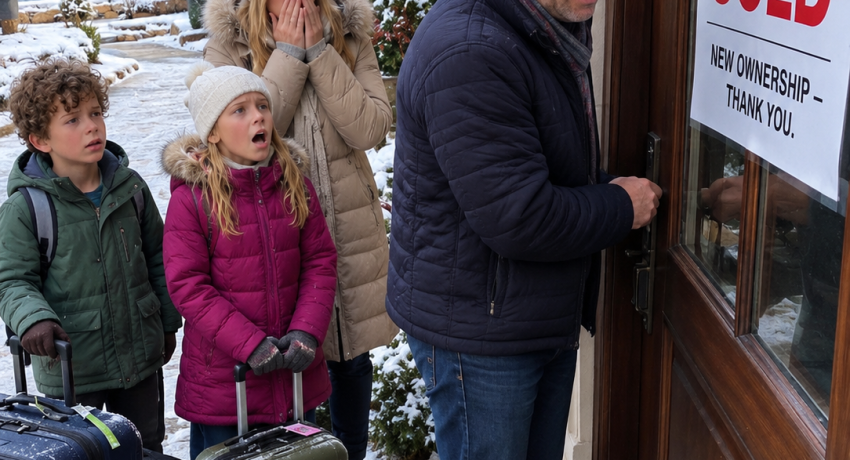
Patrick inserted his key into the front door of the lake house and turned it.
He tried once more, applying greater force. He shook the key just as his father used to do whenever the door swelled during the summer heat. He pulled it out, examined it, and slipped it back into the lock.
That was when he spotted the small white notice displayed in the front window.
Behind him, his wife, Megan, removed her sunglasses.
“What’s that doing there?”
Their SUV, packed with cruise luggage, was parked in its familiar place beneath the old maple tree. Their son, Owen, was sleeping in the back seat, his cheek resting against the window. Their daughter, Sophie, had already climbed out and was bouncing excitedly on the gravel, asking whether she could go swimming.
Patrick pulled out his phone and called me.
He told me about the incident later. I knew the porch, driveway, and maple tree so well that I could imagine the entire scene.
At that moment, I was twenty minutes away, sitting at the kitchen counter in my little apartment in town.
Through the apartment window, I could see a narrow glimpse of the lake between two brick buildings. It was nothing like the view I’d enjoyed for forty years, but it was peaceful—and it belonged to me.
Moving boxes that I hadn’t unpacked yet were stacked along the wall. I still hadn’t decided where to display George’s fishing photographs.
The phone stopped ringing, only to start again moments later.
“Mom, someone changed the locks.”
“I know,” I replied.
“What do you mean, you know?”
“I sold the house.”
Not the reaction I’d imagined when I signed the papers. He sounded as though he expected me to laugh and confess that it was all a joke.
“Yes.”
“Who bought it?”
“The new owners moved in this morning.”
In the background, I could hear Megan raising her voice.
“Put me on speaker.”
“Mom, what is going on? We’re right here. We’re standing on the porch.”
“I understand.”
“You knew we were coming home today.”
“Yes.”
“And you never bothered to tell us?”
I wondered whether he remembered the last message he’d sent me from the cruise ship. The excursion desk had refused my credit card, and he’d messaged me as though I’d made some ridiculous paperwork error that needed to be corrected immediately.
Use your own card.
To understand why I sold the house my son had been living in, you need to know how it all began.
My name is Eleanor Henderson. I’m seventy-one years old. George and I purchased that house on Wren Lake when Patrick was four years old. Back then, it was practically falling apart. The cabin sagged, the roof leaked, and the dock leaned into the water like a ship about to sink.
We were young, broke, and determined. Over the next twenty years, we renovated it one room at a time. George built the fireplace using stones from the lake. He put up the boathouse himself. His workshop in the backyard always carried the smell of cedar and motor oil, and Saturdays were reserved for making things. Bird feeders, bookshelves, and a beautiful compass-rose box he made for me during our first winter.
“So you’ll always know which direction leads home,” he told me.
Patrick spent his childhood in that house. His father taught him to swim from the end of the dock. His first dog, a golden retriever called Biscuit, was buried beneath the willow tree beside the water. The kitchen doorframe still carries the marks where we recorded his height on every birthday.
I loved that house dearly.
But it had always belonged to us. George and me. That difference is important.
George passed away six years ago.
He became ill in the autumn. Pancreatic cancer. By the time the doctors found it, the disease had already spread. Four months later, he was gone.
Those four months remain clear in my memory. The hospital hallways. Plastic cups filled with ice chips. His hand reaching out for mine in the darkness at three in the morning.
I remember Patrick coming to visit. Not as frequently as I would have liked, but he did come. He would stand at the foot of the bed with his hands tucked into his pockets. Occasionally, he’d ask his father about things around the house. The boathouse roof. The well pump. Whether the dock needed replacement pilings.
I believed he was simply trying to keep George occupied with familiar conversations.
After George passed away, Patrick began asking me for financial assistance.
It started with small requests. His business, a landscaping company he’d launched a few years earlier, had gone under. He was struggling to cover some expenses. Could I take care of his car payment just this once?
Then came Sophie’s preschool fees. After that, there was a business line of credit he promised was only temporary, just until he could get another venture started. Then they needed help with rent.
Four years ago, their landlord sold the building, and Patrick called me one Sunday evening.
“Mom, it would only be for a couple of months. Just until we find somewhere else. The children adore the lake. And besides, you really shouldn’t be living out there by yourself. What if you have a fall?”
I wasn’t particularly at risk of falling. I was sixty-seven and still swam a mile in the lake every summer morning.
But without George, the house had become awfully quiet. I missed having children around.
“Just a few months,” I agreed.
They arrived two weeks later.
I can’t pretend I didn’t enjoy it. Sophie was four, and Owen was still a baby. Suddenly, the house was lively again. Toys were scattered across the stairs. Little sticky fingerprints covered the windows. Sophie trailed behind me through the garden, asking me to identify every flower she saw.
Megan was polite but somewhat distant. She was well-organized and worked part-time in marketing, having grown up in a wealthy family. Her affluent suburban parents, Richard and Diane, came to visit twice a year. They always arrived with pricey presents for the children and looked at my furniture as though touching it might make them sick.
Before long, they stopped contributing to grocery expenses. My shopping bills grew with every passing month. Patrick’s truck payment began being deducted from my account, supposedly “just for now.” Then I started covering the children’s swimming lessons. After that came their phone bill. Eventually, I was also paying the installments on the SUV Megan purchased when Owen turned three. It was a large, white luxury vehicle with leather upholstery.
“We wanted something safer for the children,” she explained.
I rarely received any gratitude for paying those expenses. It wasn’t necessarily intentional cruelty; my financial help had simply become something they no longer noticed. They regarded my support like electricity: nobody thanks the light switch.
I tried talking to Patrick about the situation. More than once.
I’d tell him, “Sweetheart, I’m becoming a little concerned about my finances this year.”
He’d respond, “You’re doing fine, Mom. Dad left you plenty of money.”
I’d say, “I’ve always dreamed of traveling. I want to do it before I’m too old.”
He’d reply, “You should go. Maybe someday.”
I’d mention, “The boathouse roof is in terrible condition. I really need to have it repaired.”
On that particular occasion, he was sitting at the kitchen table, examining a contractor’s quote for the boathouse repairs. He’d asked to look at it himself. After reading the amount, he frowned.
“There’s no need to worry about that, Mom,” he said. “It’s all going to belong to me eventually anyway. I’ll take care of it when that time comes.”
He said it without hesitation, as though it were an unquestionable fact.
I was searching for a pen inside the drawer of the hallway desk, the one beside the staircase. It was my desk. My bills, my checkbook, and my postage stamps were kept there.
It was my house.
Inside, I found printed pictures of kitchen renovations. White cupboards. A large marble island replacing my old butcher-block table. Paint samples were stapled to the corner of one sheet. Pale Oak. Agreeable Gray. Swiss Coffee. Someone had circled Swiss Coffee twice and written kitchen beside it.
There was also a contractor’s proposal. It included removing the wall separating the kitchen from the dining room and replacing the old stone fireplace George had built with “a contemporary linear gas insert.”
There was also a layout of the upstairs floor. My bedroom had been marked PRIMARY — P & M.
The small sewing room at the far end of the hallway was labeled OFFICE (or Mom?).
Or Mom?
I remained seated until the sunlight gradually moved across the floor. Then I returned the folder to the drawer, placing it exactly where I’d discovered it.
Two weeks before the cruise, I contacted a real estate agent.
I want to make one thing clear. The cruise wasn’t the reason I decided to sell the house. I’d already made up my mind. The cruise simply made me acknowledge what I’d been trying to ignore.
Pam, a friendly and energetic realtor, had handled the sale of half the properties around Wren Lake. She came to inspect the house on Tuesday morning while Patrick was at a meeting and Megan had taken the children to a birthday celebration.
“This property will sell quickly,” Pam told me. “Lakefront homes always attract buyers. Are you certain about this, Eleanor?”
“No,” I answered. “But I’ve made my decision.”
She already knew a couple who might be interested. They’d spent two years searching for a home along the lake. Claire and Daniel Hart were schoolteachers from the city who dreamed of settling somewhere peaceful. Pam organized a private viewing for Thursday while my family was away.
Claire, a woman in her early forties, had cropped brown hair and wore a sweatshirt marked with paint stains. Her husband Daniel was tall and quiet. He carefully examined the wooden joints on George’s porch railing.
“Who made this?” he asked.
“My husband did.”
“He did an incredible job. It’s genuinely beautiful.”
Claire remained at the end of the dock for a long time, gazing across the water.
“I’m sorry,” she said with a little laugh. “We’ve searched for so long. I just… I can picture us living here.”
They examined the property with the same excitement George and I had felt when we’d first looked at it forty years earlier.
The cruise had been arranged to celebrate Patrick and Megan’s tenth wedding anniversary.
I know how that might sound. However, the trip had been organized almost a year earlier, well before I discovered the folder or contacted Pam. It was a seven-day Caribbean voyage planned for Patrick, Megan, their two children, and me.
“Mom, this is going to be wonderful for you,” Patrick had said when he first brought it up. “You hardly ever travel anywhere.”
Then, about a month before departure, Megan joined me at the kitchen table.
“I wanted to discuss something about the cabin arrangements,” she began.
The issue with the cabin was that Megan’s parents wanted to join us.
“They’ve never experienced a cruise with the children,” she explained. “Besides, they’re getting older, and the suite only accommodates six people. So I was wondering if perhaps you could skip this trip? Maybe you could join us next time?”
“I’m the one paying for the cruise, Megan.”
“I realize that, and we’re genuinely grateful. But Mom and Dad are covering their own airfare. You’ve spent the entire year with the children. You see them every single day. My parents hardly get any time with them.”
“It’s only one vacation,” she added. “You understand, don’t you?”
Despite everything, I paid the deposit, the remaining balance, and the onboard credit because the entire booking had already been charged to my card. Patrick gave me a hug and said, “You’re the greatest, Mom.”
On the cruise’s second day, Megan uploaded a photograph.
Everyone was gathered together on the ship’s deck. Patrick and Megan stood in the center. The children wore identical sunhats, while their grandparents, Richard and Diane, stood on either side, looking tanned and cheerful with umbrella-decorated drinks in their hands.
The caption read:
Finally, a vacation with the WHOLE family! Ten years and counting!
I was sitting alone on the lake-house porch, reading the post as my coffee slowly went cold.
The whole family.
I placed my phone facedown on the table and contacted Pam.
“Let’s bring the closing date forward,” I told her.
Three days later, my phone vibrated with a message from Patrick.
Mom, the excursion desk rejected your card. We’re trying to reserve the dolphin swim for the kids. Can you contact the bank and sort it out? We need it within the next hour.
The day before, I’d instructed the bank to block all onboard purchases. Anything beyond the cruise fare was excluded: excursions, spa treatments, and specialty restaurants. Even the beverage package that Richard and Diane apparently enjoyed at my expense.
I read Patrick’s message carefully.
Use your own card.
About an hour later, Megan sent me a message.
I cannot believe you’d do something like this while we’re celebrating our anniversary. The children were so excited about swimming with the dolphins. Whatever problems you have with being left out of the trip, the kids shouldn’t have to suffer because of them.
She never wondered whether her social media post or their decision to exclude me had caused any pain. She only seemed concerned once the money stopped coming.
Neither of them contacted me again for the remainder of the cruise.
By then, I’d transferred the belongings I wanted to keep into an apartment in town. Pam had helped me find it. It had two bedrooms, was on the third floor, included an elevator, and had a small balcony overlooking that narrow glimpse of the lake between the buildings.
Everything else had been sold, donated, or left for the Harts, who asked whether they could have George’s workbench.
“We would consider it an honor,” Daniel told me.
I’d carefully packed Patrick’s family’s belongings into boxes, labeled every one, and transferred them to a storage facility in town. I covered the first three months of storage. Patrick’s name was written on an envelope containing the key, which I’d left at the realtor’s office.
And that brings us back to Patrick calling me from the porch.
“What do you mean the new owners have moved in?” he asked.
“The sale was finalized yesterday.”
“Yesterday?”
“That’s right.”
“Mom, you couldn’t do that.”
“I’ve already done it.”
Megan finally moved close enough that I could hear her voice clearly.
“Patrick, hand me the phone.”
“You had absolutely no right to sell that house without informing us.”
“I was the legal owner.”
“That doesn’t give you the right to make such a huge decision without thinking about your family.”
“I spent years thinking about my family.”
“That property was supposed to remain Patrick’s.”
“No,” I replied. “It was mine, and it was supposed to remain mine until I chose otherwise.”
“You knew we were making plans for our future there.”
I looked around at the boxes scattered throughout my apartment. Now that I was away from the lake house and their expectations, his words seemed to carry an entirely different meaning.
“You were making plans for your future in a property that didn’t belong to you,” I answered.
“We thought you understood that.”
“I understood that you’d already started selecting paint colors for my kitchen.”
Megan fell silent.
In the background, Patrick asked, “What are you talking about?”
“I discovered your renovation folder,” I explained.
“That was private,” Megan protested.
“In my own house?”
“It was only a quotation,” she quickly replied. “We were just planning ahead.”
“You were planning a future that required me to disappear.”
“That’s completely unfair.”
“No,” I quietly responded. “It isn’t.”
Somewhere behind them, one of the children began asking where they were going to sleep.
I heard Sophie mention that she wanted the blue bedroom. It had been her room since she was four years old. Her voice carried the familiar, impatient tone of a tired ten-year-old who’d spent three hours in a car and had no idea that the adults’ entire world had just fallen apart on the porch.
“I don’t want the children caught up in this conversation,” I said. “Find somewhere safe and comfortable for them. Your belongings are stored on Mill Street. You can collect the key from Pam Wheeler’s office. Then call me this evening.”
“Mom—”
“I’m not having this discussion while everyone is upset.”
“You can’t sell the house we live in and then simply hang up.”
“It was never your house,” I replied.
Then I ended the call.
I stood at the kitchen counter for a moment, still holding my phone. Afterward, I got up and continued unpacking my belongings, taking my time and opening each box one by one.
George’s winter jackets went into the hallway closet.
My finest china, which had sat untouched for years in the lake-house dining room, found a place on the small shelves above the sink. That evening, I took out a teacup and made myself some chamomile tea.
I placed George’s fishing photographs where the late-afternoon sunlight could reach them through the window. One showed George proudly holding a bass on the dock. Beside him stood seven-year-old Patrick, smiling broadly, with his fishing rod caught on a large branch.
My new apartment was simple and modest. It had no spacious porch, no stone fireplace, and no lake view stretching beyond a sprawling backyard.
Later that evening, Patrick called again.
“Are you somewhere you can talk privately?” I asked.
“Yeah.”
“Are the children okay?”
“They’re with Megan’s parents. We booked a hotel.”
“I’m sorry you had to find somewhere to stay on such short notice.”
“You’re sorry?”
“I regret that the children were inconvenienced. I don’t regret selling the property.”
After a moment of silence, he said, “I honestly don’t understand how you could do something like this.”
“I think you understand perfectly well.”
“I never believed you’d actually sell it.”
“And that was exactly the problem.”
“You always called it the family home.”
“You were the one who called it that.”
“Whenever I brought up the house, you kept telling me we’d deal with it eventually.”
“Because I believed there would be an eventually.”
“There will be,” I replied. “It simply won’t involve the lake house anymore.”
“Did you sell it because of the cruise?”
“The cruise was what finally made me stop denying the truth.”
“So you’re getting back at us because Megan didn’t want you on the trip.”
“No. I’m dealing with something that began long before anyone booked that cruise.”
“Mom, Megan didn’t intend it the way you’re interpreting it.”
“I read the caption.”
“She was just trying to make her parents feel welcome.”
“And I wasn’t considered family?”
“She made a foolish social media post,” he eventually admitted.
“She also messaged me that the children shouldn’t suffer because of my emotions,” I replied. “Not once did she ask whether being excluded had hurt me. The only thing that bothered her was when I stopped paying for their expenses.”
“Patrick,” I continued. “I love you. That has never been in question.”
“Then why does it feel like you’re abandoning us?”
“Because you’ve mistaken my love for unlimited access to my money and property.”
“Your father and I supported you because we wanted you to get a good start in life. But that support gradually became an arrangement. You stopped asking whether I could afford to help. You simply expected me to cover everything. You also stopped expressing gratitude because those payments had become something you took for granted.”
“I did thank you.”
“Occasionally. But being grateful isn’t simply thanking someone after they’ve bailed you out. It also means making an effort not to require their help every month.”
“I had no idea you felt this way.”
“I tried telling you.”
“When?”
“In little conversations. I mentioned being concerned about my finances. I told you I wanted to travel. I reminded you that the boathouse roof needed replacing. And your response was always that I shouldn’t worry because everything would eventually belong to you.”
“When did you make up your mind to sell?” he asked.
“Two weeks before the cruise.”
“So you were arranging all this while still paying our expenses?”
“I was still hoping we could work things out.”
“Why didn’t you tell me?”
“Because I knew your first response would be to ask me to wait.”
“Maybe I would’ve done things differently.”
“I needed to witness that change before making another sacrifice.”
“Who purchased it?”
“A couple called Claire and Daniel Hart.”
“Do they understand what they’ve purchased?”
“They understand that they’ve bought a house.”
“Did you tell them about us?”
“I mentioned that you grew up there.”
“That’s not what I meant.”
“I understand.”
“Megan would like to speak with you,” he eventually said.
“I’ll speak with her tomorrow.”
“She believes you owe us an explanation.”
“I’ve already explained myself.”
“She says you’ve embarrassed her.”
“I never told anyone about the financial support I’d been giving you.”
“You didn’t need to. She knows people are going to wonder why we’re no longer living there.”
“That isn’t something I’m responsible for.”
“No,” he replied quietly. “I suppose it isn’t.”
He’d called that house home since he was four. His father had taught him to swim from the dock. Biscuit rested beneath the willow tree. George’s workshop still carried the familiar scent of cedar and motor oil.
“I don’t want to take away the memories you have of that place,” I told him.
“It feels like you’ve taken away our future.”
“I’ve given you the opportunity to create a future of your own.”
“That’s easy for you to say.”
“No,” I answered. “It isn’t. I know exactly how difficult starting over can be.”
The following morning, I drove back to the lake house.
There was no real reason for me to go there. The Harts already had their keys. Pam had handed over the remaining paperwork, and all my belongings had been removed.
I simply wanted to see the place one final time.
Claire opened the front door before I had even reached the porch. She was wearing the same sweatshirt covered in paint stains. Behind her, Daniel was carrying a box of books toward the living room.
“Please, come inside,” she said warmly. “I’m so happy you stopped by.”
“I wasn’t certain whether I should come.”
“You’re welcome to visit whenever you like,” she replied, smiling. “Just give us a call beforehand.”
“That sounds reasonable.”
The house felt both recognizable and strangely different. There was a slight echo throughout the rooms, but evidence of a new beginning was already visible everywhere. Dishes rested on the kitchen counter. Daniel’s books had found places on George’s old shelves.
“While we were tidying up, we came across something,” Claire said.
“What did you find?”
She looked toward Daniel. They exchanged a brief glance.
“We weren’t sure whether we should hand it over to you,” she explained. “It seemed like something personal.”
She walked down the hallway and pulled open the small drawer beneath the built-in shelves, the ones George had constructed the year Patrick was born. She reached all the way toward the back.
Then she brought out a slim wooden box.
The compass rose was engraved on its lid. So you’ll always know which way is home.
“I thought I’d packed this away,” I said.
“It had slipped behind the drawer,” Claire explained. “Daniel discovered it while repairing the drawer runner.”
Inside were a brass key to the old boathouse.
There was also a photograph of George and me standing beside the lake. We were both young, sunburned, and squinting against the bright sunlight.
George had written my name across the front in his familiar handwriting.
For Ellie, when the house is no longer hers.
I recognized George’s handwriting immediately. I’d seen it on shopping lists, birthday cards, and the little messages he’d left beside the coffee maker every morning for forty-two years. Back by 5. Love you. Eat something.
Claire’s expression softened.
“Would you like us to give you some privacy?”
I lowered myself onto the floor beside the window where George’s favorite armchair had once stood.
George had been gone for six years. Six years of managing accounts, receiving sympathy cards, handling paperwork, and sleeping alone on my side of the bed. For six years, I’d believed there were no more words from him left for me to discover anywhere.
My darling Ellie,
Outside, the lake rippled gently beneath the afternoon breeze. At the doorway, I remembered Patrick running through as an eight-year-old with muddy shoes.
Then I lowered my eyes and continued reading.
If Patrick is asking you to hand this house over to him, there is something you need to understand about the promise I made to him.
The faded writing was unmistakably George’s. The familiar slant, the careful strokes, and the long tail he always added to the letter y.
He came to see me three months before I became ill. You were visiting your sister at the time. He stayed late after helping me repair the dock, and we sat together in the workshop with the door open, listening to the water.
He asked me whether the house would belong to him someday.
I explained that you and I had built this place together, and that it would remain yours for as long as you wanted it. He told me he understood. Then he asked me to make him a promise that, eventually, I would leave the property to him.
I gave him my word.
The words appeared by themselves on the page. Beneath them, George had scratched out a sentence and rewritten it.
I made that promise out of fear. Not because I was afraid of Patrick, but because I was worried about him. His business had recently collapsed. He and Megan were arguing over finances. He believed that losing the house would mean losing the only stable thing remaining in his life. I thought making that promise might put his mind at ease.
But a promise intended to relieve one person’s worries can eventually become a burden placed on someone else’s shoulders. I realized that the very next morning. I intended to tell you.
Then the doctor phoned with the test results, and suddenly our lives revolved around appointments, medications, and conversations neither of us was prepared to have.
Patrick brought it up again two weeks before I was admitted to the hospital. He said he needed an answer so he could make plans for his future. I told him the property belonged to you, and nobody had the right to make decisions about it without your permission.
I remembered that hospital room. It was late afternoon. I’d walked down the corridor to fetch two cups of coffee. When I returned, Patrick was standing beside George’s bed, his face red with anger.
“You gave me your word.”
George looked completely worn out. “I told you what I wanted to happen.”
“That isn’t what you told me.”
Then they noticed me standing in the doorway with the coffee cups, and both immediately fell silent.
Their argument had been about the house.
I apologized to him. I explained that my promise couldn’t take away your freedom to make your own decisions. He accused me of changing the agreement simply because I was dying.
I wanted to explain everything to you, but I felt ashamed. I’d allowed him to believe something I had no right to promise.
Ellie, if he ever brings up my promise to make you feel obligated or guilty, remember one thing. I was the one who made that promise. You never did. And I free you from any responsibility for it.
George had absolved me of a commitment I hadn’t even known existed.
But there was more written in the letter.
There’s something else you should know. Before I became ill, I set aside some money for Patrick. It isn’t the house, and it certainly isn’t enough to provide for his family indefinitely. I intended it to help him get back on his feet after the business failure and establish something of his own. I told him about the money and gave him one requirement. He needed to meet with a financial adviser and put together a proper plan.
I’d never known about any such account. George had always managed our investments. After his death, our attorney, Mr. Lawson, explained everything to me. The life insurance, retirement savings, and proceeds from selling some of the workshop equipment. For months, I’d signed documents without fully understanding what they involved.
There was no account set aside for Patrick.
The funds are still held in the family trust. If Patrick has become accustomed to depending on you, I suspect he never completed the requirements needed to access the money. That isn’t something you should blame yourself for. It was his decision to leave unfinished.
At the very bottom of the letter, George had added one final message.
Never hand him the house just to demonstrate how much you love him. If he truly loves you, he will never ask you to do that.
“Eleanor?”
Claire stood in the doorway, holding two mugs.
“I’m sorry,” she said. “I didn’t mean to disturb you.”
“You haven’t.”
She placed one mug on the floor beside me and lowered herself onto the floor a short distance away. Near enough to offer company, but far enough to give me space.
“You don’t need to explain what’s written in the letter.”
“I know.” I looked down at the wooden box. “But I think I may need to share it with someone.”
My fingers gently moved across the carved compass rose.
“Did you happen to notice anything else behind the drawer?”
“No. Just the wooden box.”
“Would you mind if we checked?”
“Not at all.”
Claire helped me slide the entire drawer out. Daniel joined us, carrying a flashlight.
Behind the drawer, we discovered a narrow opening in the wall, partly concealed by accumulated dust and a loose piece of molding.
“Look over there,” I said.
Daniel carefully pulled the loose section away.
Inside was a slim blue folder, bent almost in half and pushed into the opening as though someone had hidden it there in a hurry.
MOM.
The writing wasn’t George’s.
It was Patrick’s.
Claire looked at me thoughtfully.
“Would you prefer to open it here?”
I probably should have taken it straight to Mr. Lawson without opening it myself, so he could examine it and advise me professionally.
The first sheet was a copy of a trust agreement prepared by Mr. Lawson’s law firm. It had been dated six months before George passed away.
Printed in bold across the top was the title:
The George Henderson Family Support Trust.
Beneath it were the listed beneficiaries: Patrick Henderson, Megan Henderson, and, in a separate section, the grandchildren.
The trust contained a considerable amount of money. It wasn’t enough to purchase the lake house, but it was more than sufficient to clear Patrick’s outstanding debts, pay for the children’s education, and give him a genuine opportunity to restart his business without depending on anyone else.
However, there were certain requirements. Patrick could only withdraw the funds after attending three appointments with a financial counselor and signing a declaration confirming that the money was intended to support his family, not serve as a permanent substitute for earning an income.
George’s signature.
And Patrick’s signature.
Both dated three weeks before George was admitted to the hospital.
“He signed this,” I murmured.
Attached behind the agreement was a letter from Mr. Lawson addressed to Patrick.
As we discussed, the trust has been established in accordance with your father’s wishes. Your initial appointment with our financial counselor is arranged for Tuesday, October 14. Please bring up-to-date statements for all your personal and business accounts. Your father has emphasized that the purpose of this trust is to establish lasting financial security, rather than provide unlimited monthly assistance.
At the bottom, someone from the office had added a handwritten note in blue ink:
Patrick called to cancel. Says he will arrange another date.
Dad — I’m not going to sign up for some program that makes me appear irresponsible. If the house belongs to me, I don’t need the trust. Mom will understand. She always does.
Mom will understand. She always does.
I went over those words again, not because I couldn’t believe them, but because I desperately wanted them to mean something different. Perhaps he’d written them in anger. Maybe he’d apologized afterward, or perhaps George had misunderstood his intentions.
But the date printed at the top was unmistakable. It was two months before George died.
I remembered that winter. It was when Patrick first approached me about helping with his truck payment.
After that came the preschool fees. Then the business credit line. Then their rent. And finally, the house.
I’d covered every single expense.
Yet he’d never once mentioned the trust.
“He already knew,” I said.
Claire looked at me sympathetically. “What did he know?”
“That his father had left him money. He knew there was an opportunity to become financially independent, but he deliberately kept it from me. For six whole years.”
Daniel leaned against the wall, his expression troubled. “Perhaps he felt ashamed.”
“Perhaps.”
“And signing a document doesn’t necessarily mean someone fully understood everything in it.”
“He understood enough to say he’d prefer to have the house instead.”
Outside, the lake had taken on a silvery appearance. Somewhere near the shoreline, a loon gave a single call before falling silent.
“I need to bring these documents to the lawyer.”
“Would you like me to go with you?” Claire offered.
Her offer caught me off guard. I’d known her for less than a week, yet she was offering the kind of calm companionship I’d once assumed I could always expect from my own family.
“I may take you up on that,” I replied.
“Just give me a call. Anytime.”
Before heading home, I walked through the house one last time.
The Harts’ books had already been arranged on George’s living-room shelves. The kitchen carried the scent of fresh paint and coffee. In the hallway, a framed picture of the lake now hung in the spot where George’s and my portrait had once been displayed.
I paused beside the front door.
“I’m happy you decided to buy this place,” I told her.
Claire seemed a little surprised. “What makes you say that?”
“Because you look at it as a place to build a home, not something you’re waiting to inherit.”
“We’ll look after it properly,” she assured me.
When I arrived back at my apartment, I discovered that Patrick had tried calling me four times.
I didn’t rush to return his calls. Instead, I placed the blue folder on the kitchen table. George’s letter went beside it. Then I prepared myself a cup of tea using one of my finest china cups.
“Mom.”
“Where are you right now?”
“I’m at the hotel.”
“Is Megan there with you?”
“She took the kids to the indoor swimming pool.”
“That’s good.”
“I came across a letter from your father,” I told him.
There was a long silence on the other end.
“What letter?”
“One he wrote before he passed away.”
“I have no idea what you’re talking about.”
“It talks about a promise he made.”
“Mom, whatever Dad might have told you—”
“Did he tell you that he was going to give you the lake house?”
“He said it would eventually be mine.”
“He also wrote that he later explained to you that the property would remain mine for as long as I wanted it.”
“He was ill.”
“He admitted in the letter that making that promise had been a mistake.”
Patrick released a trembling breath.
“I had no idea he’d written something like that.”
“He also established a family trust.”
“You knew about it,” I said.
“I knew Dad was planning to arrange something.”
“You signed the agreement, Patrick.”
“I never collected the money.”
“But you never told me about it either.”
“I was planning to.”
“When?”
“I honestly don’t know.”
“For six years, you allowed me to cover your expenses.”
“I never asked you to pay for absolutely everything.”
“No,” I replied. “You simply kept coming back with another expense.”
His tone immediately became defensive. “I was doing everything I could to keep our lives together.”
“And I was doing the same.”
“I believed the house would eventually belong to me.”
“It never did.”
“Dad gave me his word.”
“Then he changed his mind about that promise.”
“He had no right to go back on it.”
“He absolutely did,” I answered. “The house belonged to me.”
Patrick remained silent.
“There is something else I need to ask you,” I continued. “The folder was hidden behind the drawer in the hallway. It had the word Mom written on the front. In your handwriting.”
“I discovered it inside Dad’s workshop desk,” he slowly explained. “After the funeral, when I was helping you sort through his belongings. I wrote your name on the folder. I was planning to give it to you that evening. I swear that’s the truth.”
“What stopped you?”
“You were at the kitchen table, crying while reading all those sympathy cards. I was standing in the hallway with the folder in my hands, thinking that if I gave it to you, you’d discover what I’d written. You’d realize Dad had tried to help me and I’d turned him down. You’d know I’d chosen the house over everything else.” His voice began to crack. “So I pushed it behind the drawer. I kept telling myself I’d hand it over once things settled down. But things never settled down.”
“Why did you keep it from me?” I asked. “What was the real reason?”
“Because I was embarrassed.”
“Embarrassed about what?”
“About having to ask for help. About failing to make my business successful. About Megan’s parents constantly questioning what our future plans were. About Dad treating me like I was still a little boy.”
“You were his child.”
“I was thirty-eight years old, Mom.”
“And you believed that having my house would somehow make you feel successful?”
“I thought it would prove that I hadn’t failed at everything.”
For the first time, I could hear the fear hidden beneath all his demands. The insecurity buried underneath his sense of entitlement. But understanding his fear didn’t make his behavior acceptable.
“I’m sorry you went through those feelings,” I said. “But you made me bear the consequences just so you could protect your pride.”
“I know.”
“Are you sure you understand?”
“Yes.”
“Is there still a way for me to receive the trust money?” he asked.
“I don’t know yet.”
“Are you going to take it away from me now?”
“I intend to speak with the attorney and find out exactly what the agreement allows.”
“Mom—”
“I’m not looking to get even with you, Patrick. But I won’t keep this information hidden, I won’t continue financing your life, and I won’t hand over something I never had the right to promise you.”
“I don’t want the money if accepting it means you consider me a failure.”
“Taking help in a responsible way doesn’t make someone a failure,” I explained. “But refusing every opportunity to become independent while allowing someone else to pay your expenses is a different matter.”
“What are we supposed to do now?”
“I honestly don’t know.”
Then he spoke so softly I almost missed it.
“I’m sorry.”
His apology was barely audible. But it couldn’t undo the cruise, the photograph and its caption, the rejected credit card, or six years of being regarded as a source of money instead of a mother.
“I hear what you’re saying,” I replied.
“Could I come over and see you?”
“Not this evening.”
“All right.”
“Tomorrow, after I’ve spoken with the attorney.”
“Will you let me know what he tells you?”
“I will.”
After ending the call, I remained at the table, looking at the two papers lying in front of me.
George’s letter. Patrick’s note.
One had been written to spare me from a promise I had never made. The other had been written to shield Patrick from facing the consequences of his own decisions.
I picked up the final sheet inside the trust folder.
Right at the bottom, beneath Mr. Lawson’s signature, someone had written an additional note by hand.
Trust amended by George Henderson, November 3. Refer to sealed addendum.
Across the front, in George’s familiar handwriting, were the words:
Open only after you have sold the house.
I placed the document beside the bedside lamp, where I could see it from my bed. That night, I lay awake, unable to stop thinking about it.
The next morning, I contacted Mr. Lawson’s office. The receptionist recognized my name, and within an hour, I was sitting across from him.
He examined the blue folder I’d placed on his desk.
“I’d been wondering whether you’d ever come across this,” he said.
“You already knew it existed?”
“I knew George had prepared an addendum. I just didn’t know where he’d put it.”
“You knew Patrick had signed the trust agreement?”
“Yes.”
“And you knew he’d never completed the necessary conditions?”
Mr. Lawson brought his hands together on the desk.
“George informed me that Patrick had canceled his first appointment. After George passed away, I sent your son two additional letters. He never responded to either one.”
“Why didn’t anyone tell me?”
“Because the trust was private. George had also specifically instructed me not to bring it up with you unless Patrick decided to use it or you personally asked about it.”
“And what about this document?”
“This was confidential too,” he explained. “Until the house was sold.”
“Why was that?”
“George believed the property might eventually become a source of conflict. He wanted you to know everything before making decisions about Patrick’s future. However, he wanted you to reach your own conclusion about selling the house first, without allowing his letter to influence your decision in either direction.”
“So he understood what might happen.”
“He knew his son extremely well,” Mr. Lawson replied.
“Can I read it now?”
Inside, I found a single handwritten page from George, along with a smaller legal document bearing the firm’s official stamp.
If you’re reading these words, it means you’ve made your decision about the lake house without allowing guilt to influence you. I hope that means you’ve continued to trust your own judgment and listen to your heart.
The enclosed document makes one significant change to the trust. Patrick cannot receive the money simply by attending three counseling appointments. Before anything else, he must acknowledge in writing that the house was never promised to him in any legally binding way, and that the money is not compensation for something that rightfully belonged to you.
I’m not asking you to force him to apologize. An apology demanded from someone is nothing more than an act. I want him to accept responsibility before receiving assistance.
If he refuses, the funds will remain protected for the grandchildren’s education and your personal care.
The amendment formally divided the trust into two portions. Patrick and Megan’s share came with requirements: financial counseling, a proper financial plan, and a written acknowledgment. The remaining portion was reserved for the grandchildren’s education and healthcare.
If Patrick refused those conditions, the money wouldn’t be lost. It would remain available for the children and for my own needs.
“He made sure the grandchildren would be protected,” I said.
“And he made sure you would be protected as well,” Mr. Lawson replied.
“Protected from what?”
“From being pressured into carrying the financial burden of everyone around you.”
I looked closely at the date. George had signed the amendment just four days before his final hospital admission.
“He knew his time was running out.”
“I believe he understood that.”
At the very end of his letter, George had written one final message.
Don’t confuse being kind with surrendering, Ellie. You can love your son while still expecting him to become responsible for himself. If he falls, offer him your hand. Just don’t spend the rest of your life carrying him.
For six years, I’d convinced myself that supporting Patrick through everything was simply what a loving mother was supposed to do. Perhaps George had understood that I was confusing love with endless sacrifice.
“Did George ever explain why he believed Patrick would choose the house instead of accepting the trust?” I asked as I prepared to leave.
Mr. Lawson offered a faint, sorrowful smile.
“He told me Patrick wanted to feel that someone trusted him.”
“By giving him the property?”
“By giving him something permanent that nobody could take away from him.”
“Patrick believed owning the house would prove he wasn’t a failure.”
“Possibly.”
“And George believed that accepting responsibility would help him discover his worth in a different way.”
“Exactly,” Mr. Lawson answered. “I believe that was his intention.”
When I arrived back at my apartment building, Patrick was waiting in the lobby.
“I wasn’t certain you’d allow me upstairs,” he said.
“Honestly, neither was I.”
Once we were inside, I switched on the kettle. Patrick took a seat at my small kitchen table and quietly looked around at the shelves and photographs. His attention eventually settled on the picture of him and George holding the fishing rod.
“I remember that afternoon,” he said.
“You didn’t catch a single fish.”
“I caught a tree branch.”
“You kept insisting it was an enormous fish.”
“I’m sorry about the house.”
“I know.”
“I really mean it.”
“I believe you.”
“I was upset because I thought Dad had promised it to me. Then I became angry because you’d sold it without telling me. But more than anything—”
“More than anything, I felt ashamed. I kept imagining that if I owned the house, everyone would see that I’d accomplished something. That I finally had something permanent to my name.”
“You already had a family.”
“That never seemed like enough to me.”
“Patrick, your value as a person was never determined by whether you owned the lake house.”
“I understand that now.”
“Are you certain?”
“I’m working on it.”
I brought two cups of tea over to the table. He held his cup between both hands, just as he used to when he drank hot chocolate as a little boy.
“Did you meet with the attorney?” he asked.
“Yes.”
“And what about the trust?”
“It hasn’t been dissolved. It’s still there.”
“There are a few requirements,” I explained. “You must attend the financial counseling sessions, put together a proper financial plan, and sign a document acknowledging that the house never belonged to you and that Dad’s promise didn’t give you any legal right to claim it.”
“That sounds like admitting I did something wrong.”
“It’s simply recognizing the truth.”
“Everyone will find out that I failed.”
“Patrick, the people who care about you already know you’ve had difficulties. What they’ve been waiting for is for you to stop acting as though nothing went wrong.”
“What if I refuse to sign?”
“Then your portion of the trust remains inaccessible. The children’s share will still cover their education and medical expenses.”
“What about you?”
“I have my own finances.”
He immediately raised his eyes. “Are you certain?”
“Yes. The money from selling the house is enough for me to live comfortably. I also have my retirement savings. I don’t expect you to take care of me.”
“I never thought you did.”
“You expected the house to take care of that.”
“Yes.”
His admission hung quietly between us. It no longer felt like an open wound. It felt more like a heavy stone that had finally been placed where it belonged.
“I want to sign the agreement,” he said.
“Is that because you need the money?”
“No. It’s because I’m tired of hiding from the truth.”
“Megan is furious,” he mentioned later.
“I assumed she would be.”
“She says you’ve become a different person.”
“I have.”
“She believes the children are losing their home.”
“They’re losing a property that never belonged to them,” I replied. “They still have their parents, their grandparents, their school, their friends, and a roof over their heads. They’ll be fine.”
“We’re staying with her parents for another week.”
“That’s good. It will give you some breathing room to work out a sensible plan instead of immediately falling back into your old habits.”
“Are you planning to sell everything now?”
“No.”
“Then what are you going to do?”
“I’m going to enjoy my life.”
“I suppose that’s fair.”
“I’ve been thinking about taking a trip,” I told him.
“Where would you go?”
“Somewhere your father and I always dreamed of visiting.”
“Europe?”
“Possibly. Maybe Scotland. He always wanted to see the cliffs.”
“You should go, Mom.”
“I plan to.”
A few days later, Patrick attended his first financial counseling appointment.
He arrived ahead of schedule and brought every bank statement he’d been asked to provide.
The process wasn’t easy for him. He had to confront years of accumulated debt he’d repeatedly avoided. Forgotten subscriptions he was still paying for. His habit of reaching for temporary solutions whenever a larger financial problem frightened him.
Megan joined him for the second appointment.
Initially, she was defensive. Patrick explained what had happened afterward. She argued that the family had been dealing with enormous pressure. She insisted that everyone had always considered the lake house part of their future plans. She also complained that I’d made an unexpected decision without considering how it would affect everyone.
Then the counselor asked Megan one straightforward question.
“How much of your future was dependent on something you didn’t actually own?”
Megan couldn’t come up with an answer.
“Far too much,” she eventually admitted.
Megan contacted me two weeks later.
Our conversation was short and uncomfortable. She didn’t bring up the cruise.
However, just before ending the call, she said, “Sophie was wondering whether you’d come to watch her soccer match on Saturday.”
“Tell her I’ll be there.”
“She’d really like that,” Megan replied. After a brief pause, she added more quietly, “And so would I.”
I attended the game. I sat on the cold bleachers with a thermos of coffee in my hands. Sophie scored a goal and immediately ran toward the fence to check that I’d witnessed it.
Megan was sitting two seats away from me. We didn’t talk very much. But when Sophie scored, Megan turned toward me with a huge smile. I smiled back, and for a brief moment, we were simply two women celebrating the same little girl’s achievement.
The children adapted to the changes much more quickly than the adults.
They stayed with Megan’s parents while their parents searched for a rental property near the school. Soccer games continued, as did arguments over which movies to watch and questions about Grandma’s Sunday visits.
I continued visiting them, although not every Sunday.
I also needed to learn how to maintain that boundary. Loving someone didn’t require me to be available every hour of every day. It meant being genuinely present whenever I chose to spend time with them.
Three months after the house was sold, Patrick finally signed the acknowledgment.
Mr. Lawson sent me a copy by mail.
The document stated in straightforward terms that the lake house had always been my property. No promise George had made could legally transfer ownership to someone else. Patrick also acknowledged that he was responsible for the financial decisions he’d made.
At the bottom, Patrick had written a personal note by hand.
I believed receiving the house would demonstrate that I deserved it. I realize now that taking responsibility for my own life is the real proof I was searching for.
I placed the document inside the drawer alongside George’s letter.
Patrick’s business didn’t suddenly become successful. There was no overnight miracle.
He sold the large white SUV and reduced his expenses across the board. He accepted a part-time consulting position while gradually working to rebuild his business. Once the children had settled into school, Megan returned to working full-time.
The trust began covering the grandchildren’s school expenses directly. Patrick and Megan took responsibility for all their remaining costs according to the financial plan they’d developed with the counselor.
But whenever Patrick needed assistance after that, he contacted me before things became desperate and explained exactly what he needed. He no longer waited until a payment card was rejected.
One year after the property was sold, Claire and Daniel invited me over for dinner at the lake house.
They had repaired the old dock and planted a line of lavender along the walkway leading down to the water. They’d renovated the kitchen but preserved the original windows overlooking the lake. They had also left George’s stone fireplace exactly as he’d built it.
When I arrived, Claire greeted me with a glass of lemonade.
“We kept something especially for you,” she said.
She guided me into the living room.
Hanging above the fireplace was a framed photograph of George and me, young and sunburned, standing together beside the lake.
It was the same picture that had been inside the compass box. A month earlier, they’d asked whether they could borrow it, and I’d agreed without questioning their reasons.
“You really didn’t need to display that,” I said.
“We wanted it there,” Daniel replied. “This house had an entire history before we arrived. We didn’t want to wipe that away.”
“Thank you.”
We enjoyed dinner on the porch while the evening slowly settled over the lake. Claire shared stories about her garden, while Daniel told me about the small workshop he was constructing using George’s old one.
They spoke about the property as something they were creating and developing themselves.
When I was ready to leave, Claire embraced me at the doorway.
“Visit whenever you like,” she said.
“I’ll give you a call first.”
“Please do,” she replied, and we both laughed.
My apartment no longer felt like a temporary place to stay. I’d painted the bedroom a gentle shade of green and arranged George’s fishing photographs along the hallway walls. My balcony was filled with little pots of herbs: basil, rosemary, and thyme.
It was considerably smaller than the lake house. But every item inside was something I’d personally decided to bring into this next chapter of my life.
That winter, I arranged a trip to Scotland.
I went by myself and packed George’s photograph in my suitcase.
On the third day, I stood on top of a cliff along the northern coast. The sky was gray, and the wind tugged at my coat as the sea crashed loudly against the rocks below. George would have absolutely loved that view.
And some things deserve to be replaced with something better. Honesty. Accountability. The freedom to make choices about a life that genuinely belongs to you.
On New Year’s Day, Patrick called.
“Happy New Year, Mom.”
“Happy New Year, sweetheart.”
“We’re having dinner at home tonight. The children wanted to speak with you.”
I could hear their cheerful voices in the background, both talking excitedly over each other. Sophie told me about a book she’d been reading. Owen described a dog he’d seen at the park and wanted to know whether dogs could eat cheese. Once their excited conversation ended, Patrick came back on the phone.
“There was something I wanted to tell you,” he said.
“Go ahead.”
“I don’t think of the lake house as our property anymore.”
“What do you think of it now?”
“I think of it as somewhere we were fortunate enough to grow up.”
“I think that’s a good way to look at it.”
“And I believe I finally understand your reasons for selling it.”
“Because you wanted to have a life that belonged to you while you were still here to enjoy it,” he said.
“That’s right.”
“I’m happy you made that decision, Mom.”
“Thank you,” I replied.
After the call ended, I opened the drawer and took out George’s letter.
His final sentence was still as vivid as the first time I’d read it while sitting on the floor of the empty house.
Don’t give him the house to prove you love him. If he loves you, he won’t ask you to.
Patrick had asked me to give it to him.
And I had learned something important as well. Sometimes the most sincere way to show the people you love that you care is to trust them enough to let them stand independently.
The lake house no longer belongs to me.
But it doesn’t belong to Patrick, either.
It now belongs to two people who deliberately chose it, worked to make it theirs, and understood that a home is created through love and care, not passed down like an unpaid obligation.









