
 245 views
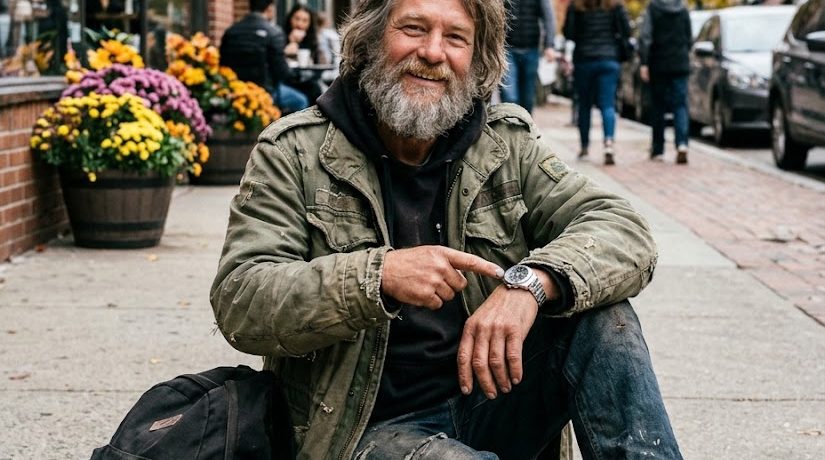
My restaurant manager shoved me onto the pavement because I looked like a homeless man. But something I noticed just before he forced me out was so disturbing that I called the police.
I hit the sidewalk, breaking my fall with both hands.
The coarse concrete scraped my palms, and the shoulder of my old, secondhand jacket ripped as I stumbled. Behind me, the glass doors of my own restaurant swung shut.
My manager stood on the other side, laughing at me.
“Stay away from here!” Kyle yelled.
A woman walking her dog hurried across the street. A businessman passed by without even glancing at me. Not a single person stopped to see if I was all right.
I remained on my knees for several seconds, hardly aware of the pain.
Because moments before Kyle shoved me outside, I had spotted something at the hostess station.
Something that changed everything.
I had walked into my restaurant hoping to find out why so many longtime customers had stopped coming.
Now I understood that the problem was much more serious than bad customer service.
And rather than simply dismissing my manager, I was preparing to bring the police into the situation.
But before I explain what happened next, you need to know about my mother, a small diner on Fulton Street, and a promise I made eighteen years ago.
My name is Frank Delgado, and I’m fifty-two years old.
Twenty years ago, I was working as a dishwasher at Gallagher’s Steakhouse, earning six dollars an hour.
I was thirty-two, out of work after the factory where I had spent eleven years closed its doors, and struggling desperately to provide for my ill mother.
I can still picture myself standing beside the industrial sinks, steam fogging up my glasses as waiters shoved dirty plates in my direction without so much as acknowledging me.
To them, I wasn’t a human being.
I was just the guy responsible for cleaning up everyone else’s mess.
My mother’s name was Rosalind, although everyone called her Rosie.
For thirty-eight years, she worked at a small restaurant on Fulton Street known as the Blue Plate.
It had just eleven tables, a narrow counter, and a loyal crowd of customers who showed up nearly every day.
Mom remembered how each person took their coffee, which regulars had lost their husbands or wives, and whose children had recently graduated.
But the thing I remember most clearly was her one rule that could never be broken.
“Nobody leaves my section hungry, Frankie. Not a single person.”
When I was twelve, I would often sit at the counter working on my homework while waiting for her shift to end.
Every now and then, a man would walk in wearing battered shoes, with barely enough coins to pay for a cup of coffee.
Mom would count his money, serve him a bowl of soup, a sandwich, and a hot drink, then quietly pay the remaining cost out of her tips.
One afternoon, I finally asked her why she did it.
“Ma, we hardly have enough money for ourselves. Why are you spending it on people you don’t even know?”
“Frankie, do you know what I see when someone like that walks through my door?”
I shook my head.
“Someone who can’t afford anything?”
She looked at me kindly.
“I see somebody’s child. Someone whose mother probably spent years worrying about whether he had enough to eat. Maybe his mother is no longer alive. That means somebody else has to look after him for a little while.”
Then she went back to work.
“Today, that somebody is me.”
Mom died eighteen years ago after a short fight with pancreatic cancer.
Toward the end, she held my hand in her hospital room.
“One day, you’re going to build something that matters,” she whispered.
“I hope I can, Ma.”
“There’s something I need you to promise me.”
“Anything you want.”
“No matter what you build, don’t ever forget the hungry.”
I gave her my word.
It took nine years before I was finally able to turn that promise into something real.
I worked my way up from dishwasher to prep cook before eventually becoming a full-time chef.
I moved between several restaurants, learning as much as I could along the way.
My wife, Denise, worked exhausting nursing shifts while I took culinary classes in the evenings.
For six years, we lived in a cramped apartment above a laundromat, putting away every dollar we could spare.
Then, eleven years ago, I finally opened a restaurant of my own.
I named it Rosie’s.
It was located in an old brick building on Grand Avenue that had once housed a pharmacy.
Inside were forty tables, a wooden counter, and black-and-white photographs of my mother displayed beside the cash register.
Her homemade chicken-and-dumpling soup was the first dish I added to the menu.
I even placed her handwritten recipe in a frame above the kitchen stove.
Her spelling wasn’t perfect, but I refused to correct even one word.
For years, Rosie’s became everything I had hoped it would be.
Retired neighbors met there for breakfast.
Families came together to celebrate birthdays.
Older customers gathered at the counter to play cards.
Every Sunday, eighty-one-year-old Mrs. Kowalczyk stopped by after church for a bowl of chicken soup and half a tuna sandwich.
She always made sure to leave a two-dollar tip.
And I kept my promise.
Next to the register sat a glass jar marked ROSIE’S RULE.
Customers could drop in their spare change to help pay for meals for people who couldn’t afford them.
Nobody was required to explain their situation.
And no one was ever sent away hungry.
That was the legacy my mother had left me.
For years, I did everything I could to preserve it.
Until I made a decision that nearly brought the whole thing crashing down.
Two years ago, a property developer approached me with an attractive offer to open another restaurant in a new suburban shopping center.
My wife advised me to take some time before making a decision.
I was too excited about the opportunity to pay attention.
I signed the agreement and opened Rosie’s Two.
But managing two restaurants turned out to be much harder than I had imagined.
The new location demanded almost all my time and attention.
Staffing shortages, unreliable suppliers, maintenance troubles, and constant financial decisions seemed to consume every waking hour.
I was putting in sixteen-hour days and could barely find time to visit my original restaurant.
Eventually, I decided to hire a general manager.
His name was Kyle Brenner.
Kyle was thirty-four years old, had earned a business degree from Rutgers, and had previously worked for several restaurant chains.
He dressed in expensive shirts, spoke with confidence, and filled our meetings with business jargon such as “revenue optimization” and “improving customer turnover.”
I didn’t completely understand his corporate terminology, but his previous financial performance looked impressive.
During his interview, he shook my hand firmly.
“Frank, I’ll run your restaurant as if it were my own. You concentrate on growing the business.”
I trusted him.
Initially, everything appeared to be going well.
Sales went up.
Expenses went down.
Every Monday, Kyle sent me polished reports packed with professional-looking charts.
I’d skim through them late at night and feel reassured.
Then the complaints started arriving.
One came from Walt Henshaw, a seventy-four-year-old man who had eaten breakfast at Rosie’s almost every weekday for nine years.
His usual order never changed: two eggs, rye toast, and black coffee.
His email was brief.
Frank, I don’t want to make a fuss, but I no longer come in. Your restaurant doesn’t feel friendly anymore. I hope everything is all right.
I asked him what had happened.
He never responded.
A month later, another customer complained that her family had waited forty minutes for a table, even though several tables were empty.
After that, more complaints followed.
The staff seemed unpleasant.
Longtime customers no longer felt welcome.
Something about the atmosphere had changed.
I called Kyle to discuss the situation.
He quickly assured me there was nothing to worry about.
“Frank, we’re operating in a more professional way now. Some of the longtime customers were used to sitting around for hours without spending much money.”
“But Walt has been supporting us for years.”
“Of course, but one person buying an inexpensive breakfast every morning isn’t enough to keep the business running. Just look at the financial statements.”
So I reviewed them.
The figures looked healthy.
And I chose to ignore my gut feeling.
It’s a decision I regret more than I can put into words.
Then Mrs. Kowalczyk stopped showing up.
I didn’t realize she was gone until almost two months had passed.
When I called her home, her granddaughter picked up.
“Grandma is doing fine,” she told me. “She just doesn’t feel like eating out anymore.”
Something about that answer bothered me.
Mrs. Kowalczyk had visited every Sunday since the day Rosie’s opened.
I knew something wasn’t right.
One evening, I dropped by the original restaurant after closing time to pick up some paperwork.
My longtime cook, Luis Ortega, was busy scrubbing the grill.
Luis had been with me since the very first day we opened.
He was in his sixties, reserved, reliable, and one of the only people who could make my mother’s soup exactly the way she used to.
When he saw me, he nervously glanced toward the manager’s office.
“Boss, could we have a word outside?”
We walked into the alley behind the kitchen.
Luis paused before speaking.
“I’ve been wanting to tell you something for months.”
“What’s going on?”
“You need to see how Kyle treats customers who appear to have very little money.”
I waited for him to continue.
“He and Madison, the new hostess, send people away even when there are empty tables. Sometimes they put elderly customers near the bathrooms and then intentionally pretend they aren’t there.”
My stomach knotted.
“What happened to the free-meal donation jar?”
Luis gave me a sorrowful look.
“Frank, Kyle took it away months ago.”
I looked at him in disbelief.
“What did you just say?”
“There was almost three hundred dollars inside. Kyle said it made the restaurant look cheap. He claimed the money had been transferred into the restaurant’s general fund.”
“Why didn’t anybody tell me about this?”
Luis dropped his gaze.
“I did try. I called you in March, but you said you were busy and would get back to me.”
I had no memory of that conversation.
He went on.
“After that, Kyle told me not to contact you again. He said a man my age would have a hard time finding another job.”
Luis was raising two grandchildren in his home.
He couldn’t afford to lose his livelihood.
I placed my hand on his shoulder.
“You should never have been forced to choose between telling the truth and protecting your family. I was the one who should have listened.”
That night, sleep wouldn’t come.
My thoughts kept returning to Walt.
Mrs. Kowalczyk.
The missing donation jar.
And the photograph of my mother smiling above the register.
Eventually, Denise switched on the bedside lamp.
“Frank, what’s weighing on your mind?”
I explained everything that had happened.
When I finished, she looked straight at me.
“Then get rid of Kyle.”
“On what grounds? He’ll deny everything, pull out his financial reports, and insist the complaints are coming from customers who are never satisfied.”
“Then go there and see for yourself.”
“He knows my face. If I walk through those doors, everyone will act perfectly.”
I fell silent.
Then an idea came to me.
“What if nobody recognized me?”
Denise stared at me in disbelief.
“Frank, what exactly are you thinking of doing?”
“I need to see how they treat someone who can’t afford an expensive meal.”
She thought the idea was absurd.
Perhaps it was.
But I needed answers.
The next afternoon, I went to a thrift store on the other side of town.
I purchased an old brown jacket with a torn pocket, faded jeans, a gray knitted cap, and a pair of scuffed boots.
Everything together cost eleven dollars.
I left my face unshaven for a couple of days and left my expensive watch, wallet, and wedding ring at home.
The only things I carried inside my jacket were my phone and four dollars in coins and small bills.
When Denise saw my appearance, she shook her head.
“You look absolutely awful.”
“That’s exactly what I’m going for.”
She straightened my collar.
“Your mother would either be incredibly proud of you or tell you off for doing something so foolish.”
I grinned.
“Knowing her, probably both.”
I left my car four blocks away from Rosie’s and walked toward Grand Avenue.
Almost immediately, I began noticing something unsettling.
People went out of their way to avoid making eye contact with me.
A woman pushing a stroller moved farther away from my path.
A businessman checked his back pocket when I came near him.
At the corner of Grand and Fifth, I passed a man sitting beside a cardboard sign asking passersby for help.
He wore a battered coat and had a gray beard.
As I went by, he looked straight at me and gave me a slight nod.
I nodded back.
He was the only stranger who acknowledged my presence during the entire walk.
At noon, I pulled open the glass doors of Rosie’s.
The small bell above the entrance chimed.
I had installed that bell eleven years earlier because the Blue Plate had used one just like it.
The restaurant was only about half occupied.
Several empty tables stood near the windows, clearly visible from the entrance.
Behind a sleek black hostess stand stood a young blonde woman with her hair pulled into a ponytail.
Madison.
She was busy staring at her phone.
When she finally looked up, her eyes traveled over my shabby clothes, and her expression immediately hardened.
“Excuse me,” I said softly. “Could I have a bowl of soup and a glass of water, please? I only have four dollars.”
I held out my hand to show her the money.
She hardly bothered to look at it.
“We don’t have any tables available.”
I glanced at the empty tables nearby.
“What about those ones?”
“They’re reserved.”
“Every single one?”
She let out an impatient sigh.
“Sir, there’s a fast-food restaurant a few blocks down the street.”
I stood there, feeling as though I didn’t even exist.
I had built this restaurant from the ground up.
My mother’s photograph was hanging just a few feet away.
Yet the employee standing before me acted as if I wasn’t worthy of stepping inside.
I was about to turn around and leave when I heard someone call after me.
“Excuse me, sir. Please wait.”
A young waitress came over from the kitchen.
She had dark hair and wore a black apron that looked a little too big for her.
Her name tag said AMBER.
Instead of judging my clothes, she looked directly at my face.
“Are you hungry?” she asked kindly.
“Yes, ma’am.”
“Come along with me.”
Madison immediately spoke up.
“Amber, those tables are reserved.”
“Which reservation?” Amber asked. “Could you show me the booking?”
Madison remained silent.
Amber led me to a small table near the front window.
“Would you care for some soup?”
“Yes, please.”
“Our chicken and dumplings are delicious. The recipe belonged to the owner’s mother.”
I nearly broke into a smile.
“That sounds perfect.”
A few minutes later, Amber came back carrying a steaming bowl of soup, some fresh bread, a cup of coffee, and a glass of ice water.
She carefully placed everything in front of me.
She treated me just as she would any other customer she valued.
I looked down at the soup.
My mother’s recipe.
Luis was still preparing it exactly as she had taught him.
With trembling fingers, I raised the spoon to my mouth.
After finishing half the bowl, I placed my four dollars on the table.
Amber noticed the money.
“You can keep that,” she told me.
“I have enough to pay.”
“I know you do. But today, allow me to help you.”
“Why would you do that?”
She gave me a gentle smile.
“Someone helped me when I was going through a difficult time. I’m simply passing that kindness along.”
She topped up my coffee and went back to work.
Sitting beside the window, I struggled to hold back my tears.
My mother’s words echoed in my mind.
Someone has to care. Today, that someone is me.
Now, it was Amber who was carrying on that kindness.
And she had absolutely no idea who I really was.
Then the kitchen door suddenly swung open.
Kyle walked out.
His expensive blue shirt was perfectly ironed, and a gold watch gleamed on his wrist.
Madison came behind him, pointing toward my table.
“What’s happening here?” Kyle demanded.
Amber stepped forward to answer him.
“I seated him. He’s just here for lunch.”
Kyle stared at me, his face filled with contempt.
“Is he paying for his meal?”
“I’m paying for it myself.”
He gave a mocking laugh.
“This is a business, Amber, not a charity organization.”
“It’s just one bowl of soup.”
“One bowl today, five tomorrow. Before long, we’ll have people occupying tables all day without spending a dime.”
He motioned toward me.
“Our customers don’t want to sit beside people like him.”
I lowered my gaze.
“I’m not here to cause any problems,” I said quietly.
Kyle walked straight toward my chair.
“Then get out.”
Amber immediately objected.
“He hasn’t done anything wrong.”
Kyle paid no attention to her. Instead, he grabbed my arm and hauled me to my feet.
My knee struck the table.
Coffee splashed across the white tablecloth.
“I said, get out!” he barked.
“I’m leaving,” I replied.
But he kept shoving me toward the entrance.
My worn-out boot caught on the carpet, causing me to stumble sideways.
That was when I noticed something that changed everything.
An elderly woman wearing a purple coat stood at the hostess counter.
She was leaning on a cane while paying her bill.
Madison took her credit card.
However, rather than immediately inserting or swiping it through the restaurant’s official payment terminal, she slipped the card beneath the counter.
I caught sight of a small black electronic device.
She ran the card through it before processing the payment through the regular system.
The entire action lasted barely a second.
Madison then smiled at the woman.
“Thank you, Mrs. Pratt. Have a lovely afternoon.”
I recognized what I had just seen.
After working in the restaurant industry for nearly twenty years, I had attended countless training sessions on payment security.
What I had witnessed looked very much like someone secretly capturing customers’ credit card information.
Then I saw Kyle glance at Madison’s hands.
His expression suddenly shifted.
“GET OUT!” he yelled.
He shoved me through the doorway.
I lost my balance and fell onto my hands and knees on the sidewalk.
Through the glass doors, I could hear him laughing.
But I hardly paid attention to him.
My mind was racing with questions.
Walt Henshaw.
Mrs. Kowalczyk.
The family who had complained about the terrible service.
Could customers have been facing unauthorized charges after dining at Rosie’s?
Could that explain why so many loyal customers had stopped coming back?
I slowly got to my feet and pulled out my phone.
My first thought was to walk straight back inside, disclose who I really was, and fire Kyle on the spot.
Then I realized that if the device vanished, it might be much harder to prove what I had witnessed.
Instead, I moved toward the side window and discreetly used my phone to record the hostess station from outside.
A few minutes later, another customer came over to pay.
I watched as Madison performed the same suspicious action beneath the counter.
Now I had evidence that investigators could examine.
Suddenly, the restaurant door opened.
I quickly lowered my phone.
Amber stepped outside.
She was carrying a white paper bag.
“Oh, thank goodness you’re still here,” she said. “Are you all right?”
She noticed the scrapes on my hands.
“I’m really sorry about what happened to you.”
“I’m fine,” I assured her.
She held out the bag.
“I put some extra soup and bread in here, along with a little money. Please take it.”
I looked at her in surprise.
“Why would you risk getting yourself into trouble to help someone you don’t even know?”
Her expression grew gentle.
“Because I understand what it’s like.”
She told me that when she was seventeen, she had lost her home and spent several months living in her car.
During that painful period, a waitress at a diner near the bus station had given her breakfast every morning.
“She never made me feel embarrassed about my situation,” Amber explained. “I’ve never forgotten her kindness.”
I felt a lump forming in my throat.
“So someone helped you, and now you’re doing the same for others?”
She nodded.
“That’s the way it should be.”
I pressed the warm paper bag against my chest.
Then I asked her something.
“Amber, have you ever seen Madison doing anything strange when customers pay with credit cards?”
Her expression immediately turned serious.
“Why do you want to know?”
Before I could answer, the restaurant door opened again.
Kyle came storming outside.
“Amber! What on earth are you doing?”
“I’m on my break.”
His eyes landed on the bag she was holding.
“Did you give him food from our kitchen?”
“I paid for it myself.”
“That doesn’t matter. You’re done here. Go get your things.”
Amber looked at him in disbelief.
“You’re firing me because I helped someone?”
“I’m the manager. I decide who works here.”
He then turned his attention to me.
His voice became quieter.
“I saw you standing outside the window with your phone.”
I said nothing.
“What were you recording?”
“Nothing you need to be concerned about.”
He stepped closer to me.
“Hand over the phone.”
“No.”
He reached for my jacket.
I moved back, keeping my phone out of his reach.
Amber stepped between us.
“Kyle, stop it!”
He shoved past her, causing her to stumble into the wall.
That was the last straw.
I pulled out my phone and dialed 911.
Kyle laughed at me.
“Go ahead. Who do you think they’re going to believe?”
When the dispatcher answered, I explained the situation clearly.
“My name is Frank Delgado. I own Rosie’s Restaurant on Grand Avenue. My manager has just acted violently toward me and one of my employees. I also suspect there’s an illegal payment-card device inside the restaurant. We need police officers to come and investigate.”
Kyle went completely still.
The confidence vanished from his face.
Amber stared at me in shock.
“Wait a minute. You’re Frank Delgado?”
I took off my gray knitted cap.
“Hello, Amber. It’s a pleasure to finally meet you.”
Kyle spun around and rushed back into the restaurant.
I went in after him.
When I reached the hostess counter, I saw Madison holding the small black device.
Kyle was insisting that she hand it over to him.
“Madison,” I said firmly, “place it on the counter.”
She looked nervously from him to me.
“The police are on their way,” I continued. “Don’t make this situation worse by trying to conceal anything.”
After a moment of hesitation, she set the device down beside the reservation tablet.
Directly beneath my mother’s photograph.
Within minutes, police officers arrived at the restaurant.
That was when the real investigation got underway.
One officer took my statement while Amber sat nearby, holding an ice pack against her shoulder.
Luis came out of the kitchen and looked completely bewildered when he learned what had happened.
Kyle was taken to a separate area for questioning.
Madison began to cry.
“He told me nobody actually loses anything,” she kept saying. “He said the banks would take care of it.”
Investigators inspected the suspicious device and examined the evidence available to them.
After obtaining the appropriate authorization, they searched Kyle’s office as well.
Inside, they found additional electronic equipment, computer records, and documents that raised serious questions about possible unauthorized payment-card activity.
A financial-crimes detective named Sharon Vance joined the investigation.
After examining the initial records, she pulled me aside to speak privately.
“Mr. Delgado, how long has Kyle been managing this restaurant?”
“Eighteen months.”
She pointed to a series of dates in the records.
“Some of this information appears to date back more than a year. We may be dealing with hundreds of compromised card transactions.”
“Hundreds?”
“That’s something we’ll have to establish through the investigation.”
I felt physically ill.
My customers had placed their trust in Rosie’s.
They had trusted the people working for me.
And because I’d been so focused on expanding my business, I’d failed to notice what was happening inside my own restaurant.
Investigators later discovered that Kyle had allegedly been working with an accomplice in another state.
Information gathered at Rosie’s had been connected to unauthorized purchases made elsewhere.
Another employee named Trent admitted that Kyle had paid him to keep quiet about suspicious activities and help drive certain customers away.
I terminated Trent’s employment.
But dismissing employees alone wouldn’t undo the harm they had caused.
After the officers departed, I shut down the restaurant for the rest of the evening.
I sat on a milk crate in the kitchen, still dressed in the clothes I’d bought from the thrift store.
Luis came over carrying two cups of coffee.
“I’m sorry, Boss,” he murmured.
“What are you apologizing for?”
“For not speaking up sooner.”
I shook my head.
“You did try, Luis. I was the one who failed to listen.”
My eyes shifted toward the framed recipe card hanging above the stove.
My mother had dedicated her life to feeding people. I had allowed someone to take away her donation jar and mistreat the very customers she would have welcomed with open arms.
Luis didn’t say anything.
A moment later, Amber appeared at the kitchen doorway.
She had come back to collect something she’d left behind.
“Amber,” I said, “why don’t you sit down with us?”
She hesitated briefly before dragging another crate over.
The three of us sat together in silence.
“I want to thank you,” I told her.
“For what?”
“For showing kindness to someone you believed had absolutely nothing.”
She shook her head.
“I had no idea you were the owner.”
“I realize that. That’s exactly why your kindness meant so much to me.”
Tears began to gather in her eyes.
I asked if she had ever witnessed anything suspicious happening at the hostess station.
She admitted that she had once asked Madison about an unfamiliar device, but Madison had told her it was backup equipment.
Not long afterward, Kyle started reprimanding her for giving customers complimentary coffee or offering assistance.
“He kept threatening to fire me,” she explained. “I started believing I wasn’t good at my job.”
“You were never the problem,” I assured her.
And I genuinely meant it.
The next morning, I started reaching out to customers who might have been affected.
Detective Vance shared information that could properly be disclosed while the investigation was still underway.
Working with the appropriate parties, I began contacting longtime customers.
Some were furious.
Others were bewildered.
A few hadn’t noticed any unauthorized transactions.
One man explained that he’d spent weeks disputing charges with his bank after losing more than a thousand dollars.
His rent payment had been disrupted, and he’d come dangerously close to losing his apartment.
I let him speak without interrupting.
When he finished, I told him:
“You have every reason to be upset. I’m sorry I didn’t protect the people who put their trust in my restaurant.”
I offered to help cover verified losses and expenses that hadn’t already been refunded.
I also assured customers that they could return whenever they felt ready.
Most told me they would consider it.
Then Walt Henshaw called.
“Frank, I’ve heard about everything that happened,” Walt told me.
“I’m truly sorry,” I replied.
“I lost around four hundred dollars, but the bank paid me back.”
“I’m glad you got your money back.”
He paused for a moment.
“Frank, money wasn’t the reason I stopped coming.”
I closed my eyes.
“Then what was it?”
“Your manager made me feel as though I wasn’t welcome anymore.”
He explained that the staff had repeatedly seated him in a secluded corner.
One morning, Kyle had approached him and asked whether he planned to order anything other than coffee.
He had then remarked that the best seats should be reserved for customers who spent more money.
“I’ve been having breakfast there since the day you opened,” Walt said quietly. “But suddenly, I wasn’t good enough for the place.”
My chest tightened.
“Walt, would you come back tomorrow morning? I’ll prepare your breakfast myself.”
He didn’t answer immediately.
At last, he said:
“Two eggs over easy. Rye toast.”
I smiled.
“I haven’t forgotten.”
The next morning, Walt returned to his familiar stool at the counter.
I cooked his eggs precisely the way he liked them.
After finishing his breakfast, he slipped five dollars beneath his coffee cup.
I attempted to give it back.
Instead, he pointed toward the register.
“Put it in the jar, Frankie.”
But the donation jar was no longer there.
That afternoon, I purchased a new glass container.
Across its front, I wrote ROSIE’S RULE and placed it beneath my mother’s photograph.
Walt’s five dollars became the very first donation.
After that, I went to visit Mrs. Kowalczyk.
She lived in a little yellow house on Mercer Street.
Her granddaughter answered the door and eventually welcomed me inside.
Mrs. Kowalczyk came into the room using a walker.
“Frankie,” she greeted me.
“Hello, Mrs. K.”
She studied my face for a moment.
Then she began explaining what had happened.
Someone had used her account information to make unauthorized purchases.
The resulting financial difficulties had temporarily interfered with her ability to afford medication and other essential items.
Her granddaughter had stepped in to help.
I promised to assist with any qualifying losses or charges that hadn’t been reimbursed.
However, Mrs. Kowalczyk still had something else to tell me.
“The money wasn’t the worst part,” she said.
She explained that during her final visit to Rosie’s, she’d struggled to get her payment card out of her purse.
Madison had become impatient with her.
In front of several other customers, she had suggested that Mrs. Kowalczyk should bring someone who knew how to handle payments.
“She made me feel stupid,” Mrs. Kowalczyk whispered. “As though I was too old to come there anymore.”
Shame washed over me.
“Your mother would never have treated me like that,” she added.
“No,” I acknowledged. “She never would have.”
I paused before asking my next question.
“Mrs. K, would it be all right if I picked you up after church this Sunday? I’ll take you to Rosie’s, and we can have lunch together.”
She looked carefully at me.
“Chicken and dumplings?”
“Absolutely.”
“And half a tuna sandwich?”
“You know it.”
Her face relaxed into a smile.
“And I’m still leaving my two-dollar tip.”
I smiled back.
“I wouldn’t have it any other way.”
The legal case continued for several months.
Investigators eventually linked Kyle’s actions to a larger payment-card fraud operation involving an accomplice.
Kyle entered a plea agreement and was sentenced to prison.
Madison cooperated with the investigators and received probation along with community-service obligations.
I attended the sentencing hearing.
When the court gave me an opportunity to speak, I told everyone about my mother.
I described how she had spent thirty-eight years feeding people who couldn’t always afford a meal.
I explained why I had named my restaurant in her honor.
Then I shared something that had been weighing on my mind for months.
“These weren’t merely account numbers. They belonged to real people. Grandparents. Parents. Neighbors. People who trusted us.”
I wasn’t there to demand revenge.
I wanted everyone involved to recognize that the consequences had reached far beyond financial losses.
That spring, Madison sent me a handwritten letter.
She explained that volunteering at a food bank as part of her community service had forced her to confront her own impatience toward people who needed additional help.
One day, she helped an elderly man who used a cane, carrying his groceries all the way to the bus stop.
In her letter, she admitted that she finally understood why her treatment of Mrs. Kowalczyk had been so painful.
I kept the letter.
I wasn’t ready to write back.
Still, I hoped she had genuinely learned from her mistakes.
Around the same time, I made another important decision.
I sold Rosie’s Two.
The suburban restaurant was making a profit, but I had finally realized that I no longer wanted to spend my life expanding a business while overlooking the people who gave it meaning.
Denise asked me if I was sure about my decision.
“I started Rosie’s to honor my mother,” I explained. “Then I became so obsessed with making more money that I lost sight of the reason I’d started in the first place.”
The sale provided me with the funds needed to address the remaining documented losses connected to the fraud.
In total, I spent approximately $41,000 helping affected customers cover expenses they hadn’t been reimbursed for.
Some needed help paying bank fees.
Others had suffered delayed payments or disruptions to their finances.
Mrs. Kowalczyk received assistance with her medication costs.
I couldn’t reverse what had happened.
But I could accept responsibility and do what I could to make things right.
Then I promoted Amber to general manager.
She looked completely stunned.
“Frank, I’ve never run a restaurant before. I don’t even have a business degree.”
I smiled at her.
“Amber, my previous manager had a business degree and impressive reports. But do you know what I really need?”
She shook her head.
“Someone who sees the person standing in front of them before making assumptions based on their appearance.”
Tears began rolling down her cheeks.
Then she agreed to take the position.
Luis was promoted to kitchen manager.
He received a salary increase, improved equipment, and greater responsibilities.
His grandchildren started coming to visit on Saturdays, sitting at the counter and working on their homework, just as I had done at the Blue Plate all those years ago.
We also established one straightforward rule.
A small chalkboard beside the entrance now displays these words:
NOBODY LEAVES HUNGRY.
The table near the front window where Amber had served me soup became known as Rosie’s Table.
Luis crafted a small brass plaque to mark it.
That table is never reserved.
Anyone who cannot afford a meal can sit there without having to explain their situation.
They receive a hot meal, something to drink, and the same courteous treatment offered to every other customer.
The donation jar helps cover the cost.
These days, it hardly ever remains empty.
People quietly drop in five-dollar bills, twenty-dollar bills, and sometimes even larger amounts.
Nobody draws attention to their generosity.
They simply lend a hand.
Last Thursday, I was standing behind the counter when the little bell above the entrance chimed.
A man walked through the door.
He had a gray beard, a weather-beaten coat, and a folded cardboard sign sticking out of his pocket.
I recognized him immediately.
He was the same man I’d seen sitting near Grand and Fifth on the morning I went out disguised as a homeless person.
He was the only stranger who had looked me directly in the eyes.
He stood uncertainly near the entrance.
Amber spotted him.
“Good afternoon,” she greeted him warmly. “Would you like something to eat?”
He looked uncomfortable.
“I’ve only got a couple of dollars.”
“That’s perfectly fine,” Amber assured him. “Come this way.”
She led him to the table beside the window.
The one marked with the brass plaque.
I went into the kitchen and prepared a hearty bowl of my mother’s chicken-and-dumpling soup.
I served it with warm bread and a cup of coffee.
Then I carried the meal to him myself.
The man looked up at me.
“Have we met somewhere before?”
I smiled.
“We crossed paths once on the street. You were kind enough to acknowledge me.”
He looked confused.
Clearly, he didn’t remember.
And that was completely all right.
Sometimes, the smallest acts of kindness mean much more to the person receiving them than they ever do to the person offering them.
He raised his spoon and tasted the soup.
A moment later, he closed his eyes.
“This is wonderful,” he murmured.
“Thank you,” I said. “It’s my mother’s recipe.”
Then I returned to the counter beneath her photograph.
As I watched him enjoy his meal, I remembered the promise I’d made beside my mother’s hospital bed eighteen years earlier.
For a time, I’d allowed that promise to disappear beneath financial statements, expansion strategies, and impressive-looking figures.
But now, at last, Rosie’s had become the kind of restaurant she had always wanted me to create.
A place where every person mattered.
A place where kindness had nothing to do with the balance in someone’s bank account.
And a place where nobody ever had to leave hungry.
Because my mother taught me that a person’s true value can never be judged by the clothes they wear, the money in their pocket, or the food they can afford.
The End.









