
 128 views
My son warned me that the widower I had been dating was after the insurance money my late husband had left behind. So, I secretly went to his house and found something that brought me to tears.
The garage door was standing fully open when I arrived.
Soft country music drifted from an old radio, while the scent of freshly cut wood and paint filled the air.
I stopped at the end of the gravel driveway, dressed in my favorite blouse with tiny blue buttons, unable to move another step.
My son had cautioned me that the man I was dating was keeping something from me.
Maybe another woman.
Maybe a completely separate life.
Or perhaps he was merely waiting for the perfect moment to claim the money my late husband had left me.
I had driven forty minutes to find out the truth.
But when I peered inside the garage, I saw something I never could have imagined.
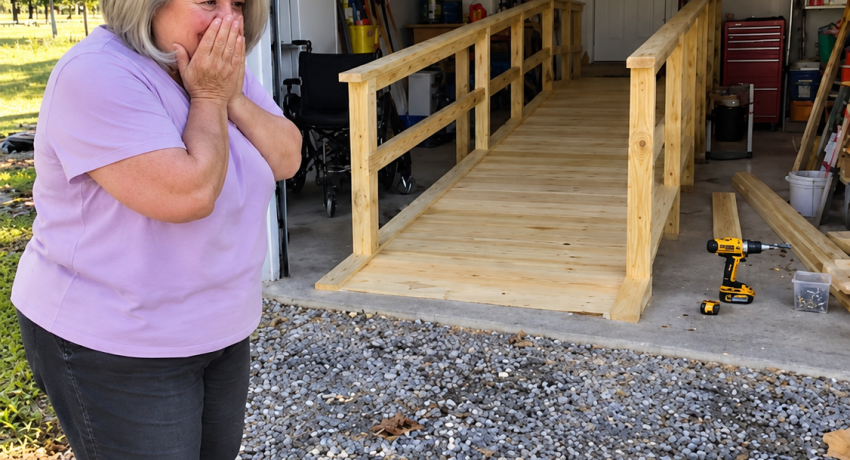
A beautifully crafted wooden ramp extended from the garage floor toward the entrance of the house.
It looked brand-new, with smooth handrails running along both sides.
I moved closer and placed my hand on one of the rails.
The height was just right.
Not for Wendell, who was well over six feet tall.
And that was when I first began to suspect that my son might have been completely mistaken.
My name is Winona Pruitt. I’m sixty-four years old, and I spent thirty-four years working as an emergency-room nurse in Dallas.
Even in retirement, I find it impossible to stop observing people’s physical condition.
Their skin color, their breathing, the way they walk—I notice it all.
My husband, Dwight, used to joke about my habit.
“Winnie, can’t we attend church without you checking everyone’s blood pressure?”
But two years ago, I overlooked the most important warning sign of my life.
Dwight walked inside after mowing the lawn and told me his arm felt unusual.
He lowered himself into his favorite brown recliner.
“Just get me some iced tea, sweetheart. I’ll be all right.”
When I came back from the kitchen, he had collapsed.
I performed CPR as I waited for the ambulance, but there was nothing I could do to save him.
For months afterward, I held myself responsible.
I had recognized medical emergencies in countless strangers, yet I had failed to understand how urgently my own husband needed help.
His recliner stayed beside the living-room window.
Every week, I cleaned the dust around it.
Nobody ever sat in it.
Not even me.
My daughter, Megan, sometimes encouraged me to get rid of it.
“Maybe one day,” I would always reply.
After Dwight passed away, my world grew unbearably small.
I shopped for groceries, attended church, and visited the cemetery.
My knees made even these simple activities difficult.
Years of walking across hospital floors had left me with serious joint pain. On some mornings, climbing the front steps seemed almost impossible.
Eventually, my neighbor Carla decided to step in.
Carla was seventy-one, a widow with a strong personality who almost always wore bright pink lipstick.
One morning, she showed up on my porch with her purse in hand.
“There’s a grief-support group at the senior center. You’re going with me.”
“Carla, I have no desire to sit around talking about my feelings.”
“You’re already sitting around feeling miserable. You might as well have some coffee.”
Before I could protest, she instructed me to put on my shoes.
That was how I met Wendell Haskins.
He was sixty-six, tall and broad-shouldered, with gray hair and exceptionally gentle hands.
He had worked for an electric cooperative for thirty-eight years before retiring.
His wife, Ruth, had passed away fourteen months earlier after battling ALS.
At our first meeting, Wendell said very little.
“I’m Wendell. My wife died last year.”
Then he lowered his eyes toward his coffee.
“I don’t think I can say anything more today.”
The group leader assured him that there was nothing wrong with that.
Still, something about him lingered in my thoughts.
He wore the same exhausted expression I had seen so often on family members waiting outside hospital rooms.
The following week, my knees were acting up, and I arrived late.
Wendell got to his feet and brought me a cup of coffee.
“Two creams, correct?”
I looked at him in surprise.
“How did you remember that?”
“You used two last week.”
He simply shrugged.
“I notice things.”
That straightforward answer stayed with me for the rest of the afternoon.
Over the next several weeks, Wendell began accompanying me to my car after our meetings.
One afternoon, he brought up my broken porch light.
“You mentioned that it hasn’t worked since Dwight passed away.”
I had entirely forgotten mentioning it to the group.
“It’s probably something wrong with the wiring,” I told him. “Dwight had planned to repair it.”
Wendell gave me a smile.
“I worked with electrical systems for thirty-eight years. Would you mind if I checked it?”
He arrived that Saturday with his tools.
After examining the wiring and replacing the damaged parts, he flipped the switch.
For the first time in nearly two years, my porch was illuminated.
I stood outside, gazing at the light.
“Everything okay, Winnie?” he called out.
I swallowed the lump forming in my throat.
“Get off that ladder before you hurt yourself. I’m cooking you dinner.”
I made chicken-fried steak, mashed potatoes, and green beans.
Wendell helped himself to two servings.
Afterward, he washed the dishes without waiting for me to ask.
The next Sunday, he came back for dinner.
Before long, our Sunday evening meals had become a small tradition of ours.
I wasn’t searching for another husband.
I had loved Dwight for nearly forty years.
But I came to realize how much I missed having someone around.
Someone to laugh with while watching television.
Someone who asked if I needed help carrying the groceries.
Someone who would listen when I shared memories of the past.
Wendell wasn’t a man of many words, but he remembered almost everything I told him.
One evening, my knees were hurting more than usual.
I gripped the counter for support as I took the cornbread out of the oven.
Wendell noticed immediately.
“Are your knees bothering you again?”
“Thirty-four years working in hospital corridors,” I joked. “I’ll probably end up in a wheelchair just like my mother.”
He didn’t laugh.
“Your mother needed a wheelchair?”
“For the last eight years of her life.”
“Did she live with you?”
“No. She stayed at our old farmhouse near Kaufman. She wouldn’t leave.”
I smiled as the memory came back to me.
“When I was six, she painted the kitchen buttercup yellow. The cabinets were white, with little glass handles. I always thought the room felt like sunshine.”
Wendell seemed to consider that for a moment.
“Buttercup yellow?”
“That was the name of the paint.”
Two weeks later, he asked me whether the yellow had been a soft shade or a bright one.
The following Sunday, he wanted to know more about the kitchen cabinets.
I chuckled.
“Why are you so curious about my mother’s kitchen?”
He smiled at me.
“Because your face lights up whenever you talk about it.”
Still, there was something about Wendell that I couldn’t figure out.
He had never invited me over to his house.
Not even once.
Whenever I brought up the idea of visiting, he would steer the conversation elsewhere.
“My place isn’t ready for visitors yet, Winnie.”
“I wouldn’t mind if it were untidy.”
“Just give me until Christmas.”
Initially, I accepted what he told me.
But gradually, I began to notice little things.
Sawdust clinging to his jeans.
Small splinters embedded in his hands.
Faint traces of pale yellow paint around his fingernails.
Whenever I questioned him about it, his answers remained unclear.
“I’m just taking care of a few projects.”
One Sunday, he showed up looking utterly worn out.
After dinner, he sank into Dwight’s recliner and fell asleep almost immediately.
For two years, that chair had remained untouched.
I nearly told him to get up.
Instead, I stood watching him sleep peacefully.
To my own surprise, seeing him there brought me comfort.
For the first time in a long time, my living room no longer seemed quite so lonely.
My son, Zachary, never had any faith in Wendell.
Zach was thirty-eight and ran an auto-repair shop called Pruitt Collision.
Dwight had helped him get the business started years before.
Zach worked hard and cared deeply for his children, but something had changed in him after his father died.
Not long after the funeral, he insisted on taking charge of my online banking.
“Mom, you’re still grieving. Let me take care of the financial matters until you’re feeling better.”
I was tired and emotionally overwhelmed, so I agreed.
He organized my online accounts and kept the password for himself.
Whenever I needed to check something, I went through him.
At the time, I thought it made things easier.
However, the moment Zach met Wendell, he became openly unfriendly.
One Sunday, he showed up without warning and found Wendell drying dishes in my kitchen.
“Who’s this?” Zach demanded.
“This is Wendell Haskins. We met at the grief-support group.”
Wendell extended his hand.
“It’s a pleasure to meet you, Zach. Your mother mentions you quite often.”
Zach shook his hand reluctantly.
After that encounter, something unusual began happening.
My son started coming over every Sunday.
He brought his wife, Jordyn, along with their children, Kaylee and Brody.
I was delighted to spend time with my grandchildren, but Zach’s sudden enthusiasm for Sunday dinners struck me as suspicious.
He kept firing questions at Wendell.
“Where did you work?”
“Trinity Valley Electric.”
“Did they give you a decent retirement pension?”
“Enough to get by comfortably.”
“Where do you live?”
“Outside Ferris.”
“That’s strange. Mom’s never visited your place.”
His interrogation made everyone uneasy.
Jordyn hardly said a word.
One afternoon, while she helped me slice the pie, she spoke softly.
“Miss Winona, Wendell really does seem like a good-hearted man.”
I smiled at her.
“He certainly is.”
But I noticed that her hands were shaking.
I assumed Zach’s behavior was making her nervous.
I had no idea there was something else behind it.
Eventually, Zach decided to confront me openly.
“Mom, you’ve been dating this man for months, and you still haven’t visited his house?”
“He told me he’s renovating it.”
“Or maybe he’s concealing a wife.”
“Zach, his wife passed away.”
“That’s what he wants you to believe.”
I could feel my anger building.
Then he said something that cut me deeply.
“Mom, men like him see a widow with insurance money and think they’ve found someone easy to exploit.”
“Wendell hasn’t asked me for a single cent.”
“Not yet.”
He took out his phone and opened my banking application.
“I’m going through your accounts. I need to make sure he hasn’t gained access to them.”
“Zachary, put your phone away.”
He paid no attention to me.
I told him again.
At last, he stopped scrolling.
For a moment, his expression grew tense.
Then he turned the phone facedown.
“Everything appears fine,” he declared. “For the time being.”
A few days afterward, my daughter Megan called me.
“Mom, Zach is concerned about you.”
“I know he is.”
“He thinks Wendell is taking advantage of your loneliness.”
“Is that what you think, too?”
She paused before answering.
“I just want you to be cautious.”
She then explained that Zach had threatened to stop bringing the children to see me if I continued dating Wendell.
I sat there without saying a word.
The thought of my own son using my grandchildren to control my personal decisions was heartbreaking.
That entire week, I struggled to sleep.
Perhaps my children really did know better.
Maybe loneliness was preventing me from seeing things clearly.
Perhaps Wendell’s kindness wasn’t as genuine as I had believed.
But then I thought about the sawdust.
The yellow paint.
How exhausted he had looked.
And his unusual interest in my mother’s kitchen.
Something about the situation simply didn’t add up.
So I resolved to uncover the truth on my own.
A few months earlier, Wendell had written down his address on a napkin in case of an emergency.
I eventually found it tucked away in my kitchen drawer.
1412 County Road 664, Ferris, Texas.
On Thursday morning, I got dressed, settled into my car, and drove toward his property.
The drive lasted almost forty minutes.
More than once, I thought about turning back.
What if Zach had been right?
What if I found another woman living in his house?
What if Wendell had been lying to me all along?
Eventually, I arrived at a simple white house with green shutters and a large pecan tree growing in the front yard.
His truck was parked behind the house.
The garage door was wide open.
Music was coming from a small radio.
I made my way slowly along the gravel driveway.
Inside the garage, I saw piles of fresh lumber, carefully organized tools, cans of paint, and a workbench.
Then my eyes fell on the ramp.
It was broad, gently inclined, and expertly built.
Smooth wooden handrails ran along either side.
I placed my hand on one of them.
It felt just right.
The railing appeared to have been designed for someone my height, someone who needed additional support while walking.
I stepped toward a shelf lined with paint cans.
One of the containers had a sample of pale yellow paint attached to its lid.
The label said:
Buttercup.
My breath caught in my throat.
I followed the ramp toward the house.
For the first time in months, I could walk up an entrance without putting extra strain on my knees.
When I reached the top, I pushed open the kitchen door.
Then I stood completely still.
The walls were painted a gentle buttercup yellow.
The cabinets were white.
Every cabinet door was fitted with a delicate glass knob.
The countertops were lower than normal, and the space beneath the sink had been left open to accommodate a wheelchair.
The doorways had been made wider.
Support bars had been fitted beside the stove and near the entrances.
A small pink geranium sat on the windowsill.
My mother used to grow those flowers.
I pressed my hand over my mouth.
Then I heard someone approaching.
Wendell came through the back door carrying painting supplies.
He stopped as soon as he noticed me.
“Winnie?”
The paintbrush fell from his hand.
“You weren’t meant to see this just yet.”
I couldn’t find the words to speak.
He looked around anxiously.
“The bathroom still needs work. I have to finish the trim and put up a few more support rails.”
“Wendell,” I said quietly, “what is all this?”
He pulled out a chair and sat down.
“I was hoping to surprise you at Christmas.”
He let out a small, uneasy laugh.
“I even rehearsed what I planned to say.”
“Why don’t you tell me now?”
He remained silent for a little while.
Then he started telling me about Ruth.
As his late wife battled her illness, she gradually lost the ability to move around independently.
Their home had narrow doorways and steps that made ordinary daily tasks more and more challenging.
For months, Wendell had promised her that he would build a ramp.
But he kept putting it off.
There was always another job to finish.
Another issue.
Another excuse to put it off.
“Ruth adored the pecan tree outside,” he said quietly. “Every evening, she would sit beneath it.”
His voice faltered.
“Toward the end, she could no longer go outside. I kept telling her I would make it possible.”
He lowered his gaze to his hands.
“But I left it too late.”
I reached over the table and took his hand in mine.
“When I met you,” he went on, “I could see how much pain your knees caused you. Then you told me about your mother having to use a wheelchair.”
He swallowed hard.
“And I thought, not again. I wasn’t going to wait until someone important to me lost the ability to move around before doing something to help.”
Through my tears, I looked at him.
“Have you been doing all of this for me?”
He nodded.
“I wanted you to have a place where you could always feel welcome. Even if your knees become worse. Even if you eventually need a wheelchair.”
He motioned toward the yellow walls.
“And I wanted it to feel like home.”
I burst into tears.
Wendell gently passed me a few paper towels.
He didn’t try to interrupt or say anything.
He just remained beside me until I was ready to speak.
Then I noticed how worn out he appeared.
“Wendell, how many hours have you been spending on this every day?”
He looked away.
“Eight or ten hours. Sometimes longer.”
“How long have you been at it?”
“Since August.”
I shook my head in disbelief.
“You’re sixty-six years old. You can’t keep pushing yourself until you’re completely worn out.”
He smiled.
“Yes, ma’am.”
“And you’re going to take a break.”
“Yes, ma’am.”
I leaned toward him and kissed his forehead, which was smudged with paint.
He took me around the rest of the house.
There was a widened doorway to the bedroom.
An accessible bathroom that was still being built.
Another ramp that extended toward the backyard.
And beneath the enormous pecan tree stood a freshly constructed bench with space for two people.
We settled down together.
“Why didn’t you tell me about any of this?” I asked.
“Because I didn’t want to make another promise that I might not be able to fulfill.”
He gently squeezed my hand.
“I wanted you to see something real.”
As we sat beneath that tree, I realized he already had.
On my drive home, I kept thinking about Zach’s accusations.
He had repeatedly claimed that Wendell was after my money.
Yet Wendell had devoted months to making a house more comfortable for me.
Then another memory came back to me.
The Sunday Zach had opened my banking application, he had suddenly fallen silent.
His jaw had stiffened.
He had quickly turned his phone facedown.
And Jordyn’s hands had shaken whenever anyone mentioned money.
The next morning, I went straight to the bank.
I met with the manager, Tamika, and asked her to provide complete statements for every account I owned.
I also reset my online banking password.
For the first time since Dwight’s death, I chose to take personal control of my finances.
Tamika printed the statements and organized them into a folder.
I brought everything home.
Sitting at my kitchen table, I put on my reading glasses and carefully examined the transactions.
The life insurance policy Dwight had left me had paid out $220,000.
After covering the funeral and other necessary expenses, I had expected to have roughly $190,000 remaining.
Instead, my account showed a balance of just $146,000.
I checked the figures once more.
Then I went through each transfer individually.
Five thousand dollars.
Three thousand dollars.
Eight thousand dollars.
Several additional withdrawals over the months that followed.
Every payment had gone to the same account.
PRUITT COLLISION LLC.
I sat completely still.
Forty-four thousand dollars.
Zach had been moving money out of my account without telling me.
All at once, I understood why he had become so determined to keep Wendell away from me.
He wasn’t trying to shield me from someone who wanted my inheritance.
He was afraid I would uncover what he had already taken.
That evening, I phoned Megan.
First, I told her about Wendell’s house.
The ramps.
The yellow kitchen.
The pecan tree.
Then I explained what I had discovered in the bank statements.
For several moments, she remained silent.
At last, she spoke in a whisper.
“Mom, I’m so sorry.”
“Did you know about this?”
“No, I swear I didn’t.”
Her voice began to shake.
“Zach kept telling me that Wendell was going to steal everything you had. I honestly believed he was worried about you.”
I glanced toward Dwight’s empty recliner.
“I believed him, too.”
Then I made up my mind.
“I’m having everyone over for Sunday dinner. Zach, Jordyn, you, and Wendell.”
“Are you certain that’s a good idea?”
“Yes. It’s time for everyone to hear the truth.”
That Sunday, I prepared pot roast, potatoes, fresh rolls, and banana pudding.
Megan arrived before the others.
Wendell showed up wearing his nicest plaid shirt.
As soon as Megan saw him, she walked over and wrapped her arms around him.
“Thank you,” she whispered.
Wendell looked puzzled.
“What for?”
“For looking after my mother.”
He gave her an awkward smile.
At five o’clock, Zach arrived with Jordyn and the children.
He appeared startled to see everyone gathered there.
“What’s going on?”
“Just a family dinner,” I answered.
We ate without much conversation.
When the meal was over, I asked Jordyn to take the children into the living room so they could watch a movie.
Then I brought out the folder from the bank.
I set it down in front of Zach.
“I visited the bank on Friday.”
He stared at the folder.
I opened it in front of him.
“Forty-four thousand dollars, Zachary. Transferred into Pruitt Collision.”
The entire room went quiet.
My son’s face shifted.
“Mom, let me explain.”
“I’m listening. Go ahead.”
He dropped his gaze.
At last, he confessed everything.
His business had been going through a difficult period.
The cost of repairs had risen.
Several skilled employees had quit.
Then an electrical fire destroyed costly equipment and damaged several customers’ vehicles.
His insurance provider was challenging the claim.
Meanwhile, he still had wages, loan payments, and everyday business expenses to manage.
“I thought I was going to lose everything Dad had helped me build,” he confessed.
His eyes began to fill with tears.
“And I knew his insurance money was sitting in your account.”
“You could have come to me and asked.”
“I couldn’t bring myself to admit that the shop was going under. I thought I’d take a little money and put it back before you found out.”
“And then Wendell came into my life,” I said.
Zach fell silent.
“You became afraid he’d discover something. So you started showing up every Sunday and trying to convince everyone that he was untrustworthy.”
He buried his face in his hands.
“I was frightened.”
“You even threatened to stop me from seeing my grandchildren.”
His shoulders slumped.
“I know I did.”
Jordyn started to cry.
“I knew about the transfers,” she confessed. “I kept pleading with him to tell you.”
I had already suspected something like that.
Then Wendell spoke up.
“Zach, would you mind if I shared something with you?”
My son slowly lifted his head.
Wendell told him about the ramp he had once promised to build for Ruth but never completed.
“The longer I put it off, the more ashamed I felt,” he explained.
“And the more ashamed I became, the harder it was to admit my mistake.”
He met Zach’s gaze.
“I’m not suggesting that what you did was right. But I understand how fear can lead someone to conceal their mistakes rather than face them and make things right.”
Zach began sobbing openly.
“I accused you of trying to take my mother’s money.”
“Yes,” Wendell replied softly.
“Meanwhile, you were building her a home.”
Wendell nodded.
“I’m sorry,” Zach whispered. “Both of you, I’m truly sorry.”
I didn’t pretend his actions were acceptable.
But at last, he was being honest with us.
The next week, Zach and I sat down with an attorney.
I wasn’t willing to simply dismiss the unauthorized withdrawals, but I also wanted to find a legal arrangement that would allow him to return the money he’d taken.
We agreed to establish a formal loan for the $44,000, complete with written documentation and specific repayment requirements.
Zach signed the agreement.
His hands were shaking.
“I don’t deserve another opportunity,” he said.
“Perhaps you don’t,” I answered. “But you’re going to make the most of this one and handle it responsibly.”
I also made it clear that he needed to apologize to Wendell and demonstrate his sincerity through his actions.
The following Saturday, Zach arrived at Wendell’s home with professional painting supplies and two of his employees.
They worked throughout the day, completing the trim, staining the ramps, and helping finish the bathroom.
That evening, Wendell phoned me.
“Your son certainly knows his way around a job,” he remarked.
“His father taught him well.”
Wendell chuckled.
“He measured everything twice. Just like you do.”
Before heading home, Zach stopped at the foot of the new ramp.
He turned to face Wendell.
“I was wrong about you. I said some awful things because I was ashamed of what I’d done.”
Wendell placed a hand on his shoulder.
“I understand, son.”
By Christmas, the house was finally finished.
On Christmas Eve, Wendell came to collect me in his truck.
He had on a red flannel shirt and seemed more nervous than usual.
“I know you’ve already seen the place,” he said. “I suppose I’ve spoiled the surprise.”
I grinned.
“You still have that speech you rehearsed to deliver.”
When we arrived, Christmas lights illuminated the house.
Several vehicles were parked outside.
Zach’s truck.
Megan’s minivan.
Carla’s little silver Buick.
I looked at Wendell.
“What have you been up to?”
He smiled.
“Why don’t you ask your son?”
Inside, my whole family was waiting.
The kitchen shone in its soft buttercup yellow.
A long dining table occupied the center of the room, surrounded by chairs fitted with strong armrests.
Jordyn explained that Zach had borrowed them from the church to make sitting down and getting back up easier for me.
My grandchildren raced joyfully from room to room.
Carla was wearing a ridiculously festive Christmas sweater.
And Zach was standing at the stove preparing gravy.
“It’s Dad’s old recipe,” he said nervously. “I hope I made it properly.”
I took a taste.
It had far too much pepper.
“Absolutely perfect,” I assured him.
After dinner, Wendell asked me to step outside with him.
Together, we followed the illuminated ramp toward the pecan tree.
The bench beneath its branches was decorated with twinkling Christmas lights.
We sat beside each other in the chilly evening air.
Wendell took my hand.
“I’d prepared a long speech,” he confessed.
“But I think I’ll say what matters most.”
He looked straight into my eyes.
“Winnie, I’m not asking you to forget Dwight. I’m not asking you to move away from your home or make any commitments before you’re ready.”
He fell silent for a moment.
“I just want you to understand that whenever you need a place to go, this house will always be here for you. Whether your knees are hurting or feeling fine. Whether you stop by for a few hours or decide to stay longer.”
His voice grew gentle.
“You will always have a place here.”
I turned to look at the man sitting beside me.
Then my thoughts drifted to Dwight.
Choosing to love Wendell didn’t mean my love for my husband had diminished in any way.
It simply meant that there was still more life ahead of me.
“Will you keep coming to my house on Sundays?” I asked.
“Absolutely.”
“And could I come here on Wednesdays? We could sit beneath this tree and drink coffee.”
He smiled warmly.
“Two creams?”
“Two creams.”
I gave his hand a gentle squeeze.
“Then that’s my answer for now. Ask me again at Easter.”
He laughed.
“I’ll keep asking every Easter if that’s what it takes.”
Ten months have gone by since that Christmas.
I still live in my house in Seagoville.
Zach now keeps Dwight’s old recliner in his living room.
My grandson Brody often dozes off in it after our Sunday dinners.
Whenever I see those photographs, I smile rather than cry.
Zach honored the repayment agreement, and once his insurance dispute was settled, he returned the remaining money.
I take care of my own banking now.
No one else has access to my passwords.
I’ve learned that growing older doesn’t mean giving up your independence.
Megan continues to call me twice each week.
Carla still insists she knew from the very beginning that Wendell and I were meant to be together.
And Wendell continues asking me about our future.
He asked me again at Easter.
I told him to bring it up in the fall.
He laughed and promised he would.
My knees have grown more troublesome over time.
My doctor says I might eventually need knee replacements.
On some mornings, even stepping down from my own porch is difficult.
Still, every Wednesday, I drive out to Wendell’s house near Ferris.
He greets me at the garage with a cup of coffee containing two creams.
Then I place my hand on the beautifully smoothed wooden railing.
Its height is just right.
I make my way up the gentle ramp, through the doorway, and into the kitchen painted buttercup yellow.
The white cabinets shine in the morning sunshine.
The little glass knobs bring back memories of my mother’s farmhouse.
And the pink geranium remains beside the window.
After spending thirty-four years working in emergency rooms, I’ve learned how differently people act when they’re afraid, ashamed, or truly in love.
My son said many things about Wendell.
Some of his accusations nearly cost me the chance to find happiness again.
But Wendell never tried to persuade me that he was a good man.
He let his actions speak for themselves.
Through a repaired porch light.
Through two creams in my coffee.
Through every doorway he made wider.
And through a wooden ramp he built long before I ever needed a wheelchair.
Because genuine love isn’t always expressed through grand promises or eloquent speeches. Sometimes, it’s shown by someone quietly creating a future where you never have to face life’s difficulties on your own.
The end.









