
 76 views
My father took $30,000 from my grandmother, escorted her to the airport check-in desk, and then casually announced that he had forgotten to book her a ticket.
Afterward, he told her to go back home.
My mother, my aunt, and my cousins immediately looked away, refusing to meet Grandma’s eyes.
Not one of them could bring themselves to look at her.
They avoided looking at me, too, and their silence communicated more than any excuse ever could.
They believed that humiliation would prevent her from questioning their actions.
What they never expected was that I would stay by her side, or that three weeks later, I would reach out to the very lawyer they had desperately tried to keep her away from for twelve years.
But to understand how we ended up standing inside that airport terminal, watching my grandmother clutch the handle of a suitcase packed for a vacation she had never genuinely been welcome to take, you first need to understand what the previous year had been like for everyone involved. At the time, everything looked like sincere love and affection.
Who I am doesn’t particularly matter to this story, so I’ll remain in the position I’ve occupied for most of my twenty-six years: quietly watching from the sidelines of a family that rarely paid much attention to me.
I’m the oldest grandchild, the one who spent childhood summers with Grandma Hazel and Grandpa Walter while my parents worked. Grandma taught me how to remove dead rose blossoms while standing on an upside-down bucket because I couldn’t reach the taller branches otherwise.
My love for Grandma was uncomplicated and unconditional. She was the kind of person who made cinnamon toast and never made you feel like your presence was a burden. Loving my father, however, was far more complicated. The same man who taught me to ride a bicycle also showed me, without realizing it, just how much patience a person could expect from someone else before deciding their feelings no longer deserved consideration.
Grandpa Walter built a small manufacturing company from almost nothing. He started in a rented garage the year my father was born and gradually expanded the business over four decades until it supplied specialized metal fixtures to construction companies across three neighboring states.
Grandma stood beside him through nearly that entire journey. She kept the financial books at their kitchen table long before they could afford to hire an accountant, answered customer calls, and taught herself to interpret financial statements because they had to learn as they went. A single costly mistake could have destroyed everything they had worked so hard to build.
Grandpa passed away six years before the painful incident at the airport. He suffered a stroke while sleeping, and his death came so unexpectedly that I tried to comfort myself by thinking that, at least, he had passed peacefully. Still, grief rarely responds to logic.
My father took over the company’s management almost immediately. In the years that followed, our entire family simply accepted that the business and its operating property belonged entirely to him, as though it were only natural for a son to inherit everything his father had spent a lifetime building.
I have to admit that I believed it, too.
Nobody had ever suggested otherwise.
There had never seemed to be any reason to question it until that year, when everything began to fall apart.
Twelve years before our confrontation at the airport, while Grandpa was still healthy and capable of making careful plans for the future, he and Grandma consulted an estate attorney named Elias Grant. Together, they established arrangements whose full importance my father never understood. These included a family trust covering the company’s property and a substantial portion of Grandma’s wealth. Mr. Grant personally explained the specific conditions to both my father and my Aunt Monica.
Grandma’s financial interests were to remain protected.
Under the trust’s provisions, beneficiaries found to have deceived, coerced, or financially exploited her could be permanently disqualified from receiving their inheritance.
Afterward, my father developed a deep resentment toward Elias Grant. It was the unmistakable bitterness people sometimes show toward someone who recognizes an uncomfortable truth they would rather keep hidden.
At the time, I couldn’t understand why he felt that way.
Twelve years later, as I watched his confidence steadily crumble inside an airport terminal, I finally understood where that resentment had come from.
Grandma never once tried to use the protections Grandpa had arranged for her.
Not during twelve years of forgotten celebrations, unanswered Sunday phone calls, or birthdays my father remembered only after my mother reminded him.
Perhaps she left those safeguards untouched because invoking them would have forced her to acknowledge painful truths about her own children that she wasn’t ready to face. She was like so many parents who continue hoping their children will eventually change, even after years of disappointment.
Then, about a year before the airport incident, our family’s behavior began to change. At first, it looked genuinely wonderful.
My father started calling Grandma every Sunday. Instead of the brief five-minute conversations that had become their usual routine, he would spend twenty or thirty minutes talking with her.
My mother began showing up with flowers. They weren’t expensive arrangements, just modest bouquets from the supermarket, but she brought them consistently, week after week. Those small gestures gradually accumulated until Grandma began to feel genuinely valued.
My Aunt Monica, who lived two states away and was usually absorbed in her demanding, image-conscious lifestyle, started sending Grandma travel photographs.
Paris in the spring.
The Amalfi Coast beneath the evening sky.
Messages suggesting that the family should create one unforgettable memory together while they still had the opportunity.
Because I lived only twenty minutes away and visited Grandma more often than anyone else, I watched these changes from a little distance, feeling what I would now call cautious hope.
For years, I had worried that my father’s gradual retreat from his mother, expressed through everyday neglect rather than one dramatic act of cruelty, had become a permanent feature of their relationship.
Watching that pattern apparently reverse felt almost like seeing a garden bloom again after an especially harsh winter.
Grandma responded to the renewed attention with genuine happiness. She began wearing her favorite jewelry again, especially the pearl earrings Grandpa had given her for their fortieth anniversary. Anyone who knew her well would have recognized these little details as signs that she was rediscovering her joy.
She became more talkative during meals and laughed more freely.
Several times, I reassured myself that it didn’t matter whether my father’s change came from remorse, maturity, or affection he had finally rediscovered, as long as it was genuine.
Then, roughly two months before the planned departure, the request finally came. It was carefully presented as an opportunity to celebrate the family’s history and create memories that would last a lifetime.
They suggested taking Grandma on a European vacation, the trip Grandpa had always wanted to arrange but had never managed to organize because he was constantly occupied with the business and reluctant to spend money that the company needed to keep growing.
The itinerary included Paris, Florence, and several days in Barcelona.
First-class flights, a private guide, and a hotel overlooking the Eiffel Tower that Aunt Monica enthusiastically recommended in a message accompanied by three exclamation marks.
The entire vacation was expected to cost slightly more than $30,000. While sitting at Grandma’s kitchen table, my father casually suggested that she contribute the money, since the trip was supposedly meant to honor her marriage and everything she and Grandpa had built together.
Grandma agreed without hesitation.
I remember how Grandma described it to me afterward. She had been genuinely thrilled, deeply moved that her children wanted to celebrate her and create another special memory together while she was still healthy enough to travel.
I was happy for her, too.
That detail matters because what happened next is difficult to comprehend unless you understand that none of us, myself included, suspected what was being planned until the truth emerged right in front of us.
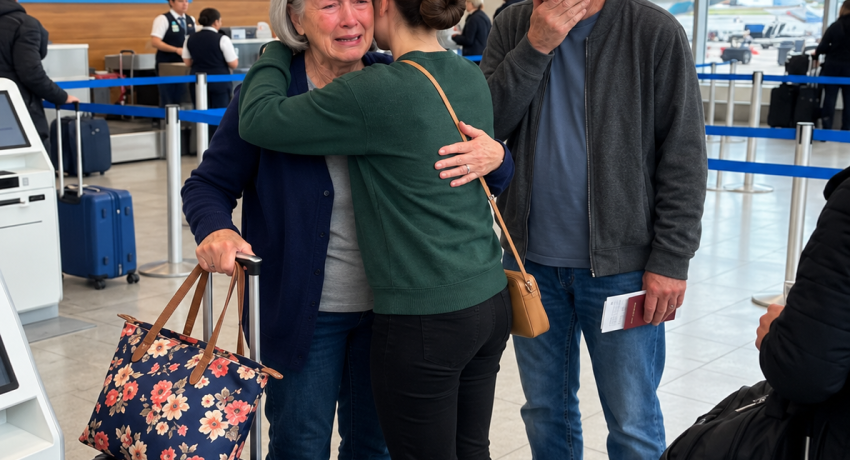
On the morning of their departure, Grandma stood beside her old green suitcase, holding its handle firmly with both hands. She was dressed carefully for the journey and wore the pearl necklace Grandpa had given her for their anniversary. Her white hair had been styled exactly the way she liked it for important occasions.
I picked her up that morning and drove her to the airport to meet the others. I noticed her checking her passport three different times and realized I couldn’t remember the last time I’d seen her this excited.
We located my parents, Aunt Monica, and my two cousins near the airline’s check-in counters. Everyone seemed strangely rushed, focusing on their luggage and travel documents while avoiding the kind of cheerful conversation I would normally expect from relatives about to embark on such a special trip.
Their behavior struck me as unusual, but I brushed the feeling aside. People often overlook little inconsistencies instead of investigating every detail.
The airline agent checked twice for Grandma’s reservation before looking up. Her expression became carefully neutral, the professional look employees adopt when they know they’re about to deliver disappointing news.
“I’m very sorry, ma’am. I’m unable to find a booking under Hazel Carter.”
Grandma turned to my father, still wearing her trusting smile.
“Richard, do you have my ticket?”
He didn’t reach for his phone or even glance at the paperwork Aunt Monica was clutching tightly.
Instead, he let out an irritated sigh, acting as though Grandma had inconvenienced him by asking a perfectly ordinary question.
“I forgot to book your ticket,” he said. “You’ll have to go home.”
The airline agent froze, her hands suspended above the keyboard.
My mother immediately lowered her attention to her phone.
Aunt Monica examined the departure board over Grandma’s shoulder, making a deliberate effort not to look at her.
My cousins stared down at the floor as though their lives depended on avoiding any uncomfortable questions.
Not one of them looked surprised. That alone told me everything.
Grandma tightened her grip on the suitcase handle.
Her shoulders trembled briefly, an unusual reaction from someone like her. Then she composed herself and managed a small, brave smile that broke my heart.
“That’s all right,” she whispered. “Please don’t miss your flight because of me.”
Aunt Monica finally faced her, and for one foolish moment, I thought she might offer an explanation or suggest a solution.
Instead, she said, “Please don’t make a scene, Mom. Richard has already explained that your reservation was forgotten.”
Grandma had paid for their entire vacation, yet my aunt was scolding her for being left behind.
My father reached for my carry-on bag and began walking toward security.
“Come on. The security lines are going to be awful.”
I pulled my luggage out of his reach.
“I’m staying here with Grandma.”
His face immediately hardened with the familiar annoyance he showed whenever someone refused to follow his expectations.
“Don’t be unreasonable.”
“Then buy her a ticket.”
“There aren’t any seats left.”
The airline representative, who had been quietly watching the exchange, spoke in a gentle voice.
“Actually, there are still eleven seats available on this flight.”
My father pressed his lips tightly together.
Aunt Monica came over and spoke to me in a lowered voice, trying to make her suggestion sound reasonable.
“Grandma is exhausted. Take her home, then fly to Rome tomorrow and meet us there.”
Even then, she couldn’t look me in the eye.
I picked up Grandma’s green suitcase and walked away beside her, leaving our relatives behind to enjoy a European vacation paid for entirely by the very woman they had deliberately excluded.
Not one of them called out to us.
During the drive home, Grandma watched the scenery slip past the windows, her hands resting quietly together in her lap.
She didn’t demand an explanation or ask anyone to return her money.
After a long silence, she finally spoke in a quiet voice.
“I suppose I should have known that such a sudden display of kindness came with a hidden cost.”
For the next three weeks, we established a calm routine together.
I moved a few belongings into her spare bedroom, telling myself that the arrangement would only be temporary, and informed my landlord that I would be staying with family.
Every morning, we sat together at the kitchen table drinking tea, the same table where she and Grandpa had once kept the records for their business.
Grandma spent time caring for her roses while I canceled my hotel bookings and ignored my father’s increasingly angry messages. He accused me of ruining the vacation, taking sides, and creating needless tension within the family.
Then a travel advertisement arrived, apparently sent by a marketing company that had obtained Grandma’s information through the original booking arrangements.
Its glossy cover featured the Eiffel Tower beneath the words Paris in Spring.
Grandma folded the brochure neatly and placed it on the table without saying anything.
When I looked at her, I saw tears quietly rolling down her cheeks.
Later that afternoon, she took a small metal box from the back of her bedroom closet. It had been tucked behind several neatly folded quilts.
Inside were documents I had never seen before: Grandpa’s death certificate, the property deed for the building where my father’s business operated, old trust documents, and a sealed yellow envelope bearing a sentence written in Grandpa’s familiar slanted handwriting.
Hazel, if our children ever pressure you over money or paperwork, contact Elias Grant.
She handed me the envelope without opening it, her fingers trembling slightly.
“I think it’s time,” she said.
Elias Grant had handled Grandpa’s estate arrangements. Even before Grandma explained everything, I was beginning to understand why my father had avoided mentioning him for so many years.
Twelve years earlier, Mr. Grant had clearly explained to my father and Aunt Monica, with witnesses present, that Grandma’s assets were protected by a family trust. He had also warned them that beneficiaries who deceived, intimidated, or financially exploited her could permanently forfeit their interests under the trust’s provisions.
Grandma had never asked anyone to enforce those protections.
That was about to change.
That evening, I called the number written on the envelope.
Mr. Grant came to see us the following morning, carrying a gray folder. He was a tall, composed man in his seventies whose quiet demeanor suggested decades of handling inheritance disputes and discovering just how many forms family conflicts over money could take.
He listened carefully while Grandma described the European vacation, her $30,000 contribution, and the humiliating experience at the airport.
Sitting at the kitchen table, she recounted everything in a straightforward manner.
When she finished, he asked just one question.
“Hazel, did anyone ever give you an airline ticket issued in your name?”
She slowly shook her head.
With her written authorization, he contacted her bank, the travel company, and the independent trustee named in Grandpa’s documents.
Within a week, the facts became clear.
No one had ever purchased a ticket for Grandma.
Her money had paid for six premium airline seats instead of seven, upgrades to expensive hotel accommodations, private transportation, and payments toward Aunt Monica’s growing credit card debt.
Then Mr. Grant uncovered something even more disturbing.
Every photograph reminded me of Grandma’s disappointment, although I doubt they were intentionally trying to hurt us.
More likely, we barely crossed their minds.
My father sent Grandma a picture that appeared to have been taken at a rooftop restaurant, with a wineglass visible near the edge of the frame.
His message said: Hope you’ve settled down. We’ll discuss your behavior when we get home.
Grandma read it once, her expression giving nothing away, and then handed me her phone.
“Save a copy,” she told me.
I took a screenshot that clearly showed the timestamp, with a feeling that it might matter later.
When their flight finally landed, I waited beside the arrivals exit with Mr. Grant, his gray folder resting against his leg.
My father came out first, laughing at something on his phone. He looked relaxed and cheerful, which somehow made the sight even more disturbing.
My mother followed, carrying shopping bags in both arms.
Aunt Monica was showing my cousins a video from their trip, and all three were laughing together.
Then they spotted us.
My father’s smile vanished. My mother tightened her hold on the bags.
Aunt Monica stopped so suddenly that another traveler accidentally bumped into her suitcase and apologized, but she appeared too distracted to respond.
Mr. Grant walked over calmly and placed his gray folder on top of my father’s rolling suitcase.
“Richard,” he began, “before we go any further, explain why your mother’s thirty thousand dollars paid for six airline tickets instead of seven.”
My father glanced around the crowded arrivals hall, apparently still worried about what the strangers nearby might think of him.
“This is a private family matter.”
“That is no longer entirely the case.”
Mr. Grant opened the folder.
The heading printed across the first page was one my father hadn’t seen in twelve years.
NOTICE OF REMOVAL AS BENEFICIARY.
For several seconds, nobody moved.
All around us, the airport continued operating as usual. Suitcase wheels rolled across the polished floor, children laughed near the baggage claim, and muffled announcements echoed overhead.
Yet my father stood completely still, staring at those printed words.
He swallowed before lifting his gaze toward Mr. Grant.
“You have no authority to issue that.”
Mr. Grant remained calm.
“No final action has been taken.”
My father frowned.
“Then put those documents away.”
“I won’t.”
His quiet refusal carried more weight than an angry confrontation would have.
My mother stepped closer and finally spoke.
“Mr. Grant, surely this isn’t necessary. Hazel is upset right now. She might not understand the documents you’re talking about.”
I almost laughed.
Grandma wasn’t even there.
She had stayed home after explaining several days earlier that she wanted no contact with them until she could understand every transaction and decision without hearing selective explanations intended to excuse their behavior.
Mr. Grant looked directly at my mother.
“Hazel hasn’t signed any document of that kind.”
She appeared confused.
“Then what are you doing here?”
“She asked me to help protect her interests.”
Aunt Monica visibly lost color and turned toward my father.
“Richard—”
He cut her off immediately.
“Enough.”
Then he faced Mr. Grant again, his voice filled with unmistakable bitterness.
“You’ve never liked anyone in this family.”
Mr. Grant carefully closed the folder.
“I have never disliked your family.”
He paused briefly before continuing.
“I simply refused to let anyone confuse a potential inheritance with property they already possessed.”
My father clenched his jaw.
“What exactly are you accusing me of doing?”
Mr. Grant reopened the folder and carefully pulled apart several pages.
“There are concerns regarding possible financial exploitation.”
My mother’s shoulders appeared to slump.
Aunt Monica immediately objected.
“That is absolutely absurd.”
“Then let’s review the records.”
He took out several bank statements.
“The first transfer from Hazel’s account took place three months earlier.”
My father examined the papers without saying anything.
“Another transfer followed four weeks later.”
He placed a second statement beside the first.
“A third transaction occurred two weeks after that.”
Aunt Monica leaned forward, her voice growing more anxious.
“What transfers?”
“Bank transactions.”
My father looked toward her. She met his gaze.
Neither of them had an explanation.
Mr. Grant continued in an even tone.
“Over the previous eleven months, eighty-seven thousand four hundred dollars was transferred from Hazel’s accounts into accounts linked to several members of this family.”
My stomach tightened as I took in the figure.
Eighty-seven thousand dollars.
All at once, the $30,000 vacation payment seemed like just one visible piece of a much larger financial problem.
My father shook his head.
“She gave us that money.”
“That’s not what the available records show,” Mr. Grant replied calmly.
“These transactions weren’t documented as gifts.”
He presented another statement.
“Three of the payments were listed as medical expenses.”
My mother crossed her arms.
“She did have medical expenses.”
“Not for these particular transactions.”
He handed her the documents.
“The hospital confirmed that Hazel had no appointments or treatments recorded on those dates.”
My mother went completely still.
Aunt Monica muttered, “Maybe there was a bookkeeping mistake.”
“The bank records show no indication of an error.”
Mr. Grant turned toward her.
“They identify transactions initiated through your access.”
She opened her mouth, struggling to respond.
“I didn’t—”
“You accessed Hazel’s online banking account.”
“She gave me permission to help her.”
“Did that permission include paying your household utility bills?”
Aunt Monica lost the last of her composure.
Mr. Grant placed another document beside the others.
“Your credit card payments.”
Then he added another.
“The deposit for your Paris hotel reservation.”
Another followed.
“The upgraded airline tickets.”
My father suddenly reached toward the folder, but Mr. Grant calmly moved it out of his reach.
“Please leave the documents where they are.”
“This is confidential information.”
“These are Hazel’s financial records.”
My father’s voice rose, drawing the attention of nearby travelers.
“You cannot stand here and accuse me publicly in front of my children.”
I finally stepped forward. After weeks of watching Grandma suffer the consequences, I could no longer remain silent.
“You were the one who humiliated Grandma in public first.”
He turned toward me, looking genuinely astonished that I had spoken up.
“What did you just say?”
“You told her to leave the airport.”
His brow furrowed.
“You don’t know the entire situation.”
“I was there. I heard everything.”
“You misunderstood what happened.”
“No, I didn’t.”
I held his gaze, surprised by how calm and steady my voice sounded.
“I was the only person willing to acknowledge what was happening.”
My mother called my name softly, her voice pleading with me to stop.
I kept looking at my father.
He studied me for several seconds before lowering his voice to an unsettling whisper.
“You have no idea what you’ve set in motion.”
Despite everything, I almost smiled.
“For once, Dad, I think I understand exactly what I’m doing.”
Mr. Grant turned to another page.
“There is one more matter.”
My father stiffened.
“What matter?”
“Your mother wasn’t simply deprived of thirty thousand dollars.”
He removed a copy of the trust agreement, briefly held it up, and then placed it on the suitcase.
“There were also circumstances that could have jeopardized her control over the property occupied by your business.”
The atmosphere grew even heavier.
My father stared at the document.
“What is that supposed to mean?”
Mr. Grant pointed to a paragraph near the beginning.
“Walter transferred ownership of this building into Hazel’s trust before he passed away.”
My father immediately rejected the claim.
“That can’t be possible.”
“It is documented.”
“I’ve been running my company out of that property for twelve years.”
“Operating a business in a building does not make you its legal owner.”
My father turned to look at me, and for the first time in my twenty-six years, I saw genuine fear in his eyes.
I had seen him angry and humiliated on numerous occasions, but I had never witnessed such obvious uncertainty.
Mr. Grant continued speaking in his usual composed manner.
“The trust authorized your company to use the premises as long as the applicable conditions continued to be met.”
My father asked in an almost inaudible voice.
“What conditions?”
“That Hazel must not be subjected to undue pressure, intentional deception, or financial exploitation.”
Aunt Monica lifted a hand to her mouth.
“Oh, my goodness.”
Mr. Grant gave a slight nod.
“Exactly.”
My father lowered his gaze.
I recalled Grandma explaining how she and Grandpa had built their business from virtually nothing, dedicating forty years of hard work to what had always been a joint accomplishment.
After Grandpa passed away, my father took charge of the company’s everyday operations, and everyone simply assumed, without checking the facts, that ownership had automatically passed to him.
Apparently, that long-held family belief had never matched the actual legal arrangements.
Mr. Grant chose the final sheet.
“Walter made his intentions very clear when preparing his estate plan.”
My father lifted his head, suddenly looking worried.
“What intentions?”
Mr. Grant read the passage carefully, giving everyone time to understand the meaning of its words.
“Any beneficiary who attempts to obtain trust property through undue pressure, deception, unauthorized financial dealings, or exploitation may be disqualified under the terms of the trust.”
My father stared at him, his face expressionless.
My mother grabbed his sleeve.
“Richard.”
He pulled away.
“No.”
Mr. Grant calmly shut the folder.
“The relevant protective clause was put in place twelve years ago.”
My father kept staring at him.
“Have you been arranging this from the beginning?”
“No,” Mr. Grant answered, his tone still composed.
“I genuinely hoped these safeguards would never have to be used.”
For several moments, nobody spoke.
Then Aunt Monica began to cry. As I watched her, I realized that her distress seemed to have less to do with what Grandma had endured and more to do with the possible consequences for her own financial future.
“Does this apply to me, too?”
Mr. Grant responded evenly.
“You are listed as a beneficiary.”
She covered her mouth with her hand.
“If my interest is revoked—”
“Any affected inheritance would be distributed in accordance with the trust’s provisions.”
“Who would get it?”
Mr. Grant looked in my direction, and an unexpected weight settled in my stomach.
“That depends on Hazel, the trustee, and the governing documents,” he replied.
My father let out a brief, bitter laugh that sounded completely out of place amid the commotion of the airport.
“You honestly think this is going to work?”
Mr. Grant paused briefly before responding.
My father stepped closer to him.
“You believe one disastrous vacation gives you the authority to put my entire business at risk?”
“No.”
Mr. Grant held his gaze firmly.
“This situation involves much more than the vacation.”
He laid another document on the suitcase.
“The trip simply produced unusually clear written evidence of a much broader pattern.”
My father looked down. The document was a bank statement with one entry highlighted in yellow. It recorded a $12,500 transfer to Richard Carter, described as: Home Repair — Hazel.
Something in my father’s expression appeared to crumble.
Mr. Grant continued. “We found eleven similar transactions.”
My father said nothing.
“Several of the payments were deposited into business accounts.”
He presented more records.
“Others were transferred into your personal account.”
He placed additional statements beside them.
“Some were used to pay expenses that had nothing to do with your mother’s needs.”
My mother gradually stepped away from him.
“Richard—”
He turned to face her.
“Please, stop.”
She looked at him, tears gathering in her eyes.
“Did you know about this?”
He said nothing.
“Richard, did you know?” she asked again, her voice cracking.
Once more, he remained silent.
Aunt Monica suddenly spoke much louder, no longer able to contain herself.
“Of course he knew!”
Throughout the peaceful weeks Grandma and I had spent together, she had never mentioned that she was considering such a step.
Mr. Grant nodded thoughtfully. “She had been considering that possibility.”
My father let out another bitter laugh.
“Do you understand now?”
“No.” Mr. Grant shook his head. “What I understand is that you acted as though your mother’s future inheritance already belonged to you.”
My father’s face turned red.
“She told me it would be mine.”
“Your mother never made any legally binding promise of that kind.”
For a brief moment, the entire airport seemed unusually quiet, despite the constant movement and noise surrounding us.
Mr. Grant collected his paperwork.
“The independent trustee plans to initiate the formal proceedings tomorrow morning.”
My father stepped toward him, displaying a level of desperation I had never seen from him before.
“You’re stripping everything away from me.”
Mr. Grant replied softly, without the slightest trace of satisfaction.
“No, Richard.”
He looked toward the terminal doors.
“You’re facing the consequences of your own decisions.”
Then he headed for the exit. I followed him, feeling strangely unsteady on my feet.
Behind us, my mother was crying as Aunt Monica and my father argued with growing frustration, their voices merging into a jumble of words I could barely make out.
But one sentence came through clearly, and I would remember it for years.
“You promised me Mom would never find out about any of this.”
I continued walking.
For the first time, I stopped believing that fixing every problem my relatives created was my responsibility.
Instead, I went home.
When I arrived, Grandma was sitting in her favorite armchair by the window, resting as the gentle late-afternoon sunlight fell across her knees.
She looked up when I came inside.
“Were they angry?”
“Very.”
She nodded slowly.
“That makes sense.”
I sat down in the chair beside her.
“Grandma…”
She reached over and took my hand, cradling it gently between both of hers.
“I understand.”
“What do you understand?”
“I understand what happened.”
She looked through the window at the roses glowing in the fading sunlight.
“Your grandfather tried to prepare me for this.”
“Why didn’t you tell me earlier?”
“Because I wanted to believe my own children would never give me a reason to protect myself against them.”
Her voice trembled a little.
“I wanted that belief to be true.”
I squeezed her hand more firmly.
“What happens now?”
She studied me for a moment before giving me a faint smile.
“Now?”
She gently pressed my fingers.
“Now they learn that being family never gives anyone the right to take what belongs to someone else.”
The next morning, Grandma and I went to Mr. Grant’s office.
There were no heated arguments, raised voices, or reporters gathered outside.
Instead, we found stacks of paperwork carefully arranged across a large conference table.
The independent trustee, a calm and composed man named Walter Kim, sat at the head of the table and explained that an immediate review would begin.
His job was to manage the trust according to the detailed terms Grandpa had established twelve years earlier. Those provisions now demanded considerably more attention than anyone had expected when they were first created.
Grandma listened quietly without interrupting.
Eventually, she asked the question that had evidently been troubling her since the airport incident.
“Could they end up in prison?”
Mr. Kim looked toward Mr. Grant, who answered in an even voice.
“That will depend on the evidence and on any decisions made by the appropriate authorities.”
Grandma nodded, her expression unchanged.
She showed no pleasure at the possibility.
She simply looked worn out, like a seventy-nine-year-old woman who had spent her life building a family and was now discovering that some of her deepest beliefs about the people she loved had been painfully wrong.
“I don’t want to punish anyone because I’m angry,” she said.
Mr. Grant folded his hands together.
“Then what would you like to see happen?”
Grandma glanced at me briefly before turning her attention to the office window.
“I want to know the truth.”
There was nothing else she needed to say.
The financial investigation proceeded through routine, methodical steps, far removed from the dramatic inquiries and courtroom clashes so often shown on television.
The bank provided transaction records reaching much further back than the eleven-month period Mr. Grant had initially identified.
The travel agency supplied booking records showing that six rooms, never seven, had been reserved at every hotel on the European itinerary.
Credit card statements revealed spending patterns that showed, one transaction at a time, how funds had gradually flowed from Grandma’s accounts toward expenses that benefited my father and aunt.
The airline also issued written confirmation that Hazel Carter had never been booked on that departure or on any of its associated connecting flights.
The hotel in Paris confirmed that six rooms had been reserved through my father’s business account.
Six rooms, not seven.
The private transportation company had received its payment weeks before the trip began.
Three restaurant reservations in three separate cities had also been made well in advance.
After examining the expenses, investigators determined that every major payment could be traced, either directly or indirectly, to money that had originated in Grandma’s accounts.
Then another discovery came to light, one that altered our understanding of the entire situation. Perhaps, however, it simply confirmed a possibility none of us had been willing to fully accept.
Three days before the departure, Aunt Monica had sent my father an email.
The subject line was short: Mom — don’t let her come.
The message contained only a handful of sentences.
If she comes with us, she’ll start asking questions. Richard, just tell her that her ticket got misplaced. She’ll feel awkward and go back home.
My father replied later that evening with two words.
Already arranged.
Investigators retained the exchange as part of the supporting evidence.
However, they also uncovered an older email my father had sent directly to my mother approximately six months earlier, well before the transactions we had first investigated.
Once Mom gets used to helping us financially, she’ll probably stop asking questions.
My mother’s reply contained just three words.
I hope so.
Grandma reviewed both messages while sitting at Mr. Grant’s conference table, her reading glasses resting low on her nose.
She remained remarkably calm.
More than almost anything else that happened during those painful weeks, her quiet response astonished me.
She closed her eyes for a few moments without saying a word.
At last, she murmured, “I loved those children.”
Mr. Grant nodded with understanding.
“I know.”
“I raised them myself.”
“I understand.”
“They were once my little babies.”
“I know.”
At last, she opened her eyes.
“And they chose to do this anyway.”
Nobody tried to respond because there was nothing anyone could say that would make the situation better.
Three weeks later, a formal hearing concerning the trust was held.
My father arrived with his own attorney, a younger man who appeared more uncomfortable with every passing moment, as though he had only recently grasped the full extent of the case he had agreed to represent.
Aunt Monica arrived by herself, dressed in unusually plain clothes instead of her usual elegant outfits.
My mother did not attend at all.
My cousins sat toward the back of the room. They were sixteen and nineteen, old enough to comprehend much of what was happening, yet young enough that I still felt sorry for them.
I sat beside Grandma.
The trustee reviewed the evidence in an orderly manner.
The disputed transfers. The deceptive descriptions attached to medical expenses. The credit card charges. The vacation reservations.
The questionable explanations Aunt Monica had apparently provided to account for several significant withdrawals.
The emails.
The original incident at the airport, supported by the available security footage supplied by the airline.
Every relevant piece of evidence was presented during a hearing that lasted almost two hours.
Once the review was complete, the trustee invited Grandma to speak.
She stood slowly, placing one hand on the table for support, and looked straight at my father.
For a moment, I thought her emotions might get the better of her.
Instead, she spoke with remarkable calmness.
“Richard, I’m not asking you to apologize again.”
My father lowered his eyes.
“I don’t need you to tell me that you misunderstood something.”
He remained quiet.
“And I don’t want to hear that you desperately needed the money.”
He said nothing.
“I only want to know why.”
At last, my father lifted his head, tears glistening in his eyes.
“Because I thought you would forgive me regardless of what I did.”
Grandma watched him in silence.
His voice shook as he continued.
“You always forgave me in the past.”
She slowly nodded.
“Maybe I made it too easy for you.”
My father could no longer hold himself together.
“Mom—”
She raised one hand, and he immediately fell silent.
“You cannot expect me to act like your loving mother whenever you need compassion, then treat me as nothing but a source of money whenever it benefits you.”
His eyes filled with more tears.
“What I did was wrong.”
“Yes.”
“I was selfish.”
“Yes.”
“I was scared.”
Grandma looked directly at him.
“What were you afraid of?”
He swallowed hard before answering.
“Ending up with nothing.”
For the first time during the hearing, Grandma’s expression grew a little softer.
“But you already had something precious.”
She paused briefly.
“You had a mother who loved you deeply.”
Silence settled over the room.
“You had people who cared about you.”
She took a slow breath.
“And you put those relationships at risk for money you never truly needed.”
My father began sobbing openly at the table.
Grandma did not move toward him or try to comfort him.
She simply returned to her chair, folded her hands in her lap, and quietly waited for the trustee to conclude the proceedings.
The decision came soon afterward.
Under the relevant provisions of the trust, my father and Aunt Monica would be removed as beneficiaries.
Their anticipated inheritance would be distributed under revised arrangements that Grandma planned to complete with Mr. Grant over the next several weeks.
The building housing my father’s manufacturing company would remain the property of the trust, while his continued occupation of the premises would be examined through a separate administrative review.
The disputed transfers would be handled through the appropriate procedures to recover the funds.
Grandma would also retain complete, independent control over her remaining assets and finances, free from the pressure and deceptive arrangements that had increasingly surrounded her during the previous year.
My father continued gazing at the table long after the trustee had finished speaking.
Aunt Monica silently dabbed at her tears beside her lawyer.
Then my father asked a question that altered the atmosphere in the room more than anything else that afternoon.
“Mom, does this mean we’ll be shut out of your life forever?”
Grandma thought about his question for several moments.
“I haven’t made that decision.”
He raised his head, a small glimmer of hope appearing in his eyes.
She continued in a thoughtful voice.
“That depends on how you act when you realize you shouldn’t expect anything from me financially.”
Nobody spoke.
“What if I genuinely change?”
Grandma’s tone softened slightly.
“Then we’ll see.”
The hearing ended shortly afterward.
Outside, the sky had turned cloudy, with dull gray clouds hanging overhead on an afternoon that seemed uncertain whether it would rain.
As we neared the courthouse steps, my father approached Grandma.
I stayed several feet behind them.
He looked older than he had at the airport, his shoulders weighed down by a heaviness I had never noticed before these events.
“Would you allow me to walk with you to the car?”
Grandma paused, then eventually agreed with a nod.
They slowly crossed the parking lot, while I followed at a distance to give them some privacy.
When they reached the vehicle, my father stopped.
“Mom.”
She turned to face him.
“I’m genuinely sorry.”
She examined his expression.
“I believe you mean that.”
He seemed taken aback.
“Does that mean you forgive me?”
Grandma gently shook her head.
“Forgiveness takes time.”
He nodded, accepting her answer.
“I understand.”
He stepped aside as Grandma settled into the passenger seat.
Before closing the door, she turned to him once more.
“Richard.”
“Yes, Mom?”
“Never put your children in a situation where loving you requires them to ignore what they know is right.”
He lowered his eyes, and Grandma quietly shut the door.
Over the following months, our lives slowly adapted to the changes, as families often have to do after a serious betrayal of trust.
The financial investigation eventually recovered a considerable amount of the missing money, although some of it remained unrecovered.
Some funds had already been spent, others had gone toward outstanding debts, and several transactions were too complicated to reverse entirely.
In time, Grandma stopped focusing on the exact amount of money involved.
One evening, as we sat at her kitchen table with our cups of tea untouched, she said to me, “For twelve years, I worried about what my children would inherit after I was gone.”
She looked around her kitchen, at the rose bushes outside the window, and at the small metal box that now sat openly on a shelf instead of being tucked beneath old quilts.
“Lately, I’ve been thinking more about the legacy I want to leave behind.”
I asked her what she meant.
She smiled sincerely.
“I’m making changes to the trust.”
I immediately realized that she had reached a decision.
In the end, she chose not to give her entire estate to charity, although she had considered doing so earlier.
She also decided against leaving everything to me, despite the possibility I had privately considered after Mr. Grant’s comments at the airport.
Instead, she created an educational scholarship in Grandpa’s honor, specifically for students studying mechanical engineering, the field that had defined his professional life.
She set aside funds for the education of every grandchild, including my cousins and me, ensuring that their parents’ decisions would not dictate the opportunities available to them.
She also established a small assistance fund for older adults who experienced financial exploitation by family members, working with a local nonprofit to ensure the money was managed responsibly.
Above all, she kept enough money to enjoy her own life.
Enough to travel whenever she wanted, care for her cherished garden, and make her own choices without needing anyone’s permission.
Almost a year after the incident at the airport, a handwritten letter arrived from my father on a clear spring morning.
Grandma opened it at the kitchen table while I sat opposite her, having forgotten all about my coffee as it grew cold.
He wrote that he had sold the expensive car he had once been so proud to show off.
He had moved into a modest apartment and started making repayments, working with an accountant to resolve the financial problems he had created for Grandma and, unexpectedly, for his own company.
Apparently, the business had accumulated far more debt than we had realized while he was diverting money toward expenses that had nothing to do with its operations.
He did not ask for financial help or demand immediate forgiveness.
Toward the end, he simply wrote, I’m trying to become someone you may eventually be able to trust again.
Grandma carefully folded the letter and sat quietly for a long time.
Then she stood, walked over to the shelf, and placed it inside the familiar metal box beside Grandpa’s papers, the yellow envelope, and the other important items she had chosen to keep.
I asked her why she wanted to store his letter there.
She gave me a gentle smile.
“Because genuine progress deserves to be remembered, too.”
A few weeks later, Aunt Monica sent a letter of her own, considerably shorter than my father’s.
Her apology was direct and contained very few excuses.
She admitted that she had convinced herself Grandma would never discover the missing money.
She acknowledged that jealousy over my father’s business success, disappointment with her own failed ventures, and an unchecked sense of entitlement had gradually shaped her choices until she barely recognized the person she had become.
Grandma read the letter twice, sitting quietly at the kitchen table.
Several months later, she eventually forgave Monica, doing so at a time and in a way that felt right to her.
However, forgiving Monica did not mean giving her access to the trust again.
Throughout the following year, Grandma often reminded me that these were two entirely different things.
“Forgiveness allows a painful experience to begin healing,” she would explain. “It doesn’t mean giving up the boundaries that protect you.”
During that first year, my cousins began visiting from time to time, initially appearing hesitant and visibly embarrassed by what their parents had done.
They had been either too young or too sheltered to fully understand the events when everything first happened.
Gradually, they began asking meaningful questions. They wanted to know why the adults had allowed things to continue and why so many family members had stayed quiet at the airport instead of speaking up.
Grandma never blamed them for what had happened.
Instead, she offered them kind but serious guidance.
“Never believe something is acceptable simply because everyone around you decides to stay silent.”
I thought about those words again and again, especially whenever I remembered the airport and how deliberately everyone had avoided looking at Grandma.
My mother, my aunt, and even my younger cousins had turned their eyes away.
Somewhere inside, they knew something was wrong, but nobody wanted to be the first to admit it aloud.
I had made the choice to stay by her side.
In the end, that one simple decision was what set my response apart from everyone else’s at the check-in desk.
Almost exactly a year after that incident, Grandma decided she wanted to return to the airport.
She had no intention of traveling with my father or making a statement about what had happened in the past.
She simply wanted to take a vacation, planned entirely on her own terms.
She chose the same lovely pearl earrings Grandpa had given her decades before.
This time, though, she brought a new blue suitcase, having finally replaced the old green one after nearly forty years of faithful service.
At the airline counter, the employee greeted her warmly.
“Good morning, Ms. Carter. Could I see your passport, please?”
Grandma handed it over with confidence.
The representative spent a few moments checking the computer before smiling.
“Your booking is fully confirmed.”
Grandma glanced at me, as I had insisted on accompanying her to the airport to make sure she departed comfortably.
“Is everything arranged?”
“Everything is ready,” the employee assured her.
Grandma burst into a cheerful laugh, displaying a warmth and happiness I hadn’t heard in years, perhaps not since Grandpa was still alive.
As we neared the security checkpoint, she suddenly stopped.
“Just a moment.”
I turned to look at her.
She reached into her handbag, and for one worried second, I thought she might have forgotten an important travel document.
Instead, she pulled out a small, familiar yellow envelope, the very same one Grandpa had prepared twelve years earlier, which had eventually helped us uncover the truth.
She placed it in my palm.
“I want you to hold on to this.”
I opened it carefully.
Inside was a copy of Grandpa’s original note, his unmistakable slanted handwriting still perfectly recognizable.
Hazel, if our children ever pressure you about money or paperwork, get in touch with Elias Grant.
Below those words, Grandma had added a sentence in her own handwriting.
Sometimes the people who let us down the most are the very ones we have spent our entire lives trying to protect.
Underneath, she had written one more thought.
Protecting yourself does not mean you have stopped loving them.
I looked up at her.
“Are you sure you want me to keep this?”
She nodded.
“Your grandfather left me that warning because he wanted me to be prepared.”
She smiled, briefly touching her pearl earrings.
“I’m giving you something I hope you’ll always remember.”
We walked through the terminal together, and a quiet sense of relief washed over me as I watched her move ahead confidently, her blue suitcase rolling smoothly beside her.
Behind us, the airport entrance doors continued to open and close, just as they did every day.
Passengers hurried toward their departure gates. Families and friends embraced near the arrivals area.
Small children dragged their suitcases behind exhausted parents.
Announcements echoed indistinctly throughout the terminal.
As I stood watching Grandma approach her gate with renewed confidence, I finally understood what that painful experience a year earlier had ultimately taught her.
It had not completely taken her family away.
Instead, it had shown her, more clearly than any easier experience could have, which relationships were built on genuine love and concern.
When we arrived at the boarding area, Grandma sat down beside the window, the sunlight falling gently across her face.
She looked entirely at peace.
I asked her where she had decided to travel first.
She thought about it for a moment, her fingers resting near her pearl earrings.
“Paris.”
I smiled at her.
“Are you absolutely sure?”
She lightly touched the pearls once more.
“Your grandfather always dreamed of taking me there.”
Then she turned to me, her eyes shining with quiet determination.
“And this time, I’ve booked my own ticket.”
I laughed, and Grandma laughed along with me. Her laughter sounded more genuine and carefree than anything I had heard from her in a very long time.
A short while later, the announcement for her flight came.
Grandma stood up, picked up her own suitcase without waiting for anyone to help, and we walked together toward the boarding entrance.
This time, nobody intended to leave her behind. Nobody was using her money to control her choices. Nobody was standing in the way of the independent life she had worked so hard for over so many years.
For the first time in longer than I could remember, Grandma Hazel was no longer simply a mother expected to give endlessly while receiving little appreciation in return.
She was no longer someone whose worth was measured by the inheritance others expected to receive.
And she was certainly no longer just a convenient source of money.
She was Hazel, a seventy-nine-year-old woman who had finally realized that loving people wholeheartedly did not mean neglecting her own needs or tolerating treatment that stripped away her dignity.
As she prepared to board, she turned back one last time and gave me a warm smile from the gate.
I smiled back.
Then she continued toward the plane.
And this time, nobody asked her to go home.









