
 152 views
My name is Jacob. I’m twenty-nine, and last year everything in my life changed when my parents passed away and left me the family ranch.
Eighty acres of rolling hills.
A farmhouse that had belonged to our family for three generations.
Pastures.
Fences my father had repaired more times than I could possibly count.
To anyone else, it was property valued at roughly $1.2 million.
To me, it was the last tangible piece of my parents I still had.
I had grown up there.
I learned to ride a horse before I learned to ride a bicycle.
I could still hear my father’s boots moving across the wooden porch early each morning.
I could still picture my mother standing at the kitchen window, gazing across the pasture as if she could somehow see years ahead.
What I hadn’t expected was how quickly grief would become a family conflict.
My older sister, Clare, was three years ahead of me and had always been completely different.
She was a lawyer.
Confident.
Ambitious.
Used to getting what she wanted.
She had moved to the city years before and rarely came to the ranch except during holidays or for the occasional weekend.
I had stayed.
I worked beside Dad.
I repaired fences.
Handled maintenance.
Helped keep the property running as his health gradually began to decline.
When the will was read and the ranch was left entirely to me, Clare congratulated me.
But her smile felt forced.
Then the comments began.
“You definitely got the golden ticket.”
“Must be nice getting the property worth more than everything else.”
One evening at dinner, she laughed and said,
“Well, Jacob needs somewhere to live.”
Everyone laughed.
I didn’t.
Still, I tried not to read too much into it.
Then Clare started showing up at the ranch more frequently.
At first, she claimed she was checking on me.
Before long, she was rearranging furniture.
Talking about which rooms needed renovations.
Suggesting that I rent out parts of the property.
One afternoon, she brought her fiancé and casually mentioned where they could put a nursery “if we ever lived here.”
I laughed.
But something about the way she said it unsettled me.
Suddenly, the ranch felt less like my home and more like a board game where someone else had already begun moving the pieces.
Two weeks later, Clare showed up carrying a stack of papers.
“Routine estate paperwork,” she said.
She set them down on my kitchen table.
I started reading.
Transfer agreements.
Title changes.
Wording that seemed much more serious than she wanted me to think.
I refused to sign anything.
That night, I called a friend who worked in real-estate law.
By the end of the week, I had taken formal steps to place the ranch into an LLC under my control.
I didn’t want to believe I needed legal protection from my own sister.
But something told me I would be grateful later.
I was.
About a month later, Clare came back.
This time, she brought an attorney.
She barely acknowledged me.
“The deed is in my name now,” she announced. “You should start packing.”
I was sitting in Dad’s old chair.
I leaned back and looked at her.
“Good luck with that.”
Her eyes narrowed.
Two days later, she came back with movers.
But as soon as they reached the gate, they were met with legal paperwork proving that the situation was nowhere near as simple as Clare had claimed.
Her smile vanished.
She turned around, instructed the movers to leave, and drove away.
I immediately knew the conflict wasn’t over.
If anything, I had only made her even more determined.
For the next week, she disappeared.
No calls.
No texts.
No unexpected visits.
The silence made me more uneasy than her arguments ever had.
Then one morning, I discovered a letter in my mailbox addressed to “Tenant.”
It claimed that the property owner was raising my rent by sixty percent.
There was one obvious problem.
I didn’t pay rent.
I owned the ranch.
I called the number listed on the notice.
Clare answered.
“Just a misunderstanding,” she said casually.
Then she added,
“You really should start considering your options, Jake. Managing that place on your own isn’t sustainable.”
I hung up.
After that, she began showing up with her fiancé.
They walked around taking photographs.
One time, I caught them measuring my kitchen counters.
“What are you doing?”
Clare rolled her eyes.
“Relax. We’re just curious.”
I wanted to throw them off the property.
Instead, I followed my lawyer friend’s advice.
Document everything.
Dates.
Times.
Messages.
Visits.
Every strange letter.
Every conversation I could remember.
“You don’t win property disputes by yelling louder,” he told me. “You win with records.”
So I began keeping a journal.
Then one Saturday, while I was repairing fencing near the back pasture, I heard voices coming from the barn.
Clare was there with two men in suits.
I stayed hidden long enough to hear her say,
“Once we get control of the property, we could sell it for several times what it’s worth now.”
That sentence told me everything.
To Clare, the ranch was real estate.
To me, it was home.
Every post my father had planted.
Every tree my mother had chosen.
Every morning I had spent working alongside them.
She saw numbers.
I saw my family.
Things got worse at Thanksgiving.
At Aunt Linda’s house, Clare announced that she would soon be making “major changes” to the ranch.
Some relatives congratulated her.
My uncle even raised his glass.
I sat there wondering how many people had already decided that the property belonged to her.
After dinner, Clare caught me in the hallway.
“You’re making this far more difficult than it needs to be,” she said.
“You could sign it over. We’d even let you stay for a little while.”
I laughed.
Not because there was anything amusing about it.
“You don’t get to decide whether I can stay in my own home.”
Her smile vanished for a moment.
Then she leaned closer.
“You really believe that LLC makes you untouchable? Lawyers challenge structures like that every day.”
She walked away.
That night, I hardly slept.
For the first time, I wondered if she could actually overwhelm me simply by making the legal process so expensive and exhausting that I would eventually give up.
My attorney friend gave me an uncomfortable answer.
“She might not have a strong case,” he said, “but someone can still make your life miserable by forcing you to respond to one issue after another.”
That was exactly what Clare did.
Complaints about the property.
County inspections.
A noise complaint because I had been mowing in the morning.
Letters.
Notices.
Relentless pressure.
Then, one stormy night, headlights appeared in my driveway.
Clare’s fiancé walked up to the porch carrying documents.
“We’re serving notice,” he said.
He handed me the papers and walked away.
Inside, I carefully read every page.
It wasn’t exactly an eviction.
It was an attempt to challenge my ownership.
I sat at the kitchen table staring at those documents for a long time.
And something inside me shifted.
I wasn’t going to keep waiting for Clare to quit.
I wasn’t going to hope she suddenly remembered that we were family.
I needed to protect myself properly.
Over the next several days, my lawyer and I collected everything.
The will.
The deed.
The LLC records.
Property-tax payments.
Maintenance receipts.
Proof that I had been running and caring for the ranch long before my parents died.
The more paperwork we gathered, the calmer I became.
Then Clare made her biggest move.
It was a gray Tuesday afternoon.
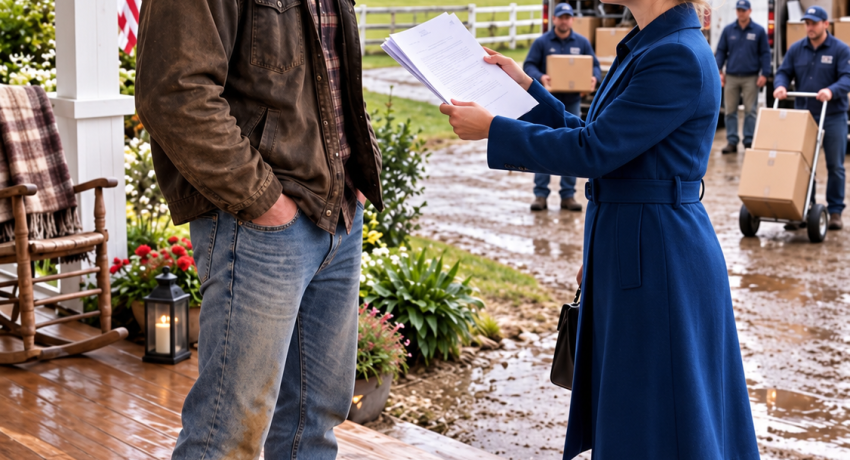
I was feeding the horses when several engines came up the driveway.
Two moving trucks.
Three cars.
Clare stepped out of the first vehicle wearing a black coat and holding an umbrella.
Her fiancé followed.
“We’re here to get started,” she called.
“Started with what?”
She pointed toward the moving trucks.
“Packing. Renovations begin next week. You should have your things out by then.”
I stared at her.
“You cannot be serious.”
“I’m completely serious. You’ve delayed this long enough.”
The movers began unloading equipment.
“Get them off my property.”
Her fiancé laughed.
“You don’t control this anymore.”
I remained calm.
“Nobody moves anything until my lawyer reviews whatever paperwork you’re relying on.”
Clare pulled a folder from her bag.
“The transfer has already been approved.”
She handed me the documents.
There was a court stamp.
There were also statements from relatives supporting her claim that I had received an unfair portion of the estate.
My uncle.
Two cousins.
People who had hugged me at my parents’ funeral.
People who had told me Dad would be proud that I was keeping the ranch alive.
Now they had signed statements supporting Clare.
That hurt almost as much as everything else she had done.
“You brought the whole family into this?”
“Someone had to be reasonable,” she replied.
She gave me until Friday to leave.
Then she played a recording from her phone.
My voice.
A private conversation from months earlier.
I had been exhausted and told a friend,
“Some days it would be easier to sell everything and walk away.”
Clare smiled.
“See? Even you admitted you don’t want the place.”
I stared at her.
“You recorded me?”
“You never prepare for anything, Jacob. Someone has to.”
That was when I understood this fight was no longer simply about inheritance.
It was about trust.
I didn’t argue anymore.
I went inside.
Closed the door.
And eventually let the movers leave without allowing them to touch anything.
That evening, I sat on the porch holding Dad’s old hat.
I thought about every year I had worked beside him.
The day he told me the ranch would one day belong to me.
The pride in his voice whenever we completed a major repair.
And I made a decision.
I wasn’t leaving.
But I also wasn’t going to react recklessly.
No shouting.
No dramatic threats.
No attempt to beat Clare at her own style of confrontation.
I would do what Dad always did when something went wrong.
Slow down.
Look at the facts.
Fix one thing at a time.
For several days, I struggled.
I barely ate.
I kept working because the horses and property still needed care, but emotionally I felt empty.
A few relatives came by.
Most seemed more interested in the drama than in how I was actually doing.
My cousin Lydia even said,
“You’ll probably be happier without all this responsibility.”
I didn’t answer.
That night, I finally let myself feel angry.
Then I opened one of Dad’s old accounting ledgers.
Twenty years of repairs.
Feed purchases.
Taxes.
Equipment.
His handwriting filled every page.
Looking at those records reminded me of something important.
This ranch had never been a free gift.
I had spent years helping build it and keep it running.
The next morning, I met with my attorney again.
He carefully reviewed Clare’s filing.
“Yes,” he said. “She managed to get the transfer approved. But it’s far from untouchable.”
He believed we had grounds to challenge it.
Possibly even reverse it.
“She’s expecting you to panic,” he told me. “Don’t.”
When I got home, I walked the entire property line.
Dad used to do that whenever he was facing an important decision.
He called it “walking the land.”
By sunset, my thoughts were clearer.
I went through every document in the house.
The will.
Trust records.
LLC paperwork.
Tax receipts.
I organized everything into a binder.
Then I made another one.
I contacted people who knew how much work I had contributed to the ranch.
Neighbors.
Suppliers.
Former ranch hands.
Little by little, the truth became harder for Clare to rewrite.
At one point, I thought about leaving.
I even loaded several boxes into my truck.
Then I sat behind the wheel and couldn’t bring myself to start the engine.
I unloaded everything.
Clare had already destroyed my trust.
I wasn’t going to let her take the home that still connected me to Mom and Dad.
From that point forward, I treated the ranch as both my home and my business.
I repaired the fences properly.
Fixed the barn roof.
Cleared out the storage rooms.
Applied for agricultural programs I had previously overlooked.
Neighbors started offering their help.
One of Dad’s old friends brought his tractor over after a storm.
“Your father would’ve done the same for me,” he said.
Even Aunt Linda came by.
She brought a pie and looked embarrassed.
“I didn’t understand what Clare was really trying to do,” she admitted.
Then she looked around.
“This was always supposed to be yours, Jacob.”
Her apology didn’t undo what had happened.
But it mattered.
By the end of the month, the ranch looked better than it had in years.
And I felt better too.
I began managing the finances through a dedicated business account.
Every purchase was recorded.
Every repair.
Every payment.
Every dollar of income.
Then the ranch started creating new opportunities.
A riding school rented sections of the pasture on weekends.
A local photographer asked to use parts of the property for photo sessions.
The amounts were modest.
But they proved something important.
The ranch could support itself.
I wasn’t simply preserving the past.
I could create something new there.
Meanwhile, Clare continued sending messages about deadlines and moving dates.
I stopped replying.
I had learned something.
Silence could be powerful when it was a choice instead of something forced upon you.
Then I went to the county records office.
I spent hours searching through the estate documents.
That was where I discovered something I had missed.
An addendum my father had signed shortly before he died.
It clearly stated that the ranch was intended solely for me because of my years of contribution to maintaining and operating it.
My lawyer read it twice.
Then he looked up.
“This changes things considerably.”
I immediately made certified copies.
I also gathered statements from former workers and neighbors.
Some had photographs showing me repairing roofs with Dad.
Baling hay.
Working with livestock.
Years of evidence.
My folders became thicker.
Then I discovered something else.
An old family friend named Mr. Collins approached me at the local diner.
“I heard Clare has been talking to developers.”
“What kind?”
“Golf and resort people.”
My stomach tightened.
Then he told me something even more significant.
Apparently, Clare and her fiancé were dealing with financial problems of their own.
An investment in a development had gone badly.
They needed money.
Suddenly, everything made sense.
Clare didn’t want the ranch because she loved it.
She needed a valuable property she could sell.
That information changed the way I handled the situation.
I spoke with professionals about legal ways to preserve the property’s agricultural character.
I looked into conservation protections and agricultural preservation programs.
Eventually, I received confirmation that the ranch qualified for preservation status.
It provided the property with tax benefits and made major redevelopment far more complicated.
The ranch could remain what my parents had intended it to be.
Land.
Pasture.
Home.
Not a quick development project.
I didn’t tell Clare right away.
Instead, I waited until my attorney was prepared.
Late in January, her SUV came up the driveway again.
This time, only she and her fiancé were inside.
She handed me another move-out notice.
I read it.
Folded it.
Set it on the porch railing.
“Thanks.”
She frowned.
“For what?”
“It’ll be useful in court.”
Her expression shifted.
“What court?”
“The one where we’re asking to reverse your transfer.”
Her fiancé laughed.
“You can try.”
“I intend to.”
I went inside and returned carrying one of my binders.
I opened it.
The amended estate documents.
Tax records.
Business records.
Photographs.
Witness statements.
Proof of years of work.
Clare’s confidence began to disappear.
Then I handed her the preservation paperwork.
She read it.
Her expression changed completely.
“You did this?”
“I protected the property.”
“You’re ruining everything.”
“No. I’m making sure the ranch stays exactly what Mom and Dad wanted.”
I told her that my attorney was also requesting legal fees and an order barring any further unauthorized entry while the dispute was being resolved.
Her fiancé quietly told her they should leave.
This time, she listened.
The following Monday, my lawyer filed the challenge.
A temporary order restricting unauthorized access was approved while the case remained pending.
A few days later, Clare came back with two men carrying clipboards.
She was stopped before she could reach the house and shown the order.
I watched from the porch.
There was no celebration.
No victory speech.
I simply felt relieved that, for once, the rules were clear.
Then the court hearing took place.
I wore Dad’s old watch.
My attorney presented the estate documents.
The LLC records.
My maintenance history.
Witness statements.
Photographs.
The addendum Dad had signed.
Even Aunt Linda testified that I had consistently been the person running the ranch.
Clare’s attorney argued that the inheritance should have been divided more evenly.
But the judge focused on the written instructions my parents had actually left.
The earlier transfer was reversed.
The deed was returned to me.
The court also awarded certain legal costs associated with the dispute.
When I stepped outside afterward, the winter sunlight seemed unusually bright.
My attorney smiled.
“That should settle the ownership issue.”
The family’s reaction was mixed.
Some relatives apologized.
Others avoided talking about it.
A few believed I had been too aggressive.
I didn’t argue with them.
I knew what the documents said.
More importantly, I knew what my parents had wanted.
Clare’s financial problems continued.
I heard that she and her fiancé eventually sold their condo after their other investment ran into trouble.
I never took pleasure in that.
I didn’t want her life to fall apart.
I simply wanted her to stop trying to build her future by taking away mine.
I put my energy back into the ranch.
The riding partnership grew.
We hosted small community gatherings.
And with some of the money recovered through the legal process, I created a modest scholarship in my parents’ names.
Turning something painful into something meaningful felt far better than revenge ever could.
Months went by.
Then, one evening, Clare’s SUV appeared again.
For a moment, all my old instincts came rushing back.
But she stayed inside the vehicle for several minutes.
When she finally walked toward the porch, she looked tired.
Different.
“I came to apologize,” she said.
I didn’t respond right away.
“I shouldn’t have done any of it,” she continued. “I convinced myself that getting the money would solve everything. It didn’t.”
She stared down at the porch floor.
“I don’t expect you to forgive me.”
For a long time, neither of us said anything.
The sun was disappearing behind the hills.
Finally, I said,
“I can’t pretend none of this ever happened.”
She nodded.
“But I hope you figure out what you truly want from your life. Because this ranch isn’t just an asset to me. It’s home.”
Her eyes filled with tears.
“I know.”
Then she walked away.
I stayed on the porch until the last light vanished.
The horses grazed quietly in the distance.
Crickets filled the evening air.
And for the first time since the conflict began, the ranch felt peaceful again.
I looked across the pasture and thought about my father.
For months, I had believed protecting the ranch meant defeating Clare.
I had been wrong.
It meant refusing to let fear, anger, or family pressure determine what happened to something my parents had spent their entire lives building.
It meant keeping records.
Asking for help.
Learning what I didn’t know.
Standing my ground without becoming cruel.
The ranch was still there.
And so was I.
I rested my hands against the porch railing and whispered into the silence,
“It’s safe now, Dad.”
And finally, I believed it.









