 167 views
 “Nobody cares about pawns.”
Miles said it with the complete confidence only a seven-year-old could have when being completely wrong.
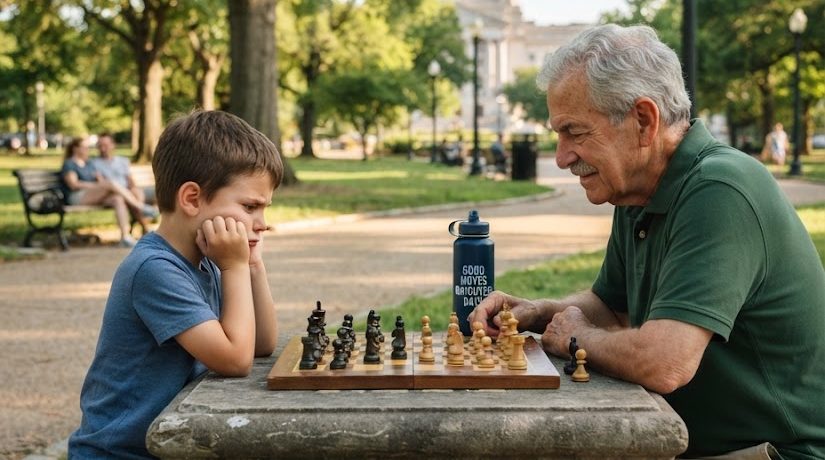
Arthur slowly reached across the concrete chess table and picked up the white pawn he had just captured.
“That’s exactly why you keep losing them, Soldier.”
Miles’s face tightened as if he had just tasted something bitter.
“Stop calling me Soldier.”
Arthur turned the pawn between his fingers.
“Why?”
“Because soldiers are basically pawns.”
“And?”
“They’re the weakest pieces.”
Arthur nodded thoughtfully, as though Miles had just presented an excellent argument in court.
“Only if they never move beyond where they started.”
Miles rolled his eyes.
“That doesn’t even make sense, Artie.”
“It will.”
“So I’ve heard.”
“You turn everything into a lesson.”
Arthur smiled and set the captured pawn beside the board.
“Your move, Soldier.”
Miles let out a dramatic groan.
Ten feet away, I hid a laugh behind my coffee cup before returning to the emails on my laptop.
At the time, I believed I was simply watching an elderly man teach my son how to play chess.
I thought I was close enough to notice anything that mattered.
I had no idea how much I was overlooking from just ten feet away.
Miles had been fascinated by chess since he was five.
I still couldn’t explain where that obsession had come from.
His father had already vanished from our lives by then—another city, another life, even a new phone number he never thought to give us.
And chess definitely didn’t come from me.
Half the time, I still had to remind myself how the knight was supposed to move.
But there was something about the game that seemed perfectly suited to Miles.
Every afternoon after school, the other children ran toward the swings and slides.
Miles walked right past them.
He went straight to the concrete chess tables at the back of the park, like an eighty-year-old man showing up for a business meeting.
I worked remotely, so eventually our routine grew around it.
School pickup.
Ninety minutes while Miles played and I worked.
Then dinner at home.
It wasn’t thrilling, but it worked.
Miles was happy.
And when you have a quiet child who is genuinely happy doing something unusual, you learn not to question it too much.
The only problem was that no one wanted to play against him.
Kids his age thought chess was boring.
Adults occasionally sat across from him, intentionally made awful moves, and let him win.
Miles hated that.
“He let me win,” he would complain afterward.
“How do you know?”
“Because I made a bad move and he didn’t capture my piece.”
So most days, Miles played against himself.
He would arrange both sides, sit in one chair, make a move, then walk around the table and become his own opponent.
Sometimes he even argued with himself.
It broke my heart a little.
But he seemed happy.
Then Arthur appeared.
The first time I noticed him, he was sitting by himself at one of the chess tables.
He wasn’t playing.
He simply stared at the empty board painted onto the concrete, both hands resting on top of his cane.
A paper cup of coffee sat beside him.
There was something remarkably peaceful about him.
He looked like a man with nowhere urgent to go who had made peace with that fact long ago.
Miles noticed him too.
And Miles noticed possible chess opponents the way a shark notices movement in the water.
He watched Arthur for nearly thirty seconds.
Then he grabbed his chess box and walked over.
“Miles?”
He ignored me.
I closed my laptop halfway, already getting ready to apologize for whatever my son was about to say.
Miles dropped his chess box onto Arthur’s table.
“Do you know how to play?”
Arthur looked at the box.
Then he looked at Miles.
“A little.”
Miles narrowed his eyes.
“That means yes.”
Arthur’s mouth twitched.
“Does it?”
“Adults say ‘a little’ when they’re actually good and don’t want kids to know.”
I covered my face.
“I’m sorry,” I called.
Arthur looked over at me.
His eyes were warm.
“No need.”
Then he reached across the table and moved one of Miles’s white pawns forward two spaces.
“Your son has already challenged my honesty,” he said. “We might as well have a game.”
Miles lost twenty minutes later.
And I had never seen him this happy about losing.
For once, the person across from him had actually played seriously.
By the end of that week, Mr. Arthur had become Artie.
Arthur pretended to dislike the nickname.
“It’s Arthur.”
“Okay, Artie.”
He would sigh.
And somewhere along the way, Arthur began calling Miles “Soldier.”
Miles hated that nickname with every ounce of his soul.
Which, naturally, meant Arthur never stopped using it.
Their games quickly became part of every afternoon.
Arthur usually arrived first.
Same table beneath the large oak tree.
Same cup of coffee.
Sometimes the same folded newspaper beside him, though I rarely saw him actually reading it.
By the time Miles came running down the path, Arthur usually had half the pieces already set up.
Most of their games sounded less like chess and more like arguments.
“You can’t do that!”
“I just did.”
“That’s cheating!”
“It’s called castling.”
“You never taught me that rule!”
“You never asked.”
“ARTIE!”
But there was something about Arthur I noticed even before I understood how important it would become.
He never hurried Miles.
Never.
Miles could sit there for five minutes, silently studying the board.
Arthur wouldn’t say a word.
Most adults can’t handle that kind of silence around a child.
They immediately start filling it.
“Take your time.”
“Do you see anything?”
“No pressure.”
Arthur never did.
He simply waited.
He drank his coffee.
Watched the birds.
Let Miles think.
It was as though Arthur was completely comfortable living within silence and didn’t mind sharing that space with someone else.
I think about that often now.
How unusual it is to find someone who can sit quietly beside another person without expecting the silence to be filled.
One afternoon, Miles sacrificed three pawns within ten moves.
Arthur leaned back.
“Do you have something against the infantry?”
“They’re useless.”
“Interesting.”
“They only move one square.”
“Usually.”
“And they can’t move backward.”
“Correct.”
“They’re terrible.”
Arthur picked up one of the captured pawns.
“What happens if this terrible little piece reaches the other side of the board?”
Miles shrugged.
“It gets stuck?”
Arthur looked so deeply offended that I laughed from my bench.
Then Arthur taught him about promotion.
He placed a queen, rook, bishop, and knight in front of Miles.
“When a pawn makes it all the way across,” Arthur explained, “it can become one of these.”
Miles stared.
“A pawn can become a queen?”
“Yes.”
“That’s stupid.”
Arthur laughed until it turned into a small cough.
“Why?”
“Then why doesn’t everyone just use pawns?”
Arthur carefully placed the pawn in the middle of the table.
“Because making it to the other side is the hard part, Soldier.”
Miles frowned.
“Anyone can begin moving,” Arthur continued. “Very few pieces make it through the entire journey. That’s part of the game—figuring out which ones are worth protecting long enough to reach the other side.”
Miles stared down at the pawn.
Then he muttered,
“I still hate when you call me Soldier.”
Arthur moved his bishop.
“Make it to the other side, Soldier.”
Miles tried his hardest not to smile.
He failed.
—
Not long after that, the pawn ritual started.
I didn’t understand it at first.
Miles came home one evening furious.
“Artie stole another one.”
I looked up from dinner.
“He stole your chess piece?”
“Not stole stole.”
He said it like I was being ridiculous.
“Not like a robber.”
“Glad we cleared that up.”
“He kept it.”
“What?”
“My pawn.”
“Why?”
“The one that reached the other side. I promoted it, and then Artie put the old pawn in his pocket.”
I turned toward him.
“Why?”
“He said it was evidence.”
“Evidence of what?”
Miles folded his arms.
“That I’m teachable.”
I laughed so hard that I had to sit down.
Miles was so offended that he barely spoke to me throughout dinner.
The next afternoon, I walked over to Arthur.
“So now we’re stealing chess pieces from seven-year-olds?”
Arthur placed one hand dramatically against his chest.
“Maisy, I am preserving history.”
“Of course you are.”
“He’s being annoying!” Miles shouted from the water fountain.
“That too,” Arthur admitted.
I went back to my bench.
I assumed it was nothing more than their little joke.
A silly tradition shared between an old man and a young boy.
It took me months to realize that every one of those pawns meant something.
Arthur was keeping proof of every occasion when Miles had managed to carry something small and seemingly unimportant across an entire difficult board and transform it into something more powerful.
And I had been sitting ten feet away the whole time.
There are things you can fail to notice even when they’re happening right in front of you.
—
Near the entrance to the park stood a small coffee kiosk.
One afternoon, Miles came running back carrying two white sugar packets.
He dropped them onto the chess table.
“These are for you.”
Arthur looked down.
“For what?”
“For your coffee.”
“I know what sugar is, Soldier.”
Miles sighed.
“Old people like sweet coffee, Artie. Everyone knows that.”
I nearly choked.
“Miles!”
“What? They do.”
Arthur stared at the two packets for a moment.
Then he picked them up with great care.
“Thank you, Soldier.”
But he never added them to his coffee.
I noticed.
Then I forgot about it.
Later, I would realize that I shouldn’t have.
Arthur eventually started missing days.
At first, it happened only once in a while.
A Tuesday.
Then a Friday a couple of weeks later.
The first time it happened, Miles arrived at the park, saw that Arthur’s chair was empty, and refused to sit anywhere else.
He stood beside the table clutching his chess box, watching the path until the sun began to disappear.
The following afternoon, Arthur came back.
Miles was furious.
“You weren’t here.”
Arthur nodded.
“I noticed.”
“I waited.”
Arthur looked down at the chessboard.
“You could have played someone else.”
Miles looked offended.
“They play weird.”
Arthur’s lips curled slightly.
“High praise indeed.”
But when Miles said, “I waited,” something changed in Arthur’s expression.
Something quiet.
Something I didn’t understand at the time.
A few days later, I noticed Arthur rubbing his chest.
He looked exhausted.
Somehow, he seemed grayer.
The instant he realized I was watching, he lowered his hand and reached for his coffee as if nothing had happened.
When Miles went to refill his water bottle, I walked over and sat in his chair.
“You okay?”
“Perfectly.”
“That’s not an answer.”
“Technically, it is.”
“Arthur.”
The humor disappeared from his face.
For a brief moment, he looked old.
Truly old.
Then he gave me a tired smile.
“Just getting older, Maisy. It happens to the best of us.”
I didn’t like his answer.
But Miles came back before I could press him further.
Arthur immediately sat straighter.
“Your move, Soldier.”
And whatever opening had briefly appeared between us closed once again.
I told myself I would ask him later.
I assumed we had plenty of time.
—
About a week later, I overheard something I would remember for the rest of my life.
Miles was studying the board intensely.
Arthur watched him in silence.
Then he said,
“Soldier, someday I might not be sitting here.”
Miles didn’t even lift his eyes.
“Then I’ll wait.”
Arthur’s hand froze above his bishop.
I looked up from my laptop.
Arthur glanced at me.
Just once.
Then he moved his piece.
Nobody said anything more.
But I remembered it.
Especially when that day finally came.
—
We arrived at the park at 3:30, just like always.
Arthur’s chair was empty.
Miles stopped.
“He’ll come.”
“Maybe he’s running late.”
“Artie doesn’t run, Mom.”
I smiled despite the knot already tightening in my stomach.
“You know what I mean.”
When we reached the table, Miles opened his chess box.
Then he froze.
The board had already been set up.
Not for the beginning of a game.
For the middle of one.
Several pieces were gone.
Only a few remained.
“Did Artie leave this?”
“Maybe. Don’t touch anything.”
Miles continued staring toward the entrance of the park.
So did I.
At 4:10, I shut my laptop.
“Miles, I think we should head home.”
“No.”
I crouched beside him.
“Sweetheart, remember what Arthur told you? About how someday he might not be here?”
Miles kept his eyes fixed on the path.
“But he didn’t say today.”
At that exact moment, a park ranger came around the corner in a small cart.
He slowed when he noticed us.
Then he stopped.
He stepped out carrying a plain white envelope.
Something about the careful way he held it made my stomach sink.
“Excuse me. Are you the mother whose son plays chess with Arthur?”
I immediately stood.
“Yes. What happened?”
The ranger held out the envelope.
“He came here early this morning. He asked me to make sure you received this.”
Miles pressed himself against my side.
“Where’s Artie?”
The ranger looked at him.
Then at me.
“He really wanted your mom to have this letter, buddy.”
It wasn’t an answer.
And sometimes, a non-answer reveals more than an answer ever could.
My hands trembled as I accepted the envelope.
The ranger gave me a small nod before driving away.
I understood why.
He was giving us privacy for whatever came next.
Arthur had written only one word on the front.
MAISY
Inside was a single sheet of paper.
Four lines.
Maisy,
I won’t be sitting at the table anymore.
Please don’t take Miles home yet.
Ask him to finish today’s game. He’ll know which one.
I read it three times.
“Miles…”
My voice sounded strange.
He snatched the paper before I could finish.
His eyes quickly scanned the words.
“What game?”
Then he looked toward the chess table.
At the unfinished board.
And suddenly became completely still.
I followed his gaze.
Beside the board were seven white pawns.
Perfectly lined up.
Miles slowly walked over.
He picked up the first pawn and turned it upside down.
A tiny blue dot was marked underneath.
“Mom.”
“Yes?”
He picked up another.
A red dot.
Then another.
Green.
His voice dropped to a whisper.
“These are mine.”
I knelt beside him.
“What do you mean?”
“These are my Soldiers.”
He looked at me with confused, watery eyes.
“The ones I promoted. Artie marked every single one.”
He stared at the row.
“He kept all of them.”
And finally, I understood.
Seven pawns.
Seven journeys.
Seven times my quiet, lonely little boy had carried something weak across a difficult distance and transformed it into something stronger.
Arthur had kept every one.
But there was still one pawn left.
It sat alone in the center of the unfinished board.
Miles picked it up.
Another folded note was hidden underneath.
He opened it.
Arthur had written:
You finished the first part.
Now come finish the game.
The address is on the back.
They’re expecting you.
—Artie
On the other side was the address of an assisted-living facility about fifteen minutes away.
Miles looked at me.
“He moved?”
“I think so.”
“Without telling me?”
The hurt in his voice struck me harder than anything else.
Because I knew what those words really meant.
People leave.
His father had vanished without any warning.
Now Arthur had done something that felt terrifyingly similar.
Miles quickly collected the seven pawns and placed them inside his chess box.
He carefully slipped the final pawn into his pocket.
“Mom…”
I grabbed my keys.
“Get in the car.”
—
We found Arthur sitting beside a window.
The room smelled of fresh sheets and disinfectant.
A thin oxygen tube ran beneath his nose.
He looked smaller than he had at the park.
Much smaller.
Miles walked straight toward him.
Arthur’s whole face lit up.
“Soldier!”
“I hate when you call me that!”
“I know.”
Arthur gave him a weak smile.
“I know you do.”
“You left.”
The smile disappeared.
“Yes.”
“You didn’t finish, Artie.”
Miles placed the chess box on the little table.
A bishop rolled onto the floor.
Arthur instinctively bent down.
Miles grabbed it before he could.
“Don’t. You’re old.”
Arthur stared at him.
Then he gave a soft laugh.
“I’m deeply touched by your concern, Soldier.”
“Mom drove.”
As though that explained everything.
Arthur looked at me.
The humor vanished from his face.
“I’m sorry.”
“For leaving?”
I sat down.
“For making a seven-year-old carry my goodbye.”
He shook his head.
“I knew it was cowardly when I wrote that note.”
“You could have told him.”
“When?”
Arthur looked toward Miles, who was already arranging the pieces.
“I told him that someday I might not be at the table.”
My throat tightened.
“And do you remember what he said?”
I remembered.
Arthur’s voice grew softer.
“He said, ‘Then I’ll wait.’”
He looked at me helplessly.
“How do you tell a boy like that that you aren’t coming back?”
I said nothing.
“He would have gone to that park every afternoon,” Arthur continued. “He would have sat there beside an empty chair, waiting.”
He glanced toward the chessboard.
“So I gave him something he could finish instead.”
His voice cracked slightly.
“Something to keep his hands busy.”
I couldn’t find an answer.
Then I noticed a clear plastic container sitting on the windowsill.
It was packed with white sugar packets.
Dozens of them.
I stared.
“Arthur.”
He immediately looked defensive.
“Don’t.”
But I was already laughing through my tears.
“You drink your coffee black.”
Miles looked up.
“What?”
I pointed at Arthur.
“I’ve watched this man drink coffee for months. He never puts sugar in it.”
Arthur pointed at me.
“Your mother is spreading outrageous misinformation.”
Miles looked betrayed.
“You don’t use the sugar?”
Arthur sighed.
“No, Soldier.”
“Then why did you keep it?”
Arthur looked down at the container.
All the humor disappeared from his face.
“Because you gave it to me.”
Miles fell silent.
So did I.
For months, I had believed Arthur was the one giving.
Arthur was helping my lonely son.
Arthur was teaching him.
Arthur was keeping him company.
I touched the container.
“I thought you were the one keeping Miles company.”
Arthur looked toward the boy carefully arranging the chess pieces.
“He was keeping me company.”
Then Arthur told me something I had never known.
His wife had passed away four years earlier.
His children loved him.
He made sure to tell me that.
Twice.
They called whenever they could.
Visited whenever life gave them the chance.
Arthur didn’t hold it against them.
But after his wife died, his days had begun to blur together.
Breakfast.
A walk.
Television.
Dinner.
Sleep.
Then doing it all over again.
Until one afternoon, a seven-year-old boy dropped a chess box onto his table and accused him of pretending not to be good at the game.
Suddenly, Arthur had somewhere he needed to be every afternoon at 3:30.
He checked the weather before going to bed.
Saved chess puzzles from the newspaper.
Carried plain cookies because Miles hated raisins and had once announced,
“Raisins are fruit pretending to be candy.”
Arthur had secretly agreed.
“I couldn’t let myself get lazy,” Arthur said. “I couldn’t have a seven-year-old beating me.”
Miles looked up.
“I beat you twice.”
“Once.”
“Twice.”
“Disputed.”
And suddenly, it felt just like being back at the park.
Same voices.
Same argument.
Same two people.
Only this time, I was actually listening.
Miles finished setting up the game Arthur had left behind.
Only a few pieces were still on the board.
One white pawn stood deep inside enemy territory.
Almost all the way across.
Miles tried complicated moves first.
Flashy ones.
Arthur simply waited.
Eventually, Miles sighed.
“Fine.”
He moved the pawn forward.
Then protected it.
Another square.
Then another.
Slowly.
Carefully.
Until finally it reached the opposite side.
Arthur leaned back.
“What do you want, Soldier?”
Miles reached for the queen.
The obvious choice.
The most powerful piece.
Then he stopped.
Instead, he picked up the knight.
Arthur raised an eyebrow.
“Not the queen?”
“No.”
“Why?”
Miles placed the knight where the pawn had been.
“Knights move weird.”
“And?”
“They can get places other pieces can’t.”
He shrugged.
“Sometimes weird is better.”
Arthur smiled more broadly than I had ever seen before.
Then he reached for the pawn Miles had just promoted.
He was going to add it to the other seven.
Make eight.
Miles stopped him.
“No, Artie.”
Arthur frowned.
Miles collected all seven saved pawns.
Then the eighth.
He dropped every single one into the clear container filled with sugar packets.
Arthur stared.
“What are you doing?”
“Keeping evidence.”
“Evidence of what?”
Miles looked genuinely confused that Arthur even had to ask.
“That you’re not finished teaching me.”
Arthur’s eyes filled with tears.
They rolled down his face.
He didn’t wipe them away.
Neither did I.
Eventually, I asked,
“Do they have a chess table here?”
A staff member located one in a common room beside a large window.
Arthur sat on one side.
Miles took the seat across from him.
I pulled up a chair nearby.
Just like at the park.
Except this time, my laptop remained zipped inside my bag.
And I watched.
Really watched.
The long stretches of silence while Miles thought.
Arthur’s hidden smile whenever Miles walked into a trap.
The way Miles bit his lower lip just before committing to a move.
For months, I had been ten feet away.
But being ten feet away while staring at a screen isn’t the same as truly seeing someone.
That afternoon, I noticed everything.
And maybe because I finally understood that there wouldn’t be endless afternoons ahead, I forced myself to remember every detail.
When it was time to leave, Arthur slowly gathered the chess pieces.
His hands trembled slightly.
“Tomorrow, Soldier.”
Miles groaned automatically.
“Fine.”
He walked halfway toward the door.
Then stopped.
He hurried back to the table.
Picked up one white pawn.
And slipped it into his pocket.
Arthur raised an eyebrow.
“Stealing?”
“Borrowing.”
“For what purpose?”
Miles closed his fingers around the pawn in his pocket.
“Because he hasn’t reached the other side yet.”
Arthur fell silent.
Then he slowly nodded.
“Fair enough.”
Miles returned and took my hand.
We started down the hallway.
Behind us, Arthur called,
“See you tomorrow, Soldier.”
Every time Arthur had used that nickname before, Miles had complained.
Stop calling me that.
Every time.
Without exception.
This time, he didn’t.
He simply slipped his free hand into his pocket.
Closed his fingers around the pawn.
And smiled.
We came back the following afternoon.
And the afternoon after that.
And every day Arthur still had left.
There turned out to be more of those days than the doctors had expected, something Arthur treated as though he had personally beaten them at a game.
Miles kept that borrowed pawn in his pocket the entire time.
At the beginning of each chess match, he sometimes placed it beside the board.
A small white witness.
Then, before we left, he would return it to his pocket.
And slowly, finally, I understood exactly what Miles was doing.
He was moving Arthur forward the same way Arthur had taught him to move every pawn.
Patiently.
One square at a time.
Protecting him for as long as he could.
All the way to the other side.