
 96 views
 The contraction hit so hard that my knees nearly gave way. My phone trembled in my hand as Rowan’s voice turned colder than the hospital floor beneath me.
“Handle it yourself, Phoebe. Stop being so dramatic.”
Then he ended the call.
For several seconds, I stared at the black screen, struggling to comprehend how the man who had promised to hold my hand through childbirth could abandon me at the exact moment I needed him most. Another contraction tore through me, and a nurse rushed over with a wheelchair.
“Is someone coming?” she asked softly.
I looked at the silent phone. “Not my husband.”
At thirty-eight weeks pregnant, I sat alone outside the maternity ward, one hand pressed against my stomach as warm fluid soaked through my dress. For months, Rowan had promised he would be there.
But his mother, Selina, had announced that her sixtieth birthday dinner was a “once-in-a-lifetime family event.”
Apparently, the arrival of our son didn’t count.
I called Rowan again, desperate enough to give him one final chance. Music, laughter, and the sound of clinking glasses filled the background.
“Rowan, my water broke,” I said through another contraction. “The contractions are four minutes apart.”
Before he could respond, Selina’s voice came through the phone. “Tell her women have been giving birth for thousands of years.”
“See? Mom understands,” he said. “Call a cab.”
Something inside me suddenly went quiet.
The fear was still there. So was the pain. But the part of me that had been pleading with my husband to choose me was gone.
“All right,” I whispered. “Enjoy the cake.”
Then I called the one person I had intentionally avoided contacting for nearly two years.
My father.
“Dad,” I managed when he answered.
He heard one shaky breath before his voice immediately changed.
“Where are you?”
Twenty minutes later, Gideon Sterling walked into the hospital wearing an old gray coat. No entourage. No driver. Nothing that hinted that financial newspapers regularly printed his photograph beside words such as founder, chairman, and billionaire investor.
Rowan knew exactly who Gideon Sterling was.
He just didn’t know that Gideon Sterling was my father.
When Rowan and I met, I had been using my late mother’s surname. I wanted one relationship that remained untouched by Dad’s wealth. When Rowan mocked “trust-fund parasites,” I said nothing. When Selina called my father “some absent retired salesman,” I allowed her to believe it.
That night, Dad held my hand through fourteen exhausting hours of labor.
Rowan never came.
At 4:17 a.m., Leo was born.
Dad gently held him against his chest, tears quietly running down his face.
“He’s perfect,” he whispered.
Watching my father cradle my sleeping baby, I felt the final fragile piece of my marriage shatter.
Then my phone lit up.
Mom loved the watch I bought her. Coming home Monday. Don’t start another fight.
My hands stopped trembling.
I took a screenshot.
Rowan still believed I was the woman who would cry, forgive, and stay exactly where he had left me.
He had forgotten something important.
I was a forensic accountant.
Three days later, Rowan finally walked through our front door.
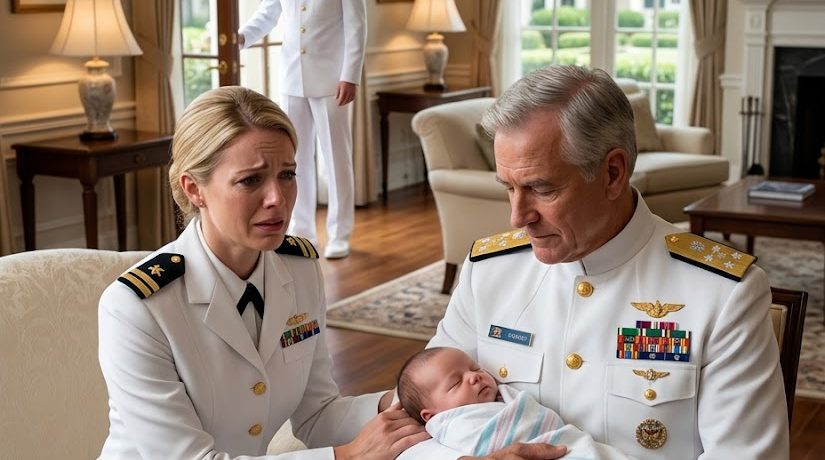
Gideon Sterling was sitting in our living room with Leo sleeping peacefully in his arms.
Every bit of color drained from Rowan’s face.
“Phoebe…” Rowan whispered. “Why is Gideon Sterling holding my son?”
Dad slowly raised his eyes.
Before I could respond, he said the six words that made Rowan go completely still.
PART 2
“Perhaps you should ask your wife.”
Rowan looked at him.
Then at me.
Then at Leo.
His suitcase was still beside the door, one hand wrapped around the handle. His jacket was wrinkled from the trip, and a gift bag from Selina’s birthday weekend dangled from his wrist.
“Phoebe,” he said carefully, “what’s happening?”
I sat at the opposite end of the sofa with a blanket covering my legs. Three days after giving birth, almost every movement still caused pain, but for the first time since I had arrived at the hospital, I felt strangely peaceful.
“Shut the door,” I said.
He did.
His eyes stayed on Dad.
“I know who that is.”
Dad adjusted Leo in his arms without responding.
Rowan swallowed. “Everyone knows who that is.”
“I’m sure everyone doesn’t,” Dad said calmly.
Under normal circumstances, Rowan would have understood the dry humor.
Not this time.
He looked back at me.
“Why is Gideon Sterling in our house?”
“Our house,” I repeated.
Something in my tone made him pause.
I hadn’t meant for the words to come out that way, but after saying them, I realized exactly what I meant.
The house had never felt less like it belonged to both of us.
Rowan stepped farther inside.
“Phoebe.”
“He’s my father.”
Silence.
Not the kind caused by ordinary surprise.
Something much deeper.
The kind of silence that forced everything that had happened before into a completely different perspective.
Rowan opened his mouth but no words came out.
I could almost watch him mentally reconsidering five years of our marriage.
“My father’s surname is Sterling,” I said. “My mother’s surname was Vale. I used hers after she passed away.”
“You told me your father was retired.”
“I told you he had stepped away from the day-to-day operations.”
“You said he traveled.”
“He does.”
“You said he was terrible at remembering birthdays.”
Dad looked slightly offended.
“I’ve gotten better.”
I almost smiled.
Almost.
Rowan stared at me.
“So all this time…”
His eyes moved around the room.
The modest oak table we had purchased together.
The secondhand bookshelf I had refinished one summer.
The framed photograph from our honeymoon in Lisbon.
Nothing in the room had physically changed, yet he seemed to be seeing everything through different eyes.
“You’re Gideon Sterling’s daughter.”
“Yes.”
“And you never told me.”
“No.”
“Why?”
It was a reasonable question.
Maybe the first genuinely reasonable one he had asked since walking through the door.
I looked over at Dad.
He understood without needing an explanation.
“Leo and I can go have a look at the garden,” he said.
“He’s only three days old,” I reminded him.
“Then I assume his expectations are fairly low.”
Dad carefully stood up with Leo in his arms.
Rowan moved automatically.
“I can hold him.”
Dad stopped.
So did I.
It was the first time Rowan had actually asked to hold his son.
The realization appeared on his face at the same moment.
Dad glanced at me.
I nodded.
He gently transferred Leo into Rowan’s arms.
Something shifted in my husband’s expression.
The anger was still there.
The confusion hadn’t disappeared either.
But underneath both was something else.
Wonder.
Leo stirred, making the tiniest little noise.
Rowan lowered his eyes to him.
His shoulders slowly loosened.
“Hey,” he murmured.
The tenderness in his voice hurt.
Because this was the man I had expected to walk into that hospital.
The man who had spent an entire Sunday putting Leo’s crib together twice because one of the rails seemed slightly crooked.
The man who used to press his ear against my stomach and laugh whenever Leo kicked.
People were almost never just one thing.
That was exactly why disappointment could hurt so deeply.
If Rowan had been cruel all the time, leaving him would have been easy.
But he hadn’t.
He had been funny, caring, ambitious, and sometimes deeply insecure.
Far too desperate for his mother’s approval.
Far too willing to make himself smaller to satisfy her expectations.
And when our marriage faced its most important moment, he had failed both of us.
Dad quietly left the room.
Rowan sat across from me, still holding Leo.
For several minutes, neither of us said a word.
At last, he asked, “Why didn’t you tell me?”
I clasped my hands together.
“When we first met, everyone I knew already had an opinion about my father’s money.”
“That still doesn’t explain why you kept it from your husband.”
“No. It explains why I didn’t tell the man I had only just met.”
“And what about after we got married?”
I met his eyes.
“That’s more complicated.”
His jaw became tense.
“I’m listening.”
So I told him.
Not dramatically.
Not defensively.
Honestly.
My childhood had been comfortable in ways most people could hardly comprehend. Private schools. Chauffeurs. Homes with entire rooms that were rarely ever used.
But money had complicated almost every relationship in my life.
At university, two friends suddenly became interested in “business opportunities” after learning who my father was. A boyfriend before Rowan borrowed money without asking because, as he later put it, I “wouldn’t even notice.”
After Mom died, I wanted a simpler life.
A life where I could figure out who I was without anyone recognizing my last name.
Then I met Rowan at a professional seminar.
He accidentally spilled coffee across my notes.
I laughed.
He bought me another cup.
For six months, everything between us felt wonderfully normal.
“Do you remember our third date?” I asked.
He looked down at Leo.
“The Italian restaurant with those awful chairs.”
“You spent twenty minutes complaining about the CEO whose company your firm was auditing.”
“I remember.”
“You said rich people’s children were usually useless because they never had to learn consequences.”
His expression shifted.
“I was speaking in general terms.”
“I know.”
“Phoebe—”
“I almost told you that night.”
He lifted his eyes toward me.
“Why didn’t you?”
“Because I liked the way you looked at me before you knew.”
The words hit him harder than I expected.
Rowan fell silent.
Leo opened his eyes for a moment, then slowly closed them again.
“After that, the longer I waited, the harder it became. Then your mother started making comments about women marrying above their station, and every time I considered telling you, it felt like I would be dropping a bomb into something I wanted to remain simple.”
“So you lied.”
“Yes.”
He obviously hadn’t expected me to admit it so plainly.
“Yes,” I said again. “I kept something important about myself from you. And I understand why that hurts.”
He exhaled slowly.
“But that doesn’t change what happened three days ago.”
His gaze fell.
“I know.”
It was the closest thing to an apology he had offered.
So I asked the question that actually mattered.
“Why didn’t you come?”
His fingers tightened around Leo’s blanket.
“I thought we had more time.”
“I told you my contractions were four minutes apart.”
“Mom said first babies usually take forever.”
“You laughed.”
His face grew tense.
“I know.”
“You told me to call a cab.”
“I know.”
“You stayed for another two nights.”
That was the part I still couldn’t make sense of.
The dinner had been bad enough.
But after Leo was born, Rowan received a message from Dad while I was asleep.
Leo arrived safely. Mother and baby are doing well.
Four hours later, Rowan responded:
Great. Tell Phoebe I’ll call.
He didn’t call until that evening.
By then, Selina had apparently convinced the family that I was trying to “punish Rowan” because I had slept instead of taking a video call.
“I should have come home,” he said.
“Yes.”
“I should have left before dinner.”
“Yes.”
He ran a hand over his face.
“I honestly don’t know what I was thinking.”
I did.
That was exactly the problem.
“You were thinking about how upset your mother would be.”
He said nothing.
“And somewhere along the way, protecting her from disappointment became more important to you than protecting me from it.”
His eyes met mine.
The truth remained between us.
Dad came back ten minutes later, and the conversation ended without being resolved.
That night, Rowan slept in the guest room.
I hadn’t asked him to.
He hadn’t asked to sleep in ours.
For the following two days, we existed in an uncomfortable but peaceful routine.
Rowan changed diapers.
He learned how to warm bottles of expressed milk.
At 2:00 a.m. Wednesday, I found him standing beside Leo’s bassinet, quietly watching our son sleep.
“You don’t have to watch him,” I whispered.
Rowan looked toward me.
“I keep thinking he’ll stop breathing if no one is watching.”
“Welcome to being a parent.”
He gave me a weary smile.
For one short moment, we felt like ourselves again.
Then I remembered the hospital.
The phone call.
The empty chair beside me.
The smile disappeared.
Dad had reserved a nearby hotel rather than staying at our house, but he came every morning carrying groceries and returned each evening with dinner.
He never criticized Rowan.
Somehow, that made Rowan even more uneasy.
One Thursday afternoon, I found the two of them alone in the kitchen.
Dad was cutting pears.
Rowan was standing beside the sink.
“You can say it,” Rowan told him.
Dad looked up.
“Say what?”
“That you think I’m a terrible husband.”
Dad studied the pear in his hand.
“I haven’t known you long enough to decide what kind of husband you are.”
Rowan gave a humorless laugh.
“You know what happened.”
“I know what Phoebe told me.”
“And?”
Dad set the knife down.
“I think you made a very bad choice.”
“That’s it?”
“No.”
Rowan waited.
Dad remained composed.
“I also think Phoebe married you because she believed you were more than your worst decision. Whether she still believes that is something only she can answer.”
I stood quietly in the hallway.
Then Dad continued, “You should probably stop worrying about what I think. My opinion isn’t the one that matters.”
That evening, Dad asked me to take a walk with him.
We left Leo with Rowan and headed to the small park two blocks away.
The early spring air had become softer, and daffodils were beginning to bloom.
“You’re thinking too loudly,” he said.
“Sorry.”
“Your mother used to do that.”
I gave a faint smile.
“What would she say?”
“That depends.”
“On what?”
“Whether she was speaking to you or speaking to Rowan.”
I laughed.
It felt strange after everything that had happened.
But it also felt good.
Dad stopped beside a bench.
“Phoebe, there’s something I want to tell you before you make any decisions.”
“I’m not staying because of Leo.”
“I know.”
“And I’m not leaving because you’re angry.”
“I’m not asking you to.”
He looked toward the playground.
“Marriage is rarely determined by one awful day,” Dad said. “But sometimes one awful day reveals something you’ve been unwilling to acknowledge.”
I looked at him carefully.
“What do you think I’ve been refusing to see?”
“That’s something you need to discover for yourself.”
Then he continued walking.
Typical Dad.
Even billionaires could be remarkably frustrating when they chose to be vague.
The next morning, Selina called.
I almost let it go to voicemail.
Curiosity got the better of me.
“Hello?”
“Phoebe.”
Her voice was unusually composed.
“Selina.”
“I understand your father is staying nearby.”
Of course, that was her opening.
“Yes.”
There was a pause.
“Rowan told me who he is.”
“I imagine that was quite a revelation.”
“I had no idea.”
“No.”
Another silence followed.
“I think perhaps we should meet.”
“No.”
The response came so quickly that even I caught myself off guard.
Selina drew in a breath.
“I want to apologize.”
“You can apologize over the phone.”
Silence.
“I shouldn’t have said those things while you were in labor.”
“No.”
“And Rowan should have left the dinner.”
“Yes.”
“I was upset.”
“I know.”
“It was my sixtieth birthday.”
“I’m aware of that too.”
Her voice became softer.
“It felt important to me.”
“My son’s birth was important to me too.”
“I understand that now.”
There was something in her voice that sounded almost genuine.
Almost.
But I had learned that regret and understanding were not the same thing.
Then she said something that made me pay attention.
“I never intended for any of this to happen, Phoebe.”
“All of what?”
“The distance between you and Rowan.”
“You’ve been encouraging that distance for years.”
“That isn’t fair.”
“I believe it is.”
“You don’t know everything.”
My accountant instincts immediately kicked in.
“What don’t I know?”
She changed the subject.
Classic Selina.
“I hope I can meet Leo when you’re ready.”
“That will be a decision Rowan and I make together.”
“Of course.”
After the call ended, I stood in the kitchen, staring down at my phone.
You don’t know everything.
The words stayed with me.
Not because I expected some huge secret.
Real life rarely arranged itself that neatly.
But there had been an odd tension for months.
Rowan stepping outside whenever certain calls came through.
An argument between him and Selina at Christmas that ended the instant I walked into the room.
A loan application that arrived at our house in January, which Rowan claimed belonged to a colleague who had accidentally used our address.
At the time, I believed him.
Now I remembered the bank’s name.
Midlands Commercial Bank.
I was a forensic accountant.
Suspicious paperwork was practically an invitation.
That afternoon, while Leo slept, I opened the filing cabinet in our home office.
Rowan and I stored tax returns, mortgage statements, insurance documents, and other financial records there.
Nothing secret.
At least, that was what I had assumed.
The bank letter was missing.
I checked the desk.
Nothing.
Then I noticed that a folder marked HOUSE—2025 had been shifted.
I opened it.
The first documents were completely ordinary.
The last page was not.
Personal Guarantee Agreement.
Borrower: Mercer & Lane Hospitality Group.
Guarantor: Rowan Hale.
Amount: $480,000.
I read it twice.
My husband worked in financial compliance.
He did not own a hospitality company.
Then I noticed the date.
Seven months earlier.
The same week Rowan told me we should delay renovating the nursery because he wanted us to “be more careful with money.”
My hands turned cold.
Not because of the amount.
Because I had never even heard of Mercer & Lane.
I searched the state business registry.
The company was real.
Managing member:
Selina Hale.
I slowly leaned back.
So that explained the Christmas argument.
And the strange bank letter.
Selina’s words suddenly carried a different meaning.
You don’t know everything.
An hour later, when Rowan returned from the pharmacy, I was sitting at the dining table waiting for him.
Leo was asleep in his bassinet beside me.
The photocopy was spread out between us.
Rowan stopped the moment he saw it.
His expression answered my question before he said a word.
“Where did you find that?”
“In the filing cabinet.”
He shut his eyes.
“How much?” I asked.
“Phoebe—”
“How much money did you guarantee for your mother?”
He pulled out a chair and sat down.
“It’s complicated.”
“That phrase has never made an accounting problem any easier.”
For a moment, he almost smiled.
I didn’t.
“How much?”
“Four hundred eighty thousand.”
“And Mercer & Lane?”
“A restaurant development.”
“Your mother owns a restaurant development?”
“She and two friends were planning to open an event venue with a restaurant attached.”
“Were?”
His silence told me everything.
“Rowan.”
“The financing collapsed.”
“When?”
“January.”
“What does that mean for the guarantee?”
He looked completely exhausted.
“It means there could be exposure.”
“How much exposure?”
“I don’t know yet.”
“You work in compliance.”
“I know.”
“You understand personal guarantees better than most people.”
“I know.”
“And you signed one without telling your wife?”
His voice became quieter.
“I thought it was going to be temporary.”
There it was.
Not some dramatic betrayal.
No hidden second family.
No criminal conspiracy.
Something painfully ordinary.
A husband trying to save his mother from a financial mistake and keeping it from his wife because he knew she would object.
I looked down at the document again.
“Does this affect our house?”
“No.”
“Our joint accounts?”
“No.”
“How do you know?”
“Because the guarantee is solely mine.”
“We’re married.”
“I legally protected you.”
I raised my eyes.
That wording bothered me.
“Protected me from what?”
Rowan reached into his laptop bag.
After a few seconds, he pulled out another folder.
“I was going to tell you.”
“When?”
“I don’t know.”
Inside was a legal document prepared six months earlier.
Postnuptial financial separation agreement.
Unsigned.
My name was printed on the first page.
“You planned to ask me to sign a postnup?”
“To keep my potential liabilities separate from you.”
“But you never asked.”
“No.”
“Why?”
“Because every time I tried, I couldn’t figure out how to explain why we suddenly needed one without telling you the whole story.”
For the first time, I saw fear in his eyes.
Not fear of Dad.
Not fear of money.
Fear that he might lose me.
“You should have told me,” I said.
“I know.”
“You say that a lot.”
“Because I really do know.”
“Now that it’s already happened.”
He lowered his gaze.
“Yes.”
Leo made a soft little sound beside us.
We both turned toward him instantly.
Our son stretched before settling back down.
When I looked at Rowan again, his eyes were filled with tears.
“I thought I could handle everything,” he said. “Mom’s business. The guarantee. Your pregnancy. Work. Everything.”
“By keeping me in the dark?”
“By handling the burden myself.”
“That isn’t the same as protecting me.”
“I understand that now.”
“Do you?”
For once, he didn’t immediately try to defend himself.
“I’m not completely sure,” he admitted.
That answer surprised me.
Maybe because it sounded completely honest.
I closed the folder.
“Is there anything else?”
He hesitated.
For too long.
My stomach tightened.
“Rowan.”
“There’s one more thing.”
He rubbed his face with both hands.
“My mother didn’t insist that I stay at her birthday dinner simply because the birthday mattered to her.”
I frowned.
“What are you saying?”
“The bank had contacted her that afternoon.”
“And?”
“They were moving to accelerate the business debt.”
I stared at him.
“She knew?”
“Yes.”
“That same day?”
“Yes.”
“And you stayed because she was scared.”
He nodded.
I sat completely still.
It didn’t excuse what had happened.
Nothing could give me those fourteen hours back.
But it changed the way I remembered everything.
Selina’s birthday dinner hadn’t simply been a selfish celebration.
Behind the flowers, cake, and wine was a woman terrified that the business she had spent two years building was falling apart.
And Rowan had tried to keep her calm.
Badly.
Dishonestly.
At my expense.
“Why didn’t she mention that when she called?”
“Pride.”
“That sounds exactly like her.”
“She also knew you’d tell me to seek legal advice instead of promising her I’d take care of everything.”
“I would have.”
“I know.”
He gave a weary laugh.
“So would I, if it had been anyone else.”
There it was again.
The pattern.
Whenever Rowan was around his mother, he stopped being the capable professional he was everywhere else.
He became a son desperate to solve every problem before she had the chance to feel disappointed.
I looked across the table at him.
“Why?”
“What?”
“Why can’t you just tell her no?”
He didn’t respond.
That evening, Dad arrived with dinner from a little Greek restaurant.
After Leo fell asleep, I showed him the documents.
Dad carefully went through every page.
Then he set them down.
“This is unfortunate.”
I stared at him.
“That’s all you have to say?”
“What reaction were you expecting?”
“I don’t know. Outrage?”
“I retired from dramatic outrage sometime around 2008.”
“Dad.”
The corner of his mouth lifted briefly before his expression became serious again.
“Do you want my lawyers involved?”
“I’m not sure yet.”
“Good.”
I blinked.
“Good?”
“You’re thinking.”
“I’m exhausted.”
“Often the two look remarkably similar.”
I leaned back in my chair.
“What would you do?”
He studied me for a moment.
“If this were a business matter, I would tell you precisely what to do.”
“And because it’s my marriage?”
“I’d be suspicious of anyone who claimed they knew the answer.”
I hated how reasonable that sounded.
Then Dad picked up the guarantee again.
“However, there’s something here you should look into.”
He pointed at the signature page.
“What?”
“The witness.”
I looked at the name.
Mara Voss.
It sounded familiar.
Then I remembered.
Mara had worked with Selina years ago.
She was also the woman who had left Rowan three messages he never returned while I was in the hospital.
“You said this agreement was signed seven months ago?”
“Yes.”
“And the company’s financing fell apart in January?”
“Yes.”
“Then why did this witness call Rowan three times last week?”
I stared at the name.
“Maybe the calls weren’t about the guarantee.”
Dad nodded.
“Maybe.”
The next morning, I searched through my professional contacts.
Mara Voss.
Former bookkeeper.
Current administrator for Mercer & Lane Hospitality Group.
Her professional profile showed a company update posted just two weeks earlier.
The photo showed Selina standing with two partners inside a renovated dining room beneath a gleaming brass sign.
The caption read:
FINAL INSPECTIONS COMPLETE. OPENING SOON.
My pulse began to race.
I enlarged the image.
Behind Selina, a permit notice was taped to a glass door.
Underneath it was the property owner.
Sterling Urban Holdings.
My father’s company.
I slowly rotated my laptop toward Dad.
His expression changed.
“Dad?”
He took the computer from me.
For the first time since he had arrived at my home, Gideon Sterling looked genuinely shocked.
“I had no idea about this.”
That was entirely believable.
His company owned hundreds of commercial properties through various subsidiaries.
But if Selina’s struggling business was operating from a Sterling property, then our families had crossed paths long before Rowan ever discovered who I was.
Dad handed the laptop back.
“Phoebe.”
“Yes?”
“You should find out who authorized that lease.”
I studied the photograph.
For the first time, I wondered whether my hidden identity was truly the only secret buried inside our marriage.
PART 3
The lease had been approved nine months earlier.
I found that out the following morning while Leo slept against my chest and Dad sat across the kitchen table drinking tea.
Sterling Urban Holdings operated through several regional divisions. Smaller commercial leases never went directly to Dad. Asset managers and legal teams reviewed them first, and then regional management handled the signing.
Normally, that meant nothing.
Except the manager who approved Mercer & Lane’s lease was Julian Cross.
I knew Julian.
Not well.
But he had been at my wedding.
Dad looked at the screen.
“That’s interesting.”
“You invited him.”
“Your mother’s foundation had worked with his wife for years.”
“Did he know Rowan was my husband?”
Dad thought about it.
“Probably.”
“Did he know Selina was Rowan’s mother?”
“I can’t say.”
There were perfectly innocent explanations.
Julian could have approved a completely legitimate application.
Selina might never have mentioned me.
Rowan used Hale professionally.
I used Vale.
Nothing obvious tied Selina to Gideon Sterling’s daughter.
Still, my instincts refused to relax.
Not because I believed there was some elaborate conspiracy.
Because hidden financial connections often appeared completely ordinary until someone laid all the pieces beside one another.
I called Julian.
He answered almost immediately.
“Phoebe?”
“Hi, Julian.”
“Well, this is unexpected. Congratulations, by the way. Your father sent me a photograph.”
I glanced at Dad.
He suddenly seemed very interested in his tea.
“Thank you.”
“How are you doing?”
“Tired.”
“That sounds about right.”
I smiled despite everything.
Then I got straight to the point.
“I’m reviewing a commercial lease you approved last year.”
There was a pause.
“Should I be concerned?”
“Mercer & Lane Hospitality.”
A longer silence followed.
“I remember it.”
“Why?”
“The application was unusual.”
Dad looked up.
“In what way?”
“The guarantor’s financial profile was stronger than the business itself.”
“Rowan.”
“Yes.”
“You knew Rowan was my husband.”
“I did.”
“And you knew Selina was his mother?”
Another pause.
“No.”
I mostly believed him.
“Then why did Rowan’s name stand out?”
“Because I recognized it from your wedding.”
“That didn’t make you question the application?”
“It made me ask legal whether there was a conflict. They said there wasn’t. You weren’t a party to the lease, and Rowan didn’t work for Sterling.”
“Did you tell my father?”
“No reason to.”
Dad nodded.
Completely standard corporate procedure.
Then Julian added:
“Phoebe, there was one other unusual detail.”
“What?”
“Someone asked us not to contact Rowan at home.”
I immediately sat straighter.
“Who?”
“I’d need to check the file.”
“Can you?”
He hesitated.
“I probably shouldn’t discuss a tenant file informally.”
“Fair enough.”
Dad reached for his phone.
Ten minutes later, Sterling’s general counsel joined the call.
By lunchtime, we had the answer.
Selina had submitted the request.
All correspondence regarding Rowan’s guarantee was supposed to go through her business office because the guarantor’s spouse was experiencing “pregnancy-related anxiety.”
I read that sentence three times.
Then I closed the laptop.
Dad waited.
Eventually, I said, “She used my pregnancy as the reason to keep financial information from me.”
“Yes.”
“I want to be angry.”
“You are.”
“I mean genuinely angry.”
He tilted his head.
“Throwing cushions?”
“Possibly.”
“We can buy more.”
I laughed.
Then, unexpectedly, I started crying.
I was exhausted from discovering how many people had made decisions on my behalf because they believed keeping the truth from me was kinder.
Rowan hid the guarantee to protect me.
Selina redirected the correspondence to protect me.
I hid my father because I wanted to protect the life Rowan and I had created.
We had all tried so hard to protect one another that trust had quietly vanished.
Dad moved closer and placed an arm around my shoulders.
“Your mother used to say secrets charge interest.”
I wiped my eyes.
“She really said that?”
“No.”
I stared at him.
“She should have.”
I laughed again.
“Dad.”
“She did say that silence usually becomes more expensive as time passes.”
“That sounds like Mom.”
“Yes.”
By afternoon, I knew what I had to do.
I asked Rowan to bring Selina over.
He looked uneasy.
“Are you sure?”
“No.”
“Should I tell her why?”
“No.”
“That’s probably going to make her more nervous.”
“I know.”
At four o’clock, Selina arrived carrying a pale blue gift bag for Leo.
She had always been elegant rather than flashy—tailored clothes, carefully styled silver-blond hair, everything perfectly coordinated.
Today, she simply looked exhausted.
She stopped when she saw Dad sitting at the dining table.
“Mr. Sterling.”
“Mrs. Hale.”
Her gaze shifted toward me.
“I didn’t realize this was a family meeting.”
“It isn’t,” I said. “It’s a conversation.”
Rowan pulled a chair out for her.
Selina remained standing.
“May I see Leo first?”
The request surprised me because her voice softened when she said his name.
Rowan looked at me.
Leo was awake in the bassinet, calmly staring into nothing.
I nodded.
Selina walked over.
She didn’t reach down to pick him up.
She simply looked at him.
“Oh,” she whispered.
Leo lifted one tiny hand.
Selina smiled.
A genuine smile.
“Hello, darling.”
Children had a strange way of making complicated adults forget everything else for a moment.
Then she sat down.
I placed the lease correspondence in front of her.
Her expression changed.
“You found that.”
“Yes.”
Rowan leaned forward.
“What is it?”
So he really hadn’t known.
He read the note.
Pregnancy-related anxiety.
His expression immediately hardened.
“Mom.”
“I was trying to help.”
“By redirecting the notices?”
“I wasn’t redirecting anything. I simply asked them to send the correspondence to the office.”
“So Phoebe wouldn’t see it.”
“She was pregnant.”
“She was also my wife.”
“I knew you would tell her when the time was appropriate.”
The forensic accountant in me almost appreciated the irony.
“Selina,” I said, “when exactly was the appropriate time?”
She looked at me.
“After the financing stabilized.”
“It never stabilized.”
“I thought it would.”
“But it didn’t.”
“No.”
“And you still went ahead with the opening?”
Her shoulders stiffened.
“We are opening.”
“When?”
“Next month.”
Rowan stared at her.
“You told me the project was finished.”
“The original project was.”
“What does that mean?”
Selina folded her hands.
“The investors pulled out. I found another solution.”
My instincts immediately sharpened.
“What solution?”
She glanced toward Dad.
That was answer enough.
“What did my company do?” he asked.
“Nothing improper.”
“I didn’t ask whether it was improper.”
Selina sighed.
“The landlord offered a deferred-rent restructuring.”
Dad leaned back.
“Who negotiated it?”
“Mara.”
There was that name again.
“Why has Mara been calling Rowan?” I asked.
Selina blinked.
“I don’t know.”
Rowan frowned.
“She left three messages.”
“She shouldn’t be involving you anymore.”
“Anymore?”
The word hung in the room.
Selina realized her mistake.
“Mom,” Rowan said quietly, “what haven’t you told me?”
She lowered her eyes.
Seeing Selina unsure of herself was almost shocking.
Finally, she answered.
“Your guarantee is being released.”
Rowan stared at her.
“What?”
“The replacement financing covered it.”
“When?”
“Last week.”
Relief washed over his face immediately.
I felt it too.
Then came the suspicion.
“Who provided the replacement financing?” I asked.
“No single person.”
“That wasn’t what I asked.”
She glanced toward Dad.
“I assumed you already knew.”
Dad lifted an eyebrow.
“Knew what?”
“The community fund.”
He frowned.
So did I.
The Sterling Foundation ran several development programs, but it didn’t finance restaurants.
Dad pulled out his phone.
“What’s the name?”
Selina told him.
He searched for it.
Then gave a quiet laugh.
“What?”
Dad turned the screen toward me.
Sterling Community Development Partnership.
It sounded as though it belonged to Dad’s company.
But it didn’t.
Not anymore.
Mom had established it twenty-three years earlier as an independent nonprofit designed to help women launch second-career businesses. After she died, Dad transferred it to a regional charitable trust.
It kept the Sterling name because that was part of its original charter.
Selina had qualified completely on her own.
Dad looked at her differently.
“You completed the full application process?”
“Yes.”
“Business review?”
“Yes.”
“Training program?”
“Six months.”
“Personal contribution requirement?”
Selina stiffened.
“Yes.”
Dad nodded.
“Then you earned it.”
Her expression softened with surprise.
For years, Selina had believed that people with money simply walked through hidden doors that were closed to everyone else.
Maybe that was part of why she had judged me so harshly when she believed I had very little.
Now, without even realizing it, she had received support from a program my mother had created specifically for women in her situation.
Life could be strangely circular.
Rowan leaned back.
“Why didn’t you tell me?”
Selina lowered her gaze.
“Because I was embarrassed.”
“Embarrassed about what?”
“About needing help.”
He stared at her.
“You let me sign a guarantee for almost half a million dollars because you were too ashamed to apply for a development program?”
“I didn’t know the program existed at the time.”
“And once you learned about it?”
“I was already working on getting you released from the guarantee.”
“You told me everything had fallen apart.”
“Because I didn’t want you contributing more money.”
His expression shifted.
“You thought I would?”
“Yes.”
“Mom.”
“I know you.”
“No,” Rowan said, surprisingly softly. “You know the version of me who keeps trying to save you.”
Selina went still.
So did I.
He had finally put it into words.
Not with anger.
With honesty.
“I never asked you to save me.”
“You didn’t need to.”
Their eyes met.
“I worried about money when you were growing up.”
“I remember.”
“I worked two jobs.”
“I remember that too.”
“I never wanted you to feel responsible for me.”
“But I did.”
“Why?”
Rowan gave a quiet laugh.
“Because every month I heard you sitting at the kitchen table saying everything was going to be fine.”
Selina’s expression faltered.
“I was nine, Mom. Children know when adults are pretending.”
She whispered, “I thought I was protecting you.”
There it was again.
Protecting.
Dad and I exchanged a glance.
Apparently, it was a family illness.
For the next hour, no one raised their voice.
They didn’t have to.
Rowan told his mother that being her son could no longer mean taking responsibility for every crisis in her life.
Selina listened.
Sometimes defensively.
Sometimes poorly.
But she listened.
Then she surprised me.
“I’m sorry about the hospital.”
The room fell silent.
She looked directly at me.
“I was scared about the bank call. Rowan was scared too. And I made your labor seem less important because I wanted my son with me.”
Her eyes filled with tears.
“That was selfish.”
No one said anything.
Then she continued:
“I don’t expect you to forgive me today.”
I believed her.
Maybe because she wasn’t asking for it.
“I appreciate you saying that,” I replied.
After she left, Rowan remained beside Leo’s bassinet for a long while.
“Do you forgive her?” he asked.
“I don’t know.”
“Do you forgive me?”
I looked at him.
“I don’t know.”
He nodded.
The answer clearly hurt.
But he accepted it.
Something important had shifted.
It wasn’t healed.
It had changed.
For the next several weeks, Rowan continued sleeping in the guest room.
It wasn’t meant as punishment.
It was because being close needed to become a choice again.
We began marriage counseling.
At our first session, the counselor asked why we wanted to save our marriage.
Rowan answered first.
“Because I love my wife.”
The counselor looked at me.
I considered my answer carefully.
“Because I want to discover whether loving someone is enough to make rebuilding trust worthwhile.”
She smiled.
“That’s an honest place to start.”
From the outside, the work probably looked ordinary.
There were no dramatic declarations.
No extravagant gestures.
Just difficult conversations every Thursday.
Rowan learned to say, “I’m afraid you’ll be angry,” rather than hiding something.
I learned to say, “I’m disappointed,” before that disappointment turned into distance.
We opened every financial account.
Every Mercer & Lane email.
Every old resentment.
I told him how much Selina’s remarks had hurt me, even when I acted as though they didn’t.
He admitted that discovering who Dad was had made him feel foolish.
“Not because of the money,” he said.
“Then why?”
“Because I spent years thinking you trusted me completely.”
I lowered my eyes.
“I didn’t.”
“I know.”
“I trusted you with almost everything.”
“That isn’t the same as everything.”
“No.”
It hurt.
But it was true.
Trust couldn’t exist as a one-way expectation.
Meanwhile, Selina got ready for the restaurant’s opening.
Before every visit with Leo, she called first.
She asked for permission each time.
Her first visit lasted twenty minutes.
The second lasted forty-five.
By the third, I felt comfortable leaving her and Rowan with Leo while Dad and I went out for coffee.
Dad looked at me from across the table.
“You’re different.”
“I’m exhausted from lack of sleep.”
“That too.”
“How am I different?”
“You used to believe being independent meant not needing anyone.”
I frowned.
“I don’t believe that.”
“You refused my help for two years.”
“That was different.”
“Was it?”
I stirred my coffee.
Annoying man.
He smiled.
“You inherited your stubbornness from your mother.”
“And from you.”
“Impossible. Mine is principled consistency.”
I laughed.
Then Dad grew quiet.
“I’m glad you called me.”
At the hospital.
He didn’t have to explain.
“So am I.”
He looked out the window.
“I wondered if you ever would.”
I felt a wave of guilt.
“Dad—”
“No. I’m not asking you to apologize.”
“I should have called sooner.”
“Probably.”
I smiled.
“You’re terrible at this.”
“At what?”
“Making people feel less guilty.”
“I prefer accuracy.”
For years, I had described my distance from Dad as independence.
Leo made that explanation harder to believe.
Watching Dad become a grandfather reminded me that family relationships weren’t permanent structures.
They were living things.
Ignore them for long enough, and they weakened.
Give them care, and sometimes they surprised you.
Two days before Mercer & Lane opened, Selina invited us to a private dinner.
I almost declined.
Rowan didn’t push me.
That was one reason I accepted.
The restaurant was beautiful.
Warm wood.
Cream-colored walls.
Plants beside tall windows.
Not extravagant.
Thoughtfully designed.
Mara Voss greeted us at the entrance.
At last, I met the mysterious bookkeeper.
She was energetic, in her fifties, and completely unaware that her unanswered calls had created so much suspicion.
“I’m so glad Rowan finally returned my call,” she said.
I looked at him.
“You did?”
“Yesterday.”
Mara smiled.
“I needed his updated address for the guarantee-release paperwork.”
That was all.
Those mysterious calls.
Just an address.
I almost laughed.
Real life often refused to follow the rules of suspense.
During dinner, Selina gave a brief speech thanking her partners, employees, and the development program.
Then she looked toward our table.
“And my family,” she said.
Rowan lowered his eyes.
“Especially the people who cared about me enough to stop helping me in ways that were hurting every one of us.”
Several guests laughed, assuming she was making a joke.
We knew she wasn’t.
Later, when dessert arrived, Dad walked in.
I stared at him.
“You came.”
“Selina invited me.”
I looked at her.
She shrugged.
“It seemed appropriate.”
Dad looked around the restaurant.
“Your mother would have liked this.”
Selina’s expression softened.
“I wish I had met her.”
That sentence reached somewhere deep inside me.
For the first time, the complicated threads connecting our families didn’t feel like secrets.
They felt like connections.
After dinner, Rowan and I walked home.
Dad had taken Leo back with the babysitter.
The rain had left the sidewalks gleaming.
Rowan slipped his hands into his coat pockets.
“Phoebe.”
“Hmm?”
“I’ve been thinking about something.”
“That sounds dangerous.”
He smiled.
Then he stopped.
“I don’t want your father’s money.”
I stared at him.
“That’s what you’ve been thinking about?”
“Partly.”
“I never believed you did.”
“I need you to know that.”
“I do.”
He looked uncertain.
“And I don’t want you staying because you’re afraid leaving would make everyone believe our marriage failed.”
“I wouldn’t.”
“Or because Leo deserves parents who are married.”
I became quiet.
Rowan looked toward our street.
“He deserves parents who respect each other, whatever address they happen to live at.”
His words surprised me.
Months earlier, Rowan would have fought desperately to maintain the appearance of our marriage.
Now he was giving me the freedom to choose.
I reached for his hand.
I didn’t hold it.
I simply touched it.
“I’m still here.”
He looked at me.
“I know.”
“That means something.”
His fingers shifted beneath mine.
“It means everything.”
We walked the final block hand in hand.
Not reconciled.
Not completely healed.
But heading in the same direction.
When we arrived home, Dad was sitting in the living room with Leo sleeping against his chest.
It was the same sight that had terrified Rowan weeks earlier.
This time, Rowan smiled.
“Has he eaten?”
“Twice.”
“That seems impossible.”
“I may have exaggerated once.”
I picked Leo up.
Dad stood.
Then something slipped from his coat pocket.
An envelope.
It landed face down.
I picked it up before Dad could.
My name was written across the front in handwriting I recognized instantly.
My mother’s.
For a moment, I stopped breathing.
“Dad?”
He looked at the envelope.
“I found it two weeks ago.”
Mom had been gone for eleven years.
“What is this?”
Dad’s voice softened.
“A letter she wrote before she died.”
My eyes filled with tears.
“Why didn’t you give it to me?”
“I was trying to decide whether I had the right.”
“The right?”
“She asked me to give it to you when you became a mother.”
I stared at the envelope.
Rowan stepped closer.
Dad continued.
“I had forgotten where she put it. After Leo was born, I searched the old study.”
My name looked impossibly familiar.
Phoebe.
One word written in a hand I hadn’t seen moving since I was twenty-three.
“What does it say?”
Dad shook his head.
“I don’t know.”
“You never opened it?”
“It wasn’t mine to open.”
I looked at Leo.
Mom had written something for this exact version of me.
Not the daughter.
Not the accountant.
Not the wife.
The mother.
I slid one finger beneath the flap.
Then stopped.
Suddenly, I felt afraid.
Not because I expected bad news.
But because I might be understood by someone who had been gone for eleven years.
Rowan touched my shoulder.
“You don’t have to read it tonight.”
I looked at him.
Then at Dad.
Then at Leo.
Maybe some truths only arrived when we were ready for them.
I carried the unopened letter upstairs.
Long after everyone else was asleep, I sat beside Leo’s crib beneath the soft nursery light.
On the back of the envelope was a tiny sentence I hadn’t noticed before.
For the day you understand that choosing your family is different from losing yourself inside it.
I stared at those words for a long time.
Then I opened the letter.
My mother’s letter was six pages long.
I read the first page twice.
Dear Phoebe,
If your father followed my instructions, you’re reading this after becoming a mother.
If he didn’t follow them, please forgive him. He’s brilliant at building companies and absolutely terrible at finding envelopes.
I laughed so suddenly that Leo stirred.
For a moment, eleven years seemed to vanish.
Mom was there again—not physically, but in the rhythm of her words, her dry sense of humor, and the way she always softened serious subjects before stating them directly.
She wrote about my childhood and how fiercely independent I had always been.
At seven, I refused to let Dad tie my shoes.
At fourteen, I rejected his driver and took the bus for three weeks before finally admitting I hated it.
At twenty-one, I worked under Mom’s surname because I wanted to accomplish something nobody could trace back to my family.
She understood me more deeply than I had realized.
Then I reached the sentence that made me stop.
I hope motherhood never teaches you to disappear inside other people.
I lowered the pages.
Leo slept peacefully, both arms raised above his head.
Mom continued.
Love will demand things from you.
Marriage will demand things from you.
Children will demand things from you.
Family will sometimes require more from you than you believe you have to give.
But love is not measured by how completely you disappear.
And independence is not measured by refusing every helping hand.
The hard part is learning the difference.
I remained there until nearly two in the morning.
Mom never told me to leave Rowan.
She never told me to forgive him.
Instead, she wrote about choices.
About honesty.
About resentment taking root where open conversations ended.
About how people could hurt each other not because they lacked love, but because fear sometimes caused them to act badly.
Then came something I wished Rowan could have read himself.
Perhaps someday you will love someone who disappoints you profoundly.
If that happens, don’t ask only whether they feel sorry.
Ask whether they are willing to change.
And ask yourself that same question.
I cried quietly.
Not the way I had cried in the hospital.
This felt less like grief and more like recognition.
For weeks, I had wondered whether Rowan deserved forgiveness.
Maybe that wasn’t the question that mattered most.
Forgiveness wasn’t a prize handed to someone simply because they had behaved properly.
The more important question was whether our marriage could become healthier than the one that had brought us to this point.
And whether both of us were prepared to build that marriage.
The bedroom door opened quietly.
Rowan stood there wearing sweatpants and an old university shirt.
“You okay?”
I nodded.
Then shook my head.
Then laughed.
“I honestly have no idea.”
He came closer.
“Your mom’s letter?”
“Yes.”
He sat down on the rug rather than beside me.
Giving me room.
That small decision mattered.
“What did she say?”
“Everything.”
“Helpful.”
“Very.”
I looked at him.
“Do you want to read part of it?”
Surprise appeared on his face.
“Are you sure?”
“Yes.”
I handed him the final page.
He read it slowly.
When he reached the part about disappointment and change, he stopped.
Then he read it again.
Finally, he handed the page back.
“She sounds terrifying.”
I laughed.
“She was.”
“I wish I could have met her.”
“So do I.”
He looked toward Leo.
“Would she have hated me?”
“No.”
“You answered that pretty quickly.”
“She had excellent taste.”
Rowan gave a faint smile.
Then I added, “But she definitely would have told you that you acted like an idiot.”
“That seems fair.”
We sat there in silence.
Then he said:
“I’m changing jobs.”
I turned toward him.
“What?”
“I haven’t accepted anything yet.”
“Why?”
“I’ve been thinking about this past year.”
He leaned forward, resting his arms on his knees.
“I kept telling myself work was why I couldn’t make it to appointments. Then Mom needed my help. Then the business needed me. There was always a reason.”
I listened.
“I don’t want Leo growing up believing that love means squeezing into whatever space is left after everything else.”
My throat tightened.
“There’s an opening for a compliance director at a smaller firm. Less money. Less travel.”
“Do you want it?”
“I think I do.”
“Don’t change your career just to apologize.”
He looked at me.
“That sounds like something your mother would have said.”
“It sounds like something a forensic accountant would say.”
He smiled.
Then his expression became serious.
“I’m not doing this as an apology. I’m doing it because I realized I built a life around priorities I never actually chose.”
That sentence stayed with me.
A life built around priorities I never actually chose.
Maybe that described both of us.
Rowan had spent years responding to other people’s expectations.
His mother’s.
His employer’s.
Sometimes mine.
I had spent years pushing back against expectations.
Dad’s name.
My family’s wealth.
People’s assumptions.
Neither of us had paused often enough to ask ourselves what we truly wanted.
“What do you want?” I asked.
He thought for a moment.
“This.”
He gestured toward the nursery.
“You. Leo. Work I can be proud of. Dinner without checking my email twelve times.”
“That sounds suspiciously reasonable.”
“I’m getting older.”
“You’re thirty-six.”
“Ancient.”
I smiled.
Then he asked:
“What do you want?”
The answer should have been simple.
It wasn’t.
“I want my career.”
“Okay.”
“I want to be Leo’s mother without becoming nothing but Leo’s mother.”
“Okay.”
“I want Dad to be part of our lives.”
Rowan nodded.
“Okay.”
“And…”
I hesitated.
“I want our marriage.”
His expression shifted.
Hope appeared cautiously.
Before he could respond, I continued.
“But not the marriage we had before.”
“No.”
“I don’t want a marriage where either of us has to wonder what the other is keeping hidden.”
“Neither do I.”
“I don’t want your mother making decisions that belong inside our relationship.”
“She won’t.”
“And I don’t want my father’s money becoming the solution whenever life gets difficult.”
Rowan almost smiled.
“I strongly agree with that one.”
“Why?”
“Your father offered to have his attorneys review my entire financial life.”
“That sounds exactly like him.”
“He called it ‘informational assistance.’”
“That definitely sounds like him.”
We laughed.
Leo stretched inside his crib.
Then Rowan looked at me.
“So what happens now?”
I thought about Mom’s letter.
The hospital.
Selina.
All the secrets created by people who believed staying silent was kinder than telling the truth.
“We keep going to counseling.”
“Yes.”
“You stay in the guest room.”
His face fell slightly.
“For now.”
“For now,” he agreed.
“And we stop trying to protect each other from difficult conversations.”
He nodded.
“That might be the hardest part.”
“Probably.”
Then I reached for him.
Rowan took my hand.
It wasn’t some dramatic reconciliation.
There was no promise that everything would suddenly become perfect.
It was simply two exhausted people sitting together on a nursery rug at two in the morning, accepting that choosing to stay would require more courage than pretending nothing had ever happened.
Three months passed.
Then six.
With a terrible joke.
Dad hosted Leo’s first birthday lunch at his smaller house outside the city instead of the enormous estate that newspapers occasionally photographed.
Twenty people attended.
Close friends.
Employees who had known me since I was a child.
Selina arrived carrying a birthday cake from Mercer & Lane.
She handed it to Dad.
“Don’t drop this.”
Dad looked offended.
“I’ve handled multinational acquisitions.”
“You’ve also dropped three plates since Christmas.”
“That statistic is missing important context.”
I watched them argue playfully all the way into the dining room.
A year earlier, I never would have imagined seeing them like this.
Rowan came toward us carrying Leo, who was wearing a tiny blue shirt and attempting to pull off one of his shoes.
“Your father and my mother are arguing over the cake.”
“They’ve become friends.”
“Don’t say that.”
“Why?”
“It encourages them.”
Leo finally managed to pull off his shoe.
Rowan caught it.
“Impressive.”
“He gets that from me.”
“The shoe removal?”
“The persistence.”
I smiled.
Across the garden, Dad had placed a small plaque beneath a young magnolia tree.
Mom’s favorite.
After lunch, I walked over by myself.
Eleanor Vale Sterling.
Her dates.
And beneath them:
Love leaves room for truth.
I stood there staring at it.
Dad came up behind me.
“You used her letter.”
“One sentence.”
“You told me you never read it.”
“I didn’t.”
I turned around.
He looked almost guilty.
“She wrote that phrase somewhere else.”
“Where?”
“In a note she left for me.”
My curiosity immediately sharpened.
“What note?”
Dad smiled.
“Some things are private.”
“After everything I inherited from you?”
“Especially after everything you inherited from me.”
I slipped my arm through his.
“I missed you.”
His expression shifted.
Dad had never been particularly good at emotional declarations.
He gently patted my hand.
“I remained available.”
“That is the most Gideon Sterling answer you could possibly give.”
Then, finally:
“I missed you too.”
I briefly rested my head against his shoulder.
When I looked back toward the house, Rowan was standing in the doorway with Leo in his arms.
Selina stood beside him.
For years, I had believed family was something you either escaped from or surrendered yourself to.
Mom had understood it differently.
Family was something you chose again and again.
Not blindly.
Not by giving up who you were.
Consciously.
With boundaries.
With honesty.
With enough humility to recognize when fear had become tangled up with love.
That evening, once everyone had gone home, Rowan and I drove home with Leo asleep in the back seat.
A soft rain began falling.
Rowan kept one hand on the steering wheel.
His other hand rested between us.
I placed mine over it.
“Do you ever think about that day?” he asked.
I knew exactly which day he meant.
“Yes.”
“So do I.”
I watched the rain distort the glow of the streetlights.
“For a long time,” Rowan said, “I wished I could erase it.”
I turned toward him.
“And now?”
“I don’t.”
His answer surprised me.
“Why?”
“Because erasing it would also erase everything we learned afterward.”
I thought about that.
“You could have learned those lessons without leaving me alone during labor.”
“Definitely.”
I smiled.
“So I’m not putting that in the gratitude journal.”
“Good.”
He squeezed my hand.
“But I don’t want to forget the person I was capable of becoming that day.”
I understood.
Memory didn’t have to turn into punishment.
Sometimes, it became a boundary.
A reminder.
Proof that choices mattered.
“I forgive you,” I said.
The words came quietly.
There was no dramatic revelation.
Only rain tapping against the windshield.
Rowan glanced at me.
For a moment, he couldn’t find the words.
“I know I’ve said it before,” I continued. “Or almost said it.”
He swallowed.
“You never actually did.”
“I know.”
“I’m sorry.”
“I know.”
“No. I mean it.”
He glanced over at me.
“I spent years convincing myself that keeping Dad’s identity from you was about protecting our relationship. But part of it was fear.”
“Fear of what?”
“That if you knew the truth, I’d never know whether you loved me or the life you believed I could provide for you.”
Rowan nodded.
“And after five years?”
“I should have understood.”
“Yes.”
“I do now.”
He smiled.
“Good.”
We drove another mile.
Then he said:
“For the record, your father’s life looks exhausting.”
“It is.”
“He had three people calling during lunch about something happening in Singapore.”
“Exactly.”
“And his coffee machine has a touchscreen.”
“You hate that machine.”
“I absolutely hate that machine.”
We were still laughing when we pulled into our driveway.
A year earlier, Rowan had walked through that same front door and turned completely white when he saw Gideon Sterling holding his newborn son.
At the time, he thought the biggest secret in our marriage was that his ordinary wife had a billionaire father.
He was wrong.
The real secret was how little we trusted each other with our fears.
His fear of disappointing his mother.
My fear of being loved because of money.
Selina’s fear of losing her security.
Dad’s fear that reaching out to me would only push me farther away.
Every one of us had confused silence with protection.
Leo changed that.
Not because having a baby somehow repaired us.
He didn’t.
Babies didn’t mend broken marriages.
They didn’t erase disappointment or suddenly turn difficult adults into different people.
But Leo’s arrival forced us to take an honest look at the lives we were creating.
Once we did, none of us could keep pretending we were content.
Six months after Leo’s first birthday, I accepted an advisory role at Mom’s foundation.
I continued running my accounting practice as well.
Rowan’s new position gave him enough flexibility to pick Leo up from daycare three afternoons each week.
On Tuesdays, Selina picked Leo up and brought him to Mercer & Lane, where the staff had unofficially adopted him.
Dad complained that this gave her an unfair advantage in the grandparent rankings.
“There are no rankings,” I told him.
“There should be.”
“You’re both impossible.”
“Yes, but independently.”
On the second anniversary of Leo’s birth, Rowan surprised me.
Not with jewelry.
Not with a vacation.
He came home early carrying a small box from a bakery.
Inside was a simple chocolate cake.
“What’s this?” I asked.
He placed two candles on top.
“Leo’s birthday is tomorrow.”
“I know.”
“This one is for tonight.”
I stared at him.
“Why?”
He lit the candles.
“Because two years ago tonight, I made the worst decision of my life.”
I crossed my arms.
“This celebration is taking a strange turn.”
He smiled.
“And you made one of the best decisions of yours.”
“What decision?”
“You called your dad.”
I looked at him.
“That brought him back into your life. It brought him into Leo’s life. And eventually, it brought your mother’s work back into yours.”
His voice softened.
“And somehow, despite everything, you also gave me a chance to become a better person.”
Emotion tightened my throat.
“So this isn’t an anniversary of what I did,” he said.
“It’s an anniversary of what you chose afterward.”
I looked at the cake.
Then at Rowan.
Still imperfect.
Still sometimes too quick to fix everything.
Still occasionally forgetting that honesty shared late is far less useful than honesty offered early.
But different.
Truly different.
Mom’s question came back to me.
Is the person who disappointed you willing to become different?
Yes.
And I was willing to become different too.
Rowan passed me the knife.
“Make a wish.”
“That’s not how anniversary cake works.”
“It is now.”
I closed my eyes.
For years, I had believed wishes were about hoping life would become easier.
That night, I wanted something different.
I wanted us to keep choosing honesty, even when it was uncomfortable.
I wanted Leo to grow up knowing he could love people without carrying their burdens.
I wanted Selina’s restaurant to thrive.
I wanted Dad to stop buying educational toys meant for six-year-olds.
Some wishes were definitely more realistic than others.
I opened my eyes and blew out the candles.
From the living room came Leo’s happy little voice.
“Cake?”
We both laughed.
Apparently, he had been listening.
Rowan picked him up.
“Weren’t you supposed to be asleep?”
“No.”
“A convincing argument.”
“Cake.”
I cut three small slices.
We sat around the kitchen table in our pajamas, eating chocolate cake far too late at night.
There were dishes waiting in the sink.
Laundry upstairs.
Emails still unanswered.
Nothing about the scene looked extraordinary.
That was exactly what made it beautiful.
I once believed safety came from controlling how much of myself other people were allowed to see.
Rowan believed love meant solving every problem before anyone else even knew there was one.
Selina believed being strong meant never needing anyone’s help.
Dad believed giving me space was the same as reminding me that his door was always open.
We had all been wrong, just in different ways.
Now Dad called too frequently.
My mother-in-law sometimes gave advice I chose to ignore.
My husband asked questions he once would have avoided.
And I answered them.
Not always right away.
Not always perfectly.
But honestly.
Later that night, after Leo had finally fallen asleep, Rowan and I stood together in the doorway of his nursery.
Our son slept beneath the gentle glow of the night-light.
“Two years,” Rowan whispered.
“Two years.”
He slipped an arm around me.
“I still can’t believe Gideon Sterling was sitting in my living room.”
I smiled.
“You looked terrified.”
“I thought I had somehow married into an international financial dynasty.”
“You did.”
“That wasn’t reassuring.”
I leaned against him.
“Do you know what Dad said after you went upstairs that night?”
“No.”
“He said you looked like a man whose calculator had suddenly stopped working.”
Rowan laughed quietly.
“That sounds exactly like him.”
We stayed there for a little while longer.
The house was silent.
Peaceful.
Not perfect.
I no longer wanted perfect.
Perfect families didn’t exist.
There were only people learning when to hold on, when to let go, when to speak, when to listen, and when to give each other another chance.
I looked at my husband.
“I’m glad you came home.”
His smile softened.
“I’m sorry it took me three days.”
“I know.”
“And I’m glad your father was there.”
“I know.”
He kissed my temple.
Leo sighed in his sleep.
Outside, a car moved quietly down the wet street.
And standing there between the life I had once hidden and the life we had rebuilt, I finally understood what Mom had meant.
Choosing your family did not mean losing yourself within it.
Sometimes it meant becoming honest enough to remain yourself while still loving them.
Sometimes it meant forgiving without pretending nothing had happened.
Sometimes it meant giving people the opportunity to grow instead of defining them forever by the moment they disappointed you.
And sometimes happiness didn’t arrive as some spectacular new beginning.
Sometimes it looked like a husband who learned how to come home.
A father who never stopped leaving the door open.
A grandmother who learned to ask before helping.
A little boy sleeping safely beneath a blue blanket.
And a woman who finally understood that she never had to choose between independence and love.
She could have both.
As long as everyone sitting at the table was willing to tell the truth.