
 137 views
 The note had been tucked beneath a landscaping stone in the middle of my patio table.
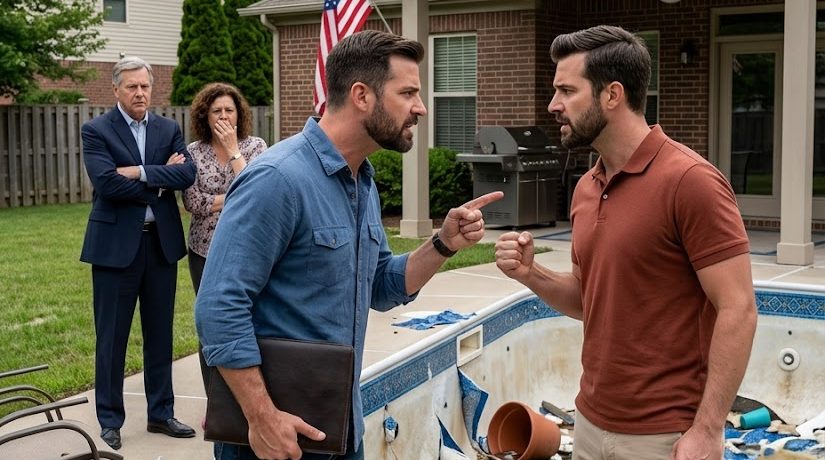
Behind it, the swimming pool I had spent years saving for sat deserted beneath the July evening sky. The deep-blue liner had pulled away from the walls in several spots. One circulation unit was broken near the shallow end, while muddy water had collected around the drain. Cedar planters had been knocked over across the stamped-concrete deck, spilling dark soil everywhere.
My wife, Sarah, stood a few feet behind me, both hands covering her mouth.
I recognized her brother Carter’s handwriting.
Matthew,
Pool parties are over. Maybe this will teach you not to rely on other people’s things. You wanted to take something that belonged to me, so now you know what it feels like to lose something you care about.
The pump may have been left off. Accidents happen.
I read the note three times.
My anger didn’t come out as shouting. Instead, it settled into a cold pressure beneath my ribs, making every sound seem sharper—the hum of the yard lights, Sarah’s uneven breathing, and the distant scrape of a trash bin being dragged along a neighbor’s driveway.
“Call him,” she whispered. “Call Carter right now.”
I folded the note carefully, once and then again.
“I’m not calling him.”
“Matthew, just look at the yard.”
“I am looking.”
“He needs to explain what happened.”
I placed the note inside a clean plastic sleeve from a folder in my home office. Even before I knew the cost of the damage, I understood that the note mattered. Carter hadn’t written it afterward in a moment of anger. He had deliberately left it in the middle of the destruction, certain that family pressure would protect him from consequences.
For eight years, that confidence had been rewarded.
I turned toward Sarah.
“Don’t warn him.”
Her hand stopped.
“What?”
“Do not call Carter. Don’t call your parents. And don’t post anything in the family group chat.”
“You’re scaring me.”
“I’m being clear.”
“What are you planning to do?”
I looked at the empty pool and remembered every summer Carter had behaved as though my backyard were his personal club.
The house and pool had not come easily.
I worked as a forensic financial analyst for a regional insurance and corporate-compliance firm. The title sounded boring, which was exactly how I preferred it. My days consisted of examining bank records, invoices, ownership papers, financial statements, and the little inconsistencies people assumed nobody would notice.
I rarely talked about my job during family gatherings. Sarah’s father, Joseph, once described me as someone who “moved numbers from one column to another.” Carter called me a professional paper pusher.
Neither of them understood that companies usually called me after somebody had already lied.
My job was to follow that lie until it reached a document that could no longer support it.
The position paid well, but I had never been careless with money. For three years, I packed my own lunches, delayed replacing my car, and deposited every annual bonus into an account I labeled Backyard.
Sarah and I didn’t have children. We owned a comfortable suburban home outside Columbus with a wide, level yard that had mostly been dirt and stubborn weeds when we purchased it.
I wanted one quiet place that was ours.
The pool cost forty thousand dollars.
It had a custom liner, stamped concrete, underwater lighting, and a shallow sun shelf where Sarah liked to sit and read. I added cedar planters, a gas grill, and an outdoor table large enough for meals with friends.
The first evening after construction was finished, I floated alone beneath the lights while darkness settled over the maple trees. After weeks of reviewing a complicated corporate fraud case, the water felt like silence I could actually touch.
For one summer, the backyard stayed peaceful.
Then Carter discovered it.
He showed up one Saturday without asking. His sons, Nathan and Luke, followed him through the side gate wearing swim trunks and carrying plastic pool toys. Carter dropped a cooler beside my brand-new lounge chair.
“Heard the rich guy finally finished his private resort,” he said.
I was reading beneath the umbrella.
“You could have called.”
“Family doesn’t need reservations.”
Sarah came outside carrying towels, happy to see her nephews.
“Carter, you should’ve told us.”
He opened a drink.
“I knew you wouldn’t mind.”
Then he looked at me, almost daring me to disagree with him in front of the children.
I let them stay.
That was the first concession.
By the end of the summer, Carter wasn’t simply visiting anymore.
He was making schedules.
Pool party Saturday at one.
Nathan is bringing four friends.
Make sure the filter is on.
The messages went to Sarah, hardly ever to me. They weren’t requests. They were announcements.
Carter showed up with children I had never met, bags of food, plastic toys, and a portable speaker that he placed beside the deep end. He used my grill, left grease on the grates, and drank whatever he found in the garage refrigerator.
When the gathering ended, the other children left with their parents. Carter loaded his cooler into his truck and drove away, leaving wet towels, soda cans, and broken toys scattered around the deck.
I cleaned everything.
The following weekend, he came back.
Sarah insisted the boys had nowhere else to swim. Carter and his former wife lived in separate small apartments, and neither complex had a pool.
“It’s only summer,” she said.
“It’s every weekend.”
“They love being here.”
“He never asks.”
“He assumes he’s welcome because he’s my brother.”
“That is the problem.”
She promised she would talk to him.
Nothing changed.
One Sunday evening, I spent almost two hours pulling pieces of water balloons out of the filtration basket. When I carried the dripping plastic into the kitchen, Sarah was loading the dishwasher.
“This needs to stop.”
She closed her eyes briefly.
“Matthew.”
“I want one weekend in my own backyard.”
“The boys had fun.”
“I’m not blaming the boys. Carter brings half the neighborhood, leaves everything behind, and behaves like I work for him.”
“He’s struggling.”
“Then he can still send a text asking permission.”
Sarah leaned against the counter.
“You know how defensive he gets.”
“His defensiveness doesn’t make the rules for our house.”
She looked exhausted.
“Please don’t make me choose between you.”
“I’m asking you to support a boundary in our home.”
To Sarah, those statements meant different things.
She had spent her entire life managing the tempers of her father and brother. Keeping the peace meant changing her own behavior before either man had to change theirs.
Joseph encouraged that arrangement.
He was a retired car salesman who spoke too loudly, wore far too much cologne, and treated every conversation like a deal he intended to close. He still considered himself the head of the family, even though all three of his adult children had homes of their own.
Sarah’s mother, Martha, protected him from disagreement.
She defended Carter even more strongly.
According to Martha, Carter never actually lost a job. He simply encountered managers who failed to recognize his initiative. His failed business ventures weren’t failures at all—they were promising ideas ruined by bad timing.
At Sunday dinners, Joseph praised Carter for being a hustler.
That word seemed to excuse almost everything.
His constantly changing jobs.
His unpaid debts.
His impulsive spending.
His inability to accept ordinary boundaries.
Two weeks after I asked Sarah to establish rules for the pool, we had dinner at her parents’ house.
Carter spent most of the meal talking about an argument with his supervisor. He said he had walked out of a meeting after being “disrespected.”
Joseph raised his glass.
“That’s what a man does. He knows his value.”
Carter looked across the table at me.
“Some guys let everyone walk all over them because they’re scared of making waves.”
I put down my fork.
“There’s a difference between standing up for yourself and being impossible to work with.”
The room went silent.
Martha’s fork made a faint metallic sound against her plate.
Joseph leaned toward me.
“You sit behind a desk all day. You don’t understand real business.”
“I understand keeping a job.”
Carter gave a humorless smile.
“Maybe you should worry about your own house.”
“I do. That’s why I’m asking you to stop treating my backyard like a public recreation center.”
Martha looked offended.
“The children love that pool.”
“The children are welcome when we invite them.”
“Family shouldn’t need an invitation.”
“People entering someone else’s home need permission.”
Joseph’s expression hardened.
“You have a big house and no children of your own. Carter is trying to give his boys good memories. You should be grateful you can help.”
“I’m happy to help. I’m not happy to be used.”
He laughed.
“You young professionals keep score over everything.”
I looked at Sarah.
She stared down at her napkin.
I waited for her to point out that I had paid for the pool, cleaned every mess, and never once told Nathan or Luke they weren’t welcome.
She said nothing.
Carter leaned back.
“Don’t worry, Dad. I’ll bring trash bags next time so the backyard prince doesn’t have to strain himself.”
Joseph laughed again.
That was when I realized I was alone at the table, even though my wife was sitting right beside me.
I left before dessert.
During the drive home, Sarah apologized for her father.
“He’s old-fashioned.”
“He mocked me in front of everyone.”
“He talks that way to all of us.”
“That doesn’t make it acceptable.”
“I was trying not to make things worse.”
“For whom?”
She turned toward the passenger-side window.
The answer was obvious.
The pool parties went on for another three years.
Instead of arguing every weekend, I withdrew. I worked in my home office with noise-canceling headphones while Carter took over the backyard. I stopped inspecting the grill until Sunday evening because seeing the mess while the party was still going on only made me more frustrated.
The resentment built slowly and quietly.
Then, one July, I finally reached my breaking point.
For six months, I had been investigating a manufacturing company and several supposed vendors that existed only on paper and invoices. My workdays regularly lasted more than ten hours. I woke up thinking about transaction dates and went to sleep with spreadsheets running through my mind.
Sarah and I hadn’t taken a vacation in two years.
I booked five days near Yellowstone.
We arranged our flights, reserved a campsite, and booked two nights at a small lodge to finish the trip. I planned easy-to-moderate hikes and enough peaceful time to remember why we had chosen each other in the first place.
We needed a tent.
Carter owned an expensive four-person tent he had purchased during a short-lived obsession with outdoor living. He used it once, complained about the insects, and then stored it away.
“Ask him,” Sarah suggested. “He hasn’t used it in years.”
I didn’t want to call him, but purchasing another expensive tent for one trip seemed wasteful.
Carter answered with loud music playing in the background.
“What’s up?”
“Sarah and I are going camping next week. Could we borrow your tent for five days? I’ll clean it before giving it back, and if anything gets damaged, I’ll replace it.”
The music became quieter.
“You’re serious?”
“Yes.”
“You want to borrow my camping equipment?”
“I’m asking about the tent.”
“That thing cost four hundred dollars.”
“I know.”
“And you expect me to just hand it over?”
“For five days.”
He laughed.
“Buy your own, Matthew.”
I remained silent.
He continued, clearly enjoying the situation.
“You have a big house, an expensive pool, and a good job. Now you’re calling me because you don’t want to spend money on a tent. That’s embarrassing.”
“You’ve used my pool every summer for four years.”
“A pool just sits there.”
“It still costs money to maintain.”
“It’s water in a hole. My tent is actual equipment.”
My grip tightened around the phone.
“You’ve brought dozens of people to my house without contributing to the water, electricity, food, or cleanup.”
“Nobody forced you to build a resort.”
Then the call ended.
I stood in the kitchen staring at my dark phone screen.
Sarah came in carrying hiking socks.
“Is he bringing the tent over?”
“He said no.”
Her shoulders dropped.
“He called me embarrassing for asking. He said the pool is just water in a hole and his tent is valuable property.”
She shifted the socks in her hands.
“He probably felt insecure.”
“He insulted me.”
“You make a lot more money than he does.”
“That has nothing to do with basic respect.”
“We can just buy one.”
“That isn’t the point.”
Sarah’s expression became tense.
“You always hold onto every little thing he says.”
“This isn’t a little thing.”
“I’m exhausted from being stuck between you and my family.”
“I didn’t put you there.”
She dropped the socks onto the counter.
“Then stop relying on Carter and buy the tent.”
Her words hurt more than anything her brother had said.
I studied her expression.
For years, I had believed she understood the imbalance but simply lacked the courage to confront it.
At that moment, I realized something worse.
She had started believing their version of me.
The man who owned the house, maintained the pool, and covered most of our expenses had somehow become the person taking advantage.
“I’ll buy the tent,” I said.
At the sporting-goods store, I selected an all-weather model that cost just over four hundred dollars.
As the cashier scanned it, something occurred to me.
How had Carter bought his tent?
At the time, he was behind on rent and borrowing money to repair his truck. Yet he had supposedly spent more than four hundred dollars on camping equipment he used only once.
When I got home, Sarah was upstairs.
I went into my office and opened the cabinet where we kept our old financial records.
Two years of credit-card statements sat inside labeled folders.
I found the purchase within ten minutes.
$435.50.
Outdoor sporting-goods store.
Sarah’s personal credit card.
The balance had been paid from our joint checking account, which at that time contained mostly my income.
I took the statement upstairs.
Sarah was standing beside the dresser, drying her hair.
“You bought Carter’s tent.”
She froze.
The towel stopped against her shoulder.
“What?”
I handed her the statement.
“You charged it to your card and paid the balance from our joint account.”
Her eyes moved down to the page.
“Dad asked me to.”
“Why?”
“Carter wanted to take the boys camping. Dad said his own card was maxed out and promised he’d pay us back.”
“Did he?”
Sarah looked down.
“No.”
Whatever warmth remained in the conversation disappeared.
“Your father used our money to buy Carter a tent.”
“I intended to tell you.”
“You had two years.”
“I knew you’d be angry.”
“So when I asked to borrow something I had essentially helped pay for, Carter mocked me, Joseph backed him up, and you called me dependent.”
“I didn’t know Carter would respond like that.”
“You knew who paid for it.”
She began crying.
“I was trying to prevent an argument.”
“You didn’t prevent anything. You delayed it and put me on the losing side.”
I folded the statement and placed it back inside the folder.
That night, we packed for Yellowstone in separate rooms.
That morning, I met with Aaron Miller, an attorney who was also a longtime friend.
His conference room overlooked downtown. I laid Carter’s note, Elijah’s estimate, photographs, the insurance incident number, the credit-card statement, and copies of the notebook pages across the table.
Aaron picked up the note first.
“He left this in your backyard?”
“Under a rock.”
“He signed it.”
“Yes.”
Aaron removed his glasses.
“Your insurance company will probably repair the pool and then seek reimbursement from him. That claim alone could put significant financial pressure on him.”
“What about the parties?”
“Since he charged fees, they weren’t simply family gatherings. Your homeowners association could consider them unauthorized commercial use. The city might also want to determine whether permits or liability coverage were required.”
“I want everything handled properly.”
“Then we move carefully. No public threats. No emotional messages. Preserve everything and allow each process to work.”
He tapped the notebook.
“Do not use private employment systems or restricted databases to investigate Carter. Stick to public records and documents you are legally allowed to access.”
“I understand.”
“You work in financial investigations. That makes respecting that boundary even more important.”
“I agree.”
Aaron leaned back in his chair.
“What result are you looking for?”
“I want my pool restored.”
“That’s straightforward.”
“I also want Carter to stop using my property and understand that being family does not eliminate responsibility.”
“That could be more difficult.”
“Then we make the evidence impossible to dismiss.”
The insurance adjuster arrived later that afternoon.
He inspected the pool, photographed the note, and examined Elijah’s report.
“The written statement makes the cause review easier,” he said carefully. “We’ll still complete our normal investigation.”
“That’s fine.”
“After the claim is paid, our recovery department may seek reimbursement from the person responsible.”
“I understand.”
The homeowners association began its own review after receiving the dates and payment records. The city’s zoning office also requested information concerning the paid events.
I had no reason to exaggerate anything.
Carter’s own notebook listed names, dates, and amounts.
Public payment-app records confirmed that several parents had sent him money marked “pool day,” “summer program,” and “swim party.”
Another pattern emerged from those records.
After receiving the payments, Carter transferred rounded sums to a small consulting company called Apex Event Services.
The company was registered to a post-office box. Public filings identified David Vance as its organizer.
I recognized that name from a financial matter my firm had examined several months earlier.
I did not access the restricted case file.
There was no need.
I told Aaron that a possible connection existed and reported the public information through my company’s conflict and compliance procedures. From that point onward, independent professionals handled the matter.
The connection did not establish that Carter knew everything about Vance’s business.
It did show that he had moved money through an entity already facing financial scrutiny.
That alone raised questions he would eventually have to answer honestly.
Aaron warned me not to contact Carter.
“He’ll receive information about the insurance recovery, association investigation, and city inquiry through formal notices.”
“What about the broader financial issue?”
“Your employer will decide whether it belongs within the existing review. Stay out of that determination.”
I nodded.
One of the most difficult parts of an investigation is knowing when the evidence is no longer yours to handle.
That evening, Sarah sat across from me at the kitchen table.
“Mom wants a family meeting.”
“No.”
“She thinks everyone should talk about this before outside people become involved.”
“Outside people are already involved because Carter damaged property and kept financial records.”
“She says Uncle Charles should host it.”
That changed my answer.
Charles Bennett was Joseph’s older brother, a retired judge known for his patience and strict sense of fairness. He rarely attended family gatherings and never tolerated Joseph’s attempts to dominate a discussion.
He also managed the family trust established by their late mother.
Joseph acted differently whenever Charles was around.
“When?”
“Sunday afternoon.”
“Carter will be there?”
“Yes.”
“Then I’ll attend if Aaron agrees, and only if the purpose is to present documented facts rather than pressure me into withdrawing anything.”
Sarah swallowed.
“What happens to us after this?”
“I don’t know.”
“Are you thinking about leaving?”
“Yes.”
She closed her eyes.
“How long have you been considering it?”
“Since you called me dependent because I asked to borrow a tent we had already paid for.”
Tears appeared in her eyes, but she didn’t use them to end the conversation.
“I don’t know how to choose you without feeling like I’m abandoning them.”
“You shouldn’t have to abandon your family. You need to stop letting them treat our marriage like something they can use.”
She stared down at the table.
“I want to try.”
“Then Sunday is where you start.”
Charles lived in a stone house surrounded by trees on a wooded property outside the city.
When Sarah and I arrived, Joseph’s Cadillac and Carter’s truck were parked near the circular driveway. Martha stood in the formal living room, nervously twisting her wedding ring. Joseph was beside the fireplace holding a drink.
Carter was sitting on a leather sofa with his boots resting on the coffee table.