 208 views
 Ten years after the woman I loved disappeared without giving me a reason, she suddenly returned to my doorstep with one final request.
She wanted me to marry her.
I believed saying yes might finally provide the answers I had spent ten years searching for.
Instead, Cara died just five days after our wedding—and left behind 127 letters that revealed a truth completely different from everything I had believed about her disappearance.
PART 1
I met Cara during my first week at college.
She had taken my seat in a packed sociology lecture and refused to give it back.
“You can sit next to me,” she said, looking at my notebook, “but only if your handwriting is actually useful.”
I sat down.
By the time the class ended, I was already falling in love with her.
For three years, we were inseparable.
We studied side by side, prepared awful meals in tiny apartments, and spent Sunday mornings arguing over crossword clues.
Cara dreamed of buying an old house with green shutters.
I dreamed of graduate school, research, and seeing the world.
Somehow, we believed we could make both dreams happen.
Then, one evening, everything changed.
I had just been accepted into graduate school when Cara asked me a simple question.
“When do you think we’ll have children?”
I laughed nervously.
“Not for a long time. There’s still so much I want to experience.”
Her expression changed.
I thought she was trying to pressure me.
She thought I wasn’t taking her seriously.
The argument quickly turned bitter.
The next morning, her side of the closet was empty.
Her phone no longer worked.
Her accounts had vanished.
Cara was simply gone.
I spent ten years searching for her.
Not every day.
But often enough that her disappearance affected every relationship I had afterward.
Then, on a rainy Thursday evening, my doorbell rang.
Cara was standing on my porch.
She was thinner.
Pale.
She looked so weak that she had to hold onto the railing.
But I knew her instantly.
“Hi,” she whispered.
I should have demanded an explanation.
Instead, I invited her inside.
We sat facing each other.
Then she told me something I never expected to hear.
“I’m sick. It’s terminal.”
I stared at her.
“How much time do you have?”
“A few months. Maybe less.”
Then she reached across and took my hand.
“I came here to ask you for something.”
She wanted me to marry her.
I actually laughed.
“You vanished for ten years, came back dying, and now you want to get married?”
“I know.”
“No, Cara. You really don’t.”
Her fingers tightened around mine.
“Please.”
I should have said no.
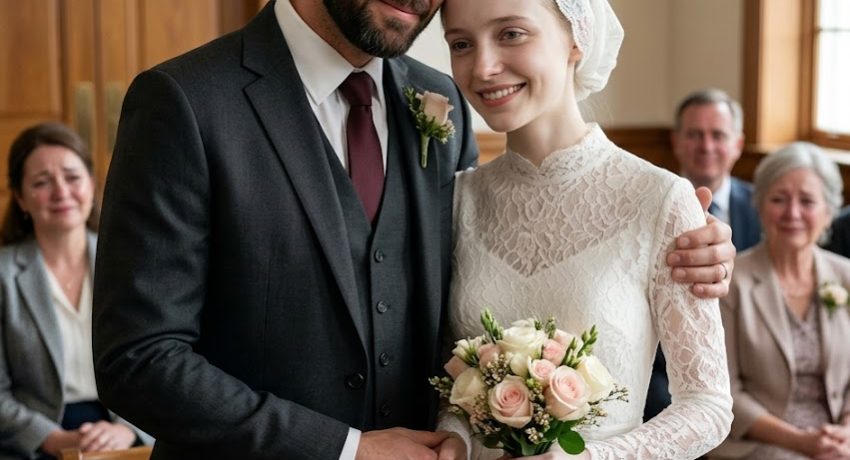
Instead, two days later, we stood together inside a courthouse.
Cara wore a simple blue dress.
She was so weak that I had to support her while we exchanged our vows.
When the clerk declared us married, she smiled exactly like the twenty-year-old woman I remembered.
For five days, we lived through a strange little miracle.
We had breakfast in bed.
We watched old movies.
We listened to the rain together.
Whenever I asked why she had come back, she gave me the same answer.
“Later.”
There simply wasn’t enough time for later.
Cara died beside me on the fifth night.
At her funeral, while the casket was being lowered, a woman I had never seen before approached me.
She placed an envelope in my hand.
Inside was a brass key.
“There are 127 letters waiting for you,” she told me.
“Start with the oldest.”
PART 2
The woman introduced herself as Mara.
She had once been Cara’s roommate.
She drove me to the apartment where Cara had been living and took me into her bedroom.
Beneath a row of coats was a dark wooden trunk.
“She wrote letters to you for years,” Mara explained.
“Then why didn’t she ever send them?”
Mara looked directly at me.
“Because fear became the reason she kept waiting.”
I opened the trunk.
Inside were dozens of envelopes, organized by date.
Every single one carried my name in Cara’s handwriting.
The oldest letter was dated three days after she disappeared.
I opened it.
The first sentence left me completely frozen.
I am pregnant.
Cara had discovered she was pregnant only hours before our final argument.
When I talked about graduate school, Europe, and waiting several years before having children, she panicked.
She convinced herself that telling me would ruin the future I had planned.
So she went to her mother’s house, planning to come back once she had figured out what to say.
She never had the opportunity.
Complications ended the pregnancy.
The next letter described a hospital room and Cara going through everything by herself.
I lost our baby. Then I lost myself.
After that came years of letters filled with intentions she never followed through on.
I’ll call tomorrow.
I bought a train ticket.
I found your office number.
Every time, fear won.
Too much time had gone by.
I would hate her.
Maybe I had already moved on.
Then the letters became even more painful to read.
Cara knew where I lived.
She knew whenever I changed jobs.
She even learned about my failed relationships because mutual friends unknowingly passed information along.
Twice, she traveled to my city.
Twice, she came close to my home.
Twice, she turned around.
“You knew about all this?” I asked Mara.
She nodded.
“I tried to convince her to contact you.”
“But you allowed it to keep happening.”
“I couldn’t make that choice for her.”
Over the next several days, Mara took me to places Cara had written about in her letters.
A diner where she had once dialed half my phone number before losing her nerve.
A park bench where she sat with my number written on a napkin.
An apartment building where she once watched me enter with Elise, a woman I had dated for eight months.
Cara assumed I was happy and decided she had no right to interfere.
“She never knew Elise left because I couldn’t stop thinking about her,” I said.
Mara lowered her eyes.
“No. Cara never found that out.”
Our final destination was our old college campus.
Behind a loose brick near the greenhouse, I discovered a small metal box.
Inside was an ultrasound photograph.
And Cara’s final letter.
She explained that she had not returned expecting me to forgive her.
Her diagnosis had simply forced her to understand how much of her life had been ruled by fear.
She refused to allow fear to make one last decision for her.
She came back because I was still the only person she could picture spending whatever time remained with.
“Five days were never supposed to make up for ten years,” she wrote.
“They were simply the only honest days I had left to give you.”
I held the letter tightly.
“I wish she had trusted me.”
Mara answered softly.
“So did she.”
PART 3
It took me three weeks to read all 127 letters.
Some made me miss Cara so intensely that breathing became difficult.
Others left me furious.
She had loved me.
She had hurt me too.
One truth did not cancel out the other.
One afternoon, Mara asked me:
“Do you hate her?”
“Sometimes.”
“Do you forgive her?”
“Sometimes.”
Mara nodded.
“Anything simpler would probably be dishonest.”
Eventually, I copied every letter and organized them chronologically into a private book.
The originals stayed safely locked inside Cara’s wooden trunk.
At the beginning of the book, I wrote a single sentence:
Love can be genuine and still fail people terribly.
Then I contacted our former college.
I arranged for a copy of the letters to be placed privately in the school archives with restricted access.
Not because I wanted strangers reading Cara’s suffering.
I wanted there to be a record of what fear and silence can cost.
Then I created something else.
The Open Door Fund.
It offered emergency assistance to students dealing with pregnancy, serious illness, medical crises, or circumstances where they felt they had nowhere safe to turn.
About a year later, we received an application from a student named Lena.
She was pregnant.
Her family had threatened to abandon her if they discovered the truth.
Near the bottom of her application, she had written one sentence:
I do not know who I can safely tell.
The committee approved her request.
A few days later, I met Lena near the greenhouse where Cara and I had once spent so much time.
She sat nervously on a bench, twisting a bracelet around her wrist.
“Am I in trouble?” she asked.
“No.”
I handed her the approval documents.
She read them and covered her mouth.
I never told her about Cara.
I never told her about the pregnancy Cara had kept secret.
I never mentioned the 127 letters.
Or the ten years we lost because Cara believed she had to face every impossible decision alone.
I simply told her what I wished someone had told Cara years earlier.
“You don’t have to figure everything out by yourself.”
Lena looked at me.
And at that moment, I finally understood what I could do with all those lost years between Cara and me.
I couldn’t change the decisions she had made.
I couldn’t recover the decade that vanished between us.
I couldn’t give us anything beyond those five final days.
But perhaps I could make sure someone else found an open door before fear convinced them to disappear.
Cara’s silence cost us ten years.
I could never undo that.
But maybe her story could prevent someone else from losing the same.