
 143 views
 Part 1
Losing my eyesight transformed the way I lived, but more than anything, it changed the way I trusted the people closest to me. Looking back now, I realize the darkest chapter of those years had very little to do with what I could or couldn’t see.
The warm afternoon sun filtered through the window as I sat quietly, wrapping both hands around a mug of tea that appeared only as a blurry shape. After eleven years of marriage, every part of my daily life had settled into familiar routines.
I recognized my home through its sounds instead of its appearance.
The steady hum of the refrigerator.
The rhythmic ticking of the hallway clock.
The deep rumble of Brian’s car pulling into the driveway every evening.
I was thirty-five years old, and I hadn’t clearly seen my own reflection in nearly a decade.
When Brian and I got married, my vision was perfectly normal.
Just one year later, I was diagnosed with a rare eye disease that slowly stole my sight.
First, road signs became impossible to read.
Then people’s faces gradually lost their details.
Eventually, everything dissolved into faded outlines and soft shadows.
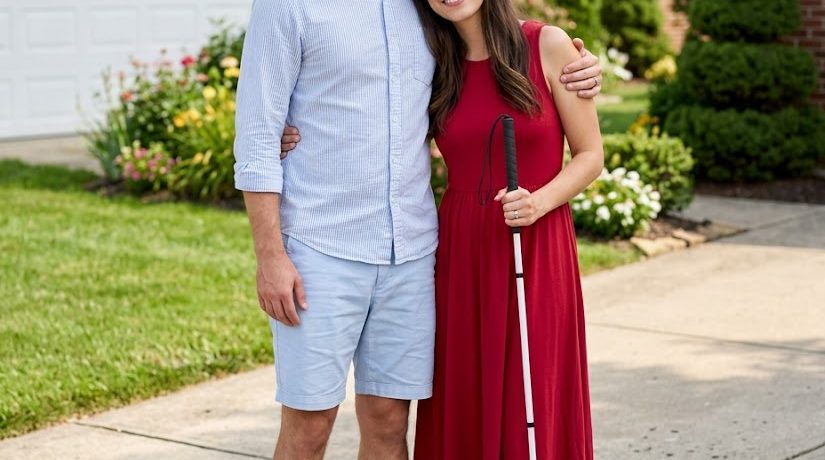
By the fourth year, I relied on a white cane.
By the sixth, I stopped pretending I could handle everything on my own because navigating unfamiliar places had become nearly impossible.
Within a few more years, almost all of my eyesight had disappeared.
I could distinguish little beyond light and large shapes.
Brian took over nearly every responsibility.
He drove me wherever I needed to go, read my mail aloud, and handled every task that required good vision.
“Don’t worry about the garage, sweetheart,” my husband told me one afternoon, gently guiding me back toward the kitchen. “I’ll take care of it now that you’re comfortable inside.”
The garage had gradually become crowded with different machines and supplies that Brian claimed were meant to help with my condition.
He also said that was where he kept his tools, storage boxes, and car equipment.
“I could help organize everything,” I suggested.
“Gina, please,” he replied. “There’s nothing in there you need to worry about. Let me handle it. If you need anything, I’ll get it for you.”
I still remember the tension that crept into his voice every time I mentioned the garage.
I convinced myself it came from concern.
I believed that was what love looked like.
I believed that was what devotion sounded like.
My best friend, Marissa, didn’t see it that way.
“You’ve changed, Gina,” she told me one afternoon while we sat together at the kitchen table. “You used to challenge everyone. Now you wait for Brian to make every decision.”
“I know he means well.”
“I know,” she answered. “But did you ever look into the clinical trial I sent you?”
“Brian says the chances are slim. He doesn’t want me getting my hopes up.”
Marissa fell silent.
I had nothing to say.
Somewhere along the way, I had stopped asking myself whether that was really true.
For years, every specialist had told me there was nothing more they could do.
Then, one month earlier, Marissa discovered an experimental laser treatment being offered through a clinical research program.
The doctors made it clear there were no guarantees, and Brian insisted I was only setting myself up for heartbreak.
Brian slowly laid his fork on the table.
“Sweetheart, we’ve already talked about this.”
“I know… I just thought…”
“You’re only going to hurt yourself,” he said, and I heard that familiar strain in his voice again. “I don’t want to watch you fall apart if it doesn’t work.”
I took a slow breath.
“I’ve spent a long time thinking about it,” I replied. “Marissa has already offered to help me through recovery no matter what happens.”
“Marissa,” Brian repeated flatly. “Of course she has.”
He didn’t argue anymore.
Instead, he changed the conversation to the leftovers, and I let him because confronting Brian had never been easy for me.
A few days later, he left for another week-long business trip.
He kissed my forehead before leaving and promised to call every evening.
The house became painfully quiet.
With Marissa’s encouragement, I decided to move forward with the surgery anyway.
The following afternoon, she arrived holding an acceptance letter from the clinic.
I had been approved for the trial.
That evening, I found myself remembering the woman I had once been before my diagnosis.
The woman who argued with a contractor until he rebuilt our entire back porch.
The woman who chose every paint color herself.
The woman who drove all the way to Asheville just to admire the autumn leaves.
Little by little, I had handed those parts of myself over to Brian until dependence became routine, and routine slowly became my identity.
For the first time in years, I was making a decision entirely on my own.
The next morning, Marissa knocked on my door carrying coffee and an overnight bag packed for the clinic.
“Are you absolutely sure about this, Gina?”
Dr. Halim was kind, patient, and completely honest about every possible risk.
The surgery itself was much quicker than I expected.
Recovery felt far stranger.
For the first two days, everything looked like a blurry watercolor painting.
On the morning of the third day, I opened my eyes and saw the ceiling fan.
I truly saw it.
The blades.
The pull chain.
Even the thin layer of dust gathered along the edges.
I cried for nearly an hour.
A few days later, once Dr. Halim confirmed I could safely return home, Marissa drove me back.
I stood in the hallway, taking in details I had forgotten were even there.
“The curtains are blue,” I whispered. “I always thought they were green. Brian kept telling me they were green.”
“They’ve always been blue,” Marissa replied gently.
I wandered through the house as if I were seeing someone else’s home for the very first time.
The family photographs resting on the mantel.
The small chip in the coffee table.
My own face reflected in the bathroom mirror—older than I remembered, but undeniably mine.
“I don’t want to tell Brian yet,” I said quietly. “I want him to walk through that door and realize I can actually see him.”
Marissa smiled, though there was hesitation in her expression.
“Whatever feels right to you, Gina.”
She left later that afternoon after promising she’d check in on me.
Once the house fell silent again, I suddenly remembered the Christmas light boxes Brian always claimed were stored in the garage.
He had talked about them for years.
Boxes of tangled lights from previous holidays, supposedly sitting untouched in the garage.
I wanted to hang them around the living room.
I hadn’t actually seen Christmas lights sparkle in years.
I walked toward the back door of the kitchen—the one I hadn’t opened in longer than I could remember.
My hand settled on the doorknob.
The metal felt cool beneath my fingers, slightly loose, exactly the way I had imagined during all those years when I could no longer see it.
I turned the handle.
The garage door creaked open.
I stepped inside expecting the familiar smell of dust, gasoline, and motor oil.
Instead…
I smelled lavender.
My hand found the light switch through instinct alone.
The lights flickered on.
And everything I believed about my life disappeared in an instant.
I froze.
There were no storage boxes.
No tools.
No machinery.
No automotive equipment.
Instead, the garage had been transformed into a cozy living space.
A soft gray sofa sat beside a coffee table.
A neatly made bed occupied one corner.
A woman’s coat hung neatly from a hook beside the side entrance.
Framed photographs lined the shelves.
I slowly stepped closer, my legs trembling beneath me.
Brian appeared in every picture.
His arm wrapped around a dark-haired woman as they smiled together on a beach, inside a restaurant, and beside a Christmas tree I had never seen before.
My hands began to shake.
“This can’t be real!” I screamed.
A pile of mail sat neatly on a small side table.
I picked up the top envelope.
It was addressed to a woman named Penelope.
I immediately assumed she was the woman smiling beside my husband in every photograph.
My fingers trembled as I reached for my phone and called Marissa.
“Gina? What’s wrong?”
She arrived less than twenty minutes later.
I heard her heels crossing the driveway before she stepped into the open garage.
Then she stopped cold.
“Oh my God,” she whispered. “Gina… what is all this?”
“This,” I replied quietly, “is what Brian has been hiding from me.”
“For who knows how long.”
“We need to search for anything that explains all of this,” Marissa said.
So we did.
Inside one of the drawers, Marissa found a folder filled with documents.
The paperwork included permits and contracts showing Brian had converted the garage into a livable apartment six years earlier.
Six years.
But the invoices for furniture, utility services for a second resident, and address-change paperwork had all been issued within the last four months.
Before that, a framed certificate hanging on the wall identified the room as:
“B. Whitfield – Private Office.”
He had created the space years before moving her into it.
Near the side door, I discovered another set of car keys.
Inside the tiny bathroom sat a woman’s toothbrush.
Then Marissa handed me a folded note.
“You need to read this.”
The handwriting curved neatly across the page.
It was addressed to Brian.
The paper trembled in my hands.
“He told her I was dying,” I whispered.
My own voice barely sounded familiar.
“He told her I was going to be placed in a care home.”
Marissa gently wrapped an arm around my shoulders.
“Gina,” she said softly. “Take a breath.”
I slowly lowered myself onto the edge of the stranger’s bed and stared at the woman’s coat hanging beside the door.
For one long, painful minute, I allowed myself to relive all eleven years of our marriage.
The white cane Brian had always guided me with.
The meals he carefully cut into bite-sized pieces.
Every gentle sentence.
“Let me get that for you.”
Every warning that the garage was too cluttered…
Too dangerous…
Too unsafe for me to enter.
Then something inside me changed.
I stood up.
“Marissa,” I said. “Take photos of everything. The pictures, the paperwork, the letter… every single piece of it.”
She looked at me in surprise.
“Are you certain?”
“I’m not going to fall apart now,” I replied. “I can finally see again, and I’m going to use that advantage. I’m going to be far smarter than Brian ever believed I could be.”
Marissa and I spent the next two hours carefully photographing and documenting everything inside the garage.
Then she gave me the contact information for a family lawyer she completely trusted.
I called the office immediately and booked the earliest appointment they had available.
Inside the same drawer that held the permits, Marissa found a small leather notebook covered with Brian’s cramped handwriting.
It contained passwords.
She read the online banking credentials aloud while I entered them into my phone, and together we accessed our joint account.
That was when I saw it.
Years of carefully planned withdrawals.
Small transfers sent to accounts I had never known existed.
Brian hadn’t just betrayed me.
He had been quietly preparing his escape while I remained trapped in darkness.
I hardly slept that night.
By nine o’clock the following morning, I was sitting across from the attorney, spreading photographs and screenshots across her desk.
She listened without interrupting, asked a few direct questions, and filled page after page with notes.
When the meeting ended, she sent me home with an initial case file, a checklist, a preservation letter, and a draft request for full financial disclosure.
Then she instructed me to wait until she contacted me again.
By that evening, the folder sat on the kitchen counter, and another meeting had already been scheduled for the end of the week.
Then I heard the front door open.
Brian’s voice drifted through the house.
Relaxed.
Cheerful.
I stood quietly in the living room.
A strand of Christmas lights I had found in the hallway closet—not in the garage—glowed softly across the furniture.
Brian stepped inside.
The color vanished from his face the instant he saw me standing there without my white cane.
“Gina?”
“I had the surgery,” I said calmly. “I opened the garage. And I know about Penelope.”
A nervous laugh escaped him.
Then his smile faded.
Something colder replaced it.
“You don’t understand what these past years have been like for me,” he said. “I needed someone who could actually see me.”
“Then look at me now, Brian,” I answered quietly. “Because I see you exactly as you are.”
I placed the folder my attorney had prepared into his hands.
Inside were separation papers.
Requests for complete financial disclosure.
And copies of every document we had found inside the hidden living space behind the garage door.
“Your mistress believes I’m dying,” I continued.
“She thinks I’m about to be moved into a care facility.”
“Gina… please…”
While Marissa had been photographing the room, I had noticed another envelope resting on the side table.
It was addressed to Penelope.
Her phone number was written beneath the return address.
Before leaving, I copied it down.
Brian stepped closer, his voice breaking with desperation as he reached for my hand the same way he had countless times before.
I moved away.
“The woman you believed would never truly see you again is standing right in front of you.”
“And now… I see everything.”
Without saying another word, I walked away.
Several weeks later, I sat beside the window in my own small apartment.
The Christmas lights I had finally hung reflected softly across the glass as evening settled outside.
Marissa knocked on the door carrying takeout containers and a bottle of wine.
“You look different,” she said with a smile.
A short note from Penelope rested on the kitchen counter.
It contained only one sentence.
“Thank you for telling me the truth.”
I looked toward the glowing lights.
Then I looked at my reflection in the window.
Losing my eyesight had taught me how to depend on other people.
Getting my vision back taught me how to depend on myself.