Frank Porter turned onto King Street and eased his foot off the accelerator, already scanning the curb for an open space even though the hospital was still a few blocks away. On the back seat of his Mercedes sat a bouquet of white roses, three glossy bags from an upscale children’s boutique, and a beige newborn car seat patterned with tiny bears—the most expensive one in the department, because he had stood there that morning and decided his great-nephew would have the best of everything from his very first week in the world.
December twenty-seventh. Four days until New Year’s. Snow drifted in slow, pale spirals across the asphalt, wrapping itself around lampposts laced with holiday lights. The city had that late-December glow to it, half celebration, half exhaustion. The thermometer on the dashboard read five degrees.
Frank smiled anyway.
For the first time in years, he felt something close to uncomplicated happiness. His niece, Elena, had given birth to a baby boy. They had named him Timothy after Frank’s father. Seven pounds, eight ounces. Twenty inches long. Healthy, loud, and, according to the nurse on the phone, already blessed with his mother’s eyes.
He parked near the hospital entrance. On the steps stood a small artificial Christmas tree wrapped in blue tinsel. In the admissions window, someone had taped up a cotton-ball snowman with crooked black-paper buttons. People moved in and out under the revolving doors in a cheerful blur—young fathers carrying flowers, grandmothers hauling oversized bags, tired but glowing faces lit by the promise of a new life waiting upstairs.
Frank got out, buttoned his wool overcoat, and started toward the entrance.
Then his gaze caught on a bench to the left of the steps.
Someone was sitting there.
At first, he did not understand what he was seeing. Just a hunched figure bowed over something wrapped in blankets, dusted white with fresh snow. A homeless woman, maybe, he thought. Or someone drunk. Chicago always had people at its edges, swallowed by cold and misfortune. But something about the shape of that body, the angle of those shoulders, tugged at him hard enough to make him change direction.
He stepped closer.
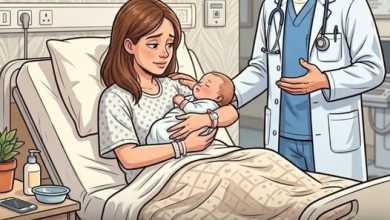
A young woman in a hospital gown over a nightshirt. An oversized, threadbare coat hanging off her shoulders. A bundle crushed to her chest with desperate, rigid arms. Her whole body was shaking so violently the bench itself seemed to tremble beneath her.
She was barefoot.
Barefoot on an icy bench in five-degree weather.
Frank stopped so abruptly he felt the shock of it in his chest.
His heart dropped.
“Elena.”
She lifted her head.
Her lips were blue, almost purple. Wet strands of hair clung to her temples, already stiffening in the cold. Snowflakes stuck to her eyelashes. Her pupils were blown wide, making her eyes look huge and hollow at the same time, like fear had eaten the rest of her from the inside out.
“Uncle Frank.”
The words came out as a hoarse whisper, so faint he almost thought he imagined them.
She tried to stand, but her legs gave beneath her.
In two long strides he was there. He ripped off his own coat, wrapped it around her shoulders, and gathered her up with the baby still clutched to her chest. She weighed almost nothing. It was the first thing that terrified him. The second was the cold radiating off her body. It cut straight through his cashmere sweater like she had been sitting in a freezer instead of out in the open air.
“My God, Elena, what happened? Where’s Max? Why are you out here?”
She did not answer. She only shivered harder and tightened her grip on the baby.
Frank nearly ran back to the car. He got her into the back seat, slammed the door, cranked the heat to the highest setting, and yanked off his sweater to wrap around her frozen feet. The skin looked wrong—white, waxy, almost translucent.
“Timmy,” Elena whispered. Her teeth chattered so hard the name broke in the middle. “Look… he’s breathing.”
Frank leaned in at once and peeled back the corner of the blanket.
A tiny pink face. Wrinkled, warm, sleeping. The baby smacked his lips in his sleep and made a faint, soft noise.
Frank let out a breath he had not realized he was holding.
“He’s breathing, honey. He’s fine. He’s breathing. It’s okay.”
He slid into the back seat beside her and pulled her against him, trying to warm her with his own body. The car was quickly filling with heat, but Elena kept shaking, every muscle locked in cold and shock.
“How long were you out there?”
“I don’t know.” Her voice was thin and scraped raw. “An hour, maybe. The security guard wouldn’t let me back in. Said I’d been discharged. Said they didn’t have space.”
Frank stared at her.
“Why didn’t you call me?”
“I did. You didn’t answer.”
He snatched out his phone.
Three missed calls from Elena.
He had been in the shower. Then dressing. Then driving with music on low, thinking about flowers and baby gifts and whether Timothy would have Elena’s smile. He had never heard the phone.
A wave of guilt hit him so hard it made him dizzy.
“God,” he said roughly. “I’m sorry. I’m so sorry. But where is Max? He was supposed to pick you up.”
Elena’s face changed.
Not much. Just enough for him to see something collapse behind her eyes.
She reached into the pocket of the hospital gown with slow, stiff fingers and handed him her phone.
A text message was already open.
The condo is my mom’s now. Your stuff is by the curb. Don’t bother suing for child support. My official salary is minimum wage. Happy New Year.
Frank read it once.
Then again.
Then a third time, because surely there had to be another meaning hidden somewhere in those words, some explanation that did not sound like a man had thrown his wife and newborn child away like garbage.
He looked up.
“What does this mean?”
And Elena told him.
The Uber had arrived at ten that morning.
She had been waiting for Max since nine. He had promised he would come straight from work, that he would carry Timmy out himself, that they would go home together, the three of them, like a family. At nine-fifteen, instead of seeing him walk through the hospital doors, she got a text.Family
Can’t get away. Called you an Uber. It’s paid for to your building.
She had not even been surprised.
That was the part that shamed her now. In the last few months of pregnancy, she had grown used to disappointment. Used to excuse after excuse. Work. Meetings. Deadlines. Emergencies. Max had learned to say vague things with such calm confidence that by the time she started doubting him, she doubted herself more.
So she went downstairs carrying Timmy, still sore and weak from labor, climbed into the Uber, and gave the driver the address.
When the car pulled up in front of their building, black trash bags were lined along the curb near the entrance.
At first, she did not understand.
She stood there in her hospital slippers, the cold already leaking through the thin soles, and stared at the bags as if she were looking at someone else’s life split open in the snow.
Then the wind shifted and one bag rolled slightly. Clothes spilled out. A sweater. Books. Framed photos with the glass shattered. A shoebox split down the side. Her cosmetics case. Her winter scarf.
And then she saw the mug.
A cream-colored mug with a black cat on the side, the one Uncle Frank had given her on her twentieth birthday because she had once told him all accountants deserved one eccentric desk item to preserve their sanity.
It lay in the snow, broken clean in half.
The Uber driver had already pulled away. The ride, Max had arranged, was paid one way only.
Elena stood on the sidewalk in her hospital gown and slippers with a three-day-old baby in her arms while five-degree wind knifed through her coatless body.
Then Mrs. Diaz from the third floor came out.
The older woman took one look at her, gasped, ran back inside, and came hurrying out again with an old oversized coat, helping Elena shove her arms into it with clumsy, numb hands.
“Honey, what happened? Did he kick you out? Your Max?”
“I don’t understand,” Elena had said, because at that moment confusion hurt more than panic. “This is our condo. My uncle gave it to us for our wedding.”
“Barbara was here this morning,” Mrs. Diaz whispered, though not nearly quietly enough to hide the disgust in her voice. “Screaming so the whole building could hear. Called you a liar. A thief. A stray little orphan. They changed the locks.”
Elena had felt something inside her go loose and hollow.
“But it’s my condo.”
“I don’t know, sweetie. I don’t know. Let me call you a cab. Where do you need to go?”
And that was when the truth hit her in its ugliest form.
She had nowhere to go.
No friends she could call without awkward silence and old distance. Over two years, Max had pared her life down with patient, skillful cruelty. He had never ordered her outright to cut people off. That would have been easier to see. Easier to resist. Instead, he had done it slowly, intelligently.
They’re jealous of you.
They only care because of your uncle’s money.
That friend of yours is a bad influence.
Your colleagues love drama.
Why do you need anyone else when you have me?
And because Elena loved him, and because she wanted marriage to mean loyalty and trust and unity, she had mistaken isolation for intimacy.
She had one blood relative left in the world besides the man who had raised her after her parents died.
And she had let Max talk her into drifting away from him too.
“To the hospital,” she told Mrs. Diaz at last. “Take me back to the hospital.”
It was the only place she could think of. It was warm there. There were doctors, nurses, people trained to help. Somewhere deep inside, she still believed that if she could just get back through those doors, someone would look at her and understand she could not be turned away with a newborn in her arms.
But the security guard stopped her.
“You’ve been discharged, miss. We’re full. Call your relatives.”
She tried to explain. Tried to beg. Asked if she could at least sit in the lobby until she figured something out. He shrugged with the flat indifference of a man who had decided rules mattered more than context.
“Rules.”
So she sat on the bench by the entrance because there was nowhere else to go.
And that was where Frank found her.
He listened without interrupting, without moving, with one hand still braced on the back of the front seat. As Elena spoke, his face changed by slow degrees. Not dramatically. Frank Porter was not a man who performed anger. But something behind his eyes darkened and tightened and went very still.
When she finished, silence filled the car.
A few seconds later, he took out his phone and dialed a number from memory.
“Arthur, it’s Frank Porter.”
His voice was level, but Elena could hear the steel under it.
“Remember, you owe me one. It’s time to collect.”
A pause.
“Yes. It’s urgent.”
Another pause.
“And tell Zena to get the guest house ready today. Right now.”
He ended the call and turned back to Elena.
She looked terrified. Not only of Max and Barbara now, but of the sheer scale of the wreckage around her. That kind of fear had no shape. It just swallowed everything.
“Uncle Frank,” she whispered, “I’m scared. They said if I fight back, they’ll take Timmy. Barbara has connections everywhere.”
Frank took her hand between both of his.
His palms were warm. Dry. Steady.
“Elena,” he said quietly, and something in his tone made her stop breathing for a second, “I buried your mother, my sister. I raised you for nine years. I would give my life for you without thinking twice. Do you really believe some retired county clerk is going to stop me?”
There was something in his face then she had never seen before.
Something that did not belong to the gentle uncle who brought birthday gifts and helped with taxes and remembered every anniversary of her parents’ deaths without ever making it about himself.
It looked like a shadow from a life he had deliberately buried.
The car pulled away from the curb. Snowflakes swirled in the headlights, and the holiday lights on the lampposts blurred into streaks of red and gold. The city was dressing itself for celebration.
Inside the car sat a woman with a newborn in her arms and a man who had just declared war.
Nine years earlier, when Elena was sixteen, the world had ended once already.
Her parents had been driving back from their lake house in January. Black ice. Interstate traffic. A semi jackknifing across the oncoming lane. Her father never had time to react.
They were buried in closed caskets.
After that, there had been only fragments. Cold church air. Black fabric. Women speaking softly in corners. People touching her arm as if she were made of cracked glass. The sensation that if she opened her mouth, something terrible and animal would come out of her instead of sound.
Her grandparents were already gone. The only relative she knew well enough to imagine in the same room with her was her mother’s younger brother.
Frank drove up from Chicago, saw his niece pale and silent and lost, and took her home with him.
No speeches. No bureaucracy. No sentimental promises.
He just took her.
He was a widower then, childless, his wife gone five years from cancer after a marriage that had been tender and brief and marked by too many hospital corridors. He had built his restaurant business with relentless discipline, and for most people in his life there was a certain clean boundary to him. But for Elena, he opened space he had never planned to give anyone.
He did not try to replace her father. He never said anything foolish like, I know how you feel. He was simply there.
He made sure she ate.
He sat up on the nights she could not sleep.
He helped with algebra homework she angrily insisted she did not need help with.
He taught her to drive in an empty grocery store parking lot on Sunday mornings. He paid for college. He listened when she wanted to talk and left the room when she did not. He loved her in the quiet, durable way people do when they are not trying to be admired for it.
Later, when she graduated with a degree in accounting, he looked more proud than he had at the opening of any of his restaurants. And when she got married, he gave her a condo on the North Side because, in his words, if his girl was going to start a family, she would start it under a roof nobody could take away.Family
Now that home had been stolen from her anyway.
Max had entered Elena’s life at a corporate party for the construction company where she worked.
He had been tall and easy with his smile, the kind of handsome that felt effortless rather than polished. Dimples. Warm eyes. A voice that always seemed calm, amused, slightly lower than expected. He knew how to listen in a way that made other people feel newly interesting in his presence. He remembered small details. He followed up on them. He made attention feel like devotion.
For Elena, who had spent years rebuilding herself from grief into competence, his love felt like a reward the universe had withheld and then abruptly offered back.
She fell hard.
Truly hard.
The kind of love that made her blush alone in elevators and read old texts before bed. The kind that turned ordinary afternoons into memories while they were still happening.
They married six months later.
Frank gave them the condo, transferring the deed to Elena as a wedding gift. Max had looked ecstatic. Barbara Crawford, his mother, had looked Elena up and down with a cool, appraising stare and said, “Well, at least she comes with a roof over her head.”
Even then, something in Frank had gone watchful.
The first year of marriage was nearly perfect.
Nearly.
There were small things at first. So small, she felt petty even naming them. Max disliked certain friends. Max rolled his eyes when she spoke to Uncle Frank too often. Max said coworkers were snakes, neighbors were gossips, and family opinions were meddling by another name.
“You only need me,” he would say, smiling as if it were romantic. “We’re a family now. Why drag outsiders into everything?”
Because she loved him, Elena heard closeness where control lived.
Because she wanted to be a good wife, she interpreted his discomfort as vulnerability.
Because she had once lost everything, she mistook possessiveness for fear of losing her.
By the end of the second year, she was barely speaking to Frank.
Max framed it cleverly.
Your uncle is controlling.
He doesn’t see you as an adult.
He uses money to keep a hand on your life.
What are you, a child? Can’t you make your own decisions?
Elena did not want to be a child. She wanted to be independent. Married. Chosen. She wanted to prove she could build a life that was hers and not one merely saved for her by Uncle Frank.
Then she got pregnant.
And the mask began to slip.
Max became short-tempered. Distracted. Cold in ways that had nothing to do with fatigue. He left early, came home late, and brought a new irritability into the condo with him, as if every room offended him by existing.
When Elena asked what was wrong, he brushed her off with a condescending patience that hurt more than shouting.
“Work. You wouldn’t understand.”
Or worse: “Don’t stress yourself. You don’t need to know everything.”
By her seventh month, she was on bed rest in the hospital, frightened and physically exhausted after a difficult stretch of pregnancy. It was there Max’s older brother, Derek, came to visit with a stack of papers.
He worked at the county recorder’s office handling real estate documents. He looked respectable in the bland, self-important way some bureaucrats do—pressed shirt, polished shoes, clipped tone, the kind of man people assume is trustworthy because he carries paperwork as if it were a moral credential.
“Just a formality,” he said. “To set up protections for the baby. A trust structure, a refiling issue, a few things Max asked me to handle. He’s drowning at work.”
Elena was between contractions, medicated, frightened, and trying to focus on keeping herself calm. Derek kept flipping the pages, tapping where she needed to sign. The nurses were busy. The doctor was waiting. Everything felt fast, messy, disjointed.
She signed.
Applications. Consent forms. Waivers.
And one quitclaim deed transferring her condo to Barbara Crawford.
She never saw it.
The guest house stood in a quiet suburb behind a high brick wall and a wrought-iron gate. It belonged to one of Frank’s longtime business associates, not to Frank himself, which was precisely the point. No Porter name on the deed. No obvious trail. Cameras ringed the perimeter. Security lights tracked the drive. Somewhere deeper in the property, a dog barked once, low and territorial.
Frank carried Elena inside as if she weighed nothing at all.
Zena, the housekeeper, was already waiting. She hurried toward them with blankets, hot water bottles, and the kind of brisk competence that made a crisis feel fractionally less impossible.
The guest house itself was warm in a deliberate, old-fashioned way. Hardwood floors. Thick rugs. Dark wood side tables. A stone fireplace throwing steady heat into the room. Frank lowered Elena into an armchair near the fire and tucked blankets around her legs while Zena disappeared into the kitchen and came back with tea, towels, and a bowl of warm water.Kitchen & Dining
An hour later, a doctor arrived.
Older. Calm. Neat gray goatee. The kind of man whose composure was a kind of medicine in itself.
He checked Timmy first, then Elena, moving methodically, asking clear questions, taking her temperature, examining her feet, listening to her lungs.
“First-degree frostbite,” he said finally. “She’s lucky. Another half hour and I’d be talking about something worse.”
He glanced toward the baby in Zena’s arms.
“The child is fine. She shielded him with her body. Smart girl.”
Smart girl.
Elena closed her eyes at that and nearly cried.
“The priorities now,” the doctor continued, “are warmth, fluids, rest, and no more shocks.”
No more shocks.
Frank almost laughed at the absurdity of that. Not because it was funny, but because the word itself felt useless against what had already happened.
When Elena finally drifted into a thin, exhausted sleep, he stepped onto the back porch and lit a cigarette for the first time in five years.
His hands shook.
That shook him more than the cigarette did.
Max Crawford had thrown his wife and three-day-old son into the freezing cold with no clothes, no money, and no documents.
Frank could still remember the wedding in humiliating detail now. Max shaking his hand. Looking him in the eye. Saying, Thank you for the condo, Mr. Porter. I’ll take care of your girl.
Your girl.
The bastard had known exactly what he was doing.
Barbara Crawford, too. Frank had met her only twice, but twice had been enough. Former department head at the county clerk’s office, now retired, but still moving through local institutions like she owned them. She had the polished manners of a woman who weaponized respectability. She looked at Elena the way some people look at mud on a clean floor—annoyed by its presence, offended by the inconvenience of having to acknowledge it.
And Derek. A man with access, paperwork, process, signatures, filing systems. A fraud built to look legal.
Frank smoked to the filter and crushed the cigarette under his heel.
In the nineties, the restaurant business in parts of Chicago had not been linen napkins and tasting menus. It had been protection. Shakedowns. Kickbacks. Territorial disputes. Men leaning too close in alleys. Money changing hands because sometimes survival and respectability were separated only by accounting language.
Frank had clawed his way out of that world, built something legitimate, paid his taxes, hired excellent lawyers, and made a point of sleeping peacefully whenever he could.
But the old world did not vanish just because a man outgrew it.
The debts remained.
So did the favors.
Arthur Vance was one of them.
Former prosecutor. Now one of the sharpest defense attorneys in the city. Fifteen years ago, his daughter had needed treatment in Germany for a rare blood disorder American specialists could not handle in time. Frank had written a check without asking whether it would ever come back.
Arthur had offered repayment many times.
Frank had always said there was no need.
Now there was.
A text lit up his screen.
I’ll be there at 9:00 a.m. tomorrow. Have the documents and the coffee ready.
Frank looked up at the sky.
The snow had stopped. Between the clouds, stars showed in cold, bright pinpoints.
Four days until New Year’s.
The Crawfords thought they had won. They thought Elena would cry, retreat, and disappear. They thought city connections and manipulated paperwork could substitute for power.
They had miscalculated.
New Year’s Eve arrived with fireworks over the city and grief in Elena’s chest.
She sat wrapped in a blanket by the guest house window, Timmy asleep in her arms, and watched the far-off bursts of red and gold above Chicago’s skyline. Somewhere people were laughing. Somewhere glasses were clinking. Somewhere, couples were kissing at midnight and talking about all the ways the year might get better.
A year earlier, she and Max had been at a company party. He had held her at the waist and bent down to murmur something ridiculous in her ear just to make her laugh. She had gone to bed believing herself lucky.
Now she sat in a house that was not hers, holding a child she had almost lost to cold, and cried without sound.
Frank came in carrying two mugs of tea with honey and lemon.
“Zena says this cures everything.”
Elena took the mug and curled both hands around it, letting the heat bite into her palms.
“I was just thinking…” she began, then stopped.
“About what?”
She laughed once, bitterly. “About what an idiot I was.”
Frank’s expression changed, but he said nothing, letting her get there on her own.
“You warned me,” she whispered. “You told me to wait. To know him better. You told me not to rush with the condo. And I thought you were just jealous, or controlling, or that you didn’t want to let me go.”
“Elena—”
“No. Let me say it.” Her voice started shaking again. “I treated you terribly. I stopped calling. I missed your birthday. I believed everything he said. I let him turn me against the only person who ever—”
The sentence broke apart and so did she.
This time, the tears came with sound.
Frank set the tea down and pulled her close, just as he had when she was sixteen and grieving in a house that still smelled like strangers.
The word came out firm enough to stop her.
“The blame belongs to the people who lied to you. Who manipulated you. Who used your trust and then abandoned you and your child in the cold. Not to you.”
He spoke in that same steady, low voice she remembered from the worst nights after her parents died. The voice he used when her grief threatened to turn the room itself unlivable.
“You’ll survive this,” he said. “We’ll survive it. Then we’ll win.”
She pulled back enough to look at him. “How? They have connections. Documents. Everything looks legal.”
Frank’s mouth hardened.
“Nothing about this is legal. They lied about what you were signing. They used your physical condition. They used hospital timing. That’s fraud. That’s coercion. That’s not untouchable. People go to prison for less.”
“You really believe that?”
“I don’t believe it,” he said. “I know it. Arthur’s coming tomorrow. He’s the best lawyer in the city, and he owes me.”
Outside, the last fireworks dimmed into smoke.
The new year had begun.
“This year,” Frank said, “we survive. Next year, we win.”
Arthur Vance arrived on January second carrying a leather briefcase and the air of a man who disliked wasted words.
He was short, lean, silver-goateed, and precise in every movement. He never raised his voice, which somehow made everything he said land harder. He had the reputation of a man who could walk into a room full of confident lies and calmly remove the floor from beneath them.
Elena told him everything.
She started with Max at the corporate party and worked forward through marriage, isolation, pregnancy, the hospital papers, the locks changed on the condo, the bench outside the hospital, the text message, the threats about Timmy.
Arthur listened with his legal pad on one knee, writing only when he needed to, his expression unreadable.
When she finished, he flipped back through his notes.
“The deed you signed in the hospital,” he said. “Did you read it?”
Elena closed her eyes briefly. “No.”
“That’s not fatal,” Arthur said at once, as if he could hear the shame in the answer and refused to let it become the centerpiece. “What matters is whether you were misled about the nature of the document.”
“Derek said it was for the baby. A trust. Refilling things. Formalities.”
Arthur nodded. “Good. That gives us misrepresentation. Second, you were on bed rest and in active labor or close to it?”
“The hospital should have them.”
“Excellent. Third, Derek Crawford works in the recorder’s office and handled real estate documentation?”
“Yes.”
Arthur’s mouth tilted very slightly.
“That opens several doors. Conflict of interest. Possible abuse of office. Potential tampering. At minimum, it makes the transaction dirty.”
Frank leaned forward from his chair. “What do you need?”
“A forensic handwriting analysis. Medical records. Witness statements. And, ideally…” He paused, tapping the pen once against the legal pad. “Other victims.”
“Schemes like this are rarely one-off improvisations. People who discover they can weaponize paperwork tend to repeat the pattern.”
Something stirred in Elena’s memory.
“Derek has an ex-wife,” she said. “I met her once at a family thing. She looked at me strangely. Then she said, ‘You poor girl.’ At the time, I didn’t understand.”Family
Arthur and Frank exchanged a quick glance.
The Crawfords struck back quickly.
On January third, a police officer called to say a report had been filed alleging child abduction. The complainant: Maxwell Dennis Crawford, father of the minor Timothy Maxwell Crawford. Elena was asked to come in and provide a statement.
She stood in the guest house kitchen holding the phone like it might burn her.Kitchen & Dining
Abducting her own son.
The accusation was so absurd it felt unreal for one stunned second.
Then fear rushed in anyway.
Frank took the phone from her, spoke calmly with the officer, wrote down the station address and time, then hung up.
“It’s pressure,” he said. “Nothing more.”
“But Max is the father.”
“And you’re the mother. Your rights are equal absent a custody order. This is a domestic dispute, not a kidnapping case.”
“But what if—”
“They want you frightened,” Frank said. “Frightened people make bad decisions. You’re not going to make one.”
Arthur arrived within the hour, read the notice, and snorted once under his breath.
“Classic harassment strategy.” He removed his glasses and polished them slowly. “The police take the report because they have to. They verify the child is safe. They document where he is. That’s it.”
“What if they try to take him?” Elena asked.
Arthur looked directly at her.
“You are the child’s mother. You are not hiding him. You are not taking him across state lines. You are not neglecting him. No court on earth is removing a newborn from a fit mother because the father who dumped them in the snow suddenly wants leverage.”
Something in Elena’s chest loosened.
Not hope exactly. Hope still felt too expensive.
But the panic retreated enough to leave room for thought.
“We go together,” Arthur said. “We give a statement. We document everything. Then we counter.”
“Counter with what?”
“With fraud, coercion, unlawful eviction, document abuse, and anything else I can make stick.”
His smile was brief and utterly unkind.
“The Crawfords think aggression will save them. It won’t.”
Marina appeared at the guest house on the evening of January fifth like a gust of cigarette smoke and bad news.
Elena was in the kitchen feeding Timmy when she heard Frank’s voice in the hall and another, sharper one answering him. A second later, a woman stepped into the doorway.Kitchen & Dining
Mid-thirties, maybe. Cropped hair. Leather jacket. Faded jeans. Face cut with strong lines that would have looked severe if not for the intelligence in her eyes.Kitchen & Dining
“Marina,” Frank said. “Private investigator.”
Marina gave Elena a quick, assessing glance. “This the one?”
“Marina.”
Frank’s tone carried a warning.
“All right, all right.” She dropped into a chair across from Elena. “Occupational habit. My old corporate security boss used to say you can’t solve a mess if you keep dressing it up.”
She leaned forward, resting her elbows on the table.
“So, honey. I found your Vera.”
Elena’s fingers tightened around the baby bottle.
“And?”
“And she’s very eager to talk.”
The next day, Vera came.
She was thinner than Elena remembered, with a tired elegance worn down by chronic disappointment. A streak of gray ran through her dark hair. Her eyes had that flat, careful look of someone who had cried so much once that now she conserved emotion like a scarce resource.
She sat in the armchair across from Elena, hands clasped tight in her lap, and said nothing for nearly a minute.
Then she looked up and told a story so familiar it made Elena’s stomach twist.
“Three years ago,” Vera said, “I was seven months pregnant. Derek said there were property tax papers to refile. Technical things. He said it would secure the condo better for the baby.”
She laughed softly then, but there was nothing amused in it.
“I signed. A month later he left me for someone else, and the condo was in Barbara’s name.”
Elena listened without moving.
Vera kept going.
“I fought for three years. Court after court. Motion after motion. Barbara had friends at the courthouse, people at CPS, people everywhere. They framed me as unstable. Vindictive. An emotional ex-wife trying to punish the father of her child.”
Her hands finally came apart. One of them shook.
“I see my son once a month.”
The room went silent.
Timmy shifted sleepily against Elena’s chest, making a small sound that somehow made the grief in the room worse.
“When I heard about you,” Vera said, looking at Elena at last, “I thought maybe if it wasn’t just me, someone would finally have to listen.”
Arthur, seated beside the fireplace with his notebook open, leaned in.
“Will you testify?”
“Will you provide the documents from your case?”
“Everything I have left.”
Arthur nodded.
“Two nearly identical cases. Same pattern. Same family. Same use of pregnancy or childbirth as vulnerability. A court takes notice of patterns.”Family
Vera turned back to Elena.
“Do you know the worst part? Not the condo. Not even losing the case. The worst part is that I loved him. I thought we were building a life. I thought he was my home.”
Elena reached across and took her hand.
“Me too,” she said softly.
And for the first time since this started, she no longer felt uniquely humiliated.
It did not lessen the pain.
But it lessened the loneliness.
Barbara called on January tenth.
Elena had just put Timmy down when an unfamiliar number flashed across the screen. She answered on instinct.
“Elena, dear. It’s Barbara.”
The honey in the older woman’s voice was so false it made Elena’s skin crawl.
“What do you want?”
“To talk. Like family. Without lawyers muddying everything.”
Elena said nothing.
Barbara continued in the same smooth tone. “I hear you’re with your uncle. You think he can protect you, and perhaps in some small ways he can. But I don’t think you understand who you’re dealing with. I have relationships everywhere. Police, CPS, the courts. One phone call and that child of yours can be declared to be in an unsafe environment.”
A pulse started beating at the base of Elena’s throat.
“Are you threatening me?”
“I’m warning you. Return my grandson. Drop this ridiculous lawsuit. And perhaps we can all forget this unfortunate misunderstanding ever happened.”
Frank walked into the room in time to see Elena’s face blanch. He held out his hand. She gave him the phone.
“Barbara,” he said.
The line went quiet.
“This is Frank Porter.”
When Barbara answered, her voice had sharpened. “Frank, this is really none of your—”
“Have you ever heard of the ’93 Callaway case?” he asked.
“No.”
“Porter from the South Side?”
“No.”
A beat of silence.
“Don’t worry,” Frank said. “You will.”
Then he hung up.
Elena stared at him. “What is the Callaway case?”
Frank’s mouth twitched. “I have absolutely no idea.”
She blinked.
He shrugged. “But she doesn’t know that.”
Outside, evening settled over the property, quiet and blue and deceptively peaceful. Snow drifted again. Somewhere far off, tires hissed on wet pavement. Inside the guest house, a war room was taking shape.
Arthur with his legal strategy.
Marina with her quiet surveillance and dirt-digging instincts.
Vera with her documents and testimony.
Frank with money, old favors, and a moral fury so cold it had become precision.
And Elena—still frightened, still bruised inside, but no longer simply broken.
She had become something else in the span of days.
A mother they had threatened.
A woman they had tried to erase.
An orphan who had already survived one collapse and had no intention of letting this one finish her too.
The Crawfords still thought they were dealing with a vulnerable girl.
They were wrong.
On January twelfth, Marina arrived carrying the first hard piece of leverage.
She came in stomping snow off her boots and tossed a flash drive onto the dining table.
“Security footage from your building,” she said.
Frank plugged it into his laptop. The grainy black-and-white video filled the screen.
9:32 a.m.
The lobby. The courtyard. Snow blowing across the entrance.
Then Max and Derek appeared on screen dragging black Hefty bags through the doors. They hauled them to the curb one by one. Clothes spilled from one bag. Derek kicked the pile aside with the lazy cruelty of a man doing something he had already decided did not count.
Barbara emerged next, mink coat buttoned to the throat, posture rigid with superiority. She gestured at the bags. Max picked one up and shook it upside down, spilling books, framed photos, and keepsake boxes straight into the snow.
Elena felt herself go cold all over again.
Those had been her things.
Her life.
Dumped in public like evidence of her own disposability.
“Keep watching,” Marina said.
Mrs. Diaz came out onto the sidewalk. She approached Barbara. Even without audio, the scene was readable. The neighbor protesting. Barbara dismissing her. Then Barbara stepping closer and saying something directly into her face.
“Mrs. Diaz remembers every word,” Marina said. “She wrote them down after, because they upset her that much. ‘Get lost, you little stray. Thought you’d ride into paradise on someone else’s coattails. You worthless orphan. You should be kissing our feet for ever letting you into our family.’”Family
Elena turned her face away from the screen.
The words hit harder hearing them repeated than they had hearing about them secondhand. There was something about cruelty phrased with that much confidence that made it feel less like rage and more like worldview.
“That’s enough,” Frank said quietly.
Arthur, who had been watching with arms folded, nodded once. “This helps. Unlawful eviction. Destruction of personal property. Witness testimony. Emotional abuse. It’s not the whole case, but it paints them exactly as they are.”
“That’s not all,” Marina said.
From her jacket pocket, she pulled a folded photocopy and spread it flat on the table.
“A receipt. Handwritten. Dated 2008. Barbara Crawford, then a supervisor in the county clerk’s office, receiving five hundred dollars for expediting a marriage license on a desirable date.”
Frank let out a low whistle.
“Where’d you get that?”
“From a woman who kept it for eighteen years because Barbara made her feel like she was paying tribute to a queen. She said the whole office ran like Barbara’s private toll booth. Want a pretty wedding date? Pay. Want to skip a line? Pay more.”
“That’s bribery,” Elena said.
“Statute’s gone for criminal prosecution,” Marina said. “But reputation? Reputation survives records. Barbara’s whole identity is built on being respected. Church committees, veterans’ council, PTA boards, all of it. This sort of thing gets around, and suddenly the queen of civic virtue starts looking like a small-town extortionist.”
Arthur studied the receipt.
“By itself, weak. Easy to dispute. But if there are more…”
“I’m already on it,” Marina said. “Barbara worked there twenty years. People remember.”
On January fifteenth, CPS called.
Elena had just managed to feed Timmy and lie down for what she hoped would be twenty uninterrupted minutes when the phone rang.
“This is Inspector Peterson from the Department of Children and Family Services,” said a crisp female voice. “We’ve received an anonymous report concerning neglect of a minor. We need to conduct a welfare check.”
Anonymous.
Elena closed her eyes.
It did not matter that the accusation was false. The words themselves hit an old terror. She had already been told once that people with power could take Timmy from her. Hearing an official title attached to that possibility made the floor seem less steady beneath her.
Arthur took the call immediately after she did.
“It’s Barbara,” he said. “Predictable. Ugly, but predictable. Don’t panic. I will be present for the visit.”
“What if they take him?”
“They won’t. The child is healthy, fed, warm, medically documented, and with his mother. CPS investigates. That is their job. They do not snatch babies from competent mothers based on anonymous noise, especially when counsel is present and the situation is already connected to pending litigation.”
Two days later, the team arrived: Inspector Peterson, a pediatrician, and a county administrative representative.
The guest room Elena was using had been arranged carefully but not theatrically—clean crib, changing table, stocked diapers, formula, washed bottles, folded onesies, blankets, baby medicine, discharge paperwork from the hospital, pediatric follow-up notes. Real life. Orderly, loving, lived in.
The pediatrician examined Timmy and nodded. “Healthy. Age-appropriate development. No concerns.”
Inspector Peterson reviewed the documents Arthur laid out with methodical attention.
Birth certificate.
Medical records.
Lease agreement for the guest house.
A draft of the property fraud complaint.
“Why are you not residing at your registered address?” she asked.
“Because my client was unlawfully deprived of that residence,” Arthur said. “The matter is now before the court. Here is the filing.”
Peterson read in silence. Her brows drew together.
“Is this accurate? You were put out with a newborn in freezing weather?”
Elena met her eyes. “In a hospital gown. My belongings were thrown into the snow.”
For a moment, the inspector’s face lost its bureaucratic neutrality.
Not dramatically. Just enough.
“We’ll file our report,” she said at last. “Current living conditions are satisfactory. No threat to the life or health of the child has been identified. You have nothing to worry about.”
After they left, Arthur allowed himself the smallest smile.
“She understands exactly what this is now,” he said. “Barbara’s next anonymous tip is going straight into a different mental file.”
On January eighteenth, Vera returned with a cardboard box full of old court records, expert reports, and rulings.
Three years of humiliation, documented neatly in labeled folders.
She spread them across the table.
“Here’s the deed I signed. Here’s the handwriting assessment I commissioned back then. The expert said the signature showed stress and impaired control. The court ignored it.”
“Why?” Elena asked.
Vera gave a tired, razor-thin smile. “Because the judge played tennis with Barbara.”
Arthur sifted through the files carefully.
Arthur rubbed the bridge of his nose. “May I take these?”
“Please.” Vera sat back, suddenly looking older than when she came in. “They’re no use to me anymore. But maybe they’ll matter now.”
Elena watched her and saw the future she might have had if Uncle Frank had not found her in time.
Years of hearings.
Months lost to paperwork.
A child seen under conditions set by crueler people.
A life narrowed by the need to keep proving what should have been obvious from the beginning.
No.
A clean, fierce certainty moved through her.
“Vera,” she said, “when this is over, I’m going to help you get your son back.”
Vera looked startled. “How?”
“I don’t know yet. But we’ll find a way. I mean that.”
For the first time, something like fragile belief flickered across Vera’s face.
Marina found the trump card on January twentieth.
She burst into the guest house close to midnight, hair windblown, cheeks red from cold, eyes bright with the kind of excitement that only comes when proof finally stops hiding.
“Got it,” she announced from the doorway. “I absolutely got it.”
Frank stepped out of his study, still buttoning his shirt. “What?”
“A recording.” She held up her phone. “Professional-quality audio. Max at the Anchor Bar on Wacker, running his mouth to two idiots who thought he was entertaining.”
She hit play.
The room filled with bar noise first—glasses, low music, men talking over each other.
Then a voice Elena knew so well it made her body lock.
“Easy, bro. She’s an orphan, you know? Rich uncle bought her a condo for the wedding. I just waited till she was knocked up. My brother Derek cooked up the paperwork. She signed between contractions and never even read it.”
Male laughter.
Max again, louder now with alcohol and ego: “Scammed the little fool out of a downtown condo and she never knew what hit her.”
Someone asked, “What about the kid? He’s yours, right?”
And Max laughed.
“The hell do I care? My mom’ll take him if it comes to it. She’s always wanted a grandkid. The orphan can crawl back to whatever hole she came from.”
The recording ended.
No one spoke.
Elena stood frozen beside the fireplace, one hand pressed flat against the mantel to keep it from shaking.
The cruelty itself hurt.
But worse was the familiarity of the voice.
That same mouth had once said I love you into her hair at night. That same voice had whispered promises across restaurant tables and in dark bedrooms and while folding baby clothes they had supposedly chosen together.
“Where did you get this?” Frank asked quietly.
“The Anchor Bar. Max is a regular. I had a guy at the next table with directional equipment.” Marina shrugged. “Sometimes stupid men think low lighting counts as secrecy.”
“Admissibility?” Arthur asked.
“In a public place? We’re in decent shape. And even if opposing counsel wants to quarrel over technicalities, the court of public opinion is a whole different matter.”
Arthur listened to the clip again.
Then again.
When he looked up, there was a real spark in his eyes for the first time.
“We now have confession, premeditation, and a direct link to Derek’s participation,” he said. “That line—my brother Derek cooked up the paperwork—that’s conspiracy. Thank you, Mr. Crawford.”
He slid the phone back to Marina and turned to Frank.
“It’s time to stop reacting. We go offensive now.”
On January twenty-third, Arthur filed everything.
Not one lawsuit. A battery.
A civil action to invalidate the property transfer.
A fraud complaint.
A criminal referral for forgery and document manipulation.
A complaint for abuse of official position related to Derek’s office role.
A motion to preserve and admit the bar recording.
An inquiry to the recorder’s office demanding disclosure of every significant property transaction Derek Crawford had handled in the last five years.
“If there are more victims,” Arthur said that night during strategy, “we will find them. And if there are enough, this stops being a family matter and becomes a pattern of predation.”Family
“What about the handwriting expert?” Elena asked.
“Scheduled. Best forensic document examiner in the state. Former federal work. His reports are treated like scripture in three counties.”
Frank sat with his forearms braced on the dining table. “What do you need from us?”
Arthur’s answer was simple.
“Patience. And readiness.”
“For what?”
“For the moment they realize they’re losing and try to make a deal.”
He smiled.
“That’s when this gets interesting.”
The Crawfords were served on January twenty-eighth.
Their panic started that same evening.
First, a young lawyer called Frank, voice trembling with indignation he clearly did not feel, demanding an end to “harassment.”
Then Max called, shouting over what sounded like traffic, “You’re all going to regret this. I’ll bury every one of you.”
And then Barbara called.
The sweet grandmotherly voice was gone. What remained was acid and strain.
Frank looked at the screen.
Sometimes power was not in what you said. Sometimes it was in demonstrating that a certain voice no longer mattered enough to interrupt dinner.
On January thirtieth, the forensic report came in.
The examiner arrived in person—dry, elderly, thick glasses, disconcertingly bland in appearance, which somehow made his certainty more impressive.
He laid out copies of the deed and comparison samples.
“The signature on the contested document,” he said, “shows multiple indicators of impaired voluntary execution. Loss of line control. Unmotivated pen lifts. Irregular pressure. The writer was under significant physical and emotional strain at the time of signing.”
Elena leaned forward. “Meaning?”
Arthur answered before the examiner did.
“Meaning they cannot credibly maintain free, informed consent.”
The expert nodded. “If you want my professional opinion, she signed in a compromised state.”
Arthur sat back and folded his hands.
“The transfer is dead.”
For the first time since this began, Elena felt something close to relief move through her body, not as an idea, but as sensation. Not joy. Not yet.
But the first exhale after a long submersion.
Barbara surrendered on February first.
Not to Frank.
To Arthur.
Her voice on the phone was hoarse, stripped of polish. “Let’s meet. Let’s talk like reasonable people.”
Arthur agreed immediately and set the meeting for February fifth at Frank’s restaurant, The Quiet Dawn, overlooking the river.
“Why there?” Elena asked.
Frank answered without hesitation. “Because people lie differently on enemy ground.”
“And if they refuse?”
“They won’t.”
Snow was falling outside in slow, beautiful flakes when Elena stood at the guest house window later that day.
One month earlier, that same sort of snowfall had almost killed her.
Now she watched it and asked the only question that still mattered.
“When this ends… what happens after?”
Frank came to stand beside her.
“You get your condo back. You divorce him. You raise Timmy in peace.”
Frank’s gaze stayed on the window. “They get exactly what they earned. Nothing more. Nothing less.”
Elena nodded slowly.
“I thought I would feel sorry for Max,” she admitted. “Or at least angry all the time. But mostly I just feel… empty.”
“That’s not emptiness,” Frank said. “That’s the beginning of distance.”
He slipped an arm around her shoulders.
“It will make sense later. Right now, you just keep moving.”
The Quiet Dawn was closed to the public on February fifth.
The dining room stood in polished stillness beneath low amber lighting. Beyond the windows, the Chicago River lay gray and hard under winter sky. A few bundled figures moved along the Riverwalk below, heads down against the wind.
One table had been set near the glass.
Elena sat beside Frank.
Arthur sat across from them with a briefcase thick with documents.
Marina lingered at the bar, pretending to scroll on her phone, but every nerve in her posture was alert.
The Crawfords arrived together.
Barbara in her mink coat, though it no longer looked like authority on her. Only armor.
Max gaunter than before, dark hollows under his eyes.
Derek pale and watchful, with the look of a cornered man who had started mentally cataloguing escape routes.
Their attorney—the same young man from the phone calls—trailed behind them with the unmistakable expression of someone already regretting law school.
Barbara sat first.
“Well,” she said, “let’s have it. What do you want?”
Arthur opened his briefcase.
“First: the deed transfer is rescinded. The property reverts immediately to Elena Porter as sole owner.”
“That will happen in court if it happens at all,” Barbara snapped.
“Exactly,” Arthur said pleasantly. “Which means you can either do it quietly or watch it happen publicly.”
He continued before she could answer.
“Second: Derek Crawford provides a complete written confession detailing the fraudulent scheme, all participants, all misuse of process, and all related transactions.”
Derek’s head snapped up. “No.”
Arthur did not even look at him. “Yes.”
“I’m not confessing to anything.”
Arthur finally turned his head.
“Then we proceed criminally. You prepared the document, filed it, and participated while holding official access. We have conspiracy language on audio. We have a pattern. We now have three additional complainants prepared to testify. Tell me, Mr. Crawford, how do you feel about prison?”
Derek’s face lost what little color remained.
Barbara turned sharply. “Three complainants?”
Arthur laid out folders with measured calm.
“Vera. The Petersons. The Coltsoffs. Same structure. Same misrepresentation. Same paper shuffle. Same displacement afterward.”
Barbara stared at Derek. “Is that true?”
He said nothing.
That silence answered more loudly than a confession could have.
Arthur moved to the next point.
“Third: Maxwell Crawford voluntarily relinquishes all parental rights to Timothy.”
Barbara surged halfway out of her chair. “Never. He’s my grandson.”
Arthur’s eyes sharpened.
“He is the child your son abandoned in subzero weather. The child your son was recorded saying he didn’t care about. Would you like me to play that clip now?”
He placed a phone on the table.
Max moved first.
“I’ll sign.”
Barbara stared at him. “Maxwell—”
“They recorded everything,” he said through his teeth. “Everything.”
Arthur did not waste the opening.
“Fourth: one hundred thousand dollars in compensation for pain, suffering, wrongful displacement, and related damages.”
Barbara laughed.
Sharp. Thin. Mean.
“Out of what? The air?”
Arthur closed one folder and opened another.
“That is not my concern. Sell the mink.”
Then he withdrew the photocopied receipt Marina had found.
“Since we’re discussing finances, here’s a relic from 2008. Five hundred dollars for a conveniently expedited marriage license at the county clerk’s office. We found seven more. And twelve witnesses.”
Barbara stared at the paper as if it had physically struck her.
“Where did you get that?”
Arthur smiled faintly. “Not important.”
The room went very quiet.
Outside, wind whipped loose snow against the frozen edge of the river.
Arthur closed the briefcase with a final, neat click.
“You have three days. Accept this settlement, or we proceed to trial. At trial, we use the recording, the witness testimony, the forensic report, the abuse-of-office angle, and every victim we have collected. Derek faces prison exposure. Max loses whatever employability he has left. And you, Barbara, lose the only thing you appear to value more than control.”
He let the pause sit there.
“Your reputation.”
The Crawfords stood to leave.
At the door, Max looked back.
Hatred. Fear. Regret. Shame. Some messy combination of all four flashed across his face.
Elena held his gaze without flinching.
He looked away first.
They accepted two days later.
The settlement was signed in Arthur’s office before a notary.
The condo returned to Elena.
Max relinquished his parental rights.
Derek signed a confession and, through a plea arrangement, received probation rather than jail.
Barbara produced the compensation money only after selling Max’s car and liquidating what was left of her pride.
When the last document was signed, Arthur removed his glasses and looked at Elena.
“Congratulations. You won.”
The deed sat in her hands.
Real paper. Legal language. Her name.
The object itself should have felt anticlimactic after so much fear, and yet she found herself staring at it as if she expected it to disappear.
“My condo,” she said softly.
Frank touched her shoulder. “Your condo.”
Marina gave her a solid clap between the shoulder blades. “You did well, kid. Didn’t break. Plenty do.”
Vera, who had attended as both witness and silent fellow survivor, stepped forward and hugged her.
“You promised,” Vera whispered. “About my son.”
Elena hugged her back.
“I remember.”
Arthur, to his credit, was already reaching for the next file.
Elena returned to the condo on February twentieth.
She stood in the entryway with Timmy in her arms and felt a disorienting split inside herself.
Everything was familiar.
And nothing felt like home.
The wallpaper in the hall. The light fixture Frank had given them for the housewarming. The nursery door she had painted while pregnant, imagining a very different future. The faint scent of the cleaning products Barbara had probably used before surrendering the place. The silence of rooms where trust had died in stages.
“You okay?” Frank asked beside her.
She answered honestly. “I don’t know.”
Timmy whimpered and shifted. She rocked him automatically until he settled again.
“This is my home,” she said at last. “But it doesn’t feel like I’ve come home.”
“It will,” Frank said. “Or it won’t. And either way, you’ll build something true here.”
That was Frank’s gift more than any condo or legal bill or emergency rescue. He never forced optimism where it did not belong. He made room for reality first.
She turned to him, eyes stinging.
“You were right about everything,” she said. “And I didn’t listen.”
“Elena—”
“No. I need to say it. I thought I was being an adult. I thought doing it on my own meant cutting away anyone who questioned my choices. I almost lost everything because I was too proud to see what was happening.”
Frank moved carefully so as not to wake Timmy and folded both of them into his arms.
“You did not lose,” he said. “You endured. You fought. You won. That matters more than being right on the timeline.”
She pressed her face into his shoulder and remembered being sixteen and doing exactly this after the funeral, when life had ended once before and he had still found a way to make her feel as if something remained.
She had survived then.
She had survived again.
Outside, February sunlight shone across rooftops edged with melting snow. Spring was still far away, but the air had changed. Not warm yet. Just different. As if the season itself had made a decision.
The weeks that followed were filled with ordinary tasks, and ordinary tasks turned out to be one of the greatest mercies of all.
Relearning where she had put things in the kitchen.Kitchen & Dining
Walking from room to room and reclaiming them with use.
Frank came by almost every day with food, supplies, and opinions.
“You need rest.”
“You should hire help for a few hours.”
“You’re not proving anything by doing everything alone.”
Elena always answered the same way. “I want him with me.”
And she meant it.
After that bench. After the hospital. After the threats. She needed the physical proof of Timmy’s presence near her—the weight of him, the warmth of him, the little sounds he made when sleeping. He was not just her son. He was also the living contradiction of what they had tried to destroy.
On February twenty-fifth, Vera called.
Elena answered while folding tiny onesies in the nursery.
“I have news,” Vera said, already crying. “Good news.”
Elena sat down at once. “Tell me.”
“Derek agreed to revise custody voluntarily. Arthur’s letter scared the life out of him. Evan comes home officially in March.”
For one bright second, Elena could not speak.
“Really?”
“Really.” Vera laughed through tears. “I get my son back.”
When the call ended, Elena sat by the window a long time and watched the city lights come on. Somewhere out there, another woman was being handed her life back by degrees. Somewhere else, the people who had called that power their birthright were watching it collapse.
There was justice in that.
Not perfect justice.
But enough to let breath into the room again.
On March first, Elena took Timmy to the park.
The stroller Frank had given her rolled smoothly over cleared paths. Snow still lingered in the shade, but the sun carried the first suggestion of thaw, and the air smelled faintly of wet stone and new beginnings.
Other mothers pushed strollers past her. Sparrows hopped between bare branches. Somewhere a dog barked. Somewhere a child laughed.
Ordinary life.
She had once underestimated the holiness of that.
Mrs. Diaz caught up with her near a bench and clasped both hands over her heart when she saw them.
“Elena, honey. Look at you. You’re back.”
“I’m back.”
“Oh, thank God. That woman—Max’s mother—she was storming around the building like she owned the place. Then one day, poof. Gone. People say they sold his unit. Moved in with relatives, or something pitiful. Good riddance.”
Elena smiled faintly. Arthur had kept her informed. Barbara had sold what she could to cover legal fees and Derek’s fines. She herself had gone to live with distant family in another state. Max was reportedly drifting between couches after losing his construction job when the bar recording leaked through local social media circles.Family
“Serves them right,” Mrs. Diaz said. “To do that to a new mother and baby… monsters.”
Timmy opened his eyes, squinted up into the pale sunlight, then gave the neighbor a gummy smile.
“Oh, would you look at him,” she cooed. “Handsome little thing. He looks like your uncle. Same eyes.”
Elena looked down at her son and felt a sudden, irrational rush of gratitude for resemblance. For continuity. For the fact that blood and love had left him anchored somewhere decent.
Before they parted, Elena took Mrs. Diaz’s hand.
“You saved me that day,” she said. “You brought the coat. You called the cab. I never thanked you properly.”
Mrs. Diaz waved it off at first, then softened when she saw Elena meant it.
“You survive how you can, honey. Sometimes that starts with one person doing the next decent thing.”
That line stayed with Elena the rest of the walk.
The next decent thing.
By the turned-off fountain, she spotted a young woman on a bench with a stroller beside her, face exhausted, eyes rimmed red. There was something in the set of her mouth Elena recognized immediately.
Shock trying to pose as endurance.
Elena paused. “Mind if I sit?”
The woman nodded.
For a moment, they said nothing.
Then Elena asked quietly, “Is it hard?”
The woman looked at her, startled. Then her face crumpled.
What followed came out in pieces. A husband gone. Parents far away. No money. Meager maternity benefits. Rent overdue. A landlord making threats. A baby just a month old.
Elena listened and saw a reflection of herself from not very long ago.
“What’s your name?” she asked.
“Kate.”
“Kate.” Elena reached into her bag, found Arthur’s business card, and pressed it into her hand. “You call this man and tell him Elena Porter sent you. He knows benefits, housing, paperwork, what to file first and what not to miss. And listen to me carefully—you are going to get through this. It won’t feel possible every day, but you will.”
Kate stared at the card. “Why are you helping me?”
Elena looked at the stroller, then out over the park.
“Because somebody helped me when I thought my life was over. Now it’s my turn.”
That evening, Frank called with another proposal.
“I’m opening a new restaurant,” he said. “Small place. Family style. Cozy. I need a manager. You know numbers. You know people. Interested?”
Elena actually laughed. A real laugh, clean and surprised.
“Uncle Frank, I can barely remember what day it is half the time.”
“Not tomorrow,” he said. “In six months. A year. Whenever you’re ready. But think about it.”
She did.
Spring came early to Chicago that year, wet and mild and full of raw edges. Elena walked the park with Timmy every day. The divorce moved quickly. Max did not even appear in person—just sent notarized consent. The judge glanced over the documents, took one look at Elena holding her son, and finalized everything in under fifteen minutes.
Support calculated from real income, not the “minimum wage” fiction Max had bragged about in his text.
Elena changed her name back to Porter.
Timothy became Porter too.
Arthur handled the paperwork efficiently, but Elena felt every signature as something ceremonial, a severing of the last paper threads that bound them to the Crawfords.
The compensation money she deposited into an account for Timmy.
College. A car. A first apartment. Something clean.
Something theirs.
In April, she began working remotely again as a part-time accountant for old clients and referrals from former coworkers. It was not glamorous, but numbers helped. Numbers demanded precision and concentration. Columns did not care about betrayal. Tax filings did not trigger memories. Reconciliation statements were mercifully free of emotional ambush.
At night was harder.
Some nights she woke drenched in sweat and ran barefoot to Timmy’s crib because in her dreams he had stopped breathing on that bench in the snow.
Frank insisted she see a therapist.
The therapist called it trauma in a voice gentle enough that Elena did not resent the label. Post-traumatic stress. Hypervigilance. Repetition of crisis memory. She went once a week. She talked. Sometimes she cried. Slowly the nightmares eased. Not all at once. Never in a neat line. But they loosened.
Cooed at ceiling lights as if in deep philosophical conversation with them.
Tried to crawl with comic determination.
Elena photographed everything and sent the pictures to Frank, Vera, and even Marina, who always pretended disinterest before responding with something suspiciously tender.
Frank visited every weekend with groceries, toys, and books Timmy was much too young to read.
“For later,” he always said.
He would sit by the window with the boy in his arms and narrate the world outside in a soft voice—cars, clouds, birds, the river, the shape of the sky before rain. Timmy listened with wide, solemn eyes.
Watching them together, Elena understood something she had almost lost the right words for.
Family was not paperwork.
Not marriage certificates or shared addresses.
Family was sustained presence. Chosen loyalty. The hand that showed up when the world had already proven itself capable of collapse.
In May, Marina called with news that might once have wrecked Elena’s week.
“Max surfaced. Florida. Construction labor. Living rough. Drinking too much. Looks terrible.”
Elena waited for panic.
It did not come.
Instead, she felt a strange stillness.
“Why tell me?” she asked.
“Because men like him circle back when they run out of better options,” Marina said. “Legally he gave up his rights. Emotionally, that doesn’t stop an opportunist from trying his luck.”
“He won’t get one.”
Marina was quiet for a beat. “Good. Keep it that way.”
After the call, Elena sat in the quiet condo and realized she was no longer afraid of Max in the way she once had been. Not because he had changed.
Because she had.
The softness in her that would once have mistaken apology for redemption had hardened into discernment.
She did not have to hate him to be free of him.
Summer came hot and bright. Elena bought a little inflatable pool for the balcony, and Timmy splashed in it with ecstatic shrieks. Vera came by with Evan, now reclaimed from Derek and slowly becoming a happy child instead of a careful one. Marina visited once “just for tea” and ended up staying three hours. Aunt Lucy reappeared in August with stories about Elena’s mother as a girl—stubborn, brave, impossible to intimidate.
Work improved. Elena joined a gym with a pool. Bought a reliable used car in October, with Frank’s approval after he inspected it himself like a skeptical mechanic. Timmy said his first word in November.
Frank froze in the middle of the living room, toy train falling forgotten from his hands. Then Timmy said it again, delighted with the reaction, and Frank scooped him up so fast he nearly laughed and cried at the same time.
Elena quietly stepped out of the room so he could have his moment alone.
Not biological grandfather.
Something deeper.
A man who had chosen them both.
By December, the city glittered with lights again. Trees in shop windows. Music in stores. Pine and cinnamon in the air.
Exactly one year after the day on the hospital bench, Elena woke before dawn and lay listening to Timmy breathe. She thought about the woman she had been that morning a year ago—barefoot, blue-lipped, certain life had ended.
Then she looked around at what existed now.
Her condo.
Her son.
Her work.
Her family.Family
Her future.
The snow falling outside no longer looked like death.
Only weather.
On December thirty-first, Frank came carrying a real Christmas tree and boxes of ornaments. By evening, the condo was full—Vera and Evan, Marina, Arthur and his wife, laughter, food, warmth, chosen people filling rooms once contaminated by deception.
At five minutes to midnight, they stepped onto the balcony.
Fireworks burst above the city.
Frank put an arm around Elena’s shoulders.
“To a new happiness,” he said.
She looked at Timmy in his snowsuit, at the bright sky above them, at the people behind her in the warm apartment, and answered with full certainty this time.
“To a new happiness.”
On January second, she took Timmy to Millennium Park.
Holiday crowds moved around the rink. Music played. The huge tree still blazed with lights. Elena sat with a paper cup of hot chocolate and watched skaters make messy, joyful circles on the ice.
Then a shadow fell across the bench.
Max.
He looked worse than Marina had described.
Thinner. Haggard. Eyes bruised with exhaustion. Cheap jacket. Scuffed boots. A man worn down by consequences and still somehow surprised by them.
“Elena,” he said hoarsely. “Please. Just talk to me.”
She looked up at him without fear.
“What do you want?”
He sat without permission, hands shaking. “I lost everything. My job. The condo. My mother turned on me. Derek said nobody would find out, and then—” He swallowed. “I made mistakes. I know that. But maybe we could start over. For our son.”
Our son.
The phrase landed like a rotten joke.
Elena set down her cup.
“A year ago,” she said quietly, “you threw me and a three-day-old baby into freezing weather. I sat barefoot outside a hospital because you and your family stole my home. My son could have died.”Family
“I wasn’t thinking.”
“Exactly.”
The word sliced cleanly between them.
“You never were. Not about me. Not about him. Only about yourself.”
She stood and took hold of the stroller.
“You know what surprises me? I thought I would hate you forever. But I don’t. You’re just… nobody to me now.”
Then she walked away.
She did not look back.
That evening, she told Frank about it over the phone.
“How are you?” he asked after she finished.
“Fine,” she said, and meant it. “Empty in the best possible way. Like he’s finally gone even when he’s standing in front of me.”
“The man you loved never existed,” Frank said. “That was a costume. You finally met the actor.”
A week later, a letter arrived from Barbara.
No return address.
Just an uneven hand and a page full of belated self-pity wrapped around partial confession. She said she had thought she was protecting her sons. Said she had seen Elena as an outsider, an orphan, a threat. Said now she was alone, poor, humiliated, sorry she would never know her grandson.
Elena read it twice, folded it neatly, and placed it in a drawer.
She did not answer.
Not every wound needed dialogue.
At the end of January, Arthur called to say the Petersons and the Coltsoffs had won their own cases using Elena’s matter as precedent.
“Your case cracked the structure,” he told her. “Once one judge names a pattern, other judges stop pretending coincidence.”
Elena sat with that for a while after the call ended.
There was something profoundly satisfying in knowing the Crawfords had not simply lost to her.
They had been stopped.
February thawed into March. Timmy learned to say Mama. Elena finally accepted Frank’s offer to manage the new restaurant. They opened in April—a small, beautiful place with light walls, fresh flowers, and a river view. Elena brought Timmy with her and set up a playpen in her office. The staff adored him. Business boomed by summer.
One September afternoon, she returned to the same park bench where she had once met Kate, the exhausted young mother she had helped. Kate now had housing, childcare, and work. They still spoke sometimes.
Elena sat there watching yellow leaves skitter along the path and understood how much her life had changed without asking permission from pain first.
By the following December, winter no longer held power over her.
Snow was just snow.
Cold was just cold.
Timmy, now one and healthy and loud and full of life, laughed in his sleep as fat flakes drifted past the apartment window.
Somewhere in the city, Max sat alone in a rented room, Barbara counted what little money she had left, and Derek worked off probation doing community service.
But here, there was warmth.
There was love.
There was a child safe in bed and a woman who had rebuilt herself in the aftermath of deliberate cruelty without becoming cruel in return.
Elena tucked Timmy’s blanket more securely around him and whispered, “Sleep, little one. Tomorrow is a new day. And after that, another. Good days.”
Then she went to the kitchen, poured herself tea, and sat by the window watching the city sleep beneath a white, quiet sky.Kitchen & Dining
She thought of her mother.
You did it, sweetheart, she imagined her saying. I always knew you were strong.
Elena smiled into the steam rising from her cup.
“Yes, Mom,” she whispered. “I did.”
Outside, the snow kept falling, soft and steady, covering the city cleanly by degrees.
By morning, everything would look new.
And this time, new no longer frightened her.